A contract archaeologist has nine days left when her trowel hits a Cold War something vast, dark, and utterly alien in the Utah desert.
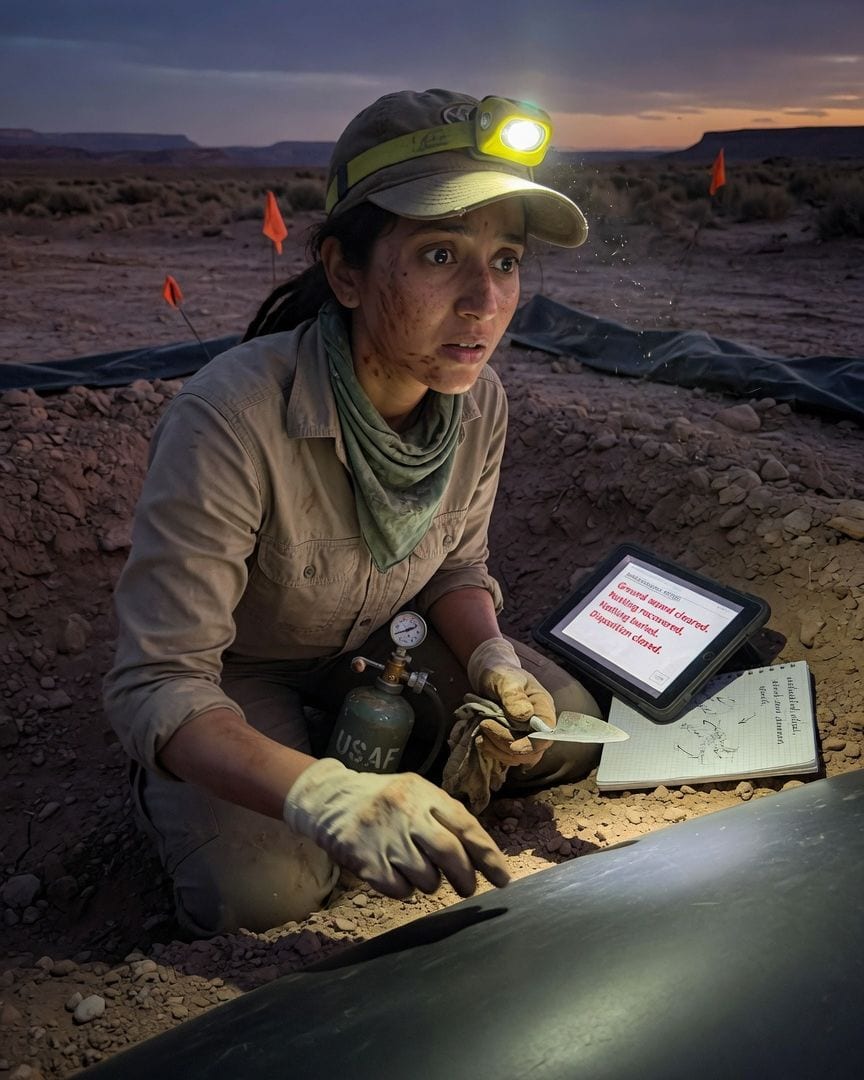
Priya Raval sat in the Utah mud, the desert sun already beating down, listening to the faint, steady hiss. It came from the oxygen bottle she’d just unearthed, its green paint faded but still visible, its valve seat impossibly intact.
Eighty years, and the pressure gauge still read fifteen hundred pounds. The Air Force site file, stamped 1948, sat open on her tablet: "Ground surveyed and cleared. Nothing recovered. Nothing buried. Disposition closed."
Priya, a contract archaeologist, knew better than to argue with official records, especially military ones. But the bottle wasn't just in the ground; it was in a cavity, carefully, deliberately backfilled by men with heavy machinery.
Her permit for this transmission corridor survey expired in nine days. The charged bottle was the least strange thing she'd found in that hole.
Her field notes, written in the careful, precise hand of a woman who needed her license renewed, simply called the rest "unidentified aerial phenomena." The hiss was a quiet, constant mockery of the official record.
Over the next two days, Priya methodically expanded the excavation around the oxygen bottle. Her initial thought was a forgotten military cache, perhaps a training exercise gone awry, but the geology didn’t support it.
The soil layers were inconsistent with natural erosion or even typical post-war dumping. Instead, she found evidence of massive, localized disturbance, followed by a meticulous re-packing of earth.
It was too precise for a simple backfill, too deliberate for a forgotten trench. She considered ancient mining, a forgotten prospector's shaft, but the patterns of compaction and the strange, almost vitrified soil samples defied explanation.
Her ground-penetrating radar, usually reliable, gave inconsistent readings, a chaotic mess of echoes beneath the 'cleared' ground. Then, she felt it with her trowel – not the gritty resistance of rock, nor the yielding softness of compacted earth.
It was cold, smooth, and utterly unyielding. She knelt, brushing away layers of desert dust and pebbles, her heart beginning to beat a slow, heavy rhythm against her ribs.
The edge of something vast, dark, and perfectly planar emerged, stretching into the earth below. It wasn't natural. It wasn't human-made, not in any way she recognized.
It was too smooth, too perfect, too alien for this desolate patch of Utah.
Priya worked through the night, the glare of her headlamp carving a stark circle in the darkness. More of the object emerged: a large, perfectly smooth, dark metallic hull, seamless and featureless, unlike any known aircraft or terrestrial construction.
It seemed to absorb the light rather than reflect it. As she traced its curve, her fingers brushed against a smaller, distinct anomaly.
Embedded flush with the hull's surface was a heavy, metallic box, roughly eight inches square, with no visible seams or fasteners. It was clearly designed to be retrieved, not buried.
With a damp cloth, she carefully wiped away the clinging mud. A faint, geometric symbol, intricate and precise, emerged, etched into the box's dark metal. Her breath hitched.
It was identical to a strange, angular pattern she’d dismissed as natural weathering on a distant rock formation during her initial site survey.
A cold certainty settled over her, a premonition that this symbol was far more than a random mark.
The symbol was her anchor. Priya spent the next day meticulously photographing the hull and the strange metal box, documenting every angle, every measurement.
She sent a carefully worded report, including images of the symbol, to Eileen Hale, her university supervisor, expecting a call about an anomalous geological find. Eileen's response was terse, almost dismissive: "Interesting rock formation.
Focus on the transmission corridor survey, Priya. Time is short." The dismissal only sharpened Priya's resolve. She tried conventional archaeological databases for the symbol, then ancient scripts, then even obscure industrial markings. Nothing.
Her search then led her to the labyrinthine world of declassified military archives, using her contractor clearance. She searched for 'Utah,' '1948,' 'cleared,' 'unidentified,' 'anomalous.'
The digital archives were vast, mostly benign, but deep within, she found a single entry: 'Project Kestrel, 1948, Utah Sector.' The cover sheet listed 12 pages, but the digital folder contained only four.
The downgrade schedule, burned into the header, read: 'DECLASSIFY NEVER.' The remaining pages were heavily redacted, solid black rectangles obscuring most of the text. But on one page, a redaction was clearly not rectangular.
It was an irregular, jagged shape, almost a crude outline of a specific, complex object. It seemed deliberate, a negative space that hinted at something hidden in plain sight.
The more she stared, the more it seemed to pulse with a silent accusation.
After accessing the 'Project Kestrel' file, Priya began to feel the shift. Her remote dig site, usually a haven of solitude after sundown, showed subtle signs of intrusion.
Faint tire tracks, too fresh to be her own, crisscrossed the loose sand near her perimeter. A stack of equipment, meticulously organized, was subtly out of place.
One evening, her ruggedized laptop, normally offline after she uploaded her daily notes, showed a brief, inexplicable network activity spike, a phantom connection in the middle of the desert. The isolation, once a comfort, began to feel like exposure.
Then, an anonymous email arrived. No subject, no sender address, just a single image attachment. It was a grainy, high-altitude aerial photograph of her dig site, clearly taken recently.
A crudely drawn red circle highlighted the exposed metallic hull and the small box embedded within it. No text accompanied the image. Priya felt a prickle of cold sweat on her neck. Someone knew. Someone was watching.
She tried to call Desmond Hartley, a retired Air Force records officer she’d consulted years ago for a different project, a contact known for his encyclopedic knowledge of obscure military paperwork. His old number was disconnected.
The air grew colder, the silence deeper, as the sun dipped below the Utah horizon.
Unnerved, Priya found a personal contact for Desmond Hartley through an old university directory. She called, her satellite phone chirping with the connection. Desmond's voice, when he finally answered, was raspy, laced with a weariness that went beyond age.
He was initially evasive, then agitated, demanding to know how she got his number. Priya, her voice steady despite the tremor in her hands, described the oxygen bottle, the UAP, the dark hull, and the geometric symbol.
She mentioned 'Project Kestrel' and the 'DECLASSIFY NEVER' tag. A long silence stretched across the line. Finally, Desmond spoke, his voice barely a whisper. "Kestrel… that was a containment operation. For… non-retrievable assets."
He confirmed the 'cleared' status was standard protocol, a lie to cover up what couldn't be explained or recovered. The oxygen bottles, he revealed, were not for human use.
They were part of a preservation effort for the asset itself, a means to control its atmospheric exchange over decades. "We didn't know what it was, Priya. Just that it shouldn't be disturbed."
He then explained the non-rectangular redaction she’d seen in the Kestrel file. "A ghost image," he called it. "A deliberate outline, left behind for those who knew what to look for. A signature, of sorts."
It was an outline, he confirmed, of an object identical to the hull she had found. His voice grew urgent. "Stop digging, Priya. You've stumbled into something far bigger than a single crash. They don't just bury things.
They file them. And sometimes, the file gets updated."
Priya pressed Desmond about the updated files, her heart pounding. "Updated? What does that mean?" He sighed, a sound that seemed to carry the weight of decades of secrets. He spoke reluctantly, his voice strained.
"For certain assets… the files aren't just historical records. They're active. They track them. They track anyone who finds them. Anyone who… pokes too hard." He paused, a chilling silence descending. "That symbol you saw? It's a designator.
We called them 'Echoes.' And there's a file for you, Priya. It's been open since you first logged that bottle. Your name, your project, your permit number. All cross-referenced with 'Echo-7, Utah Sector.'
It's not just a pattern across decades, Priya. It's a pattern that's still being signed." The line went dead. Desmond had hung up. Priya stared at her satellite phone, the cold plastic suddenly heavy in her hand.
Her name. In their file. The words echoed in the silence of the desert night, a terrifying implication. Her permit expired in nine days.
Fear, cold and sharp, propelled Priya back to the dig site. Her file. 'Disposition: Pending.' The anonymous email arrived just as she reached the edge of the excavation, a single image attachment.
It was a page from her own Air Force contractor file, her photo, her personal details, and a new entry under 'Associated Assets': 'Echo-7, Utah Sector. Disposition: Pending.' The meaning slammed into her with brutal clarity.
'Disposition pending' meant they were waiting. Waiting for her permit to expire, waiting for the legal window to close. They wanted to re-bury the 'Echo,' and her 'disappearance' would simply be another line item, another detail in the updated file.
Desmond's words rang in her ears: 'The file is still being signed.' She wasn't just an observer; she was now a subject, a variable to be managed.
Her discovery hadn't just unearthed a secret; it had activated a living record, a system that had quietly been at work for decades, filing away not just objects, but the people who found them.
The 'Redaction That Has a Shape' in the Kestrel file, the outline of the hull, wasn't just a signature; it was a warning, a breadcrumb for those who might follow, a chilling testament to the institution's methodical, patient horror.
Every clue, every strange detail, now clicked into place, forming a coherent, terrifying pattern.
With only hours left until her permit expired, Priya worked with a frantic, desperate energy. She had to expose it. Not just for herself, but for every 'filed' person who came before.
Using her satellite phone, she uploaded all her evidence: the photos of the hull and symbol, her field notes, the redacted 'Project Kestrel' file, even the anonymous emails.
She sent them to a secure, public-facing server, setting a timer for a 24-hour delayed release – a digital dead man's switch. If she vanished, the truth would still come out.
As she hit 'send,' a low, distant rumble reached her ears. Unmarked vehicle. Headlights cutting through the pre-dawn gloom, approaching fast.
She grabbed the small metal box, a desperate, irrational act of defiance, and scrambled away from the dig site, losing herself among the familiar rock formations just as the vehicle skidded to a halt.
Two figures, dressed in dark, non-descript uniforms, emerged. They moved with an unsettling, practiced efficiency, heading straight for the exposed hull. They carried specialized equipment, not archeological tools. They didn't scan the perimeter for her. They scanned the site.
One of them pulled out a device, holding it over the dark hull. A low, rhythmic hum began to emanate from the buried object, growing steadily louder, a deep thrumming that vibrated through the very ground Priya lay on.
They were not here to investigate. They were here to manage.
Priya watched from her hidden vantage point as the figures worked with chilling speed. A large, camouflaged tarp was deployed over the hull, followed minutes later by heavy machinery that began to backfill the cavity with practiced precision.
Her public release went live. News outlets, initially skeptical, picked up the story – the images of the impossible hull, the still-charged oxygen bottle, the 'DECLASSIFY NEVER' file.
The Air Force issued a swift, boilerplate denial, citing 'misidentified geological formations' and 'contractor error' due to an 'expired permit.' But the images were out. The questions were asked.
The story, a fleeting spark, spread across the internet before official narratives could fully extinguish it.
Priya Raval was gone. Her truck was found abandoned near the sealed dig site, her personal effects still inside. The small metal box she’d clutched was missing.
The news cycle, as it always did, moved on, the official denial largely prevailing. The dig site, once a place of discovery, was swiftly covered by the proposed transmission corridor, erased from the landscape.
But then, months later, a new entry appeared in a deeply obscure, declassified Air Force database, under a new, innocuous-sounding project code. It was a single line: 'Echo-7, Utah Sector, Disposition: Closed. Asset secured. Contractor Raval, P., Disposition: Filed.'
A single, anonymous comment appeared beneath one of the lingering news articles that had covered Priya’s initial findings, posted by a user named 'Kestrel_Observer.' It read: 'The file is never closed. Only signed.'
If this one got to you
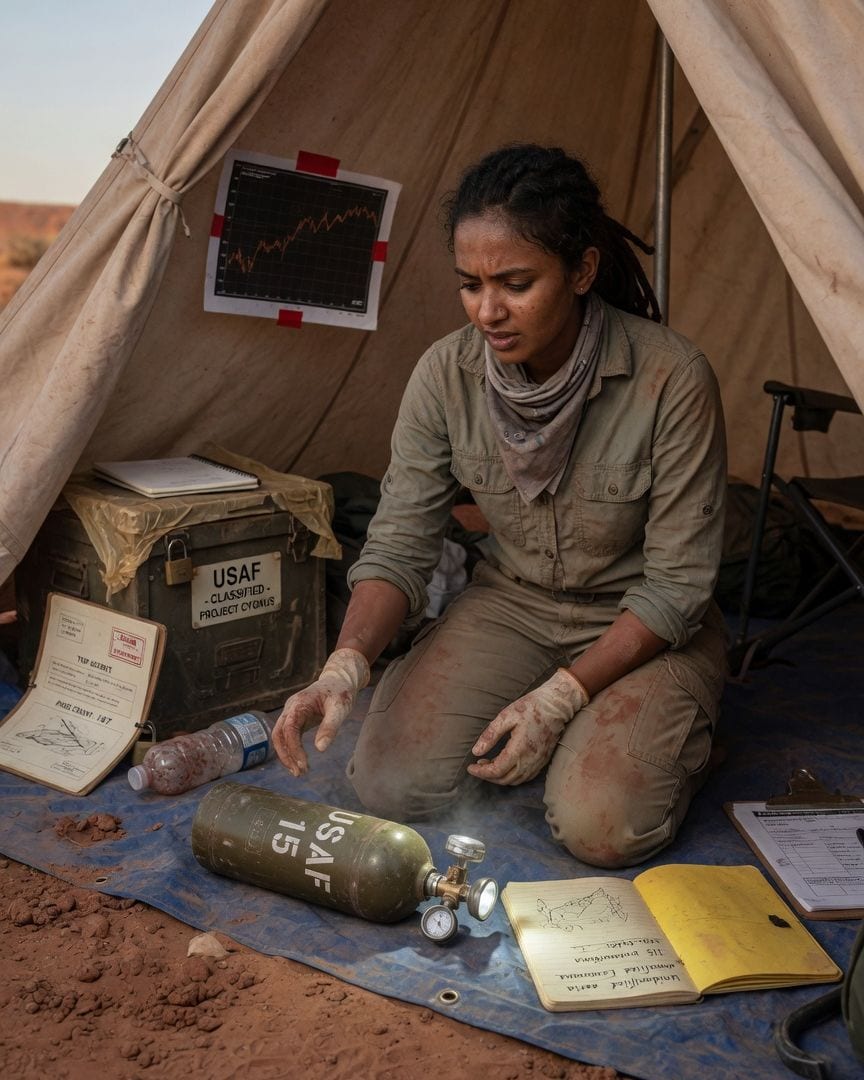
A researcher's permit is almost gone. She finds a Cold War archive box listing 187 pages, but 173 were surgically cut out.
Archaeologist Priya Raval knelt in the reddish Utah mud, her permit for the site ticking down with only nine days left. The desert silence was broken only by the hiss of an 80-year-old oxygen bottle, defying records by holding full pressure in a backfilled cavity. As Priya raced against the clock, she unearthed deeply buried concrete conduits and a classified Cold War archive box. Its cover listed 187 pages, but inside, a terrifyingly precise cut had excised 173 of them, leaving only blank space. What secret did the military bury here, then try to erase?
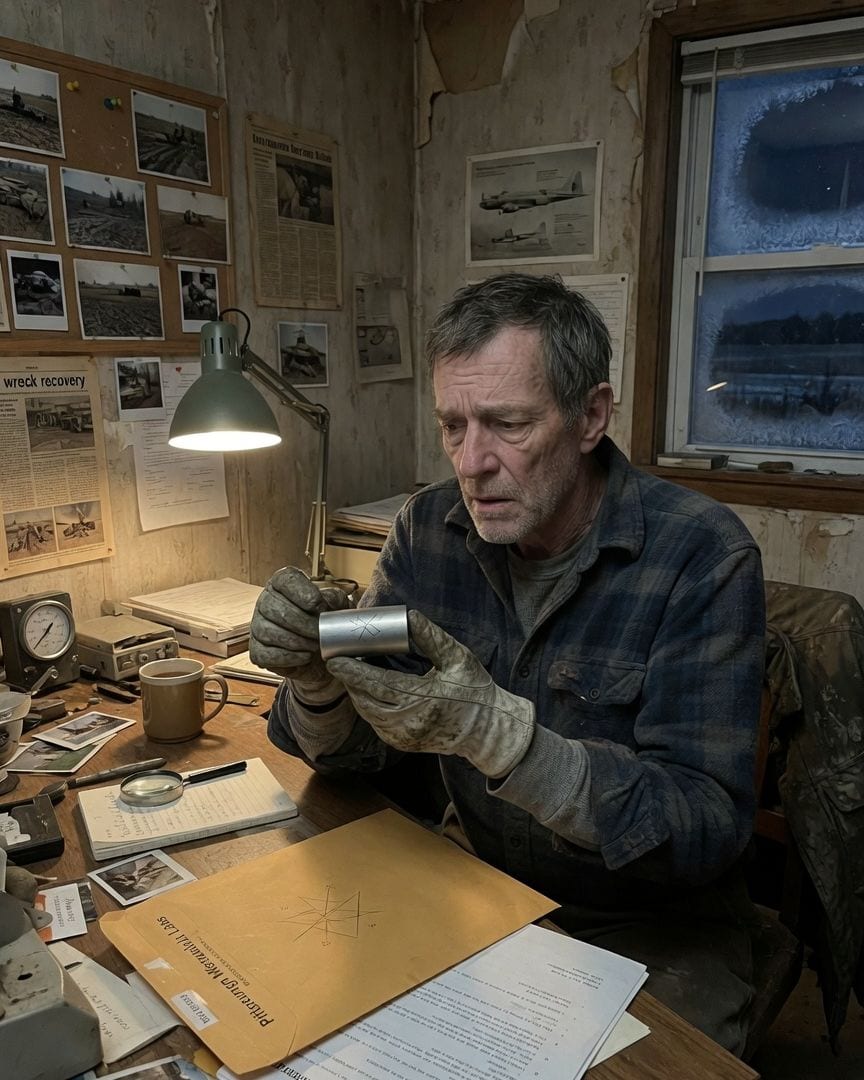
A wreck-hunter unearths a 1944 B-17, but its oxygen bottle still hisses, fully charged, beside a sealed Cold War cylinder.
Wreck-hunter Anselm Roeder, 56, carefully navigated his custom truck through the frozen, muddy fields of a rural Pennsylvania valley. He had spent a week tracking a farmer's odd report of 'bad ground,' now confirmed by his radar: an immense object buried twelve feet down. In the sharp winter air, his team finally unearthed the mud-caked wing of a B-17 bomber, remarkably preserved since 1944. But as Anselm knelt, he heard a faint, steady hiss from an oxygen bottle, impossibly charged, and then found a small, smooth metallic cylinder, too perfect for eighty years underground, bearing a symbol from a redacted Cold War file.
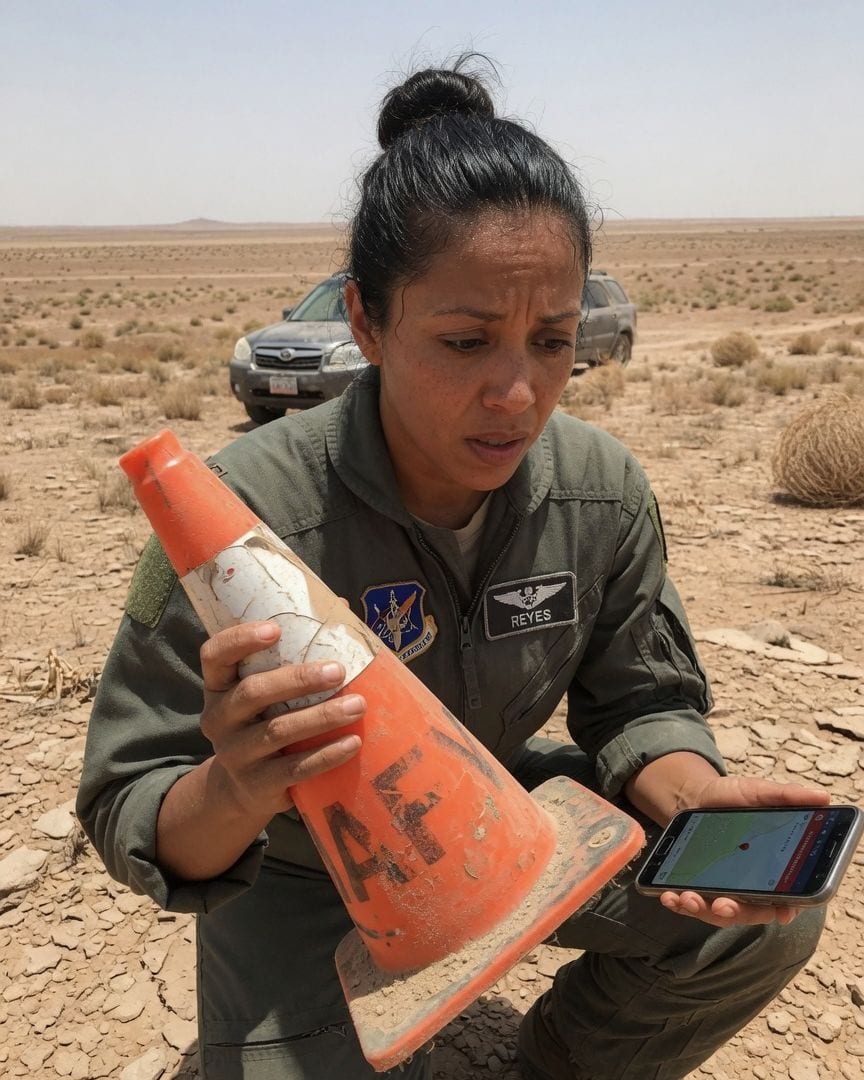
A fighter pilot's emergency landing saved her life, but the airfield was decommissioned in 2005. She found its official marker cone in the empty desert.
Captain Elena Reyes faced a dire situation: low on fuel and a storm blocking her home field, leaving one desperate divert option. A calm voice guided her to Outpost 73, and she landed her F-16 with immense relief, grateful for the lit runway and the man waving wands. However, her relief shattered when her home tower reported Outpost 73 had been decommissioned in 2005, its coordinates now just empty scrub. Faced with a career-ending inquiry, Reyes insisted on what she saw, driving to the desolate coordinates where a half-buried airfield marker cone proved her impossible landing was real. How could a ghost airfield leave physical proof?
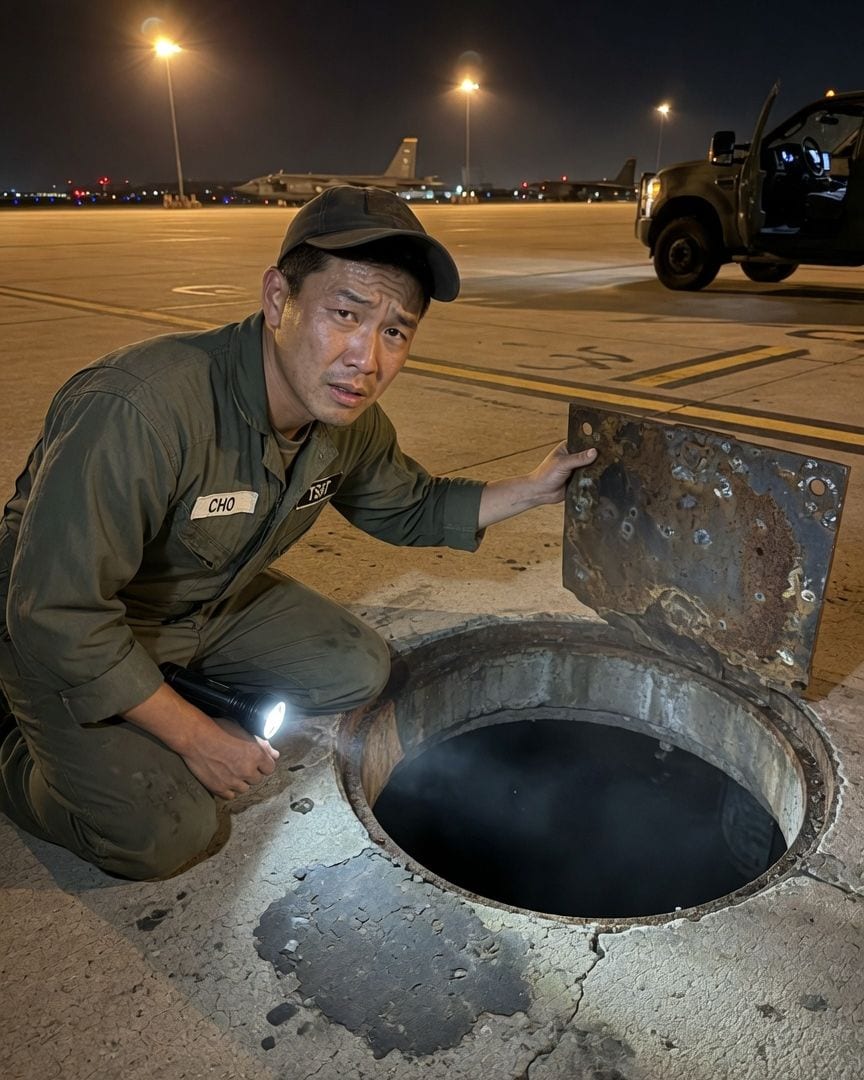
Two weeks from leaving, Technical Sergeant Cho felt a phantom weight pass through his truck, parked on the flight line.
Technical Sergeant Daniel Cho was counting down his final two weeks at the Dakota bomber base, determined to solve the phantom riddle of its floodlit flight line. Every night at 0148, a buried sensor logged a vehicle pass, yet overhead thermal cameras consistently showed nothing but empty concrete. To catch the anomaly, he parked his heavy maintenance truck directly over the sensor. But as the clock turned 0148, a low thrum vibrated through his teeth, and the sensor registered a second, impossible vehicle pass—right through his own parked truck. His investigation soon uncovered a hidden, unmapped metal plate in the concrete, sealing a dark shaft that hummed with a deep, rhythmic vibration, like an enormous heartbeat from beneath the earth.
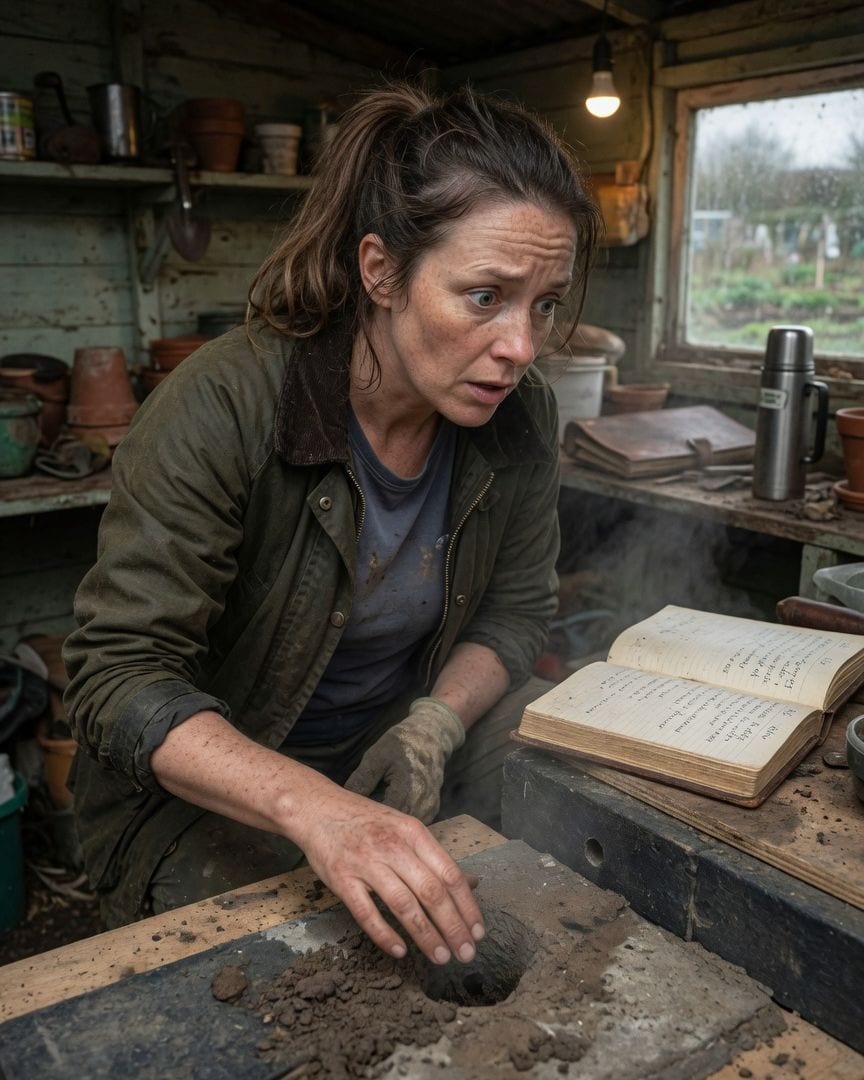
Every gardener who's held allotment plot 26 gave it up after a single season, each one leaving the same note behind: never dig the ground below two feet.
Newly single at 38, I hoped Plot 26 at Weir Field Allotments would be a fresh start. But the committee’s rent book held a strange, decades-old rule: 'ground not to be dug below two feet.' Ignoring the warnings, I dug anyway, only to find a perfectly smooth concrete slab with a tiny hole—and a distinct, unnatural cold breath rising from it.
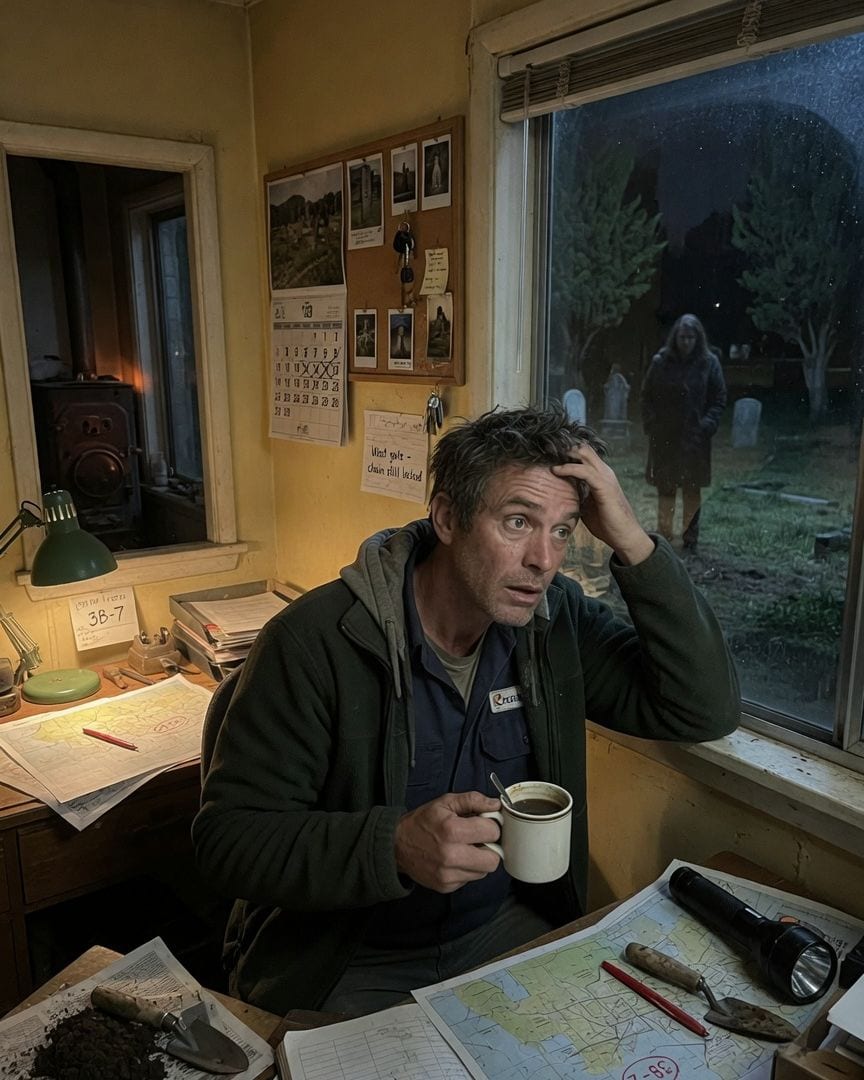
My cemetery lodge overlooks a woman visiting an empty grave near 3 AM most nights. The west gate she uses has been chained shut since autumn, its lock untouched.
As the cemetery's night caretaker, I'm used to the quiet hum of the lodge. But for three weeks, a woman has appeared nightly at plot 3B-7, a silent mourner in the deep night. What chills me is how she leaves: walking straight through the west gate that's been chained and padlocked shut for eight months.