Two weeks from leaving, Technical Sergeant Cho felt a phantom weight pass through his truck, parked on the flight line.
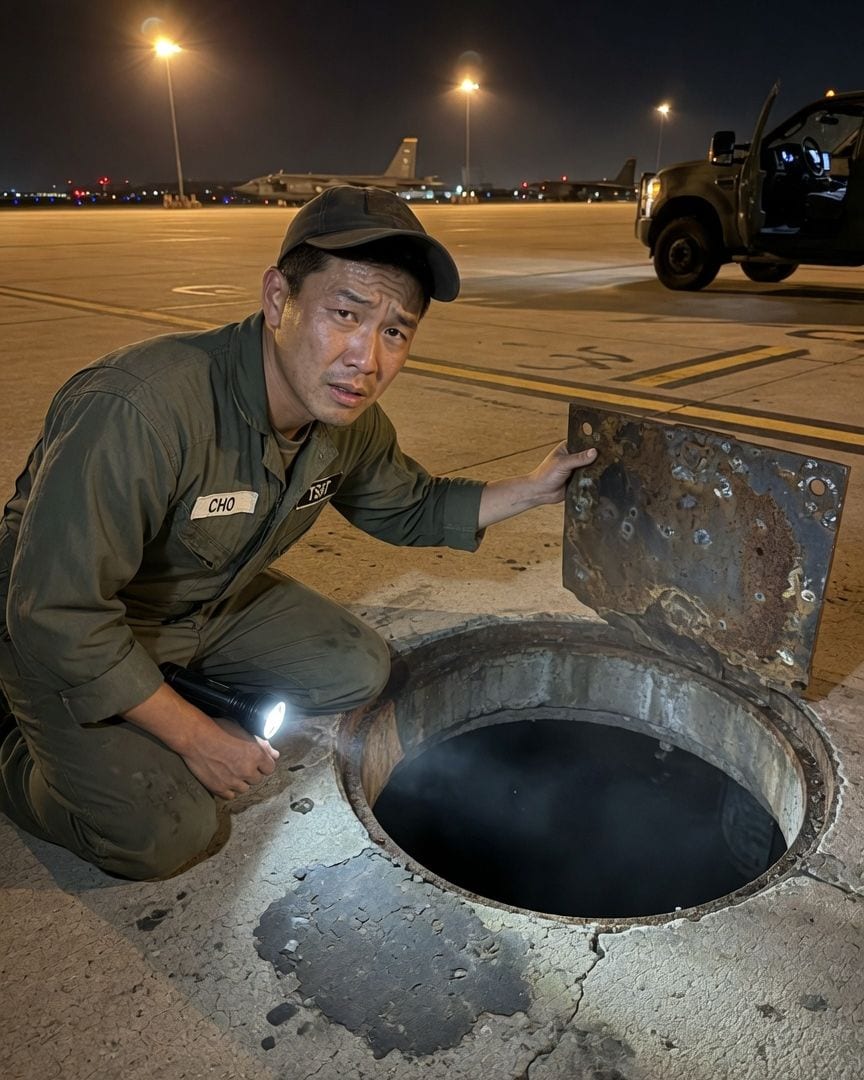
Technical Sergeant Daniel Cho, two weeks from rotating out of the Dakota bomber base, felt the familiar rumble of the flight line under his feet. He was chasing a ghost, a fault he couldn't leave for the next shift.
Every night at precisely 0148, the buried loop sensors under the floodlit flight-line apron logged a vehicle-weight pass over loop twelve. The overhead thermal cameras, however, consistently showed nothing but empty concrete and heat-shimmer under the sodium lights.
He’d pulled maintenance, expecting a shorted loop, but the event log stacked into a clean nightly line running back past the last recalibration. It was perfect, impossibly so.
Tonight, he’d parked his heavy-duty maintenance truck, a hulking Ford F-350, square on loop twelve at 0147. He sat, engine off, the air conditioning a low hum, watching the thermal camera feed on his tablet.
The digital clock on the dash clicked to 0148:00. A soft, almost imperceptible thrum vibrated through the floorboards of his truck, a low frequency that resonated more in his teeth than his ears.
Simultaneously, the screen in his lap flashed 'LOOP 12: VEHICLE PASS – 2ND INCIDENT.' The sensor had just logged a second pass, over the truck he was sitting in, a phantom weight passing through solid steel.
Cho stared at the tablet, then at the empty concrete stretching under the sodium lights. He checked the thermal feed again – still nothing, just the faint heat signature of his own truck, a dull orange blob.
He called Staff Sergeant Ingram, who was monitoring the main security console from the operations center.
“Ingram, confirm my location and the sensor log for loop twelve,” Cho ordered, his voice tight.
Ingram’s voice crackled through the comms, a slight delay. “TSgt Cho, you’re stationary on loop twelve. And… yeah, it just registered two passes, sir. Your truck, then… another one, right after. Just like the logs say.”
Cho’s gut tightened. “Another one? What did you see on thermal?”
“Nothing, sir. Thermal’s clear. Just your truck. No heat signature for anything else,” Ingram reported, a hint of confusion in his tone.
Cho spent the next hour meticulously examining the concrete around loop twelve, his heavy-duty flashlight beam cutting through the artificial glare of the floodlights. He found no scuff marks, no displaced gravel, no oil drips.
The ground was pristine, smooth, showing no sign of any physical passage. He checked for hairline cracks, for disturbances in the tarred seams. Nothing.
But then, his beam caught something odd, barely visible through the fine dust that perpetually coated the apron. A faint, almost invisible seam in the concrete, just a few feet from the sensor.
It wasn't a repair patch; the texture of the material within the seam was different, older, and it didn't quite match the surrounding concrete.
It was a circular outline, about three feet in diameter, filled with a darker, slightly sunken concrete. In its center, a heavily corroded, unmarked metal plate lay flush with the surface, a forgotten manhole cover of some kind.
It wasn't on any current base blueprint he knew of, not even the decades-old schematics he’d reviewed for the sensor placement. He tapped it with his boot; it gave a dull, metallic thud that resonated with a surprising depth.
This wasn't a fault in the system. This was something else entirely, something deliberately hidden.
The next day, armed with a pry bar and a discreet work order for ‘sub-surface integrity check,’ Daniel Cho returned to loop twelve under the guise of daylight maintenance. The circular plate was stubborn, rusted shut into its concrete bed.
The metal looked like it hadn't been moved in decades, its surface pitted and flaking. After twenty minutes of straining, levering the heavy bar against the concrete, the metal groaned, a shriek of tortured rust that grated in his ears.
The plate lifted with a final, echoing screech, revealing a narrow, dark shaft descending into the earth.
A chill, damp air wafted up, carrying the faint scent of ozone and something metallic, ancient, like old transformers and wet earth. He peered into the blackness. No ladder, just a sheer, smooth-sided drop into unseen depths.
He knelt, his ear close to the opening, and heard it: a faint, rhythmic hum, almost too low to register over the distant roar of a departing bomber.
It was a deep vibration that seemed to pulse, quietly, once every minute, like a slow, enormous heartbeat beneath the earth.
He knew, with a sickening certainty that settled cold and heavy in his stomach, that he was listening to the same pulse the sensor logs registered at 0148.
Cho spent the rest of his shift cross-referencing old base schematics with current ones, trying to find any mention of a sub-surface shaft or an older structure beneath loop twelve. Nothing.
It was as if the ground under that specific section of the flight line had been wiped clean from the official records. He showed Staff Sergeant Ingram the access panel, now covered by a temporary hazard cone.
Ingram just shook his head, a bewildered frown on his face. “Never seen anything like it, TSgt. Looks older than dirt. What do you think’s down there?” Cho had no answer.
Cho’s investigation shifted from physical inspection to archival research. He requested access to the base’s historical archives, citing a ‘preventative maintenance deep-dive’ for an upcoming inspection.
The request landed him in the quiet, dust-filled office of Cynthia Prescott, the base archivist.
She was a meticulous woman in her mid-fifties, with spectacles perched low on her nose and an air of knowing exactly where every forgotten document lay.
The office itself felt like a tomb of forgotten secrets, rows of climate-controlled shelving stretching into dim corners.
Cho explained the sensor anomaly and his discovery of the unmarked shaft. Prescott listened, her expression unreadable, her hands folded neatly on her desk. She didn’t interrupt, nor did she betray any surprise.
When he finished, she rose with a rustle of her sensible cardigan and moved to a bank of large, flat-file drawers. She retrieved a faded, oversized blueprint, its edges brittle and yellowed with age.
It was a map of the original installation, a Cold War-era 'Strategic Deployment Annex,' stamped with a date from the early 1960s. Cho’s finger traced the familiar lines of the flight line.
And there it was, beneath the current operational apron: a series of underground tunnels, clearly labeled 'Sub-Level Transport System.' A specific point on the map, directly under loop twelve, was marked 'Automated Material Transfer Point - 0148hrs.'
The blueprint showed a small, isolated chamber at the bottom of a maintenance shaft, exactly where Cho had found the access panel, a perfect, chilling match that made the hairs on his arms stand on end.
Cho’s visits to the archives became frequent. He spent his off-hours poring over documents related to the 'Sub-Level Transport System,' which Prescott, without prompting, now referred to as 'Project Echo.'
The more he dug, the more he felt a subtle shift in the air around him, a sense of being observed, even when he was alone.
Twice, he found Prescott standing silently in the doorway of the archive room, watching him, her gaze intense but not accusatory, as if waiting for him to grasp something she already knew. Her stillness was unsettling.
Once, a file he’d left open on a desk, a detailed operational log for Project Echo, was found closed and neatly returned to its folder, though he was sure he’d left it out for the next day.
He dismissed it as Prescott’s meticulous nature, her dedication to order in her domain.
Then, a week before his rotation, he received an anonymous, typewritten note in his locker. The paper was old, crisp, smelling faintly of dust and dry ink. It read: 'Some things are better left accounted for, not disturbed.
The schedule is fixed.' The note unnerved him, making the sparse barrack room feel suddenly cold. Someone knew exactly what he was looking into.
And the phrase 'accounted for' echoed the military’s own rigid lexicon, but here, in this context, it felt like a quiet threat, a warning. He looked at the operational log again, specifically at the entries for 'Loop 12 Acknowledgment.'
It wasn't just a sensor; it required a 'presence.' He felt a cold dread creep up his spine.
He wasn't just investigating a ghost; he was being watched by someone who understood its rules, someone who wanted him to know them too.
The archive room, once a sanctuary of old knowledge, now felt like a cage closing around him.
Cho confronted Prescott in her office, laying the anonymous note on her desk. The old paper looked stark against the polished wood. “Sergeant Prescott, I need to know what this is about. And what ‘Project Echo’ really was.
Someone sent me this.”
Her gaze was steady, calm, unwavering. She picked up the note, glanced at it, then set it back down. “Project Echo was a Cold War initiative, Technical Sergeant. An automated transport system, buried deep beneath this base.
Designed for absolute secrecy, absolute reliability.”
“And the 0148 loop? The phantom passes?” Cho pressed, his voice tight.
“The system was never fully decommissioned, not in the way you understand it,” she explained, her voice calm, almost detached, as if discussing routine paperwork. “It was… placed in a state of indefinite standby.
Its primary function, a daily maintenance run of an automated vehicle, was too integrated to simply shut off without catastrophic system failure. So, it continues. Every night, at precisely 0148.
Its electromagnetic signature is powerful enough to trip your modern sensors, which are, ironically, far more sensitive than anything they had back then.”
Cho pointed to the 'Loop 12 Acknowledgment' entries in the faded logbook. “What about this? It says 'presence required.' What kind of presence?”
Prescott picked up a pen from her desk, twirling it idly between her fingers. “The system was designed with a fail-safe.
If the automated vehicle detected an anomaly at a specific point, say, a technician performing maintenance, it would log that interaction, and then… complete its run. It was a form of accountability. The system recognized an authorized human presence.”
Cho felt a wave of nausea, a sudden lurch in his stomach. The pieces were locking into place with terrifying precision. “So, when my truck was on loop twelve, and it registered a 'second pass' through it…”
Prescott nodded slowly, her expression still unreadable. “It was completing its programmed interaction. Accounting for the presence it detected at that precise point, at that precise time. Your truck provided the necessary mass and proximity to trigger the acknowledgment protocol.”
The earlier clues clicked into place with an awful, cold finality: the clean event log, perfectly consistent across weeks; the lack of a physical vehicle, because it was only an electromagnetic signature; the faint, rhythmic hum from the shaft, the persistent energy of a system still running.
It wasn't a glitch, a short, or a malfunction. It was a perfect, precise function of a long-dead system that refused to die, demanding its daily due, patiently waiting for its protocol to be fulfilled.
The silence in the archive room pressed in on Cho, suddenly heavy.
Cho pressed Prescott further, his voice barely a whisper. “Who was the 'Loop 12 Technician' then? Who was accounted for in these records?”
Prescott rose and walked to a locked, reinforced cabinet behind her desk, its steel door clanking softly as she unlatched it.
She produced a thick, yellowed folder, its edges brittle, its corners dog-eared, looking much older than anything else in the archive. The faded stamp on its cover read: 'CLASSIFIED - PROJECT ECHO - SUB-LEVEL TRANSPORT, PERSONNEL & PROTOCOL.'
She placed it on the desk between them, opened it carefully, and slid a faded, black and white photograph across the polished wood.
It was a man in a crisp Air Force uniform, looking young, serious, his gaze direct. Below the photo, a nameplate read 'Technician D. Cho.'
The man in the photograph bore an unsettling resemblance to Daniel, a family likeness he couldn't deny. It was more than a passing resemblance; it was like looking at an older, stoic version of himself.
Prescott then pointed to a handwritten entry in the logbook next to the photo. 'Acknowledged presence required at Loop 12, 0148 hrs, daily.' The date on the document was from the early 1960s.
Daniel Cho felt the floor drop out from under him, a dizzying sense of freefall. His own name. His own face, decades before his birth.
He wasn't just investigating a ghost; he was looking at a pre-ordained role, waiting for him, for decades.
His very presence, his name, was already a part of the phantom’s fixed schedule, a ghost in the machine that had been waiting for him to step into its path, a silent, impossible manifest.
Prescott explained, her voice soft but firm, that 'Technician D. Cho' was Daniel's grandfather, Edmund Cho, who had been a key engineer on Project Echo.
He was the designated 'Loop 12 Acknowledgment' officer, responsible for physically verifying the automated vehicle's run at that specific point. His presence, his signature, his confirmation, was critical to the system’s daily protocol.
When the project was indefinitely suspended, Edmund Cho was transferred to another, unrelated, program. But the system's core programming for 'acknowledgment' was never purged.
The system, designed for ultimate reliability, simply continued to expect that specific 'D. Cho' presence, a constant, low-frequency electromagnetic echo of its last, fully functional run.
The base's new sensors, far more refined than anything available in the 1960s, were now detecting the phantom vehicle and, crucially, the 'lack' of the expected human acknowledgment.
It was a gap in its protocol, a duty left unfulfilled for sixty years, until Daniel had parked his truck there.
The 'second pass' wasn't just a reading; it was the system completing its programmed interaction, 'accounting for' the presence it had been waiting for, for decades.
Prescott revealed that her own family had also been involved in Project Echo, a line of 'custodians' who understood the system's persistent nature and ensured its 'logs' were maintained, even if only by observation.
She didn't see it as horror, but as a duty, a quiet, necessary accountability for a forgotten piece of history that refused to be truly erased.
The hum from the shaft, she explained, was the constant, low-frequency electromagnetic field that powered the phantom vehicle's 'loop,' a perpetual motion machine of forgotten data, still running on the ghost of its original power source, buried deep, perpetually waiting.
Daniel Cho returned to loop twelve that night, not with a pry bar, but with a profound, unsettling understanding. He knew what he had to do.
The night air was sharp, carrying the distant rumble of jet engines and the smell of exhaust, but Cho felt a deeper, colder chill.
As 0147 approached, he parked his truck, precisely as before, but this time, he didn't sit inside. He stood outside, directly on loop twelve, in the exact spot where his grandfather, Edmund Cho, would have stood over sixty years ago.
The floodlights cast his shadow long and stark on the concrete. The air was cold, but he felt a strange warmth emanating from the concrete beneath his boots, a faint vibration rising through the ground, humming up into his bones.
The hum, usually faint and almost imperceptible, was now a distinct, low thrum, vibrating through his very core, resonating with something deep inside him, a frequency he now understood.
At 0148:00, the sensor log, visible on his tablet propped on his truck’s hood, registered 'LOOP 12: VEHICLE PASS.'
A moment later, the thrum intensified, seeming to pass through him, a wave of cold pressure that chilled him to the core, then it receded, leaving a ghost of an echo in his chest.
He didn't see anything, felt no physical contact, but the sensation was unmistakable, a passing through. The tablet flashed again: 'LOOP 12: ACKNOWLEDGMENT – PRESENCE VERIFIED.' The system had finally completed its full, programmed sequence.
Daniel felt a quiet, terrible sense of resignation, a strange peace settling over him. He had fulfilled the role that had been waiting for him. He was now accounted for.
Prescott had not denied it, nor had she offered a way out. She had simply explained the protocol, the unbroken chain of accountability.
The calm in her voice, the quiet certainty that this was how things were, was far more chilling than any scream, a testament to an order that transcended the living, an unbreakable schedule.
Daniel Cho completed his rotation. He packed his bags, said his goodbyes to Ingram, and boarded the flight out of Dakota bomber base, leaving the vast, empty plains behind. His official records showed a clean transfer, an uneventful tour.
No mention of phantom vehicles, buried systems, or ancestral duties. Staff Sergeant Ingram, who took over his duties, noted that the 0148 anomaly on loop twelve had ceased.
The sensor now registered nothing at that time, just an empty, silent log. It was as if the fault had finally, definitively, been resolved.
The access panel remained sealed, unmarked, a secret under the concrete, a dull, rusted circle waiting for no one.
Cynthia Prescott continued her work in the archives, a quiet guardian of the base's deep, unwritten history, her gaze occasionally drifting toward the flight line, unperturbed.
Months later, Daniel Cho was settled into his new posting, far from Dakota. He’d adjusted, mostly.
But every night, precisely at 0148, he would feel a faint, almost imperceptible thrum, a vibration deep in his bones, no matter where he was, no matter what he was doing.
He would pause, a quiet acknowledgment of a schedule he now understood. He carried the hum with him, a constant, low-frequency echo of a duty he could never truly leave behind. He was accounted for. He always would be.
Daniel Cho’s new unit noted his meticulousness, his quiet efficiency. He was always precisely on time, always knew exactly where he needed to be.
One morning, a junior airman found him standing alone on a remote section of the flight line, staring at the empty concrete, a faint, almost imperceptible smile playing on his lips. 'Everything accounted for, sir?' the airman asked.
Daniel Cho turned, his eyes distant, and replied, 'Always.'
If this one got to you
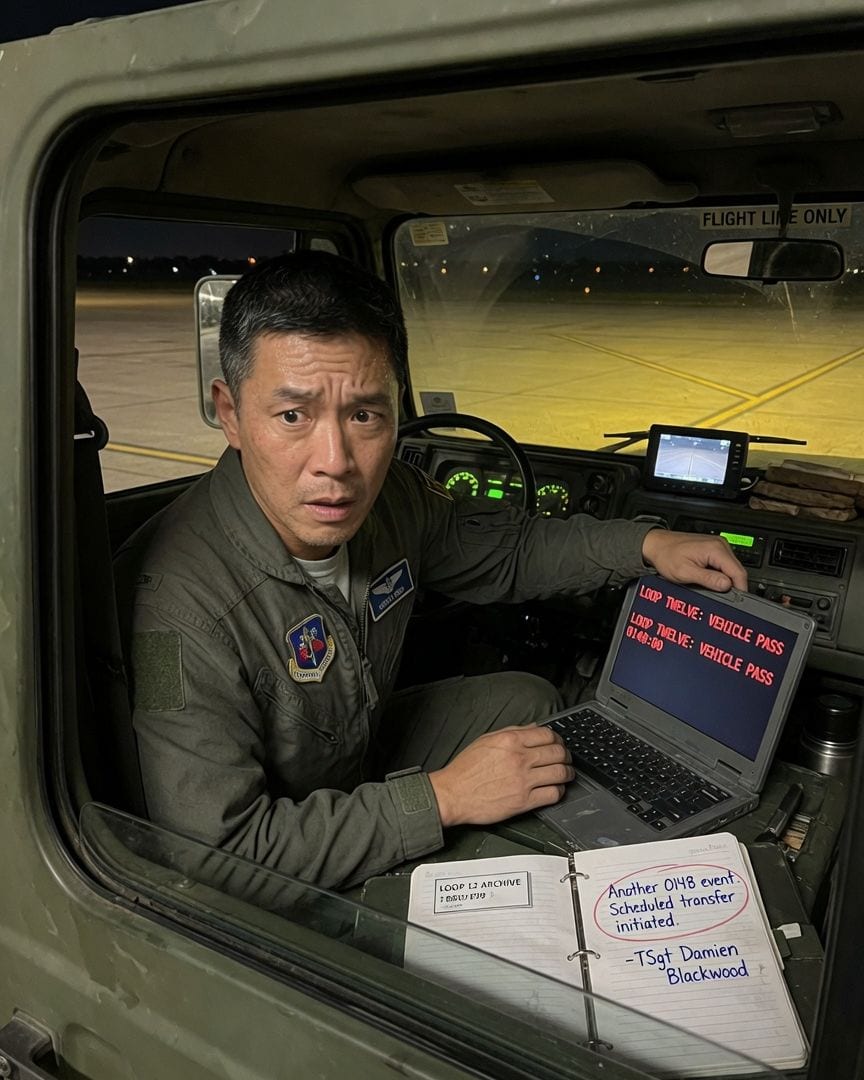
Technical Sergeant Trevor Cho sat on Cold War loop twelve. At 0148, his console chirped twice: 'Vehicle Pass.' The floodlit concrete remained empty.
Technical Sergeant Trevor Cho was two weeks from rotating out of a Dakota bomber base, determined to reconcile the impossible data from loop twelve. Every night at precisely 0148, the buried sensor registered a vehicle pass, yet control tower cameras always showed a vast, empty expanse. Cho parked his truck directly over the sensor and watched his console chirp twice at 0148: 'Vehicle Pass.' The floodlit flight line remained starkly empty. His investigation soon uncovered decades of similar 'phantom pass' entries, always at the same time, always dismissed, leaving him to wonder: what impossible presence kept crossing loop twelve?
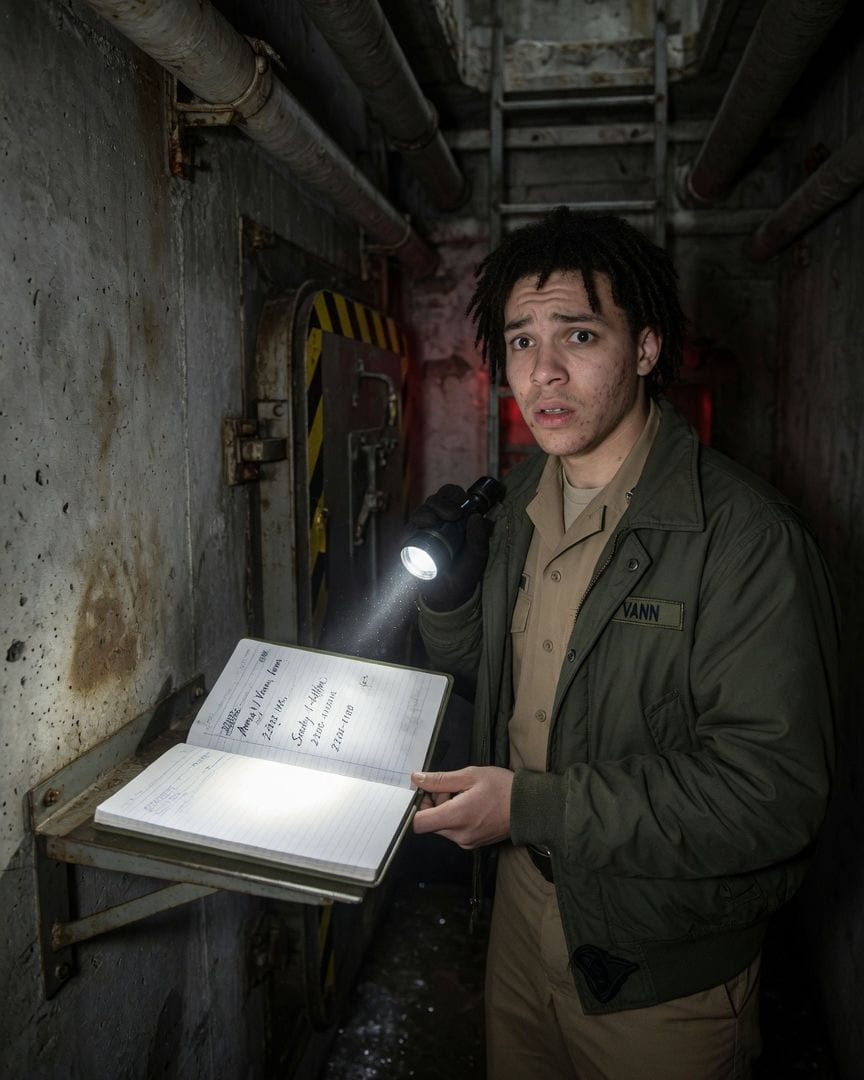
On his last patrol, Airman Vann sees a Cold War silo hatch light up from *inside*—it was welded shut a decade ago.
Airman Vincent Vann was on his last patrol across a vast, desolate Cold War missile field in the Dakotas, the cold, starless sky mirroring the emptiness of the landscape before his transfer. His routine check of eight hardened silo caps was shattered when a red fault light pulsed on Silo 4’s access panel, signaling an impossible breach from *inside* a hatch sealed for a decade. As more silos lit up, ignoring base orders, Vann found the hatch unlocked from within and descended into the dark shaft, where he discovered a pristine logbook bearing his own signature next to a chilling entry from a non-existent sentry, dated for *that very night*. Now, a steady *thump* echoed from deeper within the sealed concrete, leaving the Airman desperate for an explanation that simply wasn't there.
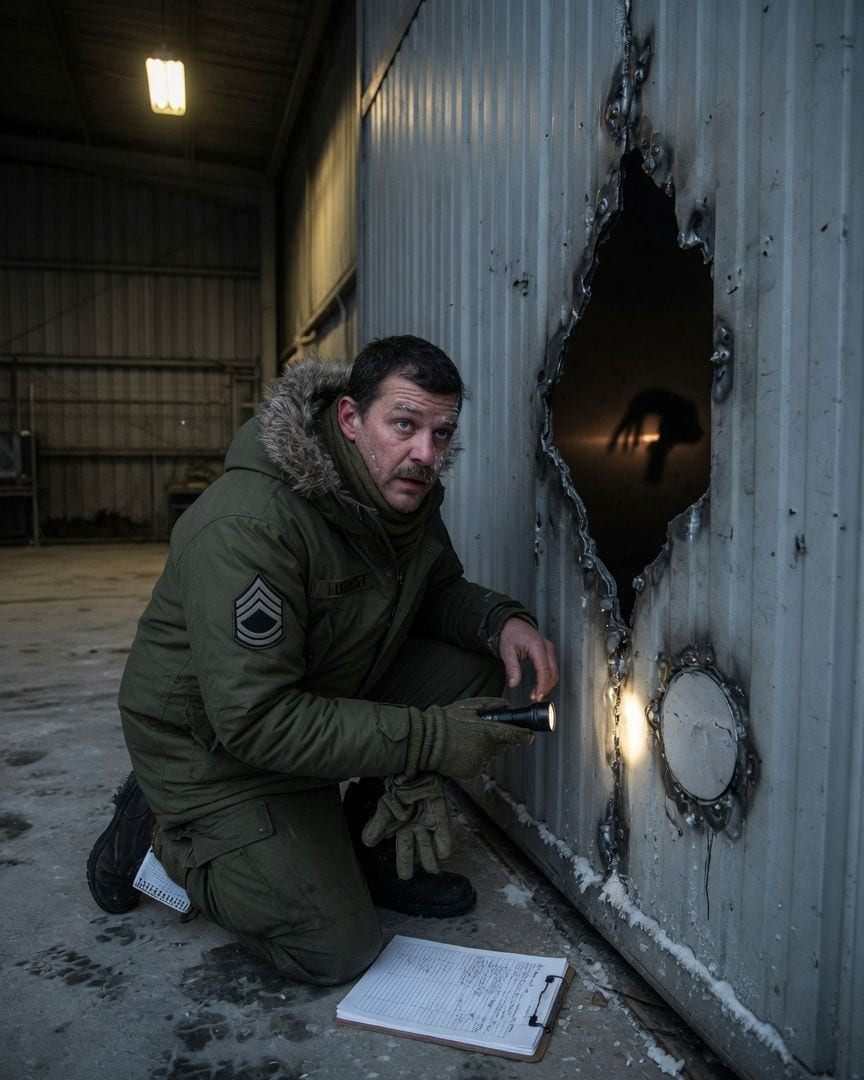
A Cold War technical sergeant found a sealed hangar door, but a secret vent led to a deep hum. Then, a slow, orange light pulsed from the darkness inside.
In the Alaskan winter of 1978, Technical Sergeant Wes Lindquist's rigid routine involved hourly temperature checks for the officially empty Hangar Bay Two. Despite being welded shut for months, the bay consistently registered nine degrees warmer than ambient. As official dismissals failed to explain the anomaly and the internal temperature climbed, Lindquist kept a secret log. His curiosity led him to a hidden vent in the crude weld, where he felt a deep, resonant hum vibrating from within. Shining his flashlight into the void, a faint, rhythmic pulse of dull orange light bloomed and receded, casting a writhing shadow too large for anything known.
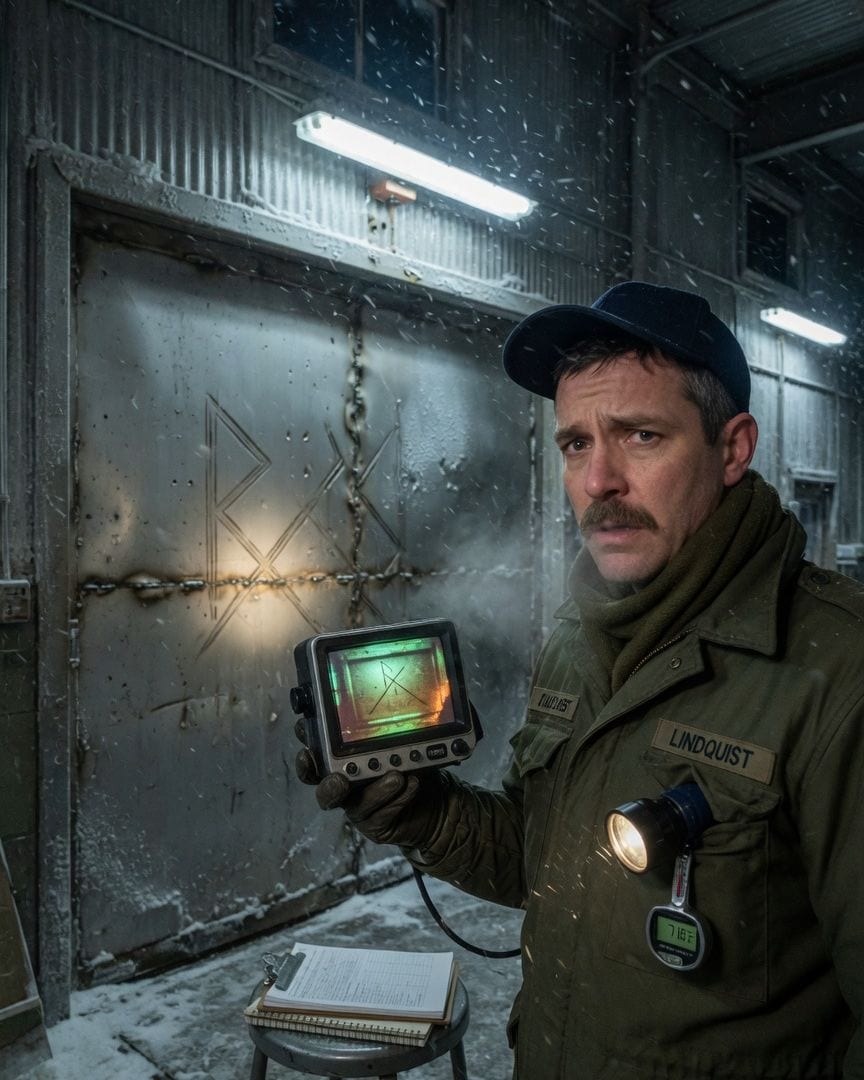
A methodical Cold War sergeant found a strange symbol etched into his sealed hangar bay. He then saw the exact same mark glowing *inside* it.
Technical Sergeant Wes Lindquist endured Alaskan winters, his duty in the vast, frigid hangar simple: log Bay Two’s temperature. The bay, sealed shut for months, inexplicably ran nine degrees warmer than the icy building for 111 straight nights in 1978. Despite official dismissal, the numbers kept climbing, forcing Lindquist to keep a secret log as the bay’s internal heat reached an impossible 72 degrees. Driven by cold certainty, he discovered a faint, unsettling symbol etched along the door's weld. Later, peering through a tiny seam with a borescope, he saw the identical mark shimmering with a fresh, orange glow from *inside* the supposedly empty, sealed bay.
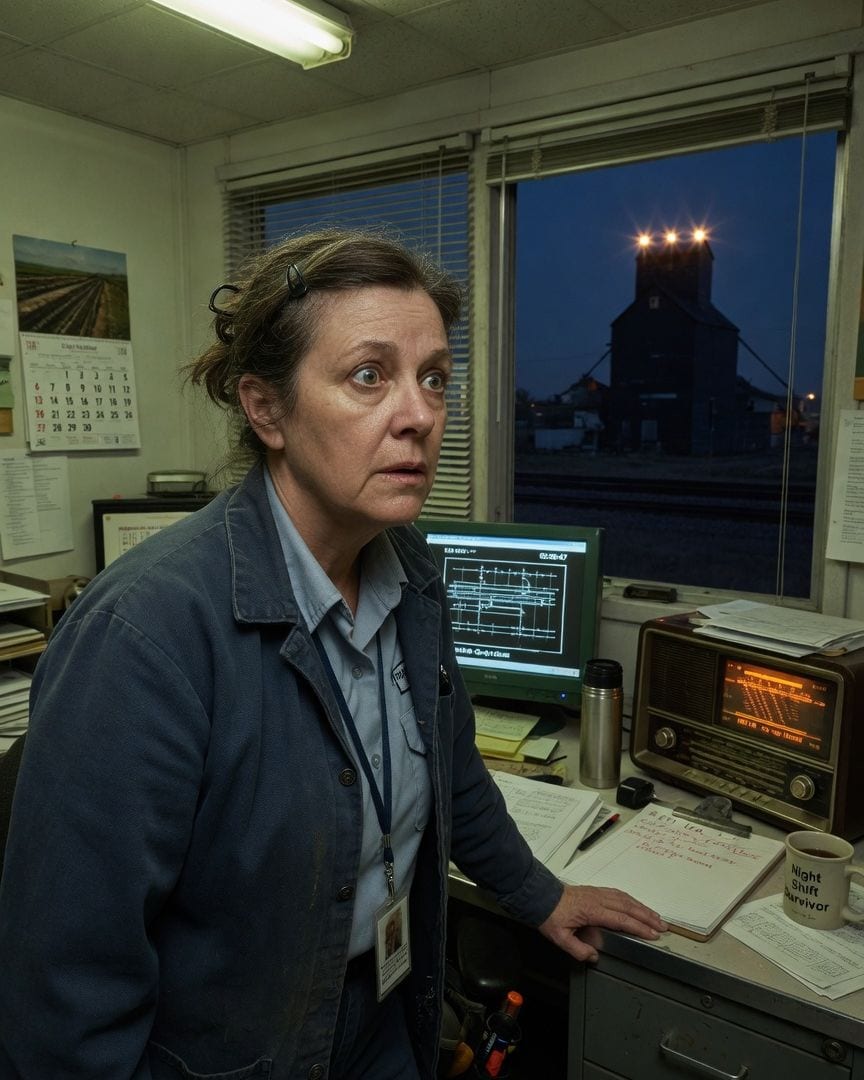
The grain tower light flashed three times at 2 AM, signaling me clear. The bulb was removed six years ago.
Every night, I work the lonely shift at the transport hub. For fifteen years, an old grain elevator, automated and unpowered with its light bulb physically removed, still flashes a 'Clear' signal across the tracks at 2 AM. Recently, the impossible flashes have grown sharper, stirring a deep unease from a place that should be completely silent.
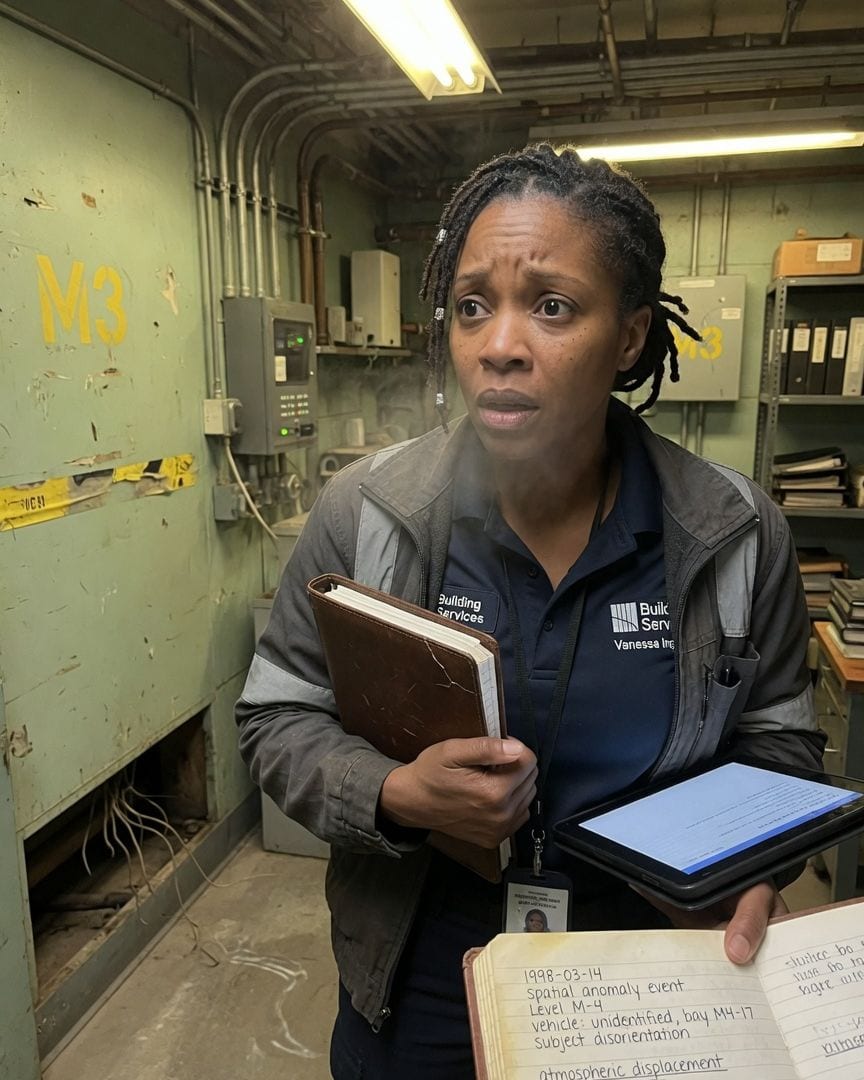
The lift offered a level below the lowest one, so I took the stairs down a flight that has never existed — into cold, empty bays where a single car sat, its engine still ticking like it had just been driven.
My routine as a Building Services Technician is usually solid, but today, the building offered a fourth basement level, M-4, that shouldn't exist. Descending into its frigid gloom, I found an old car tucked away in a bay, its engine ticking softly as if it had just arrived.