A fighter pilot's emergency landing saved her life, but the airfield was decommissioned in 2005. She found its official marker cone in the empty desert.
Low on fuel, with a wall of churning weather sealing off her home field, Captain Elena Reyes had one last divert option. Her kneeboard chart offered nothing, a blank space where emergency airfields should have been.
Yet, her comms crackled, a calm, clear voice cutting through the static: "Outpost 73, this is Outpost 73. Come in, Captain Reyes. We have you on radar. Runway two-seven is lit, ready for your approach."
Reyes acknowledged, her voice tight with relief. Below, through a break in the storm clouds, a strip of runway lights gleamed, a beacon in the desolate night. It was precise, orderly, exactly what she needed.
She brought her F-16 down with practiced grace, the tires squealing softly on the unfamiliar asphalt.
A lone figure, silhouetted against the driving rain, stood at the edge of the strip, waving illuminated wands, guiding her toward a designated parking spot.
The man wore a faded flight suit, his face obscured by shadow, but his movements were clear, professional. Reyes cut the engines, the sudden silence inside the cockpit a profound shock after the storm's fury and the jet's roar.
She sat for a moment, the immense relief washing over her.
A few hours later, after she'd secured her jet and logged her landing, the tower at her actual home field called. "Captain Reyes, glad to hear from you. Where did you put down?
We lost you on radar for a while there." Reyes rattled off the coordinates from her GPS. The voice on the other end went silent, a strained pause stretching across the connection.
Then, cold and formal, "Captain, those coordinates mark a patch of empty scrub. Outpost 73 was decommissioned in 2005. Its tower's been dark for almost two decades."
The official inquiry was swift, polite, and unyielding. Captain Reyes sat across from a panel of senior officers, the air in the sterile conference room thick with unspoken skepticism.
Her flight recorder showed her circling for a landing, her comms picking up only a faint, unidentifiable static where the controller’s calm voice should have been.
Her GPS logs, however, were undeniable: a precise landing at the coordinates she’d given, an airfield trajectory, and a touchdown. She insisted on the details: the brightly lit runway, the clear voice in her ear, the man with the wands.
She remembered his face, a man in his mid-forties with a strong jaw and a subtle scar above his left eyebrow. His wands had pulsed with an eerie, steady light, cutting through the driving rain.
The inquiry board, led by a Colonel Drummond – no relation, as far as she knew, though the name felt oddly familiar – suggested fatigue, a faulty sensor, or perhaps a highly elaborate prank.
Reyes, a pilot with a spotless record, a woman who lived by precision and verified data, knew better. She meticulously reviewed her own recordings, replayed the landing in her mind, every detail burned into her memory.
The taxi director had given her a curt nod, his eyes holding an unsettling, almost knowing emptiness.
The board concluded their findings with a quiet offer: mandatory leave, followed by a 'reassignment' to a desk job if she pressed the issue. It was a thinly veiled threat, a professional death sentence. But Reyes couldn't shake the feeling.
The coordinates, the empty scrub, the contradiction – it violated everything she knew about military precision and the immutable laws of reality.
Before the meeting concluded, she formally requested access to the original base decommissioning files for Outpost 73, citing an "academic interest" in abandoned facilities. Colonel Drummond’s gaze had lingered on her for a moment, unreadable, before he nodded his consent.
The next day, instead of reporting for mandatory leave, Captain Reyes drove her rental SUV out to the desolate coordinates. The desert wind, a hot, dry breath, whipped around the vehicle, kicking up plumes of red dust.
The sun beat down, harsh and unforgiving, on an endless, featureless expanse of dry brush and cracked earth. There was no sign of a runway, no tower, no hangar. Just the vast, silent desert.
She double-checked her GPS, its digital map showing her at the epicenter of nothing. She walked a slow, painstaking grid where her jet had supposedly touched down, her boots crunching on loose gravel. Nothing.
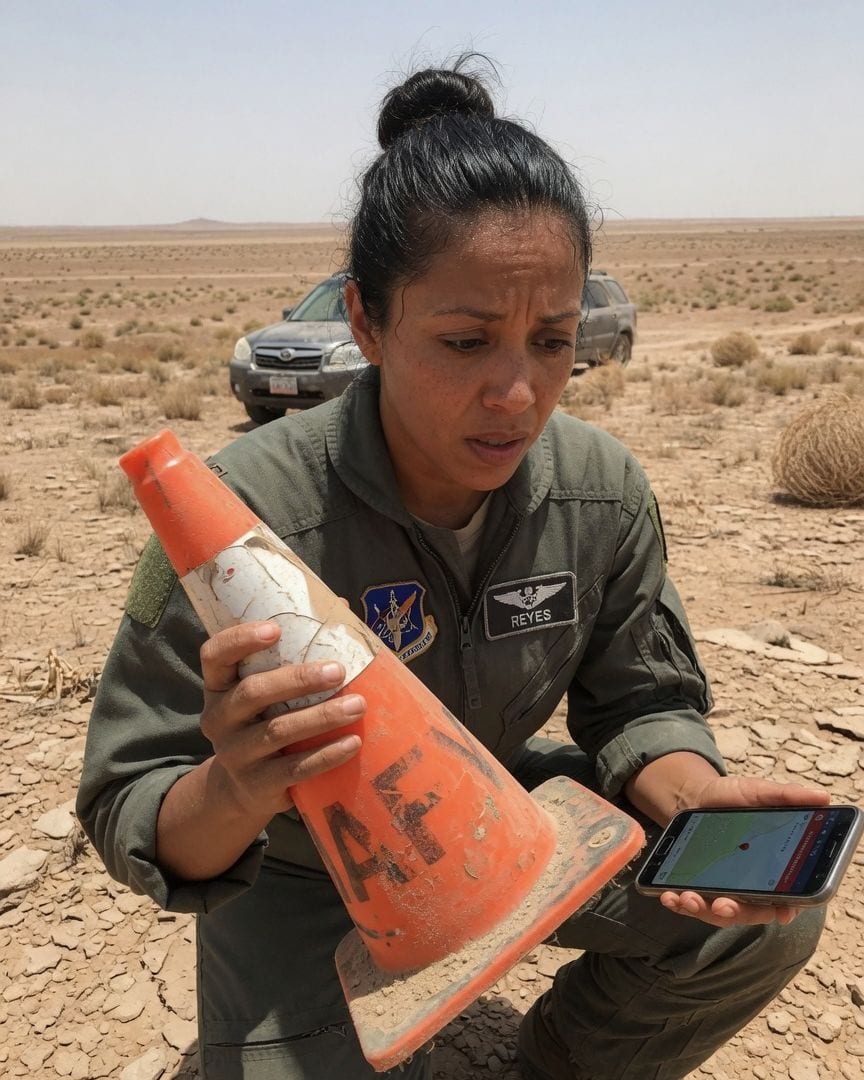
Just as she was about to give up, a glint of faded orange caught her eye. Half-buried in the sand, weathered but unmistakable, was a plastic airfield marker cone.
Its official 'AF' stamp was still visible, beneath layers of grime and desert dust. She knelt, pulling it free, the hot plastic gritty in her hand. It was real. It was here. And it shouldn't be.
Captain Reyes brought the cone back, but showed it to no one. The faded orange plastic felt impossibly heavy in her hands, tangible proof of an impossible event. It was undeniable.
She confided in Major Franklin Vance, a friend and air traffic control specialist whose professional curiosity, she knew, would be piqued by the sheer audacity of her story.
Vance, a lanky man with an analyst's keen eye, examined the cone, tracing the official 'AF' stamp with a skeptical finger that slowly lost its doubt.
Using his network, he began discreetly digging into the official records for Outpost 73, focusing on its decommissioning. The files were surprisingly sparse, considering the base’s strategic past.
He eventually found a single, hand-drawn map of the facility, dated 2004, a year before its official closure. It showed a small, auxiliary airstrip, distinct from the main runway, conspicuously labeled 'Emergency Divert - Unmanned.'
This strip was entirely absent from all digital records and later, revised maps.
Vance also found a recurring anomaly in the maintenance logs leading up to 2005: consistent, unexplained power draws reported from the 'unmanned' divert strip, even after its power was supposedly cut.
The reports were always signed off by the same facilities manager, a Mr. Calloway, who had retired shortly after the base closed.
The power fluctuations, sometimes spiking dramatically during severe weather events, were dismissed in the reports as "sensor glitches" or "ghost readings."
Meanwhile, Reyes, driven by a need to understand, began looking into local legends, finding whispers of "ghost lights" in the desert, always dismissed as old pilots' tales or heat mirages by the few who bothered to record them.
But the stories always mentioned planes in distress, always around the same coordinates.
Reyes's "academic interest" in Outpost 73 began to draw attention. Her access to old files was abruptly revoked, citing vague "security concerns" and the sensitive nature of decommissioned sites.
One evening, while reviewing satellite images of the scrubland on her personal laptop, she noticed a black sedan. It was parked a quarter-mile from her apartment, its windows tinted, and it never moved. It reappeared for three consecutive nights.
A subtle warning, she understood, a quiet pressure from an unseen hand. The room, usually a comforting sanctuary, felt suddenly cold, the silence between her and Vance on the phone stretching thin.
She and Vance agreed to meet off-base, at a quiet diner twenty miles outside the city, where the surveillance would be less overt.
Vance arrived looking shaken, his usual analytical composure frayed. He’d tried to contact Sylvia Winslow, the retired base archivist, known for her meticulous attention to detail and encyclopedic memory for old records.
Winslow, now in her sixties, had initially agreed to meet, eager to discuss the "old days" and the forgotten history of the base.
But when Vance mentioned Outpost 73 and specifically the "unmanned divert," her voice had gone cold, brittle like old parchment. She told him, "Some things are better left buried, Major. You wouldn’t want to end up like the others."
She hung up abruptly, the dial tone a sharp, accusatory sound in Vance's ear, and refused to answer any further calls. The message was clear: someone knew they were digging, and they were very close to something dangerous.
Reyes felt a prickle on her neck, a visceral awareness of being watched. The silent black sedan, the archivist’s warning – the system was pushing back, and it was doing so with chilling efficiency.
Undeterred, Vance managed to track down Mr. Calloway, the retired facilities manager. He found him living a quiet life in a small desert town, his days spent tending to a parched garden.
Calloway was frail, his memory hazy, but the mention of Outpost 73’s "unmanned divert" brought a flicker of fear to his faded eyes.
"That place… it had a way of staying on," he mumbled, picking at a loose thread on his threadbare sweater. The room, already stifling with the desert heat, seemed to press in on them.
Vance pressed him, gently sliding the old, hand-drawn map across the table. Calloway's gaze fixed on the 'Emergency Divert - Unmanned' label. He sighed, a shaky, rattling sound. "The power draws… they weren't mechanical. It wasn't equipment.
It was… a presence. Like the place itself was hungry." He explained that for years, strange energy spikes would register from the closed strip, coinciding with severe weather events that grounded aircraft across the region.
"We’d send out teams, find nothing. Just empty sand. But then, a few days later, a report would come in about a pilot landing at a 'ghost field' in the area, always low on fuel, always dismissed."
Calloway's hands trembled, his eyes darting to the window as if expecting to see something outside. "They called it the 'Watch That Won’t End.' Said it needed to be… fed."
He confessed to falsifying records, under quiet but persistent pressure, to make the power draws disappear, to make the airfield "officially" dark. "It was easier that way," he whispered, his voice barely audible.
"Less trouble than trying to explain the unexplainable. Less trouble than becoming part of the watch yourself." The silence in the room was heavy, suffocating. Reyes remembered the calm controller's voice, the silent taxi director, his unsettlingly empty gaze.
They weren't just part of the system; they were the system, trapped within it, now forever on duty.
Calloway's confession solidified Reyes's growing dread, crystallizing the impossible into a terrifying reality. Vance, fueled by this dark knowledge, returned to the archives, this time focusing on 'reassigned' or 'missing in action' pilots from the region.
He specifically targeted those whose incidents coincided with major weather events and reports of unusual activity at Outpost 73. He cross-referenced the dates with old accident reports, internal memos, and declassified flight logs.
The pattern was horrifyingly clear: a steady trickle of incidents over the past four decades, each dismissed or quietly buried under layers of bureaucracy. The files were thin, almost too clean, as if scrubbed of inconvenient details.
He found a specific file, flagged 'Missing, Presumed Reassigned' from 1987. The pilot, a Captain George Drummond, had been flying a routine training mission, encountered unexpected severe weather, and reported a "phantom airfield" before his last transmission.
His plane was never found. The official explanation cited "loss of control in extreme weather." But in his personnel file, tucked behind a commendation for a prior rescue, was a faded photograph of a young, confident Captain Drummond.
Vance felt a chill, cold and sharp, despite the warm glow of the archive lamp. The face was unmistakable. The same quiet eyes, the same sharp jawline, the same subtle scar above the left eyebrow that Reyes had mentioned.
It was the taxi director.
The man who had waved Captain Elena Reyes to her parking spot, a man who had vanished from all official records 36 years ago, was still on duty at Outpost 73, part of the watch that would not end.
The photograph of Captain Drummond, the "missing" pilot, staring back from the file, confirmed the horrifying truth for Reyes and Vance. The 'unmanned' emergency divert wasn't merely an echo, a memory of a runway long gone.
It was a self-sustaining entity, a system anomaly that drew in distressed pilots, absorbing them into its very fabric.
Drummond, the silent taxi director with the glowing wands, was a physical manifestation, a piece of the 'crew' that kept the phantom airfield alive, perpetually guiding new arrivals.
The 'calm voice' of the controller, the 'unexplained power draws' Calloway had reported, the 'ghost lights' of local lore—all were part of this insidious, repeating cycle.
The airfield wasn't just a place; it was a predator, feeding on the desperate need of pilots in distress. It offered salvation, only to claim the rescuer, adding them to its roster.
Every "reassignment" and "missing" report was another soul absorbed, another part of the watch.
The marker cone Reyes found wasn't just a physical remnant; it was a 'flag,' an anchor point the anomaly used to manifest, a tangible piece of the trap left behind from a previous iteration.
The true horror wasn't that the military system failed to account for such things; it was that the system was the horror, a perfect, self-correcting anomaly, using the very protocols of military accountability to replenish its ranks and erase its victims.
Reyes realized she hadn't just landed at a closed airfield; she had almost joined its permanent crew.
Reyes knew she couldn't fight the phantom airfield directly. It wasn't a physical enemy, not something that could be bombed or disarmed.
Her only option was to escape its insidious pull and sever all ties to the official narrative that denied its existence.
She and Vance meticulously compiled their evidence: the marker cone, Calloway's trembling testimony, the pattern of disappearances across decades, and finally, Drummond’s file, with his haunting photograph.
They presented it to a higher board, bypassing the local command, hoping that the sheer weight of coherence would break through.
The reaction was predictable: polite skepticism, followed by thinly veiled threats about their careers. "Captain Reyes, Major Vance," a stern-faced general stated, his voice devoid of warmth, "we appreciate your... thoroughness.
But this 'evidence' is circumstantial, based on the testimony of a senile man and a decades-old missing person report. The marker cone, while curious, could be anything. A relic from a training exercise, perhaps." Reyes knew they wouldn't believe it.
They couldn't. The system was designed to reject such anomalies, to smooth over the rough edges of reality. She made her choice. She publicly resigned her commission, citing "irreconcilable differences" with the official findings of her incident.
Vance, seeing her resolve and understanding the profound danger, chose a different path, accepting a transfer to a remote, obscure posting, far from any flight path, where he could continue his quiet research, safely out of reach.
Reyes walked away from her decorated career, her reputation as a "crackpot" pilot now preceding her. But she carried the truth, a truth that no one in the meticulously ordered world of the military would ever acknowledge.
She had escaped, but the cost was everything she had built.
Elena Reyes now works as a civilian flight instructor, her days filled with the mundane mechanics of takeoffs and landings, far from any military base. Her name is quietly removed from commendation lists.
Franklin Vance occasionally sends her coded emails from his new posting, always about "unusual weather patterns" or "minor discrepancies in outdated flight logs" in remote desert regions. The black sedan never reappeared outside her apartment.
The Air Force officially closed the inquiry into her incident, filing it under "pilot error due to extreme fatigue."
Outpost 73 remained a patch of empty scrub on the sectional charts, its existence denied by all official channels, a ghost in the machine.
But sometimes, when the weather turned, or a distant plane reported a low fuel warning on the civilian band, Reyes felt a familiar chill, a faint echo of a calm voice on the radio, calling out to another desperate pilot.
Reyes teaches her students to trust their instruments, to follow protocol, but she adds a quiet, unspoken caveat: some things exist beyond the charts, beyond logical explanation.
One evening, she saw a news report about a small private plane, low on fuel, diverting to an "unlisted airfield" in the American Southwest, only to vanish. The search found nothing but empty scrub.
She closed her laptop, a heavy sigh escaping her lips. She knew. She always knew. The watch would never end.
The next morning, a student asked her about the old, faded photo she kept on her desk, a smiling young man in a flight suit. "That was Captain Drummond," she said, her voice soft.
"He taught me a lot about flying. And about what happens when you land where you're not supposed to." The student nodded, then looked closer at the photograph, a puzzled frown on his face.
"He looks a lot like that guy who helps out at the private field sometimes, the one who guides planes in with the wands. Down near the old state line."
Elena Reyes didn't answer, just looked out the window at the clear, blue sky, a faint, wrong little smile playing on her lips. It was still out there, waiting.
If this one got to you
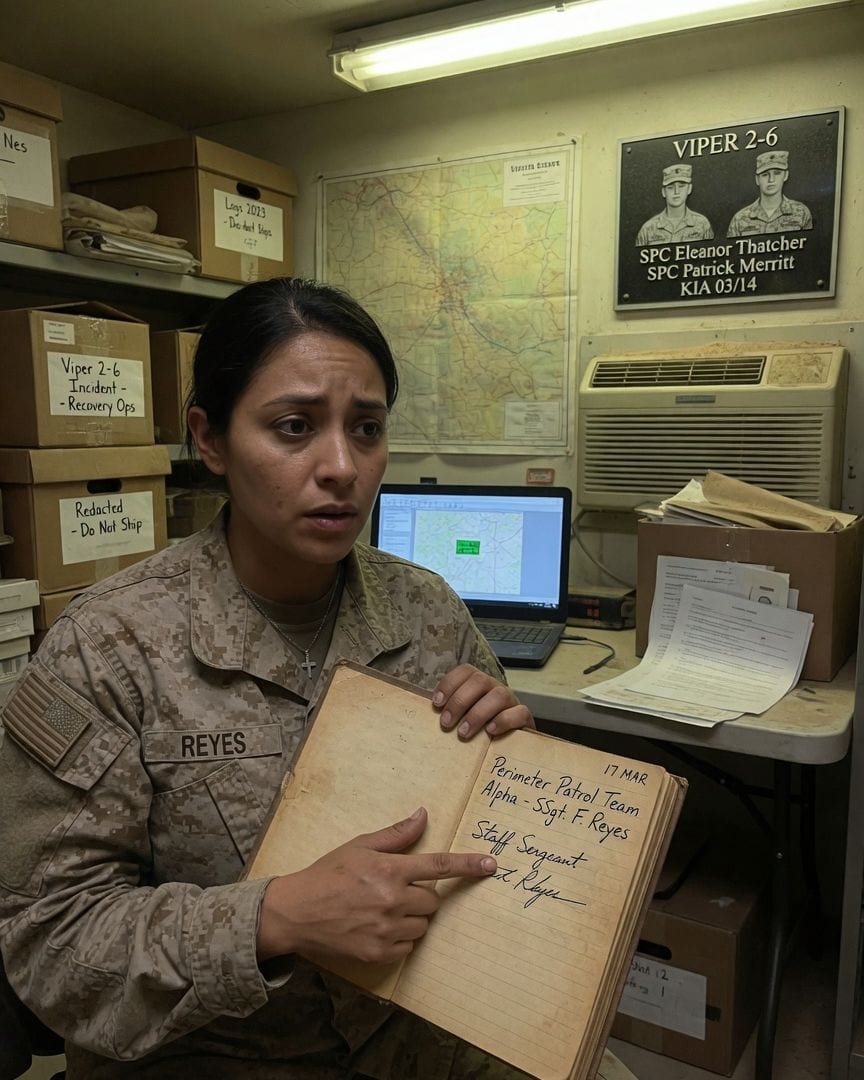
A Staff Sergeant, three weeks from transfer, finds her own signature in a logbook for a patrol she never made.
Staff Sergeant Fiona Reyes counted down her last three weeks at the high desert outpost, the fluorescent hum of the TOC a constant companion amidst the dust and old equipment. Her tired eyes scanned the digital map when an impossible icon, 'Viper 2-6' – a vehicle and crew lost last year – blinked alive, reporting its position and crawling steadily toward the base. Despite commanders dismissing it as a system ghost, Reyes meticulously searched dusty archives, finding strange log entries of phantom contacts and radio chatter, all dismissed as malfunctions. But the true chill came when she unearthed a field logbook from the recovery efforts, revealing her own undeniable signature on a perimeter patrol dated last year, a patrol she knew, with every fiber of her being, she had never made.
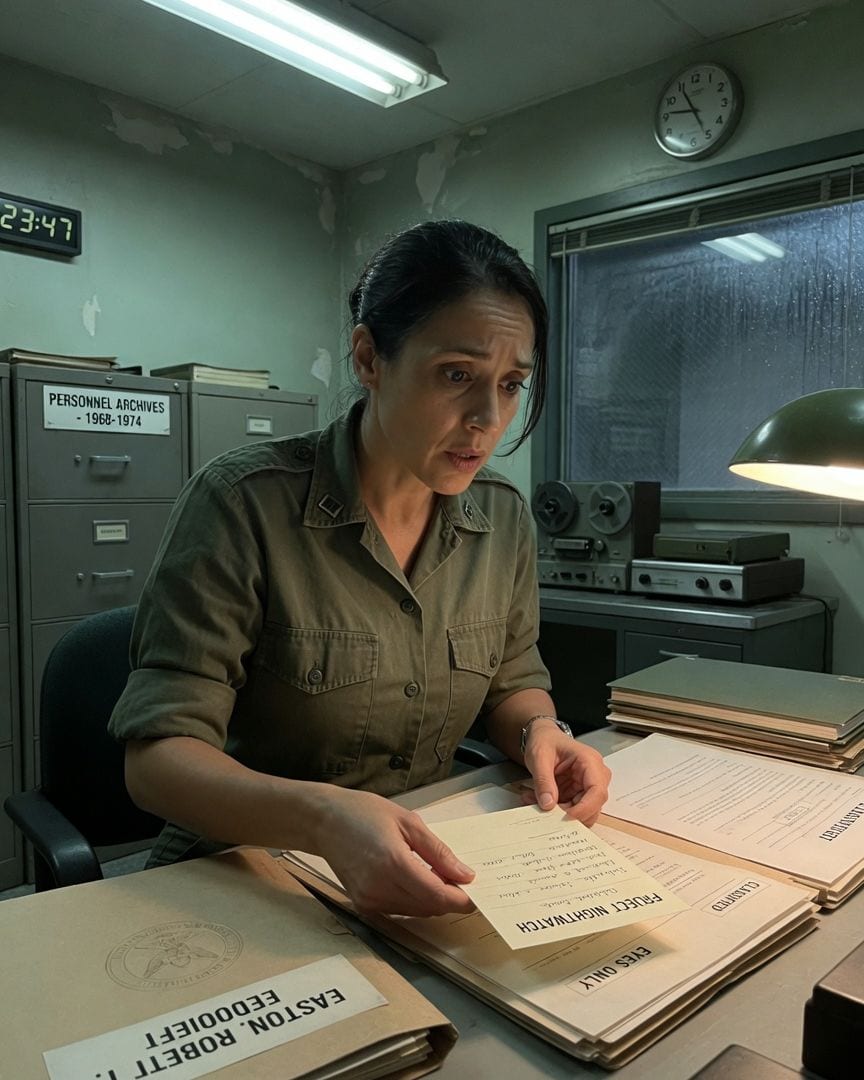
A Cold War tower controller logs an object vanish from radar, then hears the pilot scream it’s filling his windscreen. Her own name, 'Bardolph, Ines', now marked 'Observed' in a secret file.
Captain Ines Bardolph, a tower controller, was counting down the months until her transfer to Langley and the decommissioning of her base, hoping to leave behind the unsettling incidents of her final posting. But one night, her radar scope showed an impossible blip, solid and unwavering, 40 miles north of the Danube, only to vanish in less than a second, leaving a pilot screaming in terror. Despite the clear evidence, the official report blamed "atmospheric inversions," while the terrified pilot received a glowing review and promotion, his file meticulously scrubbed of any anomaly. As Captain Bardolph reviewed the pilot's pristine record, she found a hidden slip of paper, revealing a chilling truth: 'Subject: Bardolph, Ines. Status: Observed.' Was she merely an observer of the impossible, or was she now part of something far more sinister?
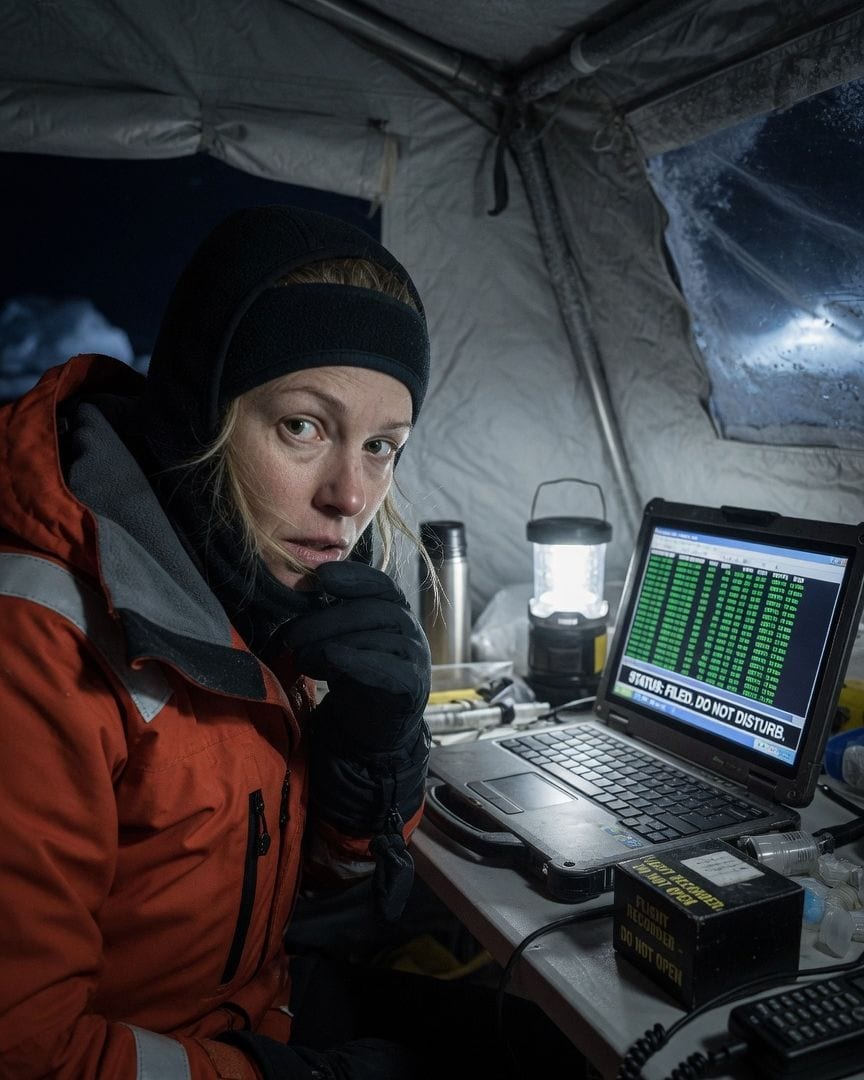
A glaciologist finds a Cold War plane 60 feet down in Greenland ice, its navigation lights still burning after sixty years.
Glaciologist Ines Faurholt skied across the vast, blinding Greenland ice cap when her path was abruptly blocked by a dark, corroded antenna mast. Beneath it, sixty feet down in ancient ice, a Cold War reconnaissance aircraft sat with its navigation lights eerily burning and its cockpit clock steadily keeping time. The sight was a violation of everything Ines knew about time and preservation in this frozen world. She called for a team, and days later, they extracted the plane's flight recorder, revealing data that showed the aircraft still flying years after its disappearance.
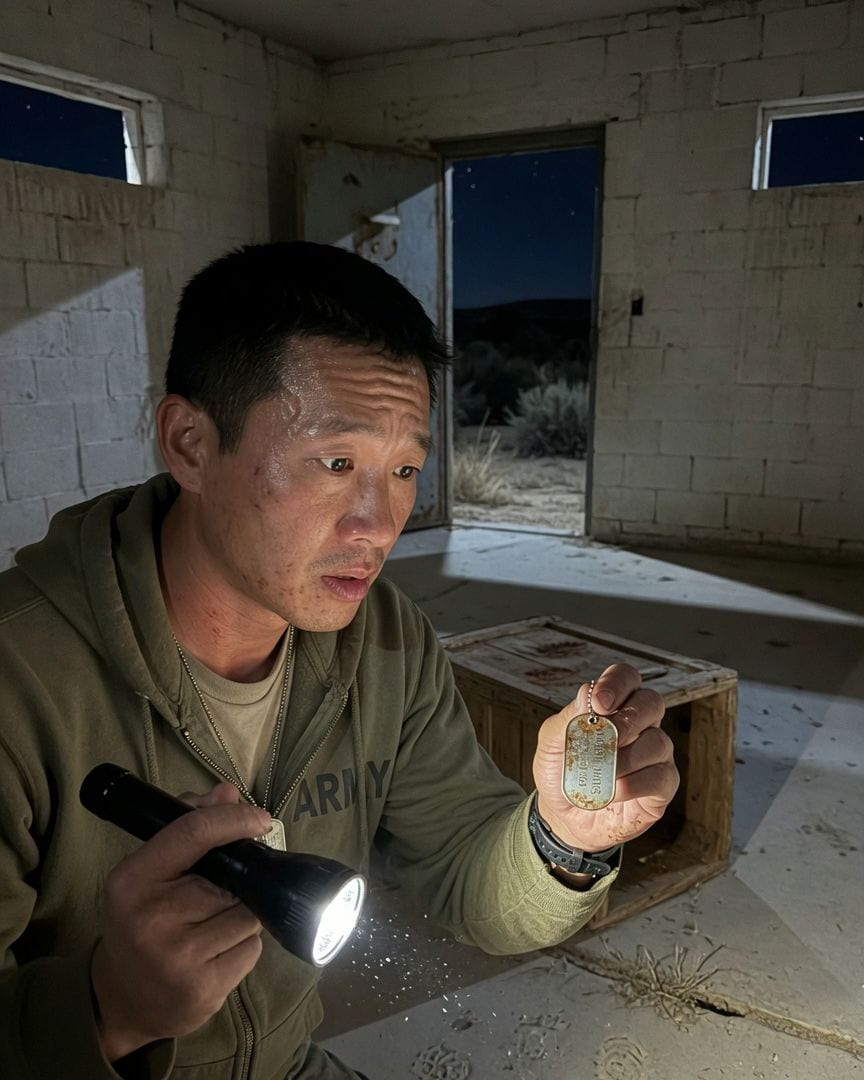
Staff Sergeant Rhee’s squad found a Cold War building not on their map. Range Control confirmed no structure. Minutes later, it vanished, leaving a foundation decades old.
Staff Sergeant Adam Rhee halted his squad at the Yakima Training Center, staring at a cinderblock building that simply wasn't on his map. Range Control confirmed there was no structure at his coordinates, leaving him to wonder what impossible thing stood before them. Moments later, after the range-safety truck arrived, the building vanished, leaving only a rectangular patch of earth with a foundation of decades-old weeds. That night, driven by an unsettling certainty, Rhee returned to find the building reappeared, its door ajar, holding a single, rusted dog tag from 1983. How could a place appear and disappear, leaving behind evidence from forty years ago?
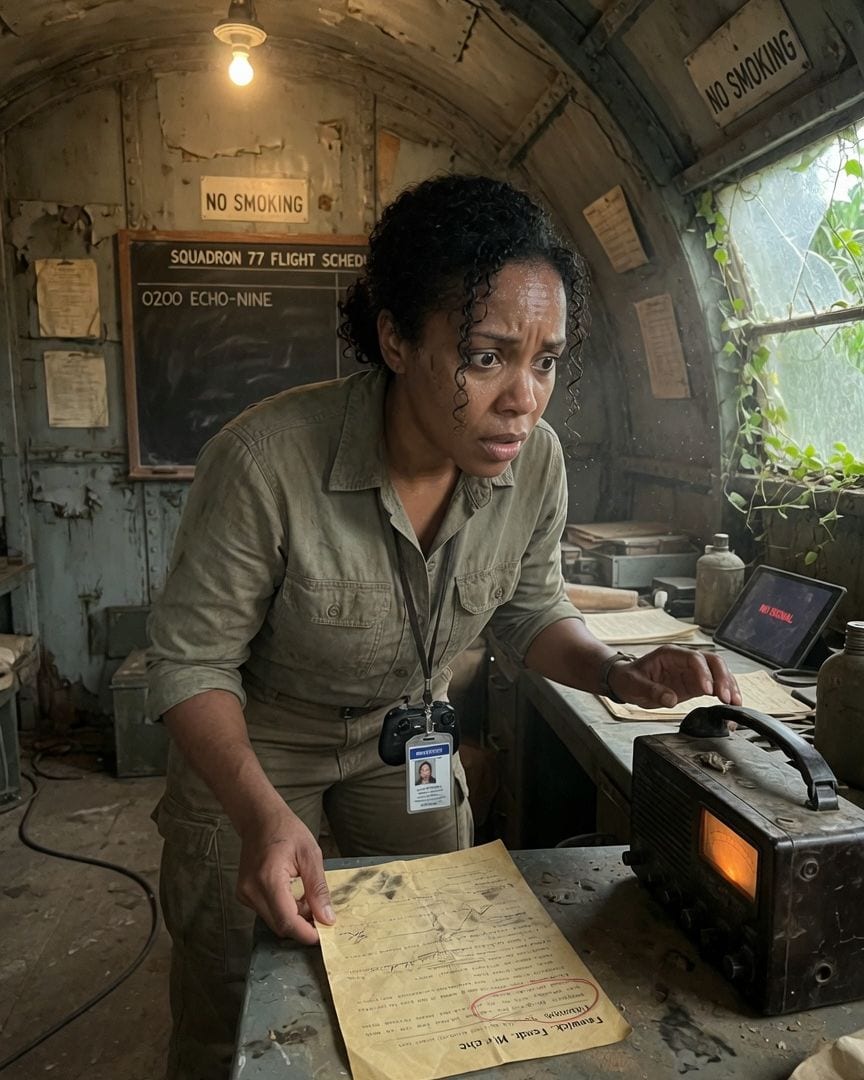
A surveyor found her name on a 1945 manifest in an eighty-year-abandoned base. Then its old radio crackled to life, calling a name from the list.
Surveyor Ade Fenwick meticulously charted a remote Pacific atoll, part of a meticulous process for a new runway contract. But her drone flagged an impossible structure: a Quonset hut not on any official record for the eighty-year-abandoned base. Inside, a generator hummed, and a 1945 flight manifest listed a phantom squadron, complete with a familiar surname: Fenwick, M. With her comms dead, an old radio in the ready-room crackled to life, calling out a call sign from the very same manifest. Who was on the other end, and how was this base still active?
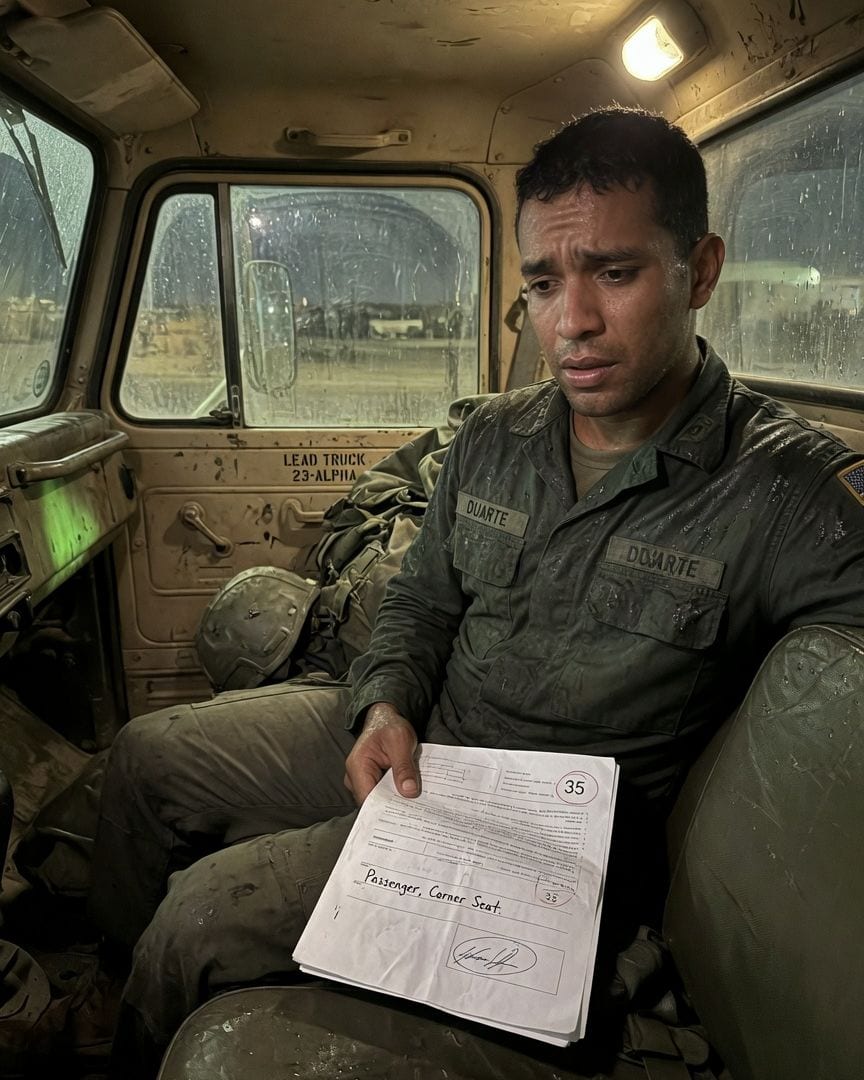
Specialist Duarte, two weeks from going home, found his empty truck seat warm and dented — then his service record showed a ghost deployment he never made.
Specialist Felix Duarte was just two weeks from going home, but a final convoy mission held an unsettling mystery. Soaked and running late, he squeezed into the lead truck's forbidden corner seat, a place every soldier knew to leave empty. Hours later, stepping out into the desert, he found the seat was strangely warm and distinctly dented, as if two unseen bodies had pressed in beside him. The official manifest then listed an extra soul for his truck, simply 'Passenger, Corner Seat,' signed by his own hand. What impossible presence had shared Specialist Duarte's ride, and what other records might it have altered?