A corporal at his isolated Cold War station plays a 1959 archive reel. Its wind and generator thrum perfectly match his own blizzard now.
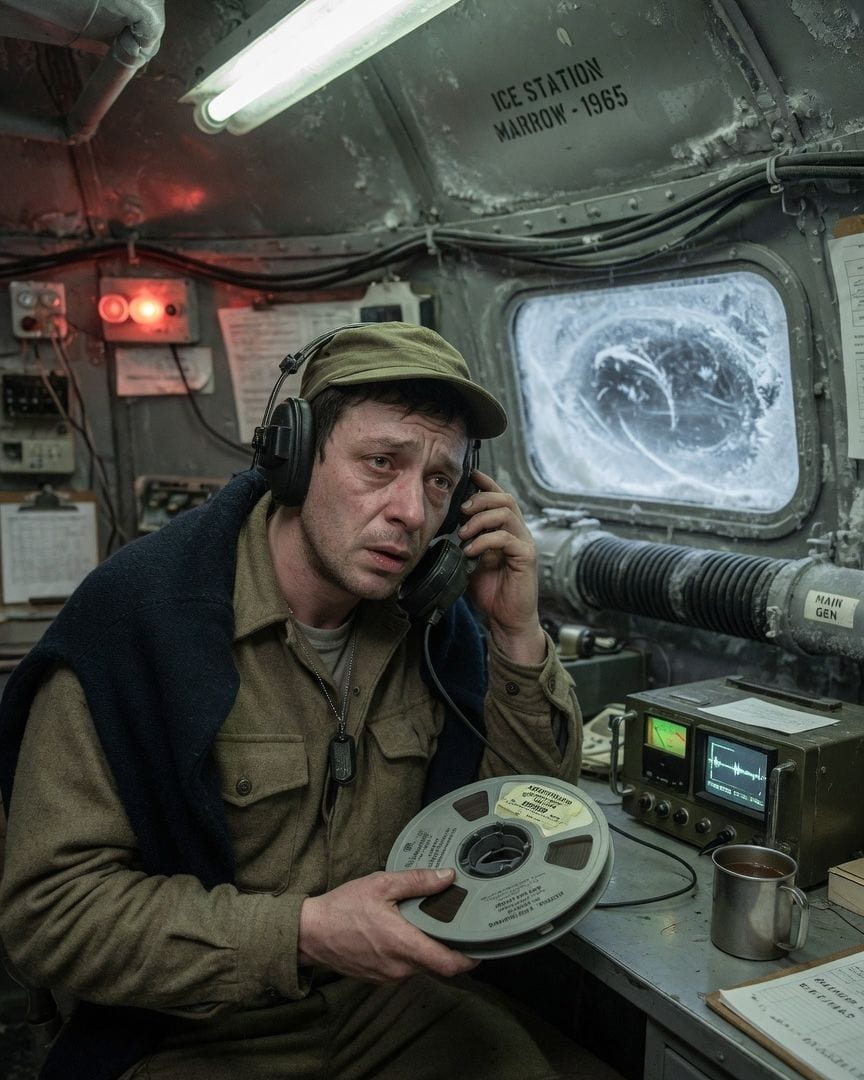
The whiteout had held for six days at Ice Station Marrow, the world outside swallowed by a relentless, shifting wall of white.
Mail had not come since October, and Corporal Yves Boudrie was bone-deep in loneliness, the kind that ate at the edges of a man’s thoughts.
It was the winter of 1965, and the station’s only entertainment was a stack of sealed reels from a declassified archive, ancient things of tape and plastic. Out of pure boredom, Yves played one.
It was a woman’s voice, calm and monotone, reading numbers in Russian. Nothing unusual for the Cold War era, but unsettling in its detached precision. Behind her, faint, was a sound like wind, a high-pitched moan.
Yves dismissed it, a recording artifact, a hiss of worn tape. Then the blizzard outside the dome gusted, a sudden, violent roar that rattled the metal skin of their isolated world.
The wind on the reel rose with it, a perfect, impossible echo of the storm's fury. The blizzard died down, receding into a low growl, and the wind on the reel softened, mimicking its ebb.
The recording, the label said, was made in Bavaria, in a summer, six years before. The discrepancy hung in the frigid air, a tiny, impossible wrongness that Yves could not shake.
Yves pulled the reel from the player, examining its casing. Standard issue, gray plastic, no visible tampering, just the faded label with its impossible date and location.
He threaded the tape back, played it again, this time with headphones, adjusting the gain to sharpen the audio.
The Russian numbers continued their hypnotic count, the wind pattern still perfectly matched the storm outside, each gust outside met with a corresponding swell in the recording. But now, with the enhanced audio isolating every nuance, a new detail emerged.
Beneath the wind, barely perceptible at first, was a low, rhythmic thump-thump. It was too steady to be part of the Bavarian summer ambiance, too even to be natural.
He tried to rationalize it – a distant motor, a heavy door closing repeatedly. But the sound had a distinct, deep resonance, a powerful, mechanical beat. It reminded him of something.
He walked through the station’s deserted corridors, the thrum of the main generator a constant, almost subconscious companion. He stopped, a chill running down his spine, colder than the Arctic air.
The thump-thump on the reel, he realized, was exactly the frequency and cadence of the station's own massive diesel generator, providing power to their isolated dome. It was impossible.
The reel was six years old, recorded thousands of miles away, in a season that was the polar opposite of their current endless winter. Yet, the heart of Ice Station Marrow beat faintly within its analog grooves.
Corporal Boudrie spent the next hour replaying the reel, trying to isolate the generator’s thrum, to prove his own ears wrong. He connected the player to the station’s diagnostic audio equipment, running spectral analyses.
The pattern of the wind was undeniably synchronized with the blizzard. And the low, rhythmic thump-thump registered as a distinct, powerful low-frequency signal, its waveform identical to the live output of their own generator.
The analytical equipment, with its cold, digital precision, confirmed what his ears screamed. He walked to the station’s main power conduit, a thick pipe humming with contained energy, snaking through the metal skeleton of the dome.
He pressed his ear to the cold, vibrating metal.
The thrumming of the generator matched the sound on the tape, beat for beat, as if a live feed from 1959 Bavaria was somehow playing the sound of his own station’s heart.
Yves knew he couldn’t keep this to himself, even if Captain Harold Mercer was a man who prized routine above all else, a man who dismissed anything 'unorthodox' as an inconvenience.
Yves presented his findings, showing the spectral analysis readouts, playing the reel side-by-side with a live feed from the generator room. Mercer listened, his face impassive, his gaze fixed on some point beyond Yves’s shoulder.
Then he scoffed, a short, dismissive sound. 'Atmospheric interference, Corporal. Or a faulty recording head. These old reels are notorious for degradation.'
He ordered Yves to dispose of the reel and focus on routine communications, on the things that kept the station running. But Yves couldn't let it go.
He secretly copied the audio, a small act of defiance, then began sifting through other declassified reels, looking for similar anomalies, for any pattern that might explain the impossible.
He found nothing for days, just more Cold War chatter, static, and the endless, droning reports of weather. Then, a reel labeled 'Meteorological Anomaly - North Atlantic, 1961' caught his eye.
It contained fragmented radio chatter about an inexplicable fog bank and distress calls from a fishing trawler that had vanished without a trace, the last word a choked cry of something unknown.
Buried deep in the static, under layers of crackle and hiss, Yves found it: a faint, high-pitched whine that subtly mirrored the unique frequency of Ice Station Marrow's emergency beacon, a sound that only activated during extreme weather or power failure.
This beacon had only been installed in 1963. The pattern was forming, threads of impossibility weaving together. He tried to access more 'meteorological anomaly' files, but his access was suddenly revoked, a digital barrier slamming shut.
Captain Mercer, passing by his station an hour later, gave him a long, unsettling look. 'Having trouble with your equipment, Corporal?' he asked, his voice calm, but with an edge that suggested a warning, a line drawn in the snow.
Yves felt Mercer’s eyes on him constantly after that, a phantom weight pressing on his back even when the Captain was nowhere in sight.
His workstation, a meticulously organized space, was subtly rearranged each morning, small things out of place – a pencil shifted an inch to the left, a comms log moved from one stack to another.
He started leaving tripwires – a pencil balanced precariously on a drawer handle, a paperclip wedged in a specific file’s spine, a faint dust trail disturbed just so. Each morning, they were disturbed, the silent evidence of an intrusion.
He knew it was Mercer. One evening, alone in the mess hall, the only sound the rattling of the exhaust fan, Mercer sat opposite him, uninvited.
'Corporal,' he began, his voice low, almost a whisper, yet it cut through the silence like ice, 'this station operates on trust. On adherence to protocol. Any deviation, any… unauthorized investigation, can have severe consequences for your career.
And your well-being.' Yves met his gaze, refusing to flinch. 'Captain, I just want to understand why a 1959 recording has our generator's thrum.' Mercer smiled, a thin, humorless line that barely touched his eyes.
'Some things aren't meant to be understood. Just filed. Now, I suggest you enjoy your last few months here. Your transfer orders are already being processed for spring.' The threat was clear, the implication stark.
Yves had to move faster, had to find something Mercer couldn't dismiss, something solid that would crack through the Captain's cold composure. He remembered the mention of 'declassified archives' in Mercer’s earlier dismissal.
If Mercer had access to current, sensitive files, perhaps there was a civilian-accessible archive of older, less guarded records.
He spent his off-hours drafting coded messages to a contact in the military records division, Fiona Abbott, a former classmate now working in a declassification office back home.
He spun a tale of a historical research project, requesting specific dates and classifications of 'atmospheric phenomena' and 'unexplained disappearances' from the late 1950s and early 1960s, hoping she would see through the flimsy cover story to the urgency beneath.
Weeks later, a reply came from Fiona, encrypted and cautious, delivered through a convoluted military email chain. She had found a trove of records, heavily redacted, but bearing recurring code names: 'Project BOREALIS' and 'Echo Transponder.'
She attached a partial manifest of 'recovered assets' and 'calibrated relays' from a series of 'atmospheric disturbances' in the late 50s. Yves poured over the document, his breath fogging in the frigid air of the comms room.
The 'assets' were ships, aircraft, even small research teams, listed with dates of disappearance. The 'calibrated relays' were locations, often remote, like isolated weather stations or lighthouses, places of stark solitude.
He noticed a pattern: each 'disturbance' was linked to a specific numeric sequence, often followed by a short, technical description of an environmental condition. 'Sequence 7-Gamma-9: Wind Velocity Match, Local.' He matched it to the Russian numbers on his reel.
The pieces clicked into place with horrifying precision: the numbers were instructions, the reels were the 'relays.' The wind was a 'match,' a parameter.
The generator's thrum and the emergency beacon's whine were the relay's activation signals, not just ambient noise, but an integral part of the process.
The reels weren't passive recordings; they were active conduits, projecting or 'filing' environmental conditions and even entire disappearances. The 'meteorological anomaly' files weren't just reports; they were operational logs, chillingly precise.
The cold dread settled in his gut, a knot of ice. The 'lost' weren't lost; they were redirected. He looked at the list of 'assets,' his finger tracing down the column.
One entry, marked 1959, read: 'Research Vessel Polaris – Bering Sea. Status: Filed. Relay: Bavarian Signal.' He felt the ship’s last moments, redirected, perhaps to a summer in Bavaria, its crew experiencing a sudden, impossible warmth before vanishing.
He realized the true horror: this wasn't an accident. It was a system. And someone was operating it.
Yves sent a frantic message back to Fiona. 'Find anything on Project BOREALIS, any operational logs, any personnel manifests. Urgently. Don't tell anyone.' Fiona, intrigued and unsettled by his intensity, dug deeper.
She spent days, weeks, navigating a maze of old databases and microfiche archives, a forgotten corner of military bureaucracy. She found a heavily redacted file labeled 'Project BOREALIS: Initial Calibration Log, Bavarian Signal Relay - 1959.'
The document detailed the testing of the 'signal relay' using numeric sequences to 'match' environmental conditions. It listed 'personnel assigned to monitoring stations' for 'long-term observation of transference effects.'
Most names were blacked out, censored by thick black lines, but one section, a manifest of 'assets for deployment,' was partially visible. It included service numbers.
Fiona’s eyes scanned the list, looking for anything familiar, anything that might be what Yves was looking for. Then she saw it.
A line, written in a different hand, squeezed in at the bottom of a list of early test subjects, almost an afterthought: 'Boudrie, Yves. Service No. 278-44-01. Deployment: Sub-Arctic Monitoring Station. Date: 05/1959.'
She blinked, rereading it, then read it again, the words refusing to make sense. Yves Boudrie. His service number. But the date was 1959. Yves had told her he enlisted in 1967.
Her own phone, still open to the email from Harold Mercer, showed Yves Boudrie's service number, the one he had given her to 'check the records,' identical, dated 1967.
Fiona immediately called Yves, overriding all protocols, all caution. 'Yves, your service number. It's in a 1959 file. Dated before you were even born.' The line went dead, a sudden, absolute silence.
The whiteout at Ice Station Marrow had intensified, cutting all communications, isolating them completely. Yves stood frozen in the radio room, Fiona’s words echoing in the sudden, vast quiet. His own service number, his identity, predated his existence.
Captain Mercer entered, a file folder in hand, his calm presence a contrast to the howling storm outside and the storm within Yves. 'Looking for this, Corporal?'
he asked, holding up a file labeled 'Project BOREALIS: Ice Station Marrow - Activation Protocol.' He opened it.
Inside, Yves saw photos of the station’s generator, its massive housing, its internal workings, schematics of the radio equipment, and, chillingly, the precise model number of his own reel-to-reel player. 'The 'Bavarian Signal Relay' needed an anchor.
Your reel, Corporal, is the heart of it. The numbers are coordinates, the wind is the environmental signature. And your generator? It provides the necessary energy, the power to bridge the gap.'
Mercer tapped a section of the file, his finger tracing a line. 'The 'assets for deployment' were not victims, Corporal. They were future operators.
Those identified as having a unique resonance with the transference effect were 'filed' – their future selves designated for specific 'relay' stations. You were one of them. The 1959 entry was your designation, not your enlistment.'
The horror of it slammed into Yves, a physical blow. He wasn't just a witness; he was a component, pre-selected, his life a pre-written script within the secrecy machine, a path laid out before he drew his first breath.
The station wasn't just a monitoring post; it was a 'transponder node,' and he was its unwitting operator. The 'lost' were simply moved, and the 'files' were their new coordinates.
Mercer placed a fresh reel on Yves's desk, identical to the first, its gray plastic gleaming under the harsh fluorescent light. 'Your transfer orders are ready, Corporal. A nice posting, warm weather. But first, a final task.
A new 'asset' requires filing. The coordinates are on this reel.' Yves stared at the reel, then at Mercer's calm, unblinking eyes, eyes that held no malice, only an unsettling, professional detachment.
He was not a prisoner, not a victim in the traditional sense, but a tool, a cog in a vast, unseen machine.
His entire life, a carefully constructed path to this moment, a destiny determined by a service number in a file dated before his birth.
The storm outside howled, a banshee wail, the dome groaning under the immense pressure of the whiteout. The generator's thrum vibrated through the floor, a deep, persistent heartbeat.
He could feel the station, the reel, himself, all humming with a terrible, patient purpose. He lunged for the emergency override switch for the station’s main power, intending to cut the connection, to sever the relay, to stop the impossible.
Mercer moved with surprising speed, intercepting him, a heavy hand clamping down on his shoulder with unexpected strength. 'Don't be foolish, Corporal. The system is self-correcting. You are part of the system now.
Your presence here, your 'activation,' is what allows it to continue. It's why your number was in the file, why you were chosen.' Yves struggled, but Mercer's grip was like iron, unyielding.
'The last operator became… unstable,' Mercer continued, his voice devoid of emotion, as if discussing a faulty piece of equipment. 'We had to re-file him. You're more resilient, we hoped. More rational.'
Yves felt a cold dread seep into his bones, colder than the Arctic night, colder than the frozen metal around them. He was not just on a list; he was a replacement.
The hand on his shoulder tightened, pressing him towards the reel-to-reel player. The blizzard outside roared, and the thrum of the generator seemed to deepen, reverberating in his chest, in his skull.
He saw his reflection in the dark screen of the player, his face a mask of terror, and behind it, a faint, almost imperceptible shimmer.
The whiteout at Ice Station Marrow finally broke two weeks later. The relief crew arrived to find Captain Harold Mercer alone, calm and in command. Corporal Yves Boudrie was gone.
Mercer reported a 'psychological breakdown' and 'desertion into the blizzard,' a common enough occurrence in such extreme isolation. The station's records were immaculate, detailing Yves's routine duties right up until his disappearance. The reel-to-reel player was clean, wiped of fingerprints.
No unusual recordings were found. The 'Project BOREALIS' files were reclassified, buried deeper within the vast, labyrinthine archives. Fiona Abbott, back in the declassification office, found her access to 'meteorological anomaly' files permanently revoked without explanation.
She never saw Mercer again.
Years passed. Fiona Abbott, now a senior archivist, occasionally wondered what became of Yves Boudrie. The mystery of his service number, dated before his birth, haunted her, a persistent itch in the back of her mind.
One day, sifting through a newly declassified box of Cold War-era audio reels, she found one marked 'Bavarian Signal Relay - Test 3.' She played it. The familiar woman's voice read numbers in Russian.
Behind her, a faint wind rose and fell. But beneath that, distinct and unmistakable, was the faint, rhythmic thump-thump of a diesel generator, and a whisper, almost inaudible, of a man's voice, pleading.
She turned up the volume, straining to hear. The whisper faded, replaced by the calm Russian voice, and the wind. Fiona paused the reel, her heart pounding. She looked at the label, then at the date: 1959.
She then looked at a new accession stamp on the reel, applied by her own department just last week. It read: 'Verified: Ice Station Marrow. 1965. Operator: Y. Boudrie.' A chill spread through her, cold and absolute.
The lost were never lost. They were filed. And the file was still being signed.
If this one got to you
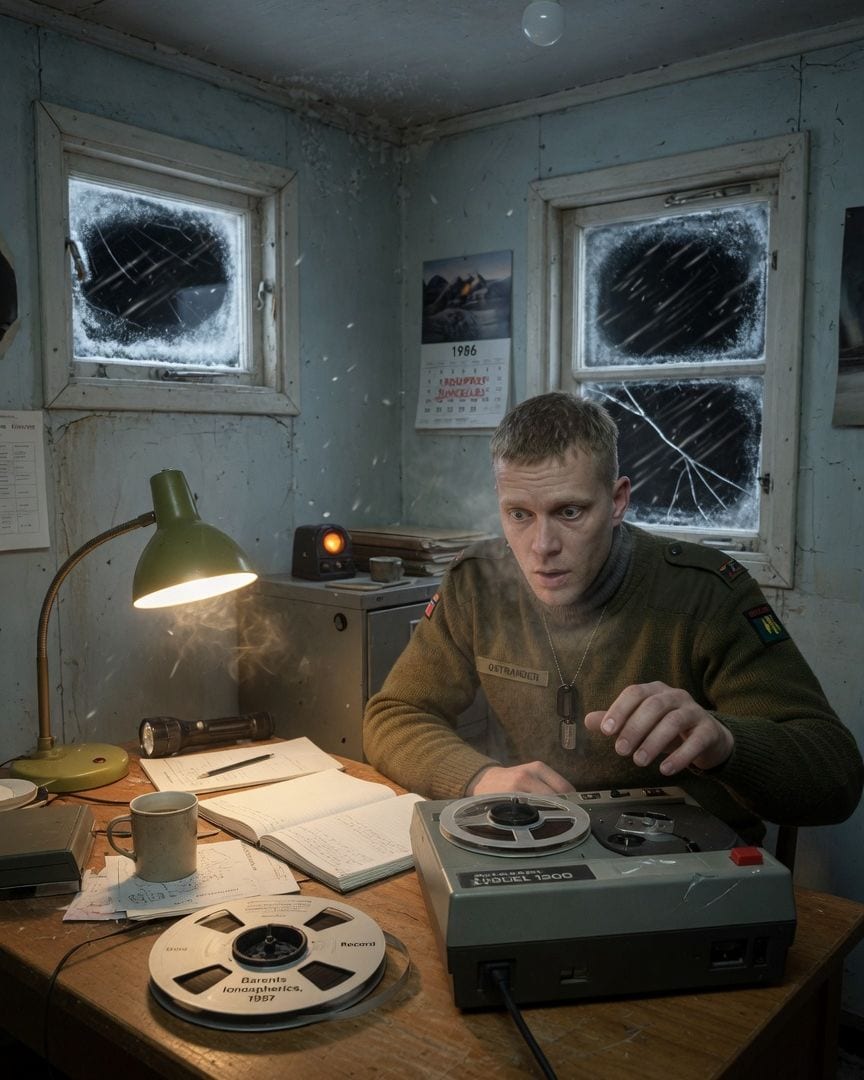
A Cold War sergeant in a lonely fell hut plays a 1957 reel. It names his service number and a fresh scratch he just made.
Sergeant Pell Ostrander, a methodical man of thirty-five, was isolated in a Norwegian fell hut in 1986, with only the generator's hum and a stack of old reels to burn by Friday. The arctic quiet led him to play a 1957 tape, expecting static. Instead, a calm voice filled the small space, detailing his exact hut, its generator, and the snow outside. His heart hammered when the voice read the log for this coming Friday, describing the record burn and more reels than he counted. But the dread truly landed when the voice named his service number and described a fresh scratch he had just made on the playback machine.
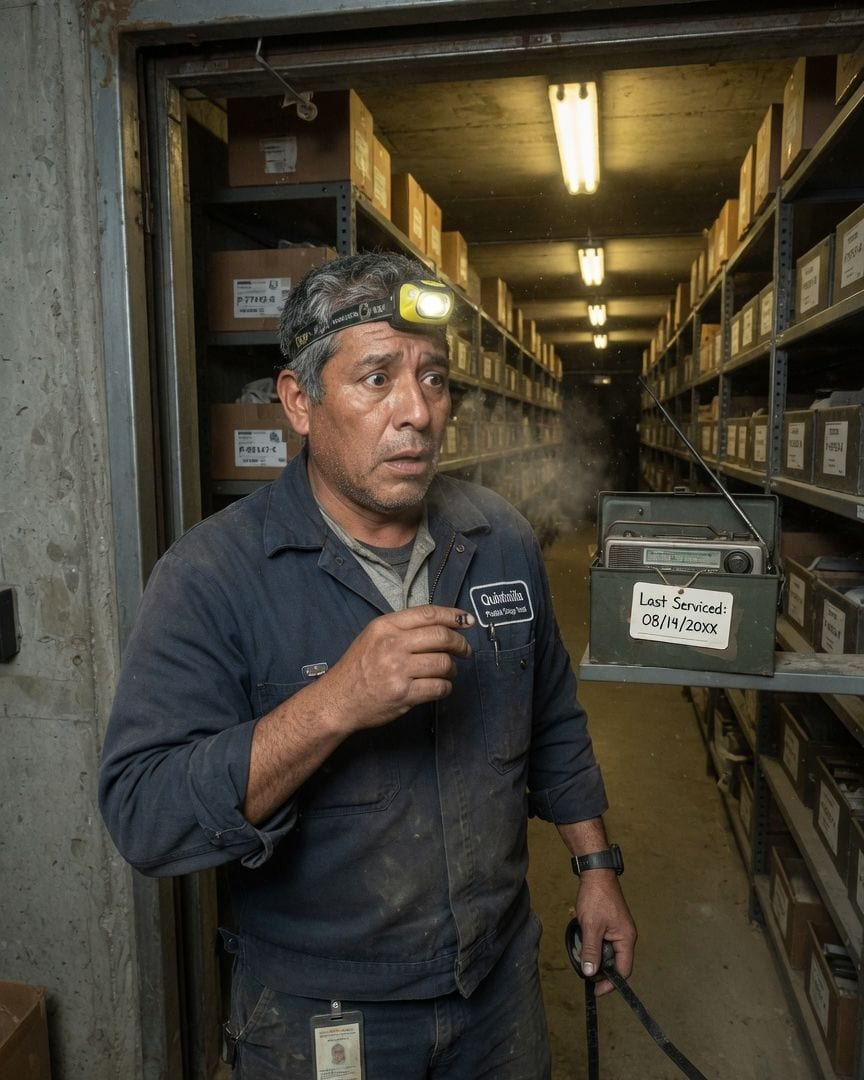
A Cold War bunker worker found a field radio serviced three years in the future, its ink still wet.
Salvador Quintanilla, one of the final two men at the Pueblo storage yard, was tasked with clearing Igloo 7, the last bunker before the facility's imminent closure. As he rolled back the heavy steel door, he discovered not an empty space, but metal racking extending impossibly far past the concrete wall, under the empty prairie, lit by a wan, humming light. Venturing into the profound chill, he found an old field radio with a service tag dated three years in the future, its dark ink still wet to the touch. The radio hummed faintly in his hands, and from deep within the impossible corridor, a metallic click echoed, confirming he was not alone.
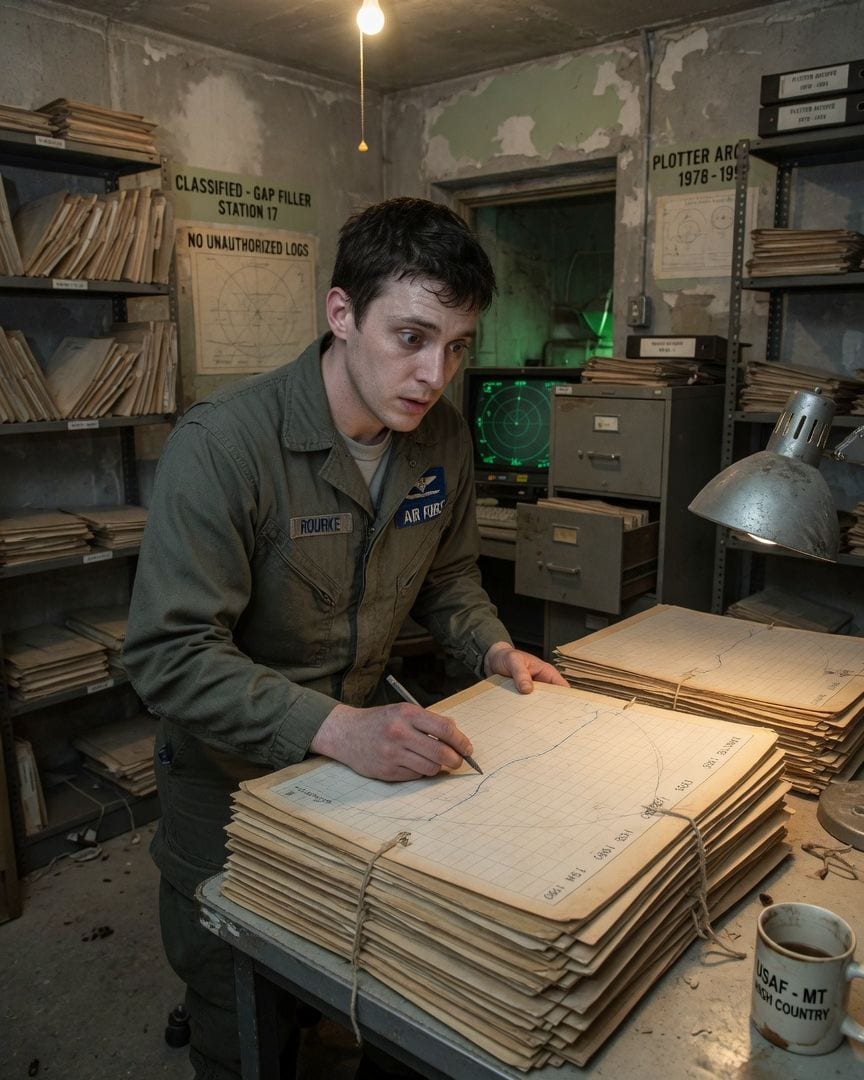
An Airman tracks a nightly radar contact. But in dusty archives, he finds old Cold War plotter boards, each showing that exact same line drawn by other airmen for three winters.
Airman Second Class Felix Rourke endured the cold, quiet nights at his isolated Cold War station, watching the perimeter radar. For three weeks, a single, slow contact appeared at 2300 hours, a precise violation of every protocol that chilled him deeply. He dismissed it as an anomaly, until a hunch led him to a forgotten closet in the dusty archives. There, he unearthed old plotter boards, each revealing the exact same impossible line drawn across the valley floor at the same hour, signed by different airmen from three consecutive winters decades ago. What impossible secret did the mountain station truly hold?
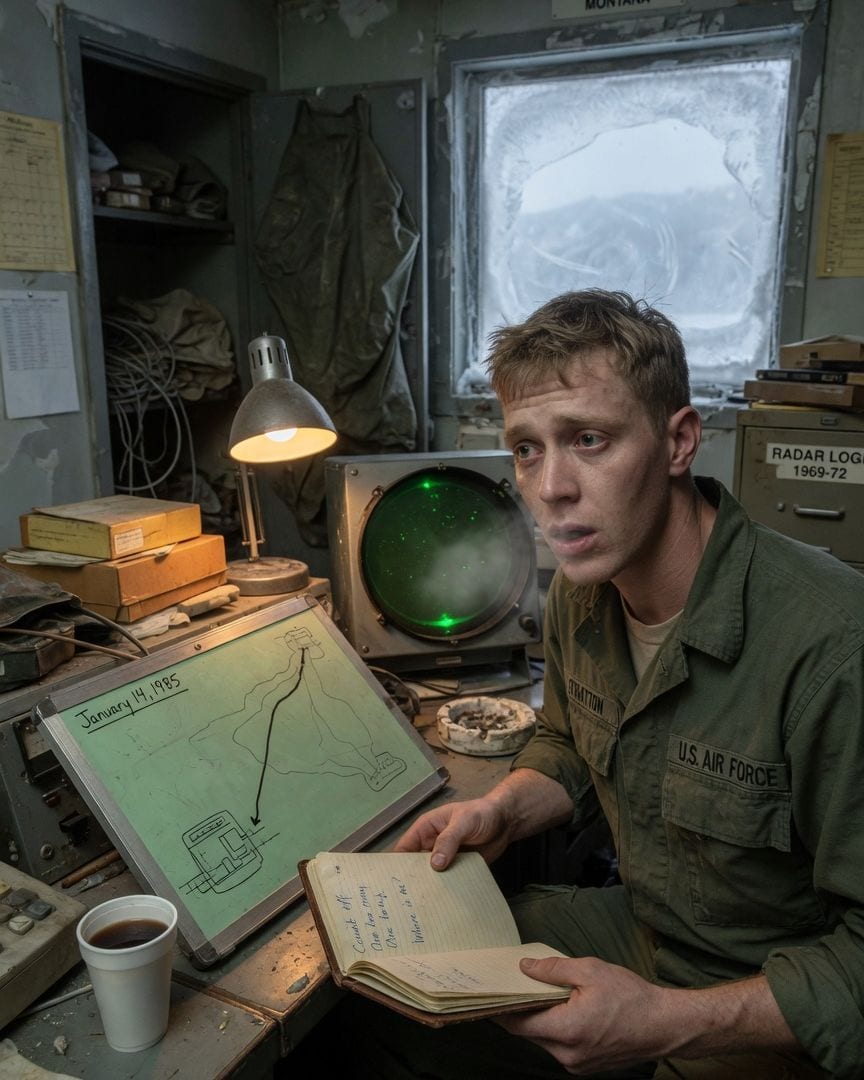
Airman Lars Stratton found an old Cold War manifest listing one name twice: 'Bernard Radcliffe' transferred and 'Bernard Radcliffe' still present.
Airman Second Class Lars Stratton was counting down his final weeks at Echo Station, a desolate Cold War outpost due for mothballing. He longed for home, far from the bitter Montana winds and the constant hum of static. Inside the dim radar shack, he logged the usual nightly ghost blip, a faint contact appearing at 2300, just as it had every winter since 1987. This night, a metallic tang like old blood lingered in the air, raising the hairs on his arms. Seeking distraction, Lars later discovered a leather-bound logbook from 1971, detailing the same 2300 contact, but with chilling notes and a manifest listing one airman's name, Bernard Radcliffe, twice—once transferred, once present. Was he truly alone in the silent, remote station?
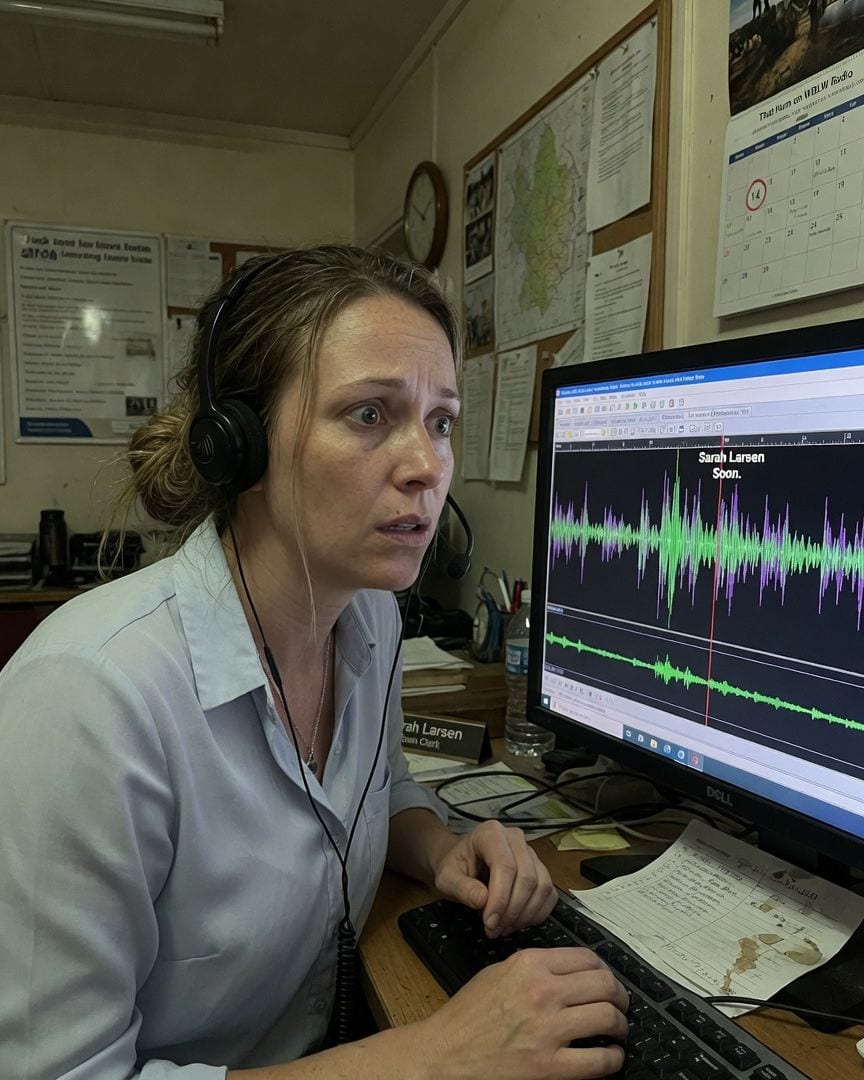
My town hall hearing loop recorded a quiet voice naming everyone present. After my name, it just said 'soon.'
As Town Clerk, reviewing the town hall meeting audio is standard procedure. But this time, beneath Councillor Sutton's droning, I heard a quiet voice systematically reading names. My breath caught when it reached my name, 'Sarah Larsen,' and then clearly whispered a single, stark word: 'Soon.'
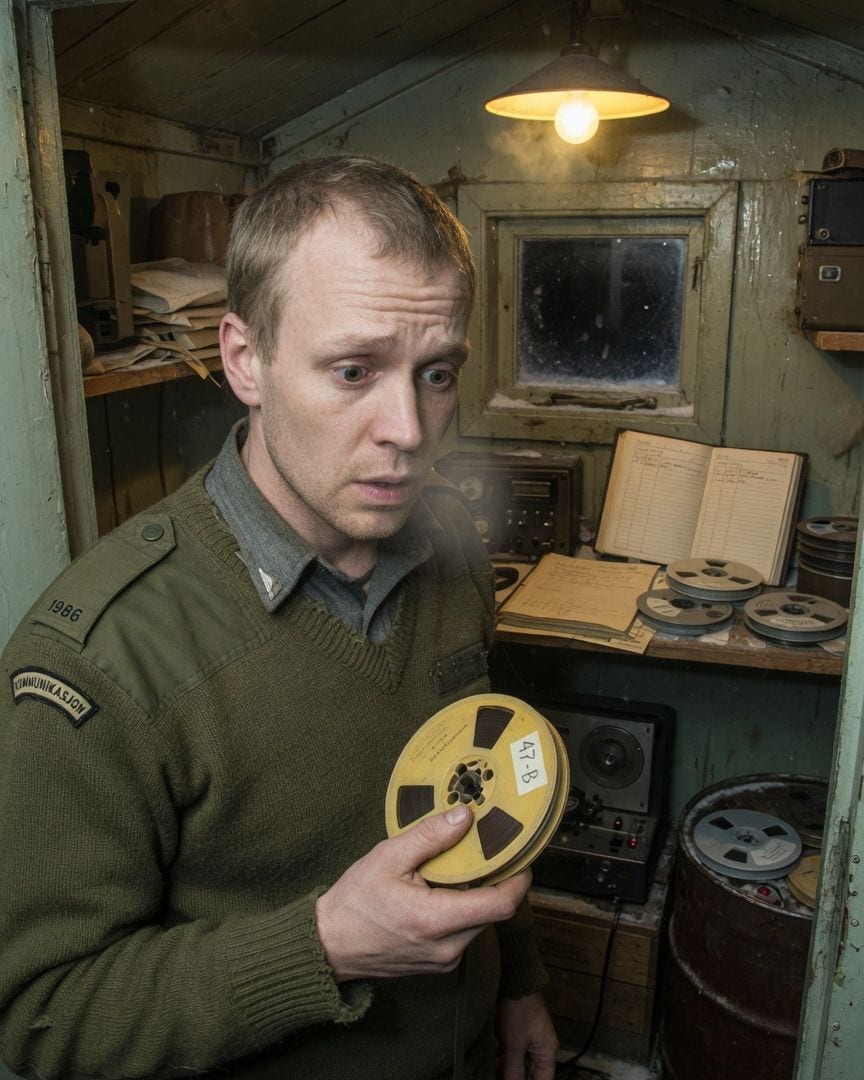
A Cold War specialist heard a tape describing tomorrow’s burn, then found the missing reel. It was warm and humming in his hand, on Thursday night.
Sergeant Pell Ostrander, a methodical communications specialist, shivered in the damp chill of a remote Norwegian fell hut in 1986. It was his last night before the facility was decommissioned, and the last resupply chopper had left him alone with crates for tomorrow's burn. Playing an old magnetic tape, Ostrander heard a station log for his very outpost. The calm voice on the recording began to read "Friday's entries," detailing a disposal count for the next day – yet it was only Thursday night. Moments later, he discovered a specific missing reel, unnaturally warm and thrumming with a faint vibration in his hand.