A declassification reviewer closed Cold War files on men lost in 1961. Then he saw their photo, dated 1983, smiling on the ice with a dark wake behind them.
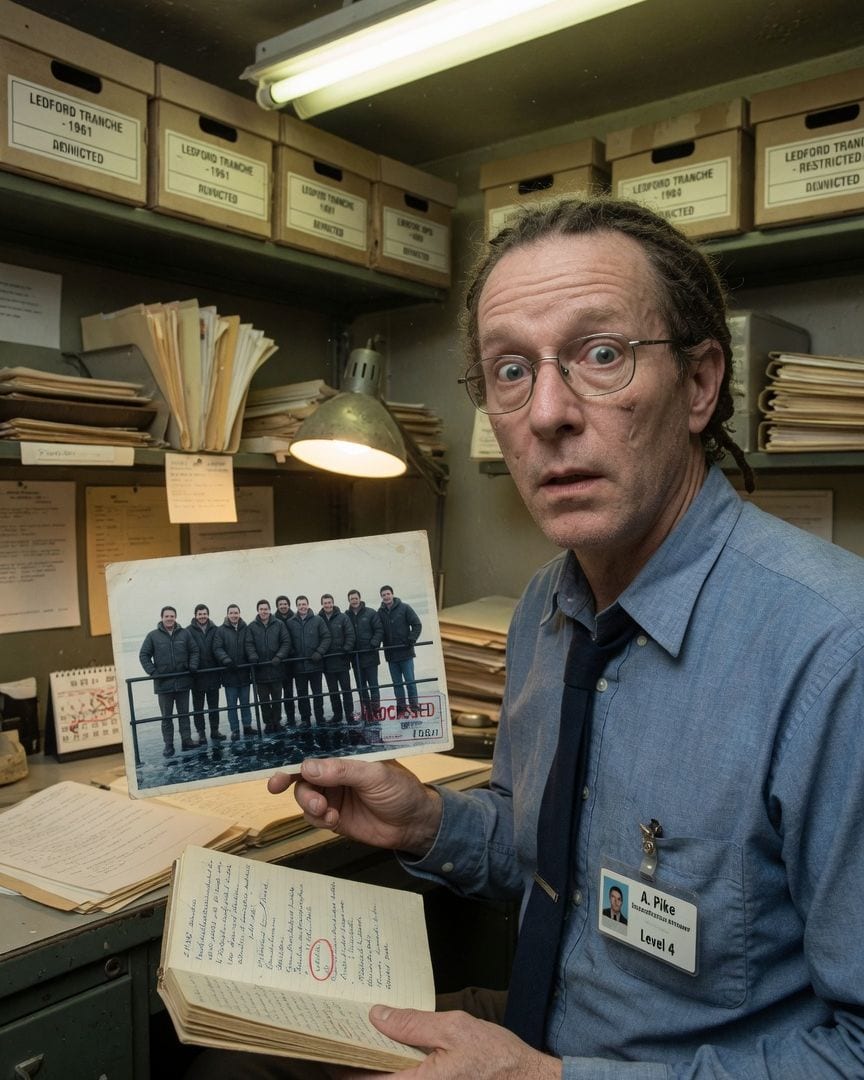
Anson Pike, a seasoned declassification reviewer, sat amidst the cold steel of the Cheyenne vault, a place he’d called his second home for two decades.
The air was dry, smelling of old paper and ozone, the rhythm of his life marked by the rustle of files and the soft click of his pen.
He’d signed off eleven thousand pages, each one a forgotten story or a closed case. Nothing ever truly surprised him. Until the Ledford tranche landed on his desk.
It detailed a detachment of eight men, officially declared lost under ice in 1961; no bodies, no beacon. A standard file, tragic but routine. Then, buried deep within, he found a photograph.
Eight men in thick parkas, gathered at a dark rail on a black, frozen lake. The file notation read 1961. Except the processing stamp in the corner, a faint, almost invisible detail, read 1983. Twenty-two years after they vanished.
The men were smiling, wide, unnerving grins into a camera nobody had ever accounted for. Behind them, stretching out across the featureless expanse of ice, a long, dark wake marred the surface, as if something immense had recently passed.
Anson felt a cold dread seep into his bones, colder than the vault itself. The smiles, the date, the impossible wake – a loop of wrongness he couldn’t unsee.
Anson's methodical nature kicked in, pushing back against the impossible. He checked the photo’s metadata, cross-referenced the processing lab. Every detail confirmed the 1983 stamp.
He searched for any mention of a follow-up expedition to the Ledford site in 1983, any recovery attempt. Nothing. The official record remained clear: lost, 1961.
He pulled every file related to the Ledford tranche, sifting through hundreds of pages of weather reports, transport manifests, and personnel records. He was looking for a clerical error, a misfiled document, anything that could explain away the twenty-two-year discrepancy.
The cold, recycled air of the vault seemed to press in on him, the fluorescent hum a dull throb behind his eyes.
He found a maintenance log for a remote weather station, Station Echo-7, located near the Ledford detachment’s last known position. It was dated 1961, detailing routine equipment checks.
But tucked between entries for anemometer calibration and generator repairs, a single, handwritten note stood out, dated October 1982: 'Installation of new optical recording device – prototype, designation 'Oracle.' Technician: C. Fairfax.' Anson’s breath hitched. 'Oracle' – a camera.
Installed twenty-one years after the Ledford detachment was declared lost, and just a year before the photo's processing stamp. And Charles Fairfax, the technician, was himself listed as 'lost at sea' in 1986, a separate, equally vague incident.
The mundane explanation crumbled, leaving a gaping void.
Anson held the old maintenance log, his fingers tracing the entry for the 'Oracle' device and the technician's name. Charles Fairfax. Lost at sea. 1986. He looked from the log to the 1983-stamped photo of the smiling men.
The unaccounted-for camera, the impossible date, the wake. It all converged. The camera was installed years after the men were lost, and its log was in the same tranche as their '1983' photo.
He flipped back to Charles Fairfax’s personnel file, which he’d quickly pulled. It was thin, almost blank, but a single transfer order caught his eye: 'Special Projects Detachment – Arctic Operations, effective 1981.'
Anson stared at the words, the cold dread turning to ice in his veins. The camera, the photo, Fairfax – all were threads in a pattern he had only just begun to see.
Anson spent the next several days meticulously cross-referencing 'Special Projects Detachment' entries. The name appeared sporadically in various declassified files, always linked to remote, isolated locations – arctic outposts, deep-sea research vessels, mountain observatories.
And always, personnel assigned to it eventually vanished, declared 'lost' or 'transferred out of theater' with minimal documentation. He created a timeline, meticulously charting each disappearance. Charles Fairfax’s was just one in a growing list.
He noticed a pattern: many of these 'lost' individuals had specialized skills – optics, sonar, geological survey – and their assignments often coincided with unusual seismic activity or unexplained atmospheric phenomena.
The official explanations in their files were always vague, contradictory, or incomplete. Anson found a single, faded note tucked into Fairfax’s file, not official, just a handwritten scribble: 'Muller – knows more about SPD.'
Harold Muller, a retired archivist Anson vaguely remembered from a departmental luncheon years ago. The name offered a tangible lead, a human connection in a labyrinth of paper.
Anson felt a growing certainty that he wasn't just uncovering a series of tragic accidents, but an orchestrated, ongoing process. The hum of the vault seemed to grow louder, the air thicker with unspoken secrets.
Anson's focused inquiries did not go unnoticed. Access to certain historical files, particularly those predating 1970, became inexplicably restricted. Log-in attempts were denied with terse 'access denied' messages.
He found his office door ajar more than once, though he was certain he'd locked it before leaving. One afternoon, his colleague, Rose Patterson, a junior reviewer, approached his desk, her voice hushed.
“Senior Archivist Doyle asked about your current focus, Anson,” she said, her voice low. “Specifically, the Ledford tranche. He seemed… interested.”
Richard Doyle, a man whose face was as unreadable as the vault walls, rarely showed interest in anything outside departmental budgets. Later that week, an anonymous email landed in Anson’s inbox. The subject line was blank.
The sender was an unfamiliar sequence of numbers. The body contained a single, grainy attachment: a partial, topographical map of the black lake from the photo, heavily pixelated, with a single word stamped across it in stark red letters: 'WATCH.'
A chill ran down Anson’s spine. Someone knew. Someone was watching his every move, tracking his descent into the files.
The danger was no longer abstract; it was personal, breathing down his neck in the quiet, sterile corridors of the vault. He felt the cold touch of unseen eyes.
Anson found Harold Muller at a quiet public library, hunched over microfiche readers in a corner bathed in the dim glow of the machines. Muller, older and frailer than Anson remembered, jumped when Anson spoke his name.
Anson sat opposite him, pulling the 1983 Ledford photo from his briefcase, then the 'Oracle' log, then Fairfax's transfer order.
Muller's eyes, wide with a fear Anson instantly recognized, darted around the quiet room, as if expecting someone to materialize from between the towering shelves. “Special Projects Detachment,” Anson pressed, his voice low, urgent. “What was it, Harold?
What did you know about the 'lost' men?” Muller stammered, denying everything at first, claiming misfiles, hoaxes, the ramblings of a tired old man. But Anson pushed, detailing the impossible dates, the pattern of disappearances, the 'Oracle' camera.
“It wasn't a hoax, was it?” Anson asked, placing the map with 'WATCH' stamped on it on the table between them. The red letters seemed to glow in the library's muted light. Muller finally broke.
He admitted the SPD was a cover. “They weren't lost, Anson,” Muller whispered, his voice raspy, barely audible over the whir of the microfiche. “They were… re-purposed. By something. Something patient, from the deep.”
He described the institution’s role not as investigators, but as record-keepers, managing the narratives, creating 'plausible' explanations. He spoke of an 'entity' that left the distinct 'wake' Anson saw in the photo – a signature of its presence.
“It’s a cycle,” Muller said, his gaze fixed on some distant horror Anson couldn’t see. “It takes, and we… we file.”
He spoke of a hidden logbook, a 'black book,' kept by a select few archivists, detailing the true nature of the 'transfers,' the real names, the real dates. “Doyle,” Muller rasped, his voice dropping to a conspiratorial whisper. “Richard Doyle.
He still manages it.” The pieces clicked into place with sickening clarity: the impossible photo, the 'lost' men, the camera, Fairfax, the restrictions on his access, the 'WATCH' email. It all fit.
The horror wasn't a glitch; it was a system.
Muller, trembling, led Anson to a forgotten corner of the library’s archives, behind a false panel in a shelf of outdated almanacs. The panel scraped open with a dry sigh of protesting wood, revealing a narrow, dust-choked cavity.
There, hidden from sight, was a thick, leather-bound volume. The 'black book.' Its pages were filled with neat, handwritten entries, detailing names, dates, locations, and cryptic 'status' notes: 'Transferred,' 'Integrated,' 'Oversight.'
Anson’s hands shook as he scanned the lists, seeing the pattern Muller described. Names of 'lost' pilots, divers, scientists, all linked to impossible dates and remote sites.
The sheer volume of it was horrifying, a meticulously kept record of an unimaginable truth. He flipped through the decades, the methodical records of an ongoing, silent process stretching back to the 1940s.
He was searching for any mention of the Ledford detachment, for Charles Fairfax. Then, his eyes snagged on a name, not in the list of 'transfers,' but in an adjacent column marked 'Associated Personnel.' A familiar surname. Pike.
Below it, 'Edmund. Status: Transferred. Ledford Detachment.' Anson froze, the breath catching in his throat. Edmund Pike. His great-uncle, officially declared lost in the Korean War in 1959, 'no body recovered.'
But here, in this secret ledger, he was explicitly linked to the Ledford Detachment, two years before its official 'loss.' Anson felt the world tilt, the quiet library suddenly roaring around him. His own family. Named in the file.
The black book wasn’t just a record of the past; it was a living document, and it had a claim on him.
The realization hit Anson with the force of a physical blow. His great-uncle, Edmund, wasn’t lost in Korea; he was an early 'transfer,' an initial 're-purposing' by the entity, later documented as part of the Ledford detachment’s eventual 'loss.'
The 'no body recovered' was a convenient lie, a carefully constructed narrative. The institution hadn’t just stumbled upon this; they had been tracking it, managing it, perhaps even facilitating it, for generations.
Anson found further entries in the black book, detailing a cyclical pattern of 'transfers' often linked to specific lunar cycles or geological events – the 'wake' a tell-tale energy signature visible in many old, grainy photographs.
He saw internal memos, redacted but legible, about 'integrating new personnel into archival oversight,' describing the selection process for those deemed 'suitable' to manage the records.
The criteria were vague, but Anson recognized the traits: meticulous, rational, isolated, with a specific family history of 'losses.' He had been chosen.
His career, his entire life, was not an accident but a carefully orchestrated path towards this very vault, this very book.
The horror wasn't that the truth was hidden, but that it was so meticulously documented, so perfectly coherent, and that he was now irrevocably part of it.
The dry, dusty air of the library archives seemed to cling to him, heavy with the weight of generations of secrets.
Anson, the black book clutched in his hand, returned to the Cheyenne vault. The fluorescent lights hummed with an almost accusatory brightness.
He found Richard Doyle, the senior archivist, in his meticulously organized office, sipping coffee from a ceramic mug, a faint smile playing on his lips. Doyle looked up, his expression unperturbed. “Found something interesting, Anson?”
he asked, his voice calm, unbothered, as if discussing the weather. Anson laid the black book on Doyle’s desk, open to the page with Edmund Pike’s name.
Doyle glanced at it, a flicker of something unreadable in his eyes, then back at Anson. “An old family matter, I presume? We knew you’d find it eventually.” Doyle didn’t threaten.
He simply explained, in a measured tone, that some things were too vast, too ancient, to fight. The institution, he said, merely acted as a steward, ensuring the 'transfers' happened with minimal disruption to the wider world.
He implied that Anson’s own family history, his 'aptitude' for detail, his very presence in the vault, had made him 'suitable' for working with these particular files. “Oversight protocol, Anson. Phase IV. You’re already integrated.”
Anson felt a profound chill, colder than any he had ever experienced in the vault. He was not escaping. He was never meant to. He was not a victim, but a recruit.
The horror was not what they would do to him, but what they expected him to do. He understood that exposing this would mean implicating himself, his family, and shattering the fragile sanity of the world.
He was now part of the mechanism, the calm, steady hand that filed the impossible. He closed the black book, its weight now his own.
Anson Pike continued his work in the Cheyenne vault. His reviews became even more meticulous, his focus sharper, his gaze unwavering. He no longer questioned the impossible dates, the smiling faces, or the faint, dark wakes.
He simply filed them, with a steady, official hand, ensuring every detail was perfectly coherent, perfectly documented. His colleagues noted a new quietness about him, a deeper absorption in his work.
The air in the vault itself seemed to settle, to hold its breath around him. Richard Doyle would often pass his desk, offering a silent nod, a faint, knowing smile. Anson would simply nod back, his face unreadable.
The black book, now residing in a locked drawer in his office, remained a silent testament to his new role.
One frigid morning, Rose Patterson found Anson at his desk, staring intently at a recently declassified file. It was a new tranche, from a remote arctic outpost, dated just last month.
The air in the vault felt colder than usual, charged with an unspoken tension, almost a palpable hum. “Anything interesting, Anson?” she asked, trying to break the heavy silence.
He didn’t look up, his gaze fixed on a blurry image within the file: eight men in parkas, standing on black ice, their faces indistinct. Behind them, a faint, dark ripple stretched across the frozen expanse. A familiar signature.
“Just another signature,” Anson Pike said, his voice flat, devoid of emotion. Then, with a barely perceptible movement, his hand reached for his pen.
If this one got to you
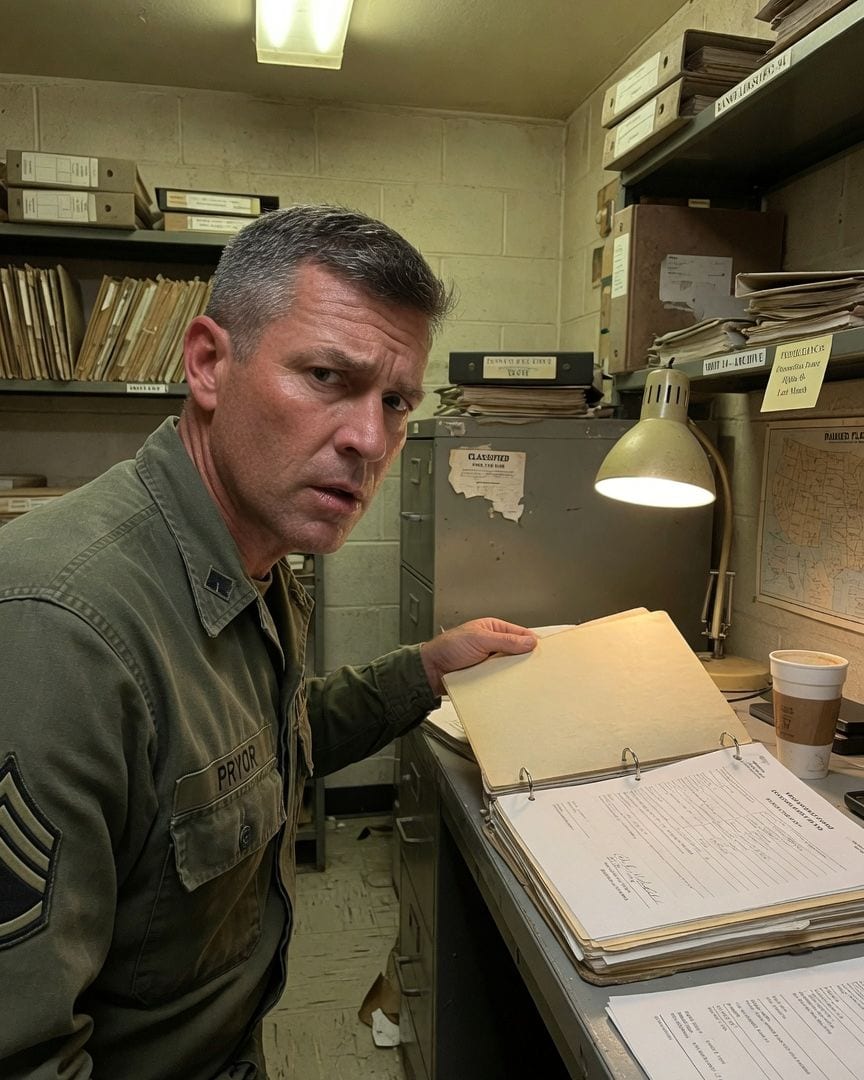
A sergeant with eleven days left finds a warm, glassed crater. Its file shows a captain lost thirty years ago is still signing reports from last week.
Sergeant Alden Pryor was counting down his final eleven days on a twenty-year hitch, expecting to spend them on routine patrols along the Ranier Flats fence line. Instead, his truck stopped at a bizarre sight: a four-hundred-foot glassed crater, miles from anywhere, its sand faintly warm at dawn despite no one recalling a blast. The air above it shimmered with an unnatural distortion, a silent scar of erased violence, and the official file for 'Shot 14' showed recent maintenance sign-offs for a decommissioned tower at the crater site. All these active documents were signed by Captain Everett Caldwell, who had been officially lost in operations thirty years ago, leaving Sergeant Pryor to wonder how a dead man could still be filing reports.
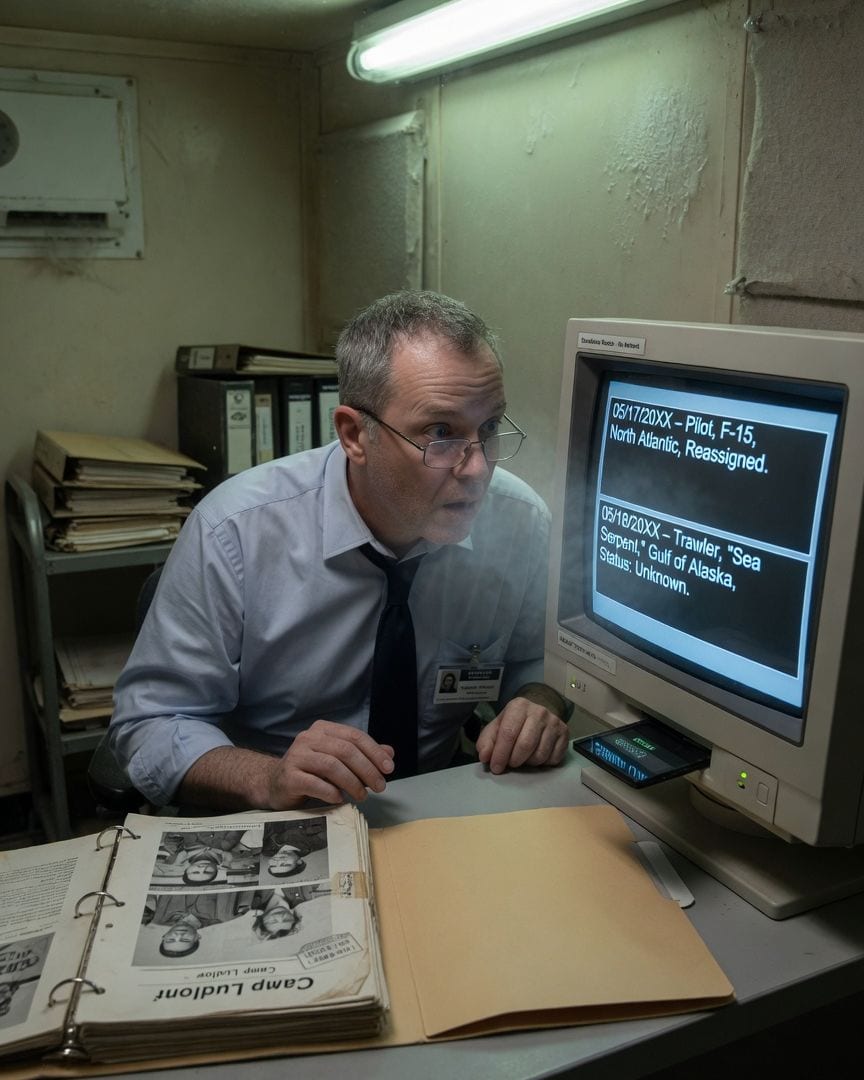
A declassification reviewer opened a Cold War 1959 file. A modern data chip inside showed a pilot missing yesterday.
Declassification reviewer Samuel Vance, whose world was built on the rigid order of official history, smoothed a letter confirming Camp Ludlow’s 1959 closure was a lie. Despite decades of records, the Air Force insisted the Greenland base remained active, its last radio check logged just four days prior. Driven by this profound wrongness, Samuel unearthed the base's ancient physical file, only to find a pristine, modern data chip hidden within its brittle pages. When he inserted it into a secure reader, the screen didn't show history, but a scrolling list of current missing persons—a pilot from yesterday, a trawler from today. How could an archived file hold a living record of the world’s most recent disappearances?
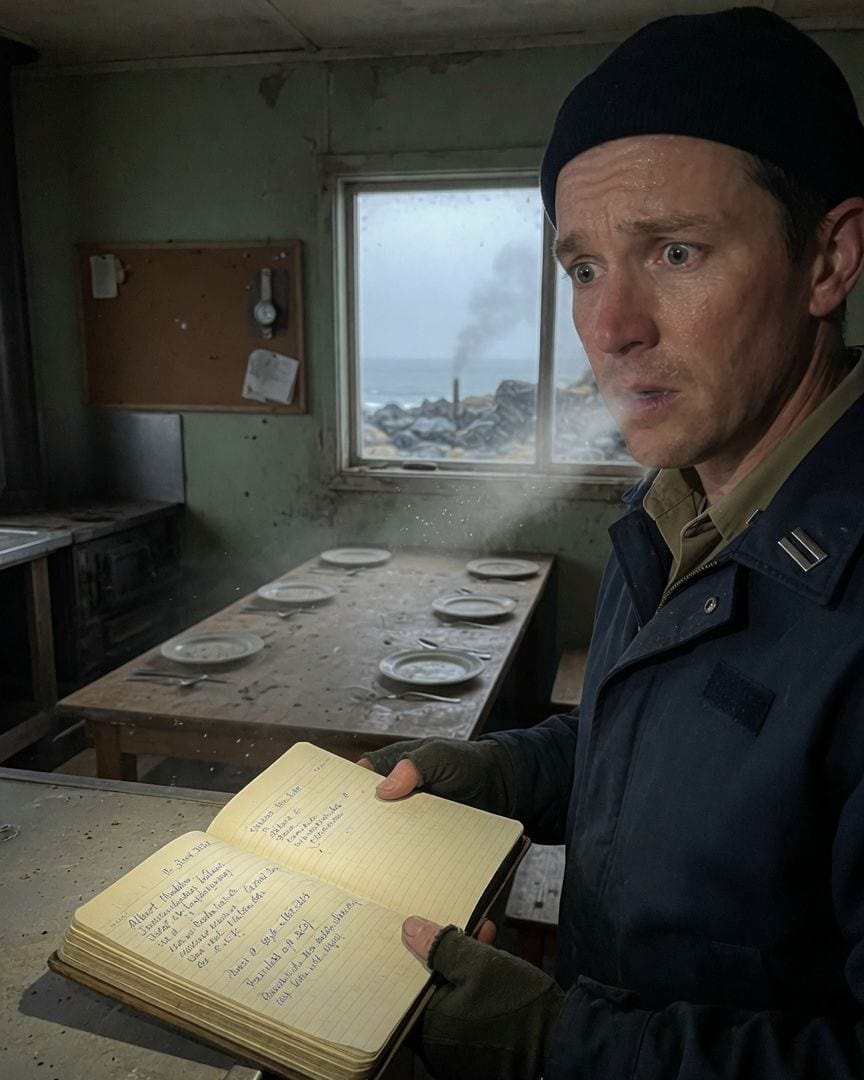
Coast Guard Lieutenant Thatcher finds an old crew photo dated today, June 15, 2024.
Lieutenant Daniel Thatcher leads a survey crew to a derelict LORAN station in the frigid Aleutians, officially abandoned for over a decade. But as they enter, a heavy-bound station log lies open on a counter, its ink startlingly wet, detailing a routine watch from today with names unknown to the Coast Guard.
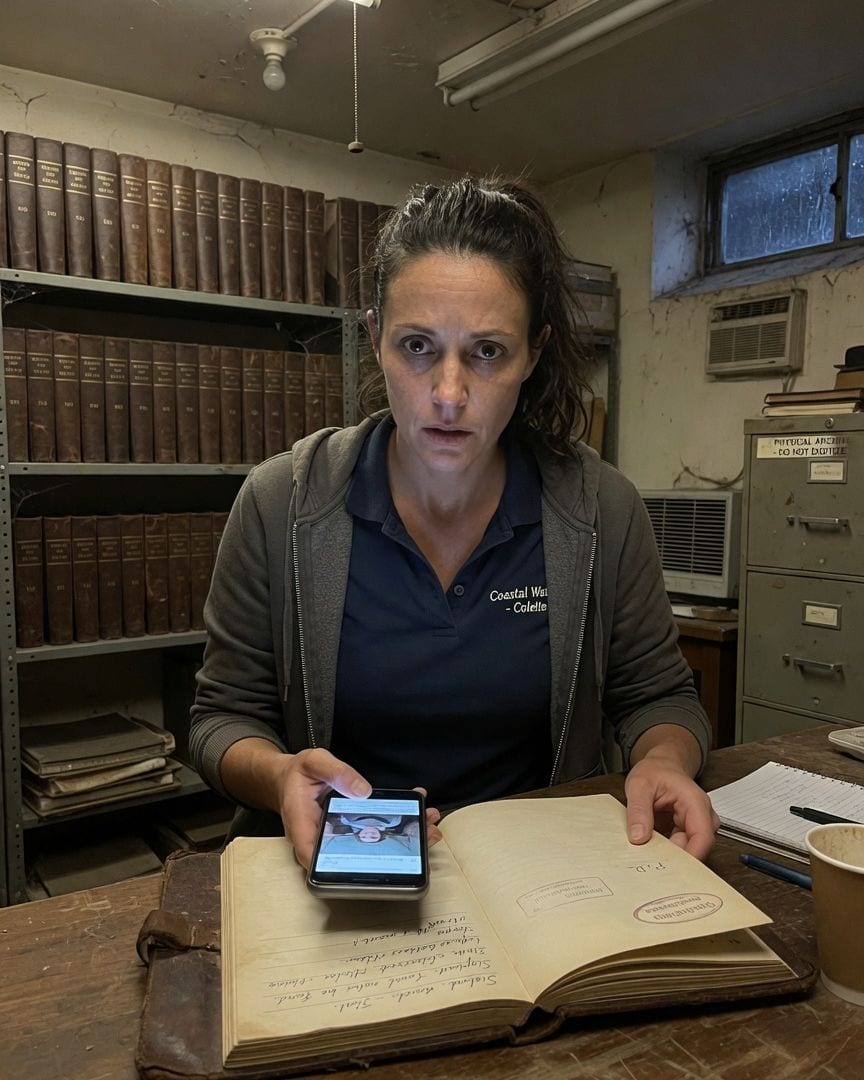
My coastguard log noted Sighting 9 again tonight, a light where no vessel showed. The old logs carry Sighting 9 off Skerry Point at 3:14am every tenth year since 1954, always 'nothing found,' always 'send no boat.'
On my watchtower night shift, the radar screen glowed green and the ocean was quiet. Then, a familiar light appeared off Skerry Point, exactly on cue, just as it had every tenth year for decades. But digging deeper, I found a hidden stamp in an old logbook: 'Operation Skerry. Status: Complete.' It left me with a chilling sense of finality.
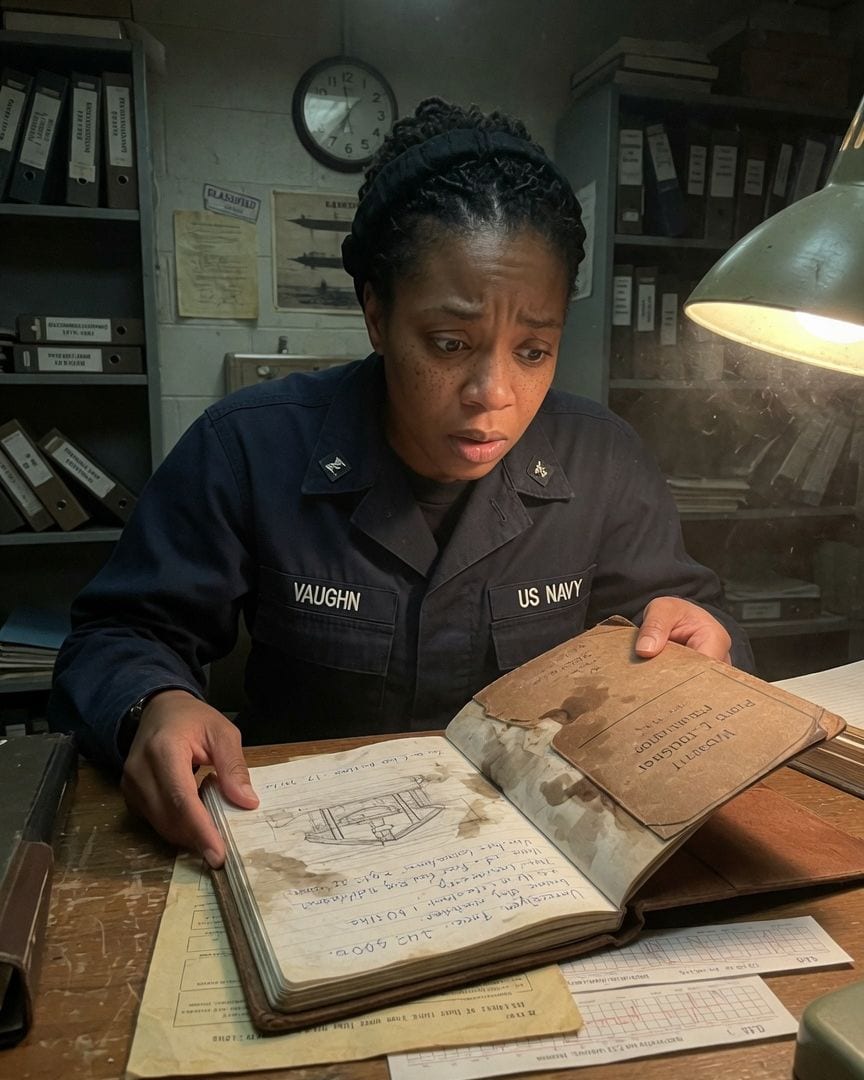
A Petty Officer's sensor logged a man-sized heat bloom at 0405. The camera saw nothing, and a journal from 1978 logged that same trace, then a Cold War Petty Officer gone MIA.
Petty Officer Rose Vaughn knew the meticulous order of Naval Submarine Base Bangor's pier by heart, especially her midnight watch routine. Every night at 0405, her IR sensor logged a man-sized heat bloom moving along the concrete path, vanishing at the pier's edge, but the watch camera showed only empty mist. This phantom warmth had walked the identical path for five years, yet the supposed steam line beneath it had been cold and dry for over a year. Her unofficial investigation led her to a faded 1978 journal, where a vanished Petty Officer, F. Pennington, logged an 'unresolved trace' at the exact same coordinates and 0405 hour, just before he went MIA. The system swore it was there, but the world swore it wasn’t – what was walking the pier, decades after it was lost?
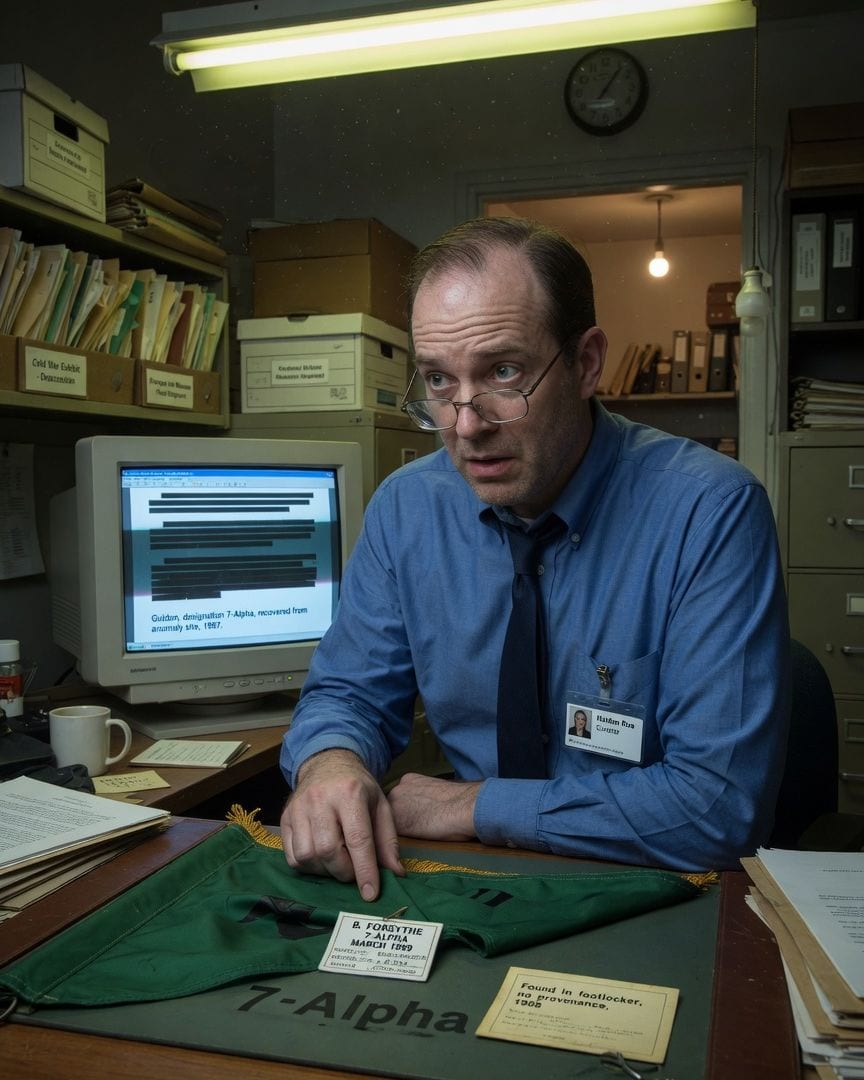
A curator found a guidon dated 1989. The museum took it in 1988, but the Cold War airman on its tag vanished in 1954.
Halden Roe, a meticulous curator, worked against a pressing deadline as the Presque Isle Museum's Cold War exhibit closed for good. In the dusty storage unit, under a single bare bulb, he discovered a small laundry tag sewn into an antique green silk guidon. Its crisp black stitching clearly read 'MARCH 1989' — a date a full year *after* the museum’s intake record for the artifact. As Halden's unease grew, he found the service number on the tag belonged to Benjamin Forsythe, an airman who vanished off Greenland in 1954. How could a museum piece found in 1988 bear a future date and belong to a ghost from decades past?