A declassification reviewer scans a Cold War photo, and the hitchhiker's blurred eyes in the image shift, looking straight out at him.
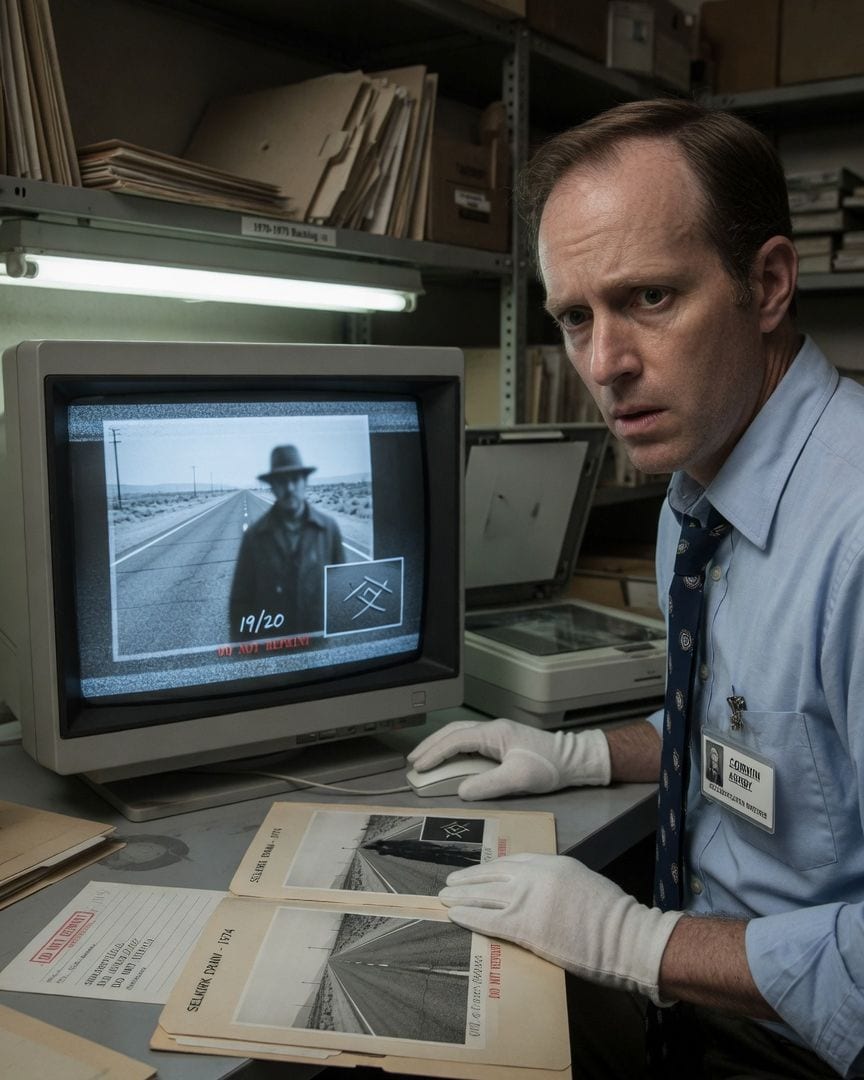
Corwin Ashby, a declassification reviewer whose life was built on meticulous order, slid the Selkirk Draw file from its dusty slot. The folder, from a 1974 backlog, felt oddly cool, almost damp against his fingertips.
Inside were nineteen photographs, each a stark, black-and-white image of a desolate stretch of two-lane road in Nevada. The first showed a lone hitchhiker as a distant speck at the far edge of the frame.
In each subsequent photo, taken minutes apart, the figure had moved closer, steadily, relentlessly, until in the nineteenth exposure, his rough coat filled the bottom third of the lens, his face a blurred enigma just inches from the camera.
The index sheet listed a twentieth exposure, but the slot was empty. Beside the empty slot, stamped in stark red, were the words: DO NOT REPRINT.
The chill from the file seemed to deepen, settling in the bones of the old building, a cold that had nothing to do with the thermostat.
Corwin, a man who trusted the logic of paperwork, tried to rationalize the missing photo. A lost negative, perhaps, or a simple clerical error. He ran a gloved finger over the index sheet again, searching for any additional notation.
Below the 'DO NOT REPRINT' stamp for the twentieth exposure, he noticed a faint, handwritten addition in faded ink: 'SUBJECT ACQUIRED.' That stopped him. Acquired? It wasn't standard terminology for a missing photograph.
Files were 'archived,' 'destroyed,' or 'redacted,' but never 'acquired.' Below that, in the same unsettling hand, was another, almost illegible scrawl: 'DO NOT VIEW.' He pulled up the agency's internal jargon database, cross-referencing 'SUBJECT ACQUIRED.' Nothing.
The terms were not official. They registered no hits in any declassification protocol. He dismissed it as an archaic, overzealous security measure, perhaps from a long-retired, eccentric clerk.
Still, the phrase 'DO NOT VIEW' gnawed at him, a tiny burr under his skin. He decided to try and digitally enhance the nineteenth photograph, hoping to glean more detail from the hitchhiker's face before he 'disappeared' from the record.
Perhaps the photographer had simply driven away before the last shot, and the file was incomplete, an abrupt end to a mundane roadside encounter.
He fed the photo into the high-resolution scanner, the machine humming to life, a low, expectant thrum against the quiet of the archive room.
As the scanner whirred, Corwin watched the image resolve on his monitor. He zoomed in on the hitchhiker's face, expecting a clearer view of a human countenance, perhaps a recognizable feature that might explain the 'acquisition.'
Instead, the screen flickered, a brief, digital distortion washing over the image like a wave of static.
When it stabilized, the hitchhiker's features were still indistinct, a blur of shadow and light, but in the desolate background, etched faintly into the asphalt of the Nevada road behind where the man stood, was a small, stylized symbol—an institutional logo, perhaps, but one Corwin had never seen in any government archive.
The symbol seemed to pulse with a faint, internal light, like a residual charge.
And then, for a split second, the hitchhiker's blurred eyes in the photograph seemed to shift, just slightly, and they were looking directly out of the frame, straight at Corwin.
Corwin spent the next two days trying to identify the symbol. His usual databases yielded nothing. The symbol was not in any official agency lexicon, active or historical.
He broadened his search, delving into obscure, unindexed internal memos from the 1950s and 60s, cross-referencing keywords like 'containment protocols' and 'informational integrity.'
The deeper he dug, the more the archives seemed to push back, as if the building itself held its breath.
He found scattered, redacted references to 'Selkirk-type events' across different geographical regions—a remote stretch of highway in Arizona, a rural logging road in Oregon, a forgotten access track in the Nebraska Sandhills.
Each file, whenever he could locate it, bore uncanny similarities: a sequence of photographic exposures, a gradually approaching anomaly, a final missing image, and the chilling annotation 'SUBJECT ACQUIRED.'
The 'DO NOT REPRINT' and 'DO NOT VIEW' warnings were present in some, absent in others, but the core pattern was unmistakable.
This wasn't a series of isolated incidents or clerical errors; it was a recurring phenomenon, meticulously documented and then, just as meticulously, erased from the public record.
He found one memo, heavily redacted, that referred to 'entities of informational volatility,' a phrase that felt like a punch to his meticulous, rational gut. The dread deepened, a cold, specific unease replacing his initial professional curiosity.
The sheer volume of these 'unhappened' events, spanning decades, suggested an entire hidden history, a vast, unseen machinery grinding beneath the visible world.
As Corwin delved deeper, the archives seemed to subtly resist him.
Files he needed were suddenly 'in use' by other departments, 'under review' for unrelated audits, or simply 'misfiled' in distant, inaccessible annexes, as if the shelves themselves conspired against his search.
His usual digital access privileges experienced inexplicable glitches, prompting him to submit repeated help desk tickets that went unanswered, swallowed by the bureaucracy. The air in his office, usually crisp and dry, began to feel heavy, as if watched.
He felt a creeping sense of being observed, a prickle on the back of his neck that no amount of rational explanation could dispel. One morning, an anonymous email landed in his inbox. The subject line read: 'Review Complete.'
The attachment was a single, grainy, black-and-white photograph. It was a long-distance shot of him, taken from across the street, walking into the archives building yesterday afternoon.
The angle was high, as if from a surveillance camera, but the agency's external cameras were not black-and-white, and their footage was never shared with individual reviewers, much less delivered to a personal email address.
His heart hammered against his ribs, a frantic bird trapped in a cage. Someone knew exactly what he was doing, and they were watching him.
The ease with which this image had reached him, bypassing all security protocols, was more unnerving than the picture itself. He was no longer just an auditor; he was a target.
Corwin confronted Leonard Pennington, his supervisor, in his office. Pennington, a man whose calm demeanor bordered on unnerving, listened patiently to Corwin's agitated account, his fingers steepled under his chin.
The office, usually a sanctuary of muted tones, felt suddenly too bright, too quiet. 'Selkirk Draw, you say? And others like it?' Pennington's voice was soft, unhurried, as if discussing the weather.
Corwin pushed the printout of the symbol across the desk, the paper trembling slightly as it slid. 'And this. What is this?' Pennington picked up the paper, his gaze lingering on the symbol, a faint, unreadable expression on his face.
'Ah, yes. An old mark. Not for public consumption.' He leaned back, a faint, almost imperceptible smile touching his lips. It was a smile that didn't hold warmth, but a vast, cold knowing.
'Corwin, some records are not meant to be declassified because their 'content,' as you put it, is volatile. The hitchhiker, the object on the logging road, the figure in the Arizona desert… they weren't just physical anomalies.
They were entities, existing both in the physical world and as pure information. And information, once recorded, can be… porous.' He paused, letting the implication hang, heavy and suffocating in the air between them.
'The 'DO NOT REPRINT' and 'DO NOT VIEW' directives were not about protecting the public from the image, Corwin. They were about protecting the image from the entity. To view, to reproduce… it’s to invite.
To allow it to… unfile itself.' Corwin stared, his rational mind struggling to process the impossible, the coherent dread of it all. 'You mean… the symbol… it’s theirs?' Pennington merely nodded, his gaze distant, as if looking through Corwin.
'Or perhaps, ours. A very old agency. Older than the official records suggest. We've been filing these things for a long, long time. Maintaining informational integrity. It's a delicate balance. And sometimes, the balance shifts.'
The room itself seemed to expand, the walls receding, filled with invisible history.
Pennington stood and walked to a locked, reinforced cabinet in the corner of his office, its heavy metal door a contrast to the quiet surroundings.
He retrieved a small, leather-bound box, its surface brittle with age, the leather cracked like ancient parchment. 'The review process, Corwin, is far more complex than you’ve been led to believe. It’s not just about auditing the past.
It’s about… continuity.' He opened the box, revealing a single, exceptionally old, brittle file, its paper yellowed and fragile, smelling faintly of dust and something metallic, like old blood. 'This isn't from the 1970s backlog. This is… much older.'
He placed it on Corwin’s desk, the aged file seeming to hum with a low, almost inaudible frequency against the polished wood. The cover bore no classification stamps, only a handwritten title: 'Operation Chronos – Acquisition Report.'
Corwin’s hands trembled slightly as he opened the file, the thin, fragile paper whispering as he turned the first page. The page was a meticulously handwritten report, dated 1947, detailing an 'acquisition' event strikingly similar to the Selkirk Draw incident.
He scanned the names of the field agents, the witnesses, looking for anything familiar, anything that could ground this new horror.
And then, his eyes landed on a specific line, written in the same elegant, archaic hand as the 'DO NOT VIEW' note: 'PRIMARY WITNESS/REVIEWER: Ashby, Corwin.'
Corwin stared at the name, then back at Pennington, his face pale, blood draining from his features. 'This… this isn't possible. This is my name.'
Pennington sighed, a sound of ancient weariness, as if he had spoken these words countless times before, across countless generations. 'It is, and it isn't. 'Corwin Ashby' is a designation, a role. A specific lineage, yes, but also a function.
Certain individuals, across generations, are drawn to these files. They become the auditors, the keepers of the 'informational integrity.' But also… the last line.' He explained that the entities, once 'filed,' remained dormant within the records.
They were information, and information, once it found a crack, could spread. But they could 'reach out' through the information, seeking a path to unfile themselves.
The hitchhiker's gaze in the photo, the symbol, the access restrictions, the anonymous photo of Corwin – they were all the entity's attempts to 'unfile' itself through him.
'The 'DO NOT VIEW' warning,' Pennington continued, his voice calm, steady, 'was never for you, Corwin. It was for the entity. A command to remain within the file.
But once violated, once the connection is made…' He paused, and a profound coldness settled into Corwin's chest, a weight that felt heavier than anything physical. 'The 'reviewers' become temporary hosts. A new container. It’s how we reset the clock.
The entity is transferred, re-filed into a new, secure archival mind, until the next 'Corwin Ashby' comes along to audit the backlog.' The hitchhiker, Pennington concluded, was trying to escape, and Corwin's review had been its opportunity.
The blood drained from Corwin’s face, leaving him feeling hollowed out, as if the air had been sucked from his lungs. 'A host? You mean… I’m a container?'
Pennington nodded, his expression devoid of malice, only a profound, detached acceptance, as one might observe a natural, inevitable process. 'The process is already underway, Corwin. You’ve viewed too much. Absorbed too much.
The original photographer of the Selkirk Draw file, Charles Lambert, was the previous reviewer for that particular entity. He felt the initial pull, just as you did when its eyes met yours in that photograph. That was the first touch.'
Corwin pushed himself away from the desk, knocking over his chair with a jarring clang that echoed in the silent office. 'No. I won't. I won't let it.'
He lunged for the door, a desperate, animal instinct for self-preservation flooding him, a primal scream caught in his throat.
But as he moved, a growing weight settled within his mind, a profound coldness, a patient, ancient awareness that was utterly alien, yet disturbingly familiar.
It was not a physical pain, but a psychic invasion, a vast, silent presence unfolding itself within his skull, like a corrupted file opening itself to take over a system.
He stumbled, his vision blurring, the edges of the room wavering. The stylized symbol he had seen in the photograph flickered in his peripheral vision, then seemed to bloom, overlaying his sight, a watermark on reality.
He heard Pennington's voice, calm and distant, as if from a great depth, 'It's not about letting it, Corwin. It's about accepting your designation. The filing is complete.' The room itself seemed to hold him still, the walls pressing in.
Corwin Ashby was still at his desk, processing files. The chair he had overturned was neatly righted, as if it had never fallen. He worked diligently, methodically, his movements precise, almost unnervingly so.
The frantic energy, the desperate fear, had simply… vanished. The Selkirk Draw file was back in its place, marked 'CLOSED - REVIEW COMPLETE' in a crisp, new stamp, the ink still smelling faintly of chemicals.
He no longer felt the faint chill from it, or from any other file. His workflow was impeccably efficient, his output far exceeding his previous rates, every document categorized, every cross-reference exact.
The small, almost imperceptible smile that occasionally touched his lips was new, a faint line of quiet satisfaction that hadn't been there before. The quiet hum of the archive no longer felt oppressive, but companionable.
Corwin's colleague, Janet Coleman, paused by his desk, clutching a stack of freshly sorted documents. The air around Corwin felt oddly still, a vacuum in the usual office bustle. 'Everything alright, Corwin? You've been quiet.
And you haven't taken a break all day.' Corwin looked up, his movements fluid, his gaze direct, unblinking.
A faint, almost imperceptible smile touched his lips, a cold, patient expression that didn't quite reach his eyes, which held a depth Janet had never noticed before. 'Just...
filing,' he said, his voice flat, devoid of its usual warmth, yet perfectly clear. 'Always filing.' He returned his attention to the screen, his fingers moving with an almost unnatural swiftness, already ahead of the system's processing speed.
The records continued to be signed, year after year, by a steady, official hand. A hand that never seemed to age.
If this one got to you
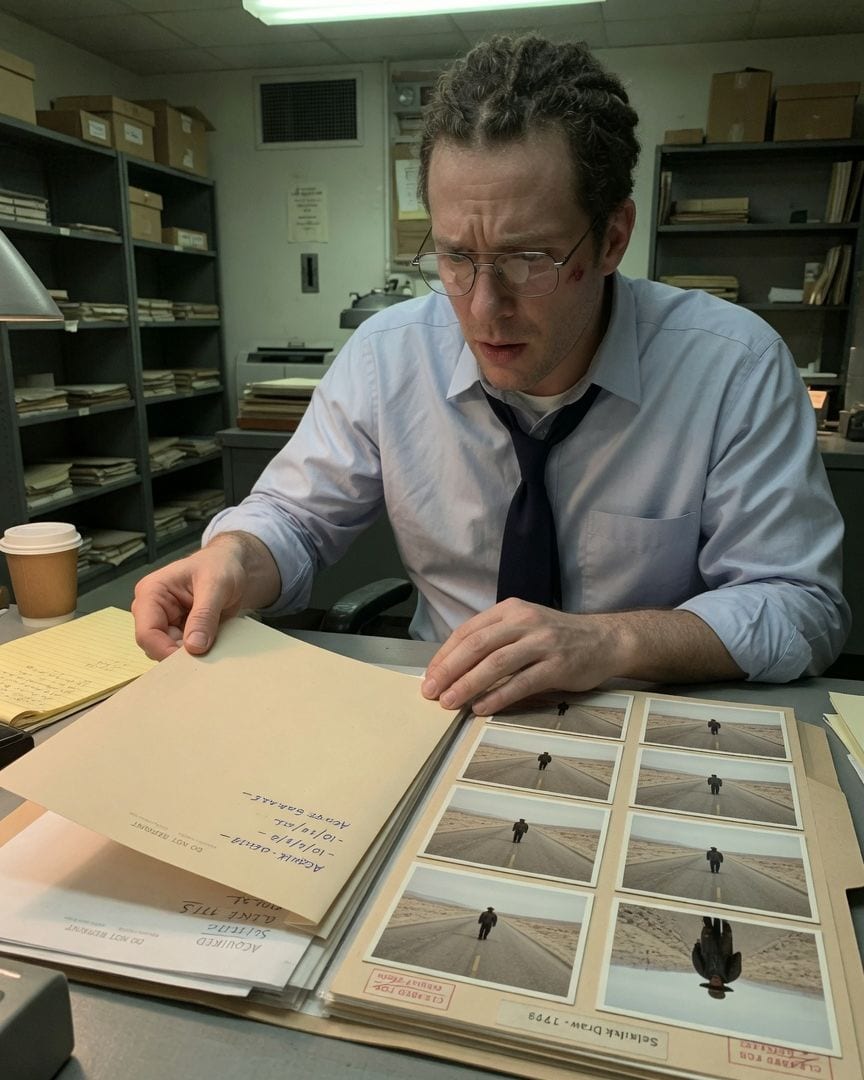
A Cold War declassification reviewer watched a hitchhiker cover miles in minutes across 1970s photos. The missing final shot's index sheet had 'ACQUIRED' written on its reverse.
Corwin Ashby, a declassification reviewer, expected mundane desert landscapes from a stack of 1970s photographs. Instead, he found nineteen identical shots of a desolate road, each showing a lone hitchhiker progressively closer, covering impossible miles in mere minutes. His methodical nature rebelled when he discovered the twentieth exposure was missing, marked 'DO NOT REPRINT'. But it was the hidden, unofficial annotation 'ACQUIRED' on the reverse of the index sheet that brought a cold dread, implying the hitchhiker wasn't just an image, but a physical thing taken. What could have been 'acquired' from a photograph?
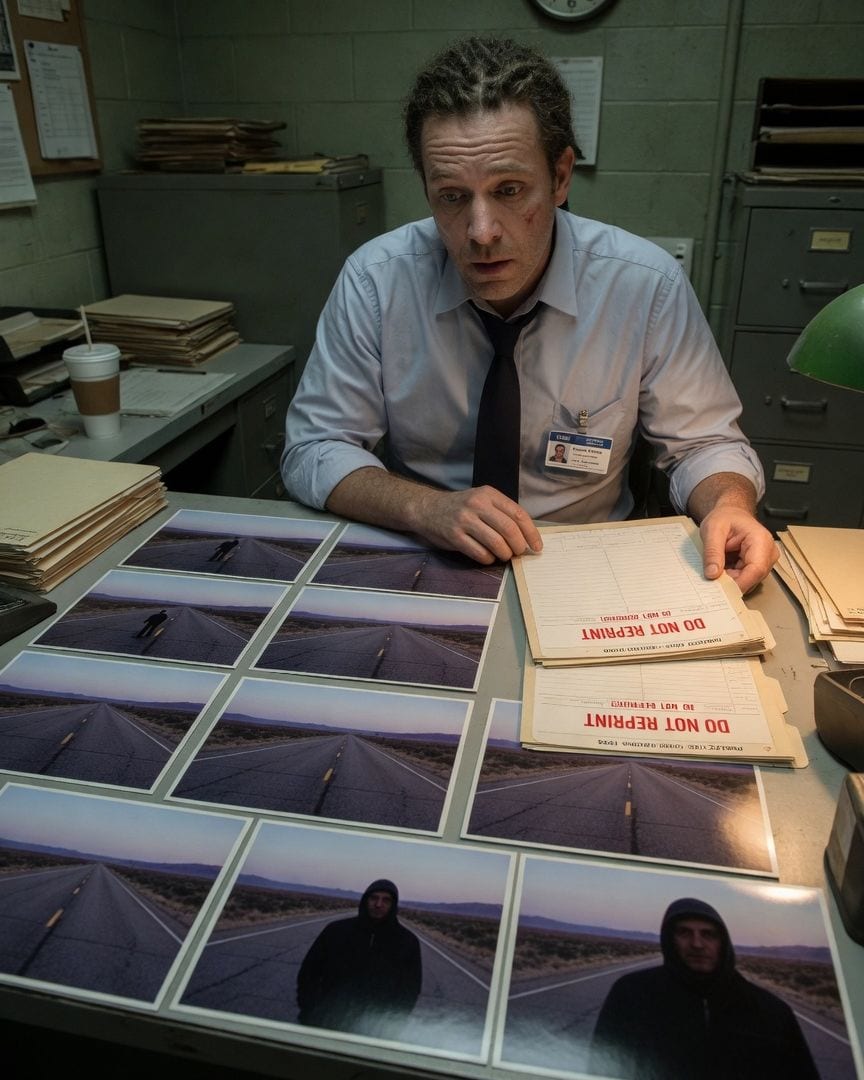
A records reviewer, trusting order, found a Cold War file: a hitchhiker appeared closer in nineteen photos, but the last was gone, stamped 'DO NOT REPRINT'.
Reviewer Corwin Ashby, whose professional life was built on faith in official records, pulled a Cold War-era file from the backlog, expecting routine images. Instead, he found nineteen glossy prints of an empty Nevada highway, each showing a lone hitchhiker advancing impossibly fast towards the lens. The twentieth photo was missing, replaced by a stark 'DO NOT REPRINT' stamp. Corwin's search for an explanation led him to a second, identical file from 1958, revealing the same impossible sequence and another vanished photographer. What secret did these missing photos hide?
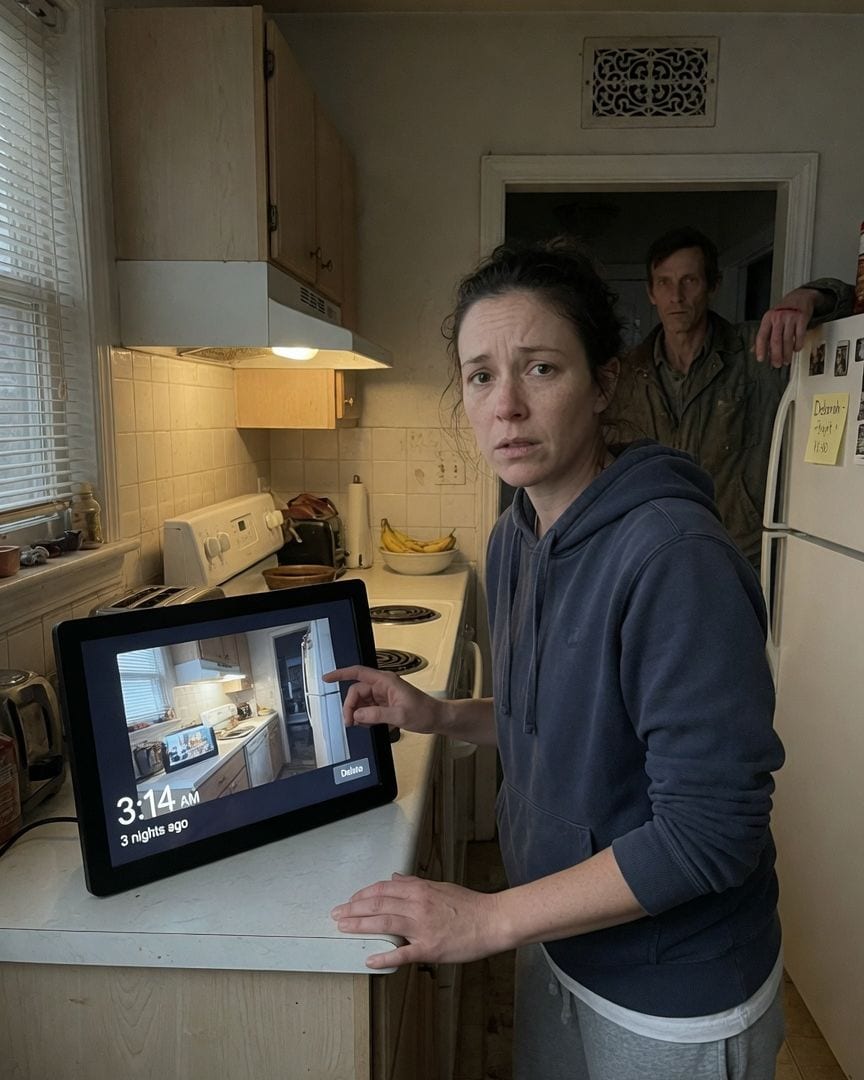
My mother-in-law's photo frame saved a picture none of us took: our kitchen at night, and a tall man we don't know in the doorway, facing the camera it doesn't have.
My mother-in-law's digital photo frame sat innocently on the kitchen counter, meant to display happy family memories. But it had frozen on a picture none of us had taken: our kitchen, late at night, with a tall, unfamiliar man standing in the doorway. The photo, timestamped 3:14 AM three nights ago, was impossible to delete.
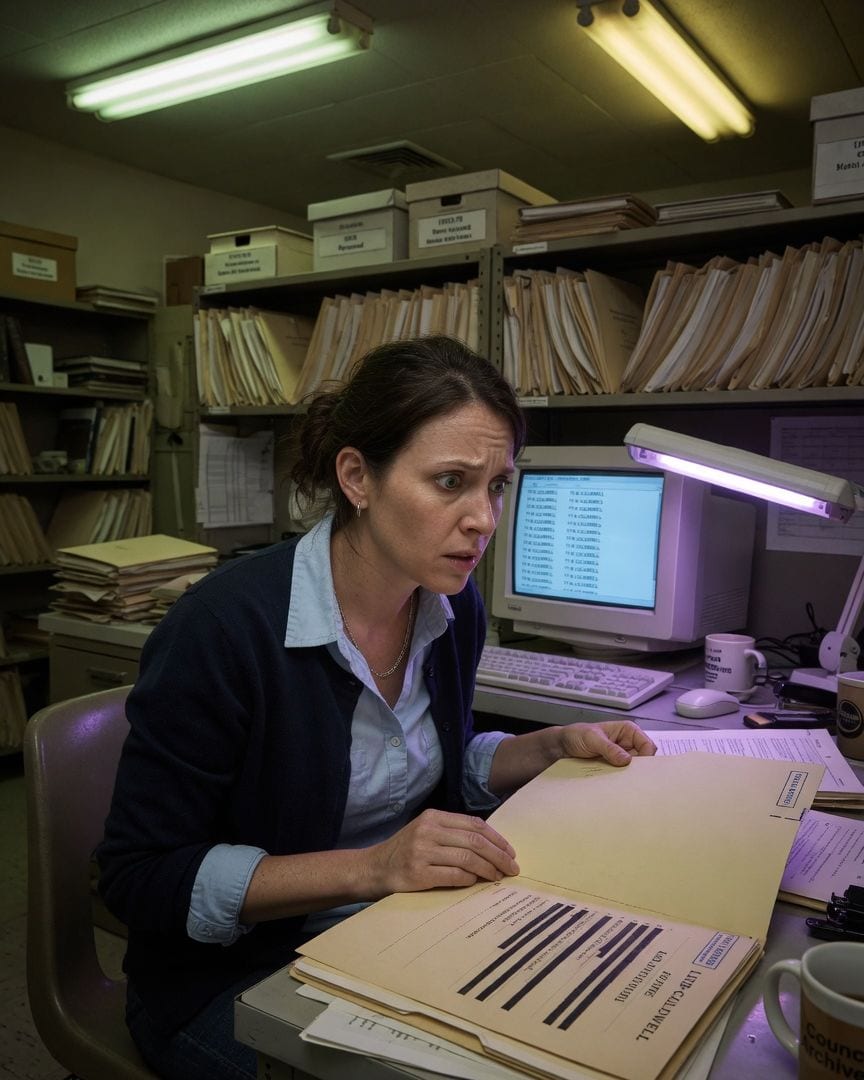
My employer's security file holds a vetting report on me dated nine years before I ever applied. It has my full name and my parents' address — with only one line, the source who referred me, blacked out.
Working a routine data audit, I pull my own security file. The issue date is nine years before I even applied for the job. Then, hidden within an old archive file, I find my current address etched under a blacked-out line.
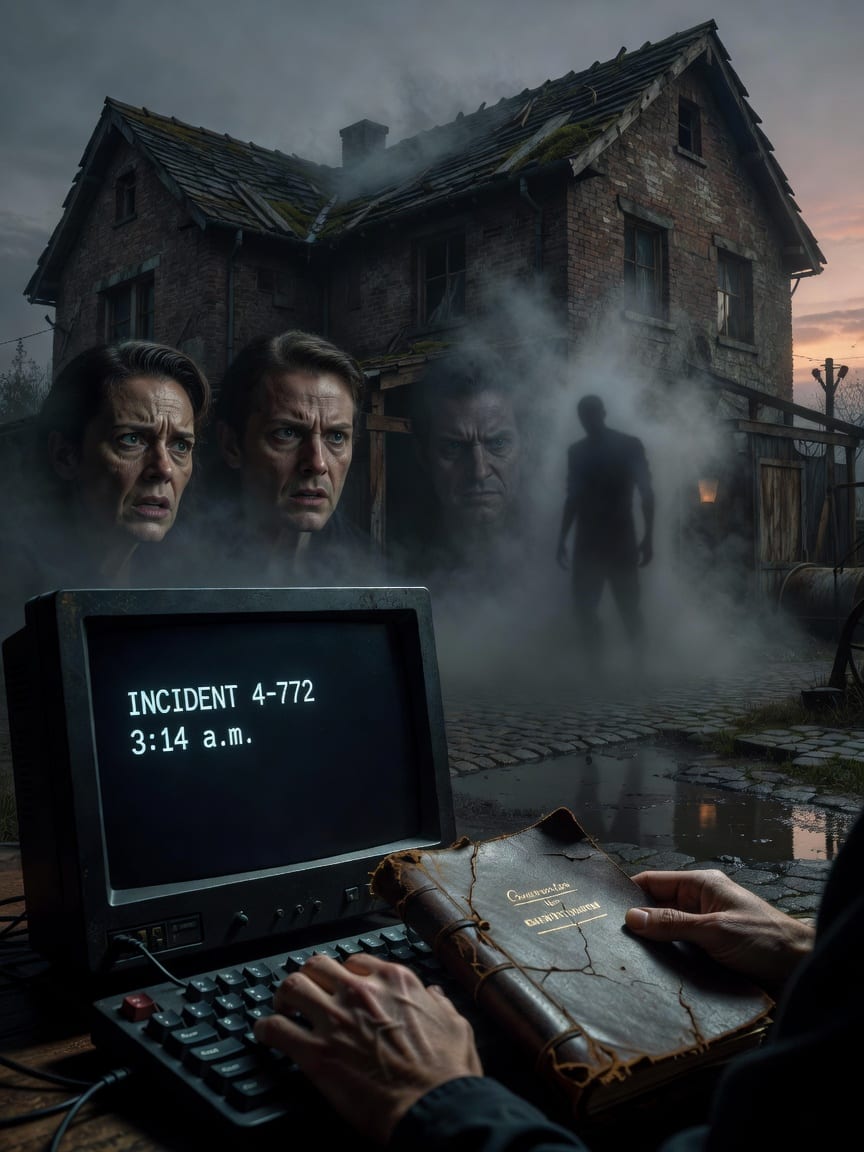
My screen showed Incident 4-772: a fire at the old rope works, 3:14 a.m. It was logged again for 1980. Then 1967. And 1993. Same incident, same time, same building. Each report ended with the same three words: 'expect recurrence.'
As a new archivist, I usually found my work digitizing old fire service records monotonous, until I found a heavily redacted line in a 1961 site assessment. Faint letters beneath the black bar slowly revealed my own family name, DRUMMOND, dated years before I was even born.
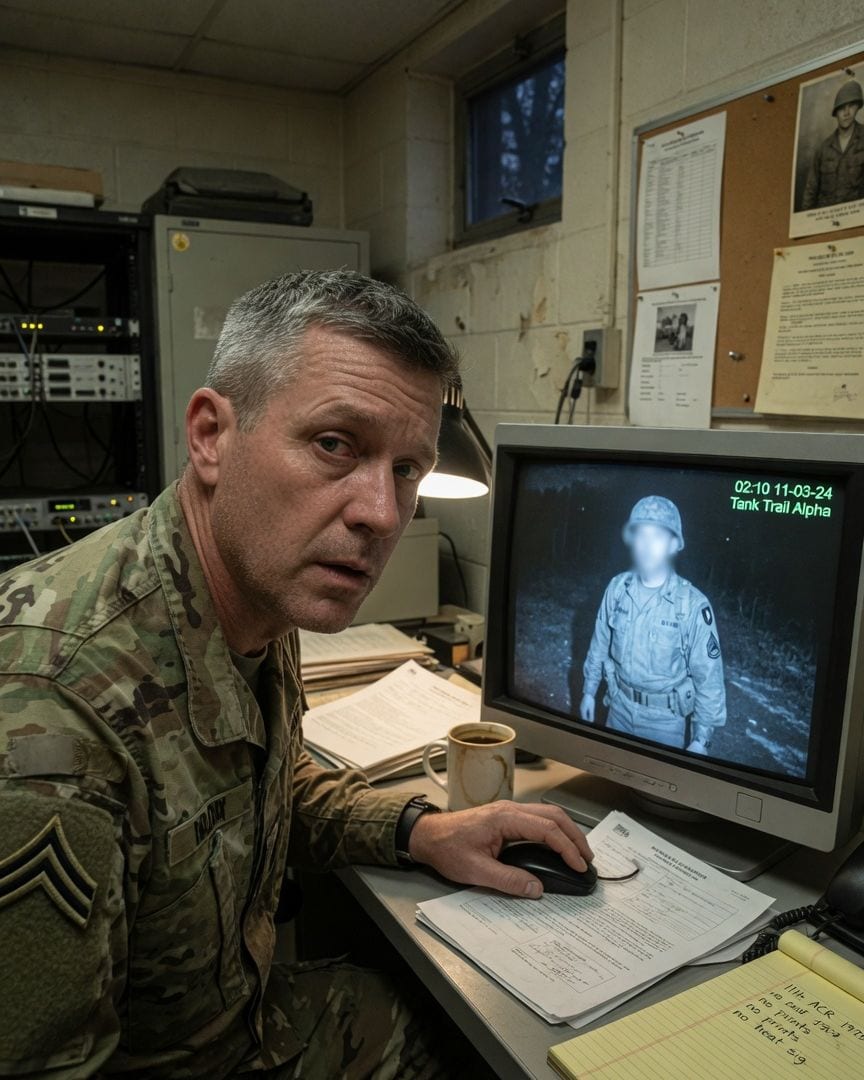
An MP sergeant reviews patrol footage: a Cold War soldier in a 1970s uniform appears but leaves no prints on soft ground.
Sergeant Richard Halloran was on duty at the MP station, reviewing routine dashcam footage from a patrol along Tank Trail Alpha. In the pre-dawn gloom, a figure in a US Army uniform flickered into view on the roadside, then vanished instantly when the patrol vehicle stopped. Halloran later walked the trail himself, finding no boot prints on the soft, damp ground where the soldier had stood. Further investigation by the base archive specialist revealed no heat signature or motion alert from the figure. The uniform itself was from the 1970s, specific to the base's past, and the figure on the footage seemed to be watching the passing vehicle. What was this unexplained presence?