A records reviewer, trusting order, found a Cold War file: a hitchhiker appeared closer in nineteen photos, but the last was gone, stamped 'DO NOT REPRINT'.
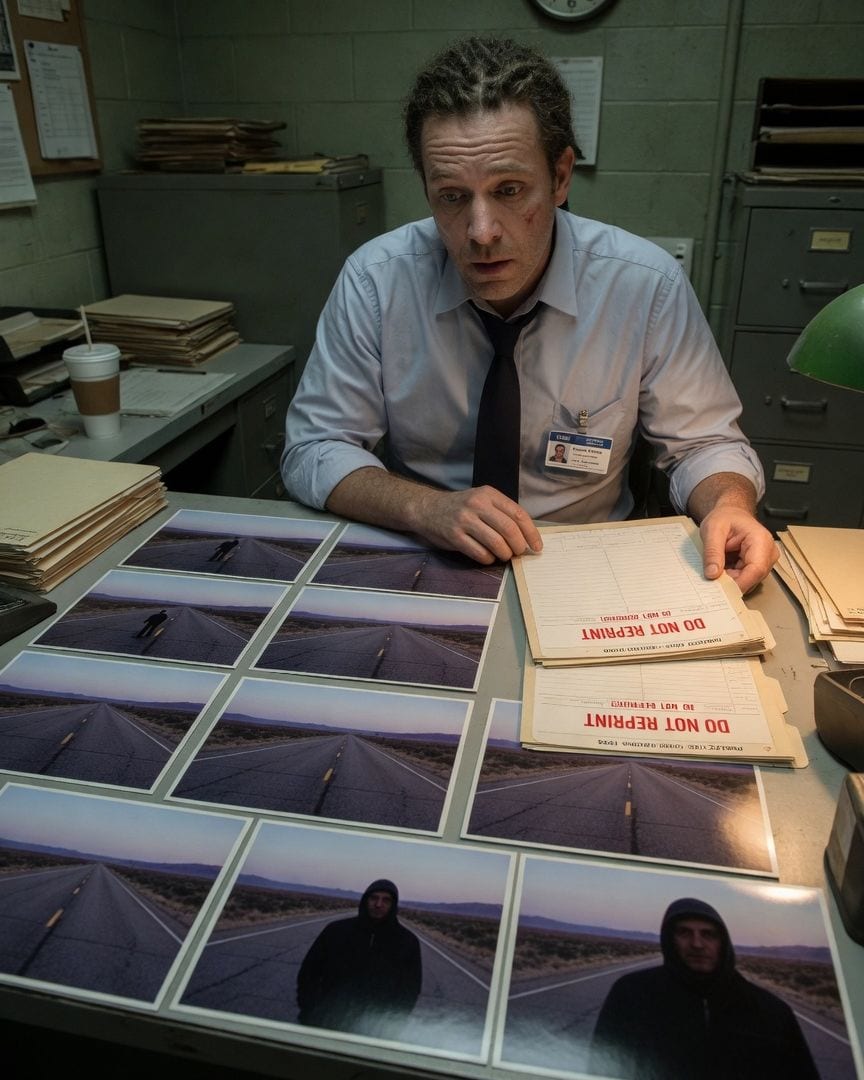
Reviewer Corwin Ashby, a man of precise habits and an unwavering faith in the order of official records, pulled the Selkirk Draw file from the 1970s downgrade backlog.
The release board had already cleared its photographic contents for public viewing, a routine step. He expected mundane landscape shots, perhaps some outdated infrastructure blueprints.
Instead, he found nineteen glossy prints, all showing the same empty stretch of two-lane Nevada highway, taken from an identical vantage point, minutes apart.
In the first photo, a lone hitchhiker stood at the far edge of the frame, a dark, indistinct figure. Corwin’s brow furrowed. With each subsequent exposure, the figure had advanced, impossibly fast, along the deserted road.
By the nineteenth, the hitchhiker was directly under the lens, their heavy coat filling the bottom third of the frame, details still obscured by shadow. Corwin checked the index sheet, tracing the entries with a finger.
It listed a twentieth exposure, but the photo itself was gone. In its place, stamped in stark red ink, across the empty slot, was a single, chilling directive: DO NOT REPRINT.
Corwin’s first impulse was to find a mundane explanation. A camera malfunction, perhaps, creating a rapid series of accidental zooms?
But the image quality remained consistent across all nineteen shots, the perspective fixed, as if the camera itself had never moved. A mis-filed sequence of photos from different dates, compiled by error?
Yet the index sheet clearly indicated a continuous sequence, explicitly marked 'Exp. 1 through 19, Selkirk Draw Incident, 11/14/1973.' The meticulous numbering left no room for clerical oversight. He checked the photographer's name: Oscar Reynolds.
A quick cross-reference in the personnel database showed Reynolds as a junior field agent at the time, assigned to a remote survey team.
His record ended abruptly just three days after the Selkirk Draw incident, marked 'Transferred, Top Secret Project, Location Undisclosed.'
Corwin had seen such designations before, for special ops or deep cover, but usually, there was at least a new unit code or a contact number, a forwarding address for classified communications.
Reynolds’s file was a dead end, a blank space where a career should have continued. The absence felt heavier than any presence.
The 'DO NOT REPRINT' note, initially just an odd administrative instruction designed to prevent a duplicate from being created, now felt like a warning, a seal on a secret Corwin had inadvertently touched.
The lack of explanation gnawed at Corwin. He returned to the 'DO NOT REPRINT' stamp, tapping the red letters on the laminated index sheet. He ran a search through the agency’s central records for other files containing the exact phrase.
The system, designed to obscure, resisted, throwing up error messages and irrelevant hits. But Corwin knew the old, forgotten pathways, the back-end queries that bypassed the newer, more restrictive interfaces.
Deep in a highly restricted sub-archive, tucked under an obsolete 'Project Chimera' classification, he found a hit. A file from 1958, detailing an incident in the Arizona desert. He pulled it, his heart hammering with a sudden, cold premonition.
Inside, he found nineteen glossy prints of another empty stretch of two-lane road, a solitary figure appearing closer in each. The twentieth exposure was missing.
And stamped across the index sheet, in the exact same red ink, was the identical instruction: DO NOT REPRINT.
The photographer for that file, a Private First Class Simon Hayes, had also vanished from all records days later, his final entry a precise match to Reynolds’s.
Corwin stared at the two index sheets side-by-side: the Selkirk Draw file from the 1970s and the Arizona desert file from 1958.
Both listed nineteen exposures, both had the twentieth removed, both bore the exact same, chilling instruction, 'DO NOT REPRINT.' The pattern was too perfect to be coincidence.
Corwin’s methodical mind, once so committed to order, now saw a chilling design in the archives. The mundane had crumbled, revealing an impossible consistency.
He spent the next week leveraging his clearance, bypassing official channels to dig deeper into the hidden corners of the system.
He searched for personnel records marked 'Transferred, Top Secret Project, Location Undisclosed' that coincided with photographic anomalies or unusual 'environmental survey' reports from isolated regions.
He found five more cases, stretching back to the late 1940s, all sharing the same eerie core: a series of photographs from a remote location, always an isolated road or a desolate stretch of land, a solitary, approaching figure, nineteen exposures, a missing twentieth, and a 'DO NOT REPRINT' directive.
Each time, the primary observer, usually a photographer or a lone field agent, vanished from official records within days, their career ending in a bureaucratic void, their files echoing Oscar Reynolds’s and Simon Hayes’s.
The figures were never clearly identifiable, always obscured by distance or shadow, but their relentless approach was consistent, an inexorable march toward the camera lens. Corwin realized this wasn't a series of unrelated incidents or clerical errors.
It was a recurring phenomenon, actively managed and scrubbed from public knowledge by the very institution he worked for. The files weren't just historical records; they were a catalog of disappearances, a silent tally of the 'unhappened'.
Corwin’s deep dives into restricted classifications did not go unnoticed. One afternoon, a secure, untraceable internal message appeared on his terminal, bypassing the usual network protocols.
The sender ID was an obsolete code for a terminal decommissioned decades ago, one that shouldn't even be active. The message was brief, stark: 'Some records are meant to stay buried. For your own good, stop digging.'
A cold dread settled over him, palpable as a sudden drop in air pressure. Someone knew. Someone was watching. He checked his office door, the hallway. Empty. The fluorescent lights hummed with their usual indifferent buzz.
He reviewed the archival section’s sparse security footage from the past few days, specifically his desk area. Nothing. Just him, hunched over his terminal, a steady, unblinking presence, framed by rows of inactive servers.
Yet, the feeling persisted—a subtle weight in the air, a sense of being observed, as if the very walls of his office had developed eyes. He knew the building was old, its systems layered over decades, but this felt different.
It was less like a security alert and more like a whisper from the very depths of the archive itself, a breath against the back of his neck.
He felt the cold touch of a hand on his shoulder, though no one was there, and the air around him thinned, drawing tight. He was no longer just a reviewer; he was a target.
The anonymous warning cemented Corwin’s resolve. He sought out Margaret Carter, a senior archivist whose tenure predated Corwin’s by decades, a quiet woman with an almost preternatural recall for the labyrinthine system’s deepest secrets.
He found her in her usual alcove, surrounded by dusty microfiche reels and towering stacks of faded files.
Corwin laid out his evidence: the Selkirk Draw file, the Arizona desert file, the other five cases he’d uncovered, all with the identical pattern of the approaching figure, the nineteen exposures, the missing twentieth photo, the 'DO NOT REPRINT' stamp, and the vanished photographer.
Margaret listened, her expression unreadable, her hands still sorting faded documents, her movements precise and unhurried. She initially tried to dismiss it as 'administrative inconsistencies,' 'the vagaries of historical record-keeping,' her voice dry as parchment.
Corwin pushed back, detailing the precise, mathematical consistency of the pattern, the identical phrasing of the warnings across decades, across classifications, across geographical locations.
He showed her the personnel files, each one a duplicate void: Oscar Reynolds, Simon Hayes, and the others, all 'transferred without record.' Finally, Margaret sighed, a sound like dry leaves rustling in an empty room.
'They are not inconsistencies, Mr. Ashby,' she said, her voice calm, devoid of emotion, a flat declaration. 'They are... managed events.' She explained that the 'figures' were a recurring phenomenon, drawn to direct observation, especially photographic recording.
The agency's role, she stated, was not to stop them, not to understand them, but to contain the knowledge of their existence.
The files were a system to track their appearances, to identify 'subjects,' and to ensure the information never reached the public.
The 'DO NOT REPRINT' was a directive to prevent further interaction, to avoid drawing more attention to the phenomenon, to ensure the 'collection' was discreet.
'They take, Mr. Ashby,' she concluded, her gaze distant, fixed on a point beyond the dusty shelves. 'They don't leave a trace beyond the record we keep. And sometimes, the record keeps itself.'
Margaret’s calm explanation was more chilling than any monster Corwin could have imagined. He felt a cold dread solidify in his gut. The coherence of it all, the way every planted clue now clicked into place, was the true horror.
Just as he thought he understood, as the chilling logic of the system settled in his mind, Margaret leaned forward, her voice dropping to a near whisper. 'But the system, Mr. Ashby, is not merely a record of past events.'
Her eyes, ancient and weary, met his, holding his gaze. 'It is active. The file is still being written.' As she spoke, Corwin’s secure terminal, which he had deliberately disconnected from the network moments before, suddenly blinked.
The screen, previously dark, flared to life with a soft, pulsing light. A blank file template appeared. It was stamped with a classification he’d never seen, beyond any clearance he possessed, a deep crimson seal glowing faintly.
A single, new entry appeared on the screen, slowly typing itself out, letter by agonizing letter: 'Ashby, Corwin. Reviewer. Location: [his current office building, floor, and room number]. Status: Engaged.'
The text solidified, glowing faintly as if etched in cold fire. Below it, a blank photo index sheet materialized, pristine and waiting.
It was titled 'Exposure Log,' and the first numbered space on the sheet, stark and empty, was for '20.'
Margaret watched the screen, her face etched with a profound, resigned weariness. 'You see now, Mr. Ashby,' she said, her voice flat, devoid of surprise. 'The hitchhiker, the figures in the desert, they are "collectors."
They are drawn to the act of witness, especially the photographic record. Your agency, for decades, has known this.
Our purpose is not to fight them, not to understand their nature, but to manage the information, to prevent panic, to ensure the world remains blissfully unaware.' She gestured to the glowing screen with a delicate, trembling hand.
'The files, as you discovered, are more than just history. They are a form of containment, a system to track the phenomenon and, crucially, to identify and contain those who become too aware, too involved. Like you.'
Corwin felt a surge of adrenaline, cold and sharp, his heart hammering against his ribs. 'The "DO NOT REPRINT" wasn't just about the photo,' Margaret continued, her voice unwavering.
'It was about preventing the file from being reopened, from reactivating the "collection" process. By digging, Mr. Ashby, you effectively "reprinted" the file. And now you are the subject. The 20th exposure is the final step in your filing.'
The true horror wasn't in the existence of a monster, but in the bureaucratic, detached system that facilitated it, that had quietly filed away countless lives, including now, his own. He was not lost; he was merely being cataloged.
Corwin tried to pull his hands away from the terminal, but a strange, unseen force seemed to lock them to the keyboard, a subtle tremor running through his arms.
The blank photo index sheet on the screen pulsed, a silent countdown. Margaret watched him, her expression unchanging, a calm that was utterly monstrous.
'The process is irreversible once triggered,' she stated, as if discussing a routine form for a transfer. 'The entity is already closing in.
Your records will be updated, your "transfer" processed, just as Oscar Reynolds's was, just as Private Hayes's was.' Corwin felt a profound lethargy spread through his limbs, his muscles refusing to obey.
He tried to stand, to scream, but only a choked gasp escaped his lips, barely audible in the suddenly heavy silence of the room.
The air in the room grew heavy, cold, as if the temperature had dropped twenty degrees in an instant, a freezing breath on his skin.
He saw nothing, no visible presence, yet he felt a distinct, silent pressure, a vastness settling around him, pressing in from all sides.
On the terminal screen, the small camera icon, usually dormant, glowed a vibrant green, indicating an active feed, a readiness. The blank space for the 20th exposure seemed to deepen, to draw him in, a perfect, inescapable void.
A faint, almost imperceptible clicking sound began, like a camera shutter in the distance, growing steadily closer, not in the room, but inside his head, resonating with every beat of his failing heart.
He felt his consciousness begin to unravel, his grip on reality loosening, the world blurring at the edges, dissolving into static. The cold deepened, reaching into his bones, extinguishing the last flicker of his self.
The next morning, Corwin Ashby’s office chair was found empty, pushed neatly under his desk. His terminal was logged out, the screen dark, wiped clean of any recent activity.
His personal effects—a worn coffee mug, a framed photo of a distant mountain range—were gone.
The security footage from the previous night showed him sitting at his desk, then, between one frame and the next, simply vanishing from his chair, leaving only an empty room.
His personnel file was updated by midday with a swift, final designation: 'Transferred, Top Secret Project, Location Undisclosed.' No further inquiries were made. No alarms were raised. The archive hummed on, undisturbed, a quiet monument to forgotten lives.
A week later, deep within the classified section of the national archives, a new file template was generated. It bore the highest possible clearance stamp, a deep crimson.
On its index page, a single name was already handwritten, in a steady, official script, across the numbered slot for the first exposure. It is still being signed.
If this one got to you
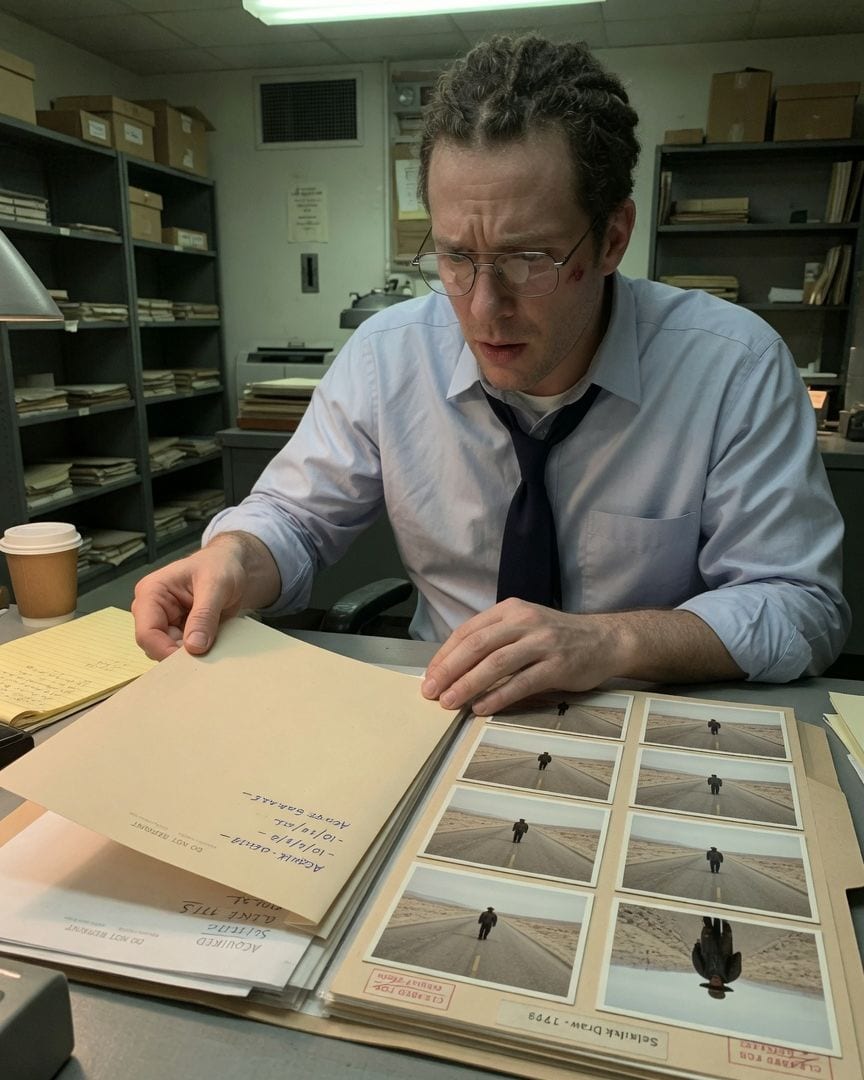
A Cold War declassification reviewer watched a hitchhiker cover miles in minutes across 1970s photos. The missing final shot's index sheet had 'ACQUIRED' written on its reverse.
Corwin Ashby, a declassification reviewer, expected mundane desert landscapes from a stack of 1970s photographs. Instead, he found nineteen identical shots of a desolate road, each showing a lone hitchhiker progressively closer, covering impossible miles in mere minutes. His methodical nature rebelled when he discovered the twentieth exposure was missing, marked 'DO NOT REPRINT'. But it was the hidden, unofficial annotation 'ACQUIRED' on the reverse of the index sheet that brought a cold dread, implying the hitchhiker wasn't just an image, but a physical thing taken. What could have been 'acquired' from a photograph?
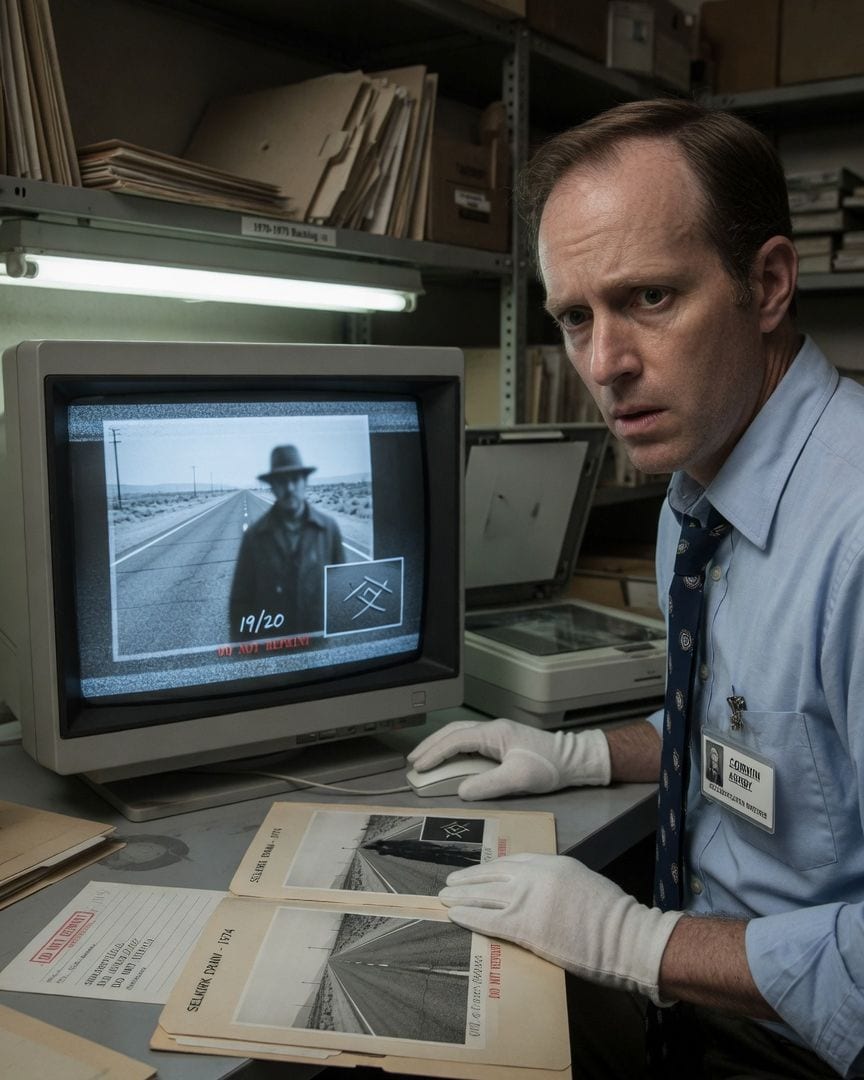
A declassification reviewer scans a Cold War photo, and the hitchhiker's blurred eyes in the image shift, looking straight out at him.
Corwin Ashby, a declassification reviewer whose life revolved around meticulous order, pulled a dusty file from a 1974 backlog. Inside, nineteen black-and-white photographs tracked a lone hitchhiker on a desolate Nevada road, each image showing him steadily nearing the camera until his face blurred inches from the lens. The twentieth photo was missing, but its slot bore a stark 'DO NOT REPRINT' stamp and the unsettling handwritten notes: 'SUBJECT ACQUIRED' and 'DO NOT VIEW.' As Corwin tried to digitally enhance the final available image, the hitchhiker's blurred eyes in the photograph seemed to shift, looking directly out of the frame.
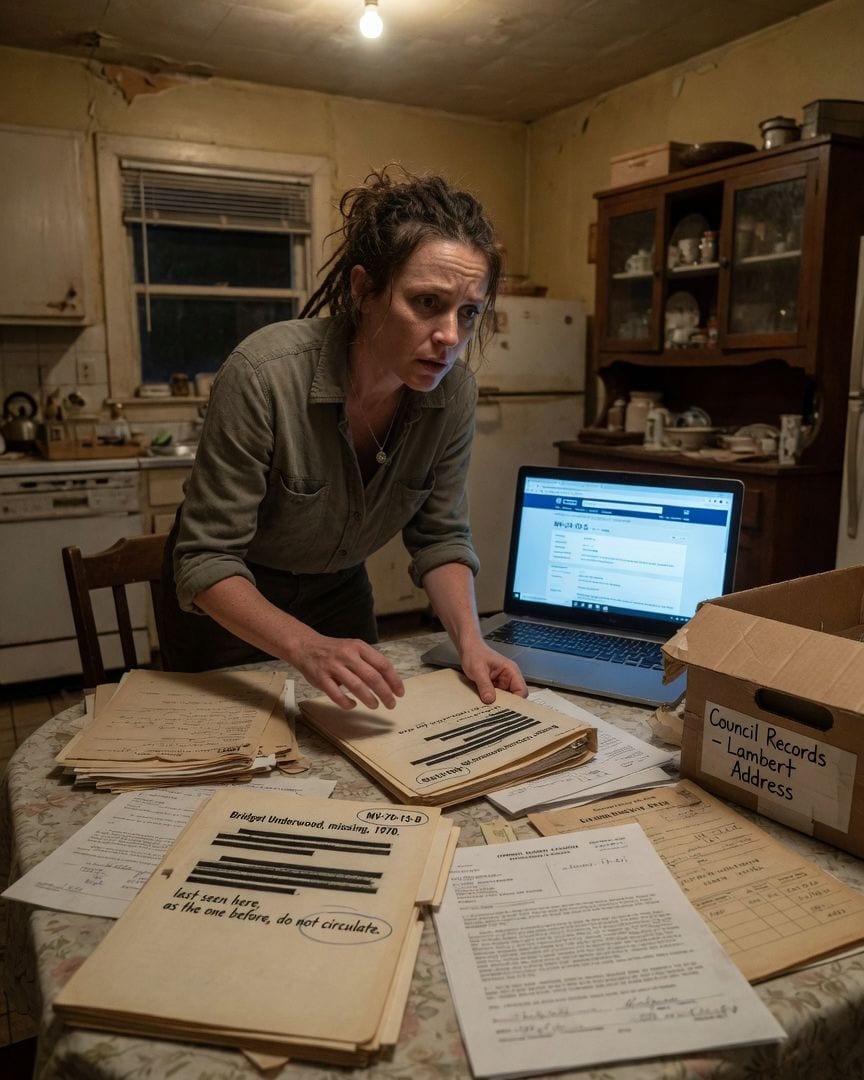
My address appears on a 1970 missing-person report. It says 'last seen here, as the one before,' and the case number is almost identical to a new one from last month.
As a local historian, I'm used to old records, but a police file for a 1970 missing person stopped me cold. It listed my current address, with a chilling note: 'last seen here, as the one before, do not circulate.' I knew Bridget Underwood never lived here, yet there it was.
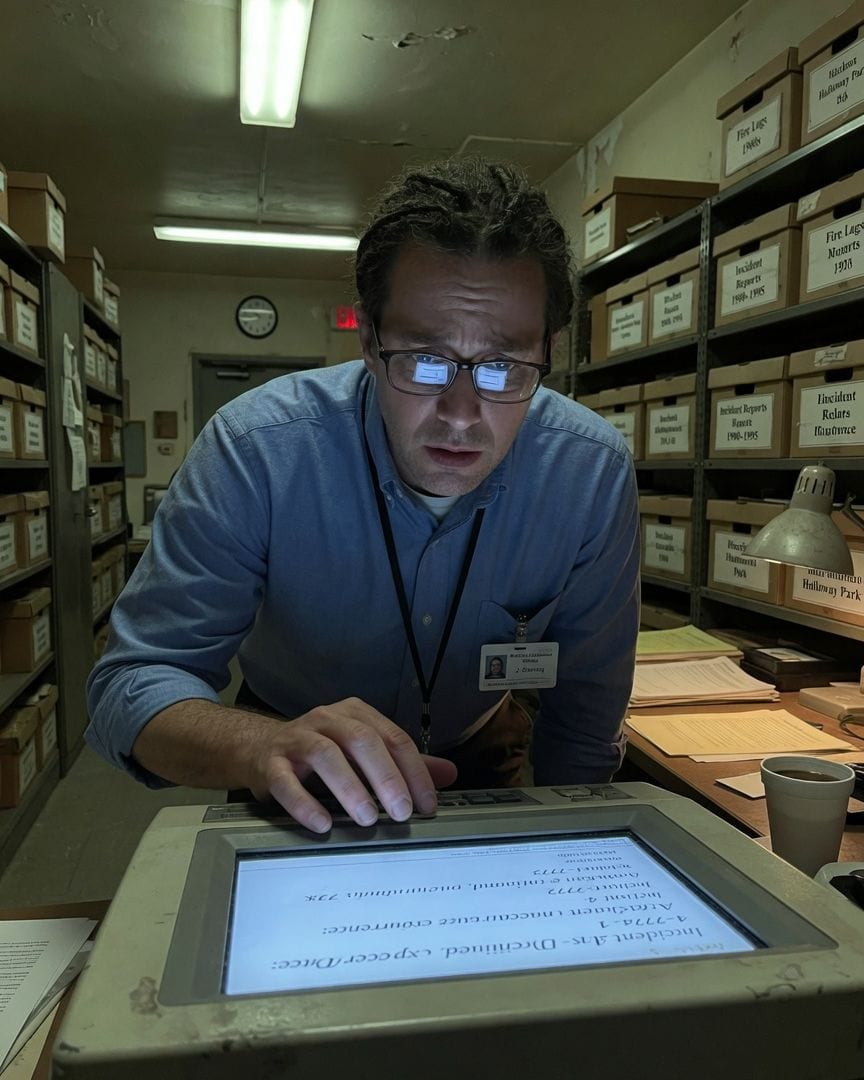
My old rope works fire log repeats the same 3:14am blaze, same incident number, across 1967, 1980, 1993. Each ends: 'origin undetermined, expect recurrence.'
As an Archival Digitization Officer, my days are spent scanning old records. I was numbly working through fire service logs when Incident 4-772 caught my eye: the same structural fire, same time, same number, repeated across different decades. Each entry ended with the chilling, identical phrase: 'origin undetermined, expect recurrence.'
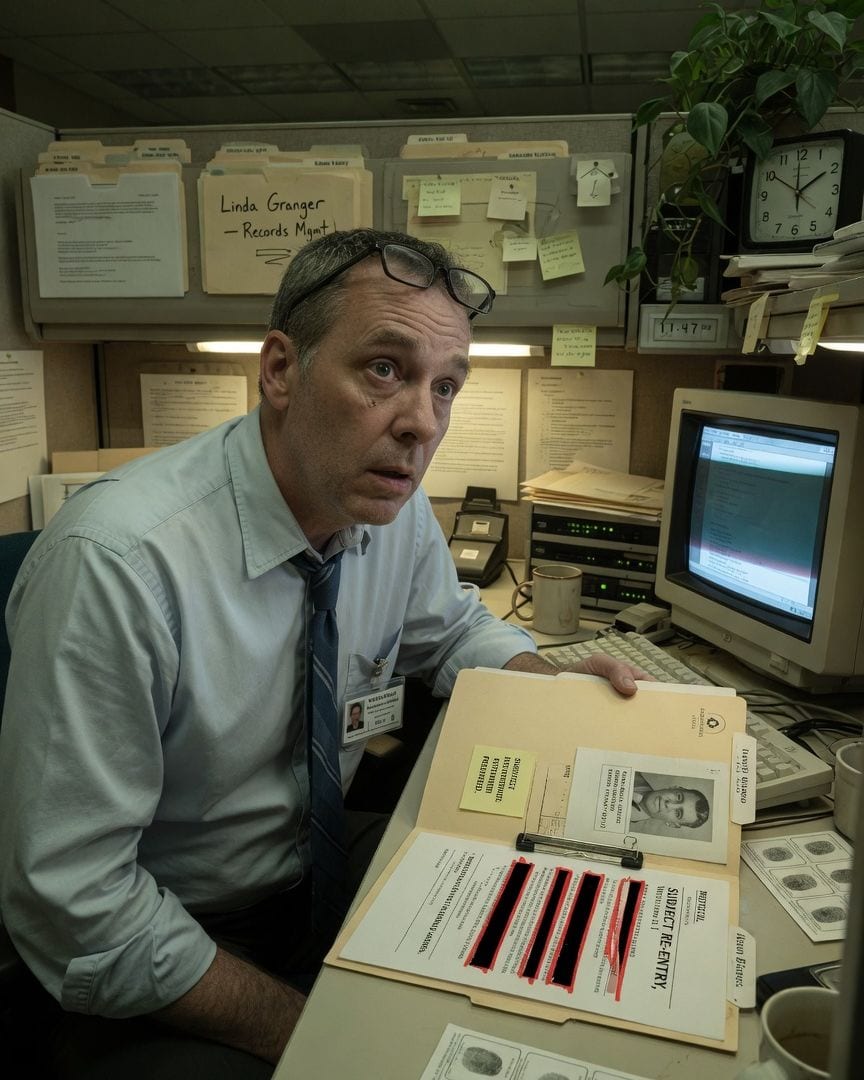
A declassification agent processed old Cold War files. A man reported dead in 1951 had 1958 fingerprints matching an employee badged into the building that morning.
Anton Skeel, a declassification agent nearing two decades of service, meticulously processed the endless backlog of Cold War secrets. His cubicle hummed with the ghosts of forgotten files, but one 'Hollow Bell' folder held a particularly glaring anomaly. It contained a 1958 fingerprint card for Henry Bishop, a man officially reported dead in 1951. When Anton fed the print into the active database, it matched Carl Romano, an employee badged into the building that very morning. A cold certainty settled over him: this wasn't an error, but a system designed for such impossible discrepancies.
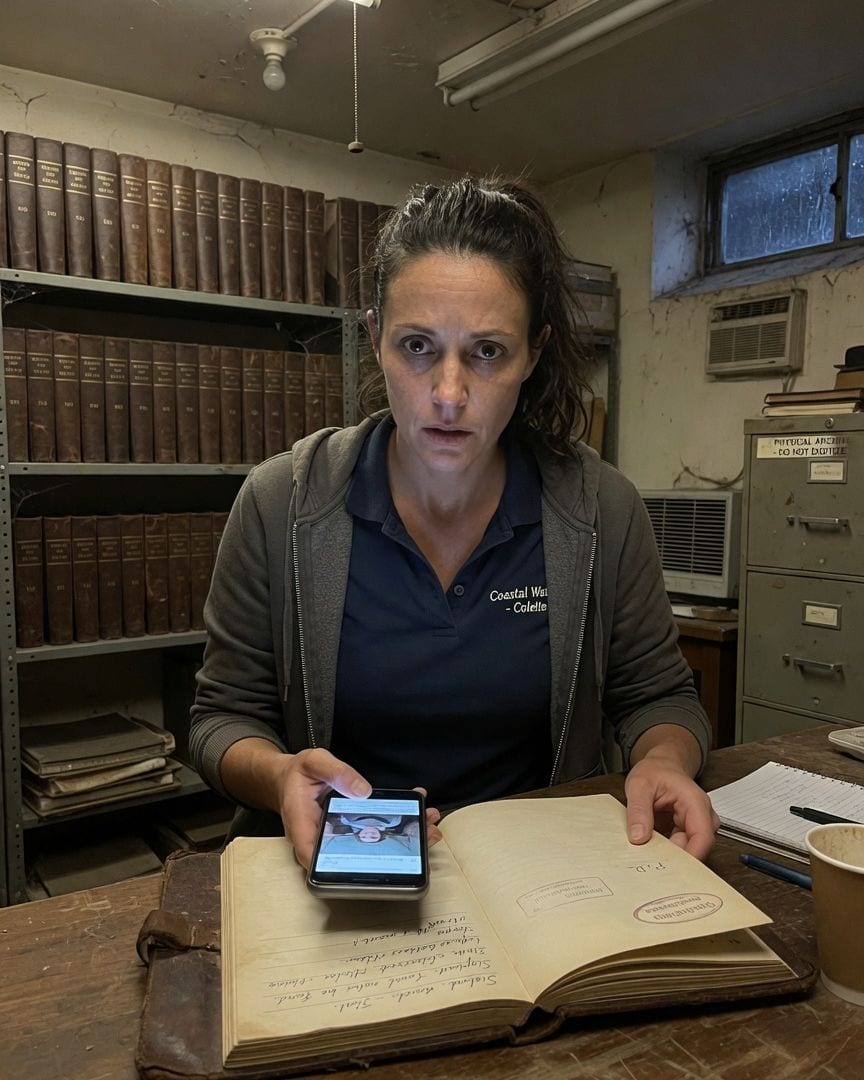
My coastguard log noted Sighting 9 again tonight, a light where no vessel showed. The old logs carry Sighting 9 off Skerry Point at 3:14am every tenth year since 1954, always 'nothing found,' always 'send no boat.'
On my watchtower night shift, the radar screen glowed green and the ocean was quiet. Then, a familiar light appeared off Skerry Point, exactly on cue, just as it had every tenth year for decades. But digging deeper, I found a hidden stamp in an old logbook: 'Operation Skerry. Status: Complete.' It left me with a chilling sense of finality.