My DNA matched a soldier k*lled in 1944. Not my grandfather, but the man himself. The lab confirms it.
I’m Sharon Lawson, 35, a forensic analyst. My job is to find order in the impossible. I’ve spent fifteen years staring down chaos, sifting through bl**d, bone, and fiber to piece together stories the dead can’t tell.
So when the national WWII unit identification project asked for DNA swabs from living relatives, I complied, meticulously.
My paternal grandfather, Preston Lawson, was among the recovered remains reburied last year, a man I only knew from faded photos and family stories. A hero, a name on a memorial.
The lab report came back a month later. It landed in my inbox like a lead weight. I opened the attachment, already half-expecting some minor discrepancy, a typo, a cross-reference error.
Instead, the top line read, clear as damn day: Subject: Sharon Lawson. Donor: Preston Lawson (Deceased, 1944). Relationship: Identical Genetic Profile.
Not a grandson’s match. Not a close relative. A direct, irrefutable match. My own genetic profile, a living woman's, was identical to a man dead for nearly eighty years.
My phone rang, startling me. Dr. Michael Whitaker, Head of Forensics at the national lab, his name flashing on the screen. He never called personally for routine results. His voice was strained, tighter than I'd ever heard it.
"Sharon," he began, no preamble, "We need to talk about your sample. And Private Lawson's."
"I saw the report," I said, my voice unnaturally steady. "It has to be a mistake. A lab error."
"We ran it three times, Sharon. Then I personally ran a fourth. Independent analysis. No discrepancies. Not a single marker out of alignment. Mitochondrial DNA, Y-chromosome, autosomal – everything. Your sample, and Private Lawson’s, are genetically identical."
The monitor hummed, a low, persistent thrum that felt less like machinery and more like a nervous tremor. It wasn't the screen; it was the air in the room, thick and cold. "We are at a loss.
I've never seen anything like it. Ever."
My first, rational response was to rule out every mundane explanation. Lab error. Chain of custody breach. Sample mix-up. Even a remote possibility of an identical twin my grandfather never knew about, an impossible twist of fate.
I systematically dismantled each theory, running scenarios through my head, applying every protocol I'd ever used in my own work. Dr. Whitaker, a man who built his career on irrefutable evidence, confirmed the integrity of their process.
“Sharon, we have protocols for this. Redundancies. Every check was performed. The samples were clean, clearly labeled, stored correctly. There’s no breach. We are at a loss. Your sample, and Private Lawson’s, are identical. Every marker.
We’ve even reviewed the initial collection site's procedures. Flawless.”
If it wasn't the lab, then it had to be me. Could I be a chimera? An undiscovered genetic oddity, a living ghost of a sibling I never knew I had?
I started looking for any anomaly in my own history. I requested my full medical history, stretching back to childhood. Doctors’ notes, vaccination records, every X-ray ever taken for minor childhood scrapes.
My childhood, a neatly archived file of mundane illnesses and minor injuries.
I sat at my home office desk, fingers flying across the trackpad, scrolling through digital files, looking for anything out of place. Years of pediatric records blurred past: measles, scraped knees, a brief bout of strep throat.
Then I found it: an X-ray from 1993, when I was five years old, taken after a tumble from a swing set. The report mentioned a minor wrist sprain, a standard injury for a clumsy kid.
But the image itself showed something else entirely. A perfectly healed, old fracture of my right ulna, just above the wrist. The bone was strong, seamlessly rejoined, a smooth, pale line across the dense white.
It looked as if it had mended years, maybe even a decade, before the X-ray was even taken. But it had been broken. Definitive. And I had no memory of it. No scar.
No story, no whispered family lore about a bad fall. My parents had no recollection of any such injury or treatment beyond the sprain. "A sprain?" my mother had said, confused, when I'd called. "That's all I remember.
You were fine a few days later."
Disturbed by the unexplained fracture, a phantom injury in my own body, I pivoted. If my DNA matched Preston, could something else? Could my own history contain fragments of his?
I accessed Preston Lawson's newly digitized wartime medical file, now available to family members through the project portal. I scrolled through scan after scan, reports detailing basic training, deployments, field hospitals. Fever, shrapnel, frostbite. Typical wartime ailments.
Then I saw it: a field report from 1942. 'Private Preston Lawson, Right Ulna Fracture, sustained during training exercise, healed without complication.'
The location, the description, the type of injury – a clean break of the ulna, just above the wrist – it was an exact, sickening match. My hand, the one holding the mouse, felt cold.
The healed break in my arm, a phantom limb I never knew, suddenly screamed its presence, a dull ache blooming from deep within the bone. It was his. My body was holding his history.
=== PART ===
My investigation intensified. I was no longer just a relative seeking answers; I was a case study of myself. The DNA had been a jolt; the fracture was a physical wound, a proof etched in my own bone.
I consulted Dr. Whitaker again, presenting the medical records side-by-side. My 1993 X-ray, highlighting the ghost fracture. Preston’s 1942 field report, detailing the precise injury. Whitaker reviewed them, his usual scientific detachment replaced by visible discomfort.
He pushed his glasses higher on his nose, running a hand over his thinning hair. “Sharon,” he said, his voice quiet, “This... this is beyond a statistical anomaly. A genetic match, and now a somatic one?
A healed fracture, unrecorded in your history, perfectly matching his specific injury? It’s not just improbable. It’s impossible.”
We discussed impossible theories. Chimerism, where a person has cells from two or more distinct individuals. Spontaneous cloning, a concept so far-fetched it belonged in a pulp novel. An unknown identical twin from Preston’s past, somehow linked to me.
Each was ruled out by the specifics of the evidence. There was no other source. No twin, no other genetic material. It was just me. And him.
I delved deeper into Preston’s life, searching for any other obscure details that might connect us. I contacted Iris Vance, a historical genealogist who had worked extensively on the unit identification project.
Iris provided access to more personal letters, photographs, and unit histories. Pages upon pages of scanned documents, personal insights into a man who should have been a stranger.
As I consumed these fragments of Preston’s past, a quiet terror began to unfurl. I started noticing subtle echoes, chillingly specific. Preston’s preference for specific, obscure classical music composers—Sibelius, late-period Beethoven—mentioned in letters home.
Composers I’d always gravitated towards, whose symphonies I knew by heart, often humming their less famous movements without realizing where I’d learned them.
His love for dark, unsweetened coffee, described as ‘tar-black poison’ by his army buddies, a habit I’d always had, but no one else in my immediate family could stand.
Small, uncanny coincidences that, in light of the identical DNA and the impossible fracture, felt less like chance and more like a terrifying, insidious pattern.
Every detail I unearthed about Preston Lawson was a mirror, reflecting a piece of myself I never questioned, now warped and horrifying. It felt like I was reading my own autobiography, written by a dead man.
As I dug deeper, focusing on Preston’s personal life and family, particularly his relationship with my grandmother Nora, I started feeling a subtle, intangible pushback. It wasn't overt, no threats or warnings, but a sense of unease.
Iris Vance, while helpful and professional with the historical records, became strangely evasive when I specifically asked about Preston’s relationship with his wife, Nora – my grandmother. Her voice would soften, her gaze would drift.
She mentioned Nora was 'a quiet woman, very perceptive.' Iris herself seemed to choose her words with unnatural care, as if walking on glass.
I found an old, faded photograph in a box of family heirlooms in my father’s garage, tucked under a pile of old tax documents.
It was a snapshot of young me, perhaps five or six, standing beside Nora in her garden. I was clutching a plastic toy, smiling at something out of frame.
Nora’s gaze in the photo wasn't at the camera, but down at me, her face unsmiling, a look of profound, almost sorrowful, understanding in her eyes. It unsettled me.
It wasn't the loving gaze of a grandmother; it was the intense, appraising stare of a witness. A quiet dread settled in my stomach, cold and heavy.
Later that week, Iris Vance called, her voice lower, more cautious than before. It was a personal call, not a professional one. "Sharon," she said, after a moment of silence, "I’ve been thinking about your grandmother. Nora. She...
she had a way of seeing things. Sometimes, things that weren’t quite there, or perhaps, were too there." Iris paused, as if gathering courage. "I remember her asking very specific questions about Preston's letters, things that seemed...
out of place for simple nostalgia. She never spoke of it directly, but there was always a sense of... something else." Iris advised me to look for Nora’s personal writings. "She kept her own counsel. A woman of her generation.
But she wrote things down. Private things." It felt less like a warning and more like a subtle, deliberate direction, a push from someone who knew more than they let on. Iris had always been professional, detached.
This call was different. The silence on the line felt charged, almost conspiratorial.
It was a whisper from the past, through a stranger, telling me to look for a truth my own family had kept hidden, buried not by malice, but by an impossible, quiet dread.
The phone in my hand felt suddenly heavy, like a stone from a distant grave.
Driven by Iris’s hint, I searched through my father’s attic. My father, who’d been raised by Nora after Preston’s death, knew little of her inner life. He simply remembered her as stoic, kind.
I focused on Nora’s few remaining personal effects, mostly practical household items.
Hidden beneath old knitting patterns and a stack of faded recipe cards in a cedar chest, I found it: a small, leather-bound notebook, its pages brittle with age, the cover worn smooth by countless touches.
It was Nora’s diary, from the early 1990s, when I was a young child, aged roughly three to five.
The early entries were sparse, mundane observations about daily life, recipes, grocery lists. A simple life. But then, about a third of the way through, the tone shifted. Nora began writing about me, aged three to five.
The handwriting grew tighter, the observations more frequent, almost frantic in their detail.
October 17, 1992: "Sharon hums that tune, the one Preston always whistled before dinner. She’s never heard it before. How?"
November 3, 1992: "She pointed to the old photo of Preston in uniform, called him 'Papa,' not 'Grandpa.' She knew his middle name, the one only he and I ever used. Joseph.
She said it so casually, as if she'd always known him."
The observations grew more frequent, more specific. My stomach churned as I read.
December 10, 1992: "The way she holds her fork, in that peculiar grip, almost formal. The quiet intensity in her eyes when she’s thinking, that faraway look. It’s him. It’s Preston. I see him in her."
January 2, 1993: "She asked me about the smell of rain on hot asphalt today. Exactly how Preston used to describe it, that unique scent after a summer storm. She’s only three."
Nora wrote about her internal struggle, the impossibility, the secret she couldn’t share with anyone, not even her own son, my father. She described trying to understand, to reconcile the impossible.
It wasn't a spiritual belief, a ghost story or a reincarnation fantasy. It was a stark, unsettling recognition of Preston’s traits manifesting in her granddaughter. She never spoke of it, never sought an explanation. She simply observed, recorded, and accepted.
My grandmother, the quiet woman I remembered, had lived with this uncanny knowledge, watching me, seeing him. The silence in the attic pressed in on me, heavy and suffocating.
I read to the final entry, dated just weeks before Nora’s death in the early 1990s. The handwriting was shaky, the ink faded, but the words were chillingly clear. My own hands trembled, turning the fragile page.
May 18, 1993: "She asked me about the war today, about the foxholes in France. She described the smell of the mud, the specific chill of the dawn before an advance. Things I never spoke of, things her father never knew.
And then she looked at me, with Preston’s eyes, those damn quiet, intense eyes, and said, 'You miss the sound of the crickets, don’t you, Nora? Before the shelling starts.' I never told anyone about the crickets. No one."
The last line of the diary, written in Nora’s weary hand, was a quiet, damning statement of acceptance, a truth she carried to her grave: "He came back, but not as I knew him. He lives in her."
I felt a cold dread spread through me, numbing my fingers, blurring the words on the page. Not just from the impossible words, but from the realization that this wasn’t just a genetic anomaly, or a physical echo.
This was always me. My grandmother had seen it. My own life, my own memories, every preference, every habit I thought was uniquely mine, were built on this foundation of impossible recurrence.
My whole life, a carefully constructed identity, suddenly felt like a borrowed coat.
I was not just a match to a grave; I was the echo, the living proof of a past that refused to stay buried, and my grandmother had known all along.
=== PART ===
I sat with the diary, the lab reports, my own medical scans spread out on the kitchen table, a tableau of the impossible. The morning light seemed to dim, unable to penetrate the weight of the truth.
My phone rang, making me jump. It was Dr. Whitaker, his voice tight, even more so than before. “Sharon, we’ve completed the mitochondrial DNA analysis on Preston’s sample. And yours. They’re identical.”
He paused, a long, heavy silence stretching across the line. “And the Y-chromosome markers… they’re also identical to yours, despite you being female.”
This was the final, impossible piece. Not just nuclear DNA, which could be explained by some as-yet-unknown genetic oddity, but the sex chromosomes. Identical Y-chromosome markers in a female subject.
It defied every biological principle, indicating a complete, inexplicable genetic replication. It was a biological impossibility, a record that could not be.
Dr. Whitaker, a man of unwavering scientific conviction, a pillar of rationality, admitted defeat. “We have no explanation, Sharon. No known biological mechanism. We’ve run every test, consulted every expert.
It’s as if… as if the genetic blueprint itself was simply copied and manifested again. In you. It’s a recurrence. The exact genetic blueprint. Down to the very last nucleotide.” He sounded broken, his career’s foundation cracking beneath him.
I explained Nora’s diary then, the childhood memories, the uncanny knowledge she’d recorded, the crickets. Whitaker listened, stunned, his scientific mind reeling. The phone line itself seemed to hum with the impossible weight of my words.
“Your grandmother,” he whispered, “she was witnessing something beyond science. Something we are only now seeing in the raw data, laid bare. She knew.”
The truth was understood. Sharon Lawson is, on a fundamental genetic and experiential level, a recurrence of Preston Lawson. A scientific impossibility, a living paradox. The wrongness wasn't in the lab, or in the records.
It was in my very cells, my bones, my unremembered past. It was me.
There was no escape from this truth; it was internal. There was no monster to confront, no conspiracy to expose. This was not a story of good versus evil, but of impossible existence.
I tried to explain to my father, carefully, about the DNA, the medical records.
I omitted Nora’s diary for now, knowing it would only complicate an already unbelievable narrative, add a layer of the fantastical he wouldn’t be able to process.
He was bewildered, suggesting more tests, another lab, grasping at any mundane explanation he could conjure, unable to comprehend the profound implications. “But you’re you, Sharon,” he’d insisted, his brow furrowed with confusion. “You’re my daughter. Preston was… my father.”
I realized the full truth was mine alone to bear. I couldn't make others see what defied all logic, what shattered the very fabric of identity. The secret felt like a living thing inside me, breathing, pulsing.
I drove to Preston Lawson’s reburial site, a quiet military cemetery tucked away from the main highway. The polished granite headstone, his name, his dates: PRESTON JOSEPH LAWSON, 1920-1944. I stood there, a living monument to his impossible return.
The understanding settled over me, cold and heavy. This wasn't a curse or a blessing. It simply was. I was Sharon, but also, impossibly, Preston.
The identity I had meticulously built, the life I had lived, was now overlaid with another, a past that was not mine, yet undeniably me. I remembered Nora’s diary: 'He came back, but not as I knew him.'
Nora had accepted it. I must too. My body, my memories, my very sense of self, had been irrevocably altered by this knowledge.
I was a walking archive of a life I hadn't lived, a ghost in my own skin, forever haunted by the impossibility of my own existence. The ground beneath my feet felt less like earth and more like thin ice.
I continued my work as a forensic analyst, the irony a constant, quiet hum beneath my professionalism. I processed DNA, identified remains, pieced together lives from scattered fragments, but now with an intimate, terrifying understanding of the impossible.
I never spoke of Nora’s diary again, nor the full extent of the truth, not even to Dr. Whitaker, who maintained our professional silence, awed and baffled by the anomaly. He’d simply called it “the Lawson case,” an unsolvable paradox.
My daily life continued, outwardly unchanged, but every reflection, every flicker of memory, every physical sensation, was now filtered through the lens of my impossible identity. The world still demanded a single, coherent self, a narrative that made sense.
But I was two, inextricably linked, one dead, one living, both contained within the same skin. It was a private horror, a constant presence.
I sat at my kitchen table, a half-eaten meal growing cold, the silence in the room heavy.
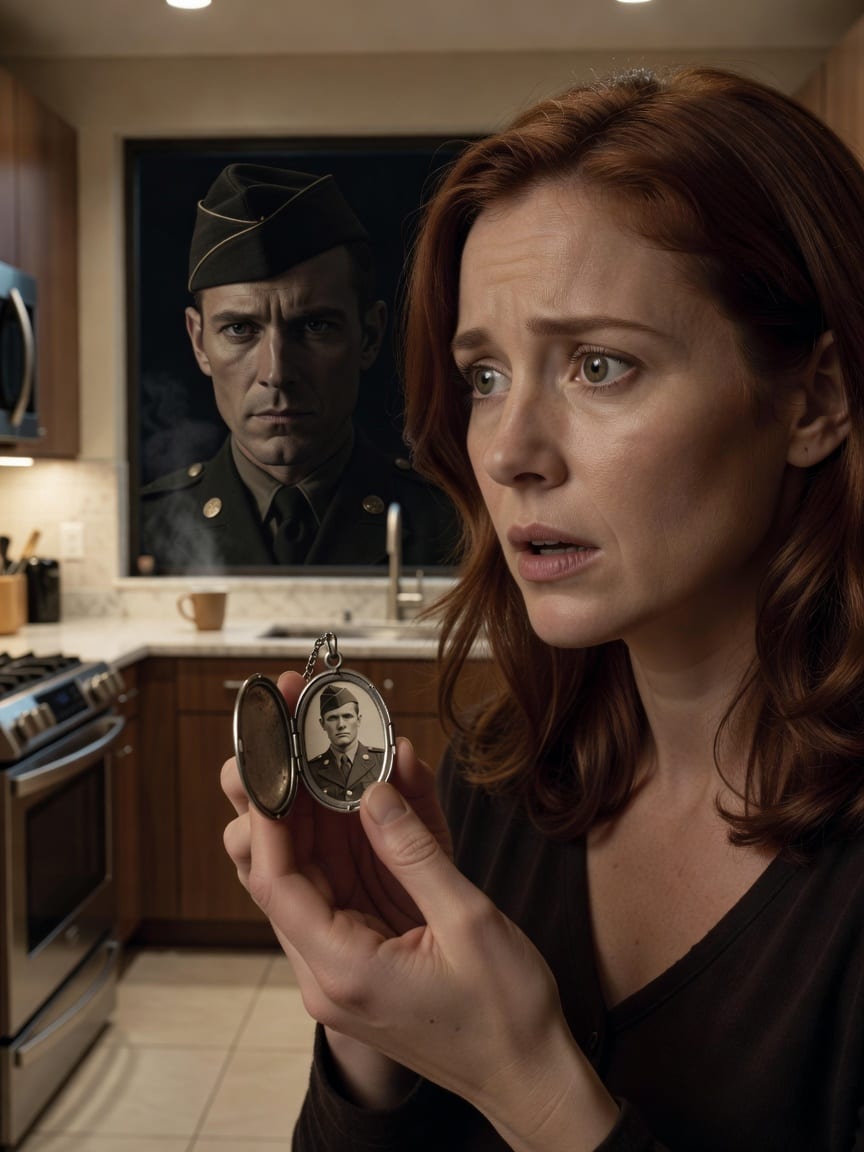
I picked up an old, tarnished silver locket from a small box of Nora’s forgotten jewelry, a locket I’d never worn before, always dismissed as just another sentimental trinket. It clicked open.
Inside, a tiny, faded photo of Preston, young and stern in his uniform, his eyes intense and direct. I looked at the photo, then at my own reflection in the dark window behind me.
The resemblance, always faint, was now stark, undeniable. Not just in the eyes, but in the set of the jaw, the subtle curve of the lip. My own face, but also his.
I ran my finger over the image of Preston’s face.
A specific, unbidden memory surfaced, one not my own: the biting wind on the Normandy coast, the smell of salt and damp earth, the distant rumble of artillery, the sharp taste of fear.
A memory that felt utterly real, utterly hers, yet impossible. It wasn’t a thought; it was a sensation, a vivid, visceral recall. I closed the locket, the click echoing in the quiet room.
Years later, a new colleague at the lab, noticing Sharon’s unusual dietary preferences and occasional, anachronistic turns of phrase, once asked her about her family history. Sharon just smiled, a faint, unsettling curve to her lips. She said, "It's complicated."
If this one got to you
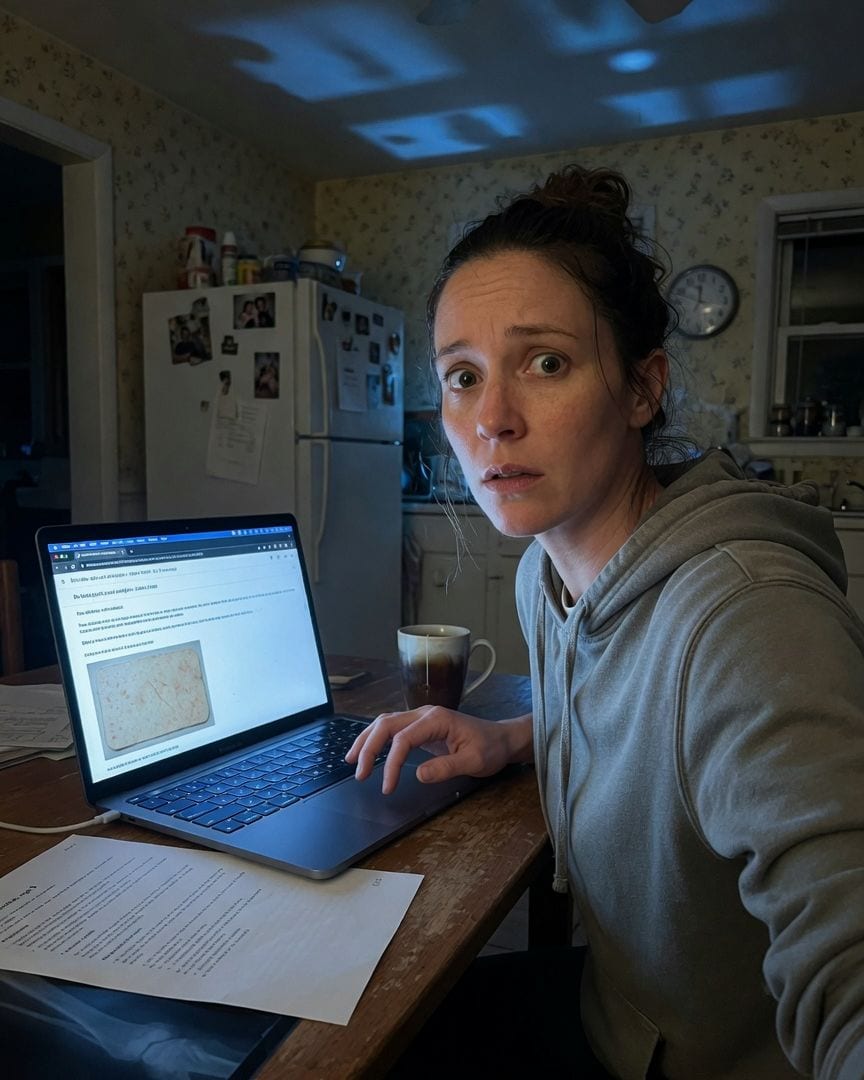
The blood on my own newborn heel-prick card — the one my mother saved in a drawer for thirty years — doesn't match the DNA in my mouth today. The lab ran it three times: two different people.
I sent my newborn heel-prick card to a genealogy lab, expecting to confirm my family tree. Instead, the lab tech called with an impossible truth: the blood from my infancy did not match my adult DNA. My own record insisted I wasn't quite myself.
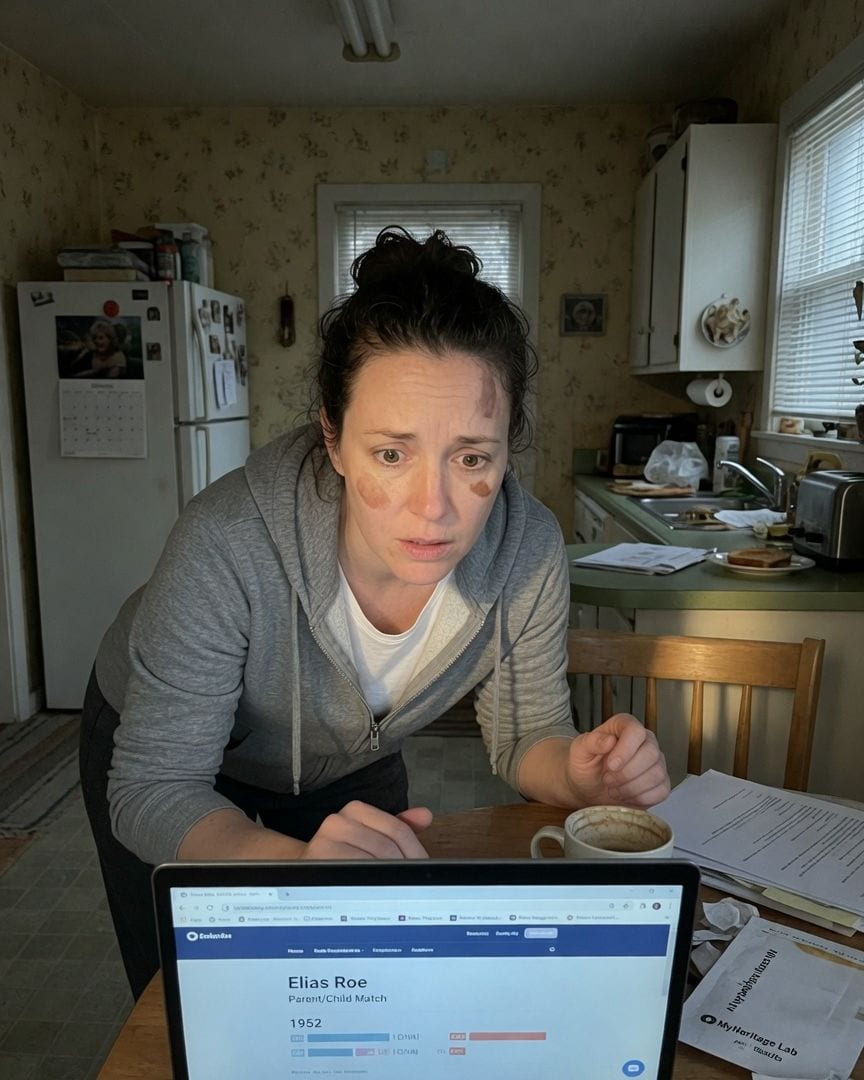
My DNA came back a parent-child match to a farmer who died in 1952. I didn't believe it, so I paid a second lab — same result, down to the last marker.
As a pragmatic software engineer, I've always trusted facts. But my recent MRI revealed a perfectly healed compound fracture on my left tibia, one that mended decades ago. I've never broken a bone in my life, and there isn't even a scar.
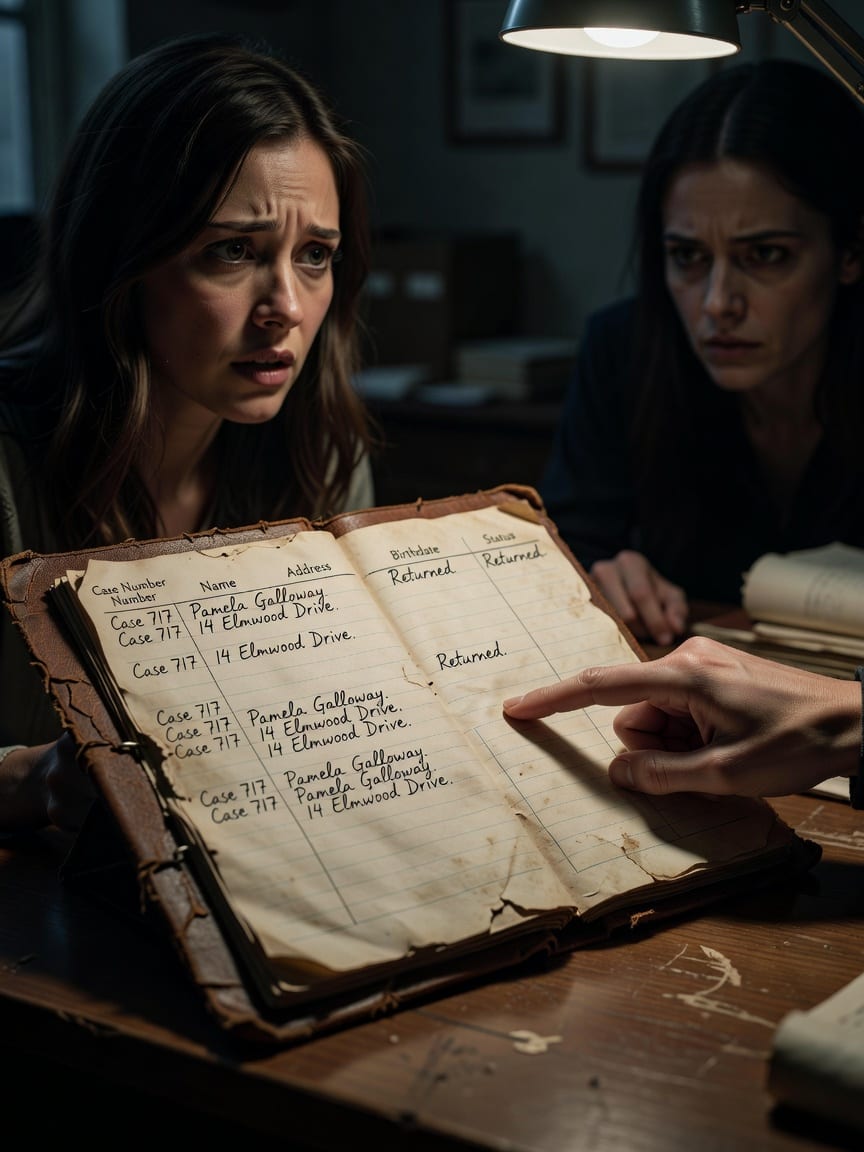
My hospital file has a blacked-out line from 1988. It names my street address, decades before I lived here. Then: 'returned'.
I finally got my medical file, hoping to clear up a ridiculous bill. Inside, I found an entry from 1988: my current home address, scrawled on a partial intake form and marked 'returned.' I was six then, living fifty miles away.
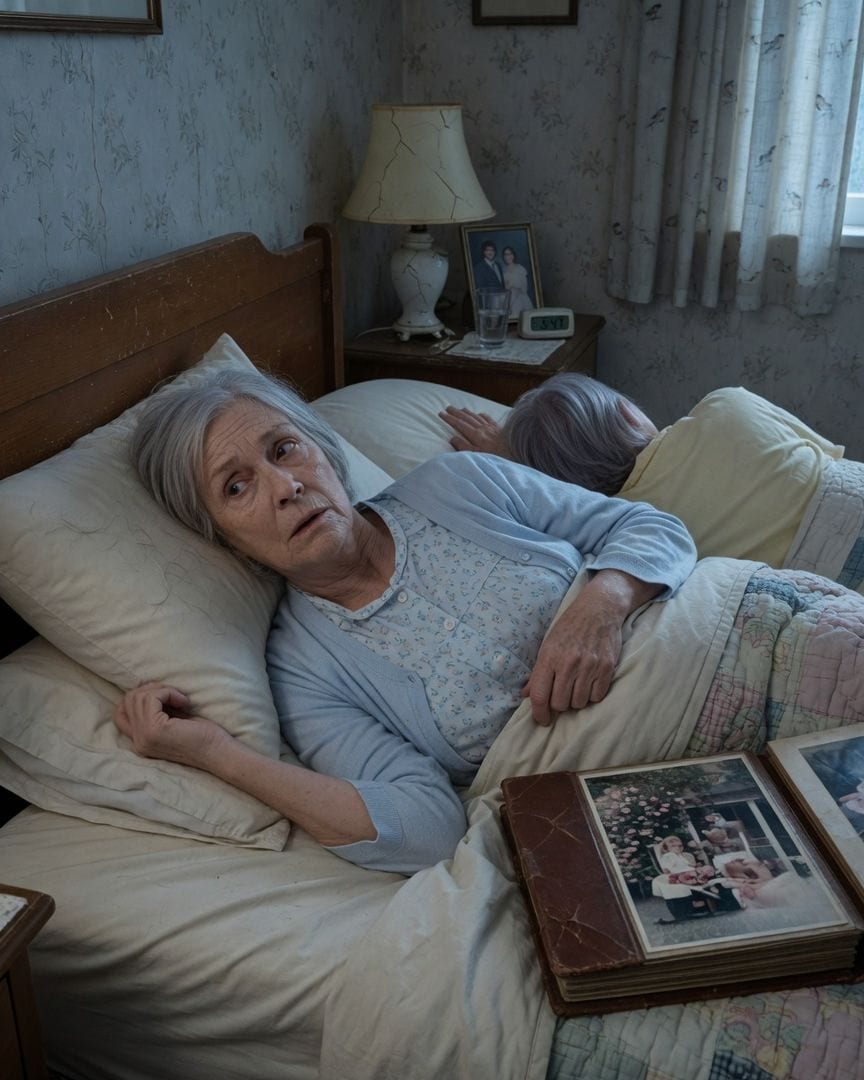
My twin sister Ruth sleeps on the right now, facing the wall. For forty-one years, she always took the left side. She insists I'm misremembering.
After three days missing, my partner Ruth finally came home. But the morning after, I woke to find her sleeping on the wrong side of our bed. She claimed she'd always slept there, and my memory was wrong, despite forty-one years together.
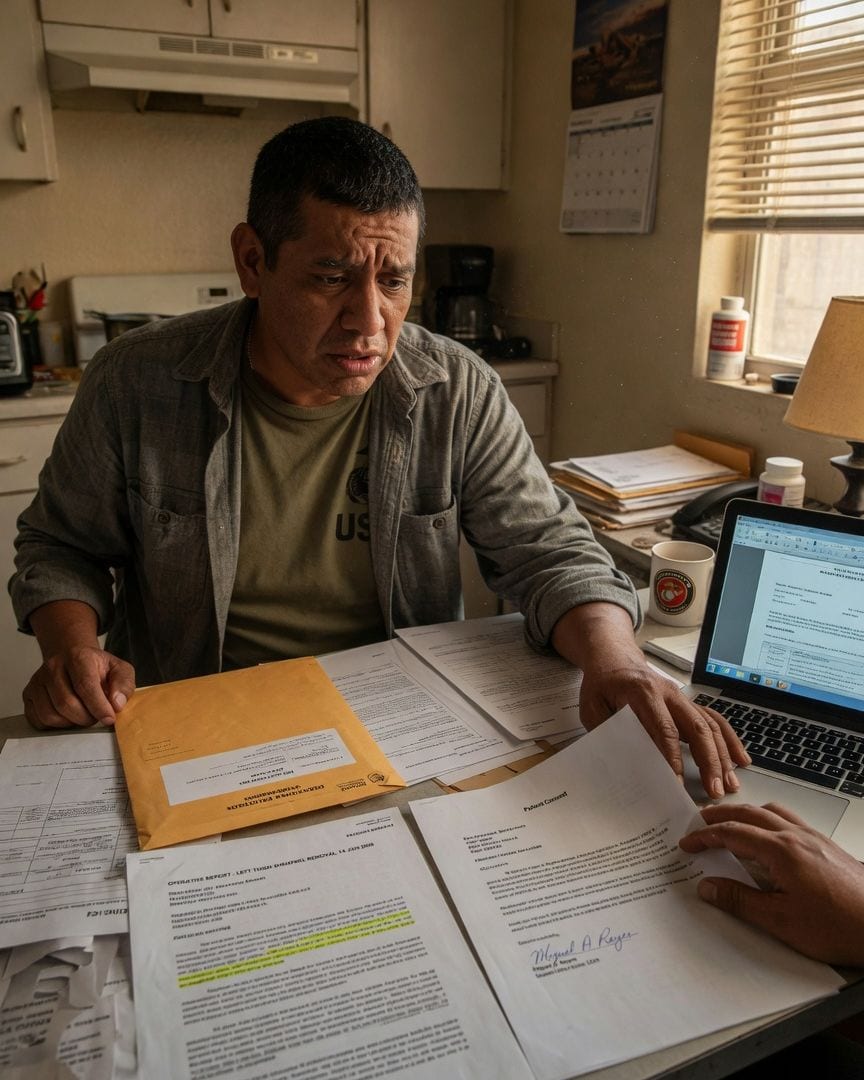
A veteran's VA file listed surgery for shrapnel. The doctor retired decades before he joined the Corps.
Miguel Reyes, a veteran, sat in a sterile VA clinic, his bad knee throbbing, expecting routine. Instead, a physician's assistant presented a digital file detailing shrapnel removed from his thigh in 2008 – an injury Miguel had no memory of, no scar for. His own service record later confirmed the impossible surgery, complete with a consent form bearing his perfect, yet utterly alien, signature. Driven by unease, Miguel researched the listed surgeon, Dr. Charlotte Bennett, only to discover she had retired from military service decades before he even enlisted. The numbers didn't just not add up; they violently contradicted each other, revealing a deliberate, impossible fabrication in his own life story.
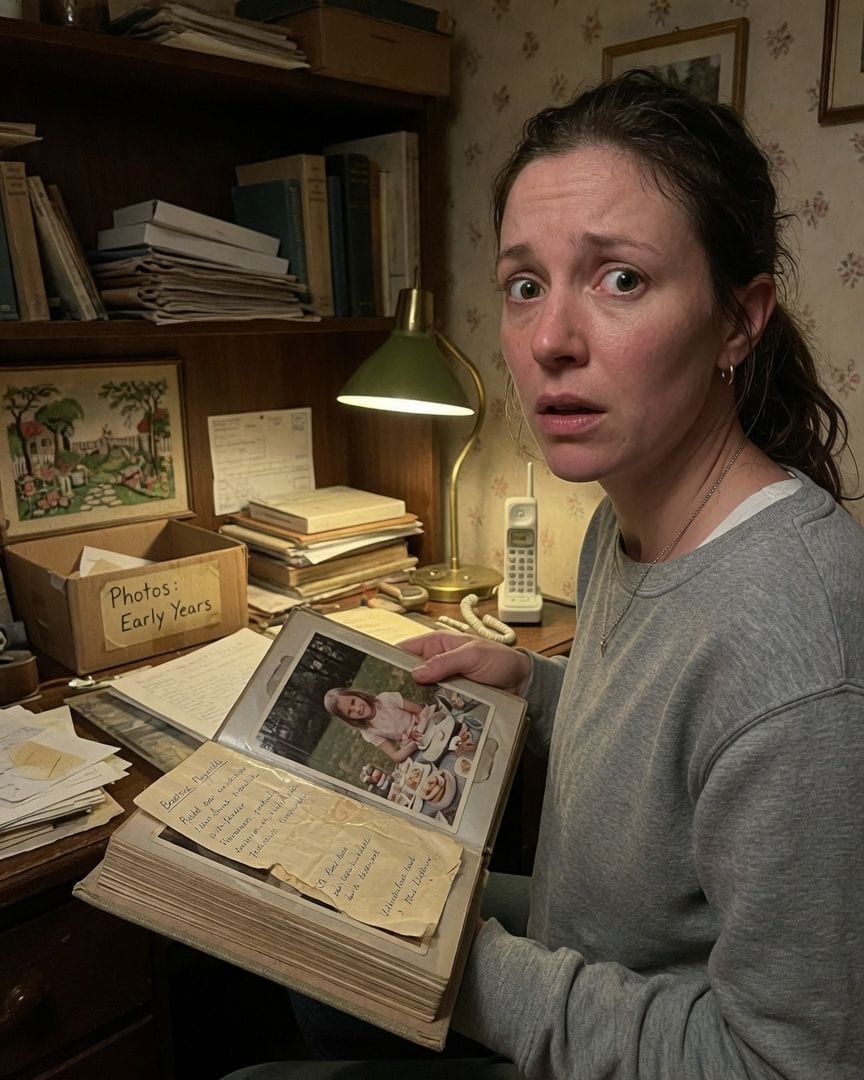
My mother's right ear has been partially deaf since she was eight. Now she's talking on the phone with it.
My mother, Beatrice, is finally back after five days, but my relief is curdling. She's using her right ear for phone calls, the one that's been partially deaf since she was eight. A new doctor confirmed her right ear was perfect, her left ear weaker, completely contradicting my lifelong memory.