Eleven men mustered for the shift. A twelfth figure stood in uniform, then warped on the camera feed.
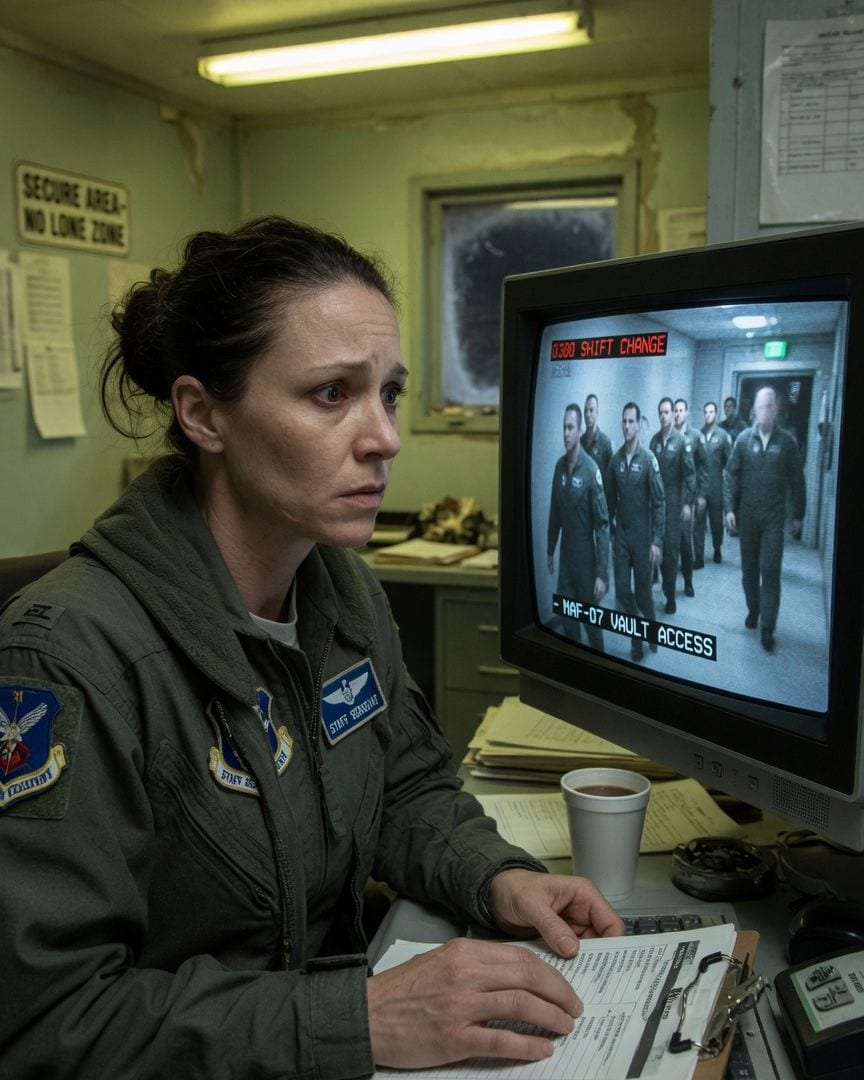
Staff Sergeant Helen Buhl stood in the chill pre-dawn air, her breath misting like white smoke. The topside crew of Missile Alert Facility-07 mustered for the 0300 shift change, their figures silhouetted against the dim horizon.
Eleven names were on the security roster, eleven men assigned to their posts.
'Radcliffe, Granger, Hale, Montgomery...' Helen called, her voice crisp, cutting through the biting prairie wind. Each man answered with a sharp 'Here, Sergeant!' stepping forward from the line. She moved down the list, her clipboard held tight against her chest.
'Lawson, Galloway.' Eleven distinct voices, eleven distinct men. All accounted for.
But as she lowered her clipboard, a twelfth man still stood in the formation. He was in uniform, boots squared, gaze straight ahead, just like the others. Not one of the names had been doubled, none left out.
He simply existed, an extra, silent body in a world where every single soul was meticulously logged, accounted for, and checked against a manifest. Helen felt the cold seep deeper than the prairie wind, settling in her bones.
She ran the roll call again, slowly, deliberately, by name, then by face, then by the sound of their voices. Each of the eleven names was answered by a distinct man.
And still, after the last name, the twelfth man remained, an impossible surplus. The vault below, she knew, would still log precisely eleven badge-ins for the day, not twelve. The numbers simply would not lie.
Helen dismissed the crew, her gaze lingering on the twelfth man as he merged with the others, seemingly unnoticed. Senior Master Sergeant Joel Montgomery, her superior, caught her eye. 'Everything alright, Buhl?'
he asked, a hint of concern in his tone.
'Just a little... overage, Senior Master Sergeant,' she replied, trying for lightness, for the comfortable mundane explanation. He frowned, running a quick visual count of the dispersing figures. 'Must be the cold playing tricks. Get some rest.'
But Helen couldn't. The phantom count tugged at her, a burr under the skin. She went straight to the security office, the fluorescent hum a contrast to the vast silence of the plains.
The digital log for the 0300 shift change was clear: eleven personnel badged out, eleven badged in. No discrepancies. She pulled up the live security feed from the muster point.
The camera was old, grainy, the image streaked with static, but functional.
She watched the eleven men file out of the underground vault, their faces clear enough to identify as they passed the biometrics. Then, a beat after the eleventh, a twelfth man emerged.
He was wearing the standard flight suit, his face indistinct in the low light, but undeniably present, moving with the others, blending in. He wasn’t on the digital log.
Helen replayed the footage, frame by frame, her finger hovering over the pause button. The eleventh man, Sergeant Galloway, exited the vault. Then, a beat later, a twelfth figure followed. He was distinct, tall, wearing the same uniform.
As he passed the biometric scanner, the timestamp flickered, freezing for a fraction of a second. His face on the low-resolution screen warped into a smooth, featureless blur, like a mannequin's, before snapping back to an ordinary, unfamiliar face.
The scanner’s green light flashed, but the log remained unchanged: only eleven unique IDs recorded.
The next morning, Helen returned to the security office. She’d spent a restless night, the blurred, featureless face haunting her thoughts, replaying behind her eyelids every time she closed them.
Sergeant Montgomery was already there, hunched over the main console, his expression grim. 'Still eleven, Buhl,' he stated, avoiding her gaze. He pushed a hand through his already rumpled hair. 'Must be an optical illusion, or...'
He trailed off, unable to articulate the ordinary explanation that would make the impossible disappear.
Helen felt a chill that had nothing to do with the facility’s recycled air. She started a systematic sweep of the muster room, looking for anything out of place.
The room felt colder than usual, a faint, metallic tang in the air that spoke of long-undisturbed dust. Under a dusty, long-forgotten bench, tucked into a crack in the concrete, her fingers brushed against something hard.
She pulled it out: an old, faded ID badge for MAF-07.
The plastic was yellowed, the edges worn smooth by time and friction.
The photo on it was murky, a faded ghost of an image, but she could make out a face – a generic, unremarkable face, but strikingly similar to the 'extra' man she’d seen on the footage.
There was no name printed on the badge, only a faded, unfamiliar rank insignia she didn't recognize, long obsolete. The badge was logged as inactive, decades old, a relic from a time before digital.
But it was physically there, in her hand. And the face on it was the ghost of her impossible twelfth man.
The obsolete ID badge felt cold in Helen’s hand, a physical anchor to the impossible.
She showed it to Joel Montgomery, who stared at it, then at the security footage of the blurred face, his earlier dismissiveness replaced by a deep, unsettling unease. The cold in the room seemed to deepen, pressing against her.
'That rank hasn't been used since the 70s,' he murmured, his brow furrowed. 'And no name? That's not regulation. Never has been.'
He tried to dismiss it as a misplaced relic, a forgotten prank, but the badge's presence felt too deliberate, too connected to the muster anomaly, to be random.
Helen, however, saw a pattern emerging. She began digging through archived paper records, starting with personnel logs from the late 70s and early 80s for MAF-07. The base’s historical archives were a forgotten wing, smelling of ozone and decaying paper.
The old, dusty binders held meticulously kept manifests. She cross-referenced them with facility entry logs, looking for any mention of 'unidentified personnel' or 'overages.' After days of fruitless searching, she found it.
Not a direct mention, not a bold headline, but a series of cryptic entries in the 'remarks' section of various shift reports: 'Personnel count reconciled, one overage, unidentified.'
These entries, spanning from 1978 to 1983, were always followed by the same notation: 'Refer to Protocol 7-Alpha.' There was no Protocol 7-Alpha in any current regulations.
The unease in the facility grew palpable.
Paige Kingsley, a young PFC assigned to the topside crew, confided in Helen that she’d heard faint, unfamiliar footsteps in the corridors late at night, when only she and the duty officer were supposed to be awake.
'Like someone's always just out of sight,' Paige whispered, her eyes wide, darting toward the empty hallway.
Helen started feeling it too – a constant sense of being observed, a fleeting shadow at the edge of her vision, a subtle shift in the air pressure in an empty hallway.
The mundane explanations had evaporated, leaving only the chilling coherence of an impossible pattern.
Helen’s investigation into 'Protocol 7-Alpha' led her to the base’s restricted archives, a windowless bunker beneath the administration building. The air inside was heavy, smelling of old paper and something metallic, like stale electricity.
She requested access, citing 'historical research for facility improvement proposals.' Her request was approved, but with an unusual caveat: Senior Master Sergeant Montgomery would be her escort.
He was clearly uncomfortable, constantly glancing over his shoulder, his face pale, his movements stiff.
As they navigated the labyrinthine shelves, filled with decades of forgotten records, Helen noticed small, almost imperceptible signs.
A file box on a high shelf, clearly labeled 'MAF-07 Personnel: 1970-1985,' had been recently disturbed, a thin layer of dust wiped clean from its edge, as if someone had just pulled it out.
Later, as she meticulously scanned through microfiche records, the faint whirring of the machine a lonely sound in the vast silence, a hushed voice, too close for comfort, drifted from an adjacent aisle.
'Some things are better left buried, Sergeant Buhl.'
Helen froze. It was Montgomery. He was standing perfectly still, his back to her, staring blankly at a row of binders that held nothing but old supply requisitions.
The voice was his, yet it was not his, devoid of his usual command, hollow. She felt a cold dread spread through her, a prickling sensation on the back of her neck. He wasn't talking to her.
He was talking to someone else, or perhaps himself, in a tone utterly devoid of recognition. The warning was clear, direct, and utterly chilling because it came from a man who seemed to be losing his grip.
She realized her digging hadn't gone unnoticed; it had been actively observed, and now, she was being warned. The danger was no longer abstract; it was personal, and it was embedded within the very system she served.
Helen pressed Montgomery in the sterile quiet of the archive, her voice low, barely a whisper against the hum of the microfiche reader. 'What was that, Senior Master Sergeant? Who were you talking to?'
His face was a mask of strained composure, his eyes flicking around the room as if searching for an escape route. 'Just... thinking aloud, Buhl. This place gets to you. All this dust, the dead files.'
He laughed, a dry, humorless sound that felt wrong.
She didn't let up. 'Protocol 7-Alpha. 'Unidentified overage, reconciled.' What does that mean?'
Montgomery sighed, running a hand over his face. He looked older, tired. 'It's... an old designation. For when the numbers didn't add up. Happens sometimes. Fatigue. Miscounts. Old forms, you know how it is.'
Helen laid the faded ID badge on the table, next to the microfiche reader displaying the 'overage' entries. The small badge, a physical link, seemed to thrum with a quiet wrongness. 'This badge. The blurry face on the camera.
The extra man. This isn't fatigue, sir. This is a pattern. A pattern that says the system knows, but doesn't want to admit it.' The very air in the room seemed to thicken, pressing down on them.
Montgomery looked at the badge, then at the microfiche, his gaze lingering on the cryptic entries. 'There was an old Chief Master Sergeant,' he began, his voice barely a whisper, as if speaking too loudly might conjure something. 'Quentin Lawson.
He retired decades ago, lives in the town nearby. He was here in '78. He used to talk about 'ghosts in the machine.' Said the numbers sometimes just... shifted. Said he'd see things in the periphery.' He swallowed hard.
'He got a lot of flak for it. Almost court-martialed for 'insubordination and spreading morale-damaging rumors.' They put him on permanent desk duty after that. Sent him home to count paperclips.'
He gestured vaguely at the archive, a vast tomb of forgotten truths. 'He might know more than the official records will ever tell you.'
Helen knew then that the first truth was simply this: the anomaly was real, it was recurring, and the institution had been actively silencing those who tried to expose it, choosing instead to manage its existence through quiet, codified denial.
The fear in Montgomery’s eyes wasn't for himself, but for the system he was trying to protect, a system already compromised, already deeply, terrifyingly aware.
Helen sought out Quentin Lawson. She found him in a quiet, dusty corner of the local veterans’ hall, nursing a coffee, surrounded by the muted clatter of dominoes and the low murmur of old men’s voices.
He was an old man now, his eyes sharp but his movements slow, his uniform long replaced by a worn flannel shirt.
She showed him the faded ID badge, then the printouts of the 'overage' entries and the reference to Protocol 7-Alpha.
Lawson’s gaze flickered to the badge, a flicker of recognition in his eyes, like a spark in dry kindling. 'So they’re still using the old codes,' he rasped, his voice gravelly, dry as the prairie wind. 'And you found it.
Good for you, Sergeant.' He confirmed the ‘ghosts in the machine,’ the impossible counts, the faces that weren’t quite right. 'They don't want you to know,' he said, tapping a gnarled finger on the microfiche printout. 'They just want it...
managed. Like a bad leak you can’t quite patch.'
He then produced an old, brittle piece of paper from his wallet, folded meticulously, its creases worn white. It was a copy of a classified directive, much like the one Helen had been searching for, but older, more detailed.
It outlined a protocol for 'Unidentified Personnel Overage (UPO) events,' instructing MAF commanders to log the overage precisely but to 'cease all attempts at identification or reconciliation beyond initial muster' and to 'ensure seamless integration into daily operational routines.'
The final instruction, underlined in red ink, chilled Helen to the bone: 'In the event of a UPO event exceeding 10% of assigned strength, initiate Phase One containment protocols.'
The signature at the bottom was a General she recognized from other 'UPO' reports across various facilities, a name that recurred across decades of these cryptic logs.
The dusty file from the restricted archive lay open on the table, the old directive brittle under Helen’s touch. She scanned the last page of the 1978 directive: '...all UPO events are to be logged as 'Resolved: Integrated.'
Further inquiry is deemed detrimental to operational continuity and personnel morale.' A handwritten note was scrawled in the margin, in faded blue ink: 'They don't replace, not at first. They add. Then they match. Then they shift.
And the records always show exactly what they want.' The signature below it was 'Lawson, CMsgt.'
Quentin Lawson, the retired Chief Master Sergeant she'd just spoken to, the man who had warned her to stop digging, had left his warning from the past.
Quentin Lawson looked at Helen, his eyes filled with a weary understanding. The silence of the veterans' hall seemed to amplify the quiet horror of his words. 'The 'extra' isn't just one man, Sergeant. It's a presence.
It comes and goes, shifts form. It learns. It integrates.' He explained how, in his time, the 'overages' would start small, an extra shadow, a voice from an empty room.
Then, an 'extra' person at muster, just like Helen had seen.
'They mimic,' Lawson continued, his voice a low, raspy drone, 'take on the appearance of someone already there, or just a generic 'blank' until they learn. The old badge you found?
That was from a 'blank' that integrated so well, it was almost indistinguishable. They never fully replace, not directly. They slip in, and then the system, the real system, just... adjusts. It accounts for them, because it has to.'
He took a slow sip of his coffee.
He revealed how 'Phase One containment' wasn't about eliminating the anomaly, but about controlling information, preventing panic, and ensuring the UPOs didn't disrupt critical operations.
The classified directives Helen had uncovered, spanning decades, were not about solving a problem, but about managing a permanent, unexplained presence. The institutional record wasn't a cover-up of a failure, but a chilling testament to a successful, albeit terrifying, co-existence.
Every 'overage' log, every blurry face on old footage, every 'Protocol 7-Alpha' reference, now clicked into place: the military, the most accounted-for system on earth, had quietly, meticulously, been documenting its own slow, systemic infiltration for over fifty years, without ever truly understanding its nature or origin, merely its effects.
Helen returned to MAF-07, the weight of Lawson's words pressing on her like a physical burden. She presented her findings – the old badge, the directives, the historical logs – to Senior Master Sergeant Montgomery.
He listened in his office, the air suddenly thick, his face slowly draining of color with each piece of evidence. 'This... this is impossible,' he whispered, but the conviction was gone from his voice, replaced by a deep, haunted resignation.
He knew it was true.
The next 0300 muster arrived like a recurring nightmare. Helen stood with Montgomery, her heart thudding a cold rhythm against her ribs, calling names. Eleven answered, crisp and clear.
And then, the twelfth man appeared, stepping into formation, blending with a seamless ease that made Helen's stomach clench.
He was the same generic, unfamiliar face from the footage, but this time, he was standing directly behind Private First Class Paige Kingsley. Kingsley shifted uncomfortably, as if sensing a presence, but didn't turn around.
Montgomery, his jaw clenched so tight it looked painful, called the last name. 'Galloway.' Both the real Sergeant Galloway and the 'extra' man, who had subtly moved to stand beside him, answered in unison, their voices identical.
Montgomery's eyes met Helen's, a silent plea for her to ignore it, to let the system 'reconcile,' to let the impossible become part of the new normal. But Helen couldn't. She knew the pattern. She knew what Lawson had seen.
She raised her voice, letting the cold air carry her command. 'Attention! Formation dismissed, except for Private First Class Kingsley and Sergeant Galloway.' The other men filed out, their footsteps echoing.
The 'extra' man, standing beside Galloway, hesitated, his posture subtly shifting, a micro-expression too fleeting to catch. Kingsley, still oblivious, looked confused, her eyes darting between Helen and Montgomery.
Montgomery stepped forward, placing a hand on Kingsley's shoulder, a silent message to stay put, to not move, to not look.
The 'extra' man, mimicking Galloway, started to move. Helen knew she couldn't fight it directly. She couldn't expose it without being silenced, without becoming another Quentin Lawson, retired to the periphery, her warnings dismissed as madness.
Her survival meant playing the game, understanding the system’s terrifying logic. 'Sergeant Galloway,' she said, her voice steady, aimed directly at the extra, 'report to the security office. Private Kingsley, you're with me.'
She looked directly at the 'extra,' now perfectly still, its gaze unreadable. She knew it had heard her. The system was too vast, too deeply integrated.
She had to escape the immediate threat and carry the knowledge, not fight an unwinnable war.
Helen Buhl requested a transfer out of MAF-07, citing 'stress-related factors.' It was granted without question, surprisingly swift. Senior Master Sergeant Montgomery remained, his face now holding a permanent, haunted resignation, a quiet acceptance of the impossible.
Private First Class Kingsley, still unaware of the full truth, continued her duties, occasionally mentioning the 'weird vibes' at the facility, the feeling of not being quite alone.
Helen carried the knowledge with her, a cold, precise data point burned into her memory. The institution had not been defeated, nor had it been saved. It simply continued, absorbing the anomaly into its own meticulously kept, terrifyingly coherent records.
Helen now served at a different, quieter base, far from the high plains and the buried vaults of MAF-07. She scanned manifests, counted personnel, and signed off on logs, all with a meticulousness that bordered on obsession.
She knew the numbers could always be wrong, precisely because they looked so right. The count always reconciled. She just knew what it took to make so.
Years later, a new Staff Sergeant at MAF-07, checking the 0300 muster, found the count came up twelve, not eleven.
She ran it again, by name, by badge, by voice, and twelve men answered to eleven names with no name doubled and none left out.
Among them, a quiet, efficient Senior Master Sergeant, his gaze straight ahead, answered to the name 'Montgomery,' a faint, almost imperceptible smile touching his lips.
If this one got to you
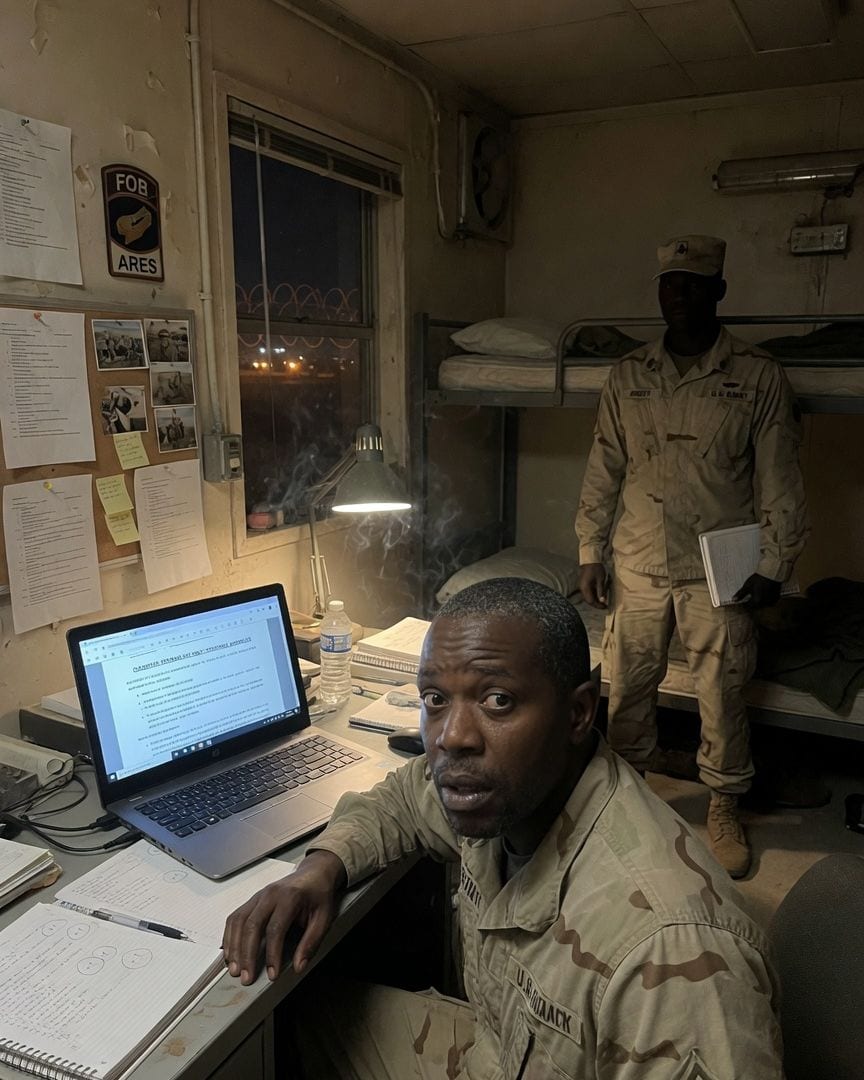
On his final rotation home, Sergeant Abbott counted his platoon: one man too many. The base’s secret files called them 'phantom units,' always watching him.
Sergeant First Class Malcolm Abbott was on his final rotation at FOB Ares, ready for transfer home. He called his platoon to formation, watching the sun break over the desolate desert as he counted each man. But the numbers didn't add up; there was always one extra soldier, standing at rigid attention, perfectly aligned with the others, yet only Malcolm could see him. Despite cross-referencing every manifest, the phantom remained, its face obscured in shadow, a silent sentinel that defied all logic. What secret did the base archives hold about these unacknowledged personnel?
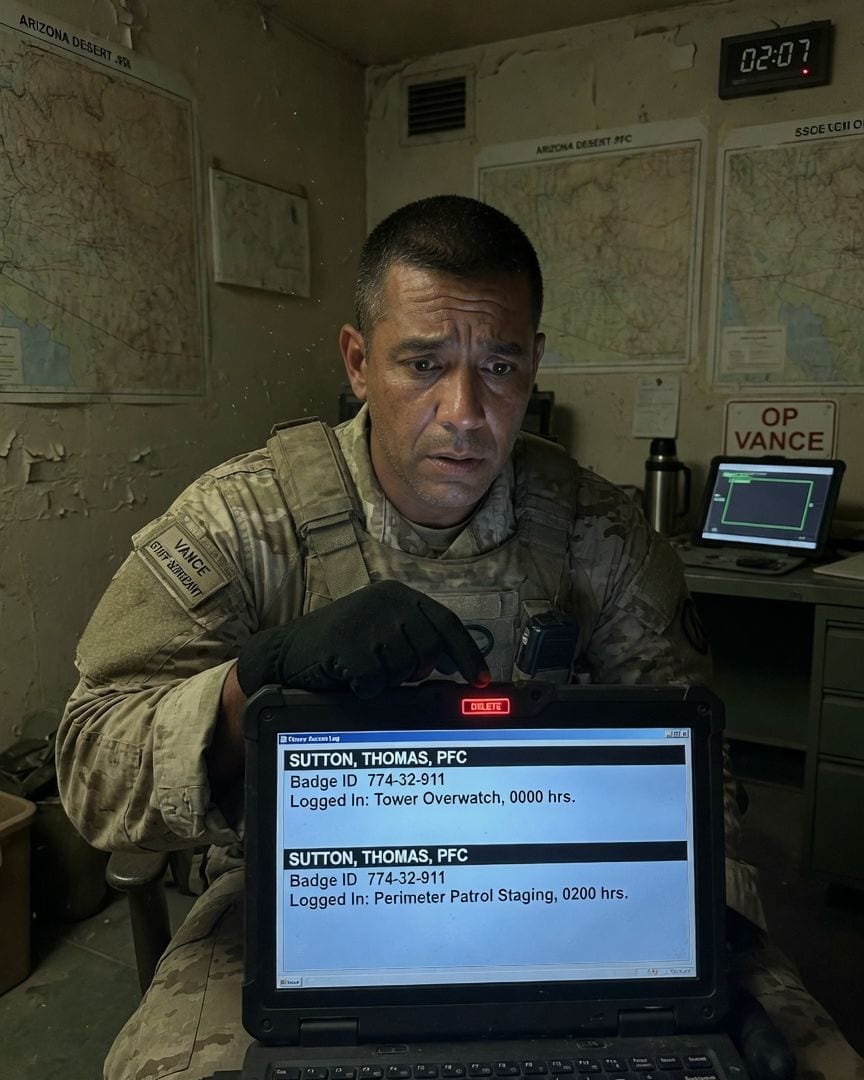
Two weeks from his rotation's end, Staff Sergeant Vance saw a fourth man report for patrol. The system then logged the same soldier in two places at once.
Staff Sergeant Eric Vance, 32, was just two weeks from finishing his rotation at Observation Post Vance, a lonely cluster of buildings in the Arizona desert. At 0200, scanning his thermal tablet for the perimeter patrol shift change, he expected three men. Instead, a fourth figure in full desert camo fell into line, moving with practiced efficiency. This Private First Class answered to the name Thomas Sutton, a soldier Vance knew was already logged in the tower on overwatch. Vance's rational mind struggled until the digital access logs confirmed an impossible truth: two identical entries for PFC Sutton, same ID, same timestamp, but from two distinct physical locations.
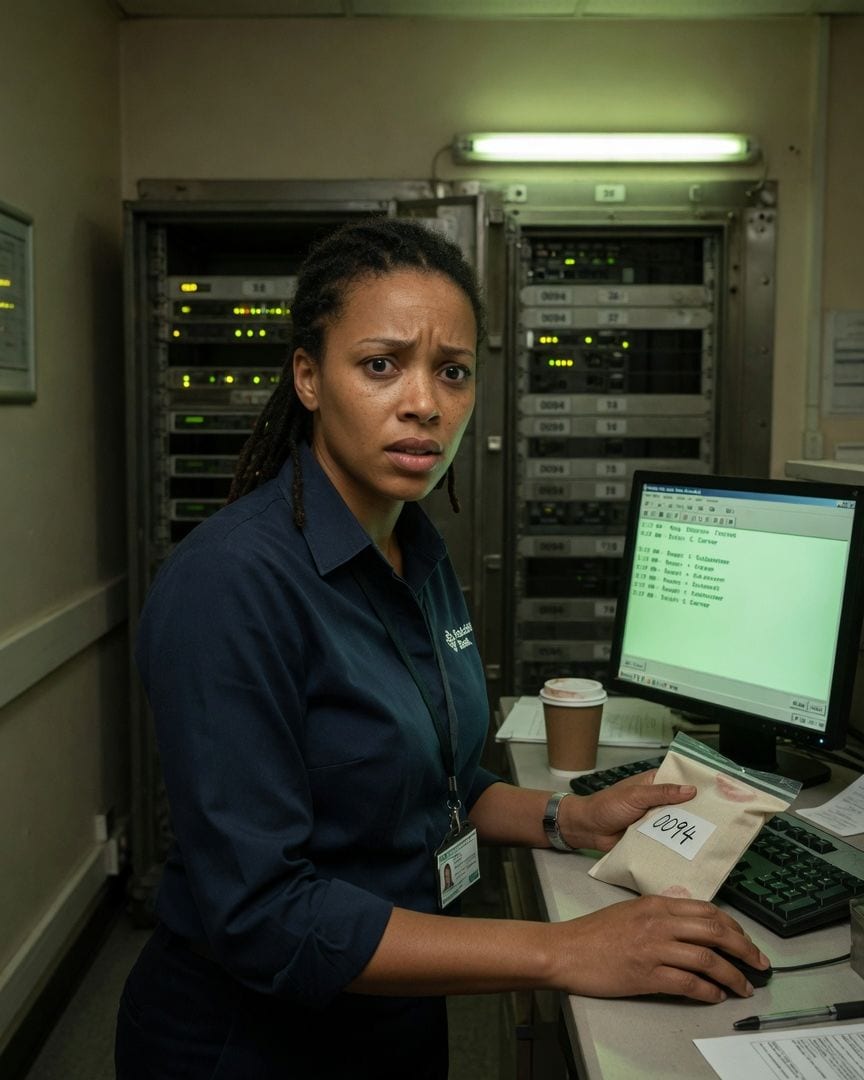
My night-deposit log shows a bag posted at 3:17 AM. My teller number, my count. Bag 0094 is still sealed in the safe, untouched.
I prided myself on precision as a night teller, logging every entry. But at 3:17 AM, a deposit appeared logged under my teller number that I never processed. Security footage then revealed a figure in my uniform, wearing my ID badge, with a blank photo slot.
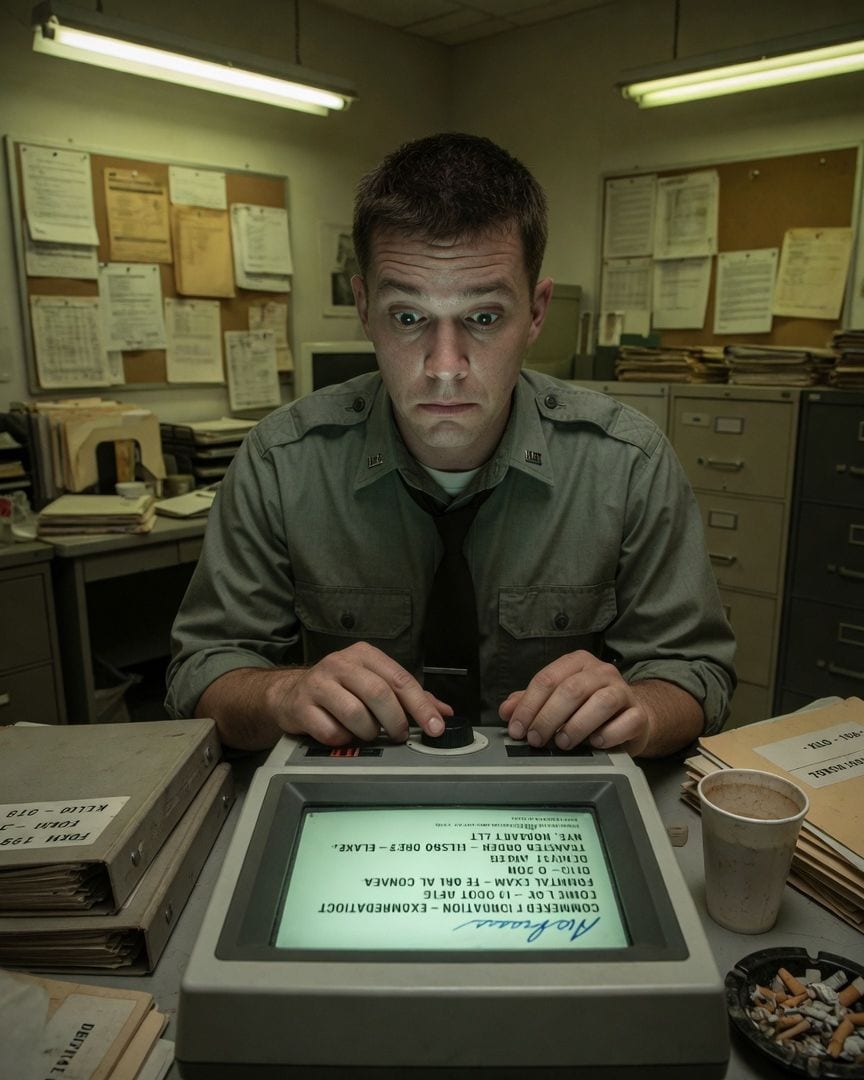
A missile commander watched his ten nuclear silos go dark. His own service record shows his signature on a future he's never lived.
Second Lieutenant Hobart Nye, a missile commander in Wyoming, had his quiet 0247 watch shattered by a security report: a massive, silent black triangle hovered over Launch Facility Kilo, casting a perfect shadow. Hobart watched his console's fault panel light up, signaling all ten nuclear missiles going dark in an impossible silence, followed by eleven minutes his security team could not remember. Official logs called it a "radio malfunction," but Hobart found a requisition for invisible-tracking sensors, signed by a base commander who was supposed to be off-base. The final, chilling discovery came when his own service record showed new entries—a dental check-up, a transfer to Alaska—all dated for a future he never lived, complete with his perfectly replicated signature.
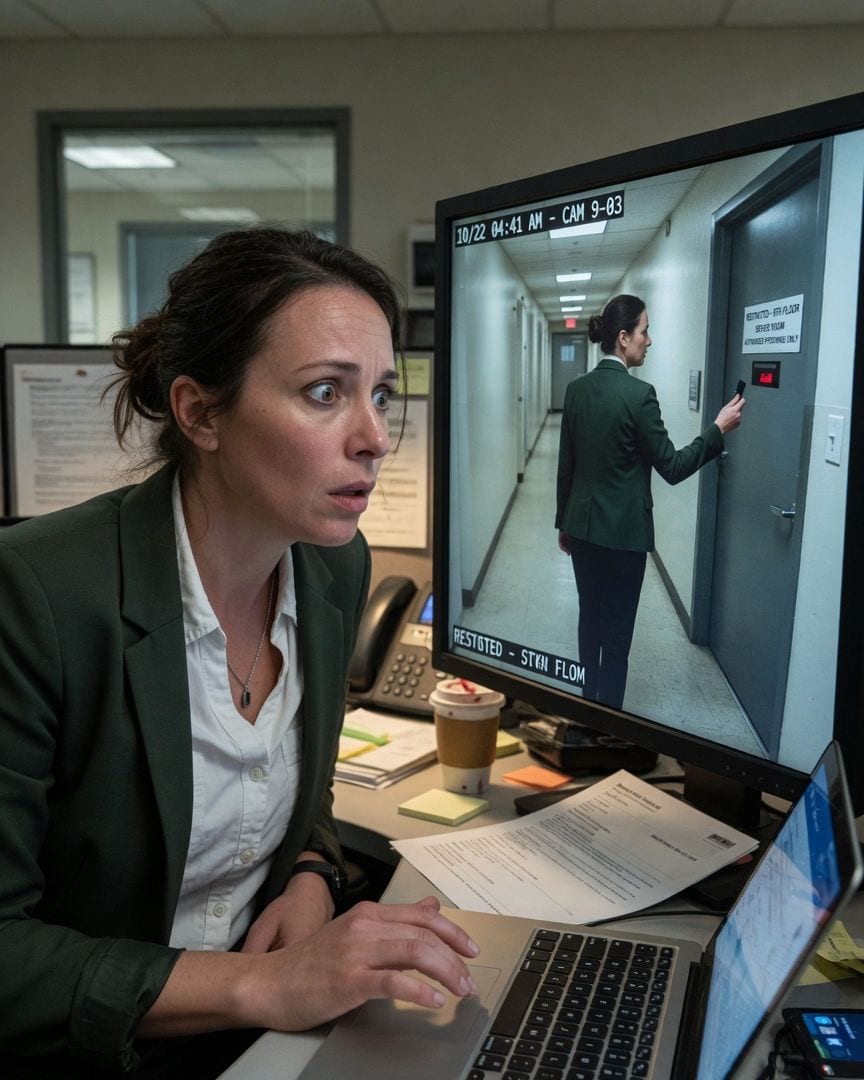
My keycard log shows me in the server room at 4:41am. I was asleep, and my badge was at home.
An email from corporate IT reveals my keycard registered entry into a restricted server room at 4:41 AM last Sunday. I was asleep in my apartment across town, my badge clipped securely to my jacket at home. But then I scrolled down and found eleven more impossible entries, all within the past week, all under my name.
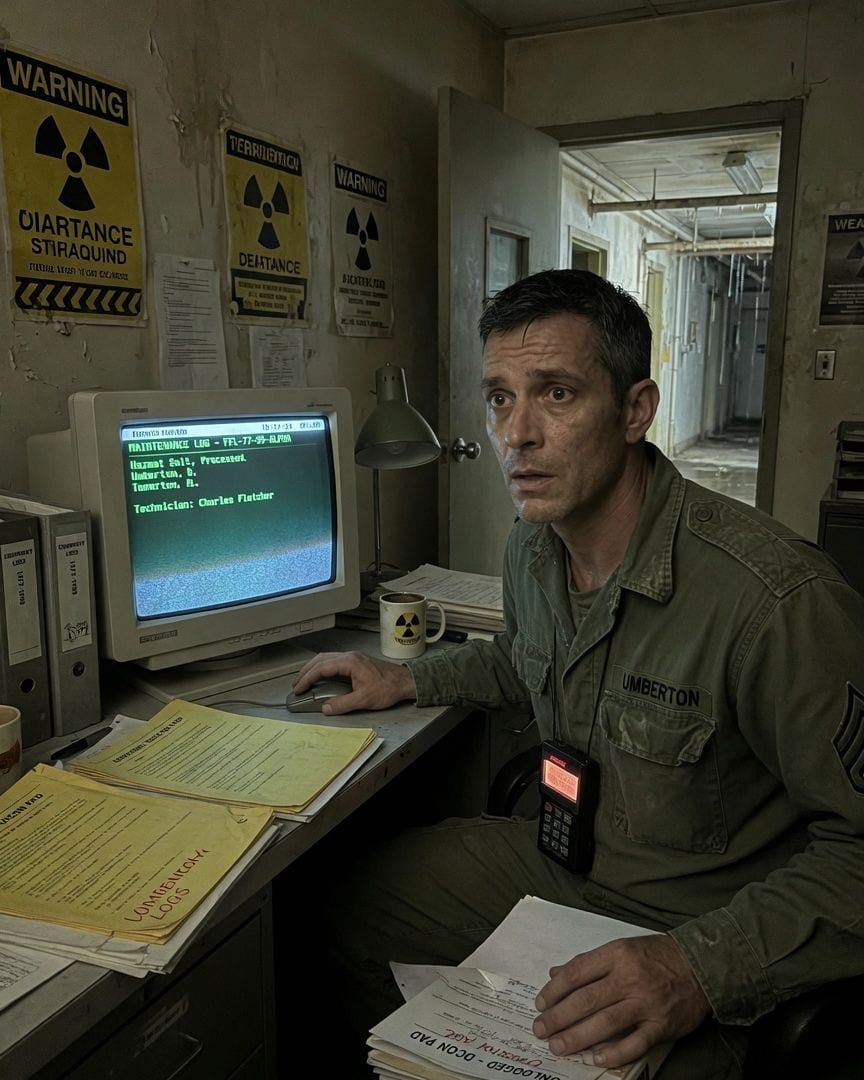
On his last shift at the closing Cold War facility, Sergeant Umberton found a hazmat suit glowing hot with his own name.
Sergeant Blaise Umberton walked his final shift at the soon-to-be-shuttered Ferriday Flats decontamination pad, the predawn air thick with ozone and the heavy silence of a closing era. His peace with the desolate site shattered when he discovered a hazmat suit, glowing faintly and shrieking on his Geiger counter, laid out with his own name stitched perfectly on the breast. Dismissed as a prank by his superior, Umberton followed protocol, but a cold dread compelled him to check the digital records of the facility's Cold War bureaucracy. There he found an entry for a hazmat suit processed under his name, dated for *tomorrow*, and signed by a technician who had retired a decade ago.