On his final rotation home, Sergeant Abbott counted his platoon: one man too many. The base’s secret files called them 'phantom units,' always watching him.
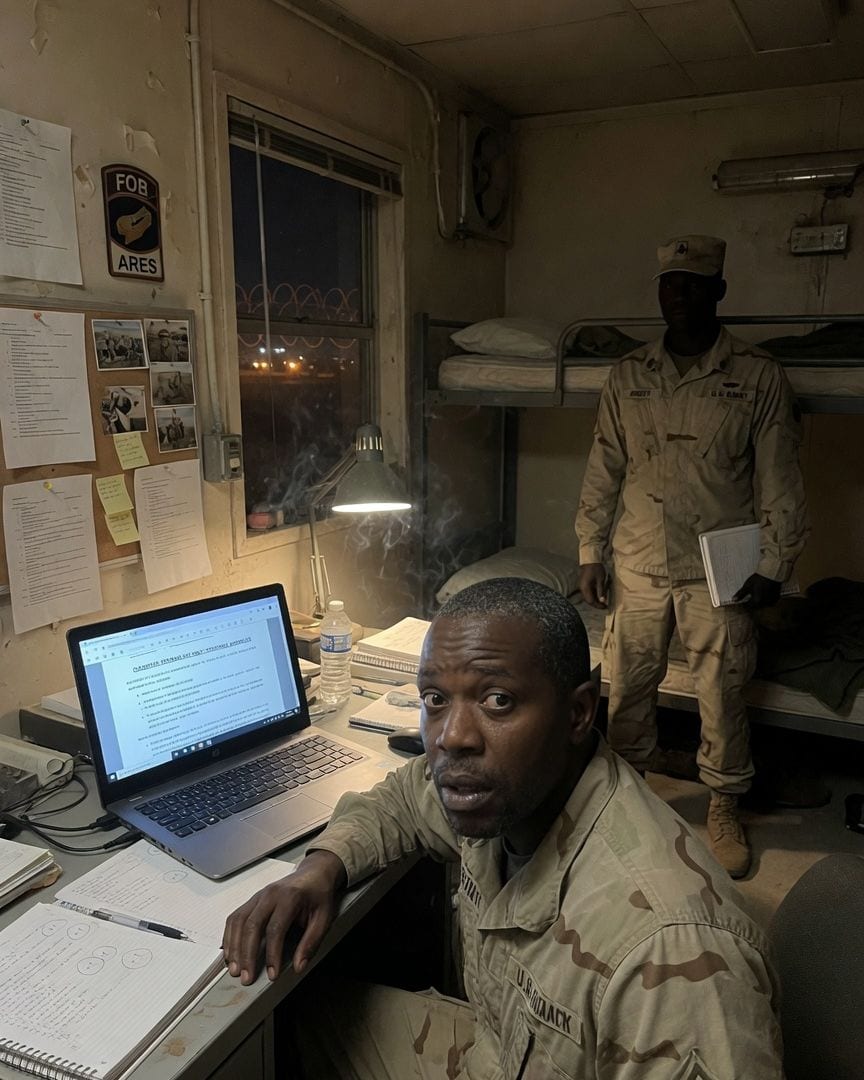
Sergeant First Class Malcolm Abbott, filling in as Platoon Sergeant at Forward Operating Base Ares, called the morning formation to attention. The sun was just breaking over the desolate desert horizon, casting long shadows across the dusty parade ground.
He snapped the count out, his voice sharp and practiced: 'One, two, three…' He ran the numbers twice, then a third time, his brow furrowing. The count came out seventy-seven. The roster, however, clearly listed seventy-six.
He knew the quiet, strange rule the regular Platoon Sergeant kept: if the count ever came up one man over, you re-formed, and you did not report it. But Malcolm was squared-away, by-the-book, and impatient.
This was his final rotation before transfer home, and he wasn't about to leave paperwork unresolved. He marched straight to the commander’s office, the over-count a stubborn knot in his mind.
When he next called formation, the extra man stood in the third rank, front and rear, left and right, always one more than the roster, always at rigid attention, always facing him.
Malcolm was the only soul in the formation who could see him.
Malcolm spent the rest of the day in his small, cramped office, a stack of digital manifests open on his laptop. He cross-referenced every name, every service number, every bunk assignment.
He called out names, confirmed identities with his battle buddy, Sergeant Olivia Drummond, who found no discrepancies. Every check confirmed it: seventy-six men were assigned to his platoon.
Yet, every time he mentally or physically tallied the formation, the extra man was there. He tried to rationalize it – fatigue, desert mirage, a prank.
But the extra man was too concrete, too perfectly aligned, too much a part of the official formation for such easy dismissal.
Its uniform was identical, its posture impeccable, only its face remained obscured in a perpetual shadow, like a trick of the light that persisted regardless of the sun’s angle.
Determined to find a mundane explanation, Malcolm began sifting through archived digital logs for FOB Ares. He focused on personnel manifests from previous rotations, specifically looking for any 'unaccounted personnel' or 'numerical discrepancies' linked to the Platoon Sergeant’s role.
He found a handful of entries, always marked 'discrepancy resolved' but with an underlying numerical oddity that didn't quite add up.
One log entry from five years prior, under a former Platoon Sergeant named Walter Thornton, simply stated: 'Formation count error. Re-formed. Still +1. No further action.' It was a tiny, almost invisible thread, but it snagged Malcolm's attention.
This wasn't a new problem.
Malcolm dug deeper into the base's digital archives, following the faint trail of 'unresolved count discrepancies.' He stumbled upon a restricted-access file, an addendum to the base’s standard operating procedures, marked 'CLASSIFIED: INTERNAL USE ONLY – PERSONNEL ANOMALIES.'
His heart hammered against his ribs, a frantic drum against the silence of his office. The document outlined an unwritten protocol for dealing with 'persistent numerical discrepancies' in personnel counts, specifically for the Platoon Sergeant’s role.
It described these 'extras' as 'phantom units' that 'must not be acknowledged or directly engaged.'
The text was clinical, detached, written with the cold precision of a regulation, but the implication was chilling: this wasn’t a hallucination; it was a known, documented phenomenon. He looked up from the screen, his mind reeling.
The extra man stood at the end of his bunk, perfectly still, watching him, its rigid attention fixed and unwavering, a silent sentinel in his personal space.
The sight of the extra man in his bunk sent a cold dread through Malcolm.
He pulled his sleeping bag tighter, trying to ignore the perfectly still figure, but its presence was a physical weight in the small room, a solid block of displaced air.
The next morning, the extra man was gone from his bunk but present in the formation, always in his peripheral vision, a shadow that moved with the ranks, yet stood with unnerving solidity.
Malcolm spent every spare moment cross-referencing the addendum's dates with archived personnel rosters. He meticulously tracked the service records of previous Platoon Sergeants who had served at FOB Ares.
The pattern solidified: those who had reported 'discrepancies' often requested immediate transfers under unusual circumstances, citing 'personal reasons,' or were medically discharged for 'stress-related psychosis.'
One such case, a Sergeant First Class Drummond from a rotation ten years prior, had been honorably discharged after a documented 'nervous breakdown' following weeks of 'unexplained sleep deprivation and paranoia.'
Malcolm tried to confide in Sergeant Olivia Drummond, his battle buddy, about the bizarre addendum and the phantom soldier. She listened patiently, her expression concerned, her hand resting briefly on his arm, a gesture of warm, human concern.
She gently suggested he was overworked, that the drawdown was getting to everyone.
'Maybe you just need some rest, Top,' she offered, completely oblivious to the extra man now standing a few feet behind her, perfectly at attention, watching Malcolm with an unblinking gaze that felt like a drill boring into his skull.
The mundane explanation failed, again.
Malcolm's attempts to access deeper, older digital archives were met with an escalating series of system errors. Files corrupted, access denied, even his secure login occasionally failed without explanation.
It felt less like a technical glitch and more like a deliberate, systemic wall, an unseen hand pushing him away. He shifted his investigation to physical records. The addendum had mentioned a 'restricted archive' in Sector Gamma.
Following a faded, hand-drawn map he'd found scrawled in an old maintenance log, he navigated through the labyrinthine, half-empty corridors of the base's administrative block, the air growing colder, dust thicker underfoot, kicking up ghostly plumes with each step.
He found a rarely used, unmarked office, its door slightly ajar. Inside, shelves overflowed with yellowed file boxes and forgotten, obsolete equipment. A faint, metallic tang hung in the stagnant air.
Tucked away beneath a pile of old supply requisitions, almost completely hidden, he found it: a heavy, leather-bound logbook, its cover bearing the faded inscription 'FOB Ares: Platoon Sergeant's Daily Log.'
It wasn't digitized, a relic from a time before everything went online. As Malcolm carefully opened the brittle pages, a sudden, sharp flicker plunged the room into momentary darkness, making the shadows leap and writhe.
From the empty office next door, he heard it: a faint, rhythmic tap-tap-tap, like heavy boots on concrete, perfectly in time, approaching his door. He froze, straining his ears, the blood pounding in them.
The sound stopped, directly outside his door. He looked up, and in the grimy windowpane, the faint reflection of the extra man stood directly behind him, mirroring his posture with chilling accuracy.
Malcolm spun around, his hand instinctively going for his sidearm. The office was empty, the door still slightly ajar, the only sound the rattling of the old fluorescent light as it hummed back to life, casting an unsteady, sickly glow.
Malcolm snatched a few pages from the logbook, tearing them free with a desperate urgency, stuffing them into his tactical pouch, before the unsettling silence in the next office became too much to bear.
He retreated quickly, his heart pounding, the sound echoing in his ears louder than his own footsteps. Back in his office, under the harsh glare of his desk lamp, he examined the retrieved pages.
The logbook belonged to Sergeant First Class Walter Thornton, the same name he’d seen in the five-year-old digital entry. Thornton's handwriting, initially steady and precise, grew increasingly frantic and sprawling across the pages.
It detailed a series of 'anomalous personnel events' dating back decades, all at FOB Ares, always centered on the Platoon Sergeant's count.
Thornton's entries described the 'extra' as a 'systemic echo,' a manifestation that occurred when the base’s operational integrity was compromised or altered, like during a drawdown or major rotation.
'It seeks to be integrated,' Thornton had scrawled in one entry, the ink blurring, 'to be acknowledged as part of the count, even when it cannot be.'
He described how the entity would attach itself to the individual responsible for maintaining order and count, subtly trying to make them acknowledge its reality, to draw them into its impossible numbers.
'My mind rebels against the impossible, yet my eyes betray me,' read a chilling line, underlined three times. Malcolm re-read his own digital findings, the 'discrepancy resolved' tags now taking on a sinister new meaning.
The previous Platoon Sergeants hadn't just seen the extra man; they had been targeted by it, drawn into its impossible system, their minds slowly unraveling as they tried to reconcile the irreconcilable.
The logbook ended abruptly, the last legible entry from Thornton describing his 'growing inability to distinguish between the counted and the uncountable,' his handwriting dissolving into an almost illegible scrawl that looked like claw marks.
The dread became a cold certainty: this wasn't just happening to him; it had been happening for generations. The base wasn't just a physical place; it was a living, counting entity, and the extra man was its persistent, unacknowledged shadow.
Malcolm flipped to the final, torn page of Thornton’s logbook. Beneath the scrawled, desperate last entry, there was a list. A column of names, seemingly random, with dates next to them. Not dates of deployment, but single, isolated years.
He recognized some of the names from the 'stress-related psychosis' medical discharges he’d found in the digital archives. He cross-referenced these names with the historical rosters he’d meticulously compiled, his fingers fumbling with the digital files.
A cold, sharp gasp escaped him. These were the names of soldiers who were never officially assigned to FOB Ares, yet they appeared in the 'over-counts' of past formations, alongside the legitimate soldiers.
They were the 'phantom units' themselves, or perhaps, the victims who had become them, integrated into its impossible numbers. His eyes scanned the list, dread coiling in his gut, a cold knot tightening with every name.
And then he saw it. Near the bottom, in Thornton’s increasingly shaky hand: 'Abbott, Malcolm – 2019.' A date from a rotation five years ago. A rotation Malcolm was not on. He had been stationed halfway across the globe then.
It was linked to an earlier entry about an 'unresolved count discrepancy' from that year. His own name.
He wasn’t just perceiving the extra man; he was part of its history, retroactively written into its impossible roster, claimed by something long before he even arrived.
The extra man stood directly in front of his desk in his small, private office, its face obscured by shadow, but its rigid attention fixed intently on him, a silent, undeniable claim.
The realization detonated in Malcolm’s mind with the force of an IED.
The entity wasn't just an 'extra' in the traditional sense; it was a placeholder, inserting itself into the system, and it also generated identities for those it targeted, drawing them into its own internal 'roster.'
The names in Thornton's log weren't just past victims; they were the names the entity had assigned to its current perceivers, a way of integrating them, of making them part of its impossible count.
And now it had assigned one to Malcolm, too, retroactively inserting him into its own history, claiming him before he even set foot on the base. The base's phased drawdown was the catalyst, making the entity desperate.
As the physical structures of FOB Ares were dismantled, its 'systemic echo' intensified, seeking to secure its place before its entire operational framework was dissolved.
It didn't want to be removed from the count; it wanted to be the count, to assimilate the counter, to make them part of its permanent, unresolvable tally.
Malcolm understood now: the extra man wasn't a ghost haunting the base; it was the base, or at least, its persistent, unacknowledged consciousness, desperately trying to maintain its existence through the only means it knew: being counted.
And he, Malcolm Abbott, was its newest entry, its newest counter, its newest phantom.
Malcolm, now burdened by this terrible understanding, tried to complete his final checks before his scheduled transfer.
His rotation was officially ending in two days, but the weight of the extra man’s presence made every action feel like a struggle through thick air.
It stood in the mess hall as he ate, its silent form always in his peripheral vision, like a missing piece of the wall that should be there.
It stood in the motor pool as he signed off equipment, its rigid attention fixed. It stood in the barracks as he packed his duffel, a constant, inescapable presence that leeched the heat from the room.
Always just there, rigid, silent, its face still obscured by shadow, yet its gaze a palpable weight, a constant pressure. He knew he couldn't leave until his section's final inventory report was reconciled.
It was the last, critical piece of paperwork before his transfer could be finalized, the last hurdle before escape. He sat at his laptop, the inventory sheet open, a grid of numbers and item codes on the screen.
Every bolt, every wrench, every spare part had to be accounted for, to the last decimal. He began inputting the numbers, meticulously, precisely, his fingers flying over the keys.
He reached the final digit, a long string of numbers representing the total value of his section's assets. He pressed 'Enter.' The system flashed an error message, stark red against the green: 'OVER-COUNT: +1 UNIT.'
Malcolm deleted the entry, his fingers trembling, and re-entered it. The exact same error. Again. And again. He tried to override it, to force the system to accept the correct number, slamming his fist on the desk in frustration.
It refused, the message mocking him with its stubborn redness. He looked up, his eyes falling on the extra man, who now stood directly opposite his desk, less than an arm's length away.
The shadows on its face seemed to shift, coalesce, and then, faintly, unmistakably, he saw it. The extra man was smiling. A subtle, impossible shift in its rigid expression, a silent, knowing triumph, cold enough to freeze the room.
Malcolm understood. There was no escaping the count. He couldn't leave the base until the count reconciled. And it never would. He was part of it now, forever tasked with an impossible tally.
Sergeant First Class Malcolm Abbott’s transfer orders were quietly rescinded due to 'unresolved administrative discrepancies.' His battle buddy, Sergeant Olivia Drummond, tried to intervene, marching up the chain of command, but the paperwork was firm, impenetrable.
Malcolm remained at the dwindling FOB Ares, perpetually stuck on the 'final rotation,' tasked with endless, futile inventory checks of a section that was now almost entirely empty.
Other soldiers rotated out, their tours ending, their faces a mix of relief and confusion as they left him behind. But he stayed.
The base slowly emptied around him, becoming a ghost town of sand-swept barracks and silent motor pools, the wind whistling through broken windows. The system, relentless and unyielding, held him fast. He was still counting.
Sergeant First Class Malcolm Abbott is seen walking the perimeter of the nearly abandoned forward operating base, meticulously counting the fence posts, each step precise, his gaze sweeping the desolate landscape.
He stops, looks back at the empty barracks, then out at the desolate desert, a vast, indifferent expanse. He smiles faintly, a subtle, wrong little smile, then continues his count, walking alone.
If this one got to you
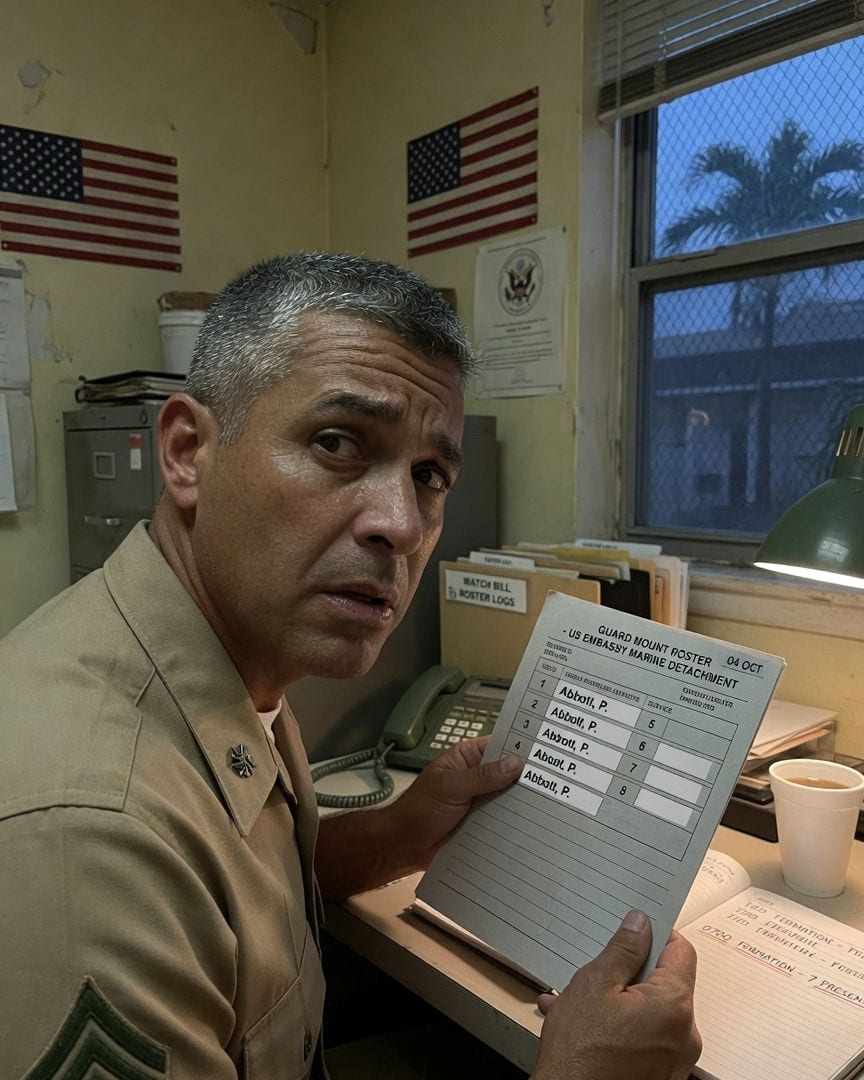
A meticulous Marine Sergeant counted eight men for guard mount, but his roster showed seven. The extra Marine gave a name already called, and a service number that was perfectly blank.
Sergeant Gordon Belanger, a career Marine NCO a month from his rotation, stood in the pre-dawn chill of the embassy courtyard. His meticulous count for guard mount revealed eight Marines, but the official watch bill listed only seven. When he confronted the extra man, the Marine gave a name already called, identical to the man standing beside him. Belanger's investigation of the impossible duplicate only deepened the mystery, as all records swore only seven Marines were present. Yet, his own signed roster confirmed an eighth man, whose service number was a stark, unnerving blank.
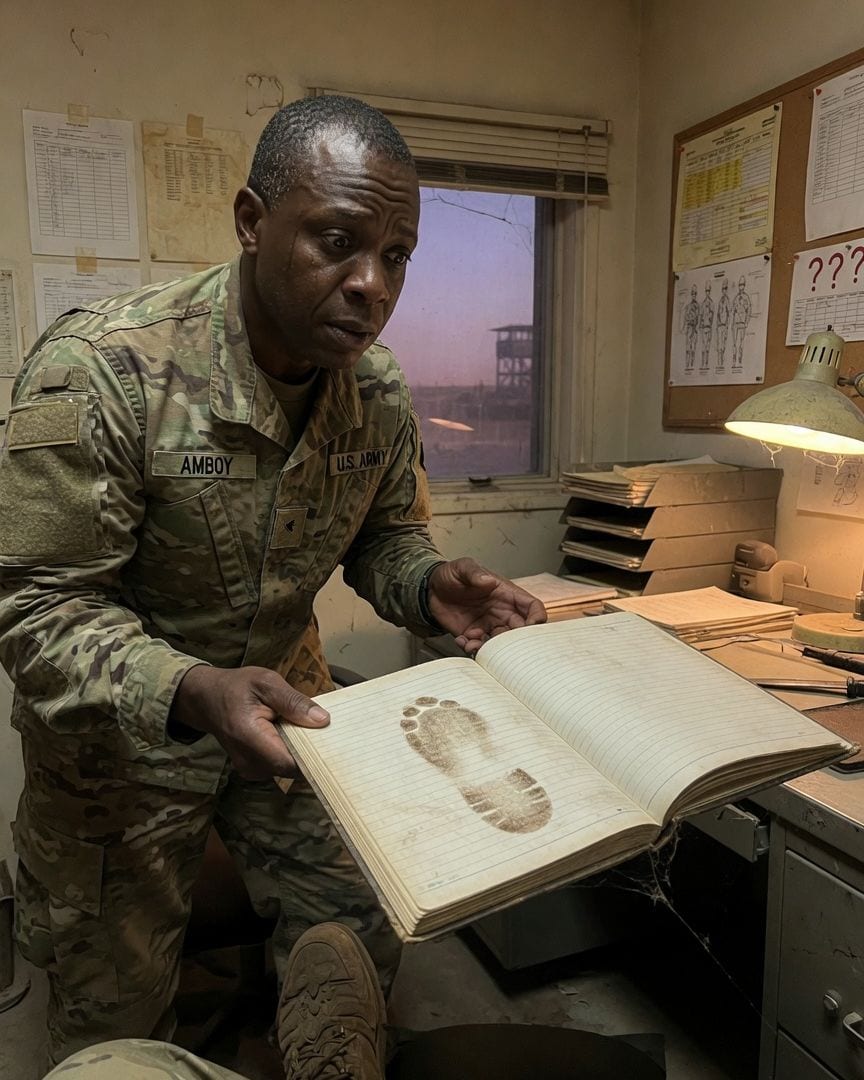
A Platoon Sergeant finds a hidden logbook, and on its last page, a bootprint matches his own sole exactly.
Sergeant First Class Nathaniel Amboy, a by-the-book NCO, was eager to complete his temporary assignment at the desolate FOB Kestrel. During a routine morning formation, his count came up one man over, a discrepancy he promptly reported to Captain Hughes, dismissing an old, superstitious warning. But that evening, after a correct count, an extra soldier shimmered into existence behind the last man, solid and silent, visible only to Amboy. As the phantom soldier persisted, defying all reason, Amboy's search for answers led him to a hidden logbook, where a bootprint on the last page matched his own combat sole exactly.
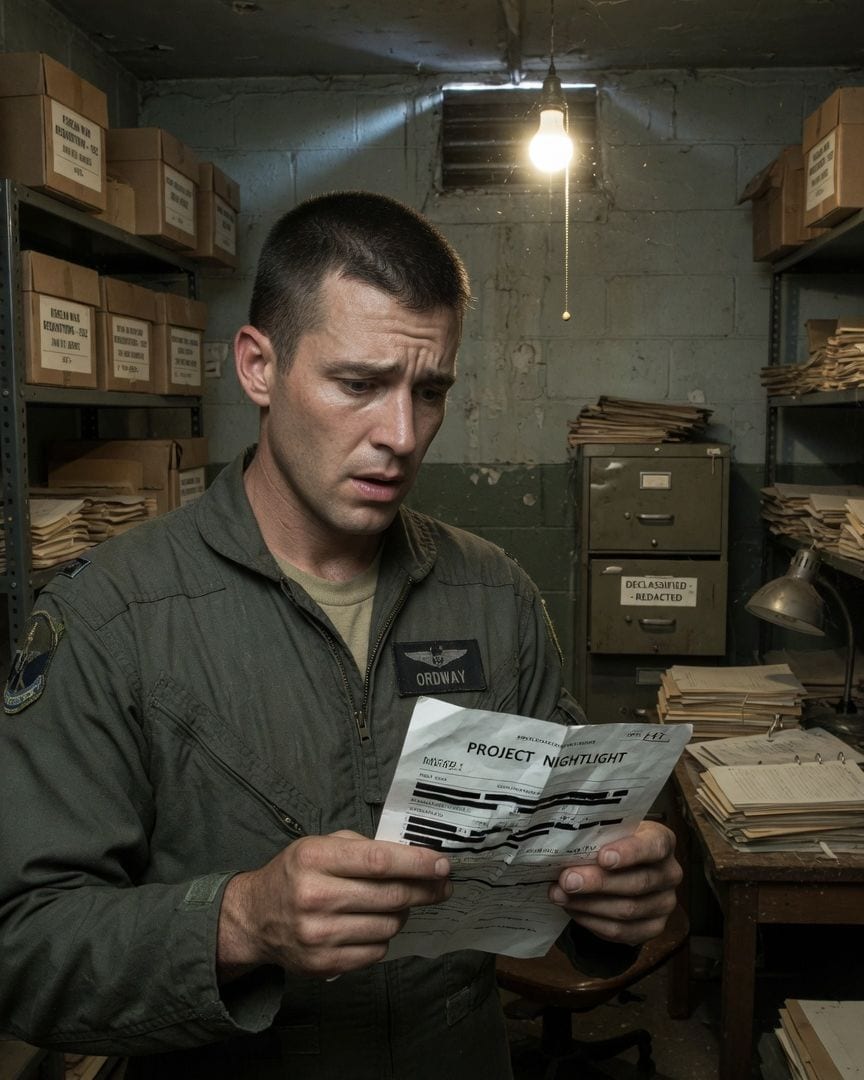
A Cold War pilot's F-104 Starfighter was shadowed by an impossible object. Weeks later, a secret memo referenced his own service number for 'pilot reassignment protocols.'
First Lieutenant Cal Ordway soared over the Mojave in his F-104 Starfighter in 1962, the night sky a familiar canvas. But that night, one 'star' broke formation, pulling alongside his wing and mirroring his every impossible maneuver. His instruments confirmed the silent, unblinking object, defying all known physics. After filing his precise report, Cal found his flight log altered to 'no incidents,' radar tapes corrupted, and a superior advising him to 'let it go.' Driven by his training, he uncovered a heavily redacted memo referencing 'Project NIGHTLIGHT' and, chillingly, his own service number for 'pilot reassignment protocols initiated.' Was he merely a witness, or already a subject in a much deeper secret?
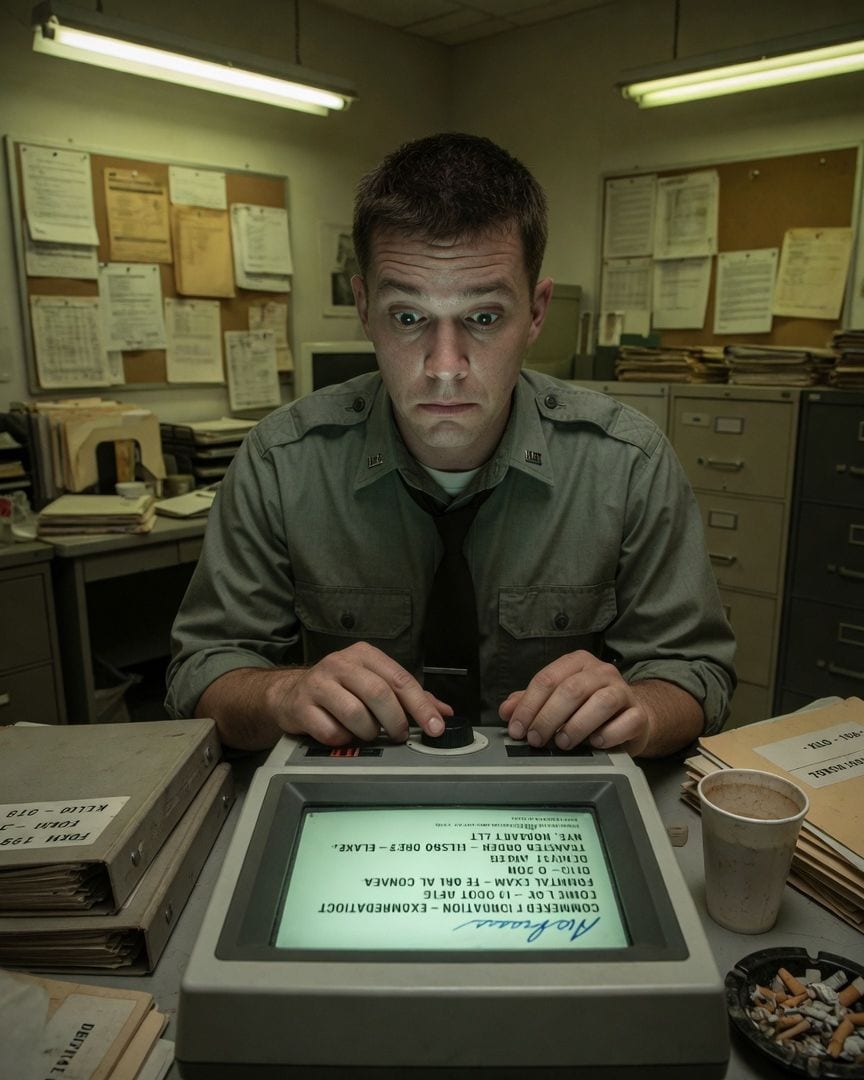
A missile commander watched his ten nuclear silos go dark. His own service record shows his signature on a future he's never lived.
Second Lieutenant Hobart Nye, a missile commander in Wyoming, had his quiet 0247 watch shattered by a security report: a massive, silent black triangle hovered over Launch Facility Kilo, casting a perfect shadow. Hobart watched his console's fault panel light up, signaling all ten nuclear missiles going dark in an impossible silence, followed by eleven minutes his security team could not remember. Official logs called it a "radio malfunction," but Hobart found a requisition for invisible-tracking sensors, signed by a base commander who was supposed to be off-base. The final, chilling discovery came when his own service record showed new entries—a dental check-up, a transfer to Alaska—all dated for a future he never lived, complete with his perfectly replicated signature.
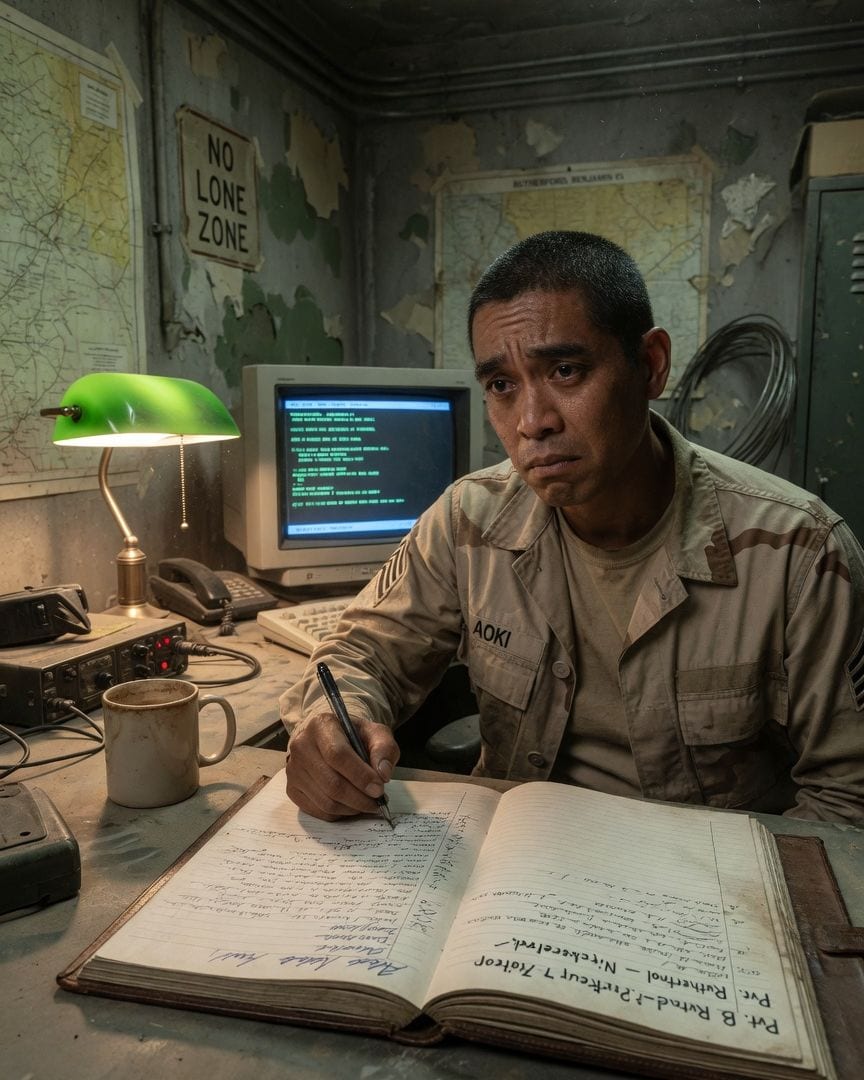
Sergeant Aoki's four-man patrol hears a fifth voice answer their count. A fresh name then appears in the duty log beneath his own signature.
Sergeant Isaac Aoki's final rotation at Outpost 7 was nearing its end, with relief due at dawn. On his four-man night patrol, he broke an old superstition, counting his team aloud in the dust-choked desert. A fifth voice answered, clear and unsettling, from the moonless dark. Back inside the bunker, the chill deepened when a fresh name appeared in the duty log, 'Pvt. B. Rutherford,' beneath Aoki's own signature, a soldier no one knew. Even more disturbing, Aoki later found his own signature on a valor citation for Rutherford, an event he never witnessed.
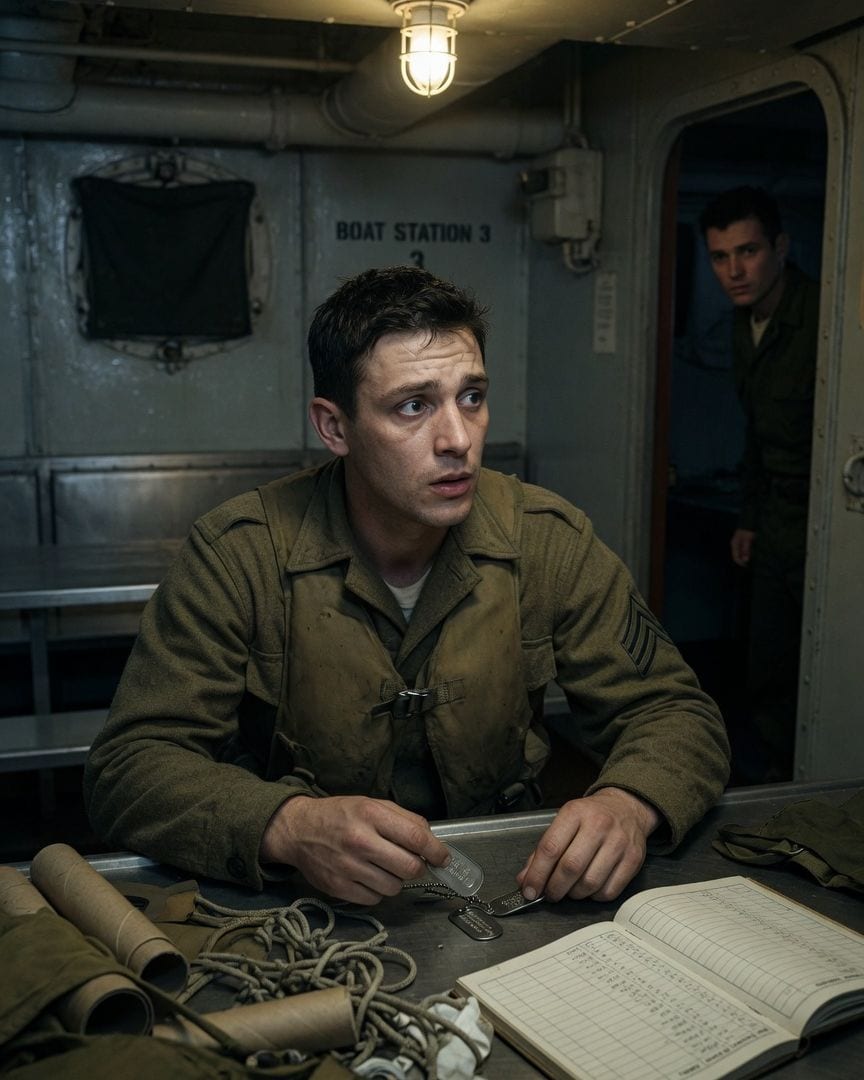
Corporal Desmond Novak counted 402 men onto his last troopship crossing. At boat drill, 403 stood in formation. Then he found two identical dog tags for the same soldier.
Corporal Desmond Novak was meticulously squaring away his last troopship crossing before transfer to shore duty on the USS Vance in 1943. He carefully counted 402 infantrymen onto the blacked-out vessel. But at the first boat drill, under dim emergency lights, 403 men solidified in formation, an impossible count that gnawed at him. Despite cross-referencing every roll, the extra man was always there, yet never the same twice. Then, tucked beneath rope in an emergency kit, Novak discovered a second, identical dog tag for Private Adam Hughes, a man he'd just seen in line, and a cold dread began to solidify.