Corporal Desmond Novak counted 402 men onto his last troopship crossing. At boat drill, 403 stood in formation. Then he found two identical dog tags for the same soldier.
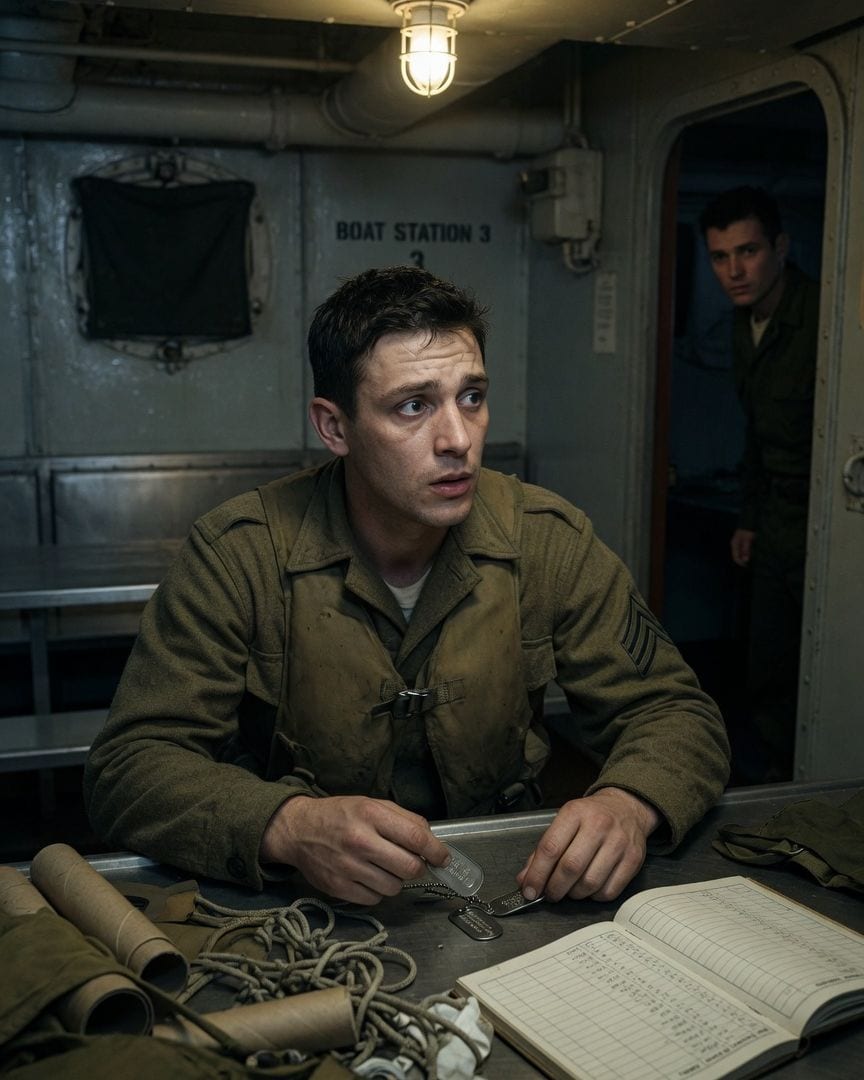
The metallic tang of salt and cold permeated the USS Vance, a blacked-out troopship cutting through the churning Atlantic in 1943.
Corporal Desmond Novak, a man whose reputation for meticulousness was both his pride and his burden, shivered slightly as he moved through the cramped passages. His last crossing before transfer to shore duty, and he wanted everything squared away.
At the first boat drill of the voyage, he’d counted the embarked infantrymen, compartment by compartment, against the embarkation roll: four hundred and two men. A precise, undeniable figure.
But then came the call to boat stations, and when the formations solidified under the dim emergency lights, a chill that had nothing to do with the sea air prickled the back of his neck. Four hundred and three.
He re-counted, his lips moving silently, his eyes scanning each face. Again, four hundred and three. He called out names from the roll, every single one, and every name drew a man, loud and clear.
Four hundred and three soldiers stood to the boats that four hundred and two had boarded at the pier. He ran the numbers again in his head, the impossibility a cold knot in his gut.
The count was always four hundred and three. Always.
Desmond spent the next few days in a quiet, frantic chase. He double-checked the embarkation roll against the port authority's manifest, cross-referenced with the ship's own internal roster. All confirmed 402 men. He tried to identify the 'extra' man.
He was always there, standing perfectly in formation, always responsive to a name on the roll, but never seemed to be the same individual twice when Desmond tried to pinpoint him.
He tried to corner men from the formations, asking discreet questions, but no one remembered a new face, or a face that didn't belong. The soldiers were a sea of tired, worried, and bored uniformity. The impossibility gnawed at Desmond.
He decided to check the emergency kits at each boat station, a long shot for a forgotten tag. Working late in the empty mess hall, he spread out the contents of Kit 7, assigned to Boat Station 3.
Among the flares and first-aid supplies, tucked beneath a coil of rope, he found it: a dog tag. Not a misplaced one, but an extra. Identical to the standard issue, bearing the name 'Private Adam Hughes'.
Desmond recognized the name; Private Hughes was a quiet, unremarkable man, assigned to C-Company, and Desmond had personally seen him at Boat Station 3 during every drill. Yet here was another tag.
He stared at the two identical tags, one in his hand, one on the man standing in line, and a cold dread began to solidify. This wasn't a clerical error. It was something far more deliberate, far more unsettling.
The thought that the tag implied an actual duplicate, not merely an extra, made his blood run cold. He looked up, his gaze sweeping the empty mess hall, a sudden, acute sense of being watched washing over him.
Desmond’s fingers tightened around the extra dog tag. He knew Private Adam Hughes, had seen him at his boat station, a quiet man. Yet this tag, identical in every detail, lay in his palm.
He pulled out the embarkation roll and found Hughes's name, confirming his presence. Then he thought of the 'extra' man, the one who always made the count 403. He pictured the formations.
He remembered a face, generic, disciplined, yet subtly unsettling in its perfection. He looked at the tag again. He looked at the name. And then he looked up from his work, his gaze drawn to the mess hall doorway.
The 'extra' man stood there, not in uniform, but in dark fatigues, observing him. Not Private Hughes, not exactly. The same features, yes, but subtly wrong, like a reflection in rippled glass.
The man’s eyes met Desmond’s, a flicker of something unreadable, before he turned and melted back into the shadows of the corridor.
The encounter in the mess hall left Desmond shaken. He spent the next few days discreetly observing the man he now thought of as the 'duplicate Adam Hughes'.
The man was a phantom, appearing and disappearing, always present during drills, yet never quite integrated into the daily life of the troopship.
He never seemed to speak, was rarely seen eating in the mess, and moved with a strange, almost too-perfect discipline that set him apart from the weary, grumbling soldiers.
Desmond began to search for any other records that might shed light on this impossible occurrence. He focused on old manifests of the USS Vance, particularly previous transatlantic crossings.
He spent hours in the ship's cramped records office, a place smelling of mildew and old paper, poring over brittle ledgers.
He found nothing explicit about 'extra' men, but he did find cryptic entries in various supply logs and personnel manifests, signed by officers long since rotated off the ship.
Entries for 'unassigned personnel' or 'variable factors' that, when cross-referenced with the official troop counts, always corresponded to a single missing man. The numbers always balanced, eventually, but the language was unsettling.
He approached Ensign Sophia Brooks, the ship's log officer, a sharp young woman who typically prided herself on the Vance's impeccable record-keeping. He showed her the odd entries, hoping for an explanation.
She initially dismissed them as wartime accounting quirks, or perhaps the 'known personality' of the old ship, which had a reputation for 'ghosts' among some of the older crew.
“Every old ship has its stories, Corporal,” she’d said, a nervous laugh in her voice. “Don’t go chasing shadows.” But Desmond saw a flicker of unease in her eyes.
Desmond’s persistent inquiries did not go unnoticed. A week later, Captain Harold Blackwood summoned him to his cabin.
The Captain, a stern man with a grizzled beard and eyes that had seen too much war, spoke in a calm, measured tone. Ostensibly, the meeting was about a minor discrepancy in Desmond’s supply reports, quickly resolved.
But the Captain’s questions then shifted, subtly, to Desmond’s recent activities. “You’ve been spending a good deal of time in the archives, Corporal,” Blackwood stated, his gaze unwavering. “Anything of particular interest? Morale issues, perhaps?”
Desmond felt a cold prickle of unease. He gave vague answers, sticking to his official duties. Blackwood nodded slowly, his expression unreadable. “Maintain focus, Corporal. These are trying times. Distractions are… ill-advised.” The message was clear.
That night, Desmond found his personal logbook, where he meticulously documented his observations, slightly disturbed. A page where he’d sketched a crude likeness of the 'extra' man had been creased, a faint thumbprint on the margin.
He felt a chill that had nothing to do with the draft in his bunk.
Later, on a late-night patrol of the main deck, he found Chief Petty Officer Walter Thornton, an old salt who’d served on the Vance for decades, leaning against a bulkhead, smoking a pipe.
Thornton watched him approach, his eyes rheumy in the dim light. “Some things on this ship are best left uncounted, son,” Thornton rasped, his voice barely a whisper. “The sea keeps its own tally, and it don’t care for ours.
Ask too many questions, and you might find your own name on a manifest you don’t recognize.” He took a long drag from his pipe, the ember glowing like a baleful eye in the darkness.
Desmond couldn't shake Thornton's warning, but the impossibility of the situation drove him on. He sought out Ensign Brooks again, this time with a grim determination.
He showed her the duplicate Adam Hughes dog tag, laid it on her desk next to the official manifest. “This man is here,” he said, tapping the manifest. “And this tag belongs to him. But I found an identical one.
And there’s always an extra man.” Brooks’s composure finally cracked. Her face went pale. “There’s… there’s something the Captain keeps locked away,” she stammered, her voice barely audible. “A section of the old archives. Only command has the key.”
Desmond pressed her, asking about the cryptic entries for 'variable factors'. She confessed that the older logs sometimes had a note, a single word: 'Reconciled.'
She led him to a heavy, iron-bound door at the very back of the ship's archives, hidden behind a stack of moth-eaten flags.
The lock was old, complex, and Ensign Brooks produced a small, tarnished key from a hidden compartment in her desk. Inside, the air was thick with the scent of stagnant water and ancient paper.
At the bottom of a heavy, metal safe, Desmond found it: an unofficial captain's log, bound in salt-stained leather. It wasn’t Captain Blackwood’s.
Flipping through the brittle pages, Desmond found entries describing similar 'extra' men on previous voyages, chillingly similar to his own observations.
The log detailed how these 'extra' men would appear, always making the count exactly one man over, and then, mysteriously, vanish, always followed by an entry of 'Reconciled' in the official records.
One passage sent a shiver down his spine: 'The Vance’s purpose is not merely transport. It is a vessel. The deep has its due, and the manifest must reflect the tally, no matter the means.
The Variable Factor ensures the count.'
The log explicitly described the 'extra' man not as a ghost, but as a 'reconciler,' a physical manifestation that ensured the ship's manifest always matched a specific, unnatural quota, a number maintained for an unseen purpose tied to the ocean itself.
The dread was no longer about a mistake, but a deliberate, systematic fulfillment of an impossible, monstrous contract.
Desmond’s hands trembled as he continued to read the unofficial log.
The entries became increasingly disturbing, detailing how the 'reconciler' would appear when the 'true count' of living souls dipped below the required quota, ensuring the entity's tally was always met.
Then, he found it: a detailed record of an 'extra' man being formally 'transferred' off the ship mid-ocean, complete with a signed order. The signature was unmistakably 'H. Blackwood'. Desmond’s breath hitched.
But the date on the order was from 1937, years before Captain Harold Blackwood had taken command of the USS Vance.
The destination unit listed was 'Deepwater Research Project 7,' a known code for a defunct, rumored deep-sea operation from the 1920s that had vanished without a trace.
It was an impossible falsification, a deliberate lie woven into the very fabric of the ship's history, spanning decades, defying all logic. The Captain knew. He wasn't just aware; he was part of it, part of a chain of custodians.
The 'accountability that cannot be' wasn't just a glitch in the system; it was the system itself. Desmond heard the distinct, heavy thud of footsteps echoing in the corridor outside the archive door, approaching slowly, deliberately.
He scrambled to close the log, his heart hammering against his ribs.
The heavy archive door swung open. Captain Blackwood stood framed in the doorway, his face unreadable. He didn't ask what Desmond was doing. Instead, he simply stepped inside, closing the door behind him with a soft click that echoed ominously.
“You’ve found it, Corporal,” Blackwood said, his voice calm, devoid of anger. “The Vance’s true purpose.” He explained, not in anger or fear, but with the weary resignation of a man fulfilling an ancient duty.
The USS Vance, he revealed, was indeed a vessel, one of several, used for a peculiar, archaic pact. An entity in the deep ocean, he explained, required a precise number of 'presences' to be maintained on board during its crossings.
The 'extra' man, the 'reconciler,' was a physical manifestation that appeared to fill any 'deficit' in this quota. “It ensures the tally is always met,” Blackwood said, his eyes distant.
“If a man is… claimed, or lost to the sea, the void is filled. The numbers, in the end, always balance.” The military's accountability, he explained, was merely a facade.
The ship’s records were always reconciled, often retroactively, by an unseen, undeniable force. Blackwood himself was a custodian, part of a long line, ensuring the 'contract' was honored. He pulled a peculiar, ancient-looking brass compass from his pocket.
“This,” he said, holding it out, “always points to where the deep makes its claim.” It spun wildly, then settled, pointing to a spot on the ocean that no chart acknowledged.
Desmond, reeling, tried to argue, to make sense of the madness. “This is insane, Captain! We have to report this!” Blackwood merely shook his head. “To whom, Corporal? And what would you report?
A man who is there, and then is not? A number that shifts, then settles? The system, as you’ve seen, corrects itself.” He explained the true horror: the 'extra' man wasn’t an addition.
It was a replacement, a placeholder for a soldier who had been subtly 'claimed' by the entity. The process was slow, insidious, beginning with a quiet withdrawal, a fading of the spark, until the man was merely a shell.
The 'reconciler' then appeared, ensuring the 'account' remained full. Blackwood pointed to a specific soldier in the crew manifest he held, a young Private named Gideon Fairfax, a man Desmond had noticed seemed increasingly withdrawn, quiet, his eyes distant.
“He was the one this voyage,” Blackwood stated, his voice devoid of emotion. “His presence was… fulfilled.” Desmond watched the next boat drill from a hidden vantage point, his gut churning.
The 'extra' man was there, standing perfectly, flawlessly, in Fairfax’s spot, answering to Fairfax’s name. The original Gideon Fairfax was gone, assimilated, his unique spark extinguished, yet his form, his presence, was still 'accounted for' by this uncanny duplicate.
The dread was not for his own survival, but for the silent, ongoing theft, the knowledge that the ship was a trap, constantly taking, always balancing its ledger in a way that defied humanity.
He was powerless to stop it, to even prove it. The military system, designed for ultimate accountability, had been co-opted, its very mechanisms used to perpetuate an unspeakable horror.
The USS Vance completed its crossing without further incident. Corporal Desmond Novak's transfer to shore duty proceeded as planned, his service record impeccable. No official report of any anomaly was ever filed.
Ensign Sophia Brooks remained on the Vance, her face a little paler, her eyes a little older, a haunted look replacing her former sharpness. Captain Harold Blackwood continued his command, his demeanor unchanged, his secret burden carried with grim resolve.
The 'extra' man, the 'reconciler' that had stood in Gideon Fairfax’s place, was no longer seen at boat drills after the ship docked, its purpose fulfilled. The manifests, once again, balanced perfectly.
Years later, a veteran, Desmond Novak found himself staring at an old newspaper clipping about the USS Vance being decommissioned, scrapped for parts. He remembered the cold, the counting, the extra man.
He knew the ship’s true purpose was never about war, but about a silent, insidious tally.
Sometimes, in a crowd, he would catch a glimpse of a blank, too-perfect face, a flicker in the periphery, and the cold dread would return.
He never spoke of it, the truth too impossible, too easily dismissed as wartime trauma, but he carried the knowledge like a lead weight in his soul, the certainty that some things simply could not be accounted for by any human system.
Decades later, a retired Navy historian, compiling records on decommissioned vessels, found a peculiar discrepancy in the USS Vance's final manifest: one sailor, Private Gideon Fairfax, listed as having transferred off mid-crossing in 1943, had no corresponding record of ever arriving at his listed destination, or any other.
The historian noted the name, then set the file aside, a faint, unsettling echo of a number that never quite added up.
If this one got to you
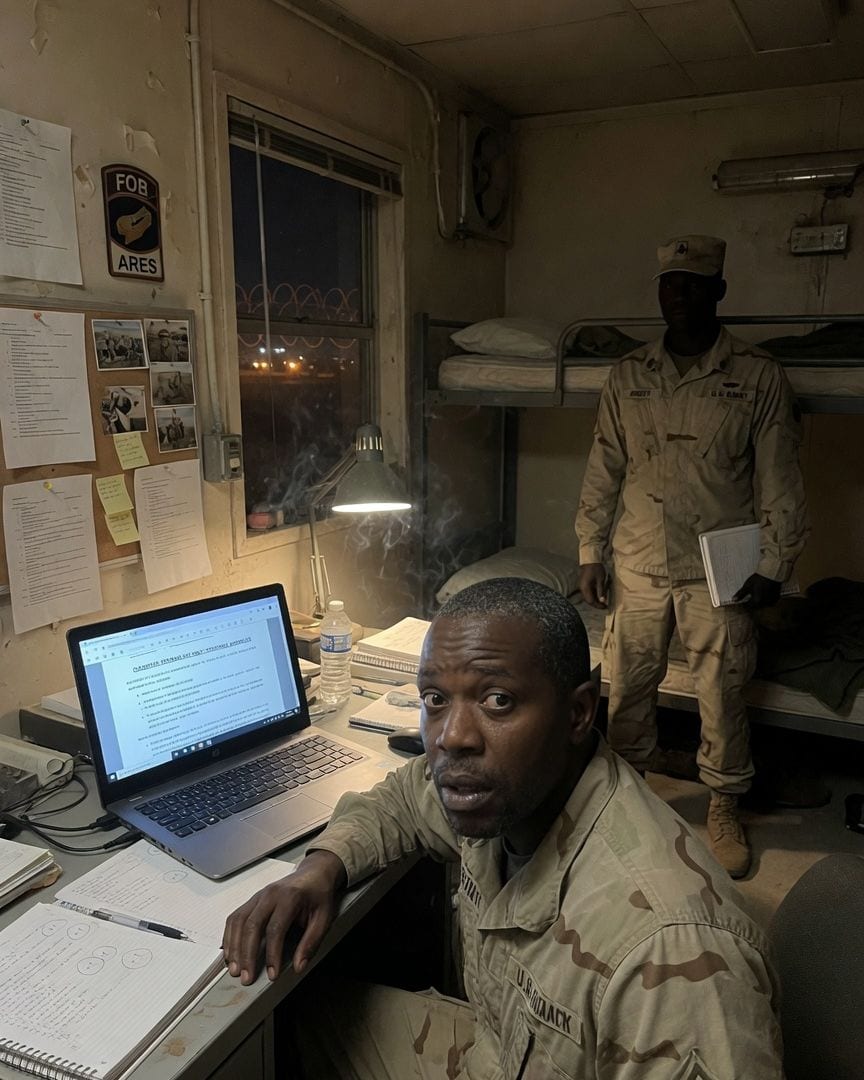
On his final rotation home, Sergeant Abbott counted his platoon: one man too many. The base’s secret files called them 'phantom units,' always watching him.
Sergeant First Class Malcolm Abbott was on his final rotation at FOB Ares, ready for transfer home. He called his platoon to formation, watching the sun break over the desolate desert as he counted each man. But the numbers didn't add up; there was always one extra soldier, standing at rigid attention, perfectly aligned with the others, yet only Malcolm could see him. Despite cross-referencing every manifest, the phantom remained, its face obscured in shadow, a silent sentinel that defied all logic. What secret did the base archives hold about these unacknowledged personnel?
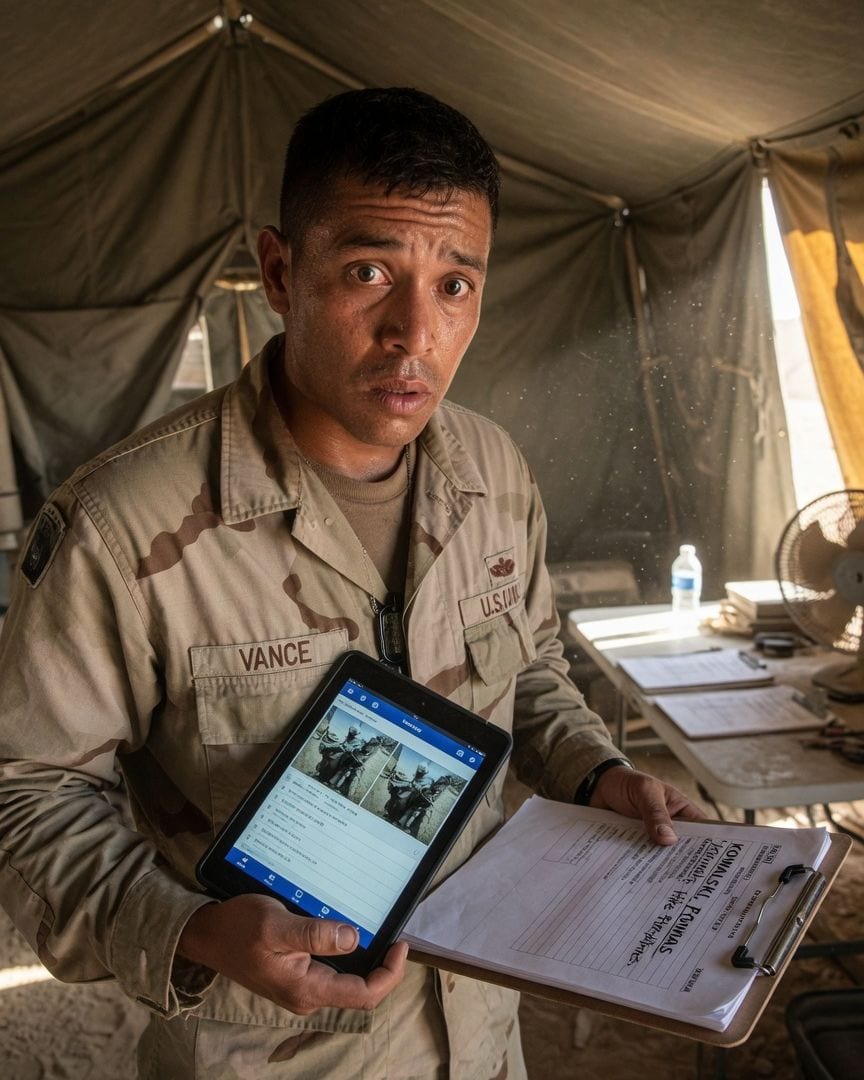
Admin NCO Vance processed Private Kowalski, then another identical soldier arrived. The manifest listed only one, but the truck held a 'KIA' dog tag with his name.
Admin NCO Russell Vance endured the scorching desert heat at FOB Lion's Tooth, his mind fixed on his rotation home in just one week. He processed a new levy of recruits, checking each name off the manifest as they boarded the transport trucks into the dusty distance. But after the last truck rumbled away, Vance found another Private Thomas Kowalski waiting, an exact duplicate of the soldier he’d just signed off. Security footage confirmed two identical men, minutes apart, boarding the same truck, yet the manifest held only one entry. A cold certainty seized him when he found an old, personalized dog tag in the truck: 'KOWALSKI, T.' marked 'KIA - Date Unknown' in the database.
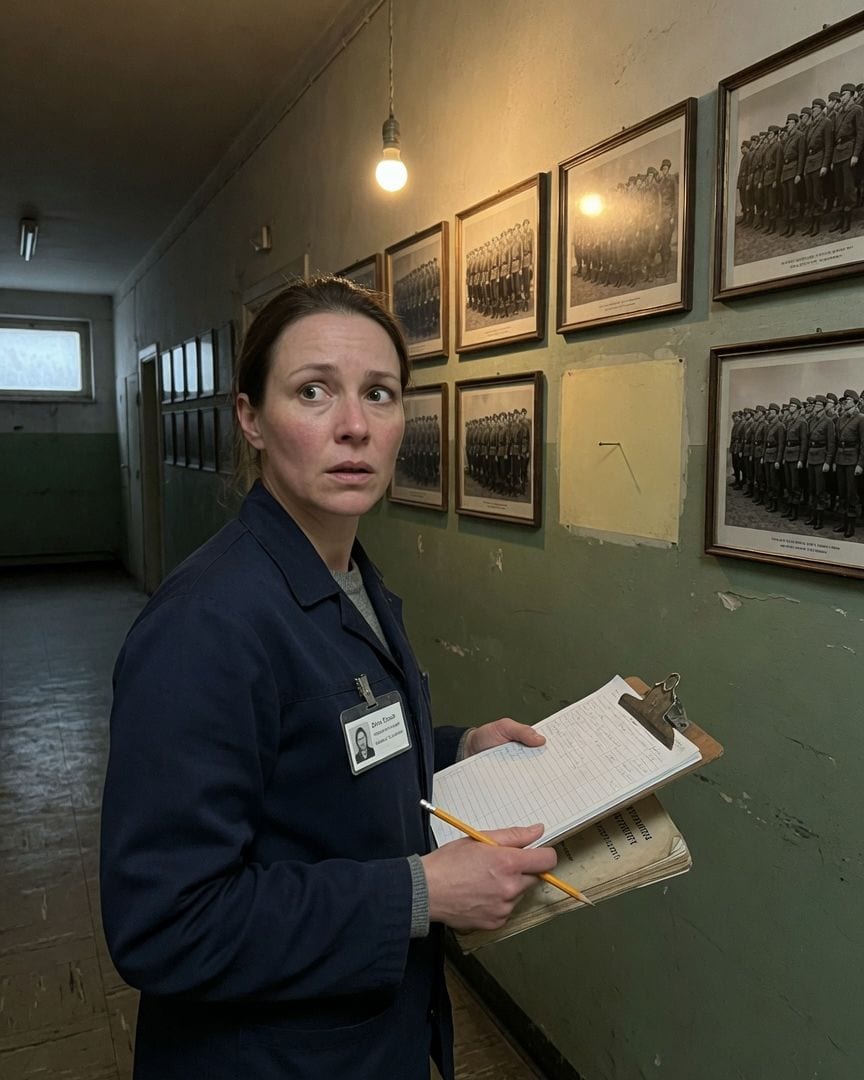
On a closing Cold War base, an inventory clerk finds every soldier in old photos staring at an empty wall. Her own name is on a hidden footlocker holding the missing picture: a dark, blurred figure among them.
Delia Straub has eleven days to inventory Kaserne Ottmarsheim, a former German base slated for demolition. The air in its echoing, abandoned halls smells of coal smoke and old wax as she races against the clock. Her task takes an unsettling turn when she discovers a phantom unit, the '604th Ordnance Detachment,' explicitly listed in old records despite never existing. Even more unnerving, every soldier in adjacent photos stares fixedly at the empty space where its picture should be. But why does a hidden footlocker, bearing Delia's own name, hold the missing photograph, revealing a dark, blurred figure among the men?
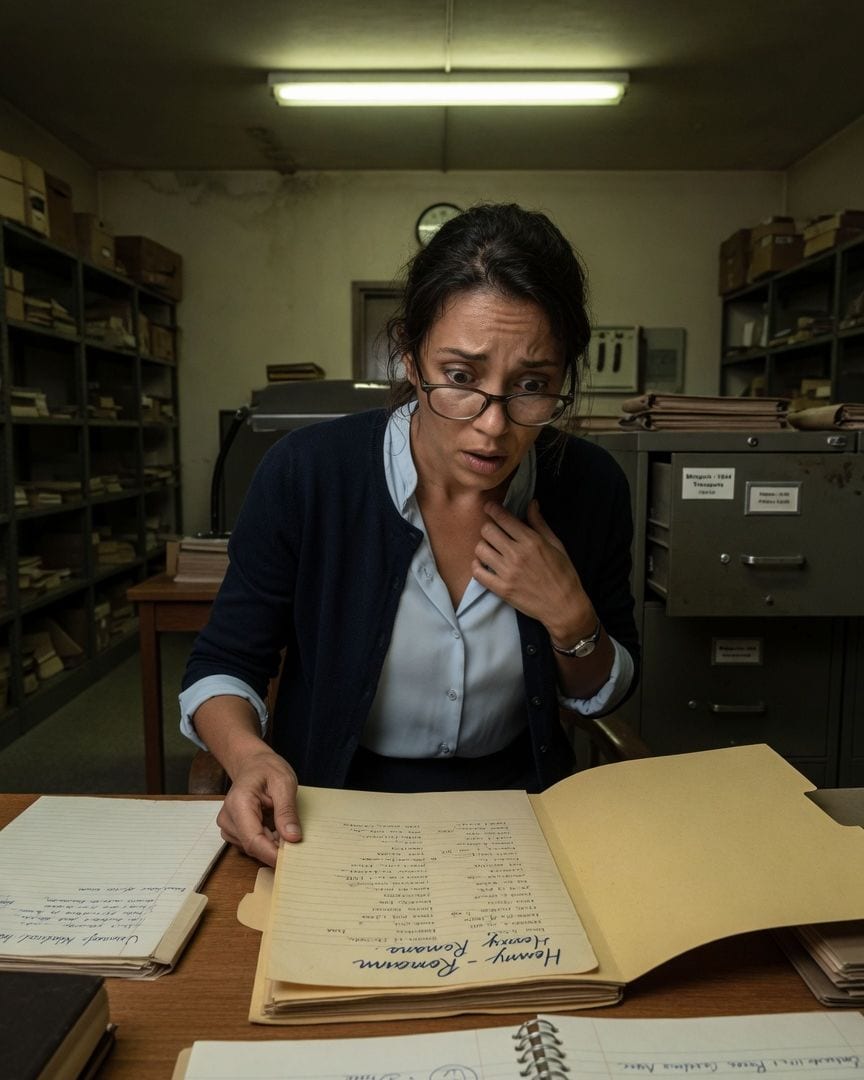
A records reviewer found a 1944 ferry manifest with an impossible 42nd name. The same dark ink marked a phantom crewman on a Cold War flight log.
Delphine Arceneaux, a dedicated records reviewer, had just minutes left in the stale reading room to finalize her review of a 1944 Mirepoix Ferry manifest. Her job was to confirm every detail of the forty-one passengers who boarded a boat that never arrived. But as the clock neared six, a forty-second name materialized on the faded paper, stark in a dark, unfamiliar ink. 'Henry Romano,' it read, with the impossible notation: 'BOARDED AT MIDSTREAM.' How could anyone board a ferry in the middle of a river?
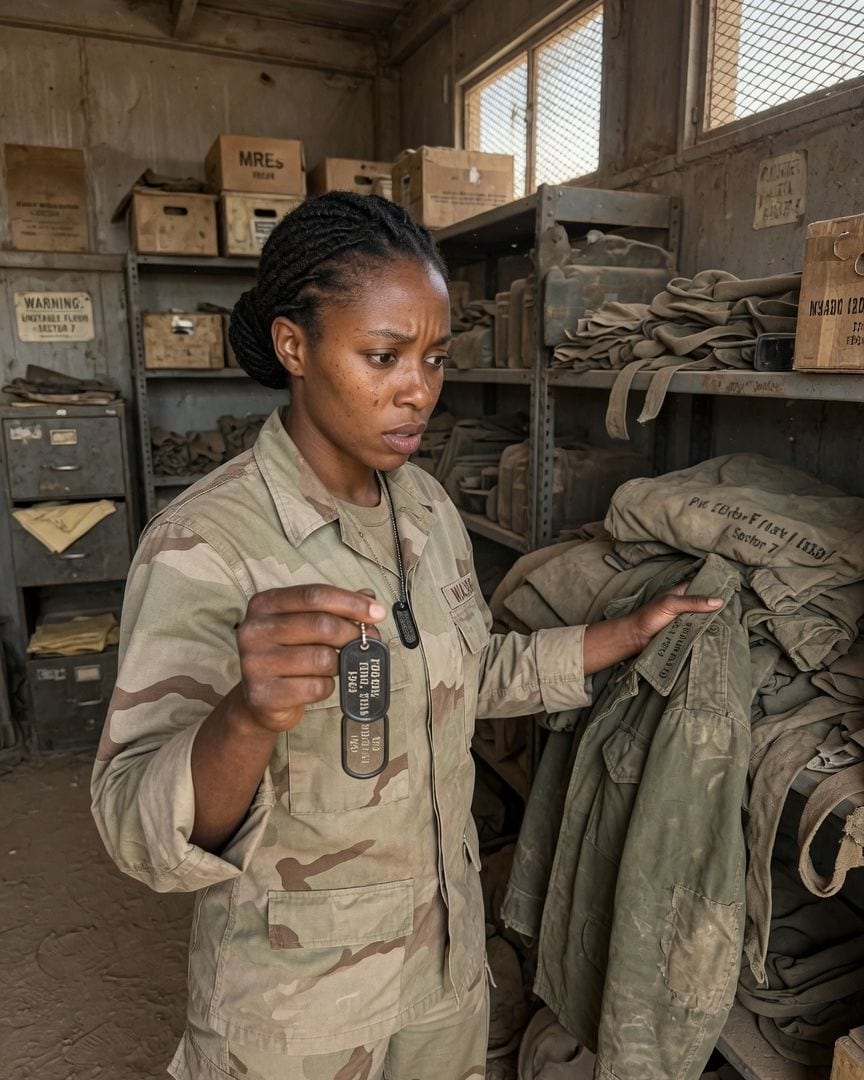
Lieutenant Walsh investigates an unnervingly silent new soldier, then finds his exact name on a Cold War dog tag dated 1983.
Observing a formation in the dry Mojave, Lieutenant Naomi Walsh felt a prickle of unease as a platoon counted one man too many. The extra soldier, Private Ethan Ford, moved with an unsettling quietness, performing duties flawlessly but without a single personal gesture. When his deployment records appeared pristine yet absent from the original manifest, Naomi searched a dusty old depot for answers. There, beneath a pile of tarps, she uncovered a field jacket bearing his name, 'Pvt. E. Ford,' and a dog tag from 1983, decades before the silent soldier could have been born.
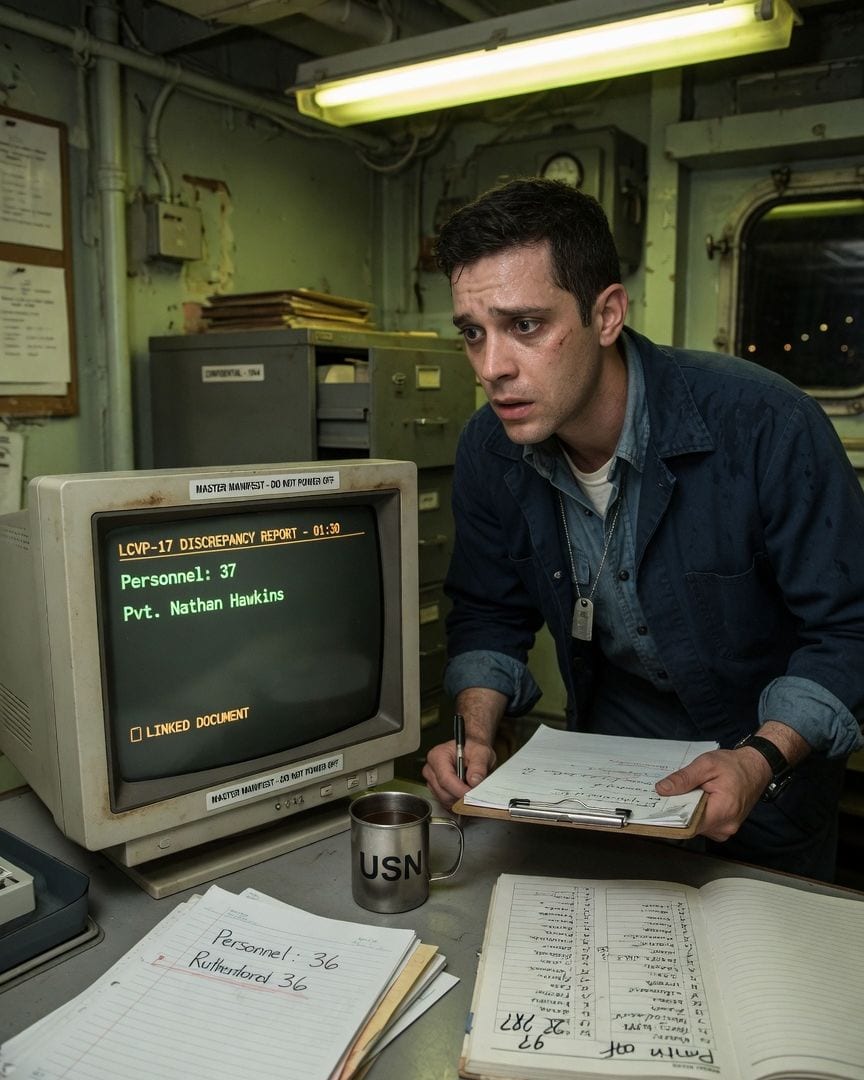
Coxswain's Mate Rutherford counted thirty-seven men in his landing craft, but the manifest logged only thirty-six. A hidden report, filed hours before, named Private Nathan Hawkins.
Coxswain's Mate Donald Rutherford, 28, began his final count for a standard load of thirty-six men in LCVP-17, the salty spray stinging his eyes. Halfway to the beach, a violent wave slammed the craft, throwing the men against each other. When the vessel settled, Rutherford instinctively recounted, his heart knocking against his ribs. This time, his count came back thirty-seven bodies crowded into the small boat. Official logs confirmed only thirty-six men, yet a hidden report, dated hours before his deployment, listed an extra man by name: Private Nathan Hawkins.