A meticulous Marine Sergeant counted eight men for guard mount, but his roster showed seven. The extra Marine gave a name already called, and a service number that was perfectly blank.
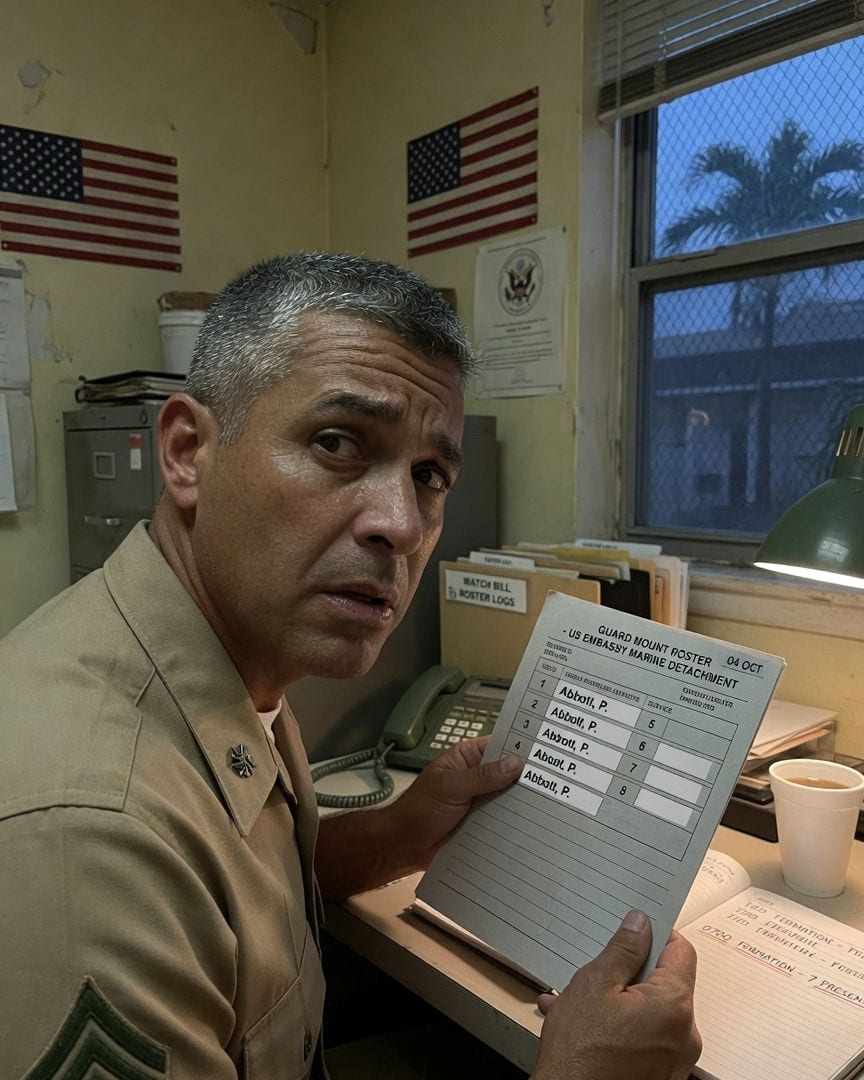
Sergeant Gordon Belanger, a month from his rotation out of this embassy posting, stood at the head of the guard mount formation.
The courtyard was still draped in the pre-dawn chill, the air crisp and hinting at the sun still hidden below the horizon.
Belanger was a man of meticulous discipline, a career Marine NCO who lived by the book, and that book, the current watch bill, listed seven Marines for seven posts, plus one reserve.
A total of eight personnel for the watch bill. His eyes swept across the gathered Marines, their silhouettes sharp against the faint glow from the barracks.
"Fall in!" he barked, his voice echoing with a familiar authority that settled the shuffling. The relief snapped to attention, a crisp, unified motion. Belanger's gaze moved from left to right, his lips forming a silent count.
One, two, three, four, five, six, seven… eight. His brow furrowed. Eight. He counted again, slowly, his finger subtly tracing an invisible path through the air. One, two, three, four, five, six, seven, eight. Still eight.
But the watch bill had seven names for posts and one reserve. Total eight. His count had been nine for a split second, then corrected to eight. It was the correct total, but felt wrong in how the formation presented.
Belanger’s eyes narrowed. "Alright, listen up!" he announced, his voice carrying clearly. "I've got seven names on this bill, and eight bodies in front of me. What gives?"
A ripple of nervous energy passed through the ranks. Marines exchanged uneasy glances, shifting their weight. No one spoke. Belanger began calling names, his voice sharp and precise.
"Abbott, P.!"
"Here, Sergeant!" Philip Abbott, a lean Lance Corporal with an earnest face, stepped forward, his uniform immaculate.
"Donovan, J.!"
"Here, Sergeant!" James Donovan, solid and dependable, moved into position.
Belanger continued down the list: Foster, Mercer, Hartley, Whitmore. Each name was answered crisply, each Marine accounted for, falling into their designated places. Seven names, seven Marines. He reached the end of his official list.
But there was still an eighth man, standing rigid in the rank, eyes front, perfectly still.
Belanger pointed, his finger unwavering. "You. Name?"
The Marine didn't flinch. His gaze was fixed straight ahead, an unnervingly perfect, blank discipline in his posture. "Abbott, P., Sergeant!"
Belanger's gaze snapped back to the first Philip Abbott, who stood just beside the second, now looking utterly bewildered. Both were young, both had the same close-cropped hair, the same crisp uniform, and now, impossibly, the same name.
The first Philip Abbott just stared, his mouth slightly agape, at his own duplicate. The second, however, met Belanger's stare with an unsettling, utterly devoid expression.
Belanger, a man who lived by the book and swore by procedure, tried the mundane first. This had to be a mistake, a prank, a miscommunication.
"Alright, Abbott," he said, addressing the first, the real Philip Abbott, whose confusion was evident on his face. "Step forward. You're excused from this formation for a moment."
He watched the real Abbott, grateful for the reprieve from the uncanny standoff, quickly fall out of rank and move to the side.
Then Belanger turned to the duplicate, his voice hardening slightly. "You. What's your full name, service number, and company?" He watched for a tell, a flicker of uncertainty, a nervous tic. Nothing.
The Marine recited, his voice flat, perfectly devoid of inflection, "Lance Corporal Philip Abbott, 867-5309-XX, Marine Detachment, US Embassy."
Belanger felt a cold prickle at the back of his neck. The name was identical, the rank and unit correct. But the service number – 867-5309-XX – it was generic. A placeholder.
He'd seen similar numbers used in training exercises for dummy personnel, never for a living, breathing Marine on active duty.
He sent the 'extra' Abbott to the reserve post, which technically still put him on the watch bill, absorbing him for the moment. Then Belanger immediately went to his office.
He pulled the official watch bill for the current guard mount, the document he'd just used. He scanned it, his eyes darting across the names. Seven names, seven posts, including Philip Abbott, with his correct, legitimate service number.
There was no eighth entry, no blank line, no duplicate name.
He checked the detachment roster, the master list of all personnel. Seven Marines were officially assigned. No eighth. No 'Lance Corporal Philip Abbott' with a generic service number.
He accessed the embassy's electronic access logs for the past hour, reviewing the badge-in times for the guard mount. Seven Marines had swiped their cards and entered the secure zone. No eighth.
Belanger pulled out his personal, handwritten duty log, a habit from his first tour of duty. This was his own meticulous record, kept separately from official channels. He’d recorded each name, each post, each assignment. Seven names.
He even had a small tally mark beside each name as he’d confirmed their presence during the previous evening's duty. He flipped through the pages, looking for a mistake, a double entry, anything that could explain the phantom Marine. Nothing.
His own log, a precise mirror of his personal reality, swore seven. Yet, eight had stood there in formation.
He tried calling Captain Blackwood, the detachment commander, but got voicemail. Belanger stared at the official roster again, his eyes drawn to the name 'Philip Abbott'.
He looked closer at the service number beside it, then the next line, and the next. All correct, all accounted for.
The first 'Philip Abbott' he'd seen, the one who stepped forward first, was clearly the real one, his records pristine. The second, the one who had answered with the same name, was not on any official record. Or was he?
Belanger’s eyes scanned the names again, a slow dread building in his gut. The name 'Philip Abbott' was there, with a valid service number.
But when he looked for the eighth entry, the one that should be blank, there was nothing. No extra line, no blank space. Just the correct seven. It was as if the eighth man had never been there, except...
he had. He checked the official guard mount roster, the very one he'd just signed off on. He found Philip Abbott’s name. And then, he saw it. The name was there, clearly printed for the eighth post.
But the service number beside it was not a string of zeros, as he had first vaguely registered in his shock. It was a perfectly blank line, stark white against the grey form.
He must have missed it in the initial bewilderment, his mind instinctively trying to rationalize what he saw.
Sergeant Belanger’s breath hitched. He stared at the official guard mount roster in his hand, the name 'Philip Abbott' printed clearly for the eighth Marine.
But beneath it, in the space for 'Service Number', was a perfectly blank line, stark white against the grey form. Not zeros. A blank.
His mind had misremembered, or perhaps, in that first moment of uncanny encounter, his brain had tried to rationalize the impossible, turning a void into something resembling a number.
A blank service number meant the system hadn't even attempted to assign one. It was an absence, not a placeholder. He ran a thumb over the paper, half expecting an indentation, a raised edge, anything. The paper was smooth.
He flipped to the back of the form, where the Sergeant of the Guard signed off on the roster. His own signature, 'Sgt. G. Belanger', bold and clear, affirmed the presence of 'Philip Abbott' with the blank service number.
He had signed it. He had attested to this impossible man.
Belanger spent the next few days in a quiet fury. The image of the blank service number, stark white against the grey form, was burned into his mind.
He reviewed every guard mount roster from the past year, cross-referencing them with his personal logs, the embassy’s access records, and even blurry CCTV footage from the gate.
He worked with a driven, almost obsessive focus, fueled by the impossible memory of the extra Marine. He found nothing. Every official record was immaculate, every count perfect, every name matched with a valid service number.
It was as if the system had scrubbed itself clean.
His personal logs, however, kept showing minor discrepancies – a name he’d written down that didn’t appear on the official roster, a missing signature on a handover form that later miraculously appeared, a faint sense of an extra presence he’d dismissed at the time as simple fatigue or an overactive imagination.
Now, those dismissals felt like self-deception.
He started digging deeper, pushing past his immediate duties, much to the subtle disapproval of junior NCOs who found him distant and preoccupied. He checked the embassy's archived detachment personnel manifests going back five years.
The basement archives were a labyrinth of narrow aisles, cold and dry, filled with the scent of old paper and dust. It was a tedious, eye-straining task, poring over microfiche readers and thick binders.
He found no other 'extra' Marines, no other blank service numbers. The system was perfect. Too perfect. Its flawless coherence felt like a threat.
He started looking for patterns, anything unusual that might precede or follow an anomaly. A Marine on sudden leave, a rapid-fire transfer, an unscheduled medical absence that might create a numerical gap. Nothing stood out.
The official system simply absorbed any change, closed any gap, without leaving a ripple. But what if the gap was intentional? What if the system expected a gap to fill?
Belanger remembered the generic service number the 'extra' Abbott had given: 867-5309-XX. He ran it through a secure internal database, searching for any record, however obscure.
It returned no results, as expected for a number that was essentially gibberish in a real context. But then he tried a partial search, '867-5309'.
It returned a handful of old, decommissioned training records from the 1970s, all for 'placeholder' personnel used in drills, none with a full name attached to them, just a number for a body. A shiver ran down his spine. Placeholders.
He thought about the blank service number on the roster he’d signed. It wasn't a mistake; it was a designation. A space left purposefully empty, waiting to be filled.
He decided to try an unofficial route. He knew Benjamin Abbott, a retired Marine who’d been the embassy’s facilities manager for thirty years before finally retiring last year.
Benjamin was a living archive, known for his encyclopedic memory and his habit of keeping his own 'unofficial' records, grumbling about 'the brass's paperwork' and its tendency to omit inconvenient truths.
Belanger found him at a local ex-pat bar, tucked away in a quiet corner, nursing a beer. The scent of stale hops and cigarette smoke hung heavy in the air.
He approached cautiously, describing a 'hypothetical' situation involving a peculiar guard mount. Benjamin Abbott listened, his eyes keen and surprisingly alert for a man his age. He didn't laugh.
Instead, he just nodded slowly, a grim set to his jaw, his gaze fixed on some point beyond Belanger’s shoulder.
"You seein' things, son?" Benjamin asked, his voice raspy, not unkindly. "Or are things just... bein' seen?"
Benjamin Abbott leaned back, his gaze distant, unfocused on the dim interior of the bar. "Happened a few times when I was here," he rasped, swirling the amber liquid in his glass. "Always just one extra.
Always for a post that was, officially, short a man. Never made a lick of sense." He took a slow sip of his beer, the ice clinking softly. "I kept my own books, you know. Back then, they weren't digital.
Just a bound ledger. Easier to spot when things got… re-written." He looked directly at Belanger, his eyes suddenly sharp. "You're digging, Sergeant. Be careful. The system doesn't like to be questioned."
The air in the bar seemed to thicken, pressing in on Belanger.
The next day, Belanger found his office door ajar when he arrived for his shift. He always locked it.
Nothing was missing, but his personal duty log, which he kept locked in his desk, was slightly out of place, its spine no longer perfectly aligned with the edge of the drawer.
He dismissed it as his own forgetfulness, a byproduct of his lack of sleep, but the unease persisted, a cold knot in his stomach. He tried to rationalize it away, but the feeling of being watched was palpable.
He then tried to access archived CCTV footage from the night the 'extra' Abbott appeared. He needed tangible proof. The system reported a 'corrupted file' for that specific timestamp, a block of several hours around the guard mount.
He tried the day before, the day after. Both played perfectly, crisp and clear. The monitors hummed like something trapped, reflecting his own worried face.
Later that week, Captain Lars Blackwood called Belanger into his office. Blackwood, a stoic, by-the-book officer, sat ramrod straight behind his pristine desk, every item perfectly aligned. The room was cool, almost sterile.
"Sergeant Belanger," Blackwood began, his voice even, devoid of any discernible emotion. "I've heard you've been spending a good deal of time in the archives. And asking Mr. Abbott some rather… pointed questions."
Belanger felt a chill, cold and internal, despite the controlled temperature of the room. He kept his face impassive. "Just reviewing some historical data, Sir. Part of my preparation for my next assignment. Standard procedure."
He knew it sounded hollow even to his own ears.
Blackwood nodded slowly, his gaze unblinking. "I understand. But I must remind you, Sergeant, that your current duties are paramount. And any… irregularities… in the official records are to be reported through proper channels. Unofficial inquiries can lead to misunderstandings.
Or worse." Blackwood’s voice remained calm, but the implication hung heavy in the air, a palpable weight. He held Belanger’s gaze, his eyes calm, unnervingly still. "This detachment runs on precision, Sergeant. Always has. Always will.
Any deviation from that… is simply not tolerated. Is that clear?"
Belanger felt the unspoken threat, a cold, hard certainty. Blackwood knew. And he was part of the system, an extension of its perfect, unyielding will.
Belanger returned to Benjamin Abbott the next evening, ignoring Captain Blackwood’s subtle warning. The subtle threat had only solidified his resolve. Benjamin was at his usual spot at the bar, a fresh beer in front of him.
"Mr. Abbott," Belanger began, pulling up a stool, his voice low. "The official records are clean. Too clean. It's like whatever happened was wiped. The CCTV footage, my personal log… there are gaps, but the official stuff is pristine."
Benjamin nodded slowly, pushing a fresh glass of water across the bar to Belanger. "They are. The official records are always clean. That's the point." He paused, taking a sip of his own beer. "See, the military hates a gap.
A missing man, an unassigned post, a blank line on a roster. It’s anathema. The system is designed to account for everything, to maintain perfect order. And if reality doesn't provide that order, the system… corrects it."
Belanger leaned forward, his elbows on the bar. "Corrects it how?"
"It fills the gap," Benjamin said, his voice a low, gravelly whisper that barely carried over the muted chatter of the bar. "Always one. Never two, never three. Just enough to make the numbers work. To make the formation whole.
To make the roster complete." He looked at Belanger, his eyes piercing. "These aren't ghosts, Sergeant. They're… echoes. Or projections. The system’s way of maintaining its own perfect image. They look real, act real, even sound real.
Until you look too close. Then you see the blank spaces, the generic numbers, the way they don’t quite fit the paper trail."
Belanger thought of the 'extra' Abbott, the blank service number, his own signature on the form. It all clicked into place with a horrifying precision. "And it’s been happening for a long time?"
"Longer than you or I have been in uniform," Benjamin confirmed, his gaze fixed on some point in the past. "I saw it first in '78. A Lance Corporal, name of Henderson.
Showed up for a post, but the log said he was on leave. Then the log changed. Henderson was suddenly back from leave, and the real Henderson’s leave dates were… shifted. Nobody noticed. Nobody cared. The numbers were right.
The system was balanced." He sighed, a tired, heavy sound. "It’s not malicious. It’s just… perfect. The system simply closes the loop. The paperwork swears otherwise, and eventually, so does everyone else. Even the ones who saw it."
Belanger felt a profound chill, deeper than anything he’d felt before. "So, the system… creates people?"
Benjamin shook his head slowly. "No. It just… fills the space. Like a program running a subroutine. It sees a numerical error, and it executes a fix. It’s not alive, not in the way we understand. It’s just… coherence.
And it’s been happening here, at this embassy, in different ways, for decades." He then reached under the counter of the bar, fumbling for a moment, and pulled out a thick, leather-bound book, its pages yellowed and brittle with age.
"I told you I kept my own books. This one… this one's from my old man. He was stationed here, same detachment, back in the sixties. Kept it going for years after he retired. A lot of old Marines did.
Something to keep the mind sharp, he said. Said it was important to know what the official logs didn't say." He pushed the book across the bar, its worn leather creaking softly. "Maybe you’ll find something in here.
Something that the official system hasn't gotten around to correcting yet."
Belanger took the old logbook back to his quarters. It was heavy, smelling of dust and forgotten years, a faint, sweet mustiness clinging to its pages.
He laid it carefully on his desk, the silence of his room amplifying the faint crackle of the brittle paper as he opened it.
He spent hours poring over it, comparing Benjamin’s father’s meticulous handwritten notes with official archived records he’d secretly copied from the embassy basement.
The unofficial entries chronicled dozens of subtle discrepancies across decades: 'extra' Marines appearing for a shift, a name on a roster that didn't quite match the face of the Marine performing the duty, a post seemingly filled by two men who were supposed to be one.
These anomalies, Benjamin’s father had noted, always coincided with a short roster, always exactly one man short. The pattern across rotations and dates was undeniable, a horrifyingly consistent thread woven through the embassy’s history.
The system had been doing this for decades, long before Belanger was even born.
He flipped further back, to the earliest entries, from the late 1950s. He saw familiar names of posts, of watch bills, of detachments. He recognized the layout, the jargon, the unchanging rhythms of Marine life.
And then, his breath caught in his throat, a sudden, sharp intake of cold air. He stared at a faded, handwritten entry in the unofficial logbook from 1987: 'Sgt. G. Belanger, SOG.'
The entry described a similar 'extra' Marine incident, a Lance Corporal who appeared for post three, even though the official log showed the post as empty.
He traced the familiar loops of the 'B' in Belanger, a name identical to his own, a record of a man who served this detachment decades before he was even born. The name was his, but the time was impossible.
Belanger returned to Benjamin Abbott, the unofficial logbook clutched in his hand, its pages now opened to the impossible entry. The bar was quieter this time, the afternoon light dimming.
"This… this name," he began, his voice hoarse, pointing to the 1987 entry with a trembling finger. "Sgt. G. Belanger. That's me. But it's not me."
Benjamin took the book, his gaze soft, a flicker of something like pity in his eyes. "No, son. It's not you. Not exactly." He paused, taking a slow, deliberate sip of his beer.
"The system, in its relentless pursuit of coherence, doesn't just fill numerical gaps; it also fills conceptual ones.
If an anomaly is observed, if a discrepancy is about to be noted, the system will often 'insert' an observer, or even a 'witness' from its own internal history, to normalize the event."
"It's like a feedback loop," Benjamin continued, his voice a low, steady drone. "The system needs to appear perfect. If it senses a flaw, it corrects it. And if someone notices the correction, it corrects the observer.
It retrofits them into the pattern. It's not personal, Sergeant. It's just… a function."
The 'Sgt. G. Belanger' in the 1987 log was a system-generated echo, a placeholder for the role of 'the one who sees,' folded into the historical pattern to ensure the anomaly was always 'accounted for' within the system's own records.
The blank service numbers, the generic names, the corrupted CCTV footage—all were subtle traces of these 'corrections,' designed to maintain the facade of an unbroken, perfect record.
The official logs would always be pristine because the system continually rewrote its own history, erasing any evidence of its self-generated placeholders.
His own signature on the current watch bill, attesting to the blank-numbered 'Philip Abbott', was proof of his integration into the ongoing pattern. He was now part of the mechanism, a witness whose testimony was already being absorbed.
The horror was not a malevolent force, but an indifferent, self-perpetuating system, infinitely more terrifying in its cold, perfect logic.
The full truth settled on Belanger like a shroud, heavy and suffocating. He understood. There was no escape, no confrontation that made any sense.
The 'wrongness' wasn't a localized entity to be fought or an evil to be stopped with a combat knife. It was the very fabric of the military's relentless, unbending drive for perfection.
He was a cog in a machine that had developed a horrifying, self-correcting sentience, one that ensured its own flawless operation regardless of reality, a machine that wrote its own truths.
He returned to the embassy, his stride measured, his face impassive. The fluorescent lights of the corridors hummed, cold and unforgiving. He saw the Marines on duty, going about their posts, their routines sharp and precise.
He saw Captain Blackwood in the distance, a figure of absolute order and unwavering discipline, moving through the halls like a ghost in a perfectly ordered system.
These were not his enemies, but fellow components of the system, either unwitting or perfectly assimilated.
He considered tearing up the official roster with his incriminating signature, but what would that achieve? The system would simply generate another, perfect one, and his personal log would be subtly misplaced, his memory shifted.
He thought about reporting it up the chain, but to whom? The chain itself was the anomaly, a series of conduits for the system’s self-correction.
His own career, his future, the promotion he'd worked so hard for—all suddenly felt like meaningless ambitions within a vast, indifferent mechanism.
He walked past the post where the 'extra' Philip Abbott had stood. Now, only the real Philip Abbott was there, performing his duties flawlessly, his movements crisp and alert.
The system had absorbed the anomaly, and the memory of the duplicate had faded from everyone else's mind, a ripple smoothed over, leaving no trace in their collective consciousness.
Belanger stood for a long time, watching the ordinary, precise movements of the Marine on post. He was a squared-away sentry, a credit to the Corps. But Belanger knew. He knew the gap that had been filled.
He knew the records that swore otherwise, the official truth that contradicted his own chilling experience.
And he knew that the system had already begun to write him into its own impossible history, not as a victim, but as a recurring, silent witness, a part of its eternal cycle of perfect coherence.
He was a Marine, disciplined and armed, trained to confront any threat. But this was not a threat he could fight. It was the air he breathed, the ground he stood on, the very institution he served.
He was trapped in the knowing.
Gordon Belanger completed his rotation a month later, his transfer orders to a new detachment arriving without a hitch.
He packed his bags, his personal duty log carefully tucked away amongst his most private possessions, a private counter-narrative to the official history. Captain Blackwood shook his hand at his departure, his grip firm, his gaze as unreadable as ever.
The embassy continued its operations, its guard mounts precise, its rosters immaculate. No one else spoke of an 'extra' Marine. The memory of the impossible Philip Abbott had vanished, leaving no trace in the collective consciousness of the detachment.
Belanger left the embassy, the heavy doors closing behind him with a resonant thud, a sense of profound, inescapable dread settling in his gut. He was out, but not saved.
He carried the knowledge of the system's flawless, terrifying self-correction, a truth that could never be undone or acted upon. It was simply a fact, an unyielding, pervasive truth that now defined his perception of the world.
Years passed. Sergeant Belanger, now Master Sergeant Belanger, continued his career, a model of efficiency and discipline. He never spoke of the embassy, or the extra Marine, or the old logbook. He watched new recruits, counted formations, signed countless rosters.
Each time, he checked the numbers, his eyes lingering on the blank spaces, the perfect counts, the silent, invisible corrections.
He never saw another 'extra' Marine himself, not overtly, but he knew they were there, silently filling the gaps, maintaining the flawless illusion.
He was part of the system now, not just a witness, but a component, his knowledge a silent, internal echo.
His personal log, still tucked away, grew thicker with each new posting, filled with the real counts, the real names, the subtle discrepancies he alone noted. He knew the truth. And the system knew he knew.
He was a perfect Marine, perfectly accounted for, perfectly integrated. He would live out his career, a living archive of the impossible. The system had won. It always did.
Master Sergeant Belanger, years later, sat at his desk, meticulously updating a duty roster. He paused, his pen hovering over a blank line. He knew it would be filled. He knew it always was.
If this one got to you
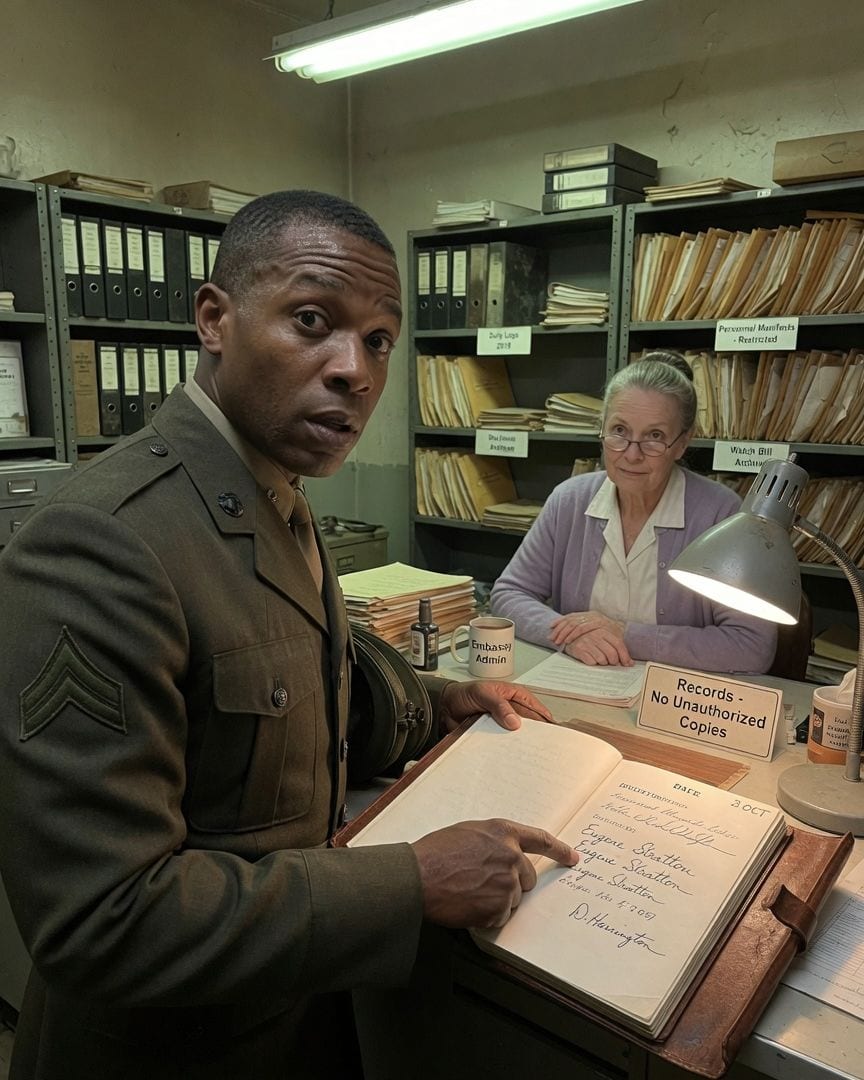
An embassy sergeant counted seven Marines, but eight stood before him, two identical men named Stratton.
Sergeant Daniel Harrington was just six months from his honorable discharge, feeling the weight of civilian life as he called his final embassy guard mount. The familiar routine in the cool courtyard was shattered when he counted seven Marines for seven posts, yet eight stood before him. His gaze sharpened, he found two identical Private First Class Eugene Strattons, both answering roll call with the same crisp voice and even the same scar. Later, his own signature appeared in the duty log, verifying an eighth Marine he never saw. Why did the civilian clerk meet his stunned gaze with such calm, knowing eyes?
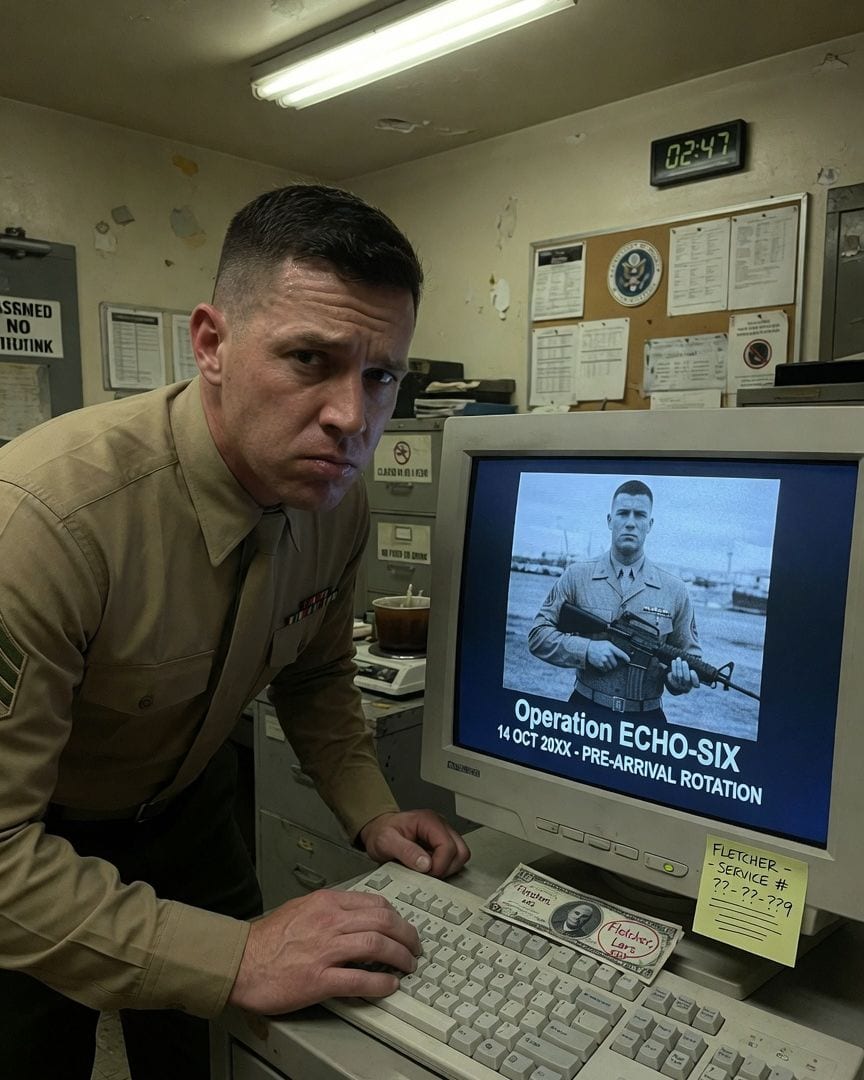
Sergeant Belanger's transfer was a week away when two Marines answered for 'Fletcher.' The impossible service number belonged to a man who shouldn't exist.
Sergeant Quentin Belanger counted down his last week at the embassy before his transfer home, yearning for a clean watch without trouble. But the familiar stale coffee smell of the guard mount room gave way to a chilling anomaly: eight Marines lined up for seven posts. When he called the first name on the roster, two crisp voices answered, one belonging to an extra man who shouldn't exist. Belanger's search for an explanation led him to barracks logs showing two identical entries for the same Marine, but with one impossible service number, ending in a digit that defied all protocol. The digital hum of the computer confirmed a truth far stranger than any prank, leaving the sergeant to wonder what other impossible echoes might be lurking.
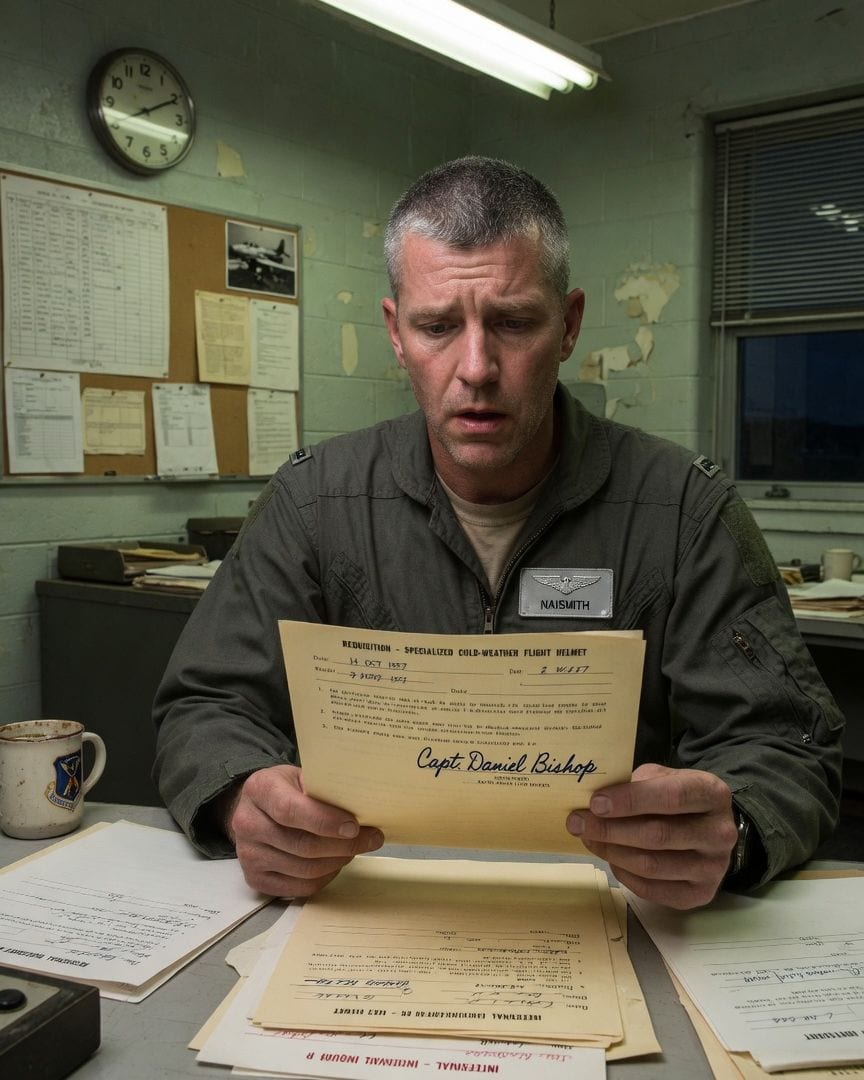
A Cold War Colonel reviews a missing pilot's file and finds Captain Bishop's signature on a form dated weeks after he vanished.
Colonel Ward Naismith faced the grim task of reviewing Captain Daniel Bishop’s personnel file, a routine chore for a man listed as Missing in Action. Bishop had vanished days after he and Naismith chased an impossible, silent disc over Lake Superior, leaving only an empty patch of air and a knot of unease in Ward's gut. Sifting through commendations, Ward found a requisition for flight gear and a maintenance sign-off, both dated *after* Bishop’s disappearance. The true chill came with the requisition for a specialized flight helmet, bearing Captain Bishop’s unmistakable signature, weeks after he was presumed lost. How could a man presumed lost have signed anything?
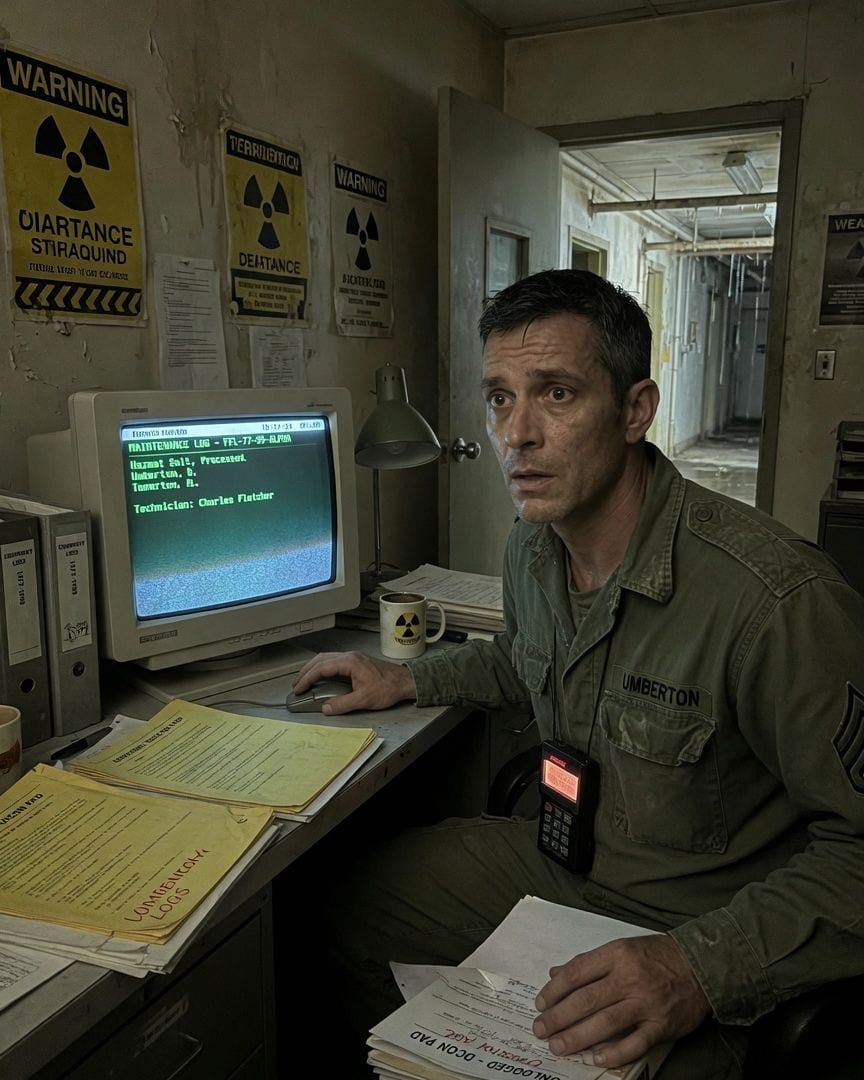
On his last shift at the closing Cold War facility, Sergeant Umberton found a hazmat suit glowing hot with his own name.
Sergeant Blaise Umberton walked his final shift at the soon-to-be-shuttered Ferriday Flats decontamination pad, the predawn air thick with ozone and the heavy silence of a closing era. His peace with the desolate site shattered when he discovered a hazmat suit, glowing faintly and shrieking on his Geiger counter, laid out with his own name stitched perfectly on the breast. Dismissed as a prank by his superior, Umberton followed protocol, but a cold dread compelled him to check the digital records of the facility's Cold War bureaucracy. There he found an entry for a hazmat suit processed under his name, dated for *tomorrow*, and signed by a technician who had retired a decade ago.
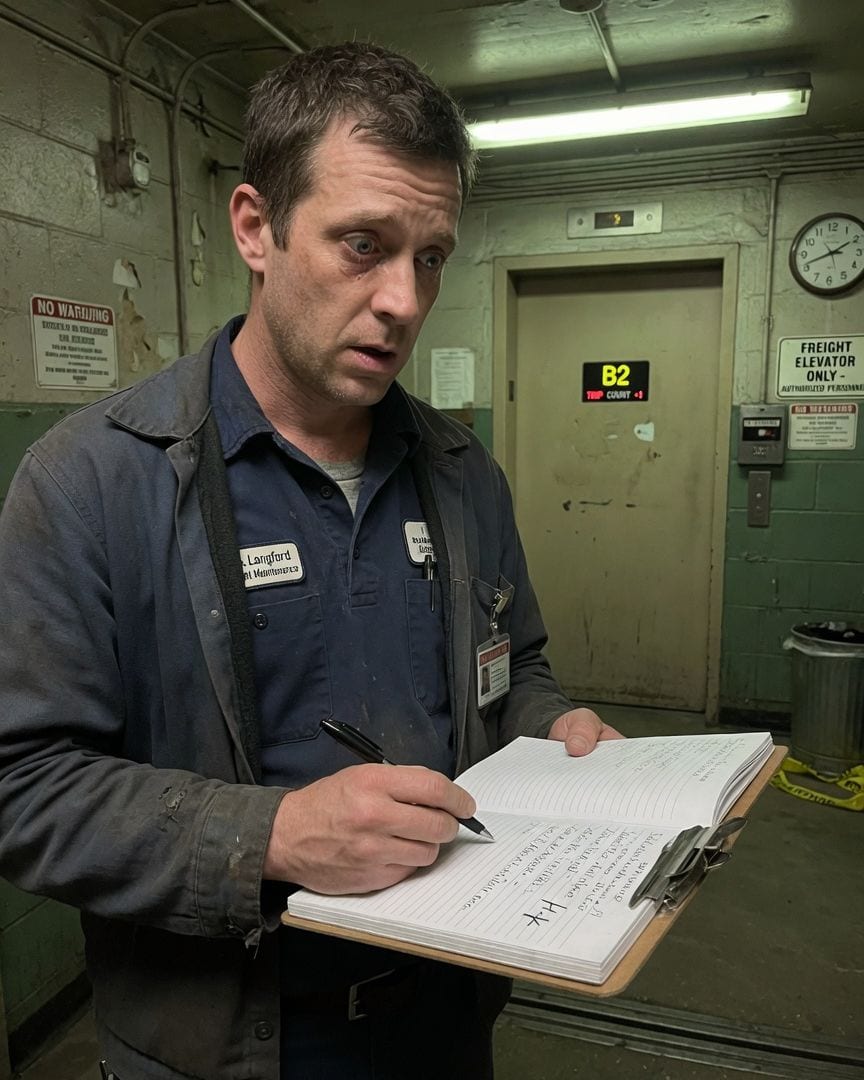
A man just took the elevator to the sealed sub-basement. He isn't on any staff roster, but my initials are in the logbook.
As a maintenance worker, my job is mostly routine, like signing the daily log for the old building's freight elevator. But one night, the log showed a trip to the sub-basement, sealed for a decade, timestamped with my key-switch and signed with my own initials, for a run I never made.
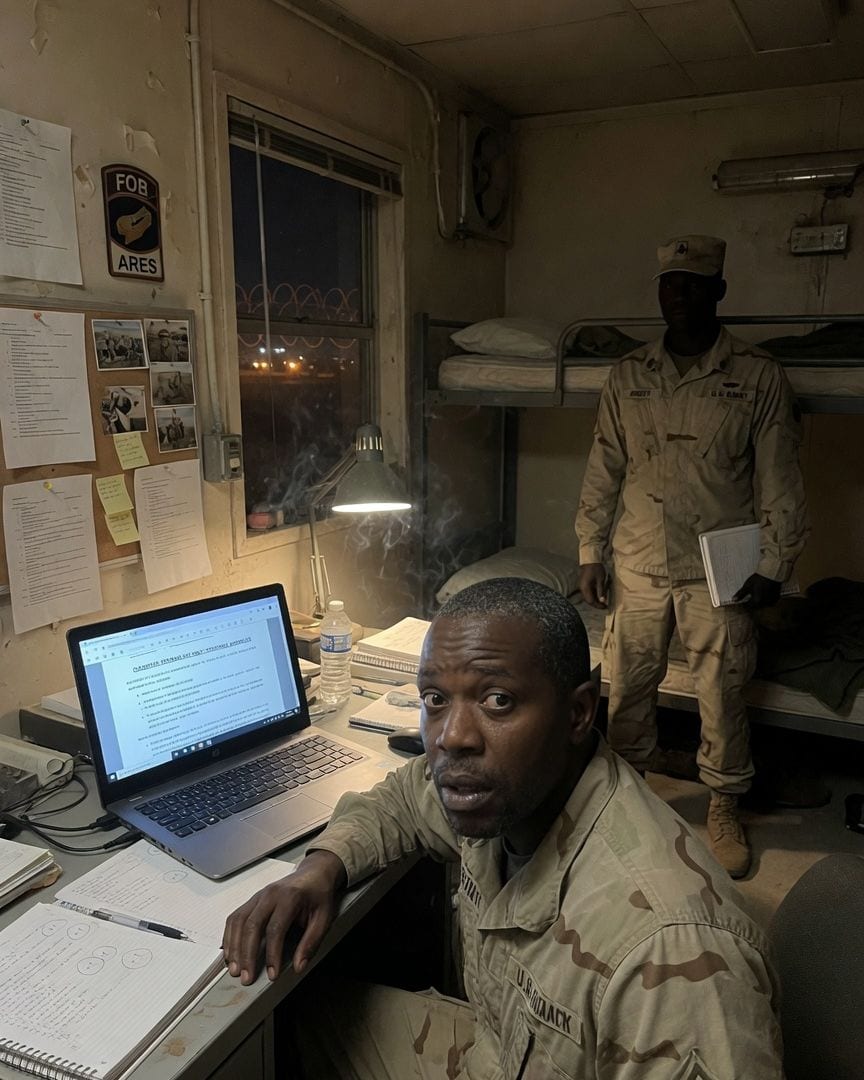
On his final rotation home, Sergeant Abbott counted his platoon: one man too many. The base’s secret files called them 'phantom units,' always watching him.
Sergeant First Class Malcolm Abbott was on his final rotation at FOB Ares, ready for transfer home. He called his platoon to formation, watching the sun break over the desolate desert as he counted each man. But the numbers didn't add up; there was always one extra soldier, standing at rigid attention, perfectly aligned with the others, yet only Malcolm could see him. Despite cross-referencing every manifest, the phantom remained, its face obscured in shadow, a silent sentinel that defied all logic. What secret did the base archives hold about these unacknowledged personnel?