Every night, a security officer's sensor logged a footfall. Tonight, it registered a step between her own boots.
Sergeant Eleanor Okafor, 32, sat hunched over her console in the dimly lit security office of the Nevada storage site. Dust motes danced in the projector beam, illuminating maps of fences and buried sensor lines.
Her current assignment, monitoring the perimeter, was usually mind-numbing until the 0122 report from sensor nine. Every night, precisely at twenty-two minutes past one, the seismic string buried along the fence line logged a single, footfall-weight event.
Every night, the co-located camera showed only frozen gravel, a barren, empty expanse under the desert stars. Okafor had initially dismissed it as a settling fault, a minor tremor in the ancient earth, a ghost in the system.
But after a month, she’d overlaid the triggers, watching them stack into one clean, unbroken line, a perfect, impossible rhythm. It wasn't random. It was deliberate. Tonight, she wouldn't be in the office.
Dressed in her fatigues, she drove her patrol vehicle to the designated section of the fence line, the desert wind whipping around her. She stood by the inconspicuous marker for sensor nine, the gravel crunching under her boots.
The digital clock on her wrist flicked to 0121. She held her breath, listening to the vast silence. 0122. A faint, almost imperceptible tremor passed up through her boots, a pressure point on the ground.
Back at the console, the feed from sensor nine pulsed green: 'MASS-DISPLACEMENT EVENT DETECTED.' The system had logged the footfall between her own boots.
Back in the office, the dread was a cold knot in Okafor’s stomach. The rational explanations – faulty sensor, settling ground, animal – had all failed. She pulled up the historical logs for sensor nine, scrolling through years of data.
Most of it was routine, but an oddity surfaced: a series of archived maintenance requests from decades ago, marked with an obscure classification code.
She managed to bypass the security lockout on one, revealing a digital 'calibration log' for sensor nine. The language was technical, archaic, but a phrase caught her eye: 'adjustment for non-standard mass-displacement signatures, residual energy patterns.'
It sounded less like geology and more like… something else. The log detailed specific adjustments made to sensor nine's sensitivity, almost as if it were being tuned to detect something that wasn't quite physical.
The dates on these logs aligned eerily with the site's original construction and then abruptly ceased, replaced by standard maintenance.
She tried to cross-reference the classification code, but the system returned only a 'NO RECORD FOUND' error, as if the category itself had been erased.
The deeper she dug, the more the ordinary explanation of a 'faulty sensor' crumbled, replaced by the unsettling implication that sensor nine wasn't broken; it was working exactly as it was designed, detecting something that shouldn't exist.
Driven by a hunch, Okafor returned to the fence line in the first light of dawn. The low angle of the sun cast long shadows, illuminating details the night camera missed.
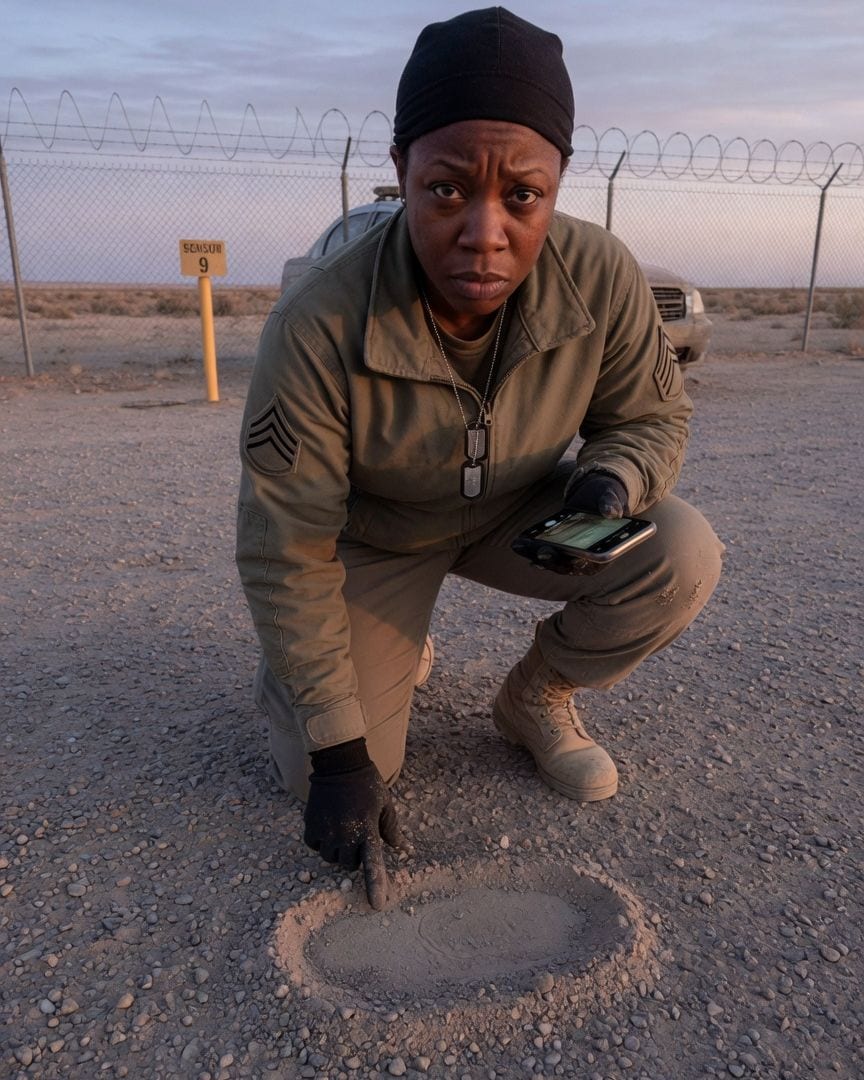
Near sensor nine, inside the perimeter wire, she saw it: a faint, almost subliminal depression in the hard-packed gravel. It wasn't a boot print, too indistinct, too shallow, but undeniably a recurring pressure point.
It was precisely where the sensor tripped, a subtle oval, barely larger than a human foot. She knelt, tracing its outline with a gloved finger. It was almost invisible, a ghost of an impression, yet it was there, consistent, impossible.
The system swore nothing crossed the line, but the ground itself silently testified otherwise. She pulled out her phone, the dread tightening its grip, and snapped a photo of the impossible mark.
Okafor spent the next day cross-referencing her photo of the gravel depression with the anomalous calibration logs. The logs, though coded, hinted at a specific section of the site.
She found older, redacted incident reports, digital ghosts in the system's memory banks, each referencing 'Protocol Shadow Step' and 'Containment Unit 734-Alpha.'
The trail led her to the oldest, most neglected section of the facility, a sub-level beneath a decommissioned administration building, long absent from active blueprints.
The entrance was a heavy, rusted access panel, secured with a lock that looked like it hadn't been touched in decades. Using archived schematics, she found the original key code, a sequence of numbers long obsolete.
The panel groaned open, revealing a dark, stale-smelling corridor. The air was thick with dust and a faint, metallic tang. She moved cautiously, her flashlight beam cutting through the gloom, illuminating peeling paint and forgotten warning signs.
The corridor ended at a heavy, reinforced door, marked with a faded stencil: 'UNIT 734-ALPHA. Authorized Personnel Only.' A shiver ran down her spine. The 'footfall' wasn't just an anomaly; it was a ghost with a specific address.
Okafor’s unauthorized access didn't go unnoticed. The next morning, Major Jeffrey Sheppard, 48, summoned her to his office. His face was a mask of polite concern, but his eyes were sharp.
“Sergeant Okafor,” he began, leaning back in his chair, “I’m seeing some unusual activity on your access logs. Decommissioned sections. Highly classified archives. Care to explain your sudden interest in… historical site maintenance?”
Okafor, maintaining a squared-away posture, tried to explain her findings, the sensor anomaly, the recurring footfall, the physical trace. Sheppard listened, his expression unreadable. “Sergeant, I appreciate your diligence. But we’re undergoing an audit. Resources are tight.
We don't have time for ghost stories.” He warned her, subtly but firmly, to stick to her assigned duties.
Later that night, back in her own office, Okafor noticed a faint, almost imperceptible scent of ozone, a smell she remembered from the old sub-level. Her computer screen, previously locked, now displayed a single, blank text document.
And then, a faint, rhythmic tap-tap-tap seemed to echo from the walls, a sound too regular, too precise, too present to be imagination. It felt like the desert itself was watching her, and the ghost was closer than she thought.
The next morning, Okafor marched into Major Sheppard’s office, the photo of the gravel depression on her tablet, printouts of the coded calibration logs, and a hand-drawn map of the sub-level with Unit 734-Alpha highlighted.
“Sir,” she stated, “this isn’t a ghost story. This is a system failure, and it’s active.” She laid out her evidence: the impossible footfall, the physical trace, the hidden logs, the sealed containment unit. Sheppard’s composure finally cracked.
He sighed, running a hand over his face. “Alright, Sergeant. Sit down.” He leaned forward, his voice low, confidential. “This site… it wasn’t always just storage. Decades ago, it was a containment facility. For… unique individuals.”
He hesitated, choosing his words carefully. “One, in particular. Designated Account #734-Alpha. Not a person in the conventional sense, not anymore. His… properties… made him difficult to… manage.”
He explained that Account #734-Alpha was 'relocated' and 'decommissioned' decades ago, but his unique energy signature, his 'pattern,' persisted. “The footfall,” Sheppard admitted, “is a residual pattern. A routine it performed during its active containment.
The system detects it, but there's no physical presence to log.” He then produced a heavily redacted, physical personnel file from a locked drawer. “This is all that’s left. A record of what was here. Account #734-Alpha.”
Okafor looked at the file. The name was blacked out, but the 'STATUS: TERMINATED, LOCATION: UNKNOWN' screamed a profound, unsettling failure of accountability.
A person, or what was once a person, was officially gone, yet its routine persisted, a ghost in the military's meticulously kept records.
Okafor took the redacted file back to her office, the weight of it heavy in her hands.
She scrutinized the faded paper, noticing a faint, almost subliminal watermark—an archaic security stamp she recognized from her initial deep dive into the system's archives.
It was a lead, a breadcrumb to a microfiche archive, a system so old it was practically analog. She spent hours in the dusty, forgotten microfiche room, scrolling through blurry, yellowed files.
Finally, she found it: an unredacted version of Account #734-Alpha's file. The name on it was clear: Harold Barlow. Her blood ran cold.
But what truly made her gasp was a small notation in the margin, next to the 'TERMINATED' status: 'Subject's pattern persisted. See Annex D, Protocol 'Shadow Step'.'
And then, a date, decades old, but written next to it, in a different pen, a faint, handwritten entry: 0122. The anomaly wasn't just a lingering echo; it was a deliberate, managed pattern.
And then, as she scrolled further, she found a second, similar file, also marked 'Annex D,' for a different name, a different 'Account,' and the same chilling, handwritten 0122 next to its 'TERMINATED' status.
The unredacted files, particularly 'Annex D, Protocol 'Shadow Step',' revealed the full, horrifying truth. 'Termination' hadn't meant eradication; it meant the physical body was gone, but the unique energy pattern, the 'subject's pattern,' persisted.
'Protocol 'Shadow Step'' was a sophisticated, decades-old containment strategy designed to manage these persistent patterns by trapping them in ingrained, harmless routines.
The daily 'footfall' at 0122 wasn't an attempt by Harold Barlow to escape; it was his residual pattern still performing an assigned perimeter check, a loop from his original containment.
The military wasn't just covering up a failure; it was actively managing a silent, invisible graveyard of anomalies. Okafor returned to the sealed sub-level, the unredacted file clutched in her hand. Inside Unit 734-Alpha, the air was still, heavy.
As she read the protocol details, a faint, shimmering distortion in the air became visible. It was subtle, like heat haze, but it moved, tracing a precise, small circuit within the chamber.
It briefly took on a vaguely human outline, barely perceptible, a silent sentinel locked in an eternal, meaningless duty. This was Harold Barlow, a ghost programmed to patrol.
Okafor located the original, archaic containment console for Unit 734-Alpha, hidden behind a false wall. It was a marvel of antiquated technology, a relic from a time when these 'patterns' were first understood.
Most of it was inert, but a few key controls still hummed with dormant power. Using the diagrams in 'Annex D,' she identified the primary energy dampeners, designed to suppress the entity's manifestation and reinforce its programmed routine.
The protocol wasn't about destroying the pattern, but making it imperceptible, effectively putting it to 'sleep.' With a deep breath, Okafor began the re-activation sequence. The console whirred to life, its ancient lights flickering.
The shimmering outline in the chamber intensified, then wavered, like a signal losing its strength. It seemed to struggle, its silent 'steps' faltering. Okafor pressed the final sequence, a surge of power flowing into the chamber.
The distortion flickered violently, collapsing into itself, shrinking to a pinpoint of light, and then vanishing completely. The air in the chamber felt suddenly still, empty.
Back at her console, the seismic sensor feed from sensor nine showed a flat line. The 0122 footfall had stopped. She had done it. She had silenced Harold Barlow.
Moments later, Major Sheppard arrived, his face grim, alerted by the system's re-activation. He surveyed the quiet chamber, then Okafor. “It’s dormant,” he stated, his voice flat.
He ordered the sealed section permanently reinforced, all digital records of Okafor’s investigation purged, and her access revoked. He reminded her, tersely, of her oath of secrecy, the implications of what she now knew.
Okafor was transferred off the Nevada site immediately, her deployment cut short. The official reason cited was 'reassignment due to critical operational needs.'
The desert wind seemed to whisper secrets as she drove away, leaving behind the silent, sealed unit and the impossible truth within.
Months later, Eleanor Okafor was stateside, processing out of the military. The silence of civilian life felt loud, hollow. She tried to forget the desert, the footfall, the files, but the knowledge gnawed at her.
One evening, packing her old deployment gear into a cardboard box, her fingers brushed against a crumpled, faded piece of paper tucked deep into a fatigue jacket pocket she rarely used.
It was a printout, a single page from one of the 'Annex D' files she must have inadvertently printed before her access was revoked. It listed other containment sites, each with a specific time next to it.
One line, stark and chilling, read: 'Site Gamma-7: 0317.' A cold tremor ran through her. She looked at her phone on the table. The digital clock read 0316.
Eleanor Okafor sat motionless, staring at her phone. The kitchen light hummed. Her old jacket lay crumpled beside her. The clock on her phone clicked to 0317. Nothing happened. The silence stretched. The desert wind blew, somewhere far away.
If this one got to you
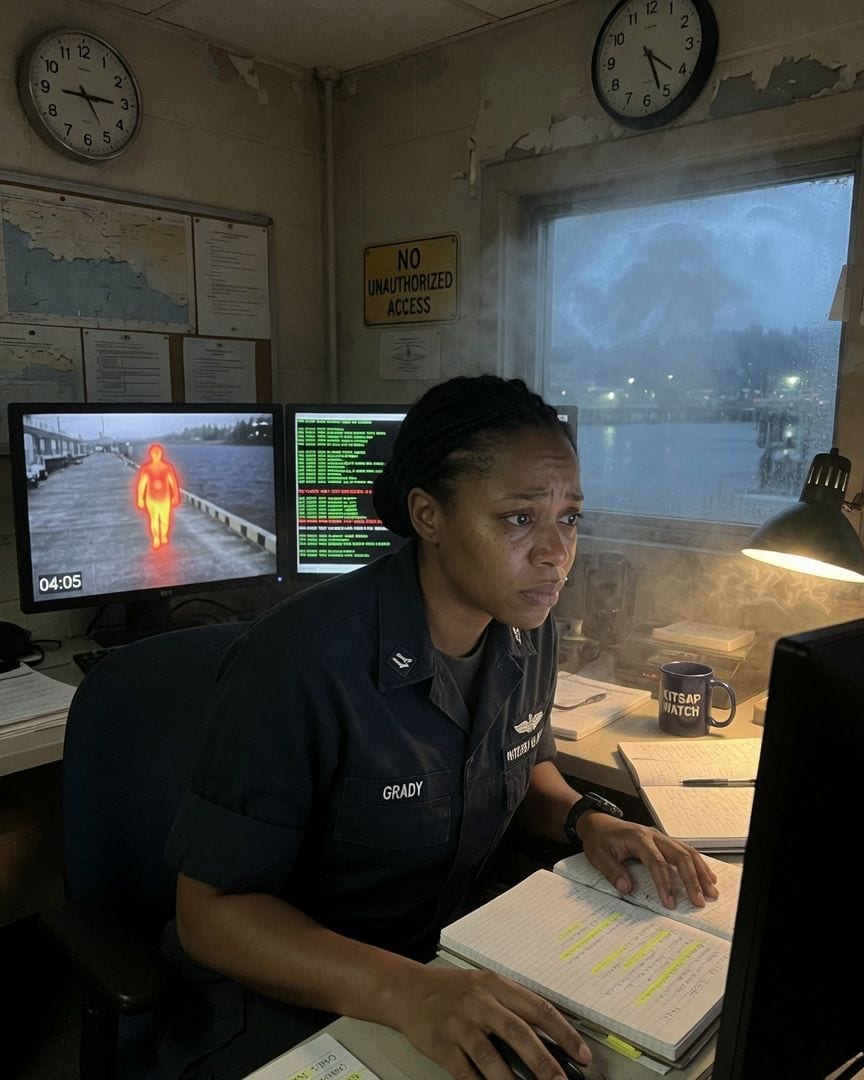
Petty Officer Olivia Grady found the base system logging impossible access at 0405. Every night for years, a blank ID walks Pier 7.
Petty Officer Olivia Grady stood her predawn watch on Pier 7, the cold mist of Puget Sound a familiar companion. Her routine scan of monitors at 0405 was shattered when an IR sensor flared with a man-sized heat bloom moving along the pier. Yet the camera feed showed only empty concrete and swirling mist. When historical logs confirmed the invisible presence had walked that exact path every night for years, Olivia dug deeper. She found a ghost "access log" entry with a unique ID but no name attached, meticulously aligned with the 0405 bloom. What impossible entity was the base system logging, night after night?
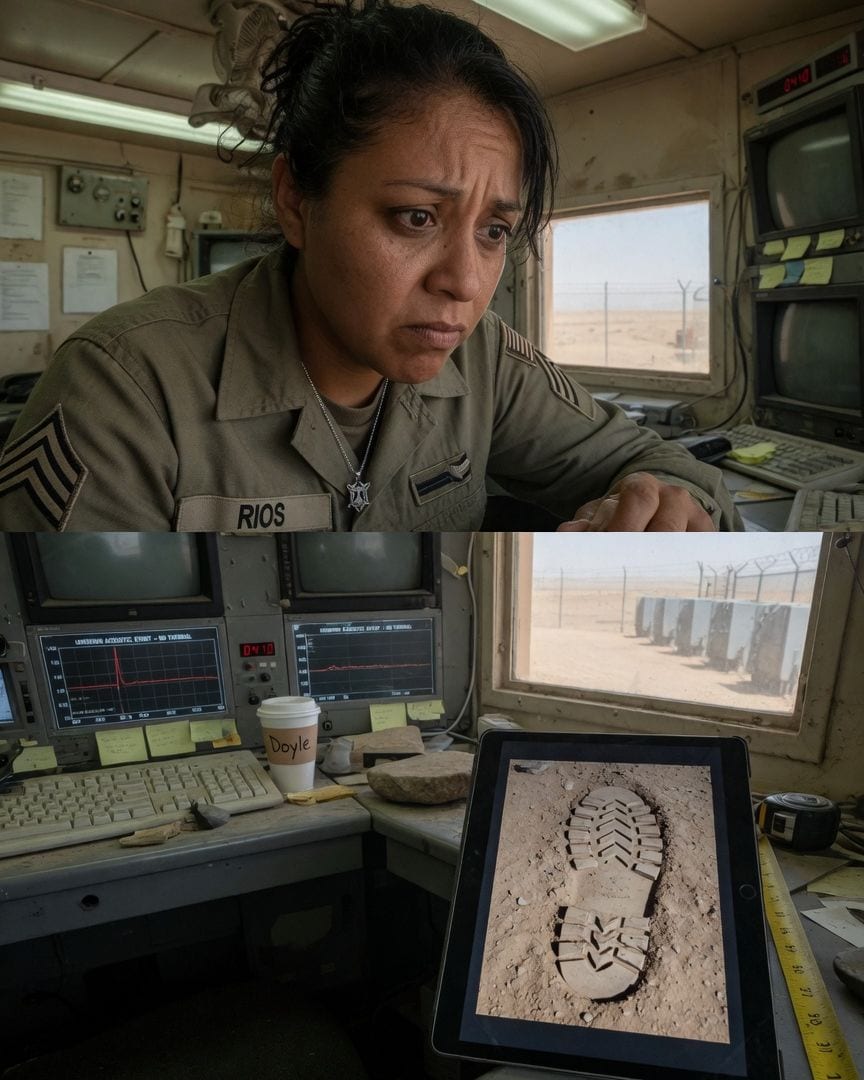
Sergeant Rios had three weeks until home. Then a unique boot print appeared outside her post, facing *inward*.
Sergeant Vivian Rios counted down her last three weeks at Observation Post 7, dreaming of home. For three months, a phantom acoustic pattern haunted her console every 0410: a lone walker crossing sensors, leaving no other trace. Then, fueled by restless nights, she walked the perimeter and found it: a single, distinct boot print in the undisturbed sand, unlike any she'd ever seen. It wasn't military, not civilian, and it faced *inward* – directly towards her isolated post. What walked the desert night, leaving a print that defied every explanation?
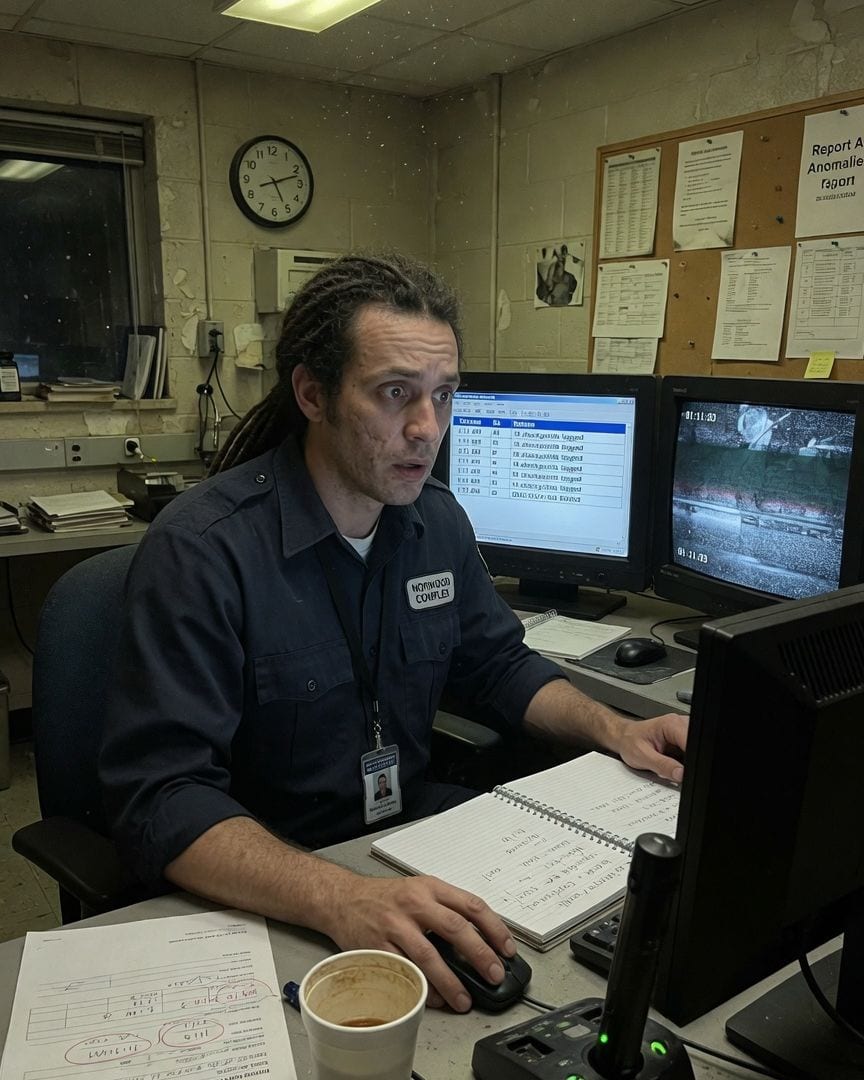
Three years ago, my security wand logged a full patrol at 1:11 AM. I was working in Arizona.
My night shift at the Norwood Complex involved the usual routine: plugging in my security wand and catching up on incident reports. But the morning's security log for that Friday showed an impossible full building sweep at 1:11 AM. All fourteen checkpoints were logged as hit by my wand, in under four minutes, a route that normally took me at least twenty.
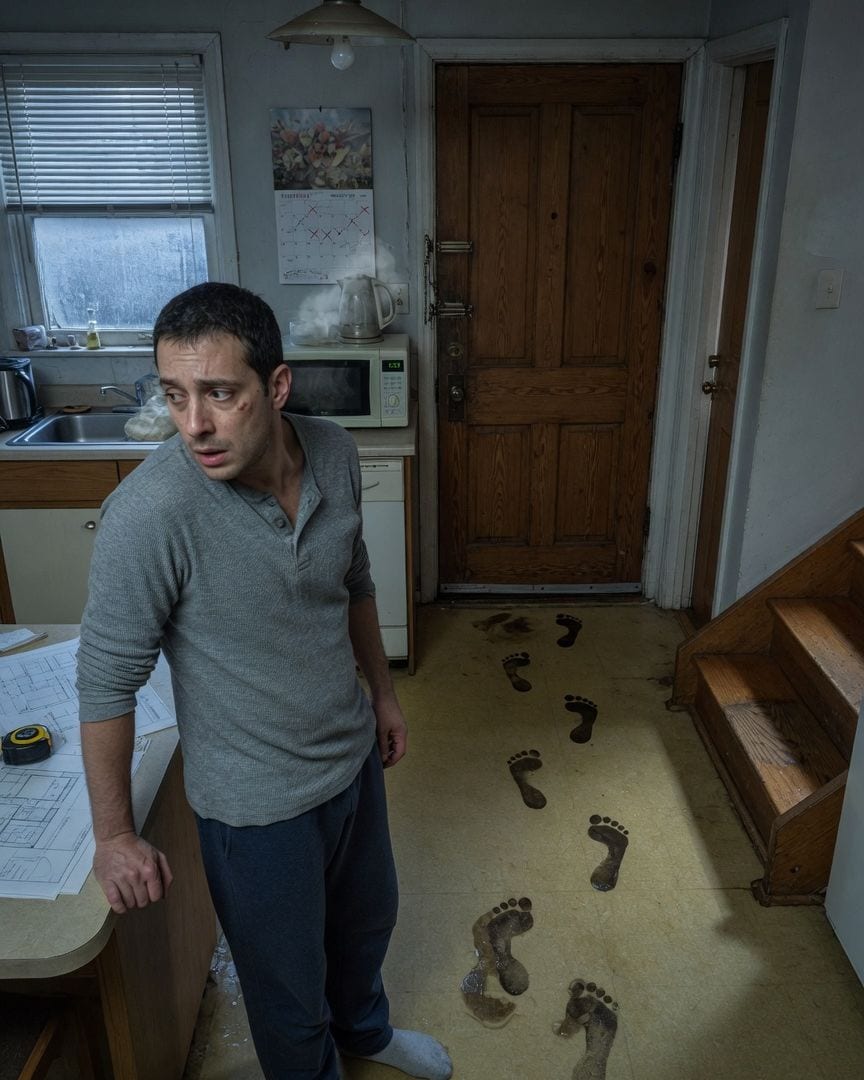
Bare wet footprints cross my locked kitchen floor every morning. Larger than mine, leading from the bolted back door to the stairs, fading from the toes as I watch.
As an architect, I notice details, but nothing in my old house's plans accounted for this. Every morning, wet, bare footprints appear across my kitchen floor, stretching from the bolted back door to the main staircase. They are larger than my own, colder than winter, and simply materialize from nothing.
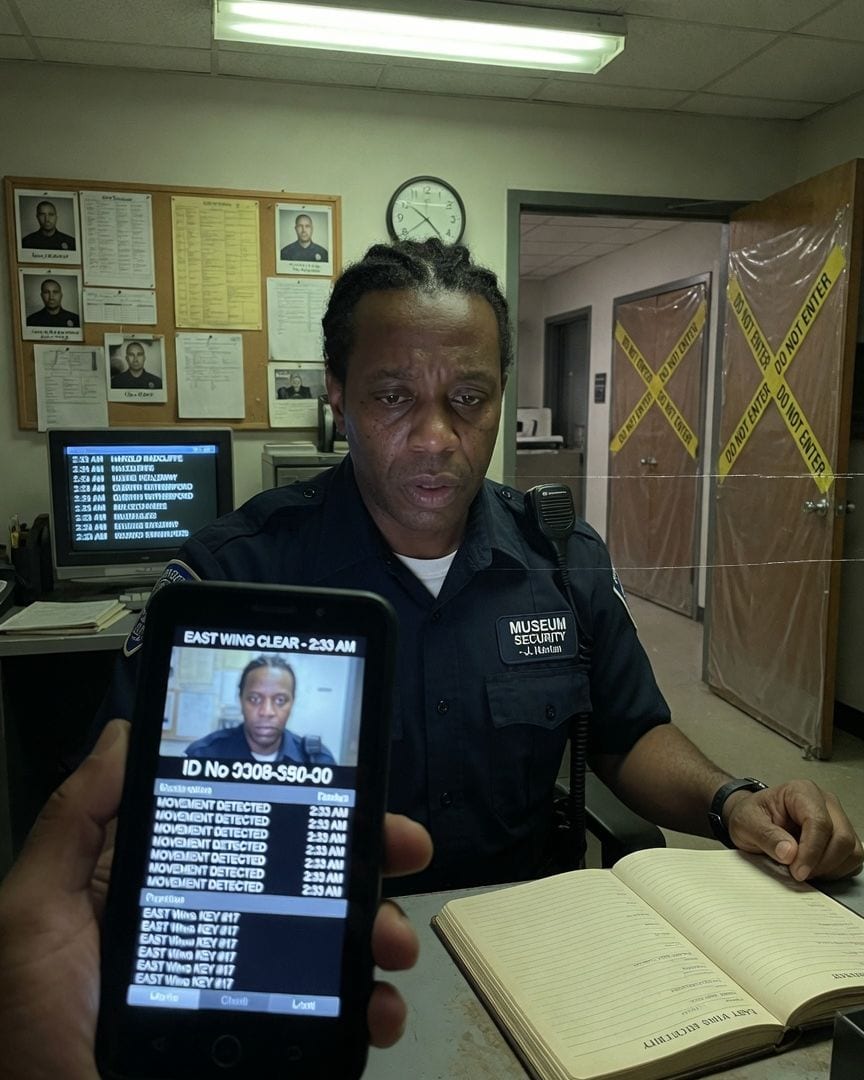
My guard log shows the east wing cleared at 2:33 AM. That wing's been sealed for months, doors screwed shut.
I was on my final security rounds in the quiet museum after midnight, ready to clock out. My handheld scanner showed the East Wing cleared at 2:33 AM under my ID, though it's been sealed for months. Then my hand brushed a faint, precise scratch on the plastic covering the doorframe, exactly where a security scanner would be held.
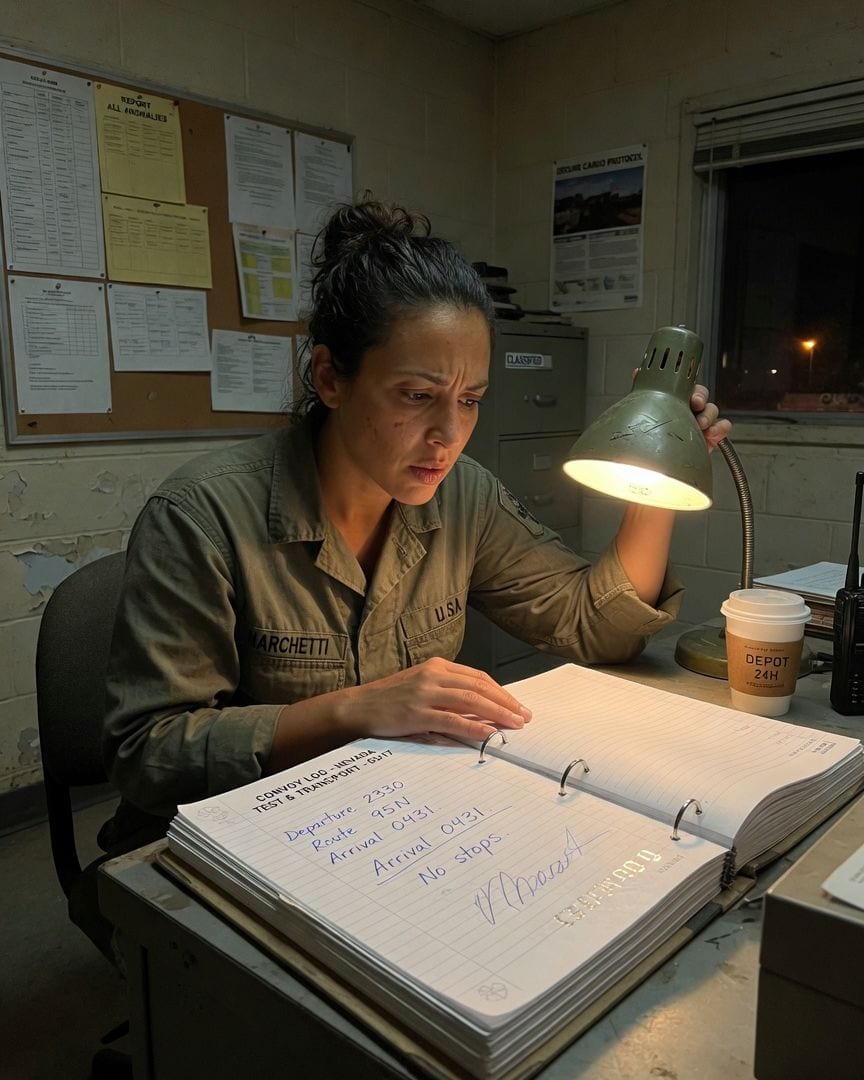
A transport driver's signed logbook claimed her four missing minutes in the desert never happened.
Specialist Cleo Marchetti followed the lead truck through the desolate Nevada desert, transporting an unidentified craft. Her only job was to keep the taillights of Senior Specialist Felix Hartley’s rig in sight. But at the halfway point, they simply vanished, leaving Cleo alone in the oppressive dark for four silent minutes. When the lights reappeared impossibly closer, Cleo knew something was terribly wrong. Yet, the official convoy log, bearing her own signature, recorded a perfect, uneventful journey with no stops. How could an entire four minutes disappear from the official record she herself confirmed?