My house has a cellar in the insurance report. Concrete slab kitchen floor for a decade. The surveyor's photos show steps down from a pantry door we don't own, light on below.
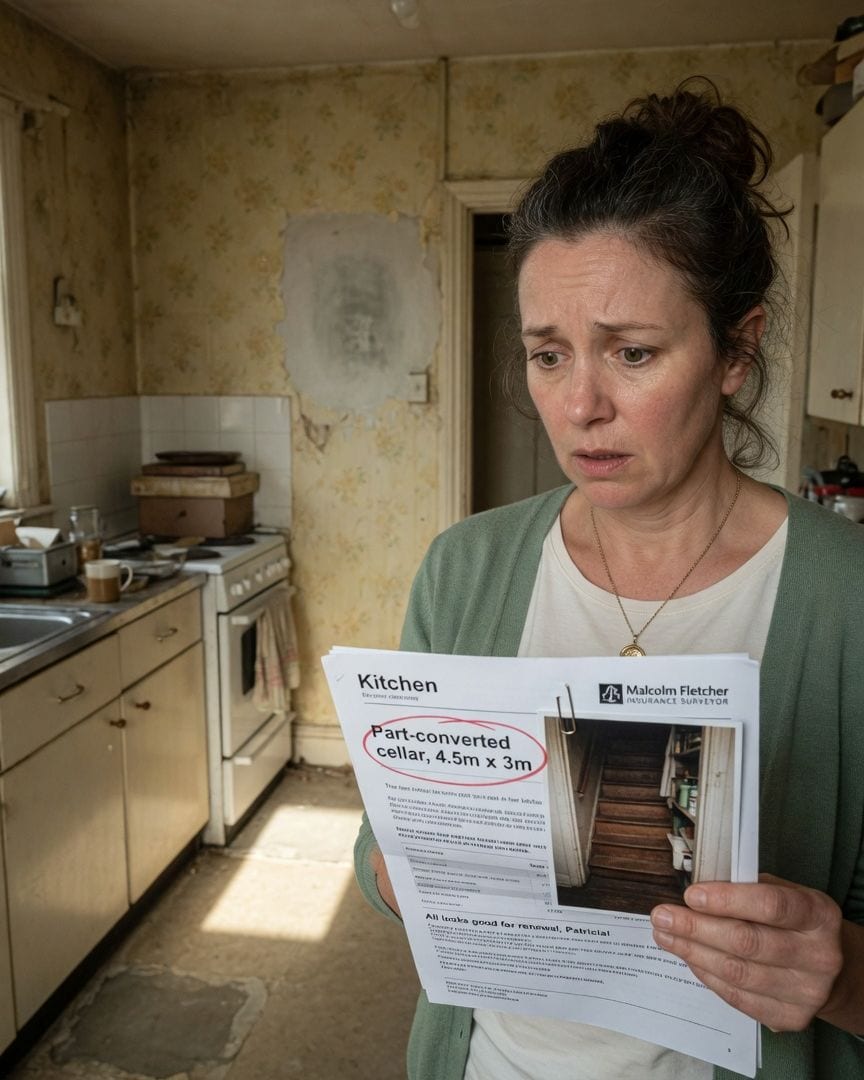
I stared at Malcolm Fletcher’s insurance surveyor report, specifically at page three, under 'Kitchen'. It listed a 'part-converted cellar, 4.5m x 3m.' I tapped my foot against the solid, unyielding concrete slab floor.
It had been there for a decade, ever since David and I laid it ourselves when we bought number 14, Willow Lane. No cellar. There was no cellar under my kitchen, and there never had been.
The report wasn't just words; it included photos. One showed a set of worn wooden steps leading down into darkness, taken from a doorway in a small, cramped pantry. A pantry I didn’t own. A pantry that didn’t exist.
Another shot, from the bottom of those steps, revealed a single bare bulb already glowing, casting long shadows on damp brickwork.
Malcolm’s accompanying email was cheerfully generic: 'All looks good for renewal, Patricia! Just a few minor discrepancies to cross-reference.' Minor discrepancies?
This wasn't a slightly off measurement; it was an entire subterranean room, a whole flight of stairs, and a pantry that simply weren't there.
I stood in my kitchen, the morning light bright on the concrete, the solid silence of the house pressing in. I lived alone now, David having moved out last year, making the phantom cellar even more unsettling.
The photos felt like an intrusion, a glimpse into a part of my own home that was utterly alien.
I called Malcolm. He was polite, slightly baffled. 'Are you sure, Mrs. Novak? My notes are quite clear. Standard terraced house, built 1880s, common to have a coal cellar, often converted.
My photos are geotagged to your address, 14 Willow Lane.' He sounded utterly confident, like I was the one who was confused. He offered to send a colleague to verify. 'No,' I said, 'that won't be necessary.
I'll check the original deeds.' I needed a proper explanation, not another baffled professional.
I spent the next day pulling dusty boxes from the attic, the air thick with the scent of old paper.
The architect's plans from 1888, brittle and faded at the creases, showed the house as a simple two-up, two-down, no cellar. A later amendment, dated 1923, detailed a small coal shed added in the garden, nothing more.
No subterranean level, no pantry, nothing like the photographs. I even checked the external walls, tracing the foundation line, looking for any sign of a filled-in window or a patched-over entrance. Nothing. Just solid brick, consistent with my current layout.
I ran my hand over the smooth, painted wall where the surveyor's photos showed a pantry door. It felt cold. Too cold, even for an old house.
It wasn’t a draft; it was a concentrated spot of chill, a presence of cold that hadn't been there before Malcolm's report. I pulled out a small stud finder, running it along the wall, listening to its chirps.
It found nothing but plaster and lath. No hidden cavity, no doorway. The cold persisted, a faint chill emanating from the spot where the phantom pantry should be, a chill that had never been there before.
It felt like standing next to an open refrigerator, only there was no refrigerator, just a wall.
Frustrated, and needing a distraction, I went through my mother Lydia Coleman's old things, boxes I hadn't touched since Lydia passed away five years ago. Old photo albums, chipped ceramic ornaments, letters tied with ribbon.
Tucked beneath a stack of old gardening magazines, I found it: a rolled-up sheet of thick, yellowed paper. It wasn't a blueprint, more like a hand-drawn architectural sketch, meticulously detailed in pencil.
I smoothed it out on the kitchen counter, the paper crackling softly.
It was my house. Every window, every chimney, every room, perfectly rendered. And there, clearly marked beneath the kitchen, exactly as described in the insurance report, was the 'Part-Converted Cellar,' complete with a 'Pantry Entry.' But that wasn't all.
To the side, where my neighbor Cynthia Fletcher's garden wall now stood, the sketch showed a narrow, unlabelled alleyway leading to an additional, impossible room, its dimensions scrawled illegibly in a tiny, cramped hand.
A date was penciled in the bottom right corner: 1952.
The 1952 sketch haunted me. It was too detailed, too accurate in its wrongness. It wasn’t a mistake; it was an impossible truth.
I remembered my mother, Lydia Coleman, mentioning an old friend who was an amateur historian, Thomas Lawson, still living in the area. Lydia had always been interested in local history, something I hadn’t paid much attention to until now.
I found Thomas’s number in an old address book and called him.
Thomas, 78, a retired librarian with a formidable memory and a slow, thoughtful way of speaking, agreed to meet me at his home, surrounded by towering bookshelves. He examined the sketch, his brow furrowed, adjusting his spectacles.
'This looks like a Lawson sketch,' he mused, tracing a line with a gnarled finger, 'my great-uncle, Philip Lawson. He was obsessed with local architecture, especially older properties. He believed houses had "memories" of past configurations.'
Thomas recalled Philip talking about 'shifting spaces' in some of the older terraced houses, particularly one on my street, although he couldn't remember the exact number. He mentioned Philip had a collection of such peculiar sketches, and even a journal.
He agreed to look for them.
I, meanwhile, started walking my street, Willow Lane, looking at the other terraced houses built in the late 1880s.
I noticed subtle differences in brickwork, odd window placements, small walled-off sections that didn't quite match the symmetry of the rest of the block. Little visual hiccups in the otherwise uniform row.
It was like a game of 'spot the difference' that I’d never played before. I even spoke to my next-door neighbor, Cynthia Fletcher, 68, who had lived there all her life.
Cynthia, tending her roses, remembered an old, bricked-up well in my garden when she was a child, long since covered over with a patio. 'Always thought it was strange,' Cynthia said, wiping her hands on her apron.
'Never heard of a well right there, right up against the house.'
The house felt different. The cold spot in the kitchen seemed to expand, a palpable chill that seeped into the floorboards, making the very air feel heavy.
Sometimes, I swore I heard faint, rhythmic thuds from beneath the concrete, like someone moving heavy furniture. It was never distinct enough to chase, always fading when I held my breath to listen.
One evening, driving home from Thomas Lawson’s, where he promised he was getting closer to finding Philip’s journal, I took my usual route: down Elm Street, turned onto Birch Lane, then onto Oak Avenue.
It was a route I could drive in my sleep. But instead of the familiar bend leading to my street, I found myself back on Elm Street, facing the same coffee shop I’d passed twenty minutes earlier.
My fuel gauge showed a slight drop, the clock on my dashboard indicating the lost time.
I tried again, meticulously. Elm, Birch, Oak… and back to Elm. Three times. The road returned me, each loop consuming mileage and fuel, yet I never reached my street.
A chilling certainty settled over me: the impossible geometry wasn’t confined to my house. It was reaching out. It was a net.
When I finally made it home by a completely different, circuitous route, my hands tight on the wheel, a small, unmarked envelope was tucked under my front door. It was thin, stiff paper, the kind that might hold a photo.
Inside was a single, faded photograph. It showed a flight of wooden steps leading down into darkness, identical to the one in Malcolm Fletcher's report. The same worn wood, the same angle.
But beneath the photo, written in shaky, old-fashioned script, were two words: 'Stop looking.'
I showed the photograph and the note to Thomas Lawson the very next morning. He had been expecting me, having located his great-uncle Philip's journal. Thomas's hands trembled as he recognized the script.
'This is Philip's,' he said, his voice hushed. 'He wrote about the "Anomalous Geometries" and the "Returning Ways". He believed certain structures were "anchored" to these shifting spaces, drawing people in.'
He opened the journal, the leather-bound cover creaking with age, and started reading, his voice low and deliberate. 'Entry, August 1952: The terraced house on Willow Lane, number 14. The cellar manifests again. The pantry door, the steps. It draws.
The pattern is consistent. They never find it until it finds them.'
My house. Number 14, Willow Lane. The 1952 date on my mother's sketch, the one I found tucked in her things, clicked into place.
The journal described how these impossible spaces would recur in specific houses, sometimes dormant for decades, then suddenly re-manifesting.
Philip had documented several instances, always the same cellar, the same pantry, appearing and disappearing, sometimes within the same house, sometimes appearing in a neighboring property for a time.
He believed it was a single, non-euclidean space that 'folded' into different physical locations, drawn by certain... affinities.
'Affinities?' I asked, my voice barely a whisper, the word feeling too soft for the terror it implied.
Thomas looked up from the journal, his eyes grave. 'He thought it had something to do with the occupants. A lineage, perhaps. A recurring bloodline.' He paused, his gaze fixed on me, then turned a page slowly, deliberately.
'He noted a recurring name in his research: Novak. And Coleman.'
I felt a cold dread spread through my veins, colder than anything I’d felt in my kitchen. Novak was my surname. Coleman was my mother's maiden name. The cold spot in my kitchen pulsed. It wasn't just a place.
It was a pattern, and I was inside it.
Thomas continued to turn the pages, his finger tracing a faded entry. 'Philip documented a specific photo, taken by a Mrs. Coleman, showing the cellar.
He believed it was proof of someone truly "inside" the geometry, not just observing its edges.' He handed me a small, leather-bound photo album he'd found with the journal, its cover worn smooth from countless hands.
I opened it, my fingers fumbling. Tucked inside, loose and slightly larger than the other sepia-toned snapshots, was a familiar image. It was my mother, Lydia, young and vibrant, smiling broadly.
She was standing at the bottom of a flight of wooden steps, the same steps from Malcolm Fletcher’s report, the same steps from the anonymous 'Stop looking' photo.
The same bare bulb glowed above her, casting its stark light on the damp brick. My breath caught in my throat. I looked closer.
On the brick wall behind my mother’s head, just above her left shoulder, was a small, irregular scratch. A scratch shaped like a crescent moon. I had seen that mark just yesterday.
I had made it myself, accidentally, with a dropped knife, on the plaster wall in my own kitchen, where the phantom pantry should be.
I stared at the photograph, then back at Thomas, my mind reeling. The crescent moon scratch. My scratch. Made yesterday. In a cellar my mother stood in decades ago.
'It's not just recurring,' I whispered, the words barely audible, 'it's always been here. Always with us.'
Thomas nodded slowly, his face grim. 'Philip theorized it was less a place that appeared and disappeared, and more a constant, impossible space that interfaced with our reality at specific points.
And those points, he believed, were tied to certain families, certain bloodlines. He called them "Anchors".' He flipped to the back of the journal, revealing a crudely drawn family tree, interspersed with house numbers and dates.
My own surname, Novak, and my mother's, Coleman, were ringed in red, connected by a thick, wavering line to house number 14, Willow Lane, and several other addresses. The dates spanned nearly a century, always coinciding with a 'manifestation' event.
'The Road That Returns,' Thomas explained, his voice low, 'was a symptom. The geometry wasn't just in the house; it was in the surrounding space, subtly re-routing those connected to it, preparing them. Making them receptive.'
I realized the cold spot in my kitchen wasn't just a draft; it was the proximity of this impossible space, a constant, subtle pull. I had always been inside it.
The house, or rather, the impossible space, had been waiting for me, drawing me in, just as it had drawn my mother, and perhaps generations before.
The cellar wasn't just a room; it was the heart of a recursive, family-bound phenomenon.
I went home. The cold in the kitchen was now palpable, almost a physical pressure against my skin. It hummed in the air. I approached the wall where the phantom pantry should be, my hand outstretched.
I could feel a faint vibration, a hum beneath the plaster. It wasn't the stud finder reacting; it was the wall itself, a low thrumming that resonated in my bones. I knew what I had to do.
The pattern snapped into place: the cellar was an invitation, a gateway that only opened for those 'anchored' to it. I wasn't meant to stop looking; I was meant to enter.
I went out into the garden. The air was still, the summer evening just beginning to cool.
I found the small, bricked-up section in the garden wall that Cynthia Fletcher had mentioned, tracing the outline of the old well cover with my fingers. It hummed with the same resonance as the kitchen wall.
This was the true anchor point. This wasn't a choice to escape, but a choice of how to exist within it. I fetched a pickaxe from the shed, its weight strangely comforting in my hands.
The first blow against the bricked-up section sent a dull thud through the ground, a tremor that seemed to echo inside me. The second cracked the mortar, a sharp, splintering sound.
With each strike, the cold in the kitchen intensified, and I could hear a faint, distant whisper from within the wall, like a sigh of anticipation. I wasn't fighting it; I was participating.
I was opening the way, not for it to come out, but for me to go in.
The wall crumbled inward, revealing not a well, but a dark, narrow passage, smelling of damp earth and something else, something ancient and still, like forgotten breath.
A single, bare bulb hung from a wire above the opening, glowing faintly, already on.
I never called Thomas Lawson again. My house remained number 14, Willow Lane, outwardly unchanged. The insurance renewal went through without a hitch, the report listing no cellar.
My neighbors, Cynthia and David, commented that I seemed quieter, more distant, but otherwise, perfectly normal. The cold spot in my kitchen was gone. Her home felt… complete.
The faint smell of damp earth sometimes lingered in the air, a subtle undertone to the scent of my morning coffee.
I often found myself standing in the kitchen, a faint, contented smile playing on my lips, my gaze fixed on the wall where the pantry door once was, or perhaps still was, in another dimension I now knew intimately.
I sometimes heard faint, rhythmic thuds from beneath the floorboards, but they no longer brought dread. They were simply the sounds of home.
David, stopping by to pick up some old mail, noticed Patricia standing by the kitchen wall, humming a tune he didn't recognize. 'Everything alright, Pat?' he asked.
She turned, her smile widening slightly, her eyes seeming to hold a depth he’d never seen before. 'Oh, yes,' she replied, 'I'm finally finding my way around the place.'
If this one got to you
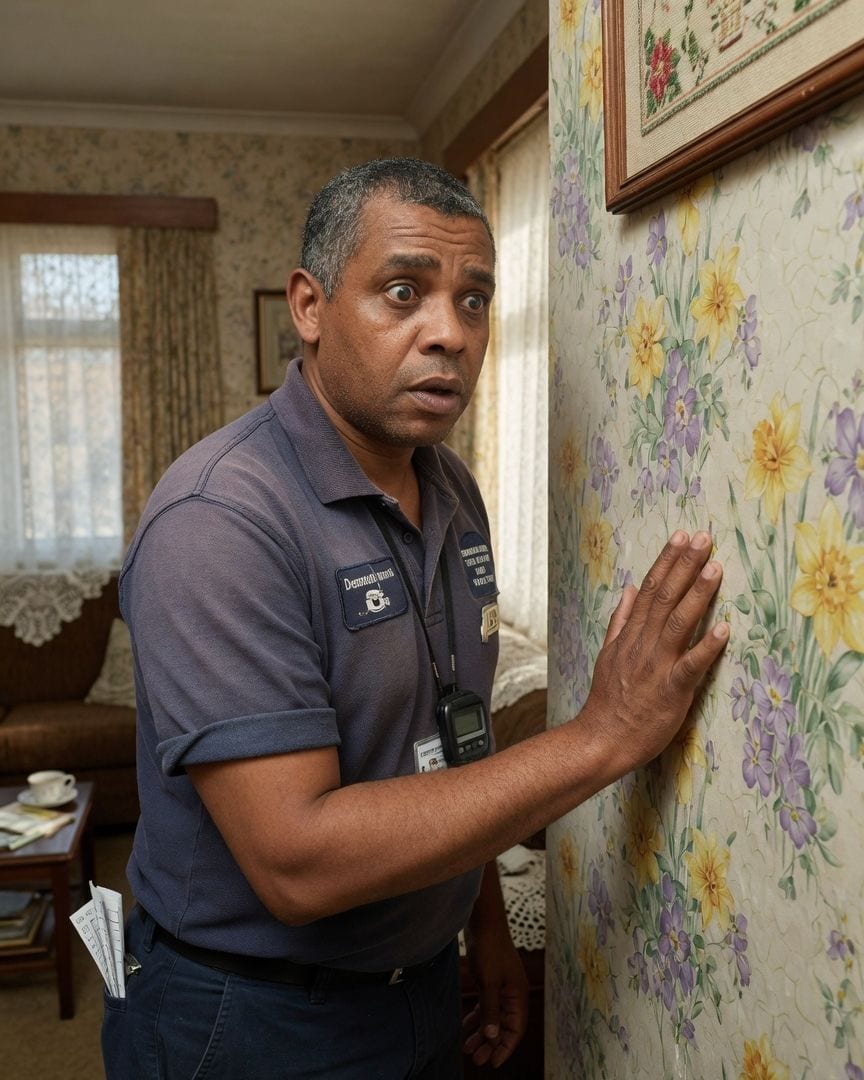
I read the water meters on this street, and this month number 30 grew a second one in pavement that was solid last month — its pipe runs back under a front door I cannot find.
I'm Desmond Drummond, a city water meter reader, used to the predictable rhythm of my fifteen-year route. But this month, Mrs. Crane's house on Elm Street showed a second meter reading. It led to a new meter pointed at a blank brick wall, and later, to a hidden door behind her living room wallpaper where no door should exist.
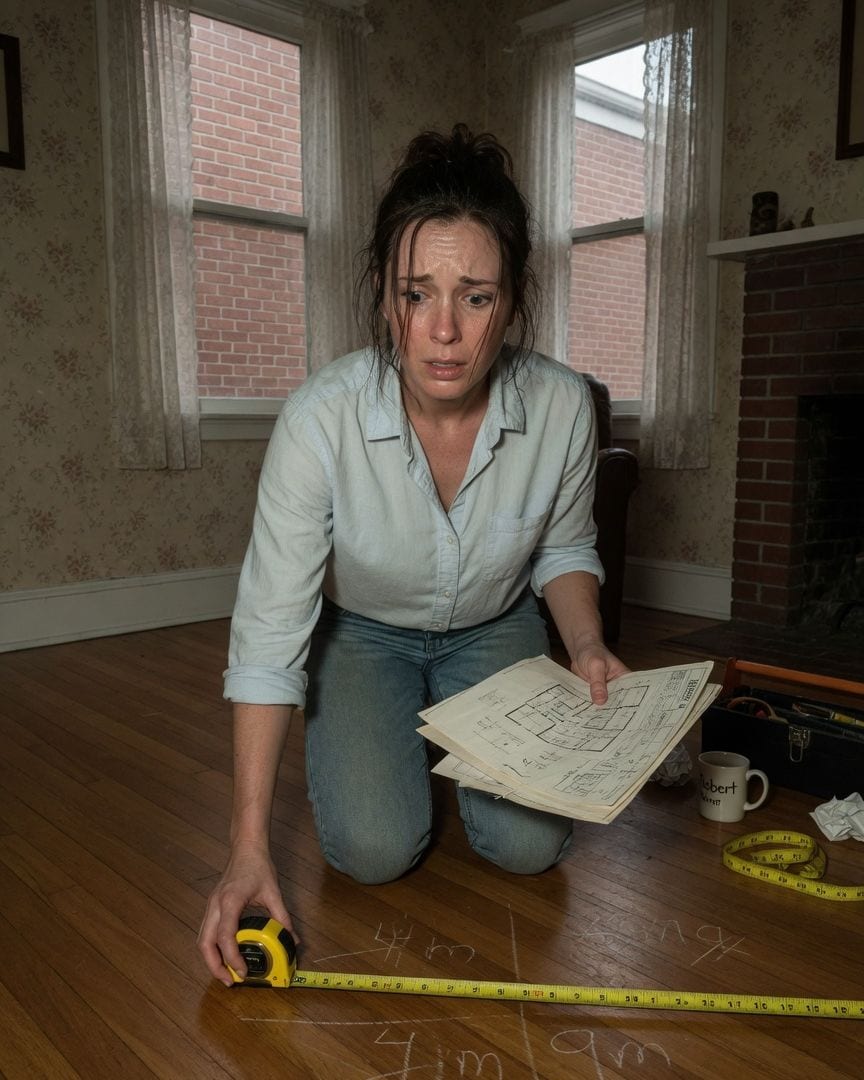
Our living room measures four by five metres. But the outside wall is nine metres long. A metre of house, gone, and I can't find it.
After moving into our charming 1920s house, I was meticulously measuring the living room when the dimensions refused to add up. My calculations of the interior space led me to discover a narrow, unpainted fifth door in the hallway, tucked almost out of sight. It wasn't on any original plans, and it opened to absolute, impenetrable darkness.
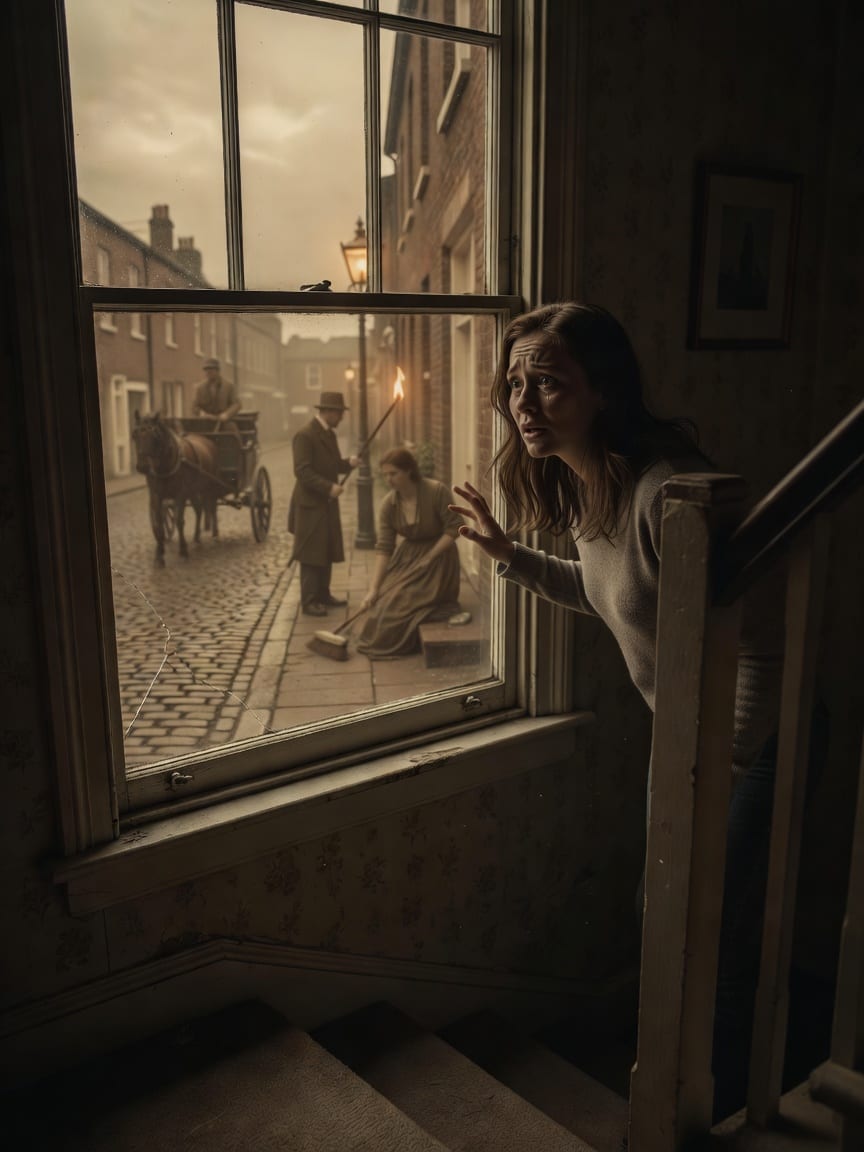
My half-landing window looked down on a cobbled street, a horse and cart. My panes, same crack. Below, only the bins.
I moved into this inherited house for a fresh start, living alone in the quiet. But the third stair on the main flight is deeply worn, a ghostly scoop hinting at decades of unseen footsteps. It feels hollow, and the wall beside it hides a faint, inexplicable seam.
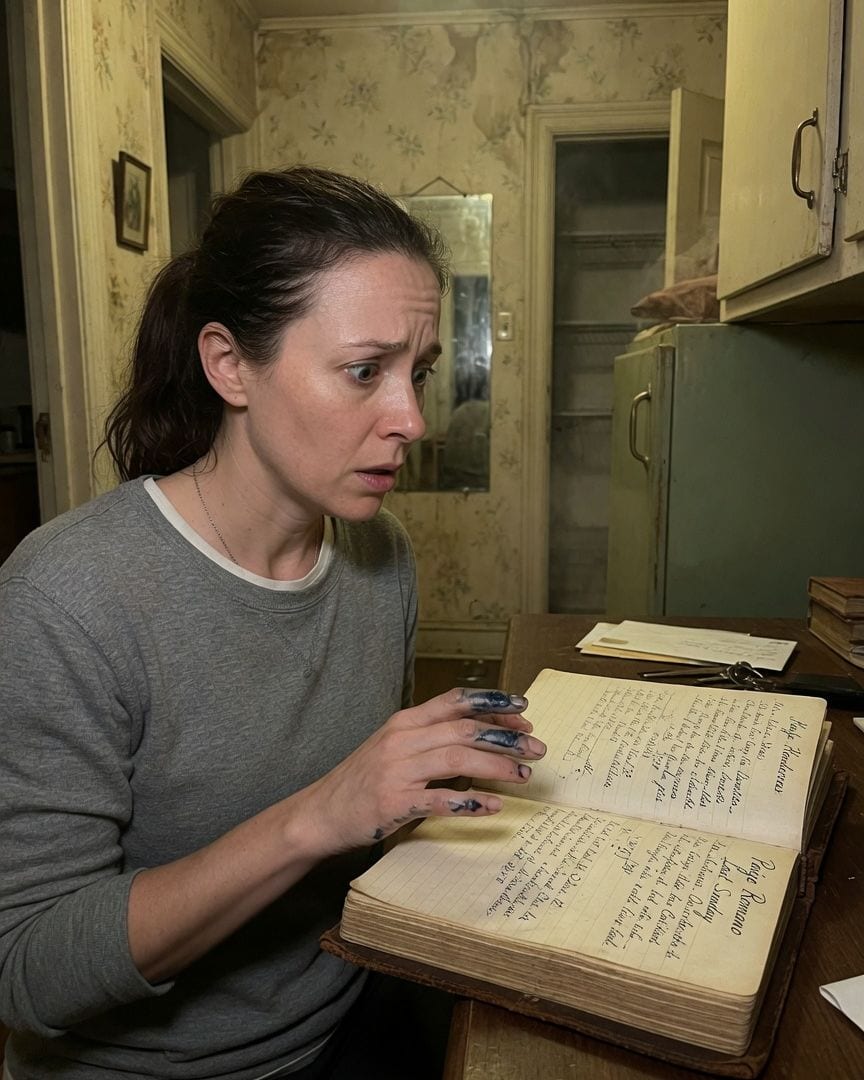
My visitors' book records guests who arrive in the future. Last Sunday, my own name appeared at the bottom, the ink still wet.
I bought an old house last March, complete with a dusty, leather-bound visitors' book. It seemed a charming relic, until I found new entries appearing, dated months into the future, the ink still wet. Then, my own name, Paige Romano, appeared, dated 'Last Sunday,' with a bead of ink shimmering at the 'R'.
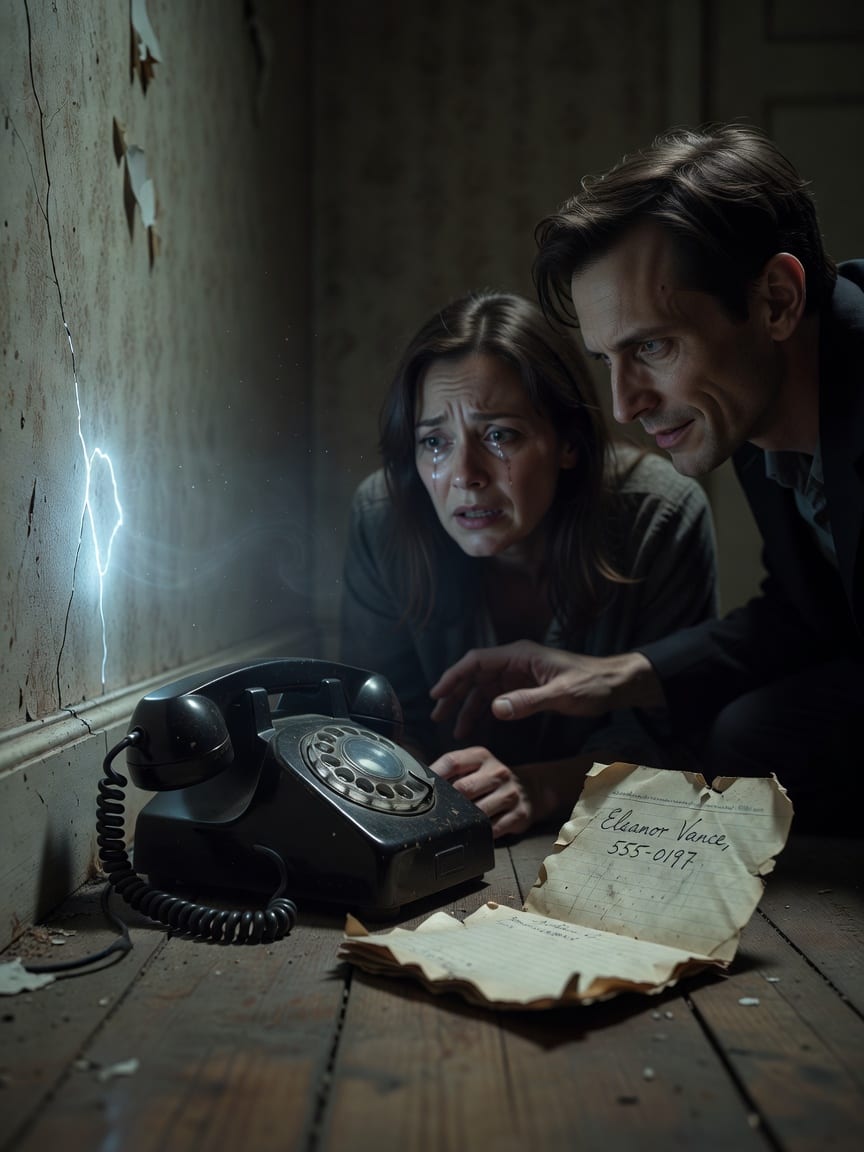
My house's walls ring when I dial a phone number from a 1974 directory. My neighbors said that directory was trash.
I was sifting boxes in my new house when I found an old 1974 telephone directory for my street. It listed my address, 12 Elm Street, under the name "Mr. & Mrs. Sheppard." On a whim, I called the faded seven-digit number. My cell phone rang, but a low, muffled sound also vibrated from the wall beside me.
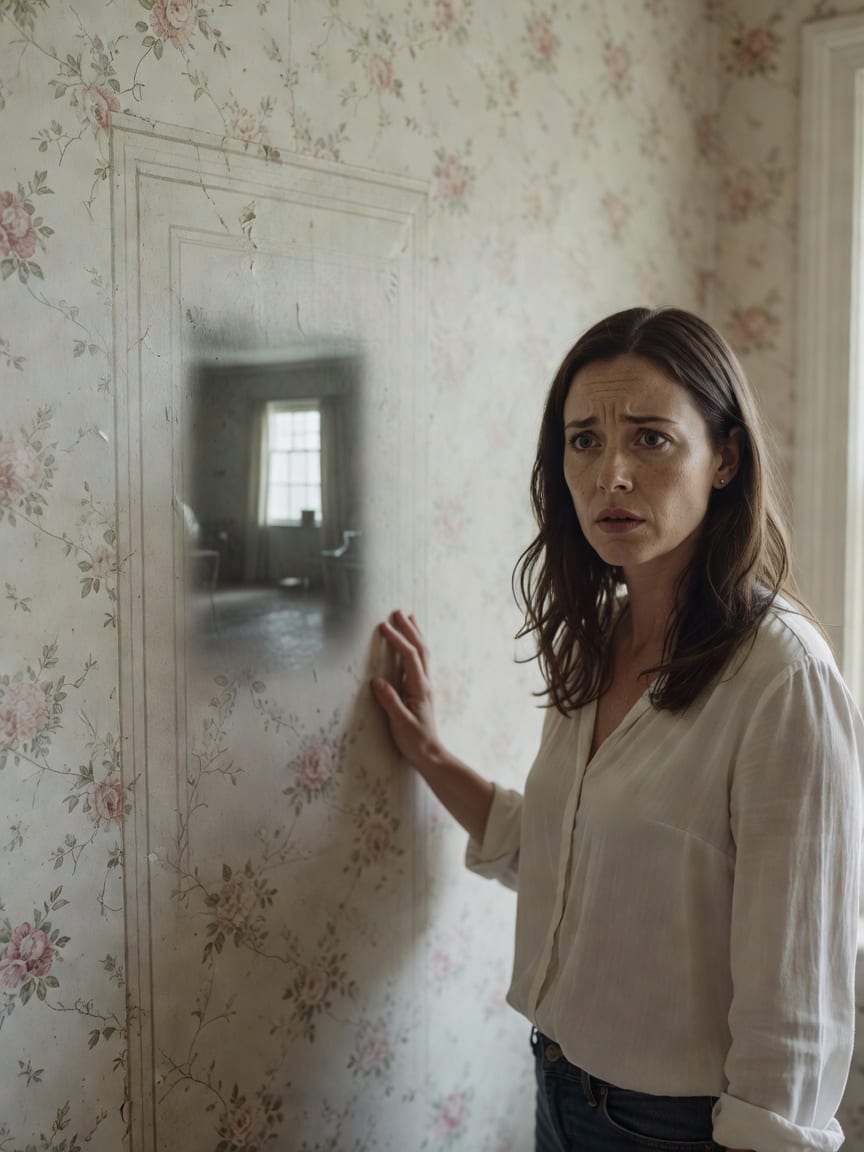
My neighbor’s house plans show a room in my bedroom that doesn’t exist. The surveyor described its door, but my wall is solid.
I was signing off on my neighbor's loft plans when I saw it: a small, square room off my own bedroom. My house, where I’d lived for five years, had no such room. But a surveyor confirmed its presence on paper, and older blueprints showed it had been there for decades. Now, I can feel a faint coldness from a hidden doorframe behind my wallpaper.