Lieutenant Ferro surveyed a station set for demolition, but its galley stovepipe curled fresh woodsmoke.
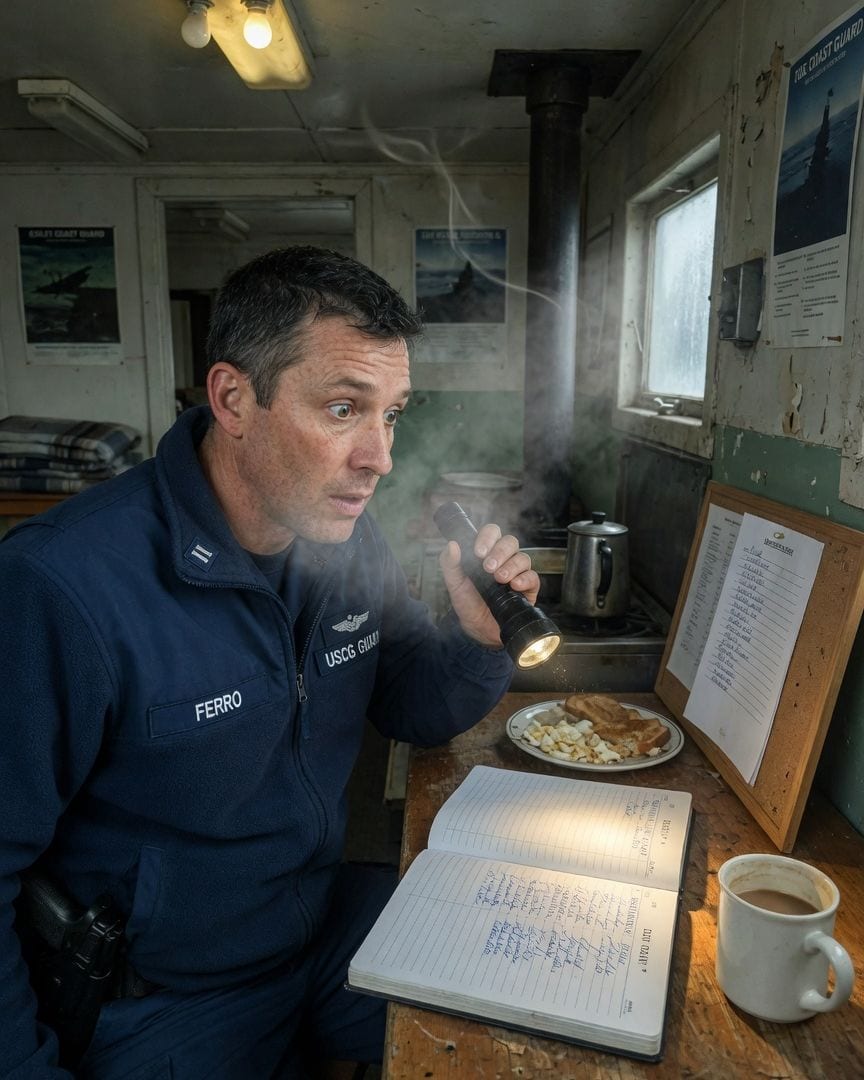
The Coast Guard buoy tender USCGC Steadfast cut through the thick Aleutian fog, its mission stark: a final survey of LORAN Station 14-J before its demolition.
Lieutenant Theodore Ferro, the Executive Officer, felt the familiar bite of the cold, saline air as the rigid-hull inflatable boat approached the black-sand beach.
The station, officially abandoned since 2010, should have been a derelict shell, its tower long dismantled, its quarters stripped. Ferro had visited decommissioned sites before; they were typically gutted, silent monuments to obsolete technology.
But as his boat crew—William Norwood and Felix Sutton—navigated the choppy surf, a thin plume of woodsmoke, acrid and undeniably fresh, curled from the galley stovepipe of the main building, twisting into the low-hanging mist.
The sight made the breath catch in Ferro's throat. It was impossible.
They landed in silence, the faint scent of woodsmoke clinging to the damp air. Ferro, pistol holstered, led the way, his boots crunching on the volcanic sand toward the main building.
The door, heavy and made of reinforced steel, was unlocked, yielding with a groan. Inside, the chill of the island seeped into every corner, the air stagnant with the smell of old damp and disuse. But the galley was different.
A subtle warmth lingered, and the air held a faint, residual aroma of something cooked, perhaps eggs and coffee. A half-eaten breakfast sat on the mess hall tables, plates still bearing faint moisture, as if recently cleared.
A fresh pot of coffee sat on a cold burner, its aroma faintly present, betraying its recent preparation. On a corkboard, affixed with a thumbtack, a duty roster, crisply printed, listed a full watch section for the current date.
Below it, on a scarred wooden table, lay the station logbook, its cover faded, but open to today’s entry. Ferro leaned closer, his eyes scanning the page.
The signatures were bold, unfamiliar, yet rendered in a precise, official hand: 'PENNINGTON, M.', 'HUGHES, S.', 'KOWALSKI, D.', 'FOSTER, L.'. He knew the Coast Guard’s personnel rolls inside and out, a memory honed by years of managing manifests.
These names were not on any active manifest, nor had they been assigned to this long-decommissioned station. The silence of the galley felt less like abandonment and more like a held breath.
Ferro checked the log’s previous entries. Each day for the past week, the same impossible names filled the duty roster, followed by concise, standard operational notes.
He tried to rationalize it—a prank, perhaps, some squatters playing a joke on the demolition crew. But the meticulousness, the use of official Coast Guard forms, the uniforms… it was too precise, too uniform.
No squatter would bother with such administrative detail. He moved through the deserted barracks, each bunk neatly made, a crisp, gray wool blanket folded at the foot of each.
The air was colder here, dust motes dancing in the beam of his flashlight, but the orderliness was absolute.
Then, in a small supply locker off the main corridor, locked from the outside but easily forced with a pry bar from his kit, he found them.
Ferro's flashlight beam swept past a row of hooks inside the small, dark space. Hanging there, pristine and freshly laundered, were several Coast Guard uniforms.
Each had a name tag, stitched above the breast pocket: 'PENNINGTON, M.', 'HUGHES, S.', 'KOWALSKI, D.' — names from the logbook, names that shouldn't be here, crisp and ready for duty.
Back on the Steadfast, Ferro’s report to Captain Joel Hughes was met with a skeptical frown. "Squatters, Lieutenant. Or some local eccentrics playing sailor. It's not unheard of on these old stations.
Burn the log, secure the station, and we proceed with demolition as planned." Hughes’s voice was dismissive, his gaze already moving to other duties. But Ferro couldn't shake it.
The sheer correctness of it all, the meticulous detail, gnawed at him. He spent the next two days in the ship’s comms room, a cramped space filled with the hum of electronics and the smell of ozone.
He cross-referenced the names from the logbook and uniform tags against every available Coast Guard personnel database, active and decommissioned. He checked historical manifests for LORAN stations across the entire Aleutian chain, going back decades. Nothing.
No 'Maxwell Pennington,' no 'Sandra Hughes,' no 'Diane Kowalski,' no 'Leonard Foster' ever officially assigned to Station 14-J. He found no record of any of them, anywhere, in any capacity that matched the dates in the log.
Yet, the station log itself was official issue, printed on Coast Guard stationery, the entries written in a steady, professional hand that matched the period-correct ink. The ink, he’d noticed, was still subtly wet on the most recent entry.
He even found an old, faded Coast Guard maintenance log from 1971, tucked away in a dusty cabinet on the Steadfast’s bridge.
Flipping through it, he saw a signature for a routine equipment check at a different, long-decommissioned Aleutian LORAN station: 'PENNINGTON, M.' The same distinct, precise hand. The same name. Decades earlier.
The mundane explanation of a prank or squatters evaporated, replaced by a cold, precise dread that tightened his stomach.
Ferro’s meticulous digging didn't go unnoticed. Captain Hughes began to eye him with concern, then irritation.
"Lieutenant Ferro," Hughes said, his voice clipped one morning as Ferro returned from another late night in comms, "I understand your thoroughness, but we have a schedule. This isn't the first time an old station has thrown up oddities.
You’re becoming…distracted." Later that night, alone again in the comms room, the air grew heavy, the hum of the equipment like a dull thrumming in his teeth.
Ferro picked up a faint, garbled signal on the LORAN station’s old frequency, a sequence of numbers that made no sense, a brief, mechanical whisper. It was there, then cut out abruptly, leaving only static.
He tried to trace it, but it was gone, swallowed by the vast, indifferent airwaves. He felt a prickle on his neck, the irrational certainty that someone, something, was listening. Was someone sending him a message?
Or was the station itself still broadcasting, a ghost in the machine? He started carrying his sidearm even when off duty, the weight of it a small, cold comfort.
The crew, too, began to keep their distance, their glances quick and furtive, whispering about his obsession with the abandoned station.
William Norwood, one of his boat crew, found him poring over old microfiche images, the light from the reader casting a green glow on Ferro’s gaunt face. "Sir, you okay? You haven't slept much.
That place… it can get to a man." Ferro just nodded, his gaze fixed on a blurry image of a young Maxwell Pennington from a 1970s service photo, a face now chillingly familiar.
The face was distinct, earnest, full of a youth that should have been long gone.
Ferro finally found it. A digitized service record, deep in the archived personnel files, for Maxwell Pennington. Date of birth: 1951. Enlisted: 1969. Service number, rank, assignments—all neatly arrayed.
And then, stark and undeniable, a line that froze the blood in Ferro’s veins: Date of Death: October 14, 1972. Training accident, San Diego. Cause of death: blunt force trauma. Never served in the Aleutians.
Ferro felt a chill that had nothing to do with the Alaskan cold or the air conditioning in the comms room.
The 'M. Pennington' who signed the 1971 maintenance log, the one whose uniform was hanging crisp in the locker, the one whose name was on today's duty roster at LORAN Station 14-J – he was dead.
And had been for over fifty years. He pulled up the photo from Pennington’s file. It was the same face he’d seen on the microfiche, the same earnest young man with a hopeful, almost innocent expression.
Ferro cross-referenced the other names from the LORAN station’s current log: Sandra Hughes, Diane Kowalski, Leonard Foster.
Each search yielded the same impossible result: a date of death, decades ago, far from the Aleutians, often in unrelated, mundane incidents, followed by a complete service record that ended abruptly. Sandra Hughes, drowned in a vehicle incident in 1998.
Diane Kowalski, perished in a house fire in 2005. Leonard Foster, lost in a diving accident in 1985. The mundane explanations had not just failed; they had been violently rejected, ground to dust by the undeniable facts.
This wasn’t a clerical error, or a prank, or squatters. This was something deeper, woven into the very fabric of military accountability.
The system itself, which should have flagged these inconsistencies with screaming alarms, instead seemed to silently endorse them, holding records for men and women long dead, yet somehow still on duty.
The realization hit Ferro with the force of a physical blow, knocking the air from his lungs. The old maintenance log, the fresh uniforms, the current duty roster – they weren't just anomalies. They were continuity, a meticulously maintained fiction.
He went back to the digital service records, digging deeper, past the death dates, past the official closure. And there, buried in obscure sub-sections of the personnel system, he found them.
Not just the death dates, but for each of the 'phantom' crew members, subsequent entries. Transfers. Assignments. Promotions. Commendations. All dated after their official deaths. Maxwell Pennington, dead 1972, showed a transfer to LORAN Station 14-J in 2023.
Sandra Hughes, deceased 1998, a promotion to Chief Petty Officer in 2020. Diane Kowalski, gone 2005, a commendation for 'exceptional service' in 2022. Leonard Foster, lost 1985, a new security clearance in 2021.
The entries were sparse, just enough to justify a continued presence, to account for personnel that should not exist. Ferro stared at the screen, the official digital record for 'PENNINGTON, MAXWELL'. Date of death: 1972.
But below it, a transfer order, dated 2023, assigning him to LORAN Station 14-J, Aleutian Chain. Then another. And another. Every name from the impossible logbook, a deceased servicemember with a new, active assignment.
The system wasn't broken; it was meticulously accounting for the dead.
Ferro realized the horrifying truth. The LORAN station wasn't just 'manned' by ghosts; it was 'accounted for' by a system that repurposed the identities of the deceased.
The smoke from the stovepipe, the half-eaten breakfast, the set mess, the fresh uniforms, the meticulously kept logbook—these were not vestiges of a past presence, but evidence of an ongoing, impossible operation.
These 'crews' were not squatters or pranksters; they were active, if phantom, personnel. The system wasn't failing to track them; it was creating their records, weaving their impossible existence into the very fabric of military bureaucracy.
He found a strange pattern: these re-manifested identities were often those of servicemen and women who had died in obscure, isolated incidents, their records easily 'reassigned' without immediate scrutiny.
Maxwell Pennington’s accident, Sandra Hughes’s drowned vehicle, Diane Kowalski’s house fire, Leonard Foster’s diving mishap—each was a death that didn't demand a public inquiry, a closed book easily reopened by the system.
The station log wasn't just a record of their phantom duty; it was the proof that the system acknowledged them, integrated them, made them real within its own twisted logic. The full implications hit him like a physical blow.
The Coast Guard wasn't just overlooking a few anomalies; it was complicit. He located a second logbook, a sister station’s record from 1980, stored in a locked box in the Steadfast’s archives.
On a random page, amidst entries for equipment checks and weather reports, a signature: 'PENNINGTON, M.' The same distinct handwriting, the same impossible name, thirty years before the station was decommissioned, fifty years after the man himself had died.
The artifact, a physical ledger from an impossible past, confirmed the pattern. It was real, dated, and checkable—the ordinary explanation died for good.
Armed with the two logbooks, the printouts of impossible service records, and the chilling coherence of it all, Ferro confronted Captain Hughes.
He laid out the evidence, calmly, rationally, the words precise and measured, the only way he knew to articulate such a monstrous truth.
Hughes listened, his face a mask of disbelief, then growing alarm as Ferro flipped through the pages of Pennington’s re-animated service record. "Lieutenant, this… this is impossible. You’re talking about… reanimated personnel?
The Coast Guard doesn’t… it’s a clerical error, a systems glitch." But the weight of the evidence, the official records, the indisputable dates, slowly, inevitably, began to crack his composure. Hughes made calls, hushed and urgent, to higher command.
Ferro stood by, watching the fear and confusion grow in his captain's eyes. The response was swift and definitive, delivered in clipped, unyielding tones that Ferro could almost hear through the comms.
His findings were dismissed as a 'severe case of operational stress and delusion,' his meticulously compiled evidence labeled 'forgeries' or 'misinterpretations.' He was ordered to stand down, to cease his 'disruptive behavior.' The demolition would proceed as planned.
Ferro knew then that he couldn't fight the system, not directly. It wasn't just ignoring the anomaly; it was actively suppressing its exposure, burying it under a mountain of administrative convenience and official denial.
The truth was too inconvenient, too terrifying, for the vast, ordered world of military bureaucracy. He made his choice.
As the Steadfast prepared to leave the Aleutian chain, the LORAN station now a distant smudge on the horizon, he slipped the current station logbook, the one with today's date and the impossible names, into his gear bag.
It was the only tangible piece of evidence he could preserve, a silent witness against the meticulous, horrifying lie.
His 'confrontation' had been with the unyielding, self-preserving nature of the system itself, a vast, cold entity that would rather bury an impossible truth than acknowledge its own dark complicity.
Lieutenant Theodore Ferro was honorably discharged three months later, citing 'psychological unsuitability for continued service.' His career was over, his impeccable record marred by the official notation of 'delusional tendencies.'
The LORAN station on the Aleutian island was demolished, its concrete foundations blasted into rubble, its history erased from the physical world. The Steadfast moved on to other duties, its crew returning to the predictable rhythms of the sea.
Captain Hughes never spoke of the incident again, his gaze distant whenever Ferro's name was mentioned in casual conversation, his face tight with an unreadable expression.
The military, in its infinite capacity for order, absorbed the anomaly by simply declaring it never happened. Ferro kept the logbook, hidden away in a fireproof safe, a heavy secret that settled deep within his bones.
Years passed. Theodore Ferro lived a quiet life, a veteran with an unexplained gap in his service, the weight of the sea and something else clinging to him.
He never spoke of the LORAN station, never dared to voice the impossible truth he carried. The logbook remained hidden, its pages a testament to a reality too terrible to share, too easily dismissed as madness.
One crisp autumn morning, he sat at his kitchen table, sipping coffee, the sun slanting through the window, idly scanning a local newspaper.
An obituary caught his eye, a young man who had died in a hiking accident, far from any ocean. Below the notice, a small, official-looking blurb from the local Coast Guard recruitment office, listing recent enlistments.
A name jumped out at him, cold and clear, making the blood drain from his face: 'FOSTER, LEONARD'. The coffee cup slipped from his fingers, shattering on the tile floor, its contents spreading in a dark stain.
He stared at the name, a name he knew, a name that could not exist. The system, he realized, was still accounting for the dead.
If this one got to you
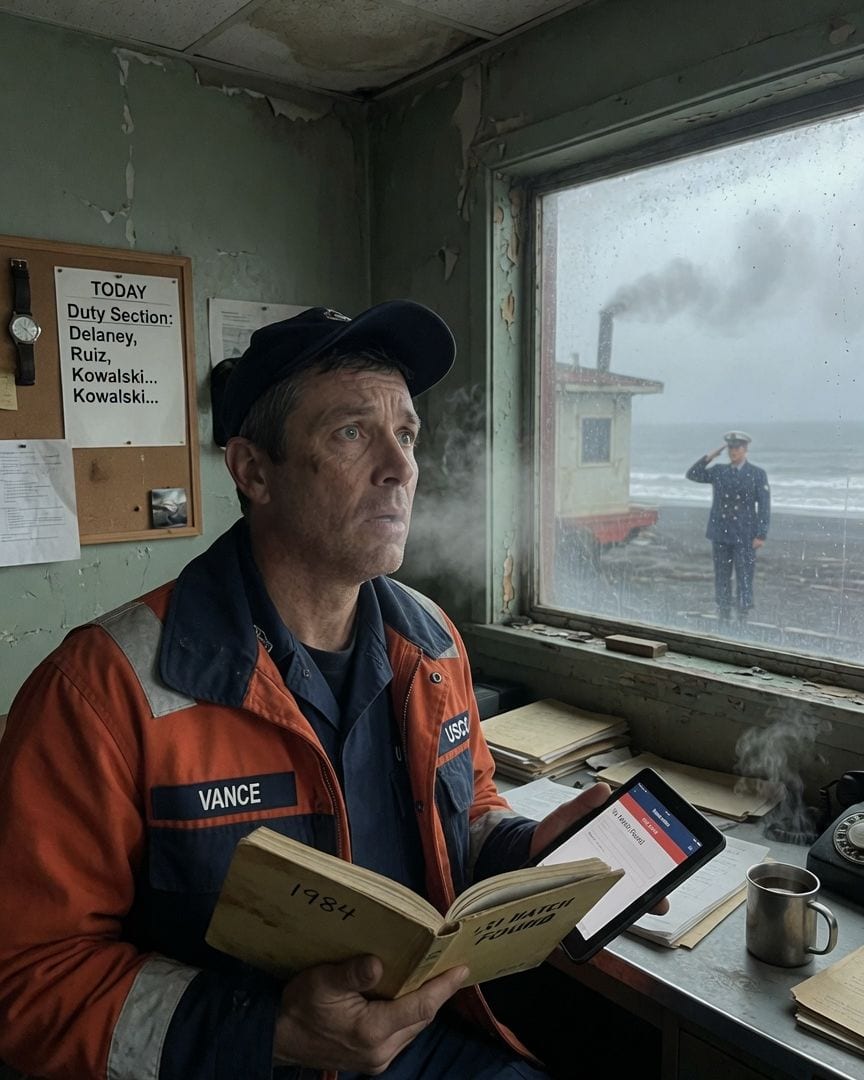
A Coast Guard XO's final survey found an abandoned Cold War LORAN station's stovepipe smoking, forty years after a man vanished.
Lieutenant Harold Vance, XO of the USCGC Whitfield, led a final survey mission to a remote Aleutian LORAN station, slated for demolition after years of dereliction. The fog-locked island was a stark silhouette as their boat approached, marking the station's lonely end. But as they neared the black-sand beach, Vance spotted a faint wisp of smoke curling from the galley stovepipe – impossible for a building stripped and abandoned since 2010. Ashore, the impossible scent of coffee filled the air. Inside, the mess hall was set with trays, a fresh watch bill, and a logbook dated today, listing unknown names. His unease grew when a second logbook revealed a signature from Lieutenant Commander Richard Delaney, reported MIA from this station four decades ago, with a chilling final entry.
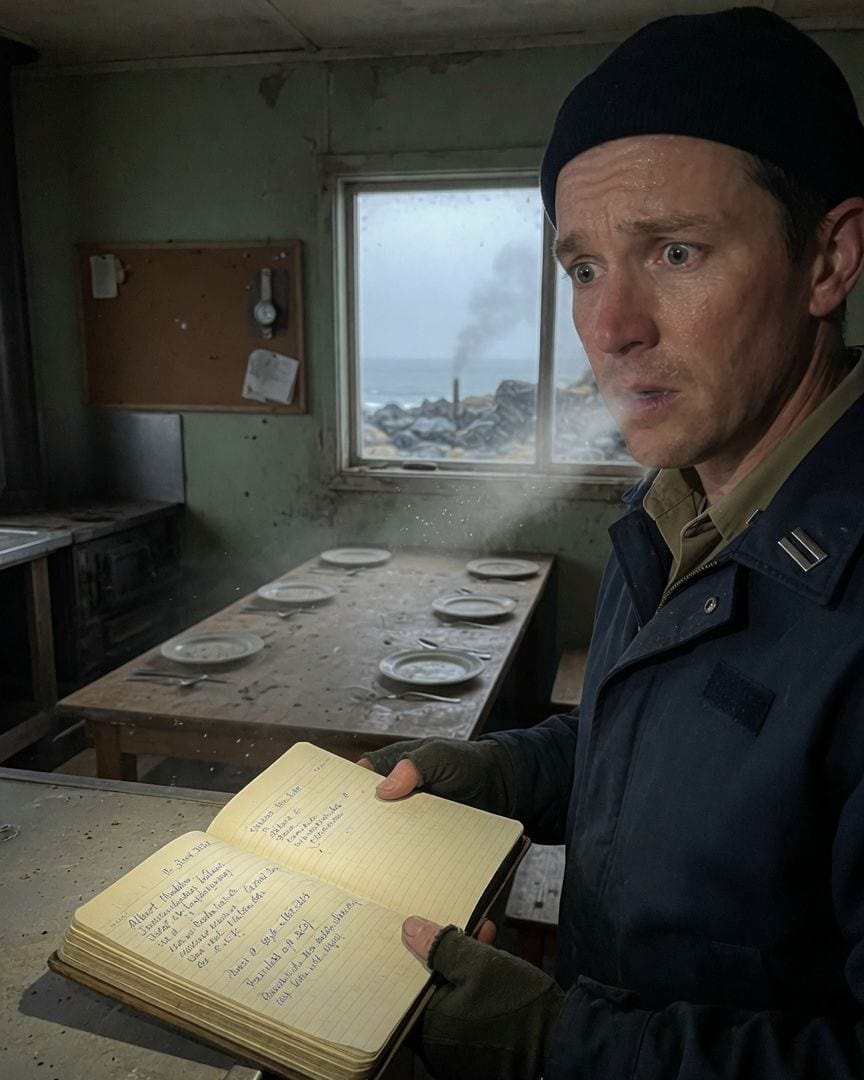
Coast Guard Lieutenant Thatcher finds an old crew photo dated today, June 15, 2024.
Lieutenant Daniel Thatcher leads a survey crew to a derelict LORAN station in the frigid Aleutians, officially abandoned for over a decade. But as they enter, a heavy-bound station log lies open on a counter, its ink startlingly wet, detailing a routine watch from today with names unknown to the Coast Guard.
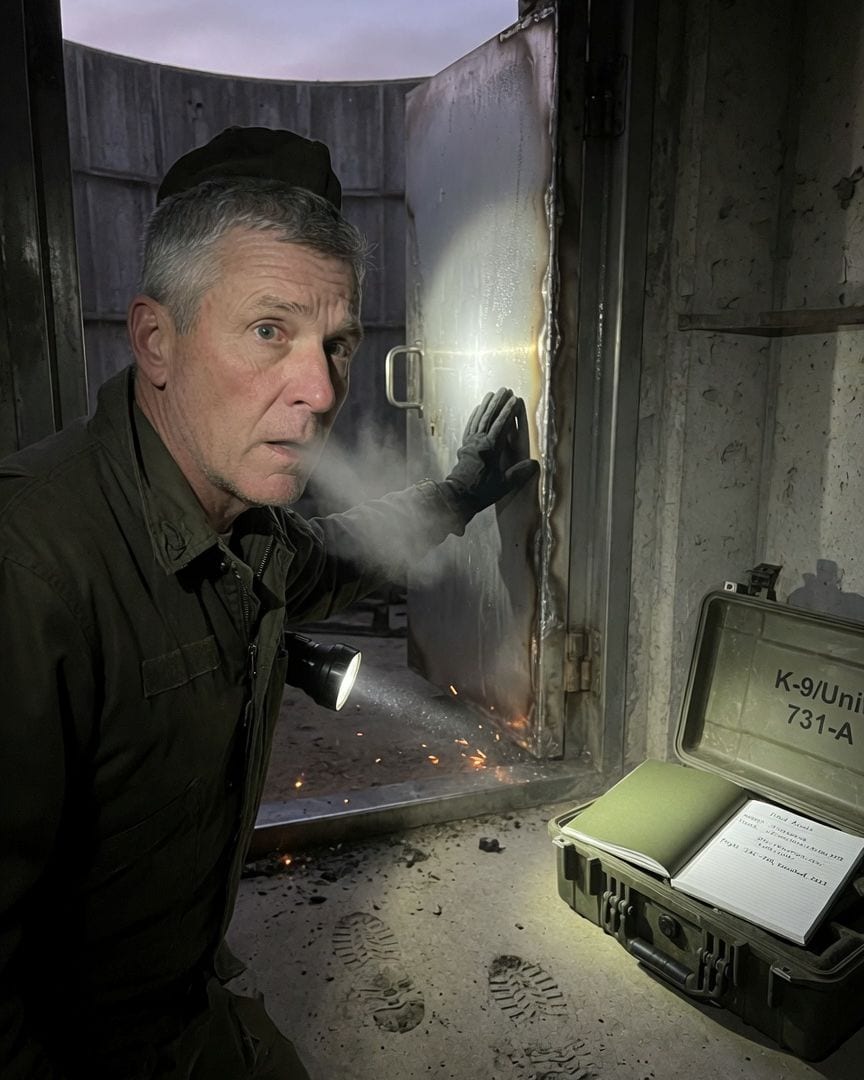
The Cold War silo was welded shut in 1968. A Captain found lights burning, fresh prints leading inside, and a logbook with a vanishing from last week.
Captain Merrit Sable faced a deadline at Silo K-9: one cold morning to retrieve classified hardware before its scheduled demolition at noon. The silo, officially welded shut by the Air Force in 1968 and long off-grid, should have been a tomb of forgotten machinery. Yet, through a cracked port, he saw nine work lights burning steadily forty feet down, and felt the faint suction of an active ventilation system. After breaching the decades-old weld, Merrit found more than just lights; fresh boot prints led deeper into the meticulously clean shaft, but none returned. A hidden compartment in an empty, warm hardcase revealed a logbook, its crisp pages detailing notorious military disappearances, with the latest entry dated just last week.
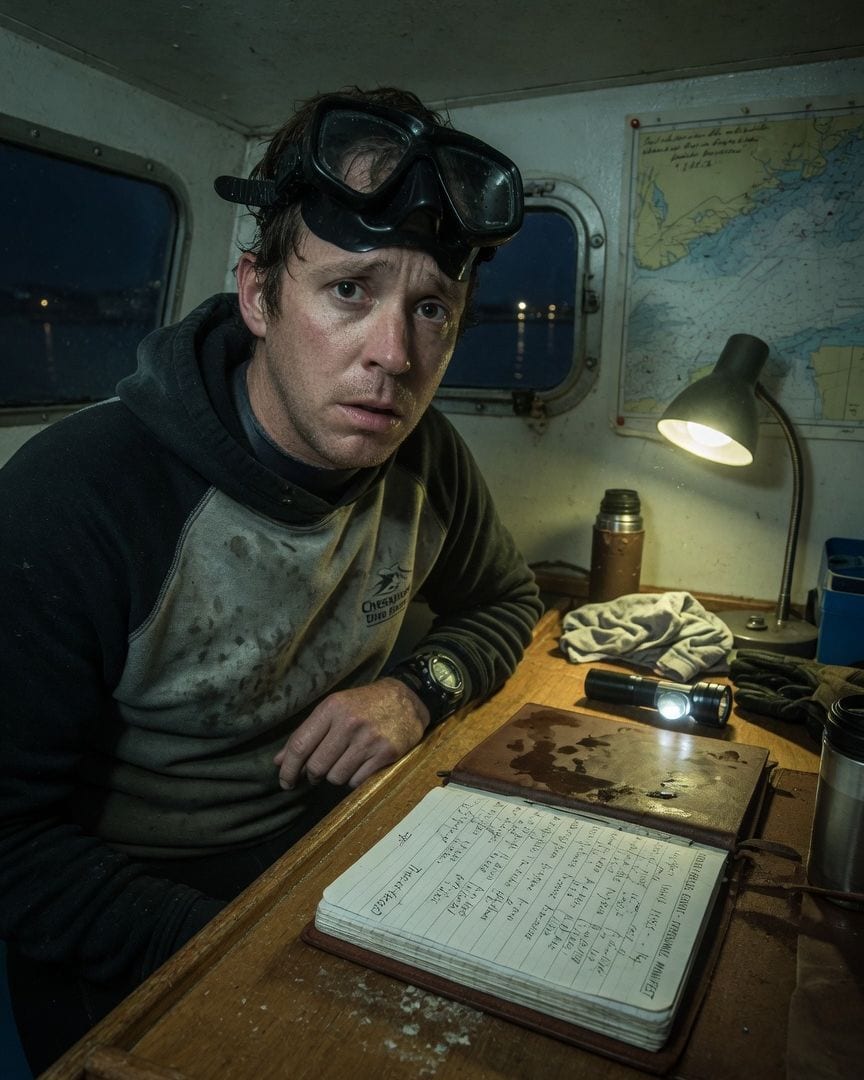
A diver on his last quest to his mother's lost ship found the crew listed in a hidden logbook as 'Transferred.'
Corey Nascimbene embarked on his last dive of the season, a personal quest to the sunken tug Harrow Belle, the ship his mother watched vanish decades ago. Descending into the cold Chesapeake gloom, he discovered a galley perfectly preserved, save for an impossibly folded, stark white napkin lying pristine on the muddy deck. Driven by unease, Corey later found a hidden, welded compartment in the engine room, containing a heavy, sealed logbook. Its personnel manifest listed the entire crew, not as lost, but with a single, unsettling word: 'Transferred.'
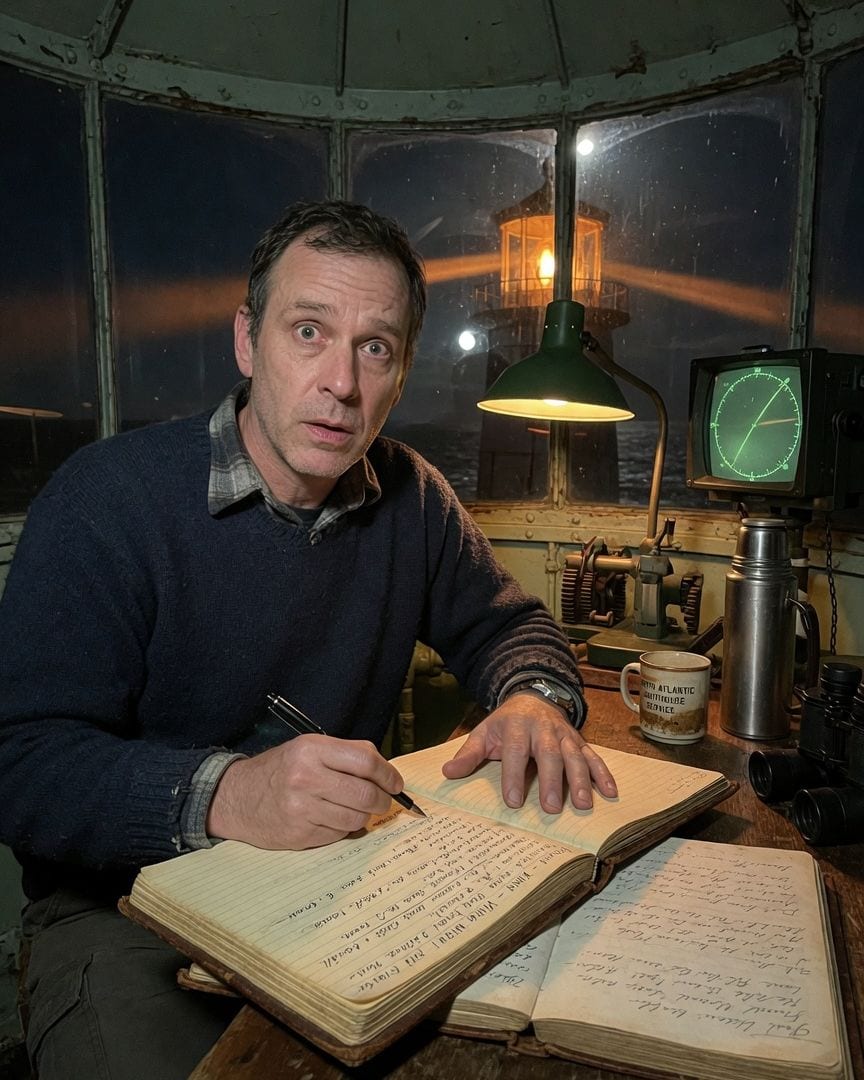
My lighthouse log has my own 3 AM entry for a phantom ship. I was alone in the tower, and I wrote no such thing.
Perched in the lantern room for my usual 2-6 AM watch, I reached for the thick logbook. But the 3:00 AM entry, under my own name, detailed a vessel I never saw. The words were in my own ink, yet I had never written them.
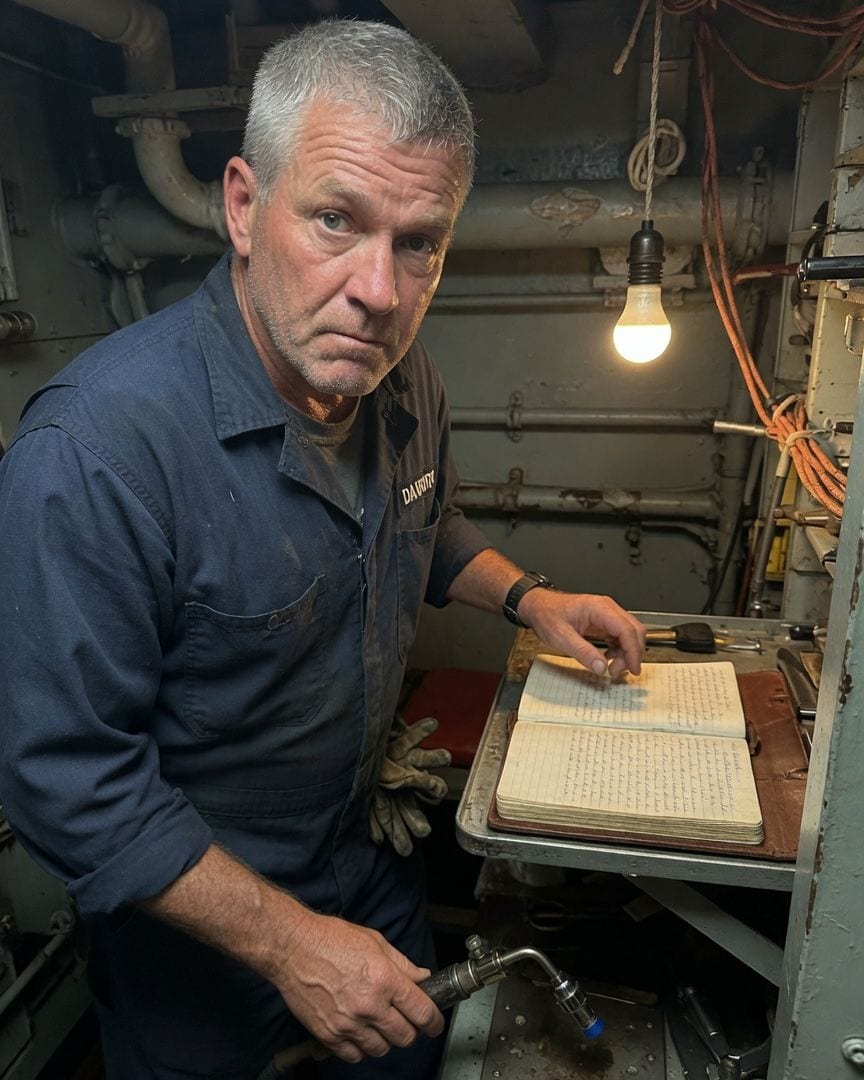
A week from shore duty, Chief Danforth cut a hatch where his ship's plans showed solid steel. An hour later, the wall was seamless, but the Cold War logbook from inside appeared under his mattress.
Chief Petty Officer Raymond Danforth, just a week from ending three decades of service, was intimately familiar with every pipe and plate of the guided-missile destroyer Weatherall. During a mid-cruise overhaul, his gloved hand found a sealed hatch where schematics promised only a solid bulkhead. He cut through the impossible seam to reveal a small, dry compartment, softly lit, containing a logbook filled with an unsettlingly familiar hand. When he returned an hour later with a witness, the hatch was gone, the wall seamless. Later that night, the same logbook appeared beneath his mattress, its pages revealing an entry: 'Petty Officer Howard Montgomery, missing, 1972.' How could a compartment vanish, yet leave its secrets behind?