Lieutenant Philip Ellsworth finds a silent sailor on deep patrol. The ship's log lists him as P. Kowalski, but his assigned locker holds a pristine Cold War 1985 uniform.
Lieutenant Philip Ellsworth moved through the humming steel corridors of the USS Vanguard, a stickler for order in a world defined by it. Deep patrol meant absolute adherence to protocol, every man accounted for, every system logged.
Tonight was mid-rats, the graveyard shift meal, and the mess hall was a low murmur of tired voices. Seaman Monica Stratton, the messcook, was running her tray count. Philip watched her, noting her brow furrow.
She counted again, then a third time, her lips moving silently, her fingers tapping the steel counter. She came up one plate short.
Then Monica glanced down the table, her eyes lingering at the far end, in the dimmest light. Philip followed her gaze. There, hunched over a tray, sat a sailor he didn't recognize. No one spoke to him.
He was just… there, a silent shadow among the tired crew. Monica, looking flustered, cleared her throat and simply started serving the rest of the line, as if the extra man had suddenly appeared to balance the books.
Philip watched the unknown man eat. He ate slowly, silently, never looking up, his movements economical, almost mechanical. When he finished, he placed his fork and knife neatly on the perfectly clean, wiped-bare tray.
There wasn't a crumb, a smear, or a drop of condensation left.
Then he stood and walked out, disappearing into the maze of bulkheads before Philip could even formulate a question, leaving the tray as if it had never been used. The mess hall's low hum seemed to drop a note.
The image of the silent, unknown sailor and his pristine tray snagged in Philip's mind. He couldn't shake it. Next morning, he pulled the mess log from the previous night.
Monica Stratton’s neat hand had recorded the official headcount, matching the manifest. Every name was there, every duty section accounted for. Philip checked it twice, then a third time, meticulously. It confirmed his initial thought: one short.
But beneath the last entry, scrawled almost as an afterthought in a different hand, was 'P. Kowalski - Mid-Rats.'
Philip’s stomach tightened. He cross-referenced 'P. Kowalski' against every current manifest, every watch bill, every transfer order for the USS Vanguard. Nothing. The name didn’t exist on his boat. He even checked the recently transferred-off list, the shore leave rosters.
No P. Kowalski. He expanded his search, delving into archived crew rosters, a tedious process that usually yielded only historical data.
Hours later, buried in a forgotten corner of the digital archives, he found it: a faded, scanned deck plan from the Vanguard’s commissioning years, circa 1985.
In an obscure, rarely accessed maintenance tunnel, a small, square space was labeled 'Locker 237 - Kowalski, P.' The tunnel was still there, a rarely used route for auxiliary systems checks, but Locker 237 should have been decommissioned decades ago, or repurposed.
Philip’s rational mind tried to construct explanations – a prank, a glitch in the ancient archive system, an error that had simply never been corrected – but the concrete detail of the locker, assigned to a non-existent sailor who had apparently eaten mid-rats last night, gnawed at him.
He knew he had to see it.
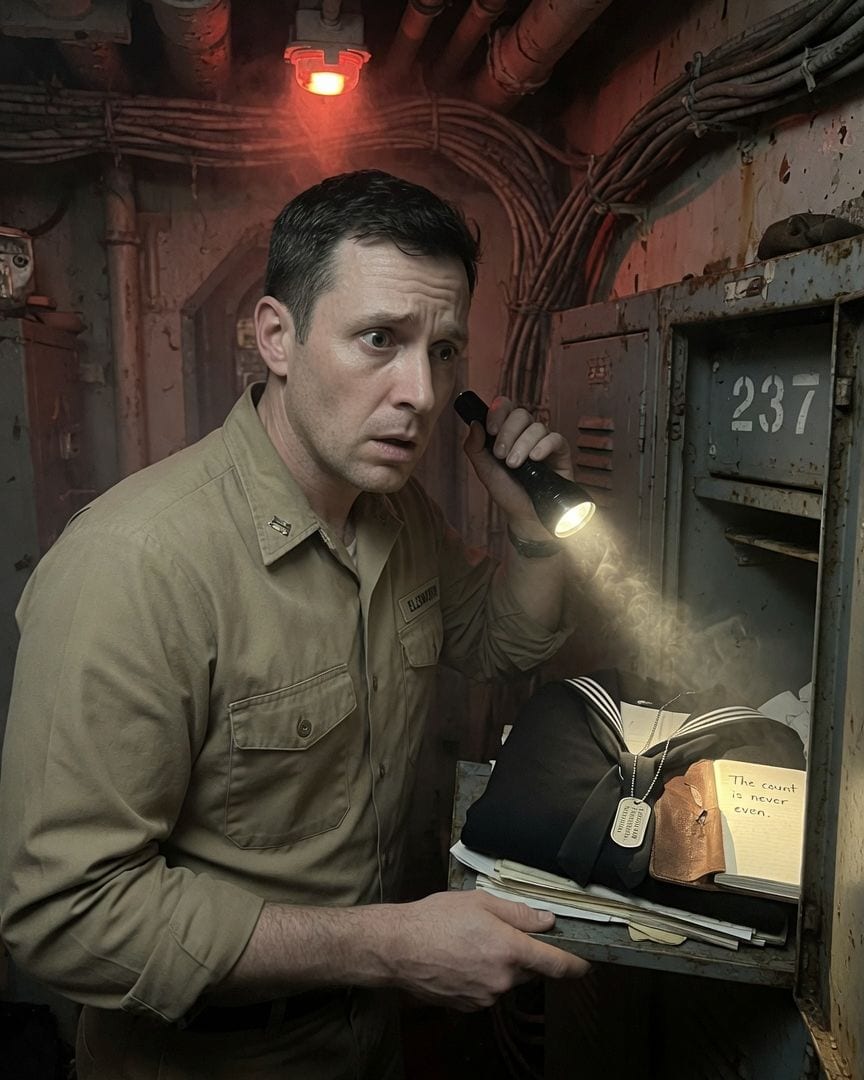
Later that night, Philip navigated the labyrinthine passages of the Vanguard, his flashlight beam piercing the gloom of the maintenance tunnel. Dust motes danced in the light, thick and ancient, disturbed by his passage.
He found Locker 237, tucked away behind a snarl of corroded pipes and bundled cables. It was rusted, its painted number barely legible, the handle stiff with age, caked in salt and grime.
He braced himself and forced it open with a pry bar he’d brought from the engineering bay. The hinges shrieked in protest, a sound that echoed unnaturally loud in the confined space.
Inside, instead of empty space or discarded junk, lay a neatly folded, perfectly preserved US Navy uniform, an older style, but pristine, as if unworn. Beside it, a tarnished dog tag. He picked it up.
The name was clear, despite the wear: 'KOWALSKI, P. VANGUARD.' Beneath the uniform, a small, leather-bound journal. Philip’s heart hammered against his ribs. He opened it, the pages brittle with time, the binding threatening to crack.
The first page bore a single, elegant line of stark, spidery script: 'The count is never even.'
The journal offered no further immediate answers, only more questions. Philip meticulously cross-referenced Peter Kowalski’s name again, this time with the specific date of the 1985 deck plan and the Vanguard's early patrols.
He finally found it: a declassified incident report from 1987, detailing the 'training accident' of Torpedoman First Class Peter Kowalski. The report stated Kowalski had vanished without a trace during a deep patrol aboard the USS Vanguard.
No distress signal, no hull breach, no body recovered. Just gone. The report’s language was evasive, full of conflicting eyewitness accounts, and a curious lack of follow-up. It read like a story carefully edited to obscure the truth.
It was as if the Navy had simply chosen to forget him, or perhaps, was ordered to. Philip felt a cold dread bloom in his chest. Kowalski hadn’t vanished from the boat; he had vanished into it.
He dug deeper, sifting through decades of Vanguard’s incident logs, cross-referencing 'unexplained losses.'
He found a pattern: every fifteen to twenty years, always on deep patrol, always a single sailor, always vanishing without cause, their records quietly scrubbed or reclassified as 'lost at sea.'
The system, designed for absolute accountability, had consistently failed in the same, silent way. He realized the 'extra man' wasn't a glitch; it was a symptom, a grim echo of the boat’s own dark history.
The journal, he now understood, was a quiet record of this impossible truth, kept by someone who had seen it before.
Philip’s late-night forays into archived records did not go unnoticed. One morning, he found his access to certain historical databases inexplicably revoked, citing 'system maintenance.' The message on his console was terse, giving no option for override or appeal.
Then, a summons to Captain Harold Brooks's cabin. Brooks, a man of quiet authority and decades of service, sat behind his polished desk, his expression unreadable, framed by the faint hum of the Vanguard.
'Lieutenant Ellsworth,' Brooks began, his voice calm, almost a murmur against the submarine’s thrum, 'your recent interest in certain… historical anomalies… has come to my attention.'
Philip felt a prickle of unease, a cold sensation that started at his spine and spread.
Brooks spoke of the 'unique character' of certain vessels, the 'unspoken traditions' that bound a crew, and the importance of focusing on the present mission.
'Submarines, Lieutenant,' Brooks continued, his gaze unwavering, fixed on Philip’s eyes, 'have their own ways of maintaining balance. Some things are best left undisturbed.'
His eyes, however, held a deep, unsettling knowledge, a quiet warning that chilled Philip more than any overt threat. The cabin itself seemed to press in, the bulkheads absorbing sound, amplifying the captain’s measured words.
Brooks concluded, 'I trust you’ll redirect your energies to your primary duties, Lieutenant. We have a long patrol ahead.'
Philip left the cabin feeling as though he had walked into a pressure chamber, the weight of Brooks's unspoken words settling on him like the crushing pressure of the deep. He was no longer just investigating; he was being watched.
Philip, emboldened by the captain's implicit warning, knew he was close. Brooks hadn't denied anything, only warned him away. He revisited Kowalski's journal, searching for more, for something that would explain Brooks's calm menace.
Tucked within its brittle pages, folded precisely, he found a faded, hand-drawn map. It was crude, but clear enough to follow. It led him to a rarely used emergency communication locker, secured by an archaic mechanical lock.
It was meant to be a backup, forgotten by most of the crew, its combination likely lost to time. But with a bit of ingenuity and a few well-placed tools, Philip managed to open it.
Inside, he found another journal, thicker, bound in canvas: an unofficial ship's log, meticulously maintained by a Captain Edmund Holloway, who had commanded the Vanguard in the 1980s.
Holloway’s entries detailed the 'Rule of the Boat' not as a superstition, but as a 'balancing mechanism.'
He wrote of the Vanguard’s impossible luck—its silent running, its ability to evade detection, its uncanny survival in situations that should have sunk it. 'The boat demands a price,' Holloway had written in elegant, precise script.
'A payment for its impossible fortune.' He described Peter Kowalski’s disappearance, not as an accident, but as the boat 'taking its due.'
Holloway’s log explained that the 'extra man' began appearing shortly after Kowalski vanished, always mirroring the lost sailor, always silent, always leaving a clean tray.
'He is the boat's ledger,' Holloway’s neat script read, 'a living placeholder, marking the debt until it is paid again.' Philip’s mind reeled. The mess count, the clean tray, Kowalski’s locker – it all clicked into a horrifying, coherent pattern.
The 'extra man' was not a ghost, but a programmatic anomaly, a chilling feature of the USS Vanguard’s very existence.
Philip devoured Holloway’s log, every entry chillingly confirming the boat’s grim accounting. He understood the cycle now: the impossible luck, the 'taking,' the 'extra man' as a temporary placeholder.
He flipped to the final pages, where Holloway, nearing his own retirement, had recorded his fears for the future of the boat, and the names of those he believed had 'seen' the truth.
Names of officers who had vanished or been quietly transferred, deemed 'unfit' or 'unstable' by official reports, their careers ending abruptly, their records sealed. And then, among those names, Philip saw it.
Not a name from the past, but one from the future.
Meticulously entered by Holloway, in the same neat script, was Philip’s own full name: 'Ellsworth, P.' Next to it, the date of the USS Vanguard’s next deep patrol, two years hence.
Below it, a single, stark sentence, chilling him to the bone: 'The boat requires its due.'
The air grew thin in the small locker, suddenly cold and stale, the hum of the submarine now sounding like a hungry growl, a low, guttural vibration that seemed to come from the very bulkheads themselves.
Philip stared at his name, at the future already written, a cold dread seizing him, locking his muscles. He was not just an observer; he was a named part of the boat's impossible, horrifying ledger.
Philip confronted Captain Brooks in his cabin, Holloway’s log clutched in his hand, his knuckles white. Brooks didn’t deny it. He simply nodded, a weary resignation in his eyes, as if Philip had only confirmed a long-held, painful truth.
'So, you’ve found Holloway’s ledger,' Brooks said, his voice calm, almost detached. 'I had hoped it would remain buried.' Brooks confirmed every word Philip had read.
He explained that the Vanguard, an experimental vessel in its early days, had been blessed with an impossible stealth capability, a ghost in the water, capable of slipping through detection grids unseen, defying the very laws of physics.
But it came at a cost. 'The boat trades a life for its luck, Lieutenant. Always has.' He spoke of the 'extra man' as the boat’s way of marking its debt, a silent reminder that a payment was due.
'You, Lieutenant Ellsworth, are not the first to notice. And those who notice… they become part of the accounting.' Brooks revealed he, too, had been 'marked' decades ago, a young officer like Philip.
He had survived by understanding the boat’s 'needs,' by ensuring the cycle continued, by never disrupting its 'balance.'
He had become a keeper of the ledger, a silent steward of its grim tradition, a man trapped by a pact he hadn't made.
But Philip’s investigation, his relentless digging, his refusal to let things lie, had accelerated his own timeline. 'The boat knows you know, Lieutenant,' Brooks said, his gaze chillingly empty. 'And now it expects you to pay.'
Trapped, Philip refused to accept his fate. He couldn’t abandon his crew, nor could he allow the boat to 'take' another. If the boat demanded payment for its luck, then he would strip it of that luck.
He would make it unworthy. He began to plan, meticulously. The boat’s strength was its silence, its invisibility. If that was gone, perhaps the debt would be voided.
He would trigger a minor, non-critical system malfunction – a sonar ping at an unscheduled interval, a fractional error in navigation data that would register on passive sensors.
Nothing to endanger the crew, nothing that would cause a critical failure, but enough to make the Vanguard 'visible,' to break its impossible stealth. The boat would lose its 'luck,' and perhaps, its 'debt' would be voided.
As he moved through the silent, late-night passages towards the control room, the 'extra man' appeared. Not in the mess, but standing in the narrow corridor ahead, blocking his path.
He was silent, unmoving, his face obscured by shadow, but Philip felt the weight of his gaze, an almost physical pressure, like being under deep water. It was a silent, disapproving presence, a physical manifestation of the boat’s will.
Philip felt a surge of cold defiance, a burning certainty. He pushed past the silent figure, not making eye contact, his heart pounding in his ears, thrumming with the boat’s low hum. In the control room, he initiated the sequence.
A jolt ran through the submarine, a momentary flicker of lights that left the space darker than before. A low, unsettling groan echoed through the hull, a sound Philip had never heard before, a sound of profound pain or protest.
The console blared a brief, anomalous warning: 'Passive Sonar Anomaly – Unscheduled Emission.' He had done it. When he looked back, the extra man was gone from the corridor.
Philip stood alone, the hum of the Vanguard now carrying a new, unsettling resonance, a faint, wounded vibration.
The USS Vanguard completed its patrol, but the return journey was fraught. The minor malfunction had no lasting physical damage, but the boat's famed 'luck' had vanished.
It was detected multiple times, narrowly avoided detection in critical zones, and the crew reported a pervasive, inexplicable unease. The 'extra man' was never seen again after Philip’s action.
Captain Brooks, his face etched with a silent, profound defeat, gave Philip a curt nod upon docking. There was no recrimination, only the shared knowledge of what had been lost.
Philip was transferred to a shore posting, deemed 'unfit for deep patrol' due to 'a pattern of unconventional behavior and a lack of adherence to established protocols.' The official report was vague, a bureaucratic whitewash, but the message was clear.
He was out of the deep, out of the boat's direct grasp. He had survived, but at a cost.
Lieutenant Philip Ellsworth now teaches at the Naval Academy, far from the crushing depths and the silent hum of a nuclear submarine.
He lives a quiet life, his days filled with lectures on navigation and propulsion systems, on the strict order and accountability that should govern every vessel.
He sees the keen, eager faces of his students, their youthful ambition untainted by the deeper truths of the ocean.
He teaches them the rules, the protocols, the manifests, the absolute necessity of accounting for every man, every bolt, every system. He never speaks of the USS Vanguard’s impossible luck, or the extra man, or the ledger it keeps.
But sometimes, when a student asks a particularly insightful question about unforeseen variables or inexplicable anomalies in naval history, Philip catches a flicker in their eyes, a spark of the same intense curiosity that once consumed him.
He offers a calm, academic answer, but inside, he knows. The old captain often spoke of the sea's unpredictable nature, but never about the boat's ledger.
He knew the silence of the deep could always take one more, and the books would always balance themselves.
If this one got to you
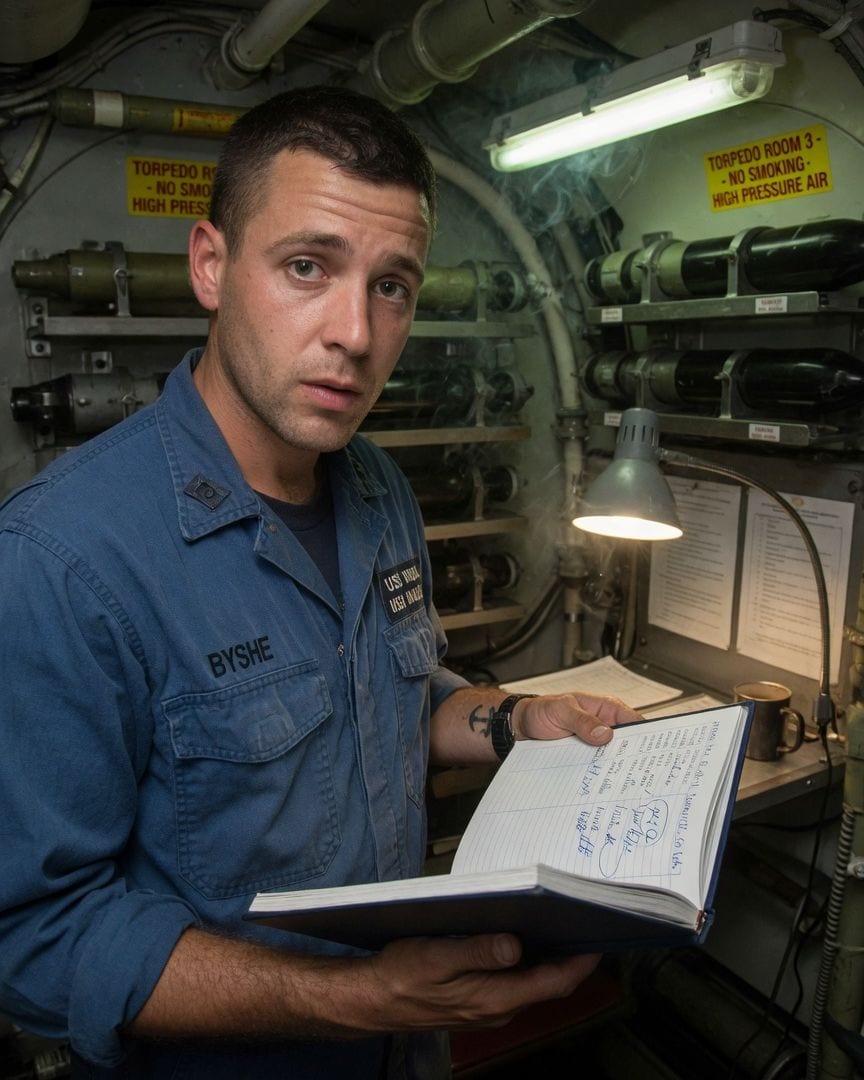
A torpedoman found his own signature in the USS Vanguard's duty log for a watch he never stood, beside a name not on the master crew manifest.
Torpedoman Oscar Bysshe, a rational sailor on his first deep patrol aboard the USS Vanguard, dismissed the messcook's nervous claim of an extra man at the table. He attributed the perfectly clean, untouched tray left behind to a prank. But later, during a routine systems check, Bysshe discovered his own familiar signature in the official duty logbook, for a watch he had been asleep through. Beside it was a name he didn't recognize, a name that shouldn't be there. A frantic check of the master crew manifest confirmed the impossible: the name appeared in the 'temporary assignments' section, dated just yesterday, scrawled in a hand eerily similar to his own.
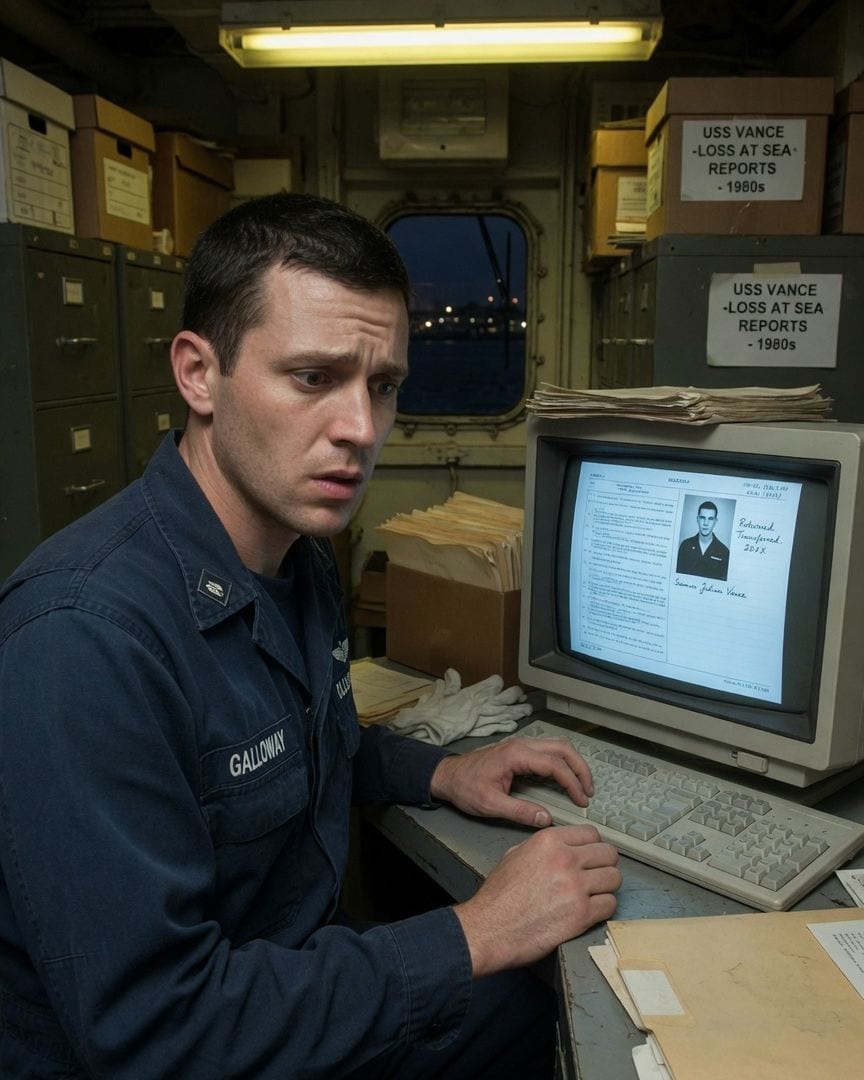
Petty Officer Galloway logged a sailor onto his ship. The man died at sea 40 years ago.
Petty Officer Joel Galloway scanned a sailor's ID on the USS Vance quarterdeck. The man's name, 'Seaman Julian Vance,' and his out-of-date uniform pricked at Galloway's memory. Later, the ship's berthing count came back one over, with an extra entry in the system but no physical body.
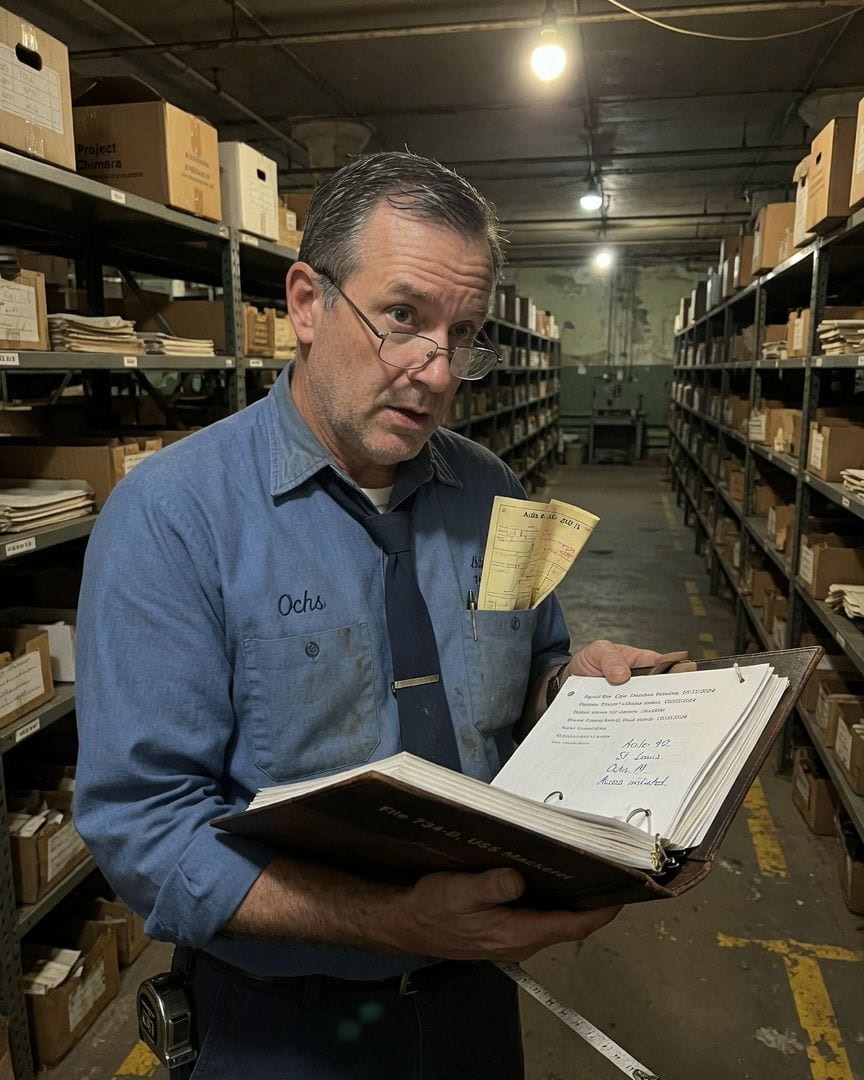
On his final inspection, a depot worker found Aisle 40 had grown 61 feet longer, and a Cold War submarine file hummed warm in his hand.
Marlin Ochs, a man of precise rhythms at the St. Louis depot, approached Aisle 40 for its final inspection before the entire structure was pulped tomorrow. For nearly two decades, the aisle had been a consistent ninety-two paces long. But on this night, his boot heels clicked past the expected mark, stretching to one hundred and nineteen paces, revealing an impossible, colder extension. Deep inside, Marlin found a heavy, leather-bound binder titled 'File 734-B, USS Mackerel,' a Cold War submarine lost with all hands in 1958. It felt oddly warm, almost humming against his palm, filled with maintenance logs and payrolls dated decades after the sub was sunk.
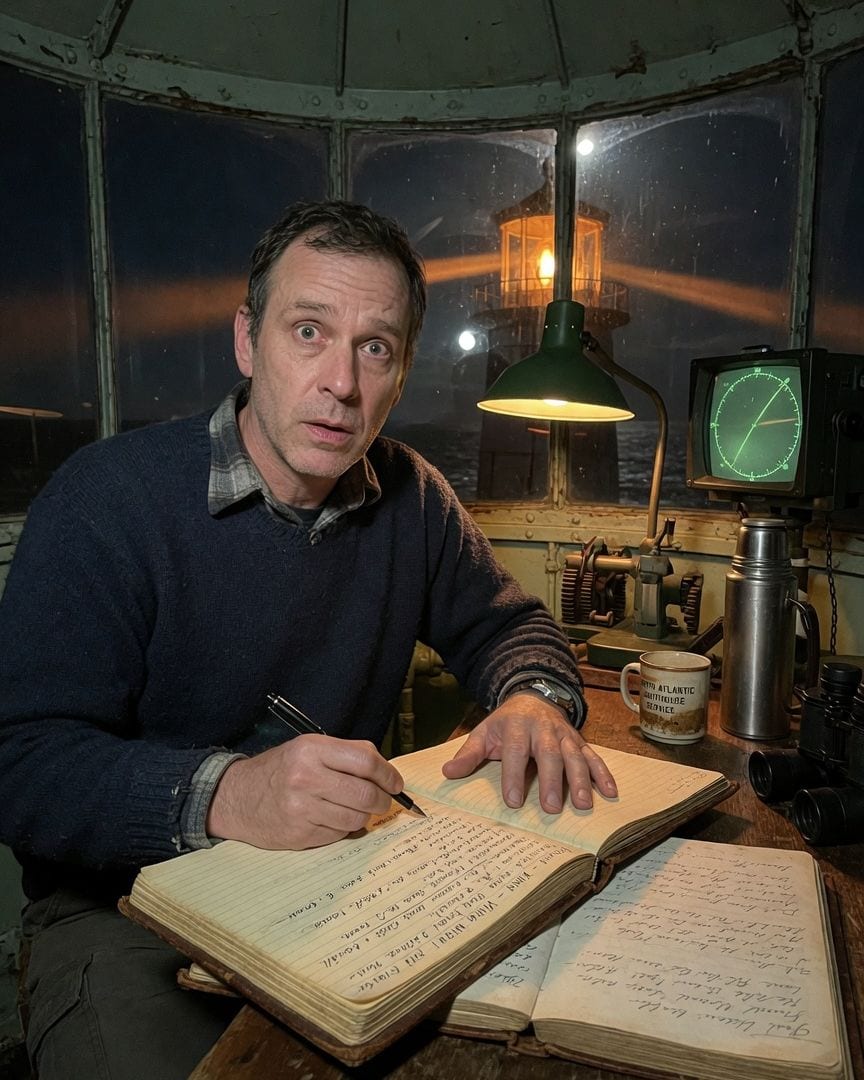
My lighthouse log has my own 3 AM entry for a phantom ship. I was alone in the tower, and I wrote no such thing.
Perched in the lantern room for my usual 2-6 AM watch, I reached for the thick logbook. But the 3:00 AM entry, under my own name, detailed a vessel I never saw. The words were in my own ink, yet I had never written them.
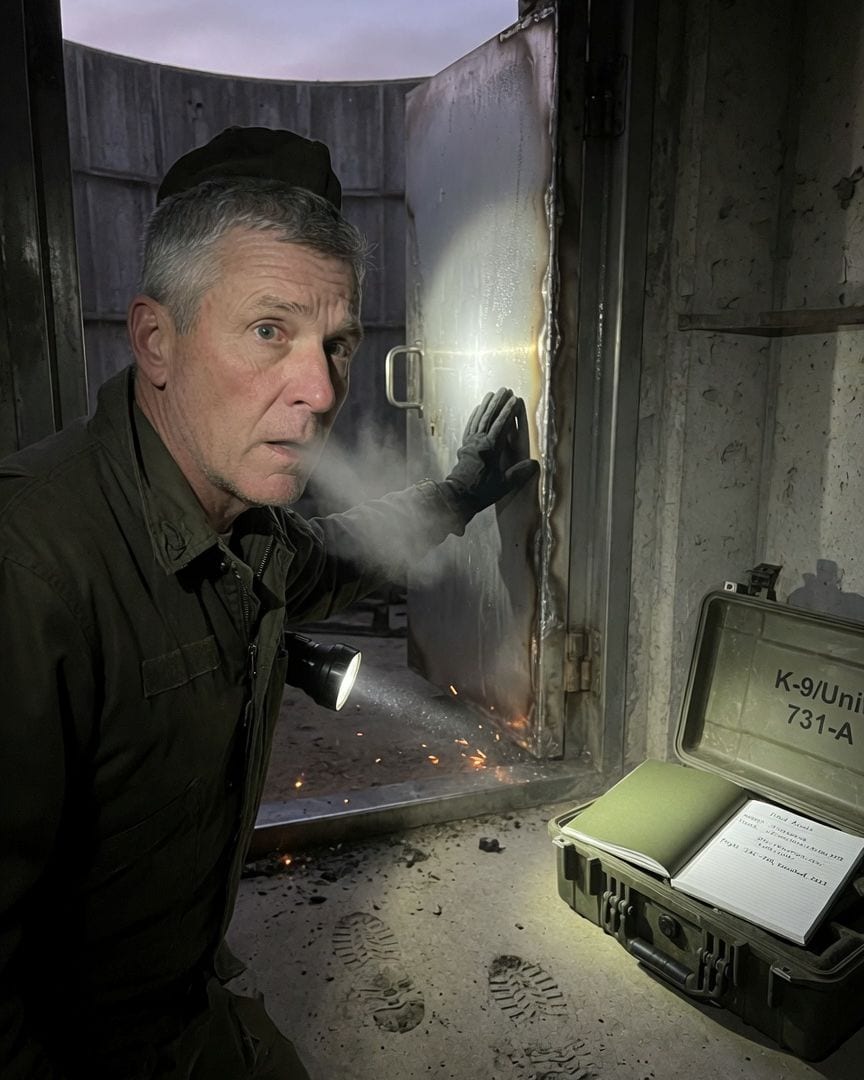
The Cold War silo was welded shut in 1968. A Captain found lights burning, fresh prints leading inside, and a logbook with a vanishing from last week.
Captain Merrit Sable faced a deadline at Silo K-9: one cold morning to retrieve classified hardware before its scheduled demolition at noon. The silo, officially welded shut by the Air Force in 1968 and long off-grid, should have been a tomb of forgotten machinery. Yet, through a cracked port, he saw nine work lights burning steadily forty feet down, and felt the faint suction of an active ventilation system. After breaching the decades-old weld, Merrit found more than just lights; fresh boot prints led deeper into the meticulously clean shaft, but none returned. A hidden compartment in an empty, warm hardcase revealed a logbook, its crisp pages detailing notorious military disappearances, with the latest entry dated just last week.
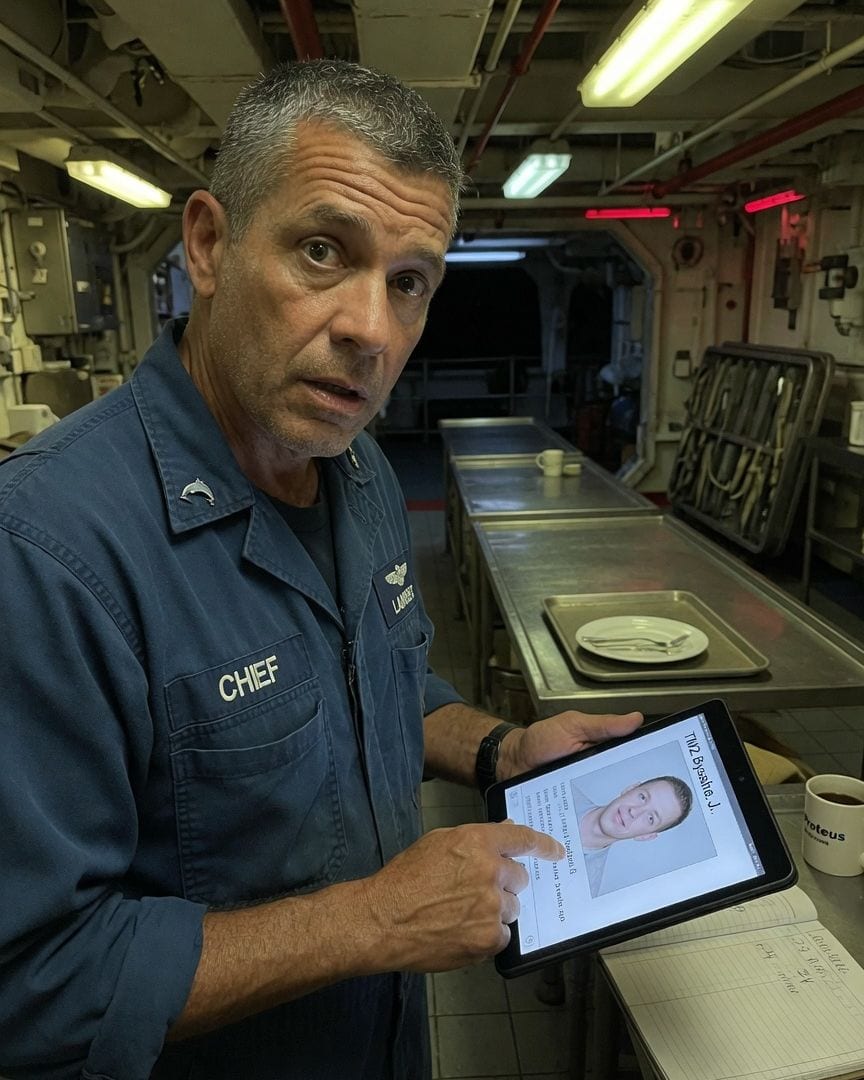
Chief Maxwell Lambert, on his final patrol, found his own signature approving a transfer for a sailor he'd never met.
Chief Maxwell Lambert was nearing the end of his final deep-sea patrol on the USS Proteus, looking forward to shore duty. The familiar hum of the boat and the clatter of the mess hall usually brought comfort, marking each day closer to home. One night, a young messcook reported a strange discrepancy: one plate short, but one man over on chow. Chief Lambert himself then saw a silent, unfamiliar figure eating alone in the shadows of the mess hall, a man who vanished into the passageway without a trace. Later, checking personnel logs, he found every man accounted for. Yet, his own signature approved a transfer for Torpedoman Bysshe—a sailor he had no memory of meeting, whose file photo was unsettlingly generic. How could his official record swear to a man he knew had never served on his boat?