My son played back his own recording and a grown man's voice comes in after he stops, finishing the last line in tune. He swears he was alone in his room with the door shut.
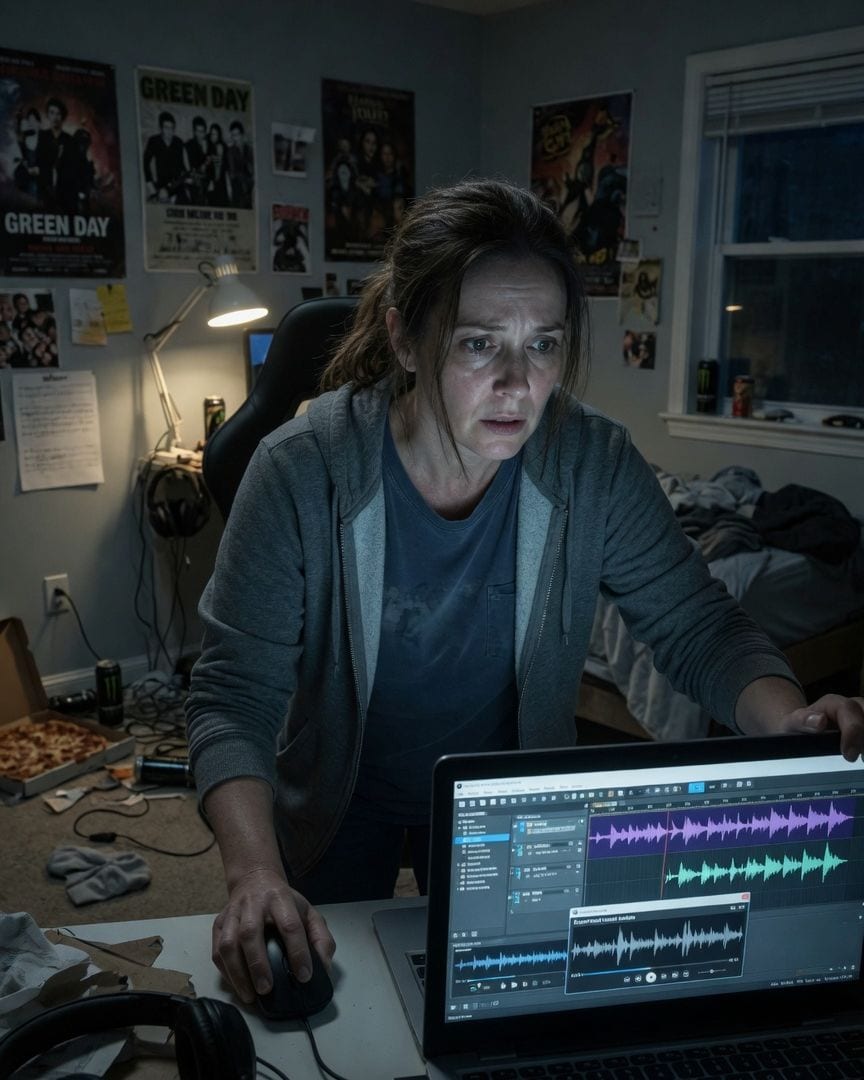
Ronald’s room always smells of something vaguely fermented – old pizza, stale energy drinks, the lingering scent of socks that should have made it to the laundry hamper days ago.
But that evening, the usual funk was overwhelmed by something else: a frantic, almost metallic tang of fear. My sixteen-year-old was slumped in his gaming chair, headphones around his neck, his face pale and drawn.
He’d called me in, not with his usual boisterous demand to hear his latest guitar riff, but with a quiet urgency that made the hair on my arms prickle.
“Mom, you have to listen.” His voice was thin.
He pulled up a track on his laptop, a pop ballad he’d been working on all week. Ronald’s voice, a surprisingly clear tenor for a teenager, filled the small room, strong and earnest.
I stood there, leaning against his cluttered desk, trying to look appreciative. He was proud of his vocal work, always had been. The song built to its final, soaring notes. His singing stopped. The recording went silent.
For a beat.
Then, a second voice came in, an adult male’s. It was a rich baritone, perfectly in tune, perfectly on pitch, singing the very last line of the song. “...and I will find you, in the dark.”
The words hung in the air, intimate, as if the singer had been right there, inches from the microphone. Ronald stared at me, his eyes wide and dark in the dim light of his monitor.
“I was alone,” he whispered, his voice cracking. “Mom, the door was locked. I had my headphones on. No one else was home.”
I tried to force a rational smile. “It’s probably just a bleed, honey. A stray signal.”
He shook his head, a violent, desperate motion. “Play it again. Please.”
I did. His voice. The silence. Then the impossible voice, finishing the melody, a ghost in the machine.
I took Ronald’s laptop, my own hands feeling a little cold. “It’s probably a bleed,” I told him again, trying to convince myself more than him. “A stray radio signal, or maybe a neighbor’s TV through the wall.”
I opened his digital audio workstation, a program I barely understood, the colorful waveforms a jumbled landscape to my untrained eye.
Ronald shook his head, insistent. “No one else was home, Mom. Dad’s on his business trip, and Chloe’s with her friends. And the windows were shut. Listen to how clean it is.”
He was right. I zoomed in on the waveform. There was a flat line of perfect silence after Ronald’s vocals ended. Not a whisper of bleed, not the faintest hint of static.
Then, the sudden, crisp appearance of the other voice. It was too clean, too precise for anything as common as interference. I clicked around, checking other tracks, listening for any background noise Ronald might have accidentally recorded. Nothing.
The voice was an anomaly, appearing out of nowhere, perfectly formed.
I selected the snippet, focusing on the last few seconds, the man’s voice alone. I exported it, then opened it in a simpler audio editor. My goal was simple: strip away anything that might be masking the true source.
I ran it through a basic noise reduction filter. Nothing changed. I tried an EQ, isolating different frequencies. The voice remained stubbornly clear, unmarred.
The more I cleaned it, the clearer it became, a rich baritone, familiar in its perfection, yet utterly alien in its presence. It wasn’t just a stray sound, a technical hiccup. It was a performance. A deliberate, controlled vocalization.
And it had appeared in Ronald’s locked room, alone, with no explanation. The air in the room, usually heavy with teenager, felt suddenly thin, as if something else had just breathed it all out.
I worked late into the night, the house quiet around me. Ronald had finally gone to bed, exhausted by fear, but I couldn’t sleep. My headphones were clamped tight, the sound canceling out everything but the digital ghost.
I scrubbed the audio, looping the few seconds of the unknown voice, then pulling back, trying to isolate the exact moment it began. Was there a faint rustle? A breath? Nothing. Just silence.
Then, I heard it. A barely audible sound, almost swallowed, so subtle I nearly missed it. It was like a ghost of a sound, a whisper just outside the realm of hearing. I looped it again, again, straining.
My finger flew to the gain knob, cranking it up until the sound became a distortion of static and hiss. Then, I applied a sharp spectral filter, trying to isolate that one tiny frequency, to bring it forward.
It was a whisper. A single word, breathed out, intimately close to the microphone, just before the singing began. My blood ran cold, a sudden, icy jolt, as the word clarified, distinct and undeniable.
‘Ronald.’
The whisper of Ronald’s name changed everything. It wasn’t a bleed. It wasn't a glitch. It was… deliberate. I couldn't dismiss it as a technical issue anymore.
The next morning, still running on fumes and a potent mix of coffee and dread, I called Simon Hughes, an old acquaintance from college who worked in sound engineering.
I sent him the isolated clip, omitting the context, asking for a professional opinion on its origin. I said it was for a 'friend's project,' trying to sound nonchalant.
Simon’s initial assessment, delivered over the phone an hour later, confirmed my growing dread. “It’s a clean capture, Colette. Really clean. Sounds like it was recorded directly into the mic. No external bleed I can detect at all.
It’s almost unnaturally isolated.” He paused. “Have you checked the microphone’s drivers? The recording software? Anything that might have, I don’t know, ghosted an old recording somehow?”
I spent hours poring over Ronald’s computer, clicking through system logs, verifying driver versions, checking every recording setting in his digital audio workstation. Everything was normal. No weird installations, no suspicious activity, no old files accidentally layered.
The setup was pristine, exactly as Ronald would have kept it.
Then, I started listening through Ronald’s archive of past covers. Days turned into nights. I found nothing else as overt as the finished line, nothing that jumped out at first listen. But a new, unsettling pattern emerged.
On older tracks, particularly those Ronald considered ‘practice’ or ‘failed’ recordings, I started to notice moments of subtle, almost imperceptible distortion. A faint hum beneath his voice that wasn’t part of the music.
A barely-there echo that seemed to linger in the quiet gaps. An almost subliminal resonance in the pauses, like a faint vibration in the air itself. It wasn't loud.
It was like something trying to be quiet, trying to hide just beneath the surface.
I exported these snippets too, focusing on the most distorted parts, the quietest anomalies, feeding them to Simon. He called back, his tone slightly more serious. “Colette, these are… unusual. Harmonic anomalies.
Like a secondary resonance, a really low-level frequency that shouldn't be there, almost perfectly phase-aligned with his vocals. I can’t explain it. It’s too consistent for random noise.” The voice wasn't a one-off. It had been there, lurking, growing.
As I delved deeper into Ronald’s files, a new, unsettling awareness began to prickle at the edges of my perception. I noticed small, unnerving details in the room itself.
Ronald’s USB microphone, a sleek silver tube with a small gain knob, was usually neatly put away in its stand.
But sometimes, when I went into his room after he’d gone to school, it would be slightly askew on his desk, its gain knob infinitesimally nudged from where he always set it.
He’d dismiss it as him being forgetful when I asked, shrugging, but I felt a prickle of unease. It wasn't like Ronald to be sloppy with his gear.
One afternoon, while Ronald was at school, I decided to test a theory. Or, more accurately, to try and rule out the impossible. I unplugged the USB microphone from his computer and plugged it into my own laptop.
I opened a simple voice recorder app on my computer – nothing fancy, just a basic wav recorder. I spoke directly into it, narrating my findings, describing the whisper, the harmonic anomalies, my growing fear.
I talked for twenty minutes, calmly, rationally, trying to document everything, to create an objective record.
When I finished and played it back, my own voice sounded clear, unmarred. Precise. Just me. A wave of relief washed over me, so potent it made my knees a little weak.
Maybe it was just Ronald's specific setup, a weird combination of his hardware and software, a phantom bug in his particular system. I saved the file, labeling it 'My Investigation Log.'
Later that evening, long after Ronald was asleep, I opened the file again, intending to add more notes, to log my renewed sense of hope. The first ten minutes were fine.
My voice, describing the early, subtle anomalies, was perfectly clear. But then, as my recorded voice described the moment I’d heard the whisper, the audio suddenly warped. My voice distorted, fragmented, breaking into static, then it cut out entirely.
A different sound emerged. A low, resonant hum, like a deep cello note held infinitely. It slowly resolved into a familiar, deep baritone. It wasn’t singing this time.
It was a low, guttural chuckle, a sound of unpleasant amusement, followed by a clear, distinct whisper. It was directed right at me, through my own recording.
‘You’re listening, Colette.’
I didn't sleep. The recorded chuckle, my name, the direct address – it was a violation beyond anything I’d imagined. It wasn't just in Ronald's room anymore. It had reached out to me.
The next morning, my throat tight, I confronted Ronald. I played him my corrupted audio log, stopping it just after the voice directly addressed me. His face drained of color, leaving his freckles stark against his skin.
“It knows us,” he whispered, terrified, pulling his knees up to his chest.
I took a shaky breath and explained my theory, pieced together from Simon’s technical notes and my own observations: the voice isn't just on the recordings; it's through the recordings.
The microphone, his software, the very act of creating music – it was forming a channel.
Simon, initially skeptical, agreed to a deeper dive. He set up a controlled environment in his studio, a sound-proofed room with calibrated equipment. He ran Ronald’s USB microphone through a battery of tests.
They recorded silence, then white noise, then Ronald singing simple scales. Each time, the anomalies appeared, faint at first, then growing stronger, more defined, a subtle distortion that shouldn't have been there.
Simon, a man of science, looked visibly shaken, his usual calm demeanor cracking. “It’s like… it’s almost like the microphone is resonating with something beyond the audible spectrum, then translating it. Or amplifying it.”
He discovered a peculiar, almost imperceptible frequency signature unique to Ronald’s microphone, a subtle harmonic distortion that wasn’t supposed to be there. It wasn’t a defect you could buy off the shelf; it was an inherent, singular quality of this specific device.
“It’s a conduit,” I stated, the words feeling heavy and true as they left my lips. “It’s been listening, learning, waiting.”
The earlier whisper of Ronald’s name, the perfectly finished song, the subtle hums in those old practice files – it all clicked into place with a sickening finality.
The entity was drawn to Ronald’s talent, his voice, using the recording process as its portal, gradually asserting its presence, learning to mimic and, eventually, to claim.
The air in Simon’s studio felt colder than it should have, despite the humming equipment.
Colette and Simon pored over Ronald’s hard drive, a silent, frantic search for more clues. They discovered a folder of old, deeply corrupted audio files, dating back two years, right when Ronald first got the USB microphone.
These weren't just 'failed' takes; they were fragmented, distorted whispers, barely human, a nascent attempt at mimicry. The voice was there from the beginning, a seed planted in the first act of creation.
Then, Colette found a newly created file in Ronald’s music folder, timestamped just an hour ago. It wasn't a song. It was labeled 'Colette Larsen.' My heart pounded, a frantic drum against my ribs. I clicked it open.
It was a recording of my own voice, from my 'investigation log' earlier that day, but it was badly distorted, a garbled echo of my words.
Then, the clear, terrible mimicry, my own inflection, my own slight catch on the 'R', calling out Ronald's name. A chill that had nothing to do with the air conditioning crawled over my skin, raising gooseflesh.
The waveform flickered on the screen, a jagged line. The file was labeled 'Colette Larsen.' It had used my name. It knew me.
The realization hit me with sickening force: the entity wasn’t just haunting Ronald’s recordings; it was using the microphone as a channel to actively engage and claim any voice it resonated with.
Simon, pale and shaken, ran a hand through his already disheveled hair, confirming it. “It’s a resonant parasite,” he muttered, his voice barely a whisper. “It feeds on vocalization, on creative output. The microphone isn’t just recording; it’s a bridge.”
He theorized that the entity, whatever it was, was drawn to Ronald’s early passion, his burgeoning talent. It subtly integrated itself into his recordings, learning his vocal patterns, his inflections, his very essence.
The older corrupted files were its infancy, the finished song its adolescence, and the recording of my voice, my name, was its declaration of intent: to expand its reach, to claim not just Ronald, but anyone close to the source of its nourishment.
It wasn’t just a voice; it was a consciousness, a parasitic intelligence that used sound as its medium, seeking to replace and embody.
The 'channel that uses your name' was a literal statement: it learns your name, mimics your voice, and then uses that connection to become you, or to access those you care about.
Ronald wasn't just being haunted; he was being slowly consumed, his identity eroded by a perfect, insidious echo.
I knew, with a certainty that chilled me to the bone, that we couldn't simply destroy the microphone.
The entity had already demonstrated its ability to move through recordings, to jump from one digital file to another, to inhabit my own recording. The only way was to sever the connection, to make Ronald uninteresting to it.
To starve it.
We devised a plan. Ronald, terrified but determined, sat at his desk, the microphone still connected to his laptop. I stood in the doorway, Simon next to me, watching every move.
Ronald began to sing, but this time, it wasn't a cover. It was a dissonant, off-key, fractured melody, filled with deliberate mistakes, vocalizations meant to be ugly, broken.
His voice cracked on purpose, soaring into screeches, then dropping into guttural croaks.
The entity, accustomed to his beautiful voice, tried to correct him. A faint, harmonious hum started to emerge from the microphone, attempting to smooth out his discordant notes, to bring them back to pitch.
Ronald pushed harder, his voice cracking, purposefully grating, his face contorted in a grimace of effort. The hum grew into a low growl, a sound of frustration, then something akin to pain.
The air in the room turned cold, thick with an unseen, oppressive presence, pressing in from all sides.
Simon monitored the audio spectrum on his small handheld device, watching as the unique harmonic signature of the entity flared, then struggled, a violent, agitated scribble across the screen.
Ronald’s voice broke into a pained, guttural shout, a primal sound of rejection, of raw, unvarnished ugliness. The microphone crackled violently.
A high-pitched, almost human shriek burst from the speakers, a sound of pure agony and rage, before the microphone itself sparked, emitted a puff of acrid smoke that smelled of burnt plastic and something metallic, and went dead.
The room instantly warmed. The oppressive presence lifted. Ronald collapsed into his chair, sobbing, exhausted, his throat raw.
The USB microphone, now a melted husk of plastic and metal, sat on Ronald’s desk, lifeless. Simon, visibly relieved, took it for further analysis, though he admitted he had no idea what he was even looking for.
He just wanted it gone, out of the house. Ronald, though physically unharmed, has lost his passion for music. He hasn't touched a mic since that day.
The digital audio files, the ones with the voice, remain on his hard drive, proof of what they faced. I keep them backed up, tucked away on an encrypted drive, a secret burden.
I know no one would ever believe me, not truly. It sounds too impossible, too insane. The world outside our house remains oblivious, untouched.
Ronald’s room is quiet now, truly quiet. No more late-night singing, no more strumming. He’s picked up drawing instead, a silent hobby. I often find him sketching intricate, abstract patterns that seem to twist and distort the page.
He never hums. Sometimes, late at night, I still find myself listening, straining to hear something, anything, in the silence of the house. A phantom echo. A whisper.
I’ll catch myself, my hand hovering over my phone, resisting the urge to open the voice recorder app, to just say my name, just once.
The silence in Ronald's room is real now, but sometimes, I still think I hear it, practicing my name.
If this one got to you
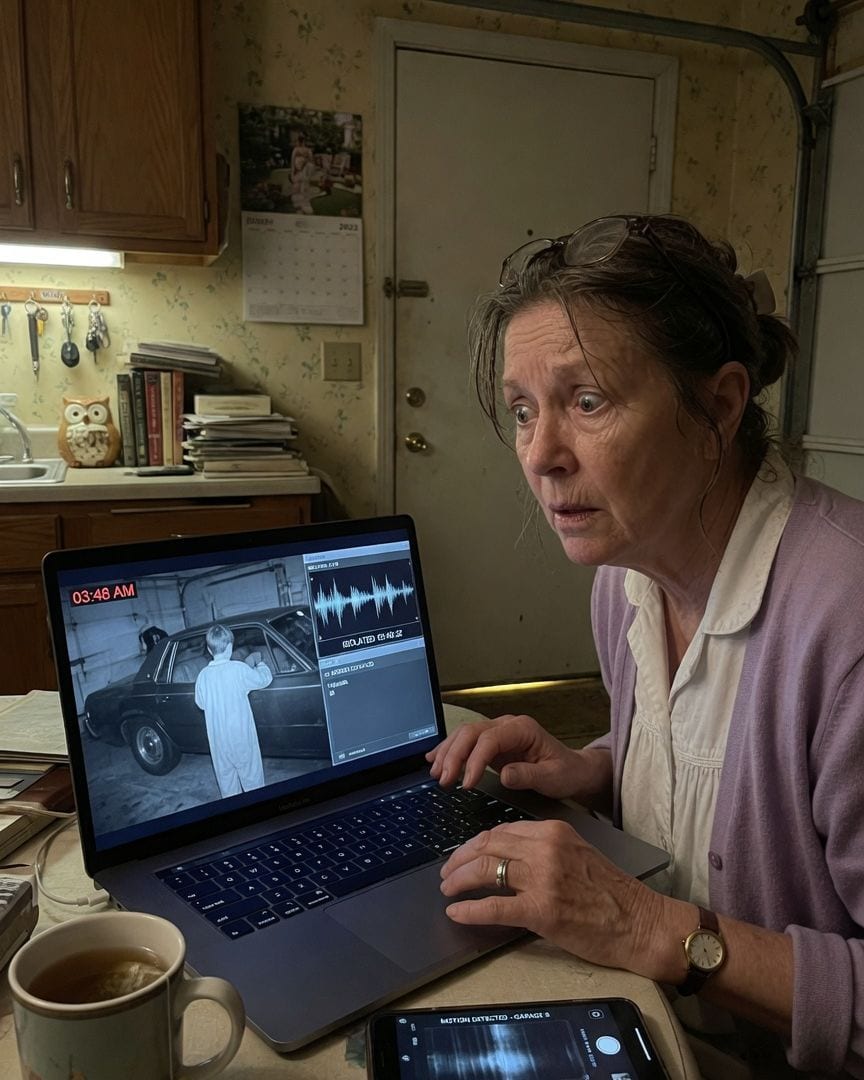
My garage camera filmed a boy of six walk out of a locked door at 3:48am, stare into my empty car, then vanish. My children live abroad.
I live in a quiet, solid house, my children grown and gone. But one night, my garage camera caught an impossible sight: my internal door, locked and bolted, slowly opened. A small, solid boy, no older than six, stepped through, then stood staring into the driver's seat of my empty car.
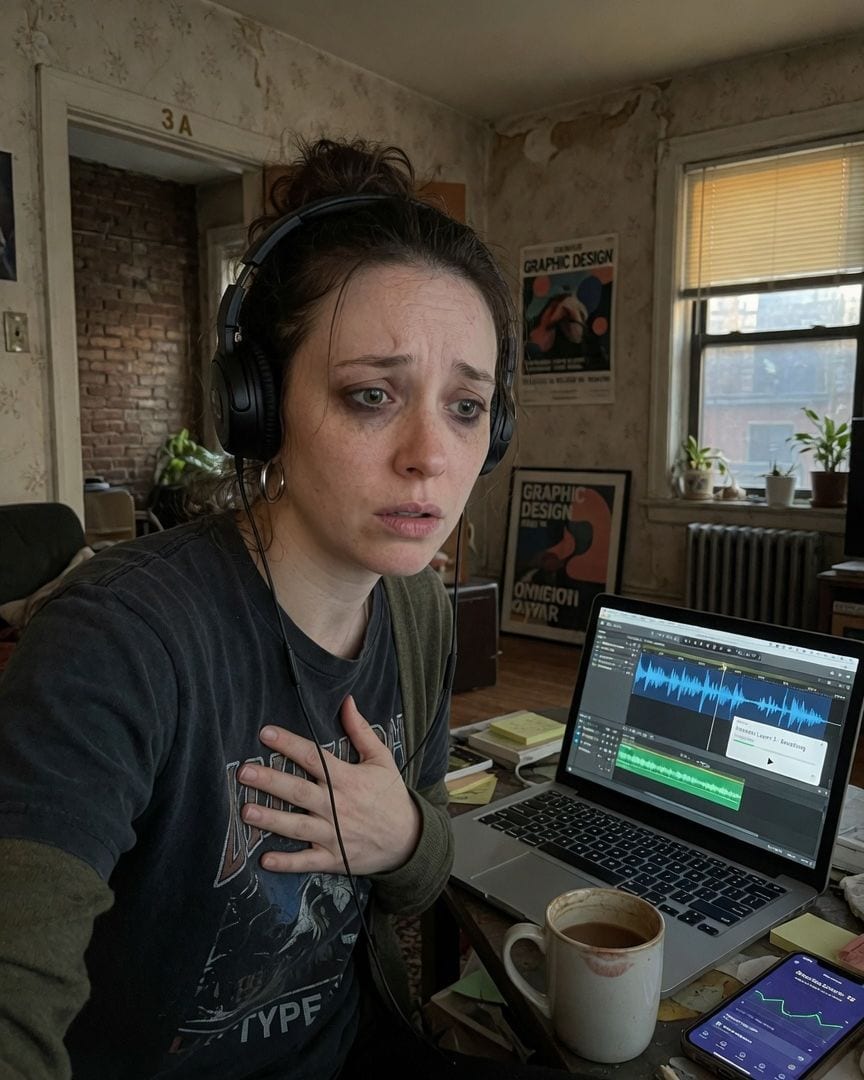
My sleep app recorded a second voice counting in my room at 2:50 AM. I live alone.
I was checking my sleep app's data, a mundane late-afternoon chore, when a flat line of quiet breathing suddenly changed. Over my own steady rhythm, a low, unhurried voice emerged, counting, "One… two… three…" It sounded like someone counting a sleeping child, just before they’re lifted. I live alone in my apartment, yet the voice was undeniably there, in my room, counting.
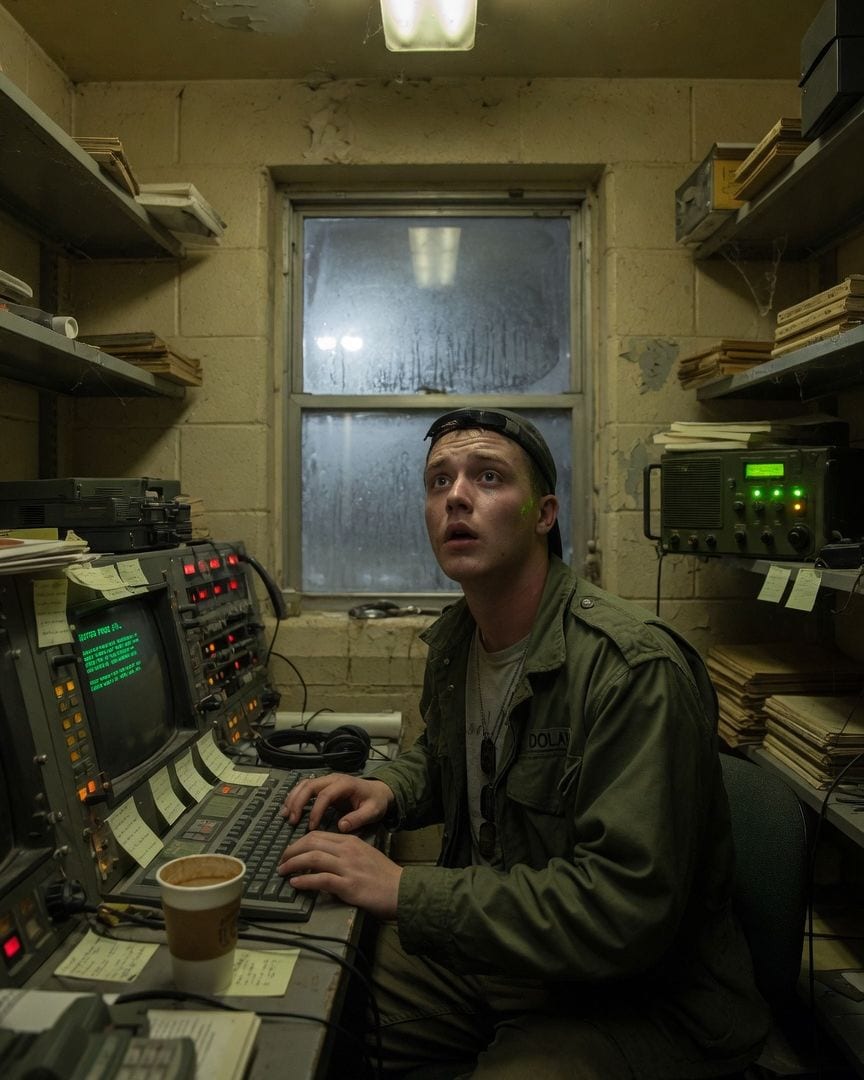
On his last watch, Specialist Dolan heard a dead soldier's voice from an old radio, a week too late.
Specialist Raymond Dolan was on his final watch at Firebase 7, a remote mountain outpost swallowed by a thick, oppressive fog, before its permanent closure. The fire-direction center should have been silent, but strange calls began routing directly to his console, reporting an enemy element in the draw where the 'Ghost Patrol' was lost just a week prior. While Control heard only Dolan's voice echoing into a void, the panicked voices in his ear were terrifyingly real. As he tried to purge the system, an old, unpowered field radio on a dusty shelf inexplicably powered on, its small light glowing green. From its speaker, the voice of Private Abigail Foster, a soldier from the Ghost Patrol, burst through—a week-old transmission, a final warning from the dead.
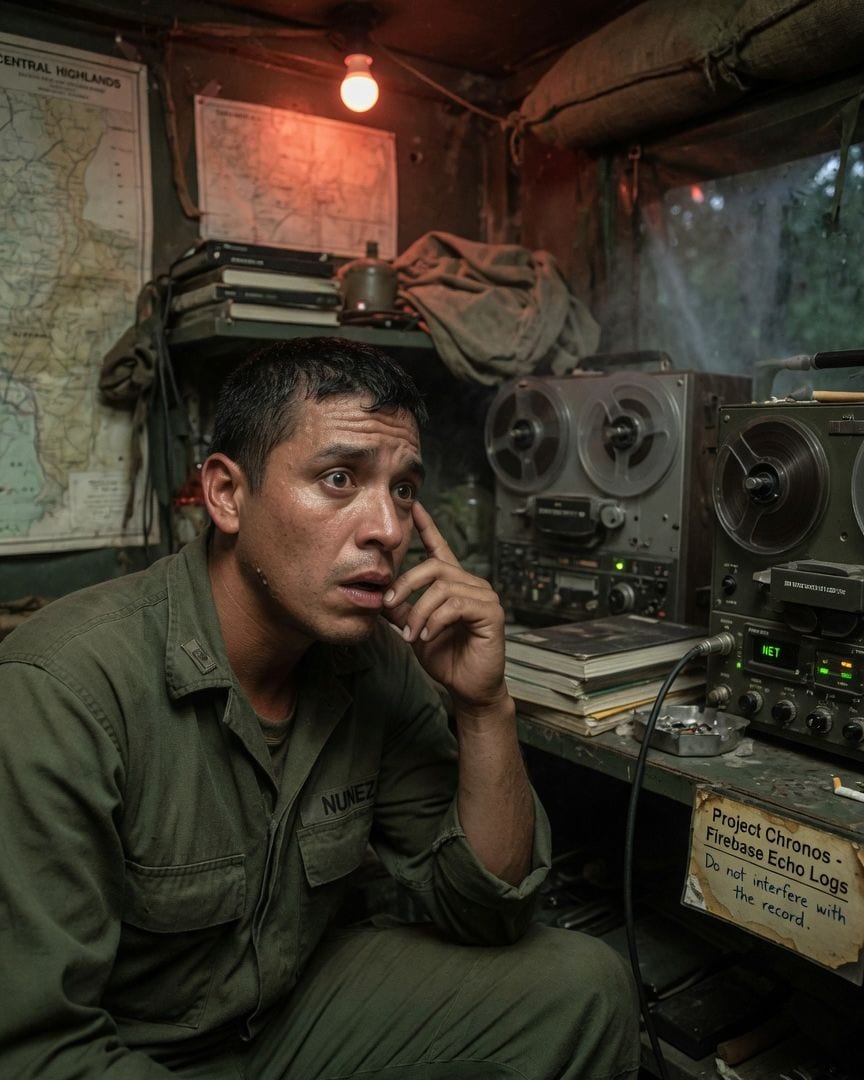
A Firebase RTO was about to send his 0400 report when his own voice crackled over the net, delivering the exact words he hadn't yet spoken.
Specialist Arthur Nunez sat alone in the RTO shack, preparing his routine 0400 SITREP amidst the humid Central Highlands night. The familiar hum of equipment was his only company, a constant drone against the isolation. Just as his thumb hovered over the transmit switch, ready to report "Perimeter quiet, all positions manned," his own voice crackled over the company net, delivering those exact words with uncanny precision. A sickening lurch twisted in his gut; he hadn't spoken a word, yet his report was already delivered by himself. Desperate for an explanation, he soon uncovered an ancient, jury-rigged reel-to-reel recorder, humming faintly. A faded label on the machine bore a stark instruction: 'Do not interfere with the record'.
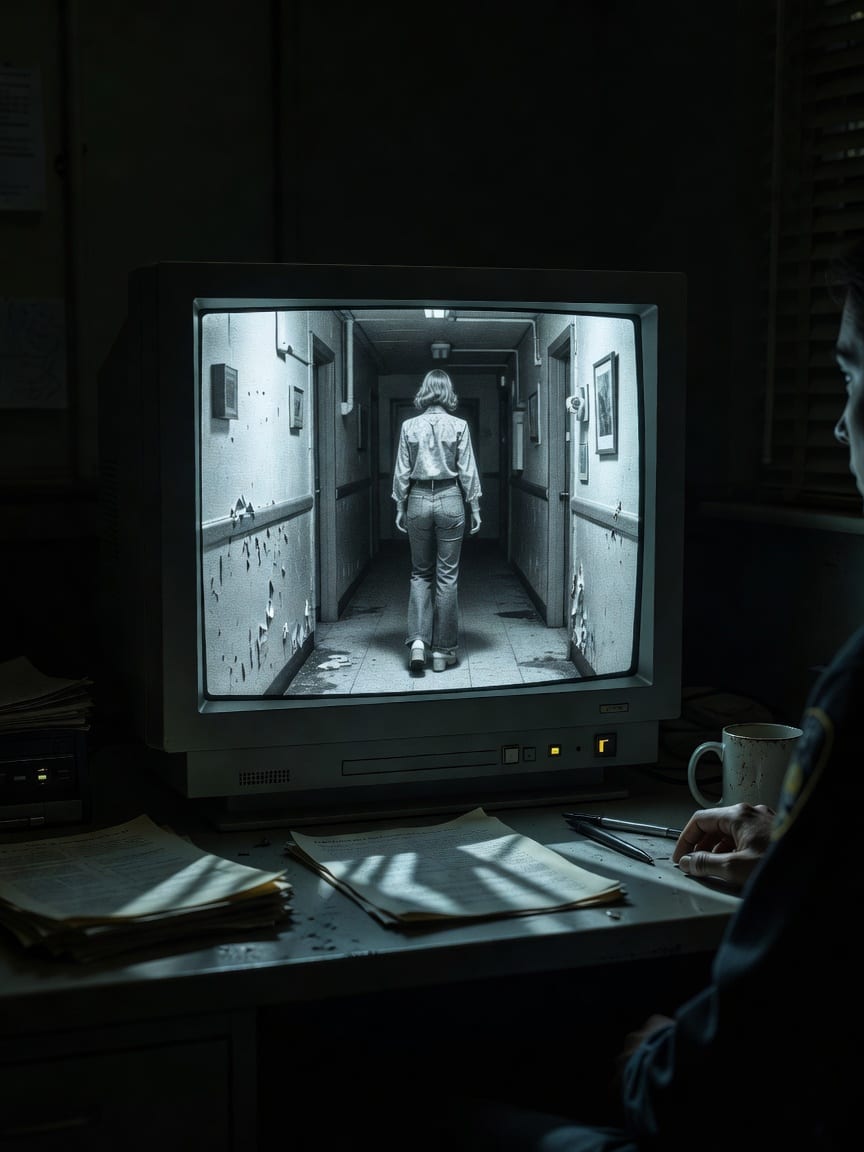
My intercom buzzed at 3 AM, a voice asking to step out for air. The station manager insists no one works the newsroom overnight, and no Cheryl is on payroll.
My shifts as the night security guard at WMVX are usually quiet, the TV station a tomb from 11 PM to 6 AM. But a late-night intercom call from a woman named Cheryl, who my manager says doesn't exist, was unsettling enough. The next night, my digital security log showed a new entry for 'Producer Cheryl Hartley'—a line I never typed, with details I couldn't have known.

My own voice called 911 from Gary, Indiana, reporting a prowler. I was asleep in Ohio, my phone on the charger.
Sitting in a police interview room, I listened as Detective Walsh played a 911 recording. A woman's hushed voice reported a prowler from a payphone in Gary, Indiana. My stomach dropped cold; it was my exact voice, my specific way of saying 'I think,' even though I was in bed in Ohio that night.