A Marine's future duty is already logged in fresh ink, weeks before it happens, at a post long closed.
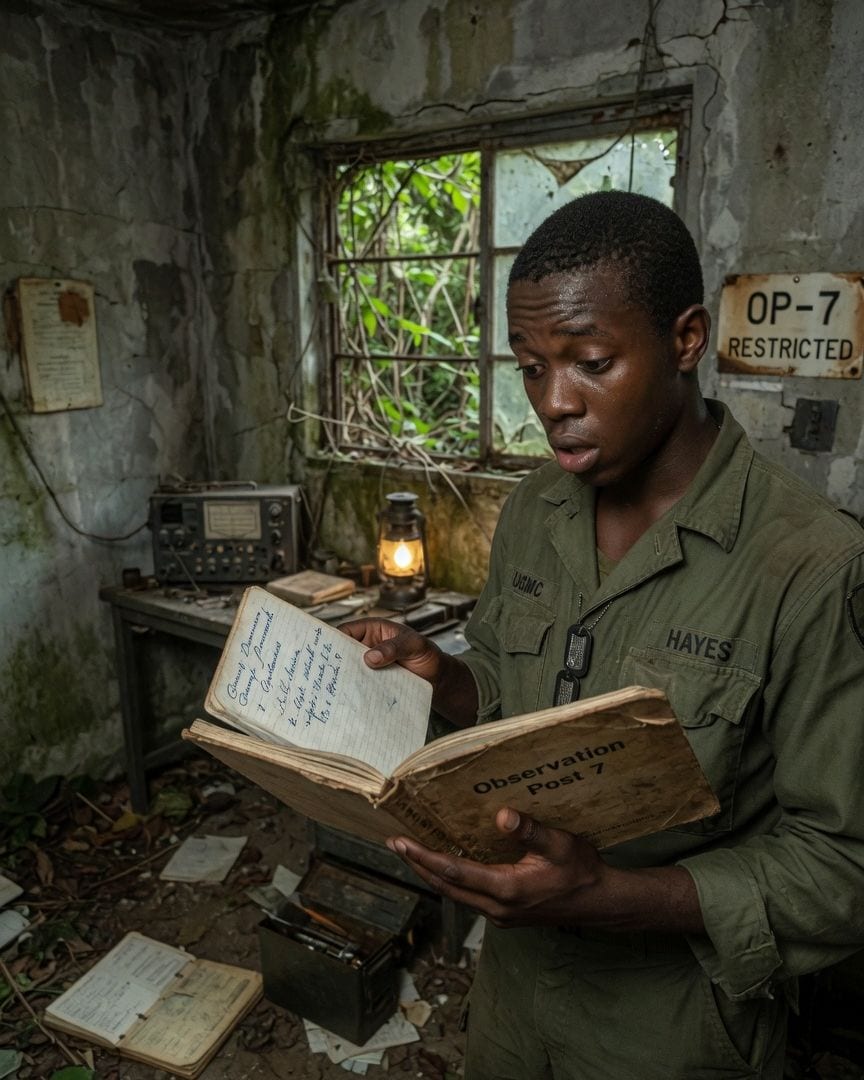
Lance Corporal Brandon Hayes, a squared-away Marine at twenty-two, stood in the Gunny’s office on Okinawa in 1974. The humid air hung thick with the smell of stale coffee and ink.
He was handed his service record book, a routine formality he was to initial before his next reassignment. Flipping through the pages, his thumb snagged on a section near the back. Entries.
Five of them, logged across two weeks the previous autumn. Each detailed a night watch at Observation Post 7, a remote radio relay station.
But OP7 had been decommissioned and officially closed years before Brandon even shipped over, let alone arrived on Okinawa. He certainly hadn’t pulled duty there. Beneath each entry, a familiar, looping signature: Gunnery Sergeant Robert Drummond.
Brandon looked up, the book still open in his hand. “Gunny Drummond,” he started, “about these entries for OP7…”
Drummond, hunched over paperwork, looked up, his face paling slightly. He took the book, scanned the page, his brow furrowed. “OP7? That post’s been shut down for years. What is this?” He shook his head, handing it back.
“Never seen that book in my life, son. Not those entries.”
But the signature, undeniably, was his own.
The gunny’s denial, coupled with the undeniable signature, gnawed at Brandon. He spent his off-duty hours at the base library, poring over old manifests and facility closure reports. Most records confirmed OP7’s decommissioning.
Yet, a few obscure, handwritten notes in a dusty archive box hinted at an 'unscheduled reactivation' for 'special surveillance' during the very weeks his record claimed he’d been there.
The dates were vague, the details suppressed, leaving Brandon with more questions than answers.
Unable to shake the uncanny anomaly, Brandon decided to find the derelict post. He borrowed a jeep and drove miles from the main base, following a faded, rarely used access road that dwindled to little more than a dirt track.
The path snaked through dense overgrowth, finally opening onto a windswept, overgrown hillside. The post was barely a concrete shell now. Officially, it was barren, a forgotten scar on the landscape.
As he picked his way through the dense undergrowth near the crumbling remains of the main structure, he nearly tripped over something half-buried in the mud: a rusted, sealed ammo can.
The lock was rusted solid, fused with decades of corrosion, but a pry bar from his pack made short work of it. Inside, wrapped in oilcloth, was a logbook.
Its cover was faded, almost bleached by sun and rain, but the words 'Observation Post 7' were still legible, though barely. The dates within were impossible, spanning years after its official closure.
Brandon’s heart hammered as he flipped through, recognizing Drummond’s distinctive signature on multiple entries. And then, he saw it. A clean, crisp entry, dated for a night watch in the coming weeks. His own name, 'L. Cpl.
Hayes, B.,' penned beneath Drummond’s signature, for a duty he hadn't been assigned, at a post that wasn't supposed to exist.
Brandon’s breath hitched in his throat. His name. In this impossible logbook. For a watch that was still days away. He traced the letters with a trembling finger. The ink looked fresh, almost wet, as if applied only hours ago.
A shiver, cold and profound, ran down his spine despite the humid air.
He felt a sudden, overwhelming sensation of being watched, not by a person, but by the derelict structure itself, by the unseen presence that had authored this impossible document. The silence of the abandoned post pressed in, heavy and expectant.
He looked up at the crumbling tower, its empty windows like vacant eyes, and knew, with chilling certainty, that he had just found something far more disturbing than a clerical error or a prank.
He was looking at his own future, etched into a past that refused to die.
Back at the barracks, Brandon confronted Gunny Drummond again, the OP7 logbook clutched in his hand. They were in the supply office, the air close and dusty. Drummond’s face, usually ruddy and stern, went ashen when he saw the book.
He took it, his fingers visibly trembling as he recognized his own signature.
“I… I don’t remember making these entries,” he stammered, his voice barely a whisper. “This isn’t… this can’t be real.”
He looked genuinely terrified, his eyes darting away from Brandon’s, toward the stacked boxes and dark corners of the room as if expecting something to emerge. The raw fear in the hardened Gunny’s eyes was more unnerving than any explanation.
Brandon, now certain this was no isolated incident, began to dig deeper, bypassing official channels.
He found an old-timer, a supply sergeant named Curtis Abbott, who, after a few beers at the off-base bar, spoke in hushed tones of 'ghost posts' and 'unaccounted-for watches'—remote outposts where sentries sometimes logged impossible contacts, or simply vanished, their records mysteriously altered.
Abbott mentioned a retired Master Sergeant, Felix Davenport, who had served on Okinawa decades ago, rumored to have kept his own 'unofficial' records of such anomalies.
Brandon started noticing things. A faint, almost imperceptible static on his radio during late-night checks, a whisper that sounded like a voice just at the edge of hearing, always when he was alone.
A shadow, briefly, in the window of the old supply shed, where no one should be. He'd turn his head quickly, but there would be nothing.
The unease was now a constant hum beneath the surface of his daily routine, a persistent low frequency that grated on his nerves.
Brandon’s locker, usually secured with a heavy-duty padlock, was found slightly ajar one morning.
Nothing was taken, but the OP7 logbook, which he’d hidden deep inside a duffel bag under a pile of uniforms, felt subtly out of place, as if it had been moved and then returned. A chill ran through him.
Someone knew. Someone was watching. The metallic scent of ozone, faint and acrid, hung in the air of the locker room for a few heartbeats, then dissipated.
A few days later, a folded piece of paper, typewritten, was slipped under his door while he was out. The message was stark: “Some watches never end. Don't look for the relief.”
The words were printed in a precise, almost archaic font, the letters dark and unblemished against the cheap paper. The threat was clear, and it was personal. Brandon felt an intense isolation.
He started watching his back, scanning faces in the mess hall, wondering who might be involved, who might be watching him. Every casual glance, every hushed conversation, felt like a potential threat. He began taking circuitous routes, avoiding predictable patterns.
The radio static intensified, sometimes resolving into faint, distorted words he couldn’t quite make out, but the tone was always flat, emotionless, like a distant, humming machine.
He felt a constant, prickling sensation on the back of his neck, the certainty of unseen eyes. This wasn't just about a record book anymore. This was about him, and the impossible duty he was fast approaching.
He knew he had to find Davenport, and fast.
Brandon finally tracked down Felix Davenport to a small, isolated bungalow on the outskirts of the base, where the retired Master Sergeant now worked as a civilian groundskeeper.
Davenport was a stoic man, his face weathered by years under the sun, his eyes holding a distant, haunted look that spoke of things seen and never forgotten. He sat on his porch swing, slowly rocking, as Brandon approached.
Brandon laid out the OP7 logbook, his service record, and the anonymous note on the small, chipped table between them. Davenport picked up the logbook, his fingers tracing Drummond’s signature, then Brandon’s name.
A long silence stretched between them, punctuated only by the creak of the porch swing and the distant hum of cicadas.
“So, you found the watch,” Davenport finally said, his voice raspy, like dry leaves scuttling across pavement. “They usually don’t let anyone dig this deep.”
Brandon pressed him. “What is it, Master Sergeant? Drummond swears he didn’t sign this. But it’s his hand.”
Davenport sighed, a sound heavy with years of unspoken dread. “He’s not lying, son. Not exactly. The signatures are real. But the men who make them… they’re not entirely themselves when they do. Not fully in control.”
He explained that some posts, like OP7, existed in a kind of temporal echo.
Duties were performed, records were made, but the men who performed them often vanished or were reassigned, their memories wiped clean, their official records seamlessly adjusted to account for the impossible.
“The system,” Davenport said, looking out at the overgrown lawn, “it doesn’t like anomalies. So it smooths them out. Replaces them. Or replaces the men.”
He described how men would pull watch, log impossible contacts, and then, the next day, their records would show them on duty at a different, impossible post, or they’d simply be gone, their barracks empty, their personal effects vanished.
The records would change to accommodate the impossible, and those who saw it were often reassigned or quietly disappeared. “Drummond,” Davenport concluded, turning his haunted eyes back to Brandon, “he’s one of the lucky ones.
They just took a piece of his memory, not all of him. He signed because he was there, in a way. But not him.”
The truth snapped into focus, re-meaning everything Brandon had seen: the flickering lights, the faint voices, the shifting records. The post wasn't just closed; it was a hungry ghost, consuming those who stood watch.
Davenport then stood, walked to a locked chest in the corner of his small living room, and pulled out a faded, dog-eared binder.
“I kept my own records,” he said, his voice flat, devoid of emotion, as if relaying a weather report. “Unofficial. The things the system erased.”
He opened it to a page filled with handwritten entries, a precise grid of dates, posts, and names. It was a watch roster, but unlike any Brandon had ever seen.
It detailed a horrifying recurring pattern: specific dates, always at remote posts, always involving single sentries, many of whom had later been declared MIA or quietly reassigned.
Brandon’s eyes scanned the names, recognizing a few from his own unit, men who had vanished without a trace, or whose stories had never quite added up. He saw the name 'L. Cpl.
Trell' for an entry in 1974, a name he dimly recalled from base rumors.
Then, his gaze landed on a familiar name, listed for 'unaccounted-for watch' at OP7, but the date was decades in the past, long before Brandon was even born.
Below it, other entries showed his name again, repeated across different years, at different 'ghost posts' that shouldn’t exist. Brandon Hayes. His own name, a recurring fixture in this terrifying ledger of the lost.
The dates on the roster aligned with the impossible dates in the OP7 logbook he’d found. He wasn’t just investigating a pattern; he was the pattern.
He was looking at his own history, inexplicably woven into a tapestry of impossible duties and vanished men, realizing with a sickening lurch that his fate was already sealed, his future determined by a watch that had no end.
The dates on Davenport’s roster screamed at Brandon. He was a piece of this, a recurring entry in a ledger of the lost. With the date of his scheduled watch at OP7 looming, Brandon knew he had to return.
He went under the cover of darkness, armed only with a flashlight and a profound sense of dread that coiled in his gut.
As he approached the derelict post, picking his way through the familiar thorny brush, he saw it: a faint, flickering light in the crumbling guard tower, a light that shouldn't exist.
Distant, distorted voices, like radio static barely resolving into words, drifted on the wind, a sound both close and impossibly far away. The post, physically abandoned, was chillingly active in another sense, humming with an unseen presence.
He realized the 'post that closed' was merely a physical shell; the duty itself persisted in a temporal loop, a dimensional bleed, drawing in and replacing soldiers across time.
The impossible entries, Drummond’s erased memory, Davenport’s roster—it all clicked into a terrifying coherence.
The signatures weren't just memory gaps; they were evidence of a partial 'takeover,' a momentary possession where the entity performing the duty used the official channels, leaving its mark.
The 'relief' never came because the watch was infinite, passed from one unwitting sentry to the next, each one feeding the post’s insatiable hunger for perpetual duty.
He understood that if he signed that logbook, he would become another entry in Davenport’s horrific roster, his memory erased, his body a vessel for the endless watch, his records smoothed over by a system designed to make anomalies impossible, yet which was complicit in their creation.
As the hour for his listed watch approached, the flickering light in the guard tower intensified, casting long, wavering shadows across the overgrown ground. Brandon hid in the thick brush, his heart pounding like a drum against his ribs.
Then, a figure emerged from the derelict tower’s entrance. It was a Marine, in a faded 1970s uniform, carrying an M16 rifle.
It moved with an unnatural, gliding gait, its movements too smooth, too precise, as if every joint had been perfectly oiled.
It wasn't a ghost; it was solid, physically present, yet its face was subtly wrong—unnervingly smooth, devoid of expression, its eyes dark and vacant, reflecting no light.
In one hand, it held a clipboard with a pen attached by a string.
The figure slowly, deliberately, walked toward a small, concrete slab, which was exactly where the logbook entry indicated his watch post would be.
Brandon realized this was 'the relief'—the entity that took over the watch, and the identity of the sentry. It stopped at the slab, turning its head slowly, scanning the perimeter with those dead eyes.
Then, it looked directly toward Brandon’s hiding spot. It raised the clipboard, extending it slightly, gesturing with the pen for him to approach, to sign.
Brandon felt an overwhelming, primal terror. He knew if he signed, he would become part of the loop, his records changing, his memory erased, his body a vessel for the endless watch. He didn't fight; he didn't scream.
He simply turned, pushing through the dense undergrowth, branches tearing at his fatigues, running as fast as his legs could carry him, away from the post, away from the figure that slowly, relentlessly, began to pursue him, its silent footsteps echoing his own frantic pounding heart.
He ran until his lungs burned, until he collapsed miles away, gasping for air, the image of those vacant eyes burned into his mind.
Brandon was found hours later, disoriented and delirious, miles from the barracks, babbling about a derelict post and a silent Marine. He was treated for severe exhaustion and stress, diagnosed with acute anxiety.
His story of the logbook, the ghost post, and the tracking entity was dismissed as a hallucination brought on by fatigue and trauma. His service record, upon official review, was perfectly clean; the impossible entries were gone.
The OP7 logbook he’d found was never recovered. Gunny Drummond claimed no memory of their conversations, his denial now seemingly genuine, his eyes clear and untroubled.
Felix Davenport, when questioned by base personnel, denied ever knowing Brandon, his face blank, his eyes no longer holding their haunted quality.
It was as if the entire terrifying episode had been scrubbed from existence, leaving Brandon as the sole, unhinged witness.
Brandon Hayes was quietly reassigned off Okinawa, to a new, isolated posting at a remote radio relay station in the desolate Mojave Desert. He tried to forget, to push the memories down, but the dread lingered like a phantom limb.
He went through the motions, a quiet, haunted man, forever looking over his shoulder.
One sweltering afternoon, checking in for his first night watch at the new station, the grizzled NCO in charge, a Master Sergeant with a tired face, handed him a familiar-looking logbook.
“Initial here, son,” the NCO said, gesturing with a pen. Brandon took the book, his hand shaking almost imperceptibly.
He opened it, and on the first page, beneath a perfectly normal entry for the previous night, he saw a faint, almost invisible signature, faded but unmistakable, barely visible against the aged paper.
The NCO watched Brandon initial the page, then looked away to secure the door. A flicker of something, a distant, knowing hum, passed through the arid air. Brandon’s smile, as he closed the logbook, was too wide, too still.
He was, at last, relieved. R. Drummond.
If this one got to you
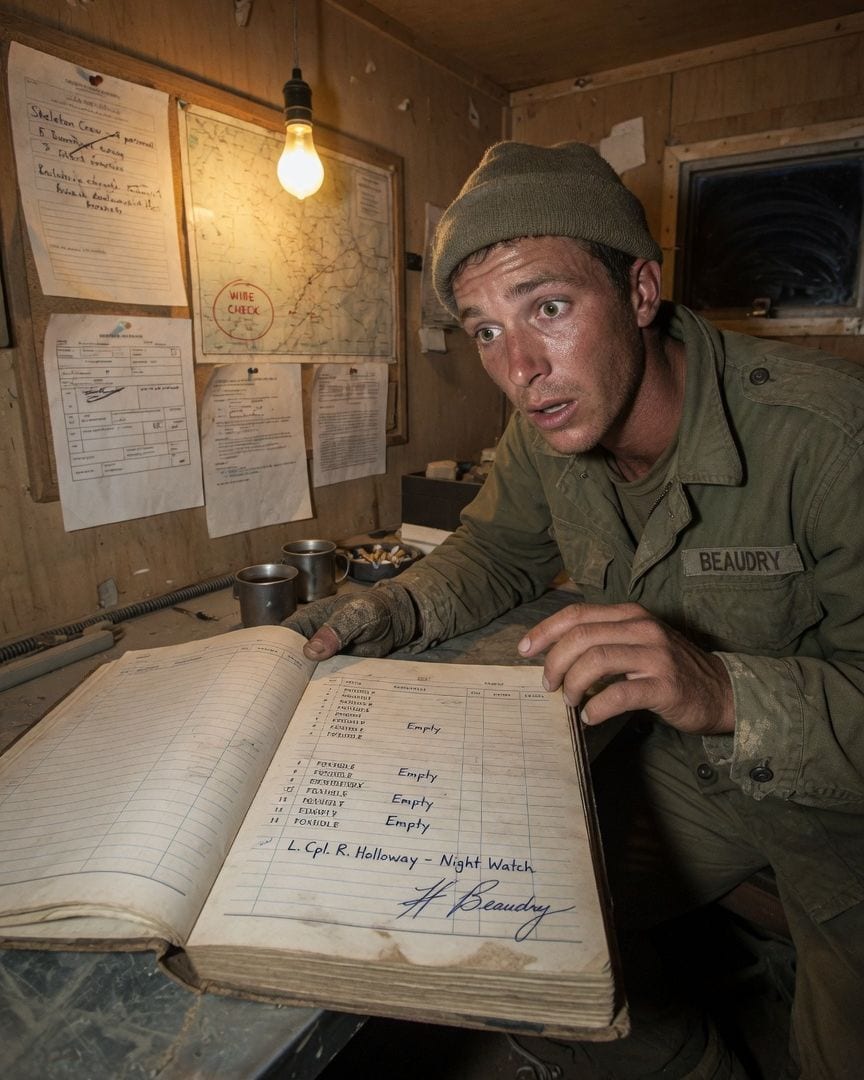
Lance Corporal Beaudry checks the perimeter's empty foxhole. The comm wire pulls back: a signal from no one.
Lance Corporal Hugo Beaudry moved along the perimeter of Firebase Kettle, a lonely outpost in its final drawdown. His solitary wire-check tonight was a routine task in the biting desert wind. He reached the third foxhole, empty for a week, and tugged its comm wire. Two distinct pulls answered back, sharp and unmistakable, from a position where no one remained. Back inside, Beaudry found his own precise signature in the duty log, assigning a Lance Corporal R. Holloway to that very foxhole – a man he'd never seen or heard of. The entry was perfectly aged, a cold dread of paper lying. Who was signalling from the empty hole, and why did his own hand confirm it?
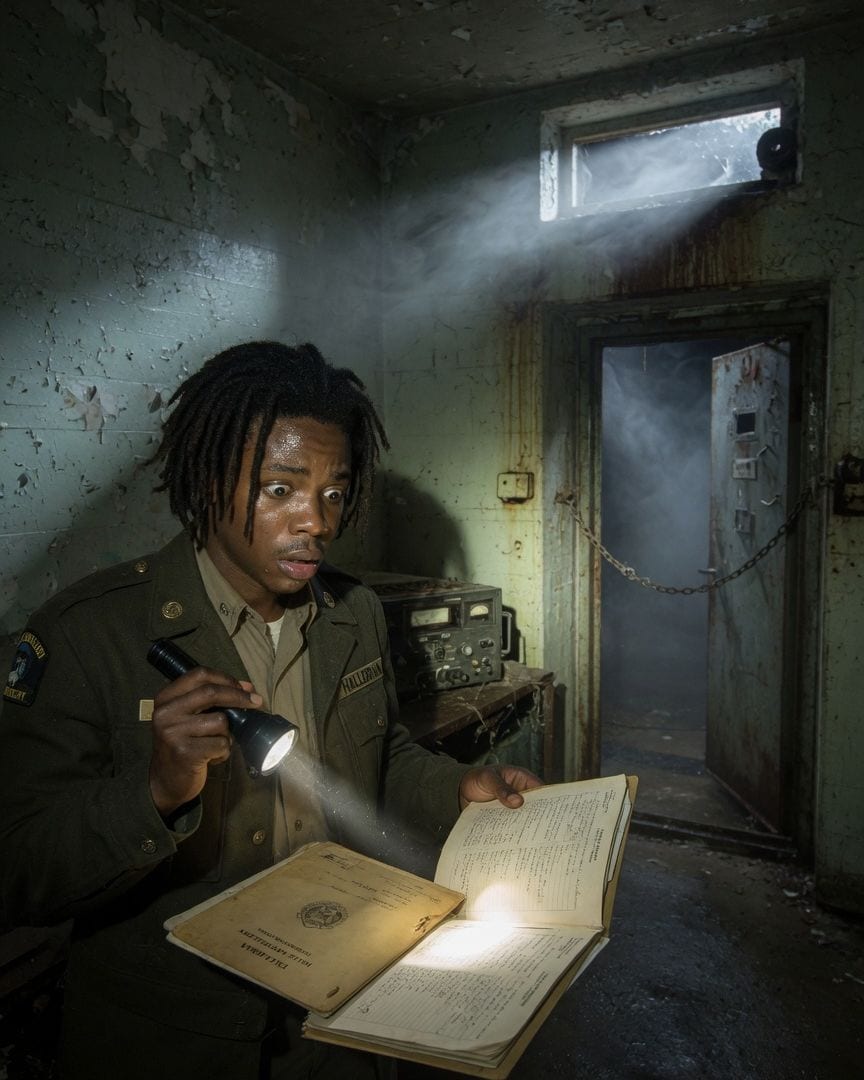
On his last shift, a coast sentry finds his own name signed in fresh ink on a 1943 army record, dated exactly one year ago.
Private Roy Halloran counted the final hours of his last watch behind the searchlight of an old, rust-tinged artillery bunker on the northern California coast. His monotonous graveyard shift was nearly done, and his transfer close, but at 0100, the swirling coastal fog revealed a silent landing party of men on the beach, their gear anachronistic and alien. When dawn burned off the mist, the beach was empty, yet faint drag marks led directly to the bunker’s long-sealed rear hatch, now mysteriously ajar. Inside, amidst the cold, acrid air, he discovered a pristine 1943 army service record bearing his own name. A freshly signed entry dated exactly one year ago to the day left him wondering: had the past somehow reached out to claim him?
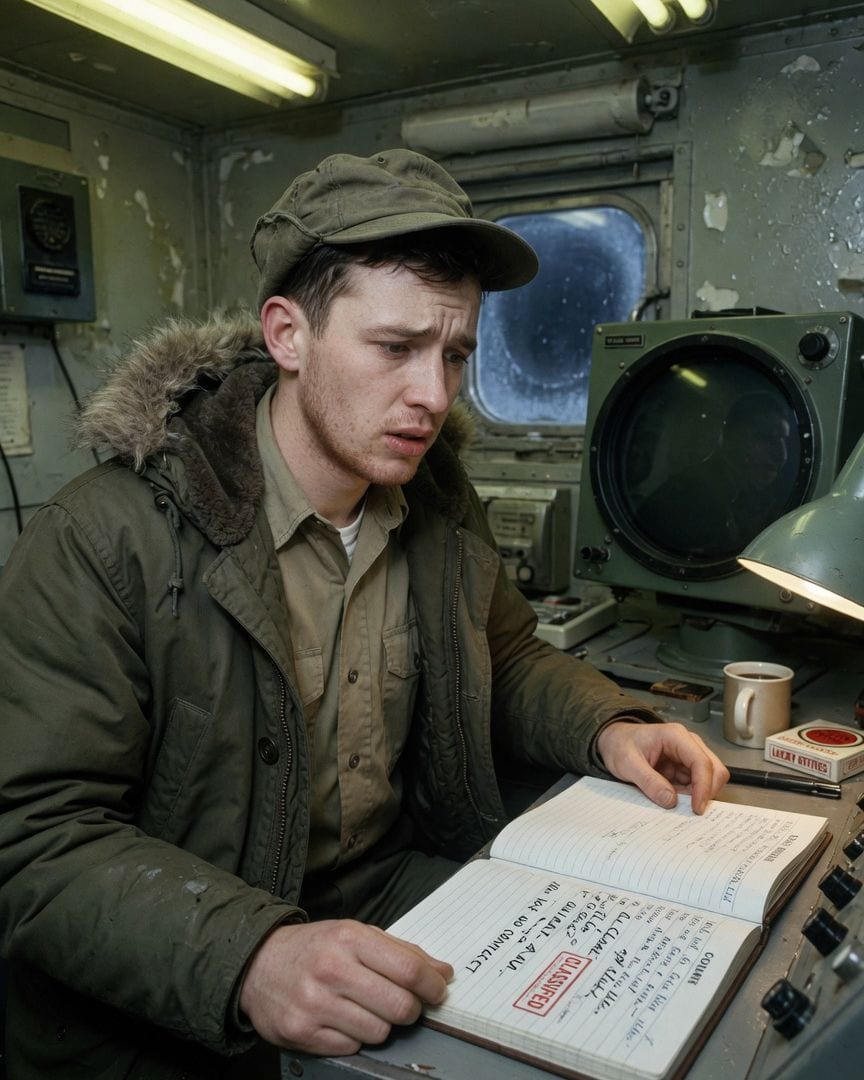
A Cold War airman logs an impossible radar contact on his last sweep. But his official logbook entry is stamped 'CLASSIFIED' and then contradicted by a hastily scrawled 'ALL CLEAR' dated moments before it.
Airman Ordway Vance, 22, manned the radar dome at Site Pellin in the biting North Atlantic dark of January 1962, running the last calibration sweep before its decommissioning. His scope picked up a faint, impossible return, growing closer with each pass, though the ocean remained empty to the eye. When Vance detailed the contact in his official logbook, a 'CLASSIFIED' stamp appeared, followed by a hastily scrawled 'ALL CLEAR' dated moments before his own entry, contradicting his every word. Commander Hartley dismissed it as equipment malfunction, but Vance sensed a chilling, official erasure behind the lie. He soon found a locked cabinet marked 'SITE PELLIN ANOMALIES,' hinting at a deeper truth buried within the base's final days.
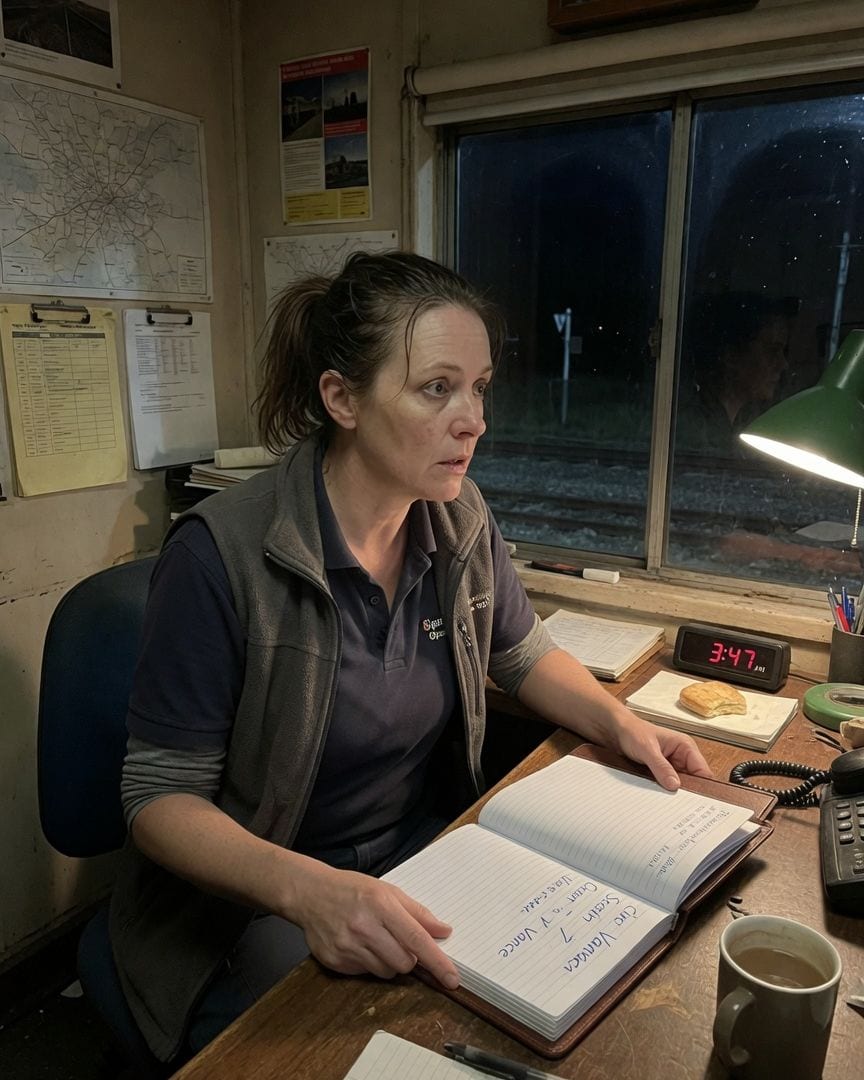
My linesman taps twice on my window at 3 AM. Control says he retired and passed years ago.
My routine at the rural signal cabin was regular: the linesman's double tap on the window at 3 AM. But then my supervisor called, revealing the linesman I knew, Warren Vance, had died five years ago. Now, an impossible entry in my official logbook, with his signature and timestamped from my shift, proves someone else was there.
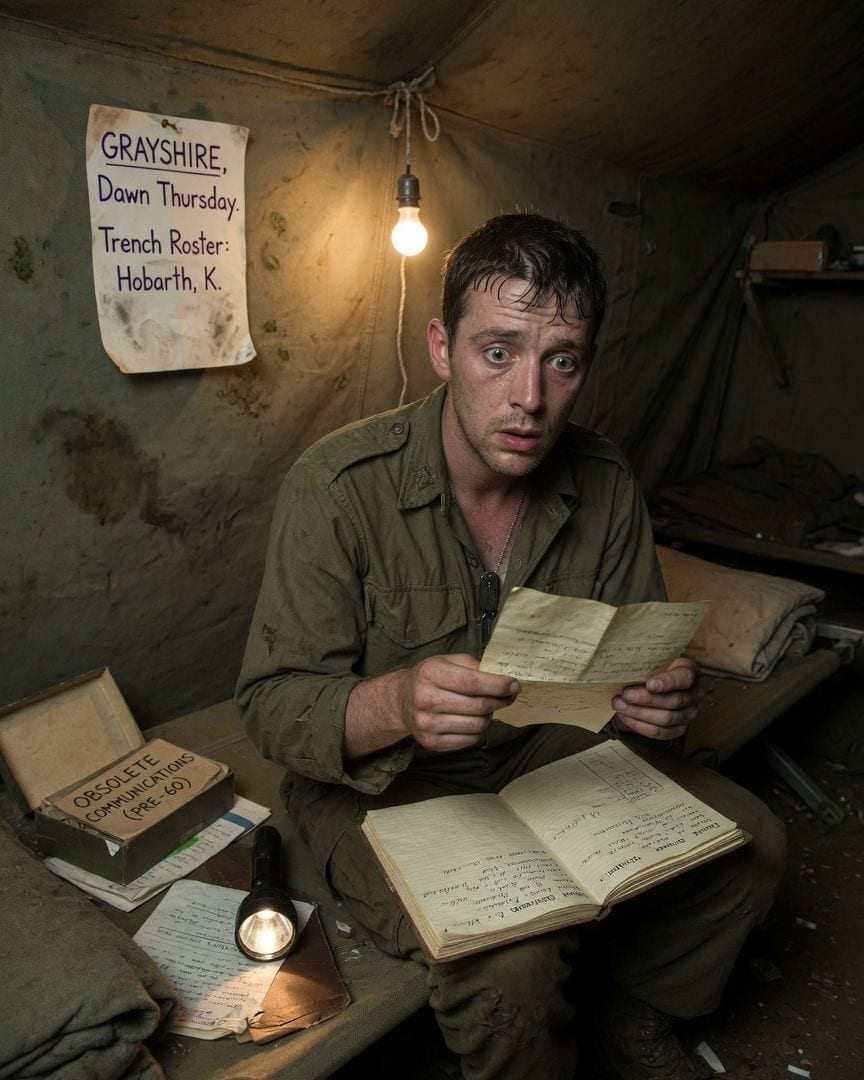
A records clerk's old logbook entry shows his service number for 'Personnel Observation' on a date that hasn't arrived, for an event he saw last week.
Private Kell Hobarth clutched the letter confirming his daughter Frances' birth, a bittersweet reminder of a world far from the Vermey Flats trench tent. He'd seen a mysterious roster entry for 'GRAYSHIRE' and been dismissed by his superior. But then, a silent, vast pulse of white light turned his tent transparent for a full minute, yet every man around him slept through it. Haunted, the records clerk searched the dusty annex archives, finding a leather logbook. Inside, his own service number was listed for 'Personnel Observation' on a date that had not yet come, for the very event he had already witnessed.
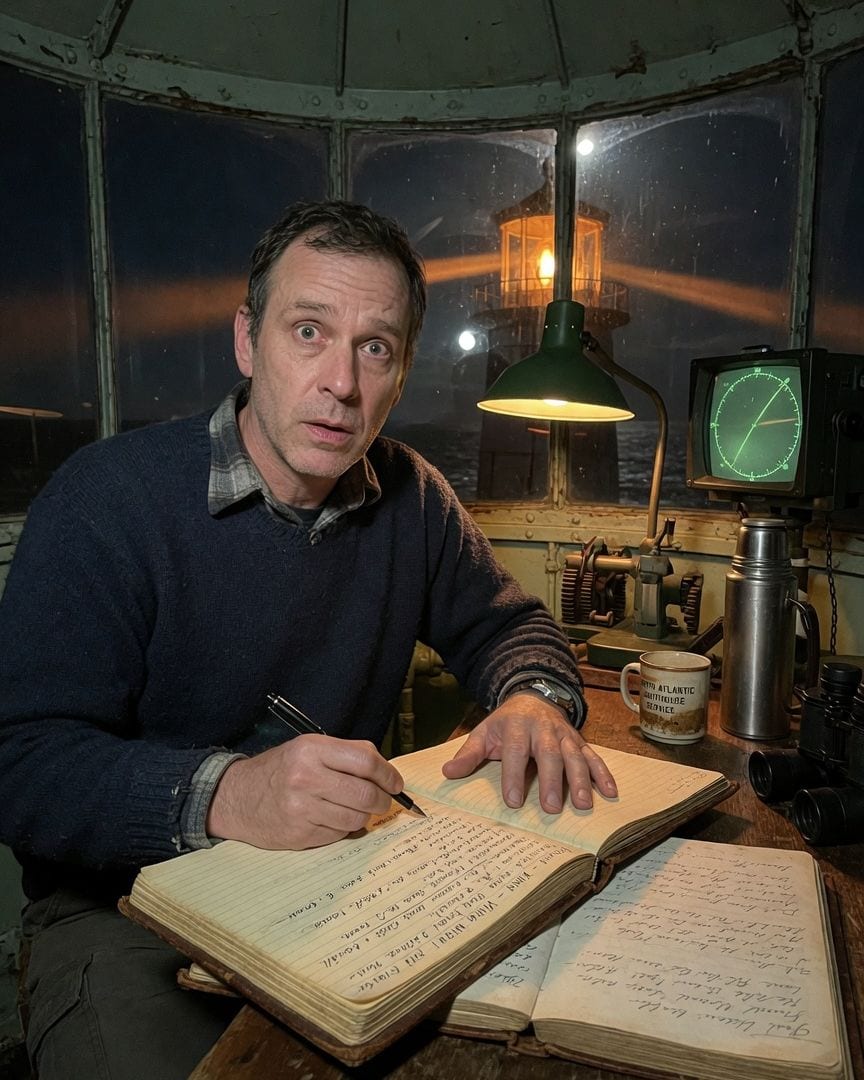
My lighthouse log has my own 3 AM entry for a phantom ship. I was alone in the tower, and I wrote no such thing.
Perched in the lantern room for my usual 2-6 AM watch, I reached for the thick logbook. But the 3:00 AM entry, under my own name, detailed a vessel I never saw. The words were in my own ink, yet I had never written them.