My phone bill shows me calling New Mexico at 1 AM. My phone was on my bedside table in Michigan, in airplane mode. The number dialed is one I don't recognize, three nights running.
The line item on my phone bill was impossible, yet there it was, stark black ink on white paper.
A nineteen-minute call placed from my number at 1:40 AM, originating from a cell tower near a motel in a town called Truth or Consequences, New Mexico.
My phone, I knew with absolute certainty, had been on my bedside table in Michigan, in airplane mode, screen dark all night.
I remembered checking it at exactly 3 AM – a quick glance at the time, no notifications, no active apps. It had been inert, a cold rectangle of plastic and glass, as I drifted back to sleep.
This wasn't a glitch. Three nights running, the bill showed calls from that same impossible location, all around the same impossible hour, each one dialed to a number I didn't recognize. A cold knot tightened in my stomach.
It felt like a phantom limb, an echo of myself in a place I’d never been, doing something I hadn’t done.
I called the phone company, my voice tight with forced calm. The customer service representative, after a frustrating series of holds and automated menus, finally confirmed the details.
"Yes, Ms. Jennings," she said, her voice flat and professional, "our records show these calls originating from a 505 area code tower. They appear legitimate." My grip tightened on the handset. "My phone was on my nightstand. In airplane mode.
It couldn't have made those calls." She paused, then offered, "Perhaps a case of cloning, Ms. Jennings? Or SIM card fraud?" I considered it, tried to make sense of it.
But the specific dates and times, mirroring my own sleep schedule so precisely, felt too targeted for random fraud. And the number it had called? A generic prepaid burner, untraceable. I hung up, my hand still trembling slightly.
I tried to rationalize it away as a sophisticated scam, something I couldn't possibly understand. But the certainty of my own memory, the feel of my phone heavy and inert on my nightstand, gnawed at me.
This wasn't just a charge. It was a violation of my own physical reality. I pulled out old bills, flipping through them.
And there it was, faint and unsettling, an echo from a year ago: a single random outgoing call from a distant, unfamiliar tower, dismissed then as a one-off error. Now, it looked like a precursor.
A week later, a thick, official-looking envelope arrived, forwarded from my old address. It was from my late grandmother Iris Fairfax's estate.
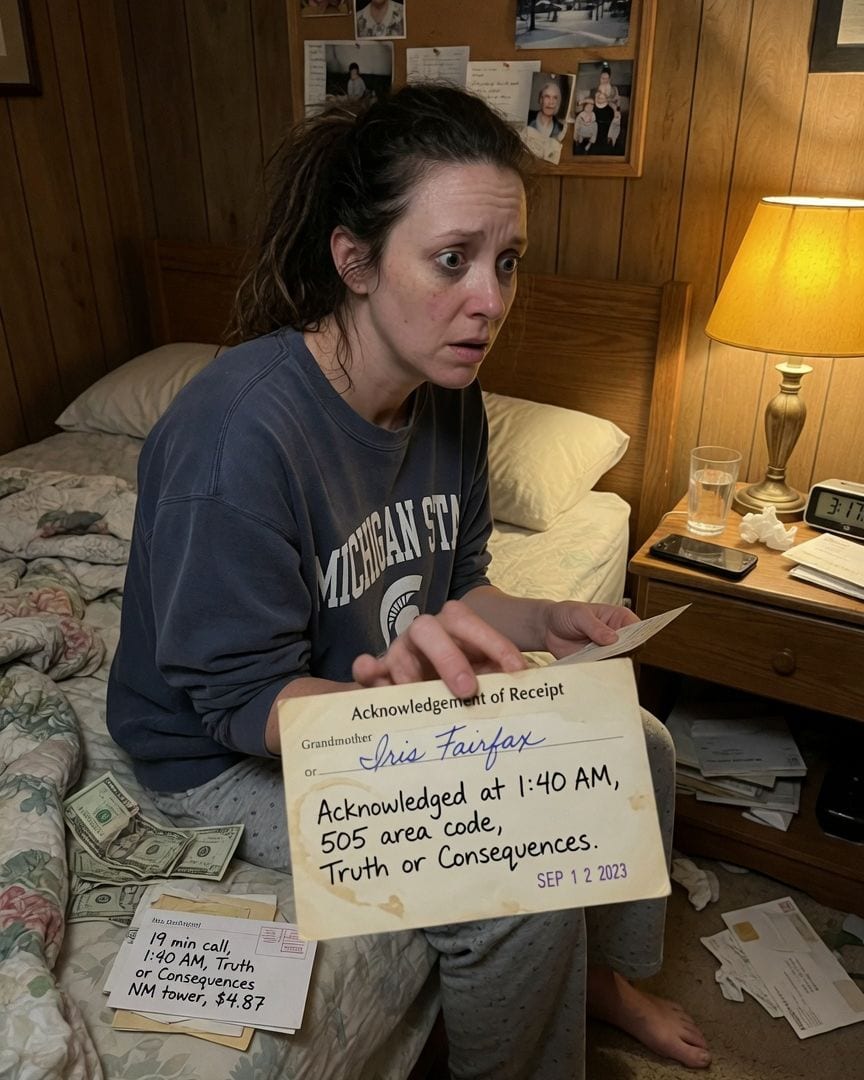
Among the legal documents and sentimental trinkets, there was a faded, cream-colored form, roughly the size of an index card. It was titled 'Acknowledgement of Receipt.' At the bottom, in my grandmother's distinctive, looping script, was her signature.
But below that, unmistakably, was my own handwriting – the exact slant of my 'M', the precise curve of my 'J' – a brief note: 'Acknowledged at 1:40 AM, 505 area code, Truth or Consequences.'
The date stamped below it was a month ago. My own hand, acknowledging something I'd never seen, in a place I'd never visited. Just like the phone bill. The paper felt cold in my hand, utterly solid, utterly wrong.
Unnerved, I researched Truth or Consequences. It was a tiny, remote New Mexico town, known for its hot springs, a place of no particular significance, certainly nothing that tied me or my grandmother to it. Nothing that explained this.
I found Daniel Carter, a retired handwriting expert, online and, with a growing sense of desperation, sent him the faded form. He called back two days later, his voice professional but tinged with a slight curiosity.
"Ms. Jennings," he said, his words measured, "the signature on the top is unequivocally your grandmother, Iris Fairfax. And the one below, the one acknowledging receipt… it’s yours. Genuinely yours. No signs of forgery. It's a perfect match."
A chill, deeper than any air conditioning, snaked its way up my spine. This wasn't a mistake, not a trick of light or memory.
My own hand had written those words, in a place I’d never been, acknowledging something I didn’t know. I started searching online forums for 'impossible records,' 'wrong signatures.'
I found a small, obscure community, mostly dismissed as conspiracy theorists, sharing stories of bank statements showing purchases they never made, camera footage of them in places they never visited, or, most disturbingly, their own signatures on forms for things they’d never seen.
A pattern started to emerge: remote locations, impossible times, undeniable personal identifiers. It wasn't just me.
My online digging became relentless, my search history a testament to my growing obsession. I focused on the more coherent accounts, trying to find a common thread, a link, anything that might explain what was happening.
That's when I started noticing the car. A dark sedan, utterly nondescript, parked two blocks from my apartment for two days. Then, it moved. It appeared on my street, parked directly across from my building.
I dismissed it, first as coincidence, then as paranoia, an expected side effect of my research. But the email arrived. No subject, no sender name, just a string of random characters for the address.
The body contained a single sentence: 'Some things are best left alone, Monica.' My heart hammered against my ribs, a trapped bird. It wasn’t a threat, not exactly, but a cold, flat statement of fact, an implicit warning.
I felt a prickle on my skin, the unmistakable sensation of being watched, of eyes on me even when no one was there. My apartment, once a sanctuary, now felt like a glass cage, every window a potential viewport.
I pulled the blinds, double-checked the lock on the front door, but the feeling persisted, a cold, invisible weight pressing down on me.
I drove three hours to my grandmother’s quiet hometown, a place of sleepy storefronts and ancient oak trees. The tiny, dusty post office was still there, smelling of old paper and wood polish.
Inside, I found Dean Reynolds, the semi-retired postmaster, sorting letters with practiced ease. He was a kindly, stooped man, his eyes crinkling at the corners. "Iris Fairfax," he said, a fond smile spreading across his face.
"Known her all my life. Sharp as a tack, that one." I showed him the form with my signature, the acknowledgment of receipt. Dean’s smile faltered. He took the paper, his brow furrowing, his thumb running over my familiar loops.
"Iris… she used to bring me things like this." He looked around, as if checking for listeners, his voice dropping to a near whisper. "Not exactly like this, mind you, but… records.
Receipts for services she never had, land deeds she never signed, all from places nowhere near here. Dates that made no sense.
She’d always ask if I’d seen anything like it, if I could explain how her signature got on them." I leaned closer. "What did she think it meant?" Dean sighed, shaking his head. "She called them 'pre-emptions.'
Said someone was laying claim. Claiming things that weren't theirs. She was trying to fight it, you know. Collecting them, trying to understand the pattern." He shook his head again, a sadness in his eyes.
"Thought she was just getting old, bless her. Always kept them in a small, locked metal box in her attic. Said if she ever... disappeared, someone should find it."
The air in the small room felt suddenly cold, as if the silence had absorbed all the warmth.
I returned to my grandmother’s house, the one I’d been slowly clearing out for the past year. The attic was a jumble of forgotten lives, dust motes dancing in the shafts of light from the small window.
Recalling Dean’s words, I searched frantically, my hands brushing through old blankets, boxes of photographs, forgotten keepsakes.
Tucked away beneath a loose floorboard, warped by decades of changing seasons, I found it: a small, tarnished metal box, heavy and cold in my hands.
The lock was simple, a cheap brass mechanism that gave way with a soft click after a few moments of fiddling with a hairpin I’d pulled from my messy bun.
Inside, wrapped in yellowed tissue paper, were dozens of forms, each one identical to the 'Acknowledgement of Receipt' I’d found. Each bore a name, a signature, and a location. My mother’s name, signed, dated five years after her death.
My aunt’s, signed, dated three years before she was even born. And then, a form with HER OWN name, HER OWN signature, starkly clear against the faded paper. But this one wasn't from a month ago.
This one was dated for next week.
I laid out the forms on the dusty attic floor, the yellowed paper fanning out like a morbid deck of cards. The pattern snapped into place with horrifying clarity, all the scattered details converging into a single, monstrous shape.
These weren't records of past events; they were future claims. The signatures weren't proof of consent but of ownership, bureaucratic markers of acquisition.
The calls from New Mexico weren't from my phone, but for me, a digital tether, an administrative opening, a declaration. My grandmother, Iris, hadn't just been collecting anomalies; she was documenting a ledger, a system.
The dates on the forms with my relatives' signatures weren't random; they corresponded to significant life events, or more chillingly, their eventual deaths, pre-empting their very existence or conclusion.
Monica’s own form, dated for next week, wasn't a bill or a receipt. It was a delivery order. A delivery receipt for 'one life, delivered.' I was never outside the pattern.
I was always inside it, a name on a list, awaiting my turn.
The realization hit me with the force of a physical blow, knocking the breath from my lungs. I couldn't fight this.
It wasn't a person, not a company, but an unseen institution that wielded bureaucracy as its weapon, operating outside of time, claiming lives through paperwork.
My grandmother's quiet resistance, her meticulous collection, had been an act of defiance, a desperate attempt to map the enemy, but ultimately, futile. The only way out wasn't to fight, but to disappear. To become untraceable.
To have no 'record' for them to claim. I acted with cold, surgical precision. I sold my apartment at a loss, liquidating my assets, closing all my bank accounts, canceling my phone, my internet, my utilities.
Every digital footprint I ever made, every piece of data that tethered me to my identity, I tried to erase. I bought a used car with cash, packed a single bag of essentials, and left.
I drove east, then north, then west, a ghost in the system, shedding every identifier, every connection. I knew it was a desperate act, a temporary reprieve. But for now, for this week, I would not be delivered.
Years passed. I lived off-grid, moving from town to town, working cash-only jobs under assumed names. I used burner phones for emergencies, never keeping them long, discarding them like hot coals.
I checked my reflection often, looking for any subtle change, any sign that the claim had finally caught up. The fear was a constant companion, a dull ache beneath my ribs, a shadow at the edge of my vision.
I avoided mirrors, avoided cameras, avoided any official interaction. My life was a careful, quiet deletion, always looking over my shoulder, always listening for the impossible call.
One day, in a small, anonymous town nestled in the foothills of some nameless mountains, a package arrived at my general delivery P.O. box, addressed simply to 'Monica Jennings.'
Inside was a single, crisp, blank form, identical in every way to the ones in my grandmother's box. Except for one detail: a new date, one day from now, stamped in stark black ink at the bottom.
I held it, feeling the weight of the paper, the finality of the date.
I closed my eyes, and then, slowly, I put the form back in the envelope, placed it in my bag, and walked out into the bright afternoon sun.
A local news article, dated three days later, reported a missing person: Monica Jennings, last seen leaving her P.O. box.
Her rented room was empty, all her sparse belongings gone, save for a single, new phone bill lying on the counter, showing a nineteen-minute call placed from New Mexico.
If this one got to you
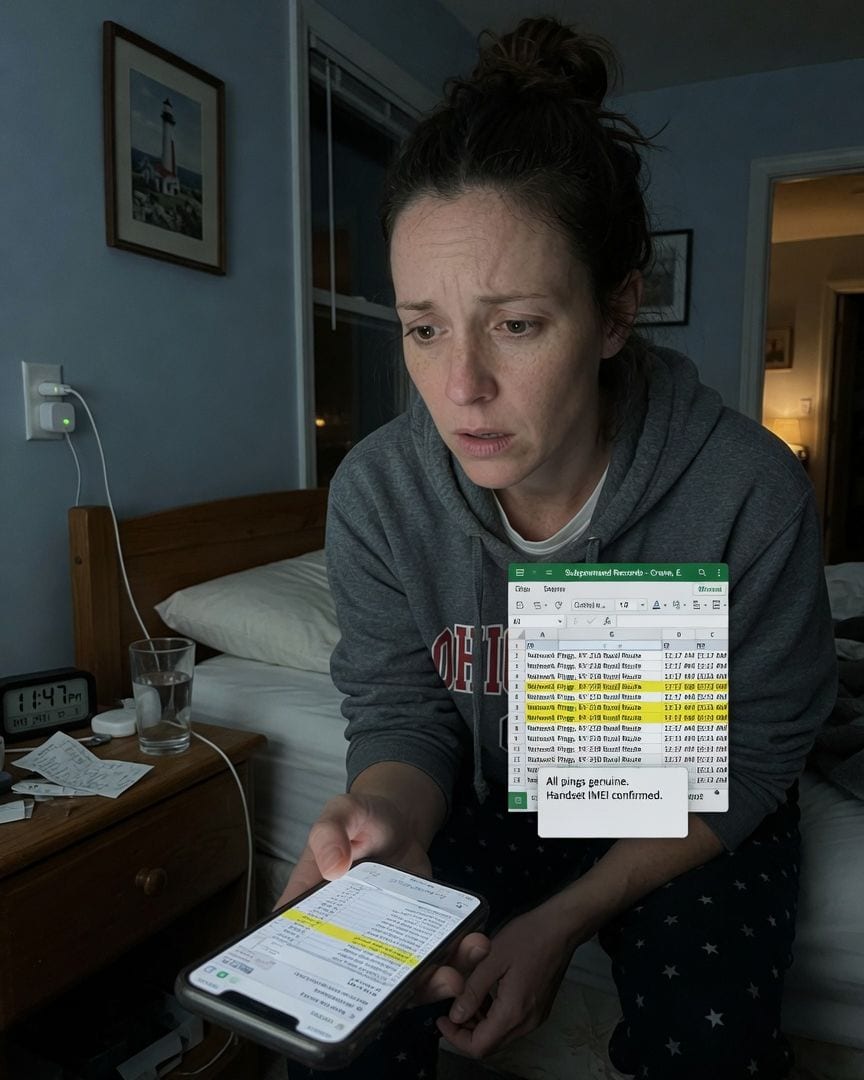
My phone logged a four-hour drive through rural Kentucky, hitting cell towers every few minutes. It was charging on my desk in Ohio all night. The carrier insists it was my handset.
My lawyer sent subpoenaed phone records showing my device driving through rural Kentucky for hours, even though it was plugged in beside my bed in Ohio. My smart-plug log confirmed its continuous charge, unbroken, all night. But then, a small charge on my bank statement for gas from that exact Kentucky route solidified the impossible.
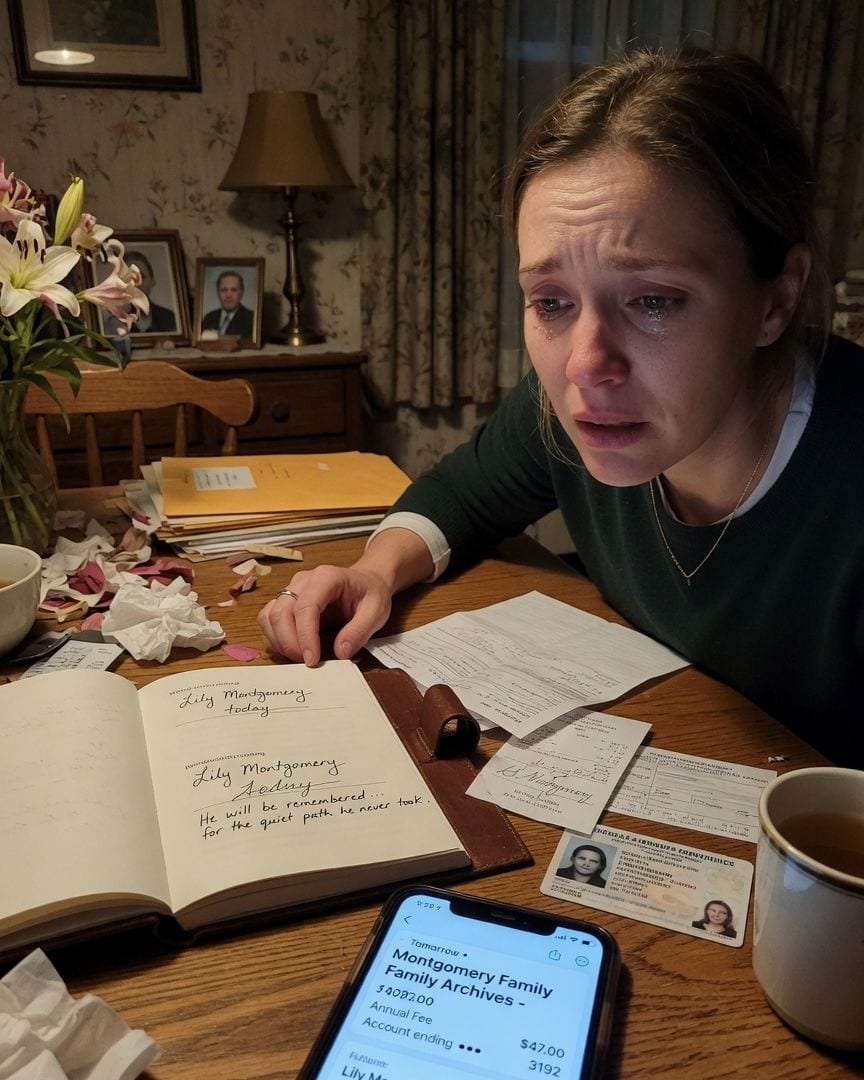
My handwriting was in the condolence book. Dated before my uncle died. Words I'd never choose.
At Uncle Howard's funeral, grief-stricken, I signed the condolence book. But later, flipping back through the pages, I found my own distinct handwriting on an entry dated the previous morning—before he had even died. The words beneath my name were chilling, a judgment I would never make.
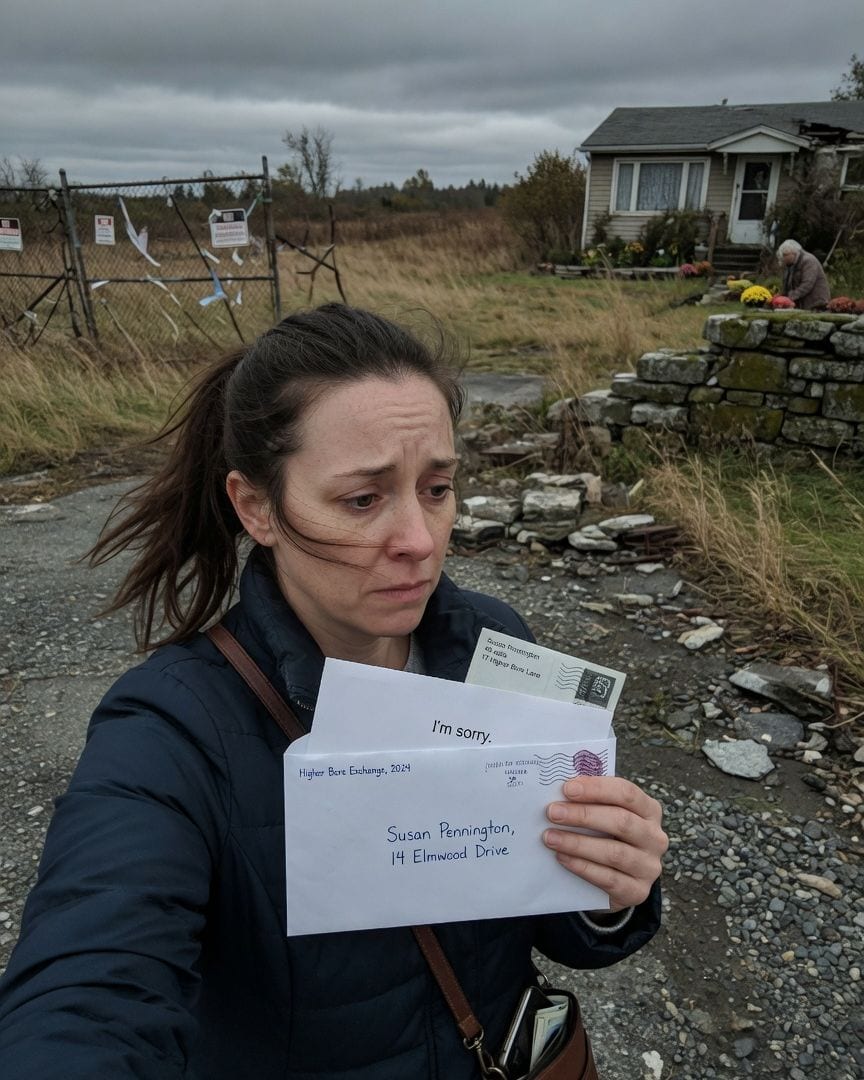
My phone bill listed forty calls made at 3:14 AM to a house demolished in 1990. The paper bill came from a flattened building. My name is on it.
I stared at my phone bill, my morning coffee forgotten. It detailed forty calls, each at 3:14 AM, to an address I knew was a vacant lot where a house had stood decades ago. But the real dread began when I saw the bill's return address: a telephone exchange flattened years before.
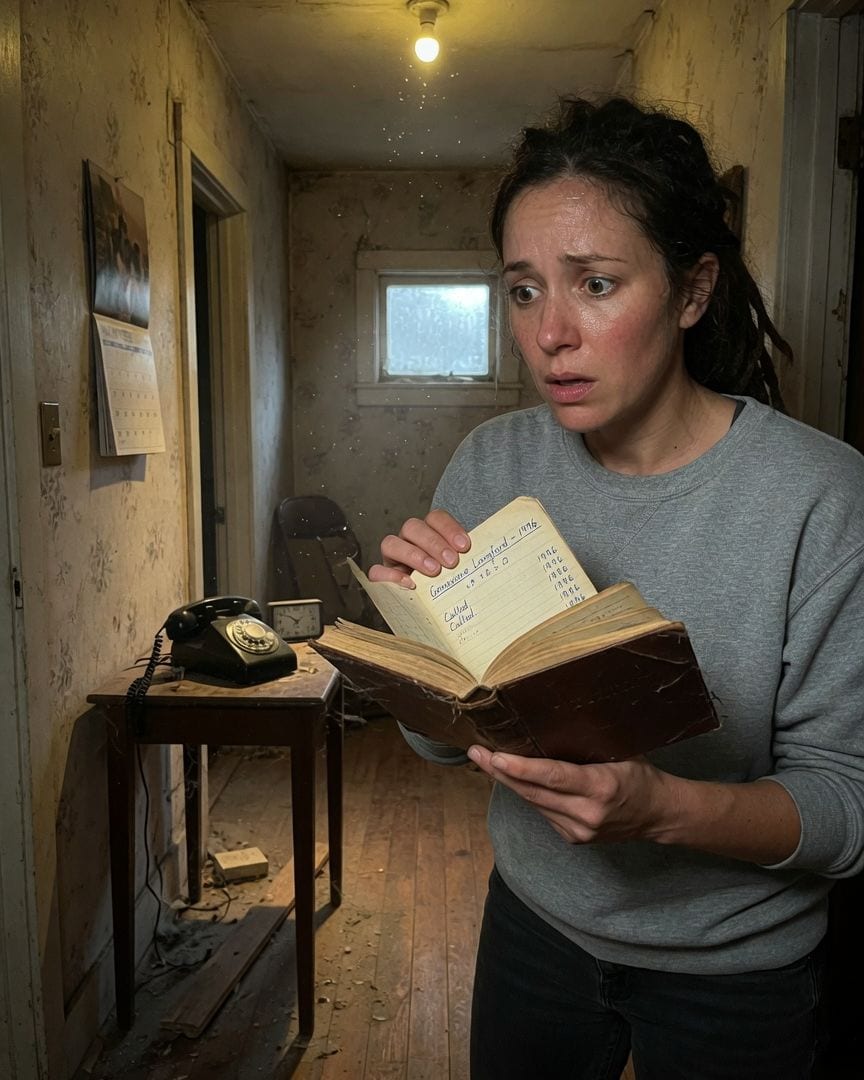
My dead rotary phone rings at 8:05 every night. I pick it up. A room full of voices, then a woman drawing breath.
I inherited an old house, complete with a black rotary phone that the company confirmed was disconnected in 1996. Yet, most evenings at 8:05 PM, it rings. When I pick up, a distant murmur fills the line, followed by a woman drawing a deep, shuddering breath every single time.
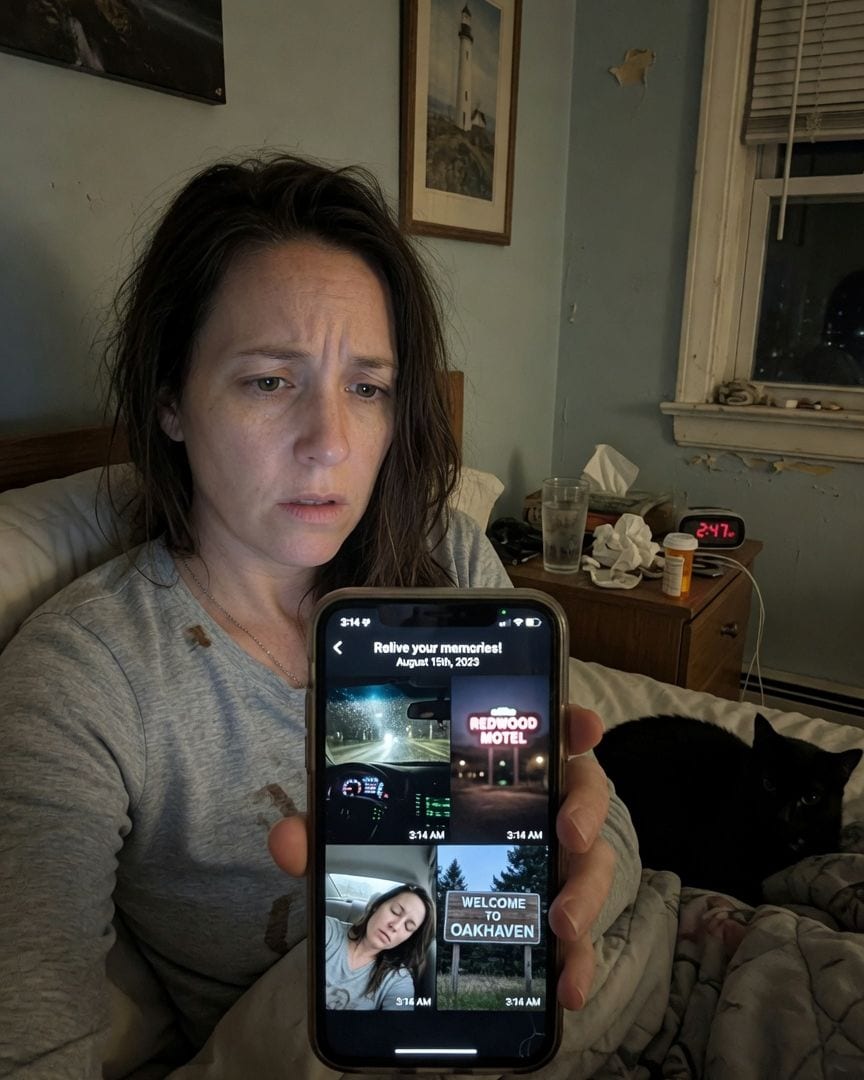
My phone has photos of me asleep in a strange car at 3 AM. Then a voicemail: 'We'll have her back by sunrise.'
My phone woke me with a cheery notification, promising memories from last August. Instead, it showed me asleep in a dark car, rain streaking the windshield, miles from my apartment. I was certain I'd been home in bed that night, but the images were undeniably in my camera roll, a quiet violation of my memory.
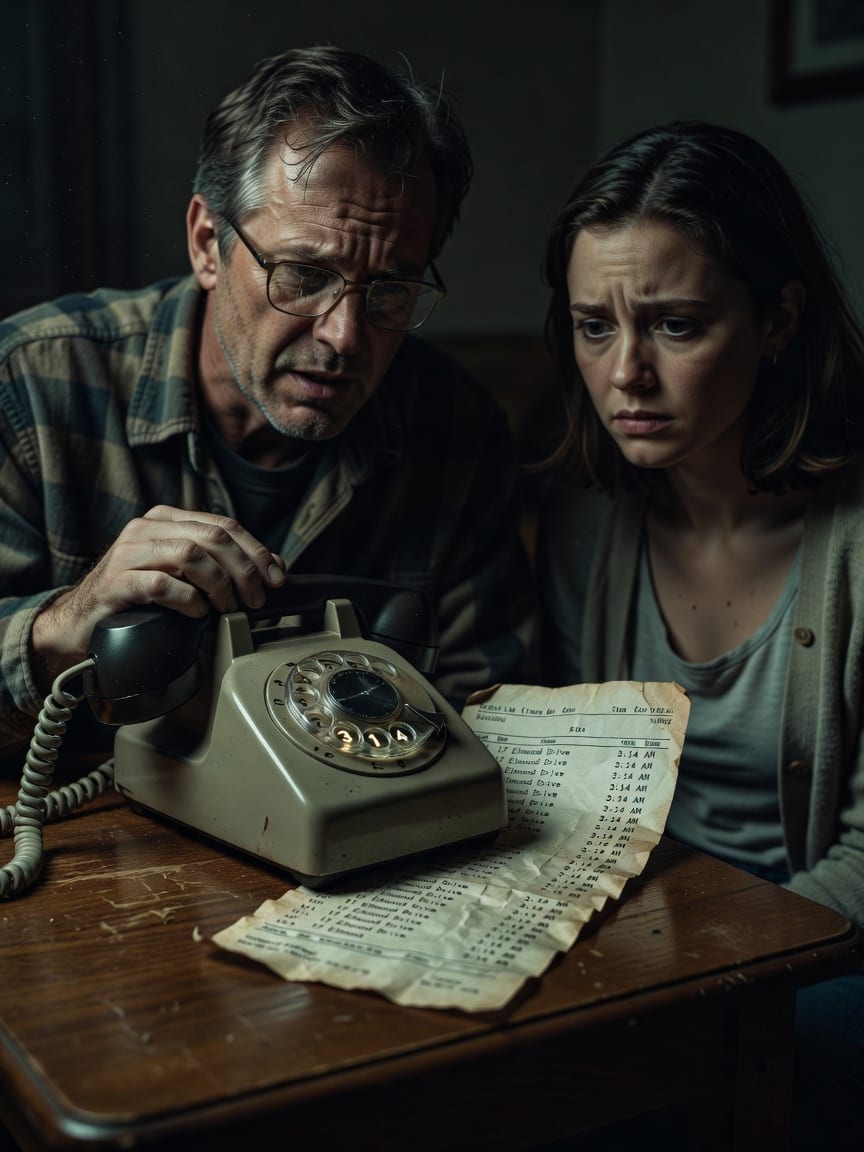
My phone bill itemised forty calls from my number to a house demolished in 1990. Each call at 3:14 AM, lasting eleven minutes. The bill arrived postmarked from a flattened building.
I expected the usual mobile bill, but my landline statement listed forty calls from my number to '17 Elmwood Drive.' That address was for a house torn down in 1990, a vacant lot I remembered from childhood. The phone company insisted the calls were legitimate, leaving me profoundly unsettled by the impossible charges.