A retired Coast Guard pilot found the survival kit she packed in 1993 — sealed with rations expiring in 2034.
The call came on a Tuesday, pulling Ada Mireles from the quiet routine of her retirement. At 48, her days of piloting search-and-rescue choppers were long past, replaced by the steady rhythm of coastal life.
But the voice on the line, a junior Coast Guard officer, spoke of something that instantly dragged her back to 1993. A shrimper's net, off the Texas coast, had brought up a piece of history.
Ada drove towards the dock, the humid air thick with the familiar tang of salt and decay, clinging to her skin like a second uniform. The sun beat down, turning the asphalt into a shimmering mirage.
Her stomach churned with a familiar unease. She hadn't thought about Dune Two in years, not truly, not with this cold grip of certainty.
At the dock, under the canvas shade of an inspection tent, lay the corroded, barnacle-encrusted remains of a helicopter seat pan. It was unmistakably from Dune Two, the markings faint but legible. A knot tightened in Ada's chest.
She had called off that search, a decision that had haunted her for decades.
A technician, gloved and solemn, pointed to a small, sealed compartment on the underside of the pan. It was the emergency survival kit, still mostly intact. "Thought you'd want to see this, ma'am," he said, his voice hushed.
Ada nodded, her throat suddenly dry. The kit was pried open with careful tools. Inside, nestled amongst flares and a first-aid tin, were several vacuum-sealed MREs – Meals Ready-to-Eat. Their plastic wrappers were surprisingly pristine.
Ada picked one up, her fingers tracing the printed date. Her breath hitched. The words stamped clearly on the packet read: "EXP: 2034."
Her heart seized, a cold, hard clench. She knew those numbers. She knew what she had packed, what had been standard issue back then. This was impossible.
The wrongness was physical, visceral, a sudden drop in the pit of her stomach as if the ground beneath her had vanished. She remembered the exact, worn-out packing list, tucked away in a shoebox in her attic.
The serial numbers, the contents. She knew.
Ada returned home, the image of the future-dated rations seared into her mind. The seat pan remained under Coast Guard custody, a grim relic, but the impossible MREs were her private torment.
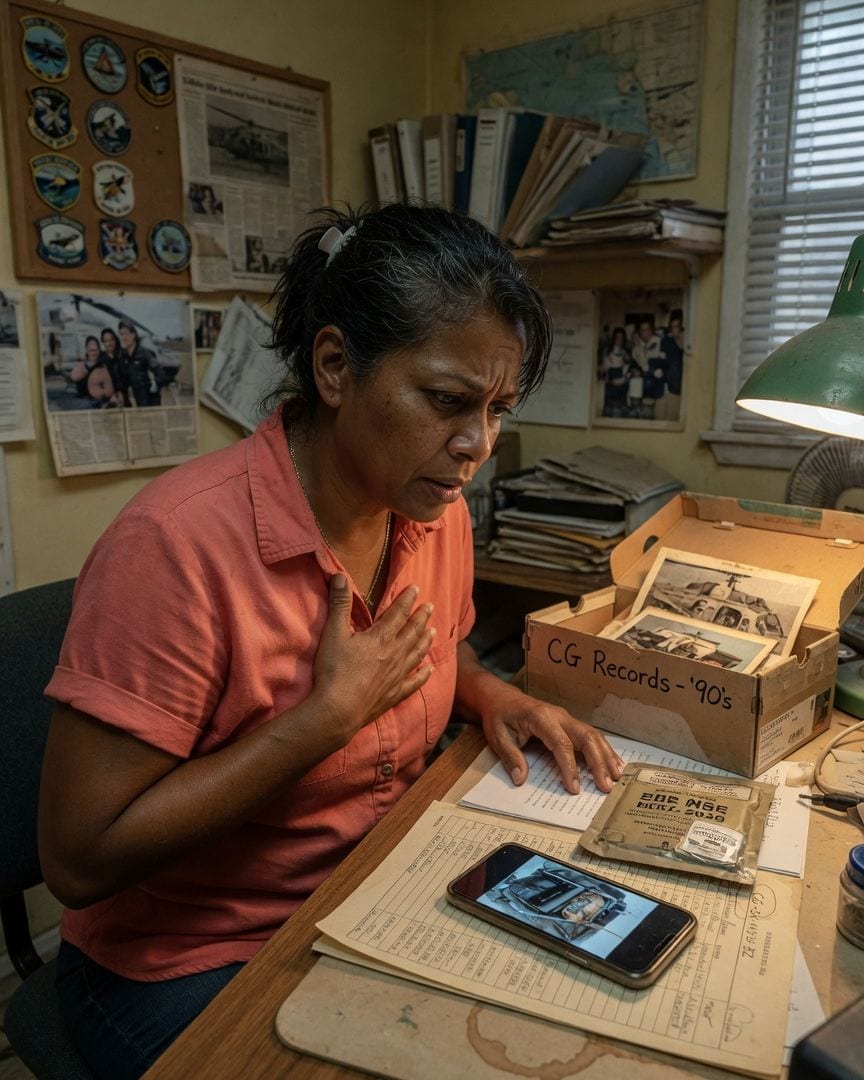
She walked into her study, the familiar scent of old paper and dust a thin comfort. From the top shelf of her closet, she pulled down a battered shoebox labeled "CG Records - '90s."
Inside, beneath faded photos and old commendations, lay the worn, official packing list from her 1993 deployment. The paper was brittle, the ink slightly faded, but perfectly legible.
She pulled out her phone, scrolling through the photos she’d insisted on taking at the dock: close-ups of the survival kit, its serial number clearly visible. She laid the phone beside the packing list on her desk.
The serial numbers matched precisely: CG-SK-4193-BZ. This kit, found in the recovered seat pan, was definitively hers. The one she had personally inventoried and sealed.
Ada tried to find a rational explanation. A faulty stamp, perhaps? But the date was too specific, too far in the future, not just a smudged '9' looking like a '0'. A resupply error? Impossible for a sealed, decades-old kit.
A plant? But by whom, and for what purpose, discovered now by chance? The kit itself was sealed, clearly undisturbed for over two decades. She meticulously checked the kit's model number against Coast Guard procurement records online for 1993.
It was the correct model for the era, a standard issue survival pack. Nothing amiss there.
But the rations. The MREs were a new type, she knew, not available in '93. Their packaging, their nutritional information, even the font of the "EXP: 2034" stamp, felt alien to the early nineties.
Ada picked up the phone again, dialing Eleanor Russo, a former colleague now an aviation historian. Eleanor, practical and grounded, listened patiently as Ada recounted the discovery.
"2034?" Eleanor's voice held a note of disbelief. "That's... quite a jump. Mislabeled batch, maybe? Supply chain mix-up, even back then."
Ada closed her eyes. "It was sealed, Eleanor. And it's a specific MRE type that didn't exist." Eleanor confirmed the MRE type hadn't been introduced until the mid-2000s.
The failure of every mundane explanation only ratcheted the dread tighter in Ada's chest. Her gut screamed that this was no mistake.
Unable to shake the profound unease, Ada decided to visit the regional Coast Guard archives. Her old credentials still held enough weight to grant her access, though the retired archivist on duty raised an eyebrow at her unusual request.
The air in the archive was cool, dry, and thick with the smell of aging paper and ozone. She settled into a dusty cubicle, loading a microfiche reel into the reader.
The hum of the machine was a low drone, a monotonous lullaby to a waking nightmare.
She sieved through search logs for Dune Two, scanned equipment manifests for the fateful helicopter, and reviewed every recovery report, however brief or inconclusive. Page after flickering page. Finally, a familiar sequence of characters swam into view.
She located the entry for her survival kit's serial number, CG-SK-4193-BZ, matching her cherished packing list exactly. It was listed as packed and deployed on September 14th, 1993. All perfectly standard.
But then, in the margin, penned in precise, official handwriting that seemed impossibly stark against the printed text, was a single, anomalous annotation.
Ada leaned closer, her breath catching in her throat. The words swam before her eyes, an official stamp on something that simply cannot be. "Packed for projected T-shift Delta-07."
The phrase "T-shift Delta-07" burned in Ada's mind like a brand. She spent days trying to find anyone who might understand such jargon, but every inquiry led to blank stares or polite deflections.
Eleanor Russo, when pressed, dismissed it as a clerical error, a bad joke, or perhaps some internal code that had long since been retired. "These archives," Eleanor had sighed, "they're full of the inexplicable, Ada. Doesn't mean it's actually inexplicable."
Ada, however, remembered something. Whispers from her early career, hushed conversations between older officers about an obscure, deep-archive section. It was called "Special Acquisitions and Dispositions," meant for equipment with "anomalous operational histories."
It sounded like something out of a pulp novel, but the memory persisted.
She found an old contact card for Trevor Harlow, 63, a retired archivist she vaguely knew from her own active duty days, known for his encyclopedic memory of Coast Guard history—and a reputation for being a bit of a conspiracy theorist, even then.
His voice on the phone was gravelly, hesitant. He was initially cagey, almost to the point of hanging up. "Special Acquisitions?" he muttered. "That's... ancient history, Ada. And for good reason."
But Ada's persistence, and her mention of Dune Two and, crucially, the impossible seat pan and its future-dated contents, piqued his interest. A long silence stretched between them, punctuated only by the crackle of the phone line.
"Some files," he finally said, his voice dropping, "they 'unhappen,' Ada. Things that were, then weren't. You understand?"
He agreed to meet, but warned her, "Some things are best left buried. They stay buried for a reason. And the reason usually involves things that disappear."
He spoke of "things on the scope" that simply vanished from official memory after being tracked by radar and gun camera. Ships, aircraft, whole units.
He hinted at a pattern spanning decades, of vessels that just… became paperwork, erased from the public record as if they'd never been. The details were never coherent, always fragmented, like shards of a broken mirror.
"The paperwork," Trevor had stressed, "always gets cleaned up. Always." His voice was flat, matter-of-fact, as if discussing the weather.
Ada met Trevor Harlow in a quiet, out-of-the-way diner, a place that felt frozen in the 1970s. The clatter of plates was muted, the fluorescent lights humming faintly. Trevor, despite his years, was visibly nervous.
He chose a booth in the corner, his back to the wall, and constantly checked the door, his eyes darting to every new arrival. He didn’t touch his coffee.
"It's real, isn't it?" Ada asked, cutting straight to it, pushing a small sugar packet back and forth across the table.
Trevor exhaled slowly, a long, weary sound. "The 'secrecy machine,' as we called it internally? Yeah, it's real. An informal network, deeply embedded. It handles incidents beyond normal classification. Things that... break reality, in a way. Like your 'T-shift.'
That refers to temporal displacement."
He leaned forward, his voice a low rumble. "I saw files on Dune Two. Back in '93, they were sealed. Later, purged from accessible records. Records that contained impossible details. Things that suggested the crew had... experienced something.
Something that couldn't be explained by a storm or equipment failure." He paused, taking a slow sip of water. "I strongly advise you to stop digging, Ada. For your own safety. And mine."
As they talked, Ada noticed a dark sedan parked across the street. Its engine idled, a low thrum against the backdrop of diner noise. The windows were tinted, opaque, reflecting the dull sky.
It had been there when she arrived, she realized, but she hadn’t given it much thought. Now, a cold dread began to spread through her. Trevor, his gaze following hers, stiffened.
He didn't say anything, but his eyes held a new, raw fear.
When they left the diner, the sedan pulled away from the curb slowly, its tinted windows still unreadable. It followed them for several blocks, maintaining a precise distance, before abruptly turning off down a side street.
Trevor looked visibly shaken, his face pale beneath the diner's artificial glow. He swallowed hard. "They know," he whispered, almost to himself. "The machine is aware." Ada’s suspicion solidified into a horrifying certainty: they were being watched.
Her investigation was no longer her secret.
"Who are 'they'?" Ada demanded, her voice low and urgent, the word feeling too small for the unseen forces closing in. "What happened to Dune Two? Tell me everything, Trevor. The full truth."
The clatter of a passing truck rattled the diner windows.
Trevor winced, running a hand over his thinning hair. "Dune Two wasn't lost in a storm, Ada. Not in the way anyone understood. It had an 'event.' We didn't have the language for it then, not publicly.
But internally, we did." He looked away, focusing on a crack in the Formica table. "Some anomalous events, when detected, cause temporal shifts. Localized displacement. The Coast Guard's role, as it evolved, was to manage the fallout.
Create false records, retrieve displaced objects, and 'file' the truth from public view. Keep the timeline... clean."
He pushed his untouched coffee cup aside. "Those rations. The future-dated MREs. They weren't a mistake. They were a calculated attempt to re-equip the crew if they returned from a projected future displacement.
A contingency, based on what little we understood. It sounds insane, I know." He finally met her gaze, his eyes full of a tired, profound weariness. "Julian Easton, Dune Two's pilot.
He reported 'impossible contact' on radar just before they vanished. Not a storm, not another craft. Something... else. Unknowable, but detectable. The 'T-shift Delta-07' note meant they had detected a high probability of a temporal anomaly. A brief, localized rift.
They were trying to prepare for what might happen on the other side, or what might come back."
The words hit Ada like a physical blow, heavier than any ocean current. The search she had called off, the decades of quiet guilt she'd carried, the mourned colleagues... it was all a charade. A performance for the public.
The people she mourned were never truly "lost" in the way she understood loss. They were simply processed, absorbed into the machine's hidden reality.
Her grief, her regret, her entire understanding of that critical moment in her career – it was all built on a managed lie. The room felt suddenly cold, the sound of her own breathing impossibly loud.
Trevor, seeing the despair settle over Ada’s face, offered one last, chilling piece of evidence. He reached into his worn leather satchel, pulling out a microfiche card.
"This is from a 'Special Acquisitions' file," he said, his voice barely a whisper. "I was never supposed to see it. Never supposed to copy it. It's an addendum to the Dune Two incident, dated 1993, but... updated recently."
His hand trembled slightly as he passed it across the table. "They don't just file away the anomalies, Ada. They file away us."
Ada took the card, her hands trembling. The plastic felt cold, alien. She thanked him, her voice thick with a mixture of terror and resignation.
Back home, in the quiet solitude of her study, she loaded the microfiche into her old reader. The screen flickered to life, bathing the room in an anemic green glow.
The document was heavily redacted, filled with classified codes and obscure references, dense with official jargon that meant nothing to her.
She scrolled through the dense text, searching for any names, any further details that might make sense of this new, terrifying reality.
Then, halfway down a page detailing "post-event investigative protocols," she saw it. Clear as day, starkly visible against the blacked-out lines, was her own name. "Mireles, A." And next to it, a series of dates and inquiries.
They precisely mirrored her current investigation in 2019. Her questions about the seat pan, her visit to the archives, her contact with Trevor. This file, dated 1993, already contained her.
The realization hit Ada like a physical blow, colder than any deep-ocean current. Her investigation wasn't a discovery; it was a predicted event, a known variable in the "secrecy machine's" grand design.
She wasn't uncovering a secret; she was merely following a pre-written script. The chill deepened.
She called Trevor, her voice strained, barely a whisper against the hum of her microfiche reader. "The file... it has my name," she breathed into the phone. "It knew what I would do. What I am doing."
Trevor’s voice was tired, devoid of surprise. "The 'pattern across decades and classifications' wasn't just about the anomalies themselves, Ada. It was about the management of those anomalies. And that includes how individuals might react to them.
How we, as rational human beings, would inevitably try to connect the dots. The file you found was a 'pre-emptive classification.' A record of your likely future actions, your inevitable uncovering of the truth."
He explained it calmly, as if discussing a weather forecast. Dune Two had encountered a phenomenon that briefly opened a localized temporal rift.
The helicopter was caught in it, and parts of it, like the seat pan, were shunted into different timelines. Some returned, some didn't.
The future-dated rations were a contingency, an attempt by "the machine" to prepare for a return that never fully materialized, or only partially. The horror was complete: the system wasn't just hiding the truth.
It was scripting the discovery of it, making her a pre-filed participant in its ongoing deception. Her entire professional life, her defining trauma, had been nothing more than an anticipated outcome.
Her free will, her sense of agency, was an illusion. The floorboards of her old house seemed to creak a little louder, settling around her in the silence.
A profound, chilling calm settled over Ada. The truth, in its full, terrifying scope, was understood. There was no escape, no action she could take that wasn't already accounted for.
She was a data point, an expected outcome, her curiosity a predictable variable in a vast, cold equation. Yet, a flicker of defiance, small and desperate, ignited within her.
If her path was pre-written, she would still choose to walk it on her own terms, however futile the gesture.
She decided to confront the "machine" in the only way she could: by trying to leave a trace, a record of her own, outside their system. She opened her laptop, the screen a stark blue against the gathering dusk.
Her fingers, usually so steady, trembled slightly as she began to type, compiling her findings, detailing everything she'd learned. The seat pan, the MREs, Trevor's confession, the impossible microfiche records.
She knew it was futile, a single whisper against an immense, patient force. But it was all she had left.
As she typed, the front door chimed. A soft, electronic whisper, barely audible over the tap of her keyboard. She froze. Her breath hitched in her throat.
Through the peephole, she saw them: two men in dark suits, indistinguishable from the ones she’d seen in the sedan. They didn't knock. They just stood there, silently, patiently, their faces unreadable, like stone carvings.
A single drop of water from the overflowing gutter outside struck the window with a sharp tap. Ada backed away from the door, her heart a drum against her ribs. She knew they weren't there to arrest her.
They were there to file her.
Ada Mireles's meticulously compiled document, detailing the Dune Two incident and the "secrecy machine," was never finished. Her computer remained open, the cursor blinking on an incomplete sentence, frozen in time.
The seat pan and its impossible rations were quietly removed from Coast Guard custody, disappearing into the archives of Special Acquisitions and Dispositions, the kind of place that made sure things truly "unhappened."
Trevor Harlow disappeared from his retirement community shortly after Ada's last call, his small apartment emptied without a trace, his pension checks suddenly redirected to a closed account.
The dark sedan was no longer seen parked across from Ada's house, its engine idling. The world moved on, oblivious to the quiet removals, the subtle recalibrations of reality.
Ada's house was eventually sold, its contents cleared by an estate sale. Among the old papers and forgotten keepsakes, a new owner found a shoebox containing a single, official-looking packing list from 1993.
It was perfectly ordinary, listing flares, a first-aid kit, and standard MREs with a 1995 expiration date. There was no impossible note, no "T-shift Delta-07" to be found. The world moved on, oblivious.
A week after Ada Mireles's house was cleared, her old colleague, Eleanor Russo, received an email from an unknown address. The subject line was blank. The body contained a single, unattached image: a blurry, low-resolution gun-camera frame, dated 1993.
In it, a Coast Guard helicopter pursued a dark, indistinct shape over churning water. The shape was turning, and for a fleeting instant, it faced the lens. It was not a craft. It was simply... a face.
If this one got to you
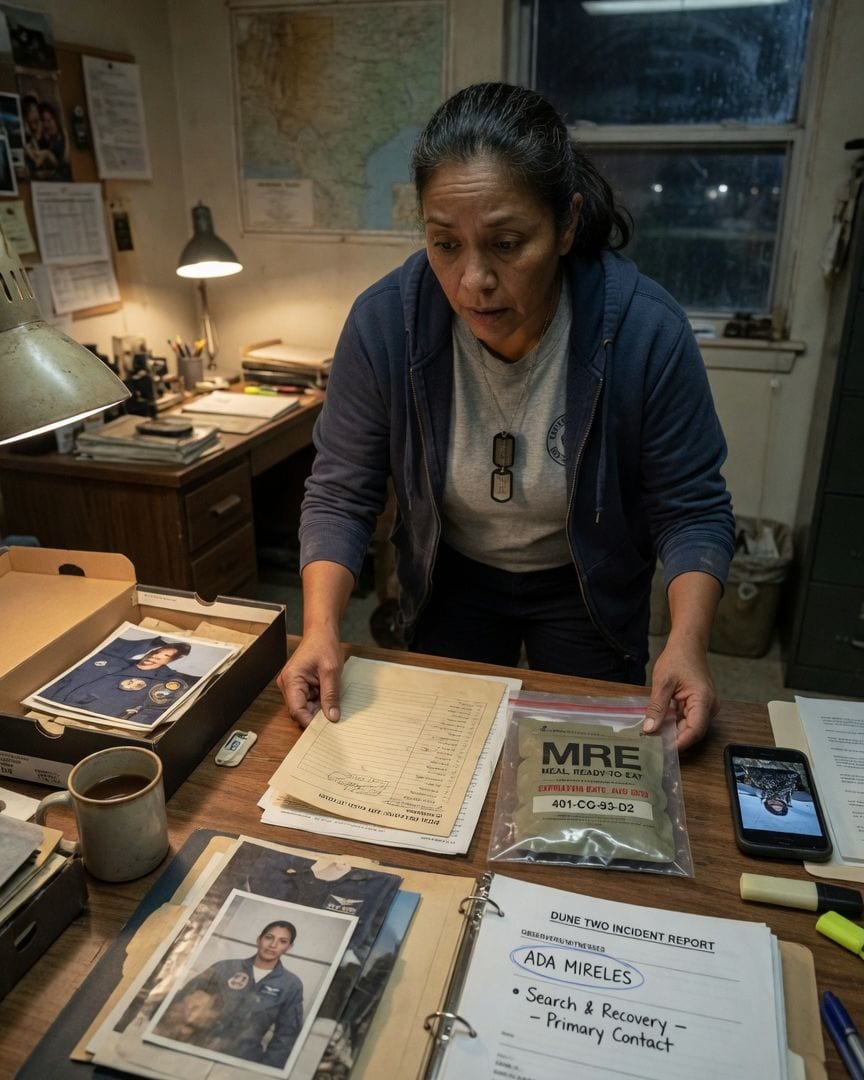
A former Coast Guard pilot found a survival kit from a chopper lost in 1993. The rations inside expire in 2030.
Former Coast Guard pilot Ada Mireles spent her youth searching for the Dune Two helicopter, lost 37 years ago. Now, a shrimper's net has snagged its corroded seat pan, complete with a sealed survival kit. But as Ada examines the kit's contents, a chilling detail emerges: the MRE packets inside are stamped with an expiration date of 'AUG 2030'. How could rations from a 1993 crash have an expiry date nearly four decades in the future? Ada's own meticulous records confirm the kit's serial number, yet defy all logic.
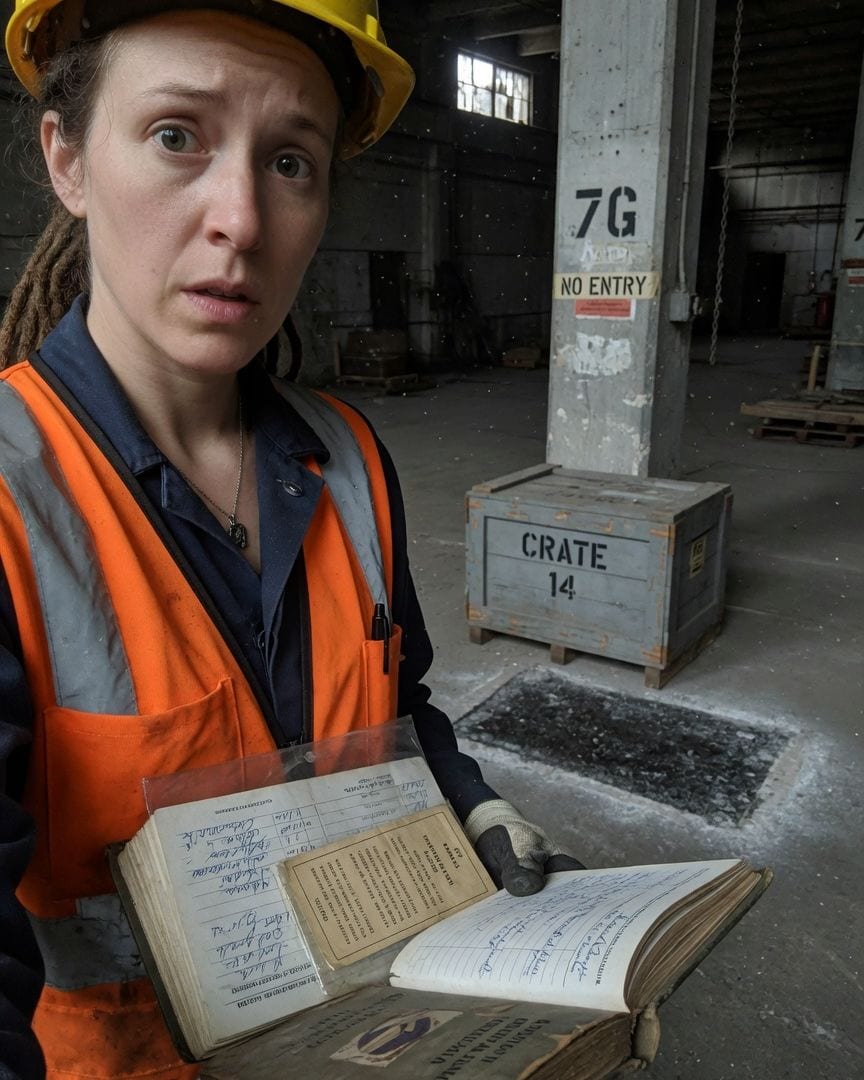
An inventory specialist's final check of a Carolina Cold War warehouse before demolition finds a crate signed for last week, years after the base closed, radiating impossible cold.
An inventory specialist, Deborah Kessling, raced a demolition deadline for a vast Carolina military warehouse, shuttered for years with its employees gone over a decade prior. Her final task was to log its forgotten contents. In a shadow-choked corner, she found Crate 14, radiating an impossible, decades-old chill. Its attached logbook showed a recent maintenance entry from 'Last week,' signed by a civilian contractor no one should have been, yet meticulous quarterly signatures stretched back sixty years, an unbroken chain of checks, even as the paper itself grew cold in her hands. What impossible secret had been so carefully maintained in this forgotten place?
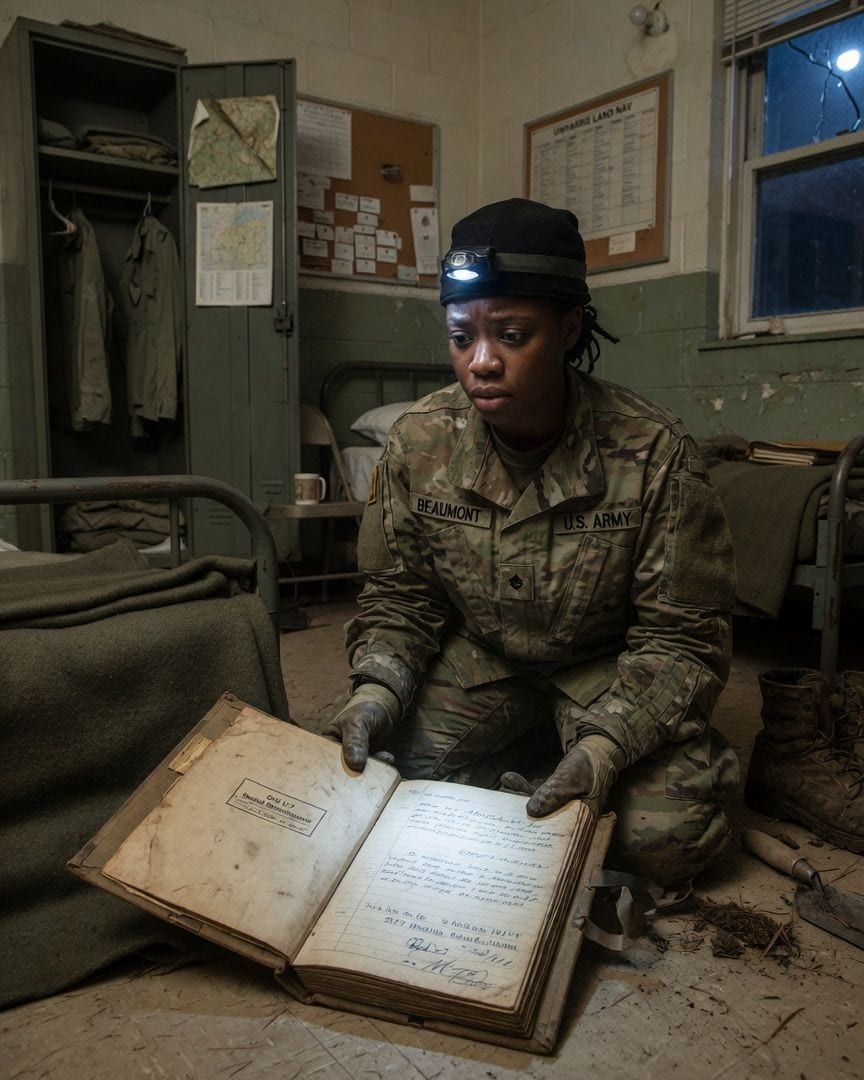
A burn barrel's impossible heat led a lieutenant to a hidden logbook, holding her own signature on a patrol she never took.
Second Lieutenant Monica Beaumont, bone-tired after a land-navigation course, logged an unexpected compound in the Uwharrie backcountry. Her cadre officer, Captain Russo, insisted she'd invented it, marking her record. The next morning, leading her platoon back to the coordinates, the compound was gone, but they found fresh post holes, cold fire pits, and a burn barrel still radiating an impossible heat. Unable to shake the uncanny feeling, Lieutenant Beaumont returned alone that night and unearthed a heavily corroded metal box. Inside, a canvas-bound logbook detailed decades of activity at a site that didn't exist, until she found an entry from eighteen months prior: her own signature on a night watch she was hundreds of miles away from.
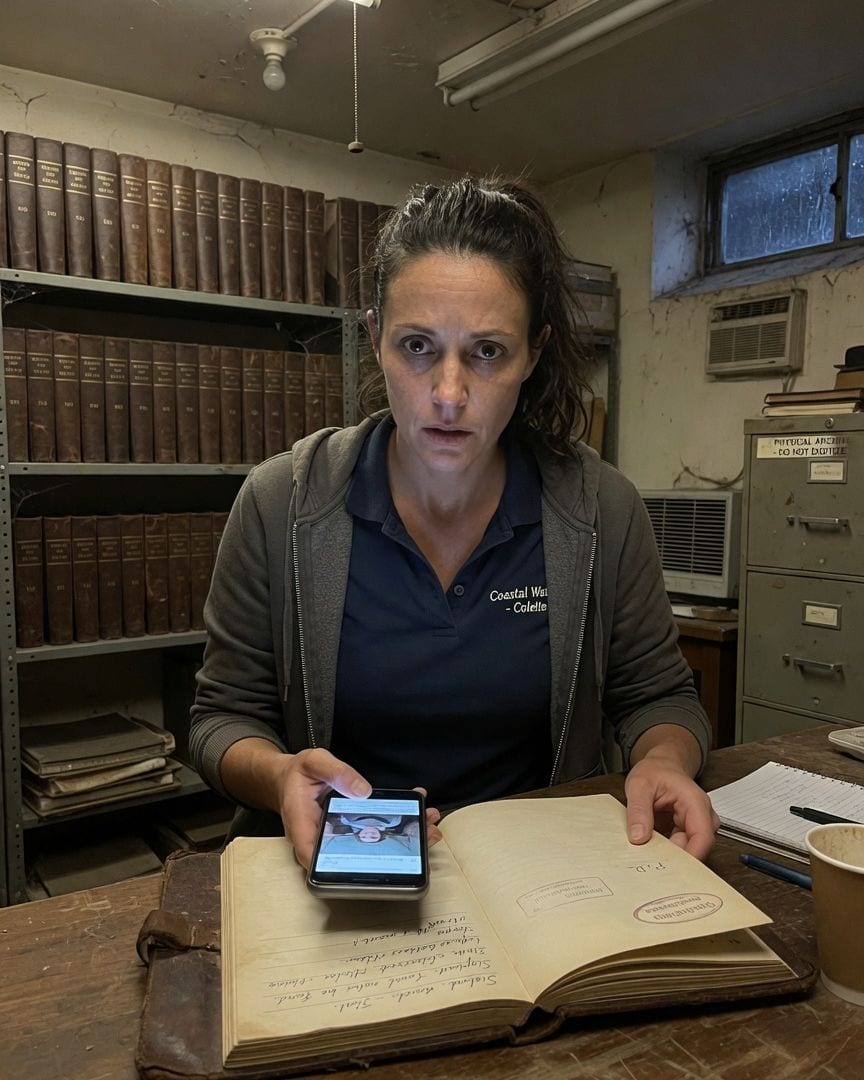
My coastguard log noted Sighting 9 again tonight, a light where no vessel showed. The old logs carry Sighting 9 off Skerry Point at 3:14am every tenth year since 1954, always 'nothing found,' always 'send no boat.'
On my watchtower night shift, the radar screen glowed green and the ocean was quiet. Then, a familiar light appeared off Skerry Point, exactly on cue, just as it had every tenth year for decades. But digging deeper, I found a hidden stamp in an old logbook: 'Operation Skerry. Status: Complete.' It left me with a chilling sense of finality.
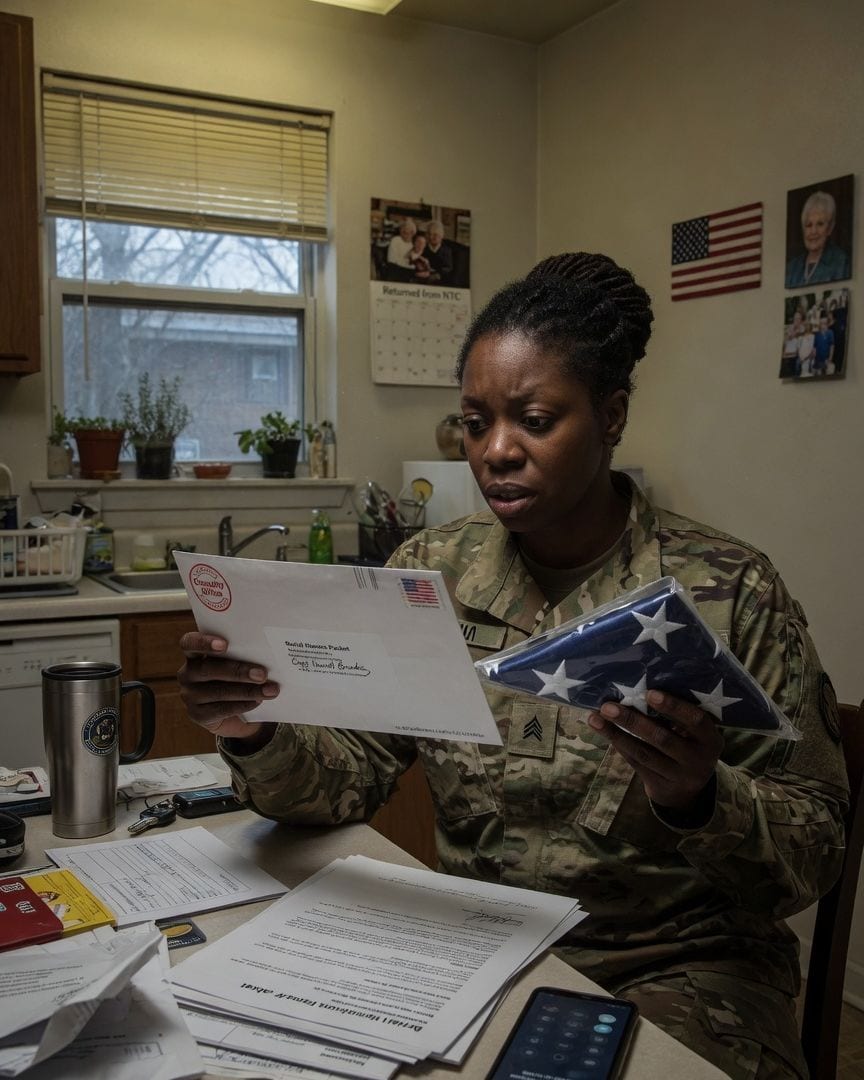
A Sergeant finds her own complete burial packet, dated for the coming spring, then finds a stack of identical ones for others.
Sergeant First Class Bree Alcott returned from a grueling training exercise, looking forward to peace, but found her kitchen table piled with mail, one official package heavy with dread. Inside was her own complete burial-honors packet, every detail filled, from Arlington plot to her grandmother’s chosen hymn, all dated for a specific day in the coming spring. The casualty office dismissed it as a 'glitch,' but Bree found a cryptic code leading to a decommissioned desert station and a stack of identical packets for other soldiers. What meticulous hand had prepared these packets, and why was Bree Alcott’s name on a list for a future she shouldn't have known?
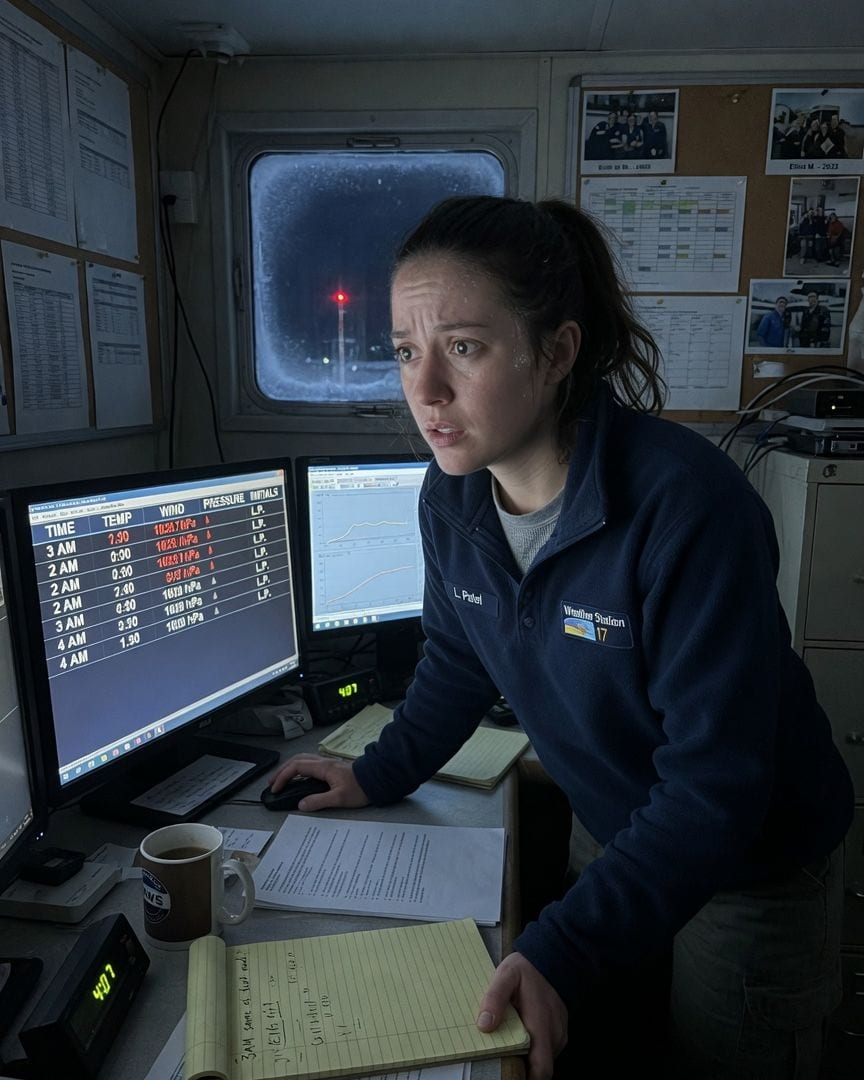
My weather station's 3 AM log shows a pressure reading I never made. My initials are on it, but the dials were dead still.
Working the overnight shift at the remote weather station, I routinely checked the digital logs. The 3 AM entry showed an impossible barometric pressure spike, a hurricane that simply hadn't happened. I distinctly remembered being outside at that time, calibrating a sensor, not making that entry. Yet, my initials, L.P., were clearly logged next to data I never made.