Sergeant Halloran found civilian boot prints leading into his garrison, then they simply vanished near a silent tower.
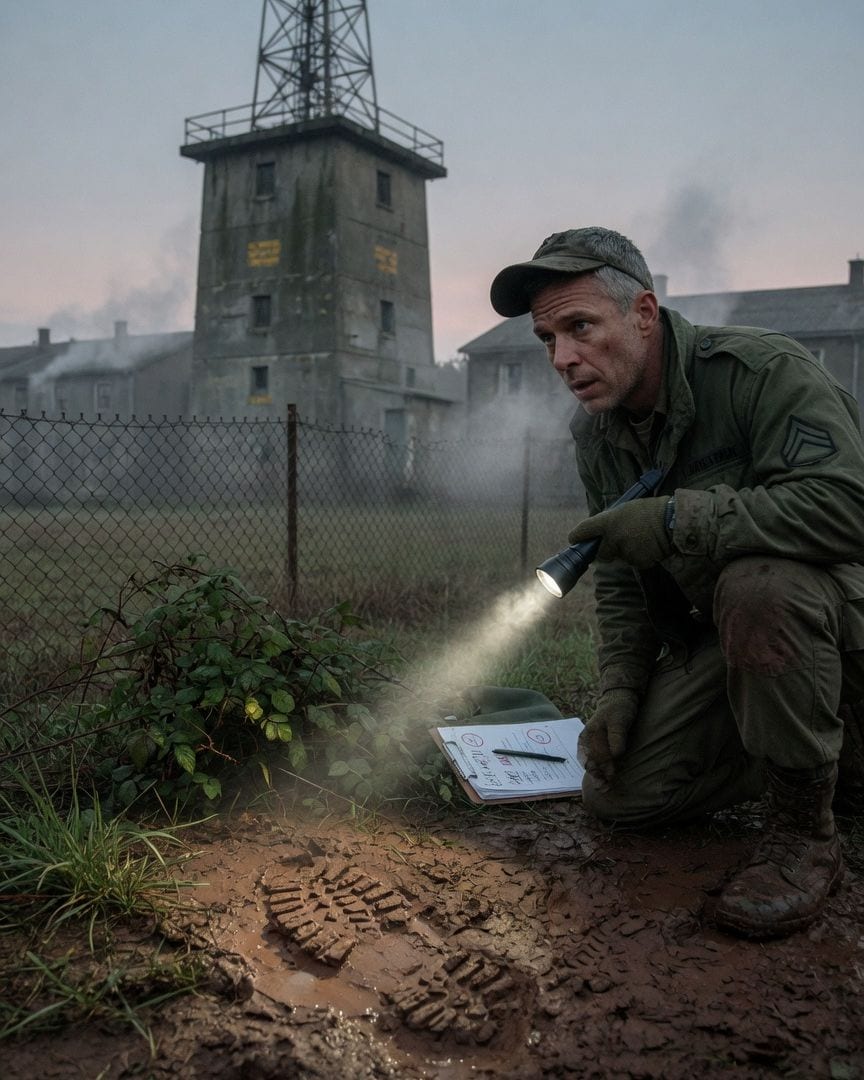
Sergeant First Class Eugene Halloran shivered in the pre-dawn chill of the West German garrison. It was 0600, and the morning report was due. For a week, the numbers had been off.
He’d stood the whole company in ranks himself, walking the line, calling out names. Every man present answered to a name on the roster. Every name on the roster had a man standing in front of him.
Yet, when he counted the formation, and then cross-referenced it with the official manifest in his clipboard, the strength was still one over. Not a man missing, but an extra.
An impossible plus-one that no one could identify, no one could account for, and no name would come off the rolls to balance it. The error persisted, a silent, concrete wrongness that defied every procedure, every head count, every log.
The fog clinging to the barracks roof seemed to absorb the sounds of the men shifting, making the silence heavier than it should have been.
Halloran tried the mundane: a faulty tally counter, a new recruit missed in processing, a prank. He even had the company re-muster twice, personally verifying each soldier’s presence and identity. Still, the count was off.
He sent Private First Class Daniel Lawson, a sharp but green recruit, to double-check the perimeter wire near the decommissioned communications relay tower, a rarely patrolled section on the edge of the garrison.
Lawson returned pale, reporting nothing amiss, but his eyes kept flicking to the tower as if he expected it to move.
Later that day, Halloran found Lawson scrubbing his boots with a wire brush in the laundry room, muttering about 'something in the mud.' Halloran, dismissing it as a new soldier’s jitters, decided to inspect that section of the perimeter himself.
The area was quiet, overgrown, the chain-link fence rusted and sagging in places, barely visible through the thick brambles.
He noted the tracks of the regular patrol boots, then his gaze snagged on something else – a distinct, deeper impression in the damp earth, partially obscured by a clump of weeds.
It was a boot print, but not a standard-issue military boot. It was a civilian combat boot, larger, with a different tread pattern.
It led from a section of the wire that appeared cut and re-spliced, almost perfectly, making it seem intact at a casual glance.
The prints continued for a short distance, then abruptly stopped, fading into nothing just a few yards from the concrete base of the old, silent relay tower.
Halloran crouched in the pre-dawn mud, the beam of his tactical flashlight cutting through the mist. The boot print was unmistakable, a clear impression of a civilian-style combat boot, not regulation issue.
It led from the broken, rusted perimeter wire, directly into the garrison's unsecured area, then vanished a few yards from the base of the long-deactivated relay tower, as if the wearer simply ceased to exist.
He looked up at the tower, a skeletal finger against the graying sky, then back at the impossible print. Something crossed a line that nothing should have been able to cross. And the system swore it was impossible.
The next morning, the extra man was still there. Halloran confronted Captain Frank Novak with his findings about the boot prints and the tampered wire.
Novak, a no-nonsense company commander, dismissed it as a local civilian cutting through for a shortcut, or perhaps a rogue training exercise gone off-book. “Halloran,” Novak said, his voice flat, “you’re two weeks from going home. Don’t go chasing ghosts.”
But the CO’s dismissive tone didn’t sit right. Halloran knew the perimeter checks were thorough, the sensors meticulously maintained. He started digging into old garrison records, focusing on incidents around the relay tower.
He found nothing in official logs, but a chance conversation with Sergeant Rosemary Pennington, an S1 clerk known for her meticulous unofficial archives, yielded a lead.
She remembered seeing an odd notation in some archived personnel files: 'Unit 7-Echo, Personnel Adj.' always followed by a date, sometimes decades apart.
“It was always around old communications sites,” she explained, flipping through a dusty ledger whose pages smelled faintly of mildew and forgotten coffee. “Like someone was adding, then removing, a ghost from the manifest.
Never a name, just a number adjustment.” Halloran asked about the tower. Pennington recalled a story: “They say it was part of some experimental comms project back in the late fifties. Shut down suddenly.”
He checked the dates on the 'Personnel Adj.' entries. They stretched back to 1959, the year the tower was reportedly decommissioned, and continued sporadically, a quiet, almost rhythmic pulse in the otherwise mundane records.
He felt a chill, the kind that had nothing to do with the German winter.
Halloran’s inquiries did not go unnoticed. A week out from his transfer, Captain Novak called him into his office. Novak’s face was tight, his usual easy smile replaced by a hard line.
“Halloran, I’ve had some… inquiries about your recent interest in the old S1 files and the tower. These are sensitive areas. I suggest you focus on your out-processing.”
His tone was a warning, not a suggestion, and the air in the small office seemed to thicken, pressing against Halloran’s eardrums. Halloran felt a prickle of unease.
He started noticing things: a staff car idling a little too long near his barracks late at night, the way conversations stopped when he walked into the mess hall, leaving a sudden, unnerving quiet in his wake.
One evening, as he left the S1 office after hours, the light in the hallway flickered, and a shadow detached itself from the building across the quad.
A figure, tall and broad-shouldered, moved with an almost unnerving stillness, keeping pace with him from a distance. Halloran ducked into a supply closet, holding his breath, watching through the crack in the door.
The figure paused, scanning the quad, then continued on, its gait unhurried, almost casual. Halloran recognized the uniform: it wasn't garrison patrol. It was a specialized unit, rarely seen, rumored to handle… unusual matters.
He realized his digging wasn't just bothering his CO; it was drawing the attention of something far more entrenched, something that watched from the periphery, ensuring certain details stayed buried.
Halloran knew he was running out of time. He sought out Felix Blackwood, a retired Master Sergeant who ran an unofficial garrison history group, known for his encyclopedic knowledge of local lore and forgotten incidents.
Blackwood, a stoic man in his fifties with a memory like a steel trap, listened to Halloran’s story about the extra man and the 'Personnel Adj.' entries without interruption, his gaze fixed on some distant point. Blackwood nodded slowly.
“Ah, Unit 7-Echo. The Ghost of the Tower.” He pulled out a worn photo album from a shelf stacked with dusty books. “It was an experimental communications system, deep-field resonance. Supposed to reach… anywhere. But sometimes, it brought things back.
Or left things behind.” He pointed to a grainy photo of a group of scientists and soldiers from the late 50s, standing in front of the tower. “They say one of the technicians, a young PFC, disappeared during a test.
Vanished right there. No body, no trace. But then, the reports started coming in. An extra man in formation, a faint voice on the comms net answering to his call sign, boot prints where none should be.
Always around the tower, always in units that rotated through this sector.” Blackwood showed him a faded, hand-drawn map with cryptic symbols marking specific areas. “They tried to contain it, to account for it.
The ‘Personnel Adj.’ was their way of acknowledging the presence without officially recognizing it. It was a secret unit, buried deep, but the local garrison staff, they knew. They just learned to live with the impossible count.”
The pieces clicked into place for Halloran: the impossible count, the boot prints, the strange entries. It wasn't a random glitch; it was a recurring haunting, officially sanctioned and quietly managed.
Blackwood, seeing the dread on Halloran’s face, reached for another album. “You think this is just about one ghost, Sergeant? One incident?” He pulled out a large, sepia-toned photograph, carefully preserved under a thin sheet of plastic.
“This was from 1959. My first tour here.” The faded photograph, tucked into the back of the old S1 logbook, showed a company formation from 1959.
Sergeant Pennington, who had silently entered the room to confirm a detail, pointed to a figure in the third rank, slightly out of step, his face blurred as if he moved just as the shutter clicked.
“This one,” she whispered, her voice tight, a tremor running through her hand as she pointed, “he’s not on the roster for that year. But he’s there, standing in formation, just like yours.”
Halloran stared at the blurred face, a cold knot forming in his stomach, realizing the 'extra man' was not new, but a photograph of the same impossible ghost, decades old.
Blackwood then flipped to another page, showing a photo from 1968, then 1977. Each one, a company formation, a subtle, almost imperceptible figure out of place, an extra man that shouldn't be there.
The same blur, the same impossible presence, repeating across rotations and dates, a silent testament to a truth far older and more profound than a single, isolated incident.
Halloran returned to the S1 office, the images of the repeating phantom etched into his mind. He found Rosemary Pennington, her face pale, a folder clutched in her hands. “Sergeant Halloran,” she whispered, her voice barely audible, “I found it.
A classified addendum, buried in the oldest physical archives, cross-referenced with your ‘Unit 7-Echo’ notes. It’s a protocol. ‘Operation Echo-7.’ It outlines the ‘management’ of a ‘persistent bio-resonant anomaly’ at Site Gamma-3, which is our tower.”
She pushed the document across the desk. Its pages, crisp despite their age, rustled faintly in the still air. In precise, military language, it detailed the accidental creation of the anomaly in 1959 during the experimental comms project.
It wasn't a ghost in the traditional sense, but an imprint, a resonant signature of a human consciousness, perpetually ‘present for duty’ within the systems it had interacted with.
The protocol mandated that any unit experiencing the ‘Echo-7 manifestation’ was to have its personnel strength quietly adjusted, maintaining the ‘presence’ on the roster without official acknowledgment, to ‘prevent disruption of morale and maintain operational security.’
It was a form of institutional accounting for an impossibility. The document even included a faded photograph of the original Private First Class who had vanished – a young man with wide, innocent eyes, his name redacted.
Halloran looked at the photo, then at the blurred figure in the 1959 formation picture from Blackwood’s album. The same man.
The system hadn’t just failed; it had adapted, integrated the impossible into its meticulous order, making the phantom a permanent, silent fixture of its accountability.
Armed with the classified addendum, Halloran marched into Captain Novak’s office. Novak, however, wasn’t alone. Two men in unmarked uniforms sat opposite him, their faces impassive, their posture rigid.
“Sergeant Halloran,” Novak said, his voice clipped, devoid of its usual warmth, “these gentlemen are from Army Investigations. They’d like a word about your unauthorized access to classified materials.”
Halloran laid the document on Novak’s desk, the crisp pages sliding across the polished wood. “This isn’t unauthorized access, sir. This is a protocol. And this is a soldier.” He pointed to the redacted photo of the young PFC.
One of the investigators, a lean man with watchful eyes that missed nothing, picked up the document. He read it quickly, his expression unreadable, then met Halloran’s gaze. “Sergeant, this is above your pay grade. Your transfer is effective immediately.
You’ll be escorted to the air base tonight.” Halloran felt a cold dread settle in his chest, heavy and certain. They weren’t denying it; they were confirming it, and silencing him. “What about the other units? The next rotation?
Do they just… keep counting him?” The lean man simply stared, his eyes like chips of flint. “Your flight leaves at 2200. You will speak of none of this.” Halloran knew he wouldn't be able to fight the system.
He was being removed, not punished.
He was being allowed to escape, but at the cost of carrying this impossible truth, knowing the 'extra man' would continue to stand in formation, forever accounted for, forever unseen by those who hadn't looked hard enough.
His tour was ending, but the watch that wouldn't end would continue for the next generation of soldiers.
Halloran was on a flight back to the States within hours, his transfer expedited without explanation. His service record was spotless, his discharge papers in order. He never spoke of the extra man, or the tower, or the classified protocol.
Rosemary Pennington was reassigned to a remote administrative post in Alaska a month later. Captain Novak remained in command, his career unaffected, a small, knowing crease at the corner of his eyes when Halloran last saw him.
The garrison continued its operations, its daily rhythms unbroken, the distant hum of the old tower a constant, ignored presence. The morning reports were filed, the formations counted.
Life, as it always did, moved on, oblivious to the quiet, impossible presence that had been built into its very foundations.
Years later, back in civilian life, Eugene Halloran would sometimes catch himself doing a mental head count of a crowd, always verifying the number twice. He knew the official explanation for the garrison's old tower was ‘decommissioned experimental communications array.’
He also knew that some things, once integrated into the system, never truly went away. They just became part of the ledger.
And every once in a while, when the news showed footage of a new unit deploying to that old German base, Halloran would wonder if the morning report still ran one man high.
He would wonder if the next squared-away NCO had started to notice the impossible count.
He would wonder if, somewhere in the quiet hum of the garrison’s daily life, the ghost of the tower still stood in formation, accounted for, but never truly present.
He knew that some things, once integrated into the system, never truly went away.
If this one got to you
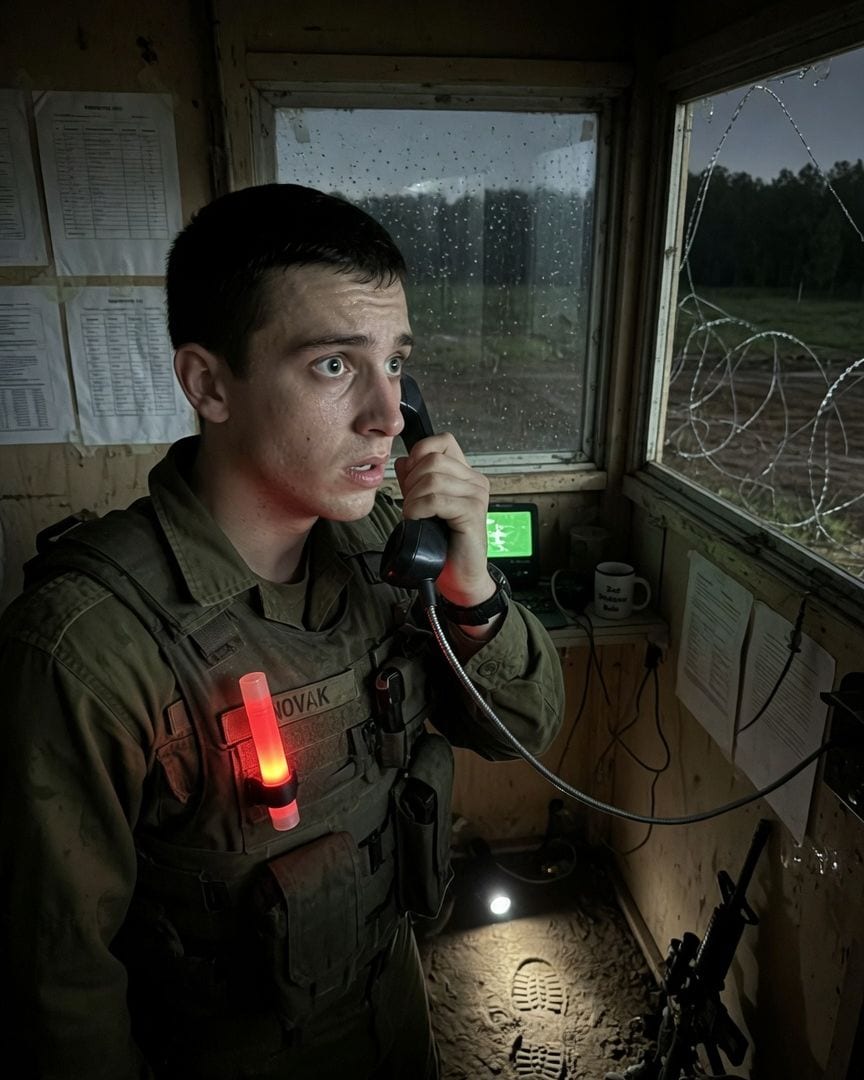
A sentry finds a fresh boot print *inside* the wire, but the barbed fence is untouched.
PFC Isaac Novak mans the outpost tower, sweeping the perimeter for any anomaly. After an unnervingly smiling man appears and vanishes beyond the wire, Novak descends to patrol. He finds a single fresh boot print deep *inside* the perimeter, yet the barbed wire remains perfectly intact and undisturbed.
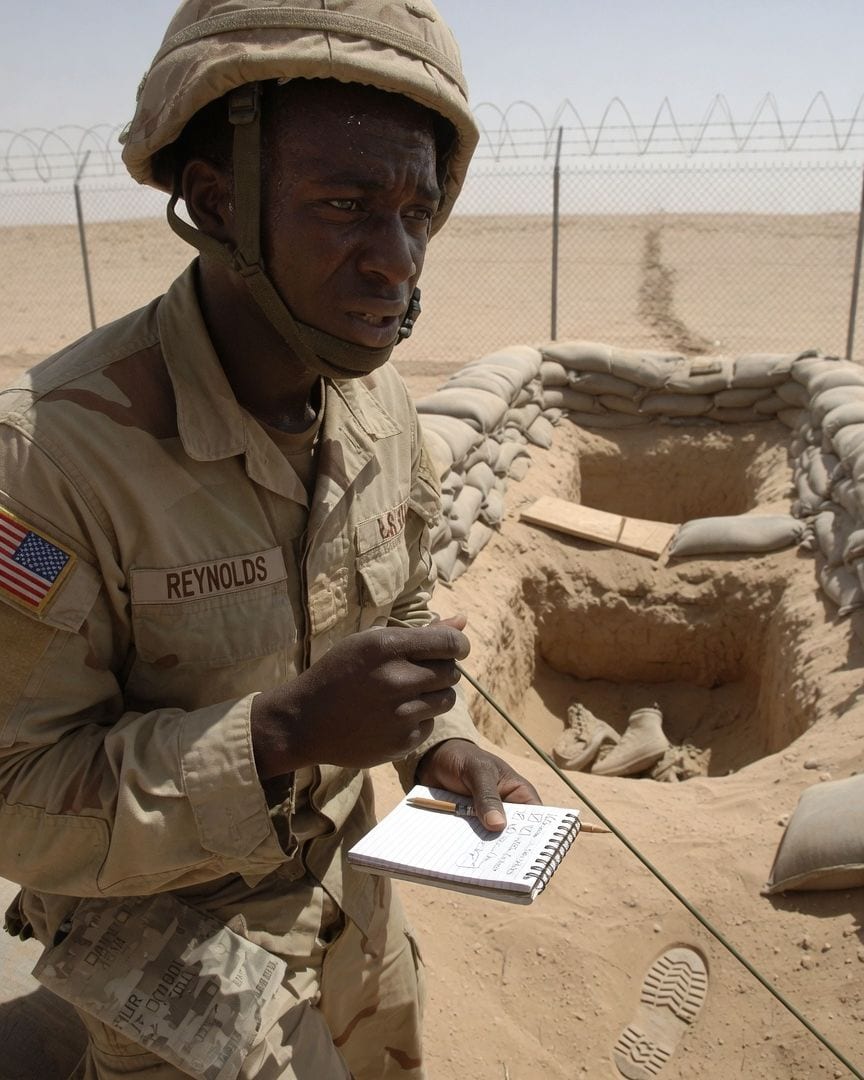
Weeks from going home, Lance Corporal Reynolds found a boot print leading straight through the base's perimeter wire.
Lance Corporal Isaac Reynolds was just weeks from his discharge, eager to leave Firebase Kettle and finally go home. On his final rotation, running routine wire-checks around the remote, slowly collapsing outpost, he expected nothing but the familiar rhythm of confirmed positions. But near an empty foxhole, a comm wire tugged back as if from a living man, and his crew count came out one man too many. Later, walking the perimeter, Reynolds found a distinct boot print leading directly through the intact fence line, out into the empty, silent desert. No breach, no cut wire—just the impossible impression of a boot sole where no one should be.
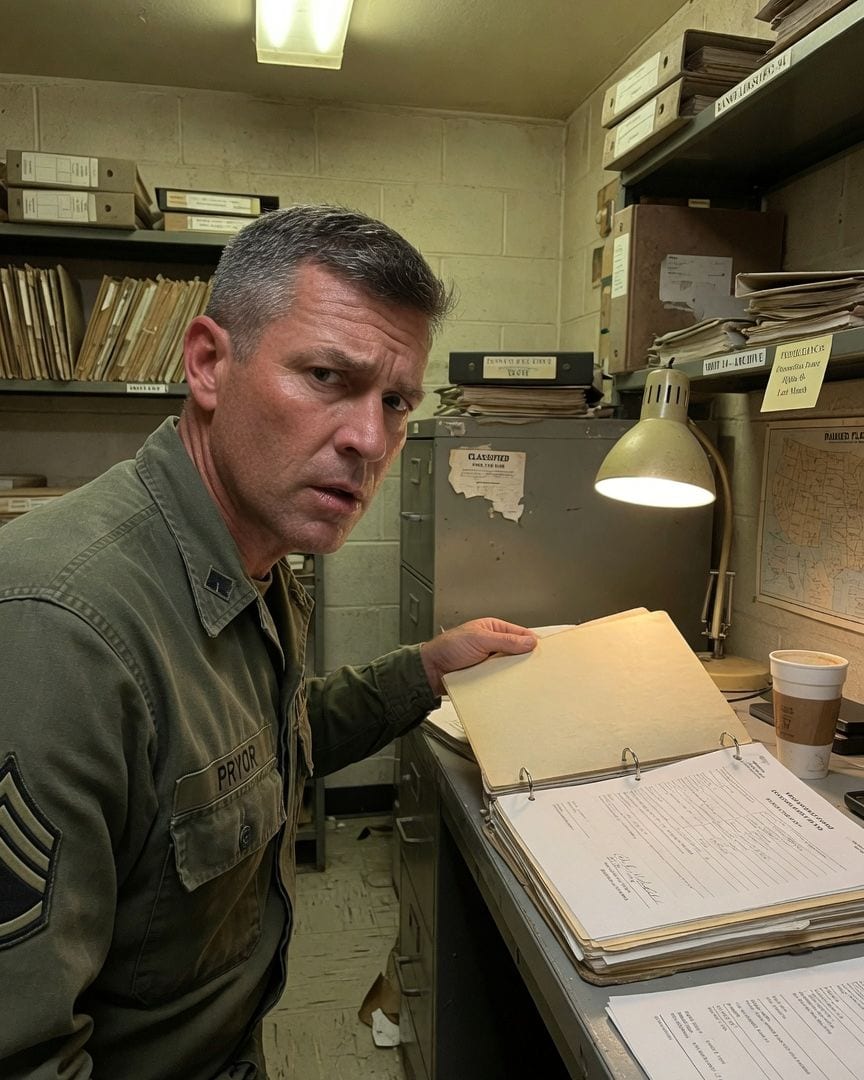
A sergeant with eleven days left finds a warm, glassed crater. Its file shows a captain lost thirty years ago is still signing reports from last week.
Sergeant Alden Pryor was counting down his final eleven days on a twenty-year hitch, expecting to spend them on routine patrols along the Ranier Flats fence line. Instead, his truck stopped at a bizarre sight: a four-hundred-foot glassed crater, miles from anywhere, its sand faintly warm at dawn despite no one recalling a blast. The air above it shimmered with an unnatural distortion, a silent scar of erased violence, and the official file for 'Shot 14' showed recent maintenance sign-offs for a decommissioned tower at the crater site. All these active documents were signed by Captain Everett Caldwell, who had been officially lost in operations thirty years ago, leaving Sergeant Pryor to wonder how a dead man could still be filing reports.
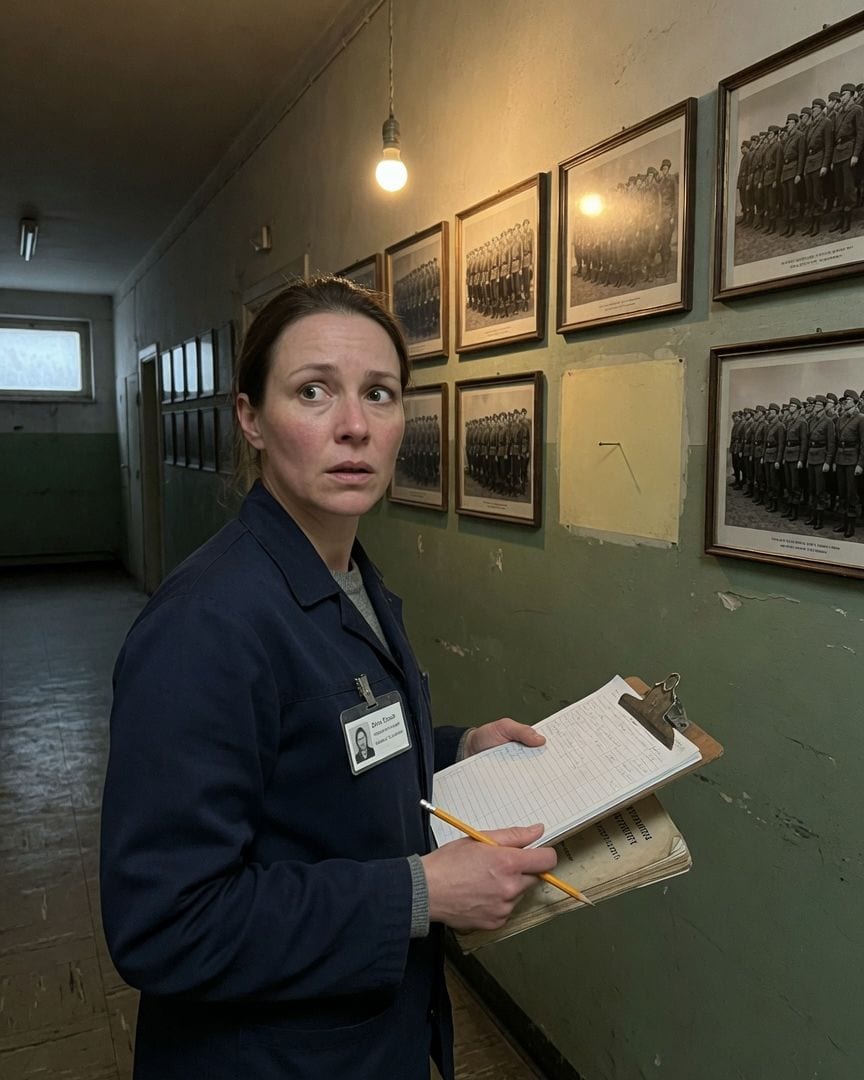
On a closing Cold War base, an inventory clerk finds every soldier in old photos staring at an empty wall. Her own name is on a hidden footlocker holding the missing picture: a dark, blurred figure among them.
Delia Straub has eleven days to inventory Kaserne Ottmarsheim, a former German base slated for demolition. The air in its echoing, abandoned halls smells of coal smoke and old wax as she races against the clock. Her task takes an unsettling turn when she discovers a phantom unit, the '604th Ordnance Detachment,' explicitly listed in old records despite never existing. Even more unnerving, every soldier in adjacent photos stares fixedly at the empty space where its picture should be. But why does a hidden footlocker, bearing Delia's own name, hold the missing photograph, revealing a dark, blurred figure among the men?
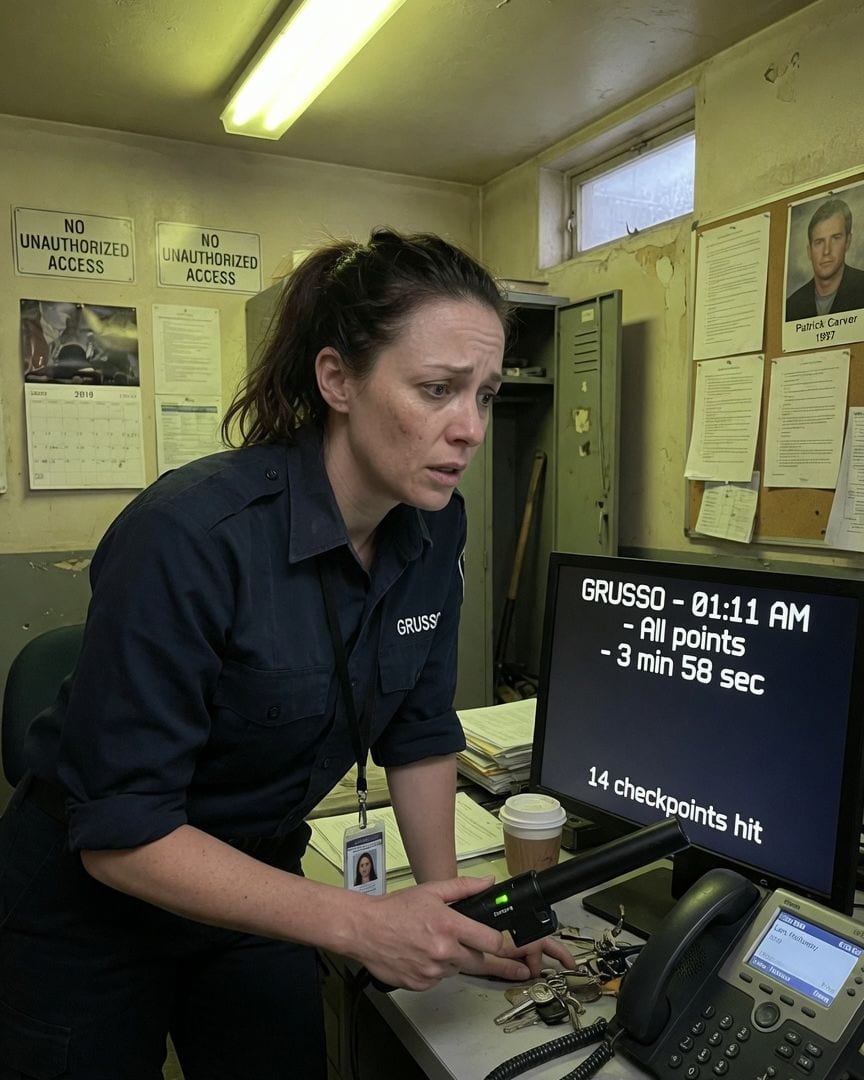
My security wand logged a full round at 1:11 AM in under four minutes. It was in the charger. Every tap is logged as mine.
Finishing my night shift, all I wanted was to get home. But the dock readout screen showed my security wand logged a full patrol at 1:11 AM, completed in just under four minutes. I knew my wand had been charging right beside the monitor the entire time, yet the log, under my ID, confirmed the impossible.
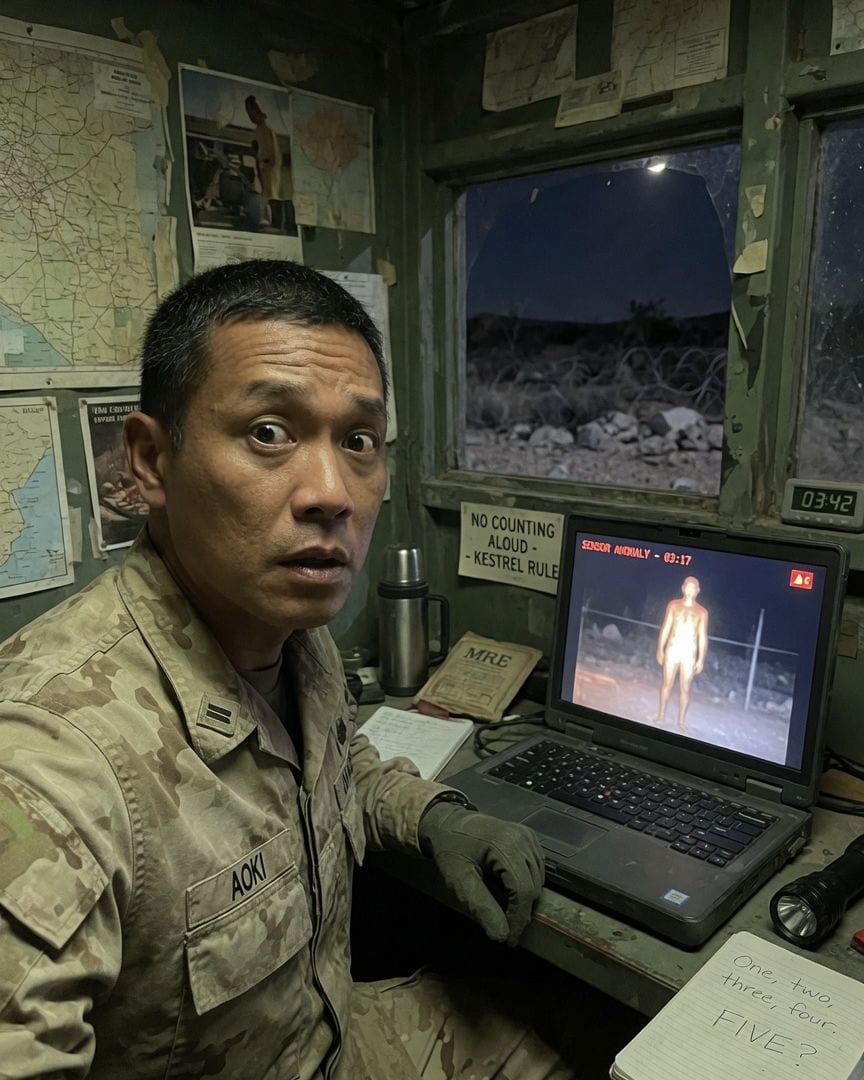
Sergeant Harold Aoki, hours from relief, counted his four-man patrol. A dry voice rasped, 'Five.'
Sergeant Harold Aoki was just hours from relief, walking the perimeter of Firebase Kestrel under a sliver of moon. A man who valued accountability, he counted his four-man patrol at the halfway mark: 'One, two, three, four.' A beat of silence, then a faint, dry voice, not one of his men, rasped, 'Five.' Later, back in the watchtower, the thermal camera feed flickered with a distinct, too-tall heat signature outside the wire, then vanished. When Aoki went to check, he found impossible boot prints just beyond the perimeter, appearing from nowhere and leaving no trail.