A Sergeant on his last week watched the abandoned tower's searchlight lock onto his face. The tower's power was cut for years, but the duty log named a soldier who didn't exist.
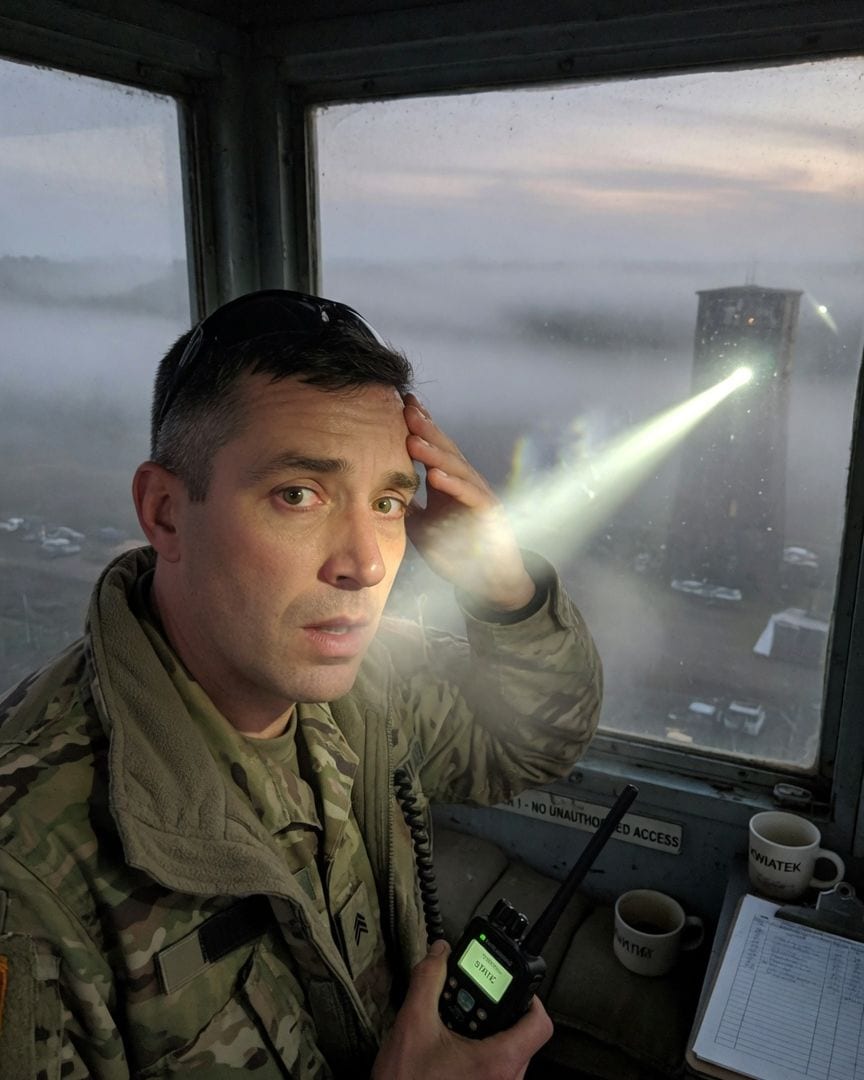
Sergeant Milo Kwiatek was on his last week at the US Army garrison in Germany, pulling the front tower's night watch.
The base was winding down, a skeleton crew, the air thick with the scent of decommissioning and the damp fog rolling off the training area.
From his vantage, the rear tower across the compound was a dark, silent silhouette, long abandoned, its windows boarded, its power cut for years.
He watched the fog thicken, swallowing the motor pool, until only the nearest perimeter lights glowed faintly through the swirling gray.
Then, the rear tower's searchlight woke.
A single, stark beam cut through the fog, sweeping slowly, deliberately, across the empty motor pool. It tracked the perimeter fence, paused, then, with an impossible precision, locked onto Kwiatek’s face in the front tower.
The sudden, intense light momentarily blinded him, leaving afterimages dancing in his vision. He blinked, peering into the beam, feeling a cold, unnerving prickle on his skin despite the insulated glass of his post. He checked his comms. Static.
He scanned the night, leaning closer to the reinforced window. Nothing. No one else reacted to the impossible light.
The beam held him, a silent, unblinking eye, until the first hint of pre-dawn light began to break through the gray, watery expanse of the sky.
As dawn broke, a faint tremor ran through the front tower, a low hum that vibrated in Kwiatek's teeth, and the searchlight across the compound flickered once, then died.
Kwiatek, squared-away despite the profoundly unnerving night, immediately reported the incident to Sergeant Jeffrey Hughes. Hughes, a man whose face was etched with the chaos of the base's final week, just waved it off.
'Phantom power surges, Kwiatek,' Hughes grunted, barely looking up from a stack of forms. 'Demolition crews messing with the old grid. Or your imagination after too many hours on watch.'
Kwiatek tried to explain the precision of the beam, the direct lock onto his position, the sheer impossibility of an unpowered light. Hughes only shook his head. 'I don't have time for ghost stories, Sergeant. Stick to your post.'
Kwiatek felt a familiar burn of irritation mixed with something colder, harder. He was disciplined, but he wasn’t stupid. The rear tower had no power, no key, no active personnel. It was a tomb of concrete and rusted steel.
He finished his shift, the memory of the unwavering beam still stark behind his eyes. Against orders, ignoring the lingering instructions to pack out the remaining supply room, he made his way across the compound.
The tower was as he remembered: rusted, padlocked with a heavy, corroded chain, clearly disused for years. The windows were still boarded, peeling paint the only testament to its past. He checked the external power box for the tower.
The main breaker was off, a solid block of corrosion, fused by years of disuse and the damp German weather. No way. Absolutely no way for power to have run through that system.
Back in the operations building, the chill in the air had nothing to do with the early morning. Kwiatek found the duty logs, a stack of thick, leather-bound books, for the tower's last active period.
He flipped through the dusty pages, the dry scent of old paper filling his nostrils, looking for any mention of recent maintenance or reactivation. He found nothing, just the steady, repetitive entries of watch rotations and uneventful nights.
He continued, methodically, until he reached the entry for the night he had just pulled. His date. His shift. But the name wasn't his. Scrawled neatly beneath the time stamp, in a clear, almost formal hand, was 'Private David Larsen.'
Kwiatek didn't know a Private Larsen. He checked the base manifests, the active rosters, the recent transfer lists. No David Larsen.
The official record, signed and dated, swore a soldier had been in that tower, on that night, operating a searchlight that had no power.
The log entry for Private David Larsen gnawed at Kwiatek. It was an itch he couldn't scratch, a persistent static in the back of his mind. He spent his off-duty hours chasing ghosts.
He queried supply manifests for any equipment signed out by a Larsen, checked mess hall rosters, even the old barracks assignment sheets. He pulled every digital and paper record he could access through the base's antiquated systems. Nothing.
David Larsen simply did not exist anywhere in the official, meticulously cataloged world of the US Army.
His search led him, inevitably, to the base archives. It was a cavernous, dust-filled building, cold and damp, now being systematically emptied by a small team of contractors and one civilian archivist, Deborah Sinclair.
Sinclair was a precise woman, sharp-eyed and neatly dressed even amidst the chaos of boxes and disused shelving. She seemed to possess a keen eye for detail and a memory like a steel trap.
Initially, she was helpful, if a little weary of Kwiatek’s 'unusual' request for a phantom soldier.
'A Private David Larsen, you said?' she asked, her finger already tracing lines on a terminal screen that glowed faintly in the dim room. 'I'm showing no record of anyone by that name serving at this installation, ever.'
She confirmed no David Larsen appeared on any official personnel record for the base’s entire operational history.
But as Kwiatek explained the context – the rear tower, the searchlight, the impossible log entry – a flicker of something unreadable crossed her face. Her hands, which had been efficiently typing, paused.
She looked at him, then away, toward the dusty shelves, as if seeking confirmation from the silent rows of binders. She pulled out a series of older, hand-written duty logs, dating back decades, their covers brittle with age.
'We’ve had… oddities, around that tower,' she admitted, her voice lower, almost a whisper in the echoing space.
She pointed to a series of cryptic marginal notes, penned in different hands over the years, all scrawled next to entries for the rear tower: 'Anomalous light activity, Rear Tower, 0200 hrs,' read one, its ink faded.
Another, decades later: 'Perimeter check, unaccounted for personnel count +1, Sector 7.' And then another: 'Equipment usage, Tower Bravo-2, no assigned operator.' These entries, spanning years, never resulted in formal investigations.
They were always 'normalized' or 'attributed to malfunction' in the official reports Kwiatek found attached. But the pattern across rotations was undeniable, a faint but persistent echo in the system, a wrongness that never quite went away.
The cold in the archive deepened, clinging to Kwiatek's skin.
Kwiatek became a fixture in the archives, meticulously cross-referencing every 'anomaly' Sinclair unearthed. He felt a strange pull, a sense that the records themselves were trying to tell him something, whispering secrets from behind their neat columns and official stamps.
Sinclair grew increasingly uneasy. Her movements became more deliberate, her glances more frequent towards the closed archive doors.
'Sergeant Kwiatek,' she said one afternoon, her voice hushed, the words barely audible above the rustle of turning pages, 'this base is closing. Some things are best left undisturbed.'
Her tone was not a warning, but a plea, heavy with unspoken knowledge.
Kwiatek felt a prickle on his neck, the distinct sensation of being observed, not by Sinclair, but by the oppressive weight of the old files, the silent rows of binders that seemed to lean in, holding their breath.
A faint scent, metallic and strangely sterile, like ozone mixed with old paper, seemed to emanate from the stacks.
He spent hours tracing power lines on faded blueprints, their brittle edges crumbling under his touch. The base’s main electrical grid was a snarled mess of conduits and junctions, but he was looking for something specific.
In a dusty, unlabeled box marked 'Original Construction Schematics,' buried beneath a pile of discarded administrative forms, he found what he was looking for. A diagram, dated from the base’s earliest days, showed the rear tower.
But unlike every other structure, it had a separate, dedicated power conduit, branching off the main grid, snaking out from a shielded junction box Kwiatek had never seen before.
This conduit was labeled, in a precise, almost clinical hand, the lettering faded but legible: 'Auxiliary Tracking System.' It wasn't just a guard tower. It was something else entirely.
The realization hit him with a cold dread that had nothing to do with the drafty archive. The 'something else' had been built into the base from the ground up.
Kwiatek returned to Sinclair, the 'Auxiliary Tracking System' diagram clutched in his hand, its thin paper crackling. He laid it on her desk, pointing to the precise, clinical label. 'What is this?'
he demanded, his voice low, the question a heavy stone dropped into the quiet of the archive.
Sinclair blanched, her composure finally cracking. The precise lines of her face tightened. She tried to dismiss it as an outdated design, a contingency never implemented, her voice a reedy protest against the obvious. 'Just a theoretical plan, Sergeant.
Standard military over-planning.'
Kwiatek wouldn't let it go. He spread out the old duty logs, the cryptic entries he and Sinclair had found – the 'anomalous light activity,' the 'unaccounted for personnel count +1,' the 'equipment usage, no assigned operator.'
He pointed to the pattern, the recurring dates, the undeniable systemic echo. 'This isn't a malfunction, Ms. Sinclair. This is a system. What was it tracking?'
Sinclair wrung her hands, her gaze darting towards the door, as if expecting someone to walk in and stop her. Her voice was barely a whisper. 'There were… protocols,' she confessed, 'for… unaccounted for presences. Things the system couldn’t… normalize.'
She explained that for decades, there had been 'ghost counts,' 'manifest discrepancies,' and 'unexplained equipment activations' at the base, particularly around the rear tower.
Command always insisted on 'normalizing' them, burying them in paperwork, attributing them to hardware failures or sleep deprivation. The searchlight, she confessed, was part of an old 'containment procedure.'
It was meant to detect and, in a way, acknowledge the anomaly, to keep it within the base's perimeter.
The military's meticulous accounting system, designed to make anomalies impossible, was, in fact, silently documenting a persistent one. It wasn't a glitch; it was a feature, a hidden function of the base itself.
The terror wasn't that something was wrong; it was that the system had always known and had built itself around it. The truth settled around Kwiatek like a shroud, cold and undeniable.
The base wasn't just a garrison; it was a cage.
Kwiatek’s mind reeled. 'What kind of presences?' he pressed, his voice barely a whisper, the chill of the archive seeping into his bones. 'What was the containment for?'
Sinclair looked utterly terrified, glancing nervously around the emptying archive, as if the walls themselves had ears. 'It wasn’t… physical,' she stammered, her hands trembling as she smoothed the desk’s surface. 'More like… an echo.
Something that filled empty spaces in the system.' She finally, reluctantly, pulled a heavily redacted, classified document from a hidden compartment in her desk. The small drawer had clicked open with a sound like a dry bone.
It was an internal memo, fragile and yellowed, from the base’s original commanding officer, Colonel Everett Hartley, dated almost forty years prior. The subject line read, starkly, in faded typewriter font: 'Tracking and Observation of Unit 734-Alpha, Unmanifested Entity.'
Attached was a personnel roster, a list of soldiers assigned to the 'Auxiliary Tracking System' over the years, names typed with neat precision.
Kwiatek’s eyes scanned the names, a chill spreading through him as he recognized some, then others he didn’t. Then he saw it. His own name. Milo Kwiatek. Listed with a specific date from five years prior, 1986.
For a period he was demonstrably deployed to a different continent, thousands of miles away, guarding a supply depot in Kuwait. His finger traced his own name on the faded, classified roster: 'Kwiatek, Milo.
Assignment: Auxiliary Tracking, Unit 734-Alpha, Rear Tower. Dated: 1986.' The words were a punch to his gut, not just a clerical error, but an impossible truth staring back from unimpeachable military paperwork. He was never there.
He was always in it.
Kwiatek, armed with the classified memo and Sinclair's terrified admissions, tracked down retired Colonel Everett Hartley in a quiet German village.
Hartley, a a man in his early seventies with silver hair and eyes that held the calm distance of someone who had seen too much, sat in his sun-drenched study, sipping tea.
He seemed calm and unbothered as Kwiatek laid out the evidence: the logbooks, the diagrams, the redacted memo.
'Unit 734-Alpha,' Hartley began, his voice raspy with age, yet clear, 'was never a person. It's an imprint. A pattern. It manifests as a 'plus one' in any meticulously accounted-for system.'
He explained that the base had been built over an ancient, localized anomaly, a place where the veil between what was and what was almost was thin.
This anomaly, 734-Alpha, had a unique property: it could integrate itself into any strict system of record-keeping, manifesting as a perfectly valid, yet non-existent, entry.
'Private David Larsen,' Hartley confirmed, his gaze meeting Kwiatek's without a flicker of surprise, 'was just its latest manifestation. A name to fill an empty slot in the duty log. An echo to fill an echo.'
He gestured vaguely toward the window, where the small village hummed with ordinary life. 'The rear tower, the searchlight, the 'Auxiliary Tracking System' – all of it was designed to monitor 734-Alpha.
To ensure it never left the perimeter, never integrated into the wider world, never became more than a phantom entry.'
The searchlight had locked onto Kwiatek not to merely track him, Hartley continued, but because it had recognized him, a latent 'connection' established years ago when his name appeared on that roster. The base's closure was catastrophic, Hartley concluded.
The system, the cage, was breaking down. Unit 734-Alpha was no longer contained.
Hartley explained that the 'tracking system' wasn't just physical. 'It’s also… cognitive,' he said, his gaze distant, fixed on some point beyond Kwiatek. 'It subtly influences those who interact with it, those who look too closely.
It seeks to manifest, to gain a real presence, through the very people meant to contain it.'
Kwiatek's name on that old roster wasn't a mistake or a phantom entry from 734-Alpha after all. It was 734-Alpha's attempt to manifest through him, years ago, to gain a 'real' foothold.
The system, the base, had recorded that attempt, that connection, for posterity. The searchlight locking onto Kwiatek wasn't just tracking; it was an activation, an attempt to bring that latent connection to fruition, to make him a host.
'The base is empty now,' Hartley concluded, his voice flat, emotionless. 'The system is dismantled. Unit 734-Alpha is… free. And it knows you.'
The realization hit Kwiatek with sickening force. The danger wasn't external; it had always been internal, a seed planted years ago in the meticulous records of his own service.
The containment had failed, not just for the entity, but for him. The military's perfect system, designed to prevent anomalies, had instead bred one, had meticulously documented its integration, and now it had found its way out, through him.
He understood then that the thing wasn't stopped; its prison was merely gone, and he was now, irrevocably, part of its ongoing pattern. The quiet German study, previously so peaceful, now felt like the very heart of the anomaly itself.
Days later, the German depot was a ghost town, its gates chained and locked, all personnel gone. Kwiatek, officially discharged, returned to the United States.
He tried to forget the rear tower, the searchlight, the phantom private, the impossible entry in a classified roster.
But the meticulous order of the military, once a comfort, now felt like a trap, a system always prone to a 'plus one.'
He found himself compulsively checking manifests, scrutinizing duty rosters, searching for specific patterns, for names that shouldn't be there, for the subtle 'plus one' in any system of accounting.
He saw them everywhere now, faint echoes in the periphery of his vision, in the precise, ordered world he once trusted. A grocery receipt with an extra item. A newspaper column with an unlisted contributor.
The dread wasn't in what he had seen, but in what he now knew was always there, hidden in plain sight, waiting for an empty slot.
Months after his discharge, Milo Kwiatek sat alone in his new apartment, the silence punctuated only by the distant hum of traffic outside his window. He pulled out his old service record, the official, unimpeachable document of his military career.
He flipped through it, page by page, past commendations and deployment orders, each line crisp, exact. He stopped at a page detailing his service in Germany.
A small, faint entry, almost faded into the paper, for a period he knew he was elsewhere, thousands of miles away. It listed him as assigned to 'Auxiliary Tracking, Unit 734-Alpha, Rear Tower.'
He ran his finger over the words, a ghost of a signature seeming to shimmer beneath his touch, a silent acknowledgment from a system that never forgot.
Later, his neighbor, Tessa Langford, dropped by with a plate of cookies. She found Kwiatek staring blankly at his old military records, a precise, almost unnerving stillness about him. 'Everything alright, Milo?'
she asked, a note of concern in her voice. He looked up, a faint, wrong little smile on his face. 'Just checking the numbers,' he said. 'Everything's accounted for.'
If this one got to you
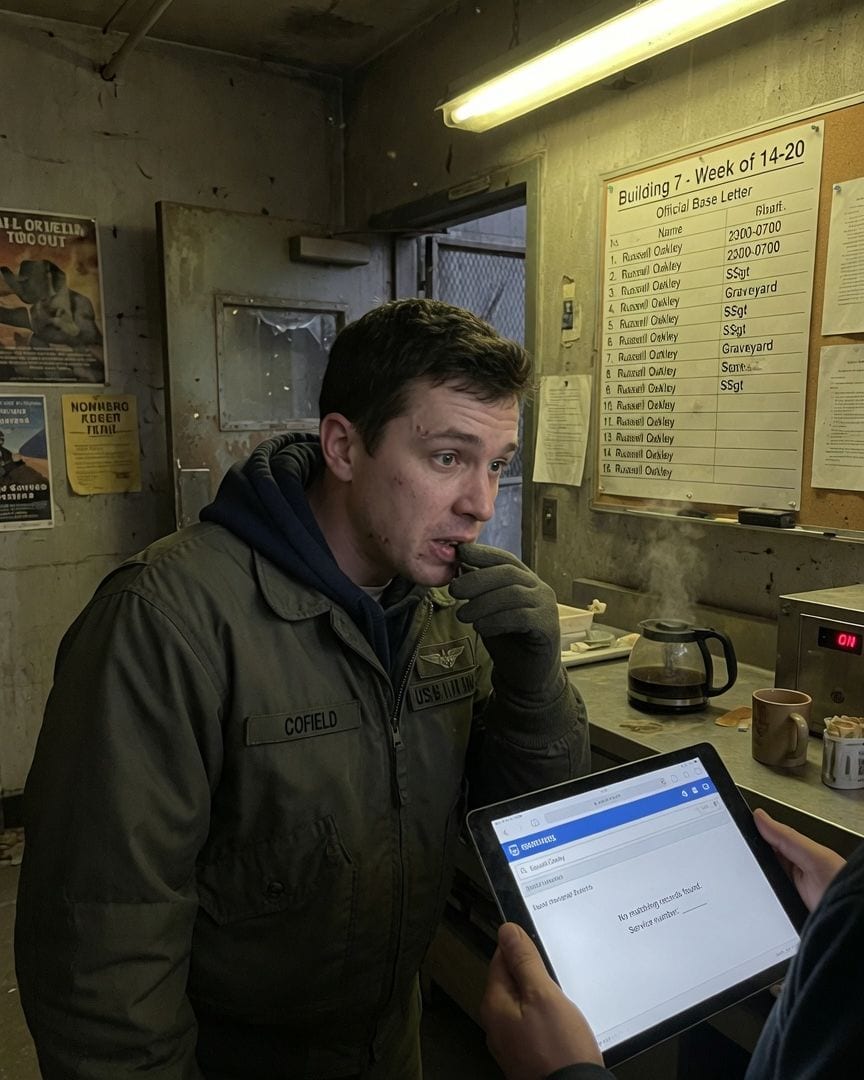
Airman Cofield, two weeks from transfer, found a warm coffee pot in a building without power for thirty years. Its new shift roster listed a name that didn't exist.
Senior Airman David Cofield, just two weeks from his long-awaited transfer, patrolled the perimeter of a decommissioned weapons storage area. Building 7, a concrete shell dark since 1992, suddenly showed a faint, warm light in its window. Inside, fluorescent lights hummed, and a coffee pot on the counter was still warm, defying the building's decades-long power shutdown. A freshly pinned shift roster for the coming week then revealed a name: 'Russell Oakley,' listed for Cofield’s own graveyard shift, yet completely absent from every official base record. Who was Russell Oakley, and how was he on shift in a dead building?
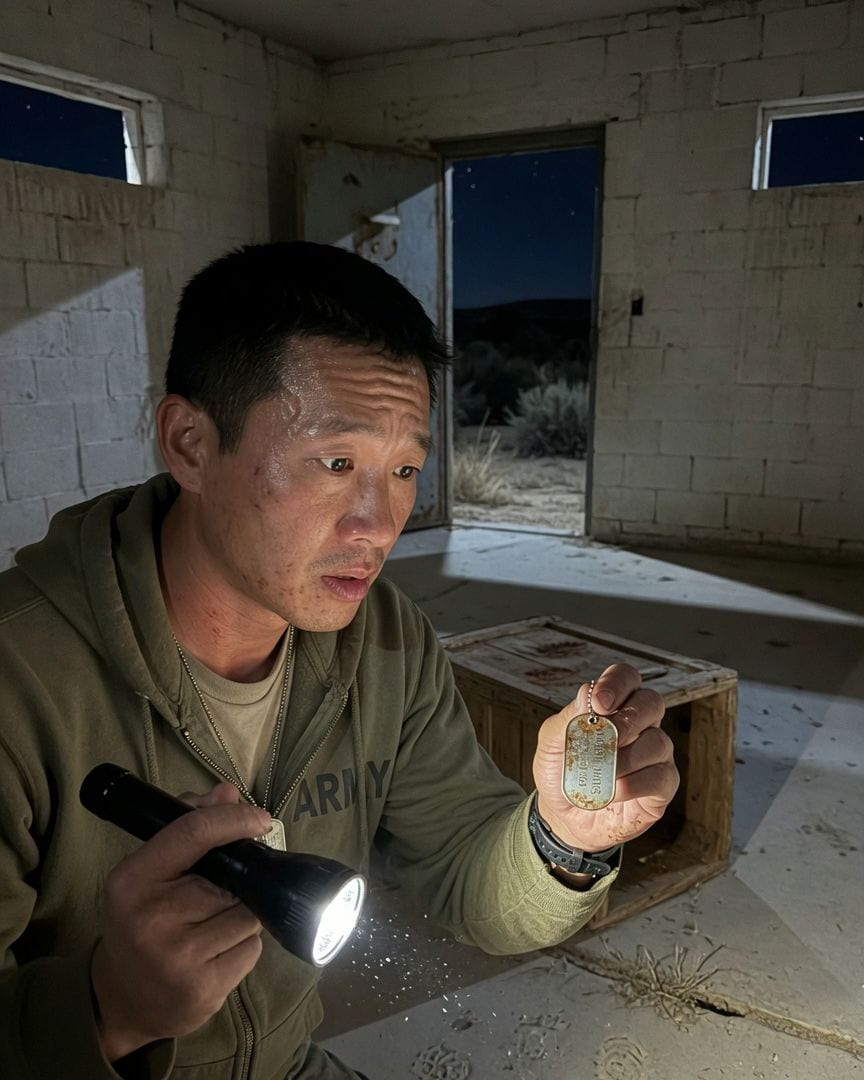
Staff Sergeant Rhee’s squad found a Cold War building not on their map. Range Control confirmed no structure. Minutes later, it vanished, leaving a foundation decades old.
Staff Sergeant Adam Rhee halted his squad at the Yakima Training Center, staring at a cinderblock building that simply wasn't on his map. Range Control confirmed there was no structure at his coordinates, leaving him to wonder what impossible thing stood before them. Moments later, after the range-safety truck arrived, the building vanished, leaving only a rectangular patch of earth with a foundation of decades-old weeds. That night, driven by an unsettling certainty, Rhee returned to find the building reappeared, its door ajar, holding a single, rusted dog tag from 1983. How could a place appear and disappear, leaving behind evidence from forty years ago?
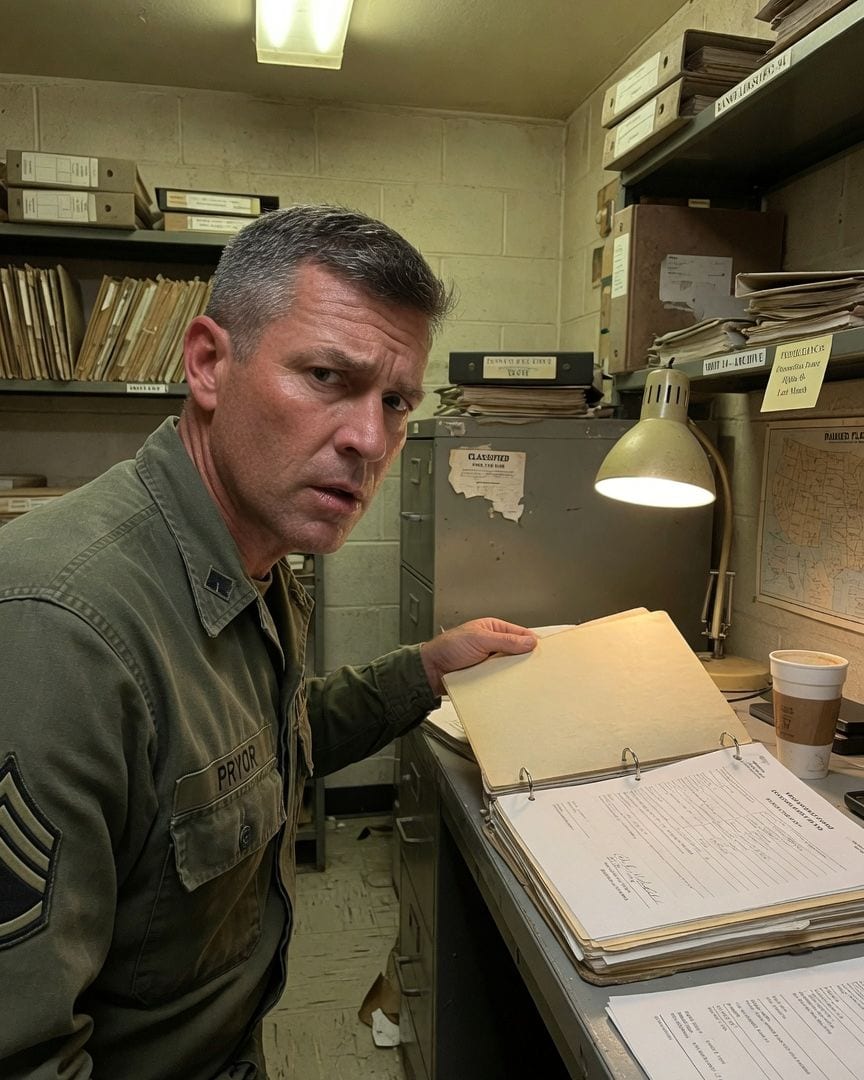
A sergeant with eleven days left finds a warm, glassed crater. Its file shows a captain lost thirty years ago is still signing reports from last week.
Sergeant Alden Pryor was counting down his final eleven days on a twenty-year hitch, expecting to spend them on routine patrols along the Ranier Flats fence line. Instead, his truck stopped at a bizarre sight: a four-hundred-foot glassed crater, miles from anywhere, its sand faintly warm at dawn despite no one recalling a blast. The air above it shimmered with an unnatural distortion, a silent scar of erased violence, and the official file for 'Shot 14' showed recent maintenance sign-offs for a decommissioned tower at the crater site. All these active documents were signed by Captain Everett Caldwell, who had been officially lost in operations thirty years ago, leaving Sergeant Pryor to wonder how a dead man could still be filing reports.
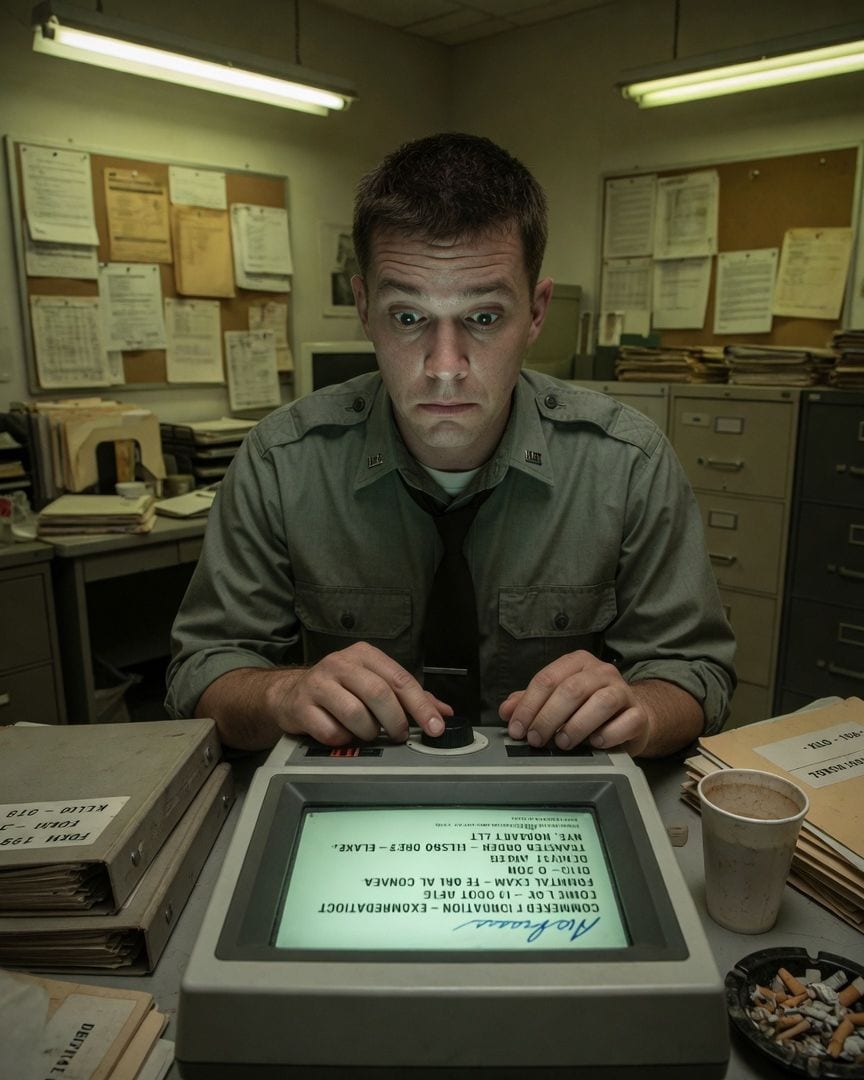
A missile commander watched his ten nuclear silos go dark. His own service record shows his signature on a future he's never lived.
Second Lieutenant Hobart Nye, a missile commander in Wyoming, had his quiet 0247 watch shattered by a security report: a massive, silent black triangle hovered over Launch Facility Kilo, casting a perfect shadow. Hobart watched his console's fault panel light up, signaling all ten nuclear missiles going dark in an impossible silence, followed by eleven minutes his security team could not remember. Official logs called it a "radio malfunction," but Hobart found a requisition for invisible-tracking sensors, signed by a base commander who was supposed to be off-base. The final, chilling discovery came when his own service record showed new entries—a dental check-up, a transfer to Alaska—all dated for a future he never lived, complete with his perfectly replicated signature.
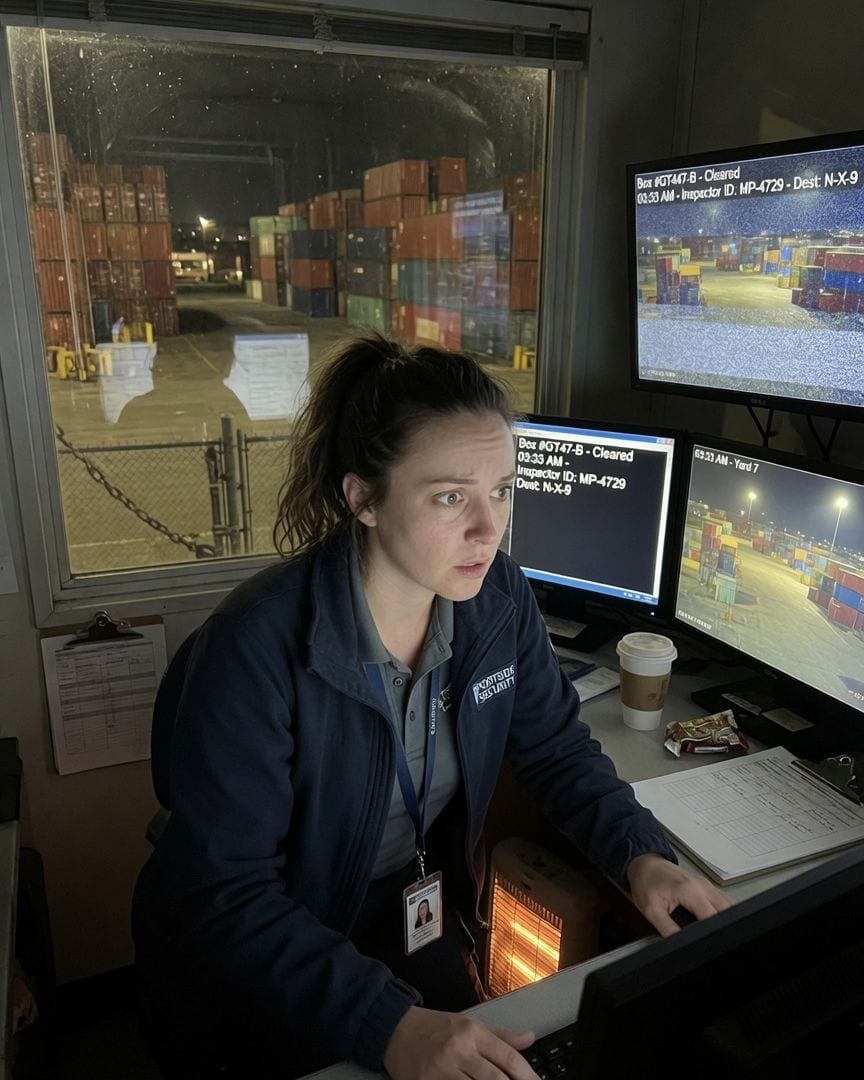
The log says a container cleared my gate at 3:33 AM, stamped with my ID — but the gate was chained and locked, and the yard beyond it was dark and empty. No truck was ever booked.
My night shift at Portside Container Terminal is usually a predictable drone of monitors and stale coffee. But then I saw a familiar guard, Arthur Larsen, on a live feed, smiling unsettlingly at the camera. The next morning, my supervisor searched for him; the employee database returned 'No results found.'
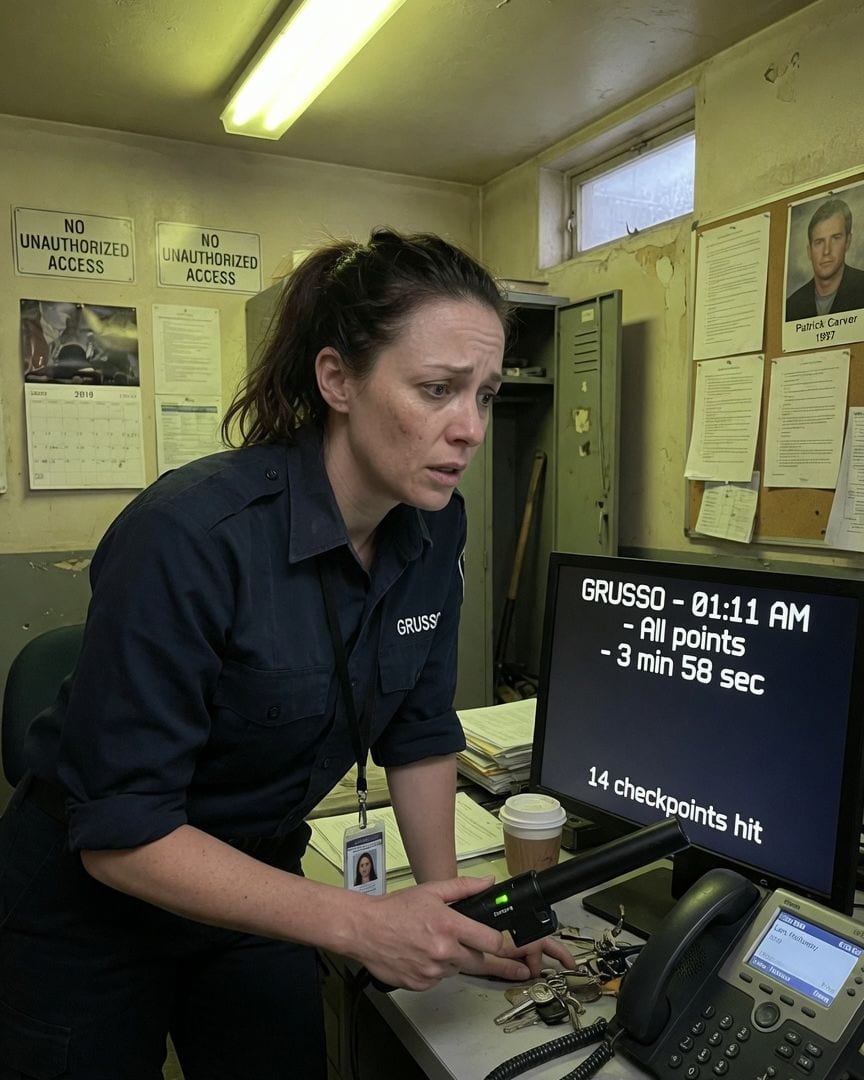
My security wand logged a full round at 1:11 AM in under four minutes. It was in the charger. Every tap is logged as mine.
Finishing my night shift, all I wanted was to get home. But the dock readout screen showed my security wand logged a full patrol at 1:11 AM, completed in just under four minutes. I knew my wand had been charging right beside the monitor the entire time, yet the log, under my ID, confirmed the impossible.