Sergeant Romano counts mess kits at a closing outpost. An extra plate matches a 1944 log of a missing soldier.
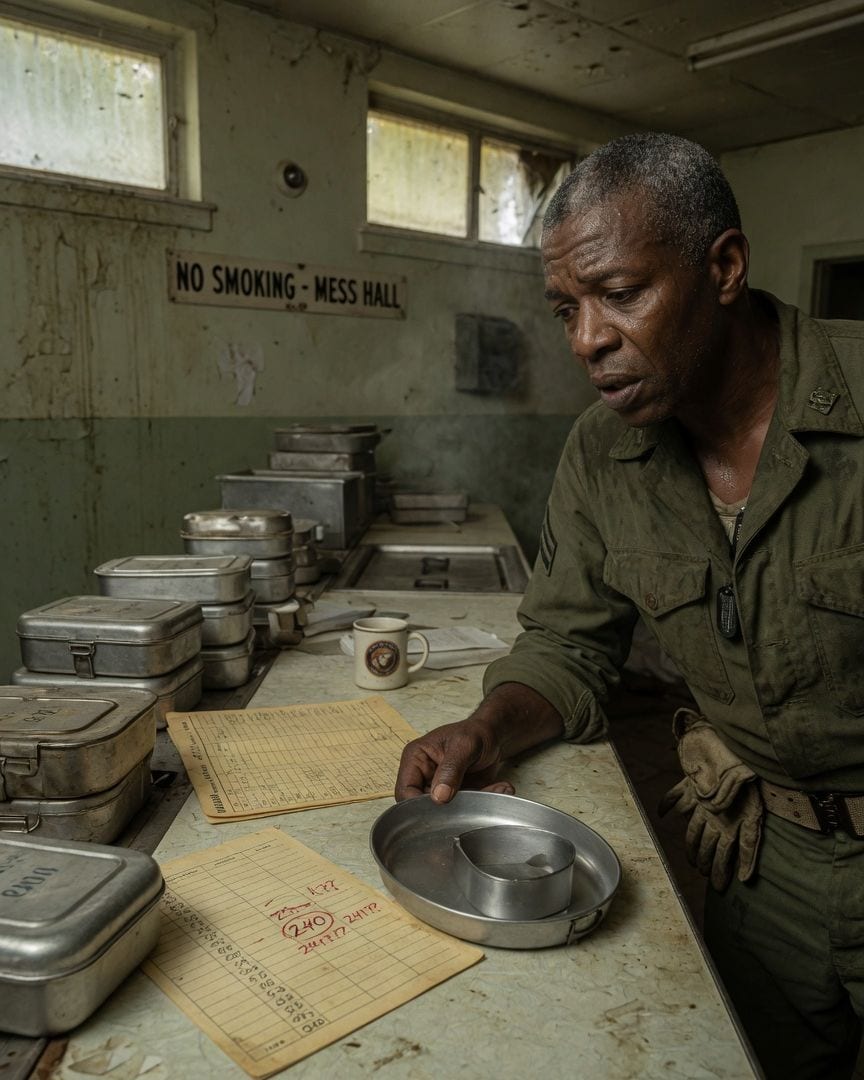
Sergeant William Romano wiped a bead of sweat from his brow, the humid air of Outpost 73 clinging to him like a second skin.
The clang of metal echoed in the cavernous, derelict mess hall as he worked, supervising the final inventory before the remote Pacific island outpost was officially struck from the rolls.
His current task was mundane, tedious: tallying the mess kits, stacks of tarnished, heavy steel plates and cups that had seen decades of forgotten meals.
The grease-stained walls, the broken serving line, the lingering scent of stale cooking oil—it all spoke of a past long gone, a place waiting for the wrecking ball.
He’d already counted the kits twice, once against the faded, brittle manifest from the 1940s, then again from scratch, methodically moving each kit from one side of the long, greasy counter to the other.
Both times, the numbers stubbornly refused to align.
The manifest listed 240 complete kits. Romano, a Marine sergeant whose entire career was built on meticulous accuracy and unflinching adherence to procedure, had counted 241. A vein throbbed in his temple.
He sighed, pulling off his work gloves and running a hand through his close-cropped hair. 'Alright, let's do this again,' he muttered, more to himself than to the empty room.
This was his final deployment before a planned transfer to a training command, and he wasn't about to leave a single discrepancy on his watch.
He started a third pass, slower this time, calling out each number as he slid a kit across the chipped Formica. 'One... two... three...' The stack dwindled. He reached the end of the original pile. 'Two hundred thirty-nine...
two hundred forty.' He looked at the manifest. Done. But on the far end of the counter, gleaming faintly in the dim light filtering through the grimy windows, sat a single, solitary mess kit. Pristine. Unused. Unaccounted for. Waiting.
He stared at it, a cold prickle of unease rising on his neck. It was too concrete, too undeniably present to be a trick of the light or a simple miscount. He’d just counted 240.
Where, precisely, had the extra one come from? The silence of the mess hall seemed to deepen, heavy with unspoken things. He picked up the extra plate, turning it over in his hands. It felt solid, real, yet utterly impossible.
Romano spent the next hour re-counting, re-checking the manifest, even searching for a hidden kit or a mislabeled box. Nothing. The extra plate persisted, a stubborn anomaly.
Frustrated, he finally delegated the task to Corporal Nathaniel Hale, his junior team member, with explicit instructions to double-check everything. Hale returned an hour later, looking pale and sweating profusely despite the mess hall's stagnant air.
'Sergeant, I… I keep getting one extra,' Hale stammered, his voice tight. 'Every single time.' The confirmation chilled Romano. This wasn't a mistake; it was something else entirely.
Determined to find a mundane explanation, Romano plunged into the outpost's meager, mildewed archives, a small, damp room filled with decaying records.
He sorted through brittle supply requisitions, faded personnel manifests, and finally, a tattered, hand-bound mess hall logbook from 1944. Its pages were filled with neat, tight script, detailing daily chow counts and ration allotments.
Flipping through, he found an entry from Mess Sergeant Okafor, dated December 14th, 1944, detailing the exact same problem: 'Strength count reports one over. Served 240, 241st plate remained in pot.' A few lines down, a note added: 'Pvt.
Everett Brooks, transfer orders delayed, still on strength for chow.' Romano felt a jolt. The discrepancy wasn't new, and it had a name attached to it.
Romano kept reading Okafor's log, his fingers tracing the faded ink. Another entry, dated three days after the first, stated: 'Brooks still on strength. Still one over. Confirmed transfer never processed. Still here.'
The meticulous entries continued, detailing the phantom plate and Brooks' unresolvable status. Then, on the final line of that page, written in a different, hurried hand, almost a scrawl, it simply stated: 'Brooks reported missing, not found.'
Romano looked up from the logbook, the humid air suddenly cold, raising goosebumps on his arms. The extra plate on the counter seemed to pulse with an impossible presence.
Romano showed the log to Hale, who visibly recoiled, a cold dread replacing his earlier frustration. 'Private Brooks… he’s still here?' Hale whispered, glancing nervously towards the mess hall. Romano, ever the rationalist, tried to maintain composure.
'It's a historical anomaly, Corporal. A clerical error that never got resolved. We need to find out why.' They began to cross-reference the name Everett Brooks with every other archived document they could find.
They unearthed a few scattered references: a supply request from December 1944 for '1x uniform, size L, Pvt.
Brooks,' a brief mention in a patrol report from the same month about a 'search for missing personnel, Brooks, E.' But always, the trail went cold.
There was no resolution, no KIA report, no official missing-in-action file that had ever been closed. The paperwork simply tapered off, as if the system itself had forgotten him.
Romano then turned to the outpost's internal radio log from that period, hoping for a transmission that might shed light on Brooks' ultimate fate. The log entries were sparse, mostly routine weather reports and supply requests.
But he found something else: a series of garbled, intermittent transmissions on a specific frequency, dated to the week Brooks went missing. They were logged simply as 'unidentified chatter, possible interference.'
The frequency was unusual, not one typically used for inter-outpost communication. Romano leaned closer to the faded entries, a knot tightening in his stomach.
The static-laced words seemed to hum with an unheard message, a whisper from the past that refused to be silenced.
As Romano and Hale delved deeper into the forgotten files, a subtle shift occurred in the outpost. Equipment they’d meticulously inventoried and secured was found slightly disturbed.
A specific mess kit, the 'extra' one, was discovered moved from the 'checked' pile back to its solitary spot on the shelf, even after Romano had personally locked the mess hall.
In the abandoned barracks, a bunk – number 7 – which they had cleared, showed a fresh, shallow indentation on its dusty mattress, as if someone had recently rested there.
Hale, jumpy and on edge, swore he heard faint footsteps late one night, echoing from the empty barracks. Romano, trying to stay rational, attributed it to the old building settling, or the wind playing tricks.
One night, however, while Romano was alone in the comms room, reviewing the radio logs for any further anomalies, he heard it.
A faint, almost imperceptible static crackled from the long-dead radio set, a sound he'd dismissed as interference earlier in the day. He tried to ignore it, focusing on the log entries.
But then, a single, clear, low-frequency tone cut through the static, holding for a moment before fading back into silence. It was distinct, deliberate, and utterly out of place.
He froze, his hand hovering over the logbook, open to the 'unidentified chatter' entries. The hair on his neck stood up, a primal warning. He wasn't just investigating a ghost in the system; he was being observed.
The silence of the outpost, once merely desolate, now felt watchful.
Romano decided he needed external verification. He contacted the central archives back at base, requesting a full service record for Everett Brooks, carefully explaining the historical discrepancy and the persistent 'extra plate.'
After several days of frustrating delays and vague responses from overwhelmed clerks, he finally received a call.
The voice on the other end was calm, almost serenely unbothered, introducing herself as Eleanor Crane, a retired archivist who still consulted for the military on 'special cases.'
'Sergeant Romano,' she began, her voice crisp, 'you've stumbled onto a rather problematic file. Private Everett Brooks.' Romano felt a chill. 'Problematic how, ma'am?' Eleanor chuckled softly, a dry, papery sound. 'His file, you see, was never officially closed.
Every attempt to mark him KIA or MIA resulted in system errors. Phantom 'active' statuses would reappear. It was as if the system itself refused to let him go.'
She recounted how, after the war, a small, specialized team was quietly dispatched to Outpost 73 specifically to resolve the 'Brooks anomaly' in the records. 'They returned with no answers, Sergeant. Only a strange, persistent silence about what they found.
The official report was classified, then buried.'
'So, he just… stayed on the books?' Romano asked, incredulous. 'In a manner of speaking,' Eleanor replied. 'Some men just don't want to be forgotten, Sergeant. Especially when the paperwork says they're still here, even if their body isn't.
The military's system of accountability is exhaustive, Sergeant. Sometimes, it's too exhaustive for its own good. It creates its own kind of permanence.'
Romano looked down at the mess hall logbook open on his desk, then at the single, extra plate on the counter. The ordinary explanation was dead. The dread was earned.
Eleanor Crane continued, her voice unwavering, a steady stream of cold, hard facts. 'The problem, Sergeant, is that it wasn't just Outpost 73 in 1944.
Over the decades, whenever that particular property was briefly reactivated for any reason – a survey team, a temporary comms relay, even a single-man watch – the same discrepancy would resurface.
Not always a mess kit, not always a chow count. Sometimes it was a patrol log showing an extra man on duty where none existed. Sometimes it was a supply manifest with an inexplicable 'plus one' for rations.
Sometimes, it was just that garbled radio chatter you mentioned.'
Romano listened, a growing horror blooming in his chest. 'Always one too many,' Eleanor said, her voice dropping slightly, 'Always, somehow, connected to Everett Brooks. It's not just a file that won't close, Sergeant. It's a pattern.
A persistent anomaly tied to the very coordinates of that outpost, affecting any system that tries to account for personnel there.'
As she said this, Romano looked down at the open mess hall logbook from 1944, then at a modern-day inventory sheet for the outpost's current equipment, both showing the same impossible 'plus one' in their respective columns, separated by eighty years.
The phone went silent, but the numbers on the pages screamed.
The implication hit Romano with sickening force, a cold wave washing over him.
Brooks wasn't just a lingering ghost; he was a persistent, systemic error, a glitch in the very fabric of military accountability, a man the system refused to let go of.
Eleanor explained that after the initial failed attempts to close his file, the military tried to bury the whole affair, declaring the property 'unsuitable' for future use, hoping the anomaly would simply fade. But it never did.
The system kept generating phantom entries for Brooks, a testament to its own relentless, flawed precision.
She directed Romano to a specific, unofficial 'ghost file' she had maintained, a collection of all the anomalous reports and observations related to Outpost 73 and Brooks.
In it, among faded official documents and cryptic notes, Romano found an old, brittle photograph. It showed a group of Marines from 1944, standing casually in front of the mess hall, their faces young and eager.
One face, at the very edge of the frame, was subtly blurred, almost transparent, a faint smudge in the otherwise clear image, but undeniably present. Beneath it, a handwritten note, almost too small to read: 'Brooks.
The one who wasn't there, but was.' It was a chilling visual confirmation, a spectral figure caught in a moment of ordinary life, blurring the line between existence and absence.
Romano and Hale, now fully convinced and deeply unnerved, decided they had to locate the physical source of the anomaly, the final anchor.
Using the clues gleaned from Eleanor's ghost file and the meticulous details in Okafor's log, they returned to the mess hall.
Eleanor had mentioned a particular bunk that was always left undisturbed, even decades after the outpost was abandoned, as if someone still claimed it. They found it in the old barracks adjacent to the mess hall: bunk number 7.
It was slightly cleaner than the others, less dust clinging to its rusty frame.
Romano knelt, Hale shining a flashlight. Beneath the rusted bed frame, half-buried in the packed dirt and debris, they found a small, tarnished metal box. It was heavy, sealed by decades of rust. With a grunt, Romano pried it open.
Inside, nestled on a bed of dried leaves, was a single, tarnished dog tag. He lifted it carefully, brushing away the dirt. The engraving was clear, despite the age: 'BROOKS, EVERETT, USMC.'
Beside it, folded and brittle, was a worn-out copy of a letter, dated November 1944, from a mother to her son, expressing worry about his delayed transfer and asking if he was getting enough to eat.
The artifact was real, tangible, and undeniable. It was Brooks' last earthly possessions, left exactly where he was, never officially retrieved, never accounted for.
The fact that it was here, undisturbed for eighty years, confirmed the unyielding, unshakeable nature of the wrongness.
The system had failed to account for him, and so, he remained, a permanent fixture in the accounting, a ghost in the machine of military bureaucracy.
Romano and Hale reported their findings, including the dog tag and the letter, to command.
The official response was swift and quiet: an immediate and permanent order to decommission Outpost 73, with no further surveys or attempts to utilize the land. Eleanor Crane's ghost file was sealed and classified at the highest level.
Sergeant William Romano's transfer to the training command was processed without delay, but he carried the weight of Outpost 73, and the knowledge of Private Brooks, with him. Hale, too, was transferred, never speaking of the outpost again.
Months later, back at a bustling training base, Sergeant Romano was going over a new recruit roster, checking names against bunk assignments for an incoming platoon.
The system flagged an error: one bunk, number 7, had no assigned recruit, but the strength count for that barracks still came out one over.
He stared at the screen, a familiar, cold dread settling in his gut, a pattern he knew all too well. He closed the file, took a deep breath, and opened another. The barracks was full, the numbers swore it.
But the system, in its own way, knew better.
A week later, a new recruit, Private Janet Ellison, reported to her assigned barracks. She walked down the aisle, looking for her bunk.
On the empty bunk number 7, a single, tarnished mess kit sat alone on the pristine white sheet, waiting.
If this one got to you
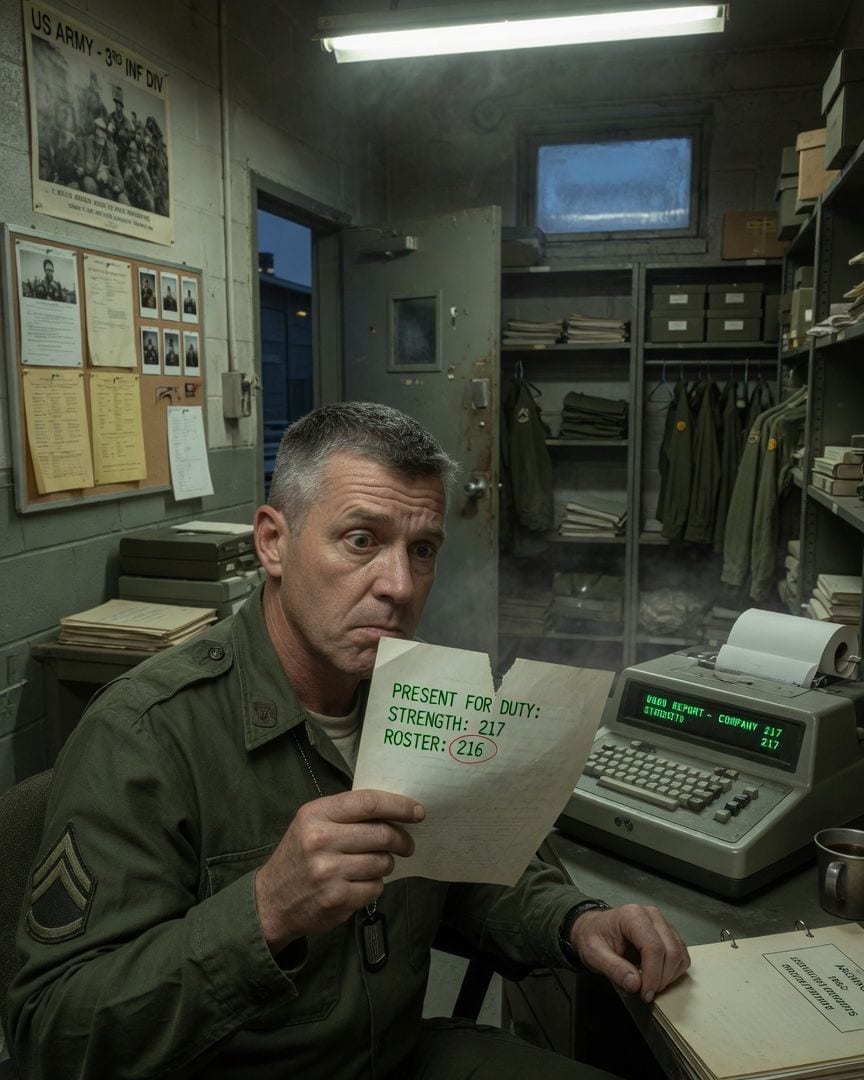
Sergeant Halloran is three months from a promotion, but his Cold War morning report shows 217 men. He counted only 216. A cold, hidden log from 1963 records the same impossible count.
Sergeant First Class Joseph Halloran, three months from a promotion and stateside transfer, faced the chilly 0600 darkness of his West German garrison in 1987, his career built on impeccable order now threatened. For a week, his morning reports had defied him: a meticulous physical count of 216 shivering soldiers always resulted in the Teletype machine blinking 217. His exhaustive double-checks confirmed no error, yet the impossible 'plus one' persisted, leading him to a distinctly colder section of the supply room. Behind ancient manuals, a hidden alcove revealed a worn leather log, where a Sergeant Hayes in 1963 had recorded the identical, chilling discrepancy.
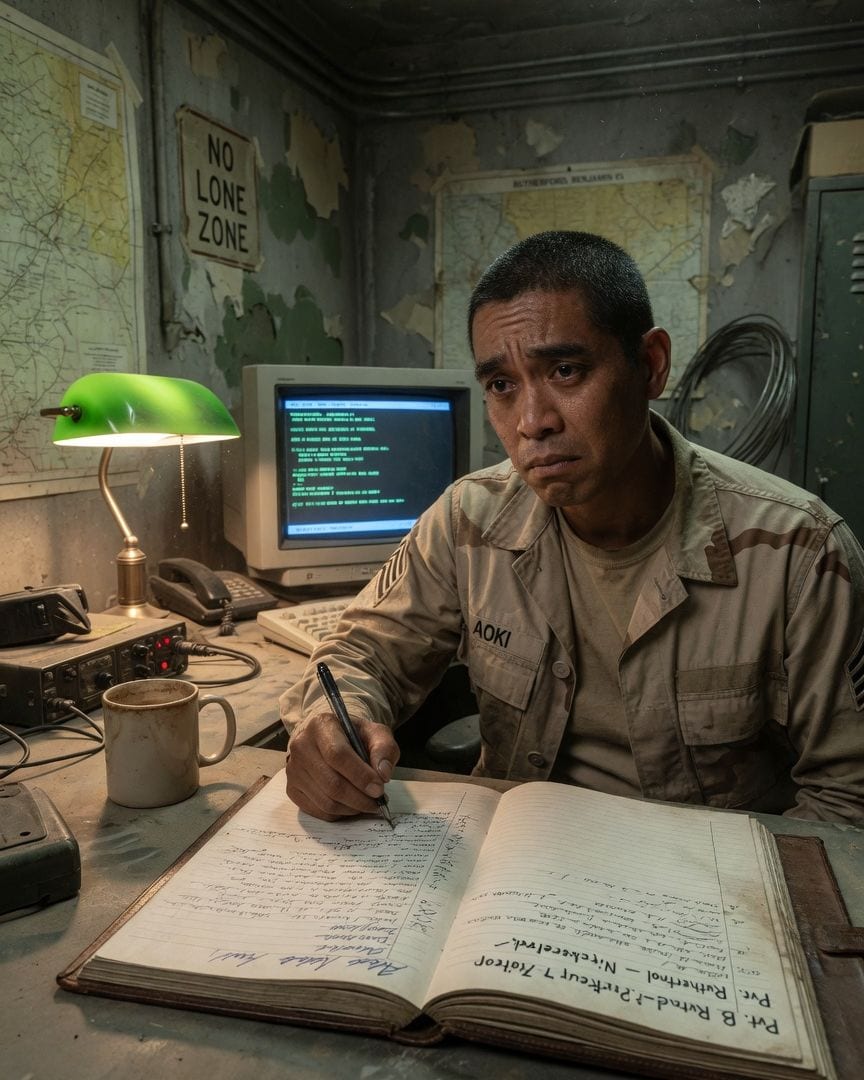
Sergeant Aoki's four-man patrol hears a fifth voice answer their count. A fresh name then appears in the duty log beneath his own signature.
Sergeant Isaac Aoki's final rotation at Outpost 7 was nearing its end, with relief due at dawn. On his four-man night patrol, he broke an old superstition, counting his team aloud in the dust-choked desert. A fifth voice answered, clear and unsettling, from the moonless dark. Back inside the bunker, the chill deepened when a fresh name appeared in the duty log, 'Pvt. B. Rutherford,' beneath Aoki's own signature, a soldier no one knew. Even more disturbing, Aoki later found his own signature on a valor citation for Rutherford, an event he never witnessed.
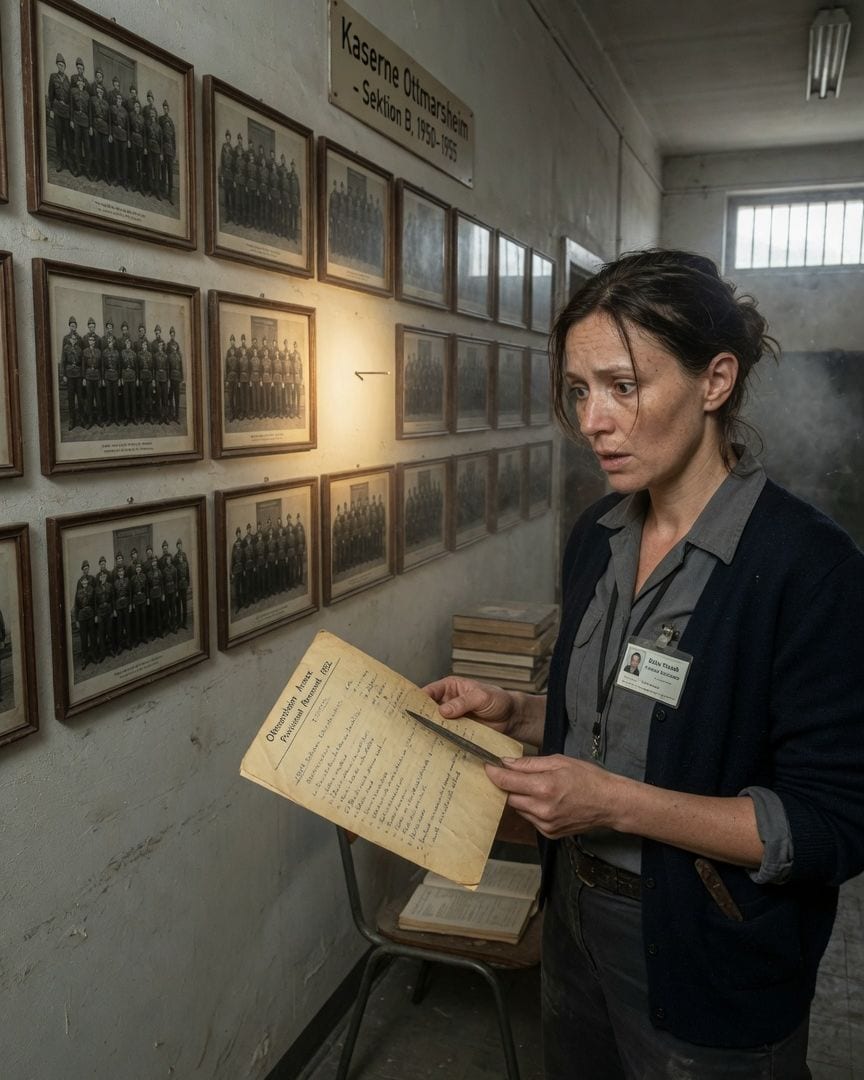
At a Cold War kaserne days from demolition, inventory clerk Delia Straub found a missing photo frame for a unit that never existed. Every soldier on the wall stared directly at its empty space.
Inventory clerk Delia Straub had eleven days to log every item at Kaserne Ottmarsheim before demolition crews arrived, turning history into rubble. Amid the dusty halls, she found a stark anomaly: a missing photo frame for the 604th Ordnance Detachment, a unit never officially stationed at the base. What made the empty space chilling was that every soldier in the surrounding photographs was looking not at the camera, but directly into that void. Delia's search for answers unearthed an unofficial manifest listing the 604th, with names of men officially declared killed in action years before. Who were these phantom soldiers, and why did their impossible record persist?
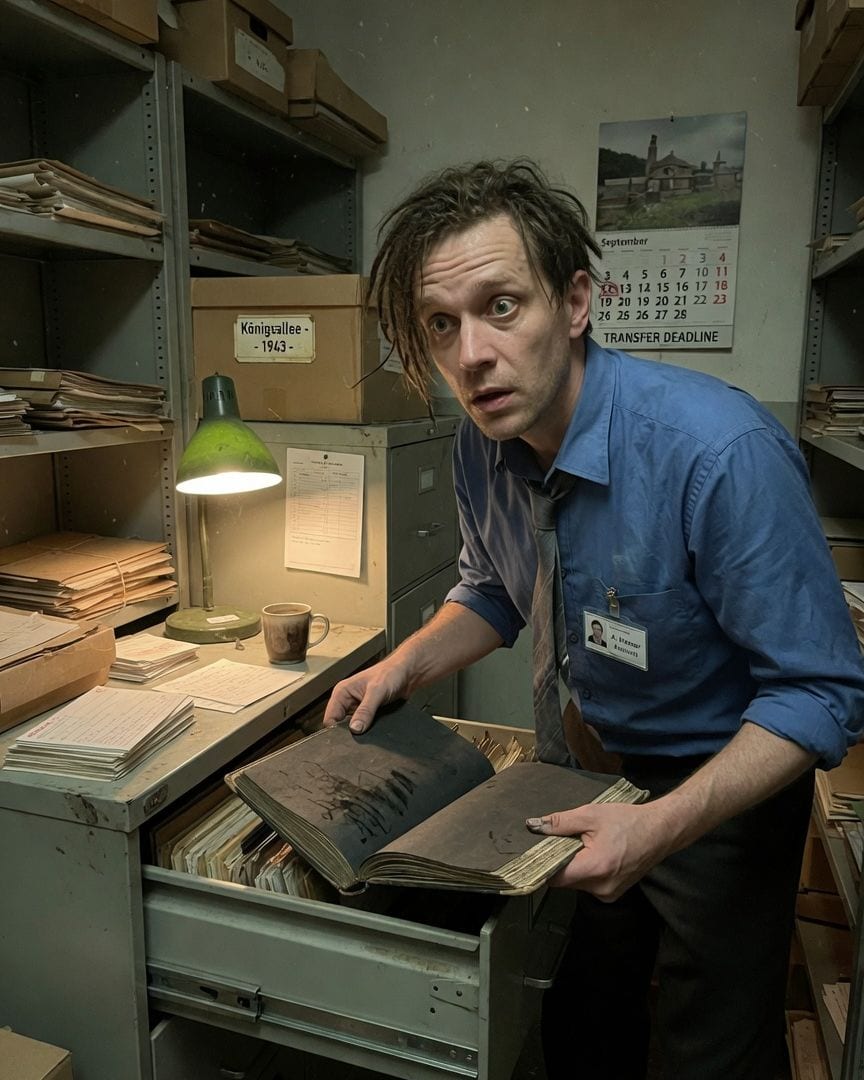
A Berlin archive researcher races a deadline. A hidden log for a Cold War barracks on a vacant lot has ink still wet from last month.
Ansel Vidmar, a methodical researcher, felt the pressure of a looming deadline. The municipal transfer of the old Berlin archive was days away, and he still had countless documents to categorize amidst towering stacks of forgotten history. His focus narrowed to an unindexed metal cabinet, revealing records for a garrison company at Königsallee – an address that had been a vacant lot since the war. A punishment log inside listed an entry from 1983, a date far too recent for a non-existent building. When Ansel visited the site, he found only overgrown grass, save for a single, eerily clean concrete doorstep emerging from the earth. His unease solidified into dread when he later uncovered a hidden Quartermaster's Log, meticulously detailing supplies for the same barracks, with entries extending to "last month," the final page's ink still faintly wet. What unseen operations were still being maintained?
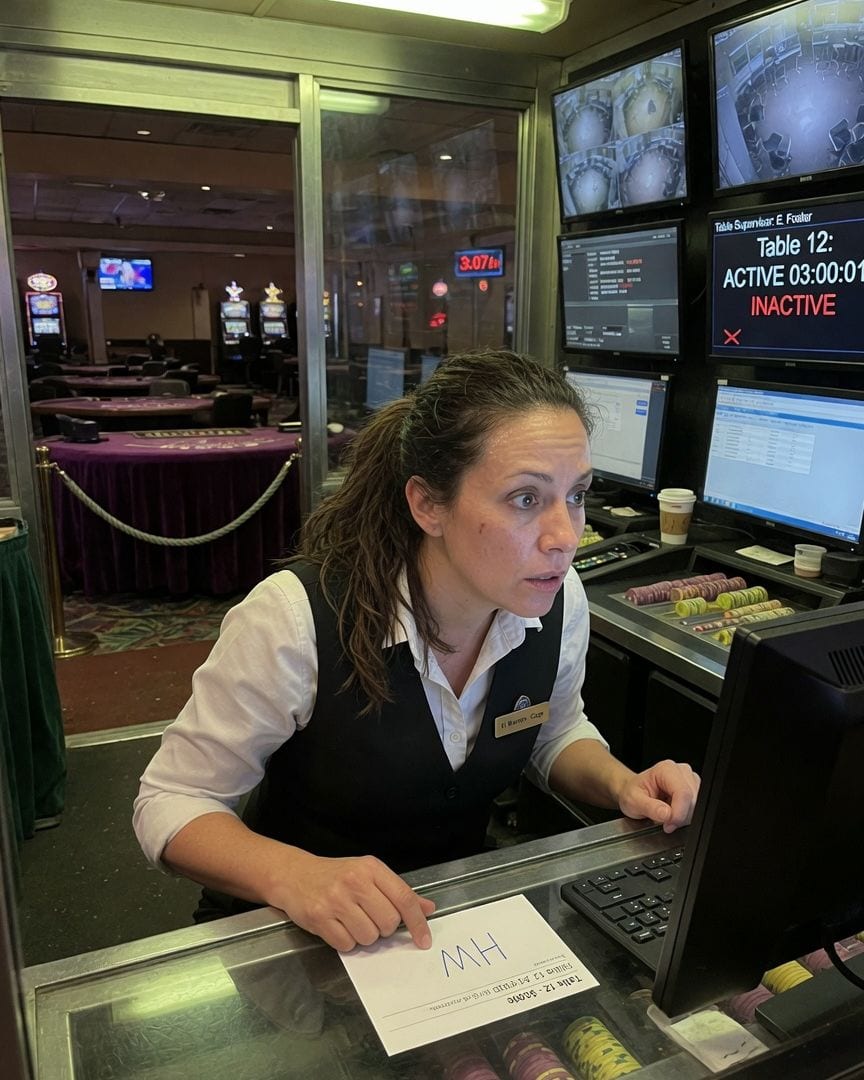
My name signed a fifty-thousand dollar casino fill to a dark, roped-off table. The cage is short by that exact amount. I never touched the slip.
Working the casino cage on a slow night, I logged off after counting my stack of chips. Then the system pinged: a $50,000 transfer to Table 12, closed for months, with my initials on it. The security feed showed my hand moving, making an imperceptible scribble, but I know I never touched a thing.
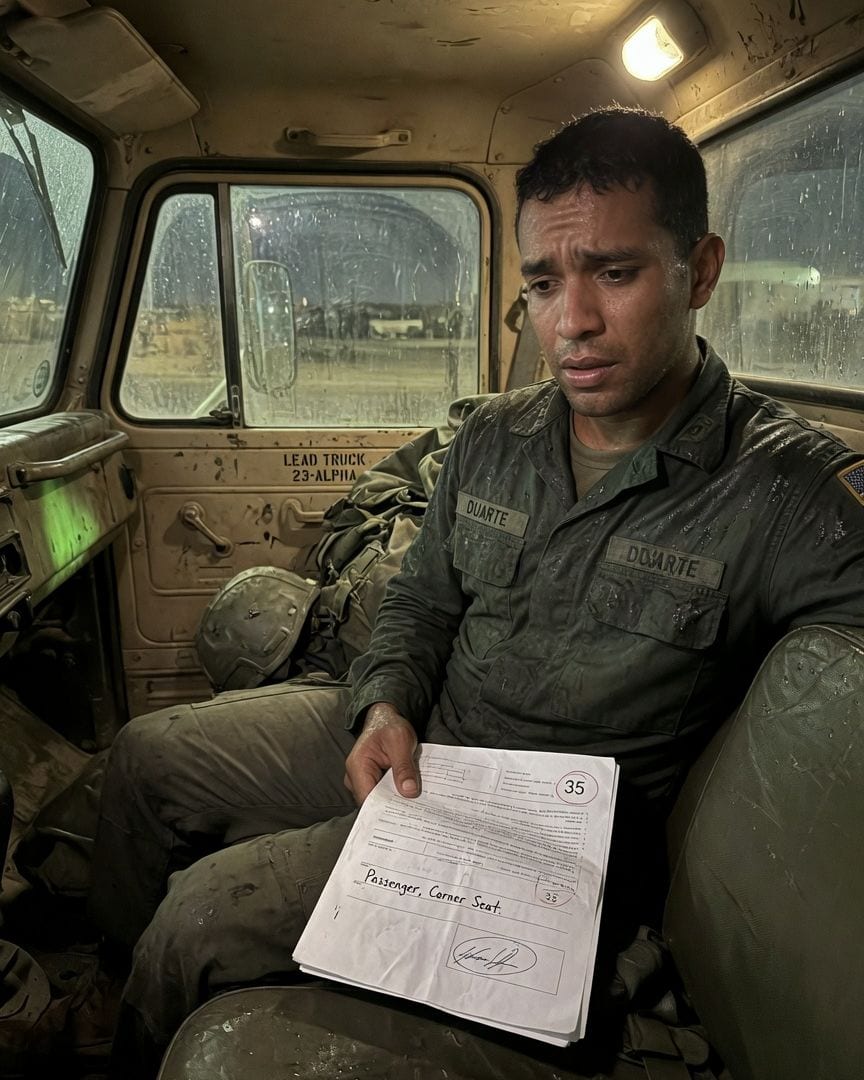
Specialist Duarte, two weeks from going home, found his empty truck seat warm and dented — then his service record showed a ghost deployment he never made.
Specialist Felix Duarte was just two weeks from going home, but a final convoy mission held an unsettling mystery. Soaked and running late, he squeezed into the lead truck's forbidden corner seat, a place every soldier knew to leave empty. Hours later, stepping out into the desert, he found the seat was strangely warm and distinctly dented, as if two unseen bodies had pressed in beside him. The official manifest then listed an extra soul for his truck, simply 'Passenger, Corner Seat,' signed by his own hand. What impossible presence had shared Specialist Duarte's ride, and what other records might it have altered?