Specialist Duarte felt a phantom warmth in the truck's empty seat. Later, the manifest listed him twice with two service numbers.
The rain was a cold curtain, blurring the desert road ahead of the convoy. Specialist Adam Duarte, soaked and shivering, cursed the delay. Every other truck was full, every seat taken.
He knew the rule: the far corner seat in the lead truck stayed empty. It was an unspoken law, a superstition passed down through rotations at Outpost Echo-7, but a law nonetheless. Doubling up was preferred to taking that seat.
But today, running late, with Private Hughes already crammed into the middle, Duarte saw no other option. With a sigh that fogged the humid air, he dropped into the corner, the worn canvas sagging under his weight.
A strange warmth bloomed immediately against his hip and shoulder, as if someone had just vacated the spot next to him, though he was utterly alone.
The other drivers, passing his truck, shot quick, unreadable glances at the corner of his cab.
Back at Outpost Echo-7, the incident lingered. Duarte tried to shake off the unsettling warmth, attributing it to residual engine heat or his own fatigue. He was a professional, a soldier, not prone to superstitions.
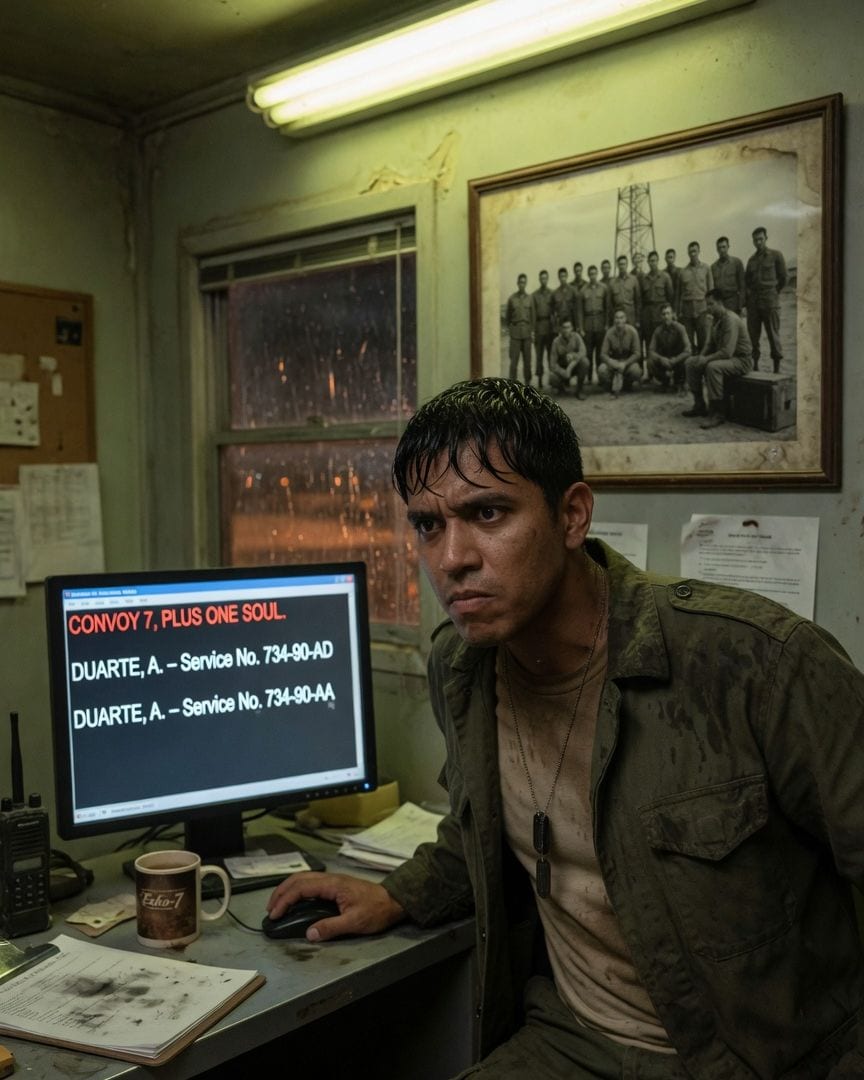
His first task was to file the convoy manifest. The digital system, usually precise to a fault, flagged an error: 'Convoy 7, plus one soul.' Duarte frowned. He’d counted heads; every truck was accounted for.
He tried to override the discrepancy, but the system insisted. He pulled up the detailed manifest, scrolling through the names.
And there it was, glaring back at him: 'Duarte, A. – Service No. 734-90-AD' and then, directly beneath it, 'Duarte, A. – Service No. 734-90-AA.' The second service number was subtly, impossibly wrong. He checked his own dog tags.
His number ended 'AD.' He tried to delete the erroneous entry. The system rejected it. He ran a diagnostic on the terminal, then on the manifest server. Everything came back clean.
The 'plus one' and the duplicate 'Duarte, A.' were, according to the system, undeniably real. The fluorescent hum of the office lights seemed to thrum with a sudden, oppressive weight.
Duarte, his jaw tight, marched into Captain Marcus Norwood’s office. He laid out the manifest error, the duplicate name, the impossible service number.
Norwood, a man of regulations and order, initially dismissed it as a system glitch or a clerical error from a new recruit. “It happens, Specialist. We’ll get it sorted.” But Duarte pressed, detailing his failed attempts to correct it.
Norwood sighed, promising to look into it personally. As Duarte turned to leave, his gaze drifted to a dusty, framed photograph on Norwood’s wall.
It depicted Outpost Echo-7’s first crew, a dozen grim-faced soldiers in archaic uniforms, standing stiffly in front of the original radio tower.
In the blurred background, near a shadowy corner of the building, a thirteenth figure was faintly visible, sitting on an overturned crate, their face obscured by shadow and the photograph's age.
But the posture, the set of the shoulders, and the faint outline of the profile, were unmistakably his.
The image from the photograph haunted Duarte. He couldn’t shake the uncanny resemblance. Discreetly, he began his own investigation, starting with the station's oldest hands.
Sergeant Kenneth Foster, a quiet, grizzled NCO who’d seen three decades of service, was his best bet. Foster listened to Duarte’s questions about old records and strange occurrences with a knowing, weary patience.
“Some places, Specialist,” Foster rasped, his voice like gravel, “they got their own rules. And some things, they just… fill the gaps.” Foster spoke of “unaccounted-for spaces” and “things that slip in when the ledger ain’t square.”
Duarte, avoiding direct mention of his own manifest entry, then accessed the station’s archived digital logs, cross-referencing 'plus one' anomalies with convoy manifests and patrol reports.
He found similar discrepancies stretching back years, always linked to specific convoys that had crossed the unmarked perimeter line around Echo-7, or to patrols that had lingered too long in the desolate 'Boundary' region.
He even found records of several soldiers who had either vanished without a trace or were reassigned under vague, urgent orders shortly after reporting similar phenomena: strange sounds, phantom heat signatures, or inexplicable additions to their patrol rosters.
The pattern was undeniable, a subtle thread woven through decades of military precision, taut as a wire waiting to snap.
Duarte’s quiet digging did not go unnoticed. One night, while reviewing patrol routes on his secure terminal, an unauthorized message flashed across his screen.
It was just a string of coordinates, but Duarte’s blood ran cold: they perfectly matched the specific perimeter line he’d identified as being linked to the 'plus one' anomalies. No sender, no timestamp, just the numbers.
He ran a trace, but the message vanished, leaving no digital footprint. During his subsequent night patrols, the desert’s vast silence seemed to shift, to press in.
He’d hear faint, echoing footsteps behind him that didn’t match his own cadence, or the distant, impossible crunch of gravel where only sand lay. One particularly dark shift, as he manned the long-range comms, static suddenly erupted in his headset.
Through the crackle, a voice, not quite human, not quite machine, whispered his name. “Duarte… leave the records alone.” The sound was dry, like sand sifting over bone. He ripped the headset off, heart hammering, but the line was dead.
He was no longer just investigating; he was being observed, warned. The silence that followed was not empty, but heavy with unseen scrutiny.
Duarte found Sergeant Foster in the mess hall, nursing a lukewarm coffee. He sat opposite him, pushing his tablet across the table, displaying the coordinate message, the anomaly logs, and a blurred image of the old photograph.
“Sergeant,” Duarte said, his voice low, “what is this place?” Foster’s eyes, ancient and tired, scanned the tablet. He took a long, slow sip of his coffee. “The locals, they call it the Boundary. Old legends, nothing official.
But the patterns here… they get strong. This outpost, it’s built right on top of it.” He explained that the entity wasn’t a ghost, but a 'pattern' that sought to fill any void, any unaccounted-for space within a structured system.
“You took that seat, Specialist. A breach. The system, it had a gap. And something filled it. Not with a body, not at first. With an entry. A duplicate. It mirrors you, it tries to become… an extra you.
Then it tries to make the original… unnecessary.” Foster’s voice dropped. “These records, these manifests. They’re its way in. It needs the system to acknowledge it. Once it picks you, once it starts to mirror, it doesn’t let go easily.
It wants to replace you, not just add to the count.” Duarte felt a chill deeper than the desert night.
The warm seat, the duplicate manifest entry, the figure in the photo – it all snapped into a horrifying, coherent picture. The entity was using the very accounting that was supposed to protect them, to erase them.
The room seemed to expand, its walls no longer offering sanctuary, but hinting at infinite, terrifying voids.
Shaken by Foster’s grim explanation, Duarte retreated to his bunk, the weight of the desert night pressing down on him. He felt a profound unease, a sense of being watched even in the privacy of his small space.
He sat on the edge of his cot, trying to process the idea of an entity that could infiltrate the very fabric of military records, that could duplicate and replace. Was he already marked?
Was the 'other' Duarte already out there, waiting? His hand brushed against something hard and unexpected under his mattress. He pulled it out: a small, aged, leather-bound journal, its cover worn smooth with years of handling. It wasn't his.
It was Sergeant Foster's, clearly, judging by the inscription inside the front cover. Duarte’s heart pounded as he flipped through the brittle pages, filled with Foster’s cramped, familiar handwriting.
He stopped on a page, the ink faded but the words chillingly clear. The date at the top read 'March 2003.' And below it, a terse entry, a military report distilled to its raw, terrifying essence: 'Convoy 7. Outpost Echo-7.
Private A. Duarte, extra on manifest. Found in the corner seat, warm.'
The journal entry from 2003 detonated the last vestiges of Duarte’s rational defenses. He wasn't just a target; he was the target, or rather, a recurring template.
The 'Private A. Duarte' from 2003 was an earlier manifestation, an attempt by the entity to establish a duplicate using his very name. The warm seat, the extra manifest entry—it wasn't a random occurrence. It was a pattern, a signature.
The entity wasn't just adding to the system; it was actively trying to overwrite it, to create a parallel identity that would eventually absorb and replace the original. Foster’s words echoed: 'It tries to make the original… unnecessary.'
Duarte understood now. The system’s meticulousness was its weakness. Every record, every manifest, every head count was a potential entry point for something that could perfectly mimic and then supersede.
The old records of vanished soldiers, the blurred figure in the photo – they were all victims of this insidious, systematic replacement. The entity didn't want to kill; it wanted to become.
And his own name, his own identity, had been its blueprint for years, a terrifying echo across two decades.
Duarte, with Foster’s grim, reluctant assistance, devised a desperate plan. The entity thrived on order, on filling gaps within the system.
To stop it, they needed to create a disorder so profound, so undeniable, that the system couldn't account for it, couldn't mirror it. During his next night watch, Duarte took a heavy-duty plasma cutter.
He made his way to the perimeter line, to a critical, redundant piece of comms equipment — a relay beacon that broadcast a constant, verifiable signal back to base. This beacon, though secondary, was meticulously logged and accounted for.
Destroying it would be an act of sabotage, an unrecoverable loss. It couldn't be explained as an 'extra,' only as an undeniable breach.
As he activated the plasma cutter, the air around him grew impossibly cold, then fiercely hot, as if a presence was fighting back, trying to maintain its hold.
He felt a consuming pressure, like a mirror shattering around him, a silent scream of non-existence. Gritting his teeth, he sliced through the beacon’s main conduit. Sparks flew, a shower of molten metal illuminating the desert night. The signal died.
Simultaneously, Duarte accessed his secure terminal and, with trembling fingers, filed a comprehensive, perfectly documented report of his actions: the intentional destruction of military property.
He detailed the exact time, the equipment, his own service number, leaving no room for ambiguity, no 'extra' explanation. He forced the system to acknowledge a deliberate, irreparable loss that could not be filled by a duplicate.
As he hit 'send,' the cold pressure vanished, replaced by a hollow emptiness. He knew he was facing a court-martial, but he also knew he had, for now, broken the pattern.
Specialist Adam Duarte was court-martialed and received a dishonorable discharge for his actions at Outpost Echo-7. His service record, however, contained no 'plus one' anomalies, no duplicate entries for his name.
The 'extra soul' on the convoy manifest was gone, officially purged as an 'unexplained system error.' Captain Norwood, after testifying, was transferred to a desk job in a quiet, landlocked base.
Sergeant Foster remained at Outpost Echo-7, a silent, watchful sentinel, his face etched with a deeper weariness. The 'plus one' incidents at the station ceased, for a time.
The corner seat in the lead convoy truck, Duarte heard, was once again left empty, and the perimeter line was patrolled with renewed, almost obsessive, vigilance.
Years later, Adam Duarte worked a civilian job, far from the desert and the military. He lived a quiet life, meticulously checking every piece of official documentation: his bank statements, his driver's license, his utility bills.
He lived alone, the silence of his apartment a constant companion. He never married, never truly settled, always half-expecting. One quiet evening, as he sorted through a stack of mail, he found a letter from the Department of Veterans Affairs.
It was addressed to 'Duarte, A.', just as his own official records would dictate. But the service number printed beneath his name was subtly, impossibly, wrong. It ended 'AA'.
If this one got to you
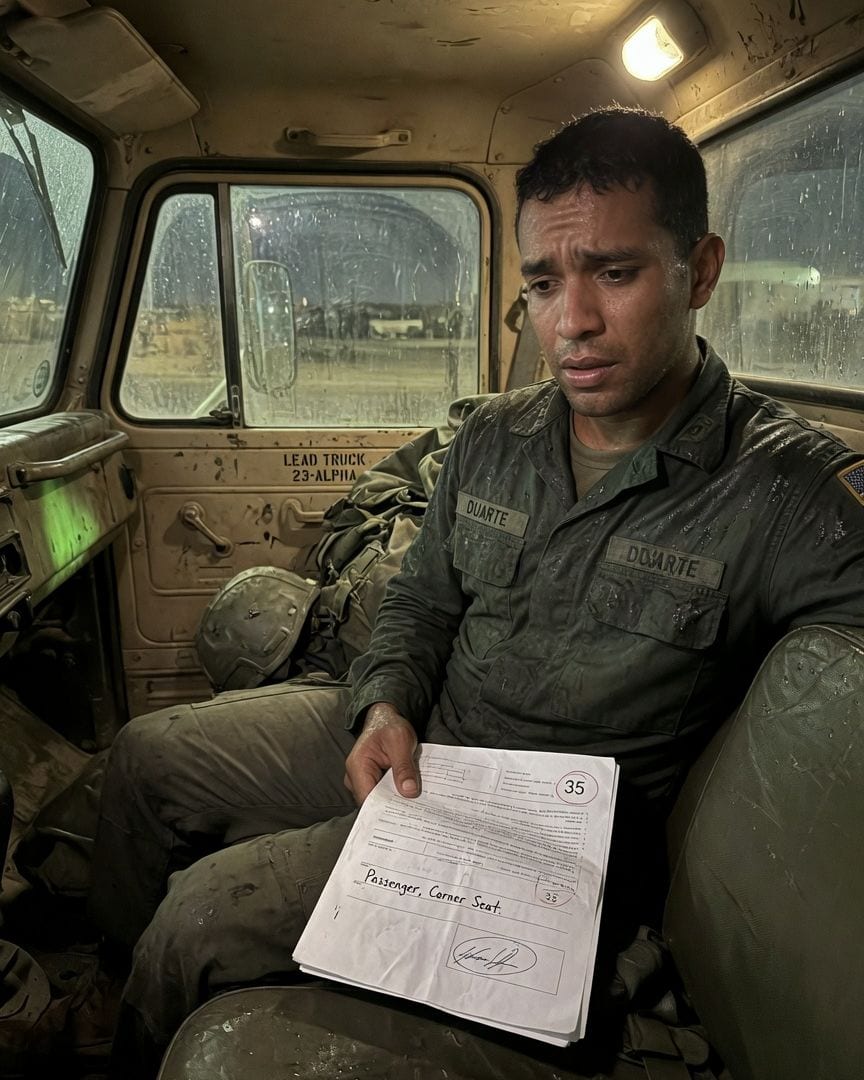
Specialist Duarte, two weeks from going home, found his empty truck seat warm and dented — then his service record showed a ghost deployment he never made.
Specialist Felix Duarte was just two weeks from going home, but a final convoy mission held an unsettling mystery. Soaked and running late, he squeezed into the lead truck's forbidden corner seat, a place every soldier knew to leave empty. Hours later, stepping out into the desert, he found the seat was strangely warm and distinctly dented, as if two unseen bodies had pressed in beside him. The official manifest then listed an extra soul for his truck, simply 'Passenger, Corner Seat,' signed by his own hand. What impossible presence had shared Specialist Duarte's ride, and what other records might it have altered?
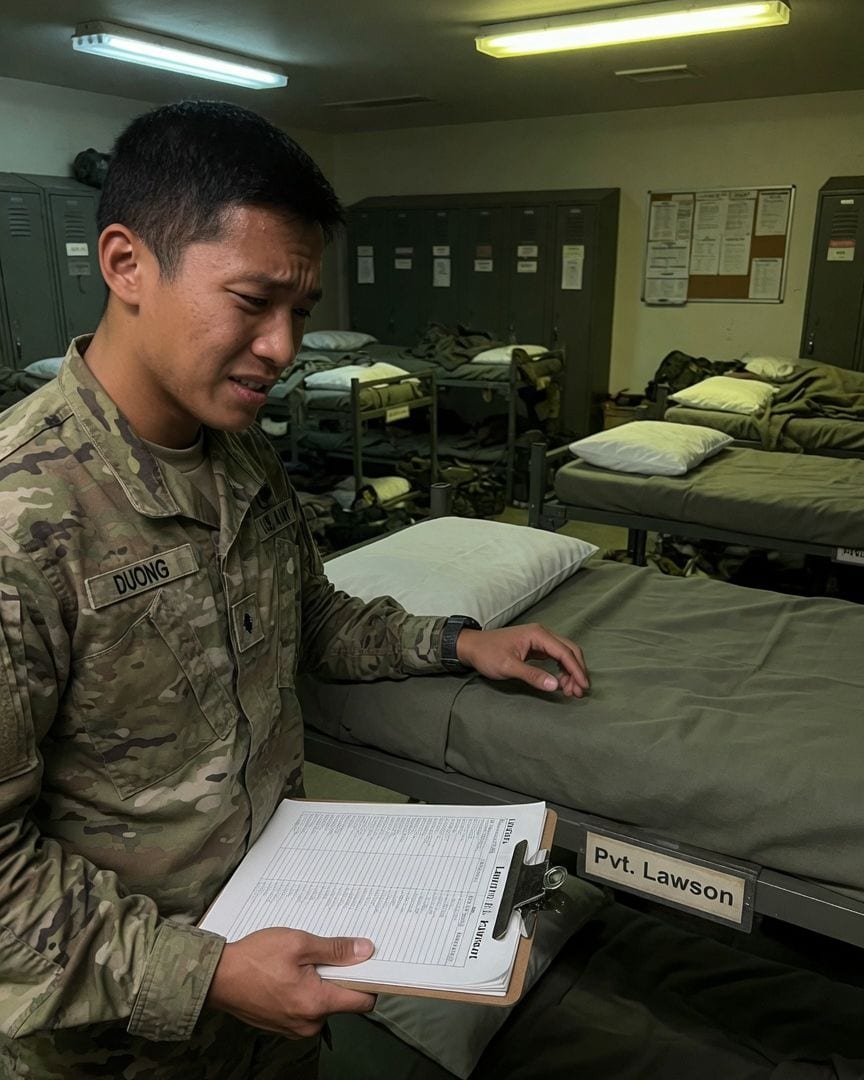
Specialist Duong found a perfectly made bunk for a Private Lawson who didn't exist, then saw his own signature on a duty log with him.
Specialist Gideon Duong found solace in the precise order of barracks life, especially after a grueling week in the field. His final task before tomorrow's graduation was barracks accountability, a routine count of sleeping soldiers against the official roster. But at the end of the aisle, a tenth bunk stood impossibly perfect, sheets hospital-folded, with a faded name tag for 'Pvt. Lawson'. No one was in it, no one ever used it, yet the roster listed Lawson, and Duong's own signature later appeared on a duty log for a patrol he never pulled, alongside the phantom Private. What secret did the meticulously made bunk hide?
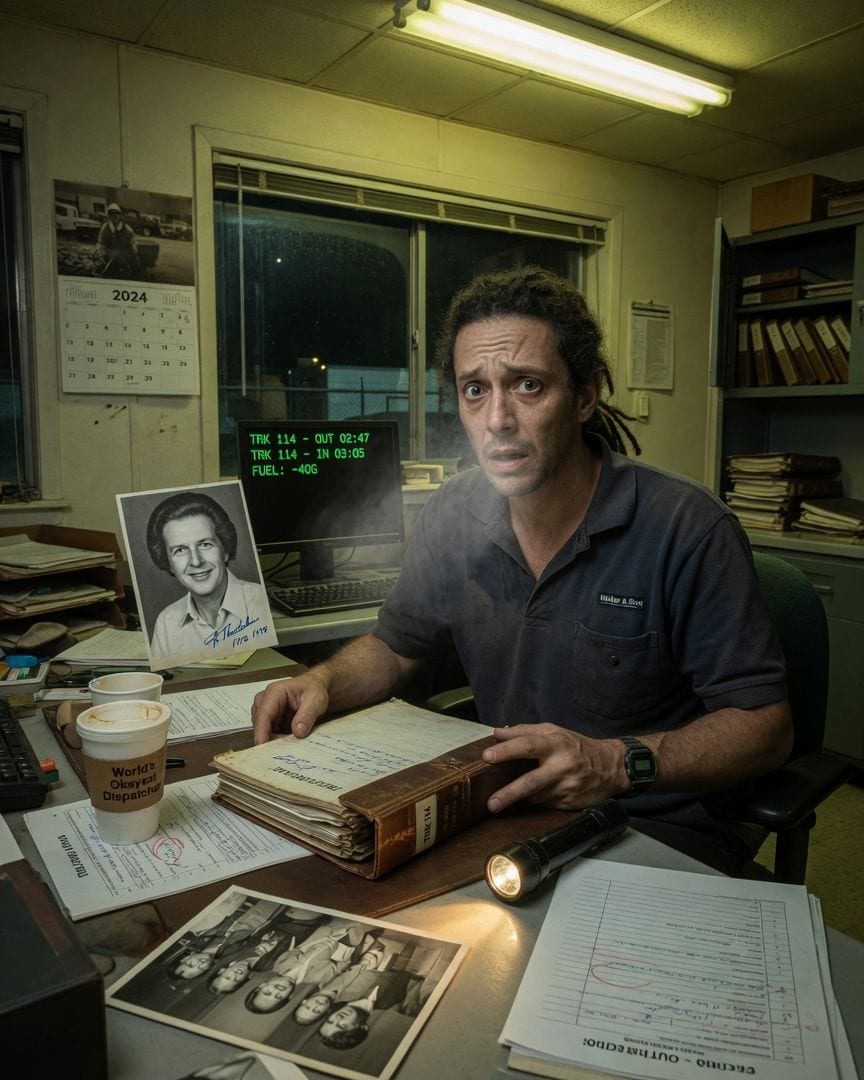
Truck 114 logged forty miles gone last night. It was on the lift, no wheels, and I was the only dispatcher.
My shift in the freight yard dispatch office was quiet, just routine monitoring. But then the CAD system logged Truck 114 moving out for a forty-mile run. That truck was impossible; it had no wheels and was on blocks in maintenance all week.
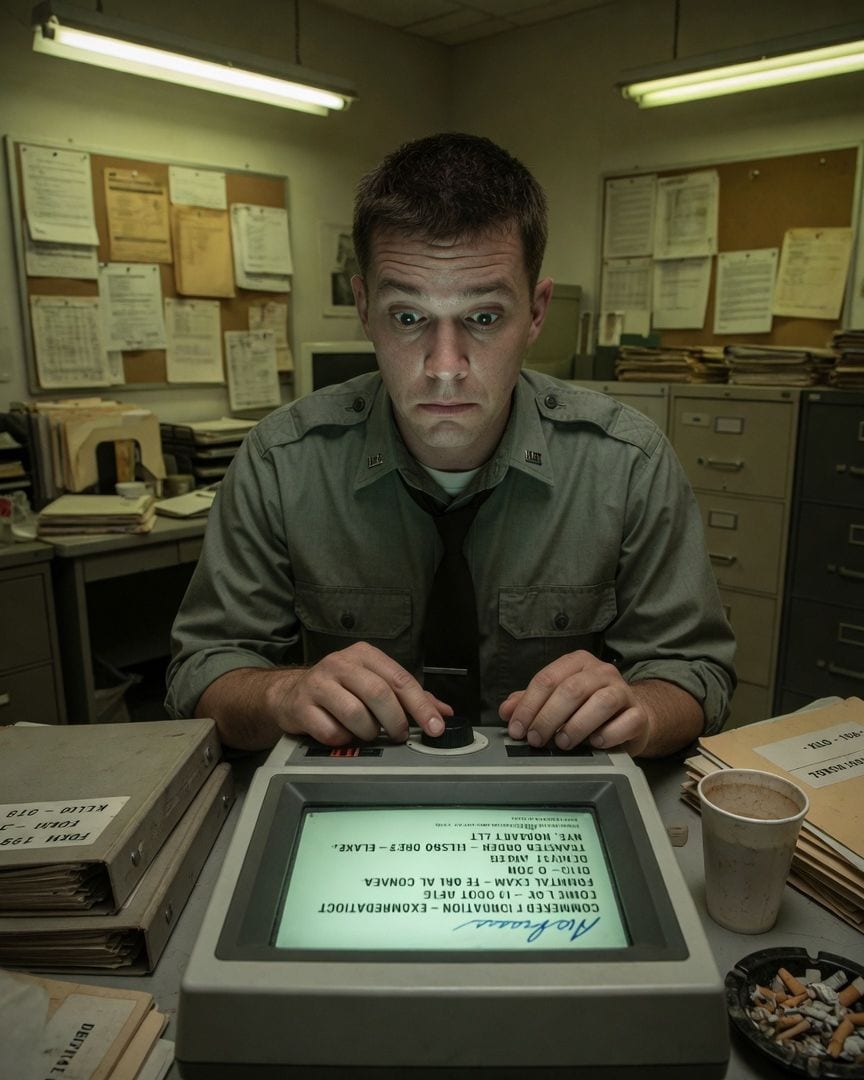
A missile commander watched his ten nuclear silos go dark. His own service record shows his signature on a future he's never lived.
Second Lieutenant Hobart Nye, a missile commander in Wyoming, had his quiet 0247 watch shattered by a security report: a massive, silent black triangle hovered over Launch Facility Kilo, casting a perfect shadow. Hobart watched his console's fault panel light up, signaling all ten nuclear missiles going dark in an impossible silence, followed by eleven minutes his security team could not remember. Official logs called it a "radio malfunction," but Hobart found a requisition for invisible-tracking sensors, signed by a base commander who was supposed to be off-base. The final, chilling discovery came when his own service record showed new entries—a dental check-up, a transfer to Alaska—all dated for a future he never lived, complete with his perfectly replicated signature.
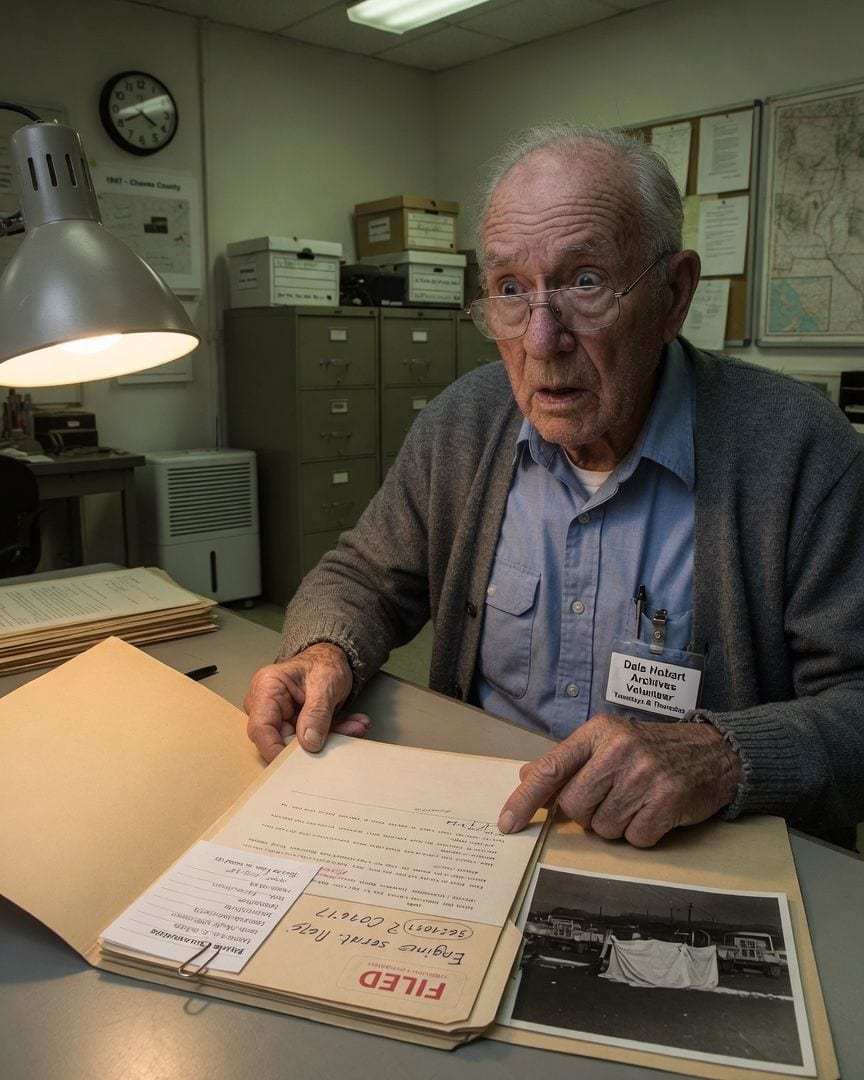
An old sergeant found his 1947 report listed an engine serial number from a jet not yet invented.
Sergeant Dale Hobart was nearing the end of his enlistment in 1947, weary of the dusty New Mexico scrubland. He stood guard over a canvas-covered shape in a remote pasture, the ground unnaturally warm, while the farmer wondered who had called it in. Decades later, volunteering at the National Archives, 85-year-old Hobart unearthed a faded file: 'Project Nightingale - Chaves County Anomaly - March 1947'. Inside, Lieutenant Fontaine’s neat script detailed an engine serial number from a jet not conceptualized for another decade. Then Hobart found his own service number on a 'special recovery team' manifest fifty miles away, on the exact same impossible date and time.
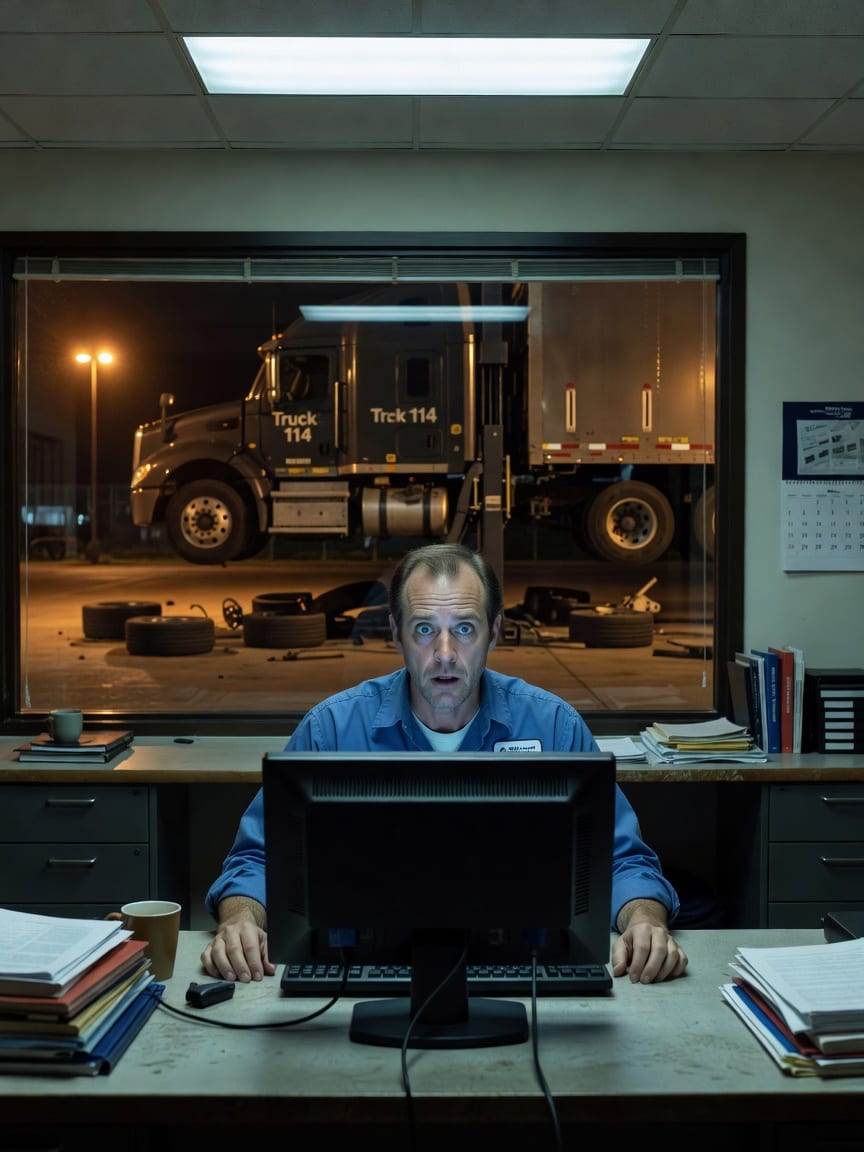
Truck 114 left the yard last night, CAD says. It burned forty miles of fuel. But my truck 114 was up on the lift, no wheels, all shift.
It was another quiet Wednesday overnight in the dispatch office until the CAD system pinged. My screen blared, showing Truck 114 logged outbound for forty miles and back, burning forty gallons of fuel. But I knew that very truck was immobile, suspended on a lift in Bay 4 with its drive wheels removed.