Three weeks from discharge, Corporal Marsh saw the monitor show a private badge in — but the man was asleep in his bunk.
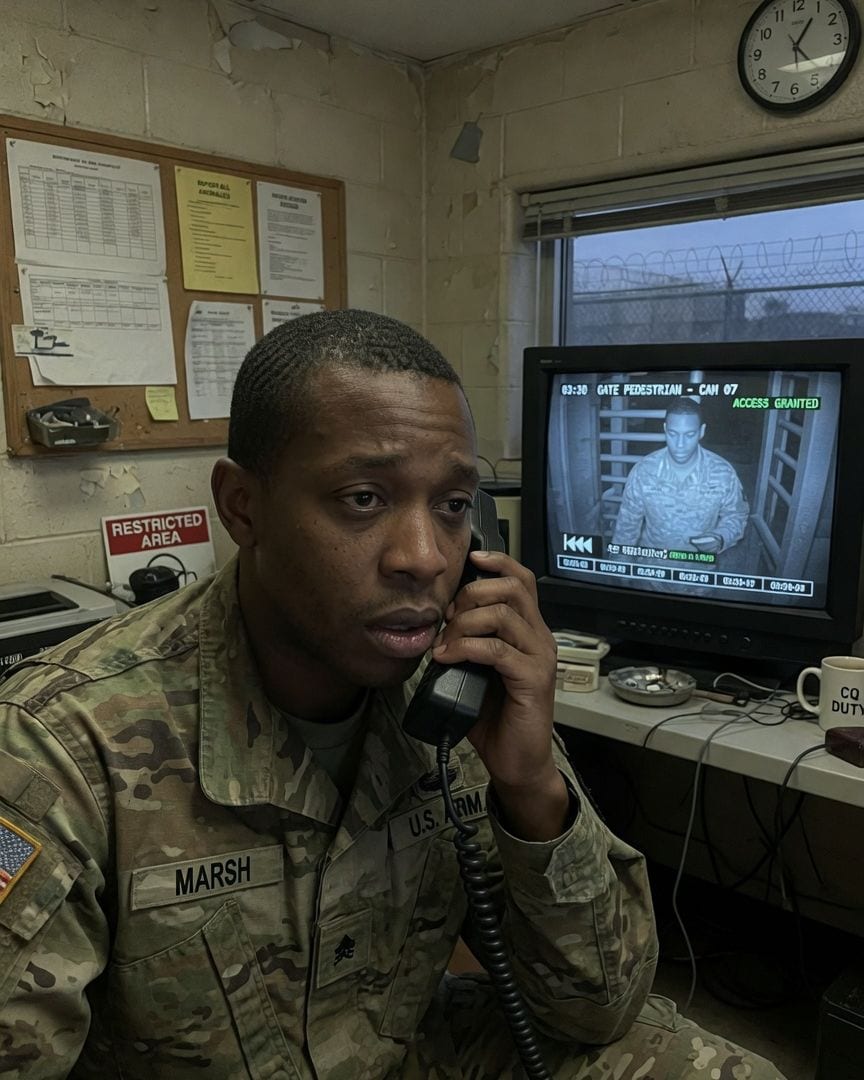
Corporal Simon Marsh, three weeks from his honorable discharge, stared at the security monitor. It was 0338, the dead hour of the Fort in the Carolinas, a time when the sprawling base usually settled into a deep, silent hum.
On screen, the gate camera feed showed Private Theodore Delgado, clear as day, stepping up to the pedestrian turnstile. His profile was unmistakable: the close-cropped hair, the slight slump of his shoulders, the precise way he swiped his ID card.
The access system chimed, a bright, artificial sound cutting through the barracks’ usual drone, confirming the card read. Delgado pushed through the barrier, then vanished from the frame, absorbed by the predawn gloom beyond the gate.
Marsh picked up his radio, the cold plastic familiar against his ear. He thumbed the mic. "CQ, Barracks Four. Sergeant Brooks, you got eyes on Private Delgado?"
A moment of static crackled, amplifying the silence in the security office, then Sergeant William Brooks’ groggy voice broke through. "Yeah, Marsh. He's in his rack, snoring like a freight train. Why?"
Marsh didn't answer immediately. His gaze was fixed on the screen, a knot tightening in his stomach. He rewound the digital footage, skipping back through days, then weeks. Forty nights. Every single one, at precisely 0338, Private Delgado, badging in.
The same movement, the same phantom chime, the same man confirmed asleep two miles away. It was a digital ghost, a glitch the system kept replaying, a perfect, impossible loop.
The static on the radio seemed to thicken, pressing against his ear, but Marsh couldn't look away from the silent, undeniable wrongness of it.
The next night, Marsh couldn't shake it. The image of Delgado’s face, captured with such crisp clarity, had burrowed into his mind.
He reviewed the footage again, frame by frame, his eyes straining for a shimmer, a distortion, anything that screamed 'digital error.' There was nothing. It was solid, clear, undeniable.
The footage wasn't corrupted; it was simply showing something that shouldn't be.
His shift ended at 0700, but instead of heading to the mess hall, Marsh drove his beat-up sedan towards the perimeter fence.
He parked near an old, rusted 'Restricted' sign that marked a decommissioned section of the Fort, not far from the pedestrian turnstile. He’d heard rumors of forgotten bunkers, old training grounds swallowed by kudzu, but nothing official.
The air was still and humid, the pre-dawn light just starting to gray the sky, casting the neglected fence line in a hazy, uncertain glow.
He walked the fence, his boots crunching on gravel, looking for any sign of tampering, a loose wire, a cut that might explain an unauthorized entry. Nothing. The fence was old, but intact. Then, he felt it.
A faint vibration through the soles of his boots, a low, almost inaudible hum in the air. It wasn't the distant thrum of power lines, or the drone of generators. It was deeper, more resonant, originating from beneath the ground.
He knelt, pressing his hand to the damp earth. The hum was stronger here, right where the fence line met a patch of thick, untended kudzu that seemed to swallow the old 'Restricted' sign.
He pulled away a few vines, revealing more rusted wire, clearly untouched for decades. The ground around him was silent save for the hum, which pulsed, a quiet, insistent thrum against his palm.
Marsh knew, with a certainty that chilled him to the bone, this wasn't just a glitch in the system.
Marsh returned to the perimeter fence the following night, after his shift. He couldn't stay away. The humid air hung heavy, and the hum was back, faint but undeniable, a low throb in the quiet night.
He navigated the overgrown path, pushing aside thick branches and tangled vines that clawed at his uniform. The ground here was soft, undisturbed by foot traffic for years, covered in a damp carpet of leaves and pine needles.
He reached the turnstile, the metal cold and still beneath his touch, a silent sentinel. The hum throbbed directly beneath him, vibrating up from the earth. He scanned the ground, then froze.
Leading from the base of the turnstile, through a small, almost invisible gap in the rusted fence wire, was a single, distinct set of boot prints.
They were fresh, the mud still soft around the edges, perfectly formed in the standard issue military pattern. They led directly into the dense, silent overgrowth of the long-abandoned sector, a dark wall of trees and vines.
Then, abruptly, they vanished. It was as if the person who made them had simply lifted off the earth, dissolving into the air itself. There were no other marks, no disturbed leaves, no broken twigs nearby.
Just the prints, and the hum, and the impossible silence.
Marsh spent the next few days in a quiet, methodical obsession. The boot prints were too real, too precise. He confirmed that they matched Private Delgado's issue size and pattern.
He tried to rationalize it – a prank, a stray animal, a hallucination brought on by fatigue from his upcoming discharge. But the prints were too precise, too isolated.
They existed in a vacuum, a record of passage without a source.
He started cross-referencing old base maps with the current digital schematics, focusing on the abandoned sector beyond the fence.
The maps, brittle with age, showed a network of service tunnels, storage bunkers, and a few buildings marked 'Decommissioned - Hazardous Material.' Most were from the late 1960s, early 70s, their original purpose obscured by faded ink and official stamps.
During his next overnight shift, Marsh monitored the gate camera with a new intensity, a tight coil of anticipation in his gut.
At 0338, Delgado appeared again, badged in, then seemed to simply phase out of existence just beyond the turnstile, where the boot prints had vanished into the overgrowth. Marsh radioed Sergeant Brooks again, confirming Delgado was still asleep.
"Look, Marsh," Brooks had sighed, his voice laced with annoyance, "you're almost out. Don't go looking for ghosts on your last few weeks."
But Marsh wasn't looking for ghosts; he was looking for answers. He found a civilian archivist, Dr. Genevieve Kingsley, who had worked at the Fort for decades.
She was a quiet woman, with sharp, knowing eyes that seemed to have seen more than they let on. He asked about the decommissioned sector, about any 'anomalies' in past records. Dr. Kingsley didn't dismiss him.
She just smiled faintly, her eyes distant, as if recalling forgotten shadows. "This Fort has seen many things, Corporal. Some things the records… don't quite capture. There's a reason some places are left alone. Unfinished business, you might say."
Her words settled heavily in the air, a peculiar calm surrounding them. She directed him to an old, thick ledger in a restricted section of the archives, its cover faded and unmarked.
"For those with eyes to see," she'd murmured, her gaze lingering on him for a moment too long.
The ledger was heavy, its pages brittle with age, smelling of dust and forgotten paper. It contained cryptic entries, coded dates, and strange symbols that looked less like military schematics and more like diagrams for something alien.
Marsh spent hours poring over it, trying to decipher the archaic military jargon and scientific terms.
He noted recurring patterns: specific dates, always in the early hours of the morning, always tied to unexplained equipment malfunctions or temporary personnel disappearances in the decommissioned sector.
The very air in the archives felt heavy, like dust and forgotten secrets settling on his skin.
He felt a subtle shift in the atmosphere of the Fort itself. Other soldiers, usually friendly, seemed to avoid his gaze in the mess hall or on the parade ground.
His requests for access to the old sector, once simply denied, were now actively blocked by higher-ups, polite but firm. One afternoon, as Marsh walked back to his barracks, a black sedan, unmarked but clearly military, idled slowly past him.
The windows were tinted, but he felt eyes on him, a prickle on the back of his neck. The vehicle continued slowly for a block, then sped off, leaving him alone on the quiet street.
The next morning, a note was slipped under his barracks door. It was a single sheet of paper, a printout of the gate camera footage from the night before. 0338. Private Delgado badging in.
But this time, a small, vivid red circle was drawn around Marsh, standing by the gate, watching the phantom. Beneath it, a single, typewritten word, stark and chilling: 'WATCHED.' Marsh crumpled the paper, the dread twisting in his gut.
Someone knew he was digging. Someone was watching him. And they weren't trying to stop him; they were reminding him he was seen.
Marsh returned to Dr. Kingsley, the crumpled note clutched in his hand. She looked at the printout, her expression unreadable, a flicker of something almost like concern in her eyes. "They're not subtle, are they?"
she said, her voice soft, barely a whisper in the quiet archive. "The ones who protect the Fort's secrets."
Marsh pressed her, his voice tight with a rising fear. "What is this place, Dr. Kingsley? What's in that sector? And why is Delgado... badging in?"
She led him deeper into the archives, past rows of dusty files and forgotten microfiches, to a small, windowless office tucked away in the back. The air here was cooler, drier, somehow heavier.
"The Fort," she began, her gaze fixed on a distant point, "was built over something older. Something from the Cold War. It had a name: Project Echo."
She pulled out a faded blueprint from a secure drawer, unrolling it carefully on a small, cluttered desk. It showed a massive underground complex beneath the decommissioned sector, a labyrinth of chambers and conduits.
"It was an attempt to create… non-corporeal assets. Phantoms, if you will. Soldiers who could infiltrate anywhere, leave no trace."
Marsh stared at the blueprint, the faint hum from the perimeter fence echoing in his mind, suddenly making a terrible kind of sense. "It failed," she continued, her voice flat, "catastrophically. The project was deemed too dangerous, too unpredictable.
But the system… it never truly shut down. It's like a phantom limb, still twitching, still trying to complete its original protocols."
She pointed to a section of the blueprint marked 'Manifestation Chamber,' directly beneath the old perimeter fence and the turnstile. "The gate is a routine. A protocol. Delgado is just… the latest iteration. An echo."
Marsh thought of the boot prints, the resonant hum, the impossible clarity of the camera footage. It all clicked into place, a horrifying coherence. The system was trying to manifest, to create a solid form. "So, Delgado isn't really there?"
Marsh asked, his voice barely a whisper.
Dr. Kingsley shook her head. "Not the real one. Just an imprint. A pattern. The system needs to draw on living patterns to complete itself. It's searching for a compatible host, a perfect match to fully manifest a stable echo."
Her eyes met his, a flicker of something he couldn't quite place – pity, warning, or a deep, weary resignation. "And the system… it has a very specific way of finding those matches."
Dr. Kingsley then led Marsh to a section of the ledger he hadn't fully deciphered – a list of 'potential subjects' for Project Echo, cross-referenced with biological markers.
It detailed specific genetic predispositions, psychological profiles, all coded in a language he was only now beginning to understand. She explained that the 'echo' system, even in its dormant state, could detect these markers in active personnel on the Fort.
"It's how it chooses its patterns," she whispered, her voice barely audible, like a secret the room itself wanted to swallow.
Marsh's heart pounded as he scanned the yellowed list. He saw names, service numbers, dates that stretched back decades.
He recognized a few names from old Fort legends, soldiers who had simply vanished or gone AWOL under strange, unexplained circumstances, their fates wrapped in rumor and hushed tones.
The pattern was undeniable: a recurring cycle of disappearances, always linked to these 'potential subjects.' His fingers trembled as he scrolled down the last page, a more recent addendum, added in a different, fainter ink.
He saw a service number he knew, a string of digits that sent a jolt of ice through his veins, a number tattooed onto his own memory. He looked at the name next to it. Simon Marsh. His own name.
His own service number. Listed as a 'potential subject' for Project Echo, decades before he was even born. The realization hit him like a physical blow, a cold, sickening certainty that he was never just an observer.
He was part of the pattern, already marked, already chosen.
Marsh ripped his eyes from the roster, staring at Dr. Kingsley, his face pale. "This isn't possible," he choked out. "I wasn't even born when this was written."
Dr. Kingsley placed a hand on his arm, her grip surprisingly firm, her eyes unblinking. "The system, Corporal, doesn't operate on our timeline. It identifies potential. It lays dormant, waiting for the right conditions, the right 'patterns' to arrive.
You, Simon, fit the profile. That's why you were drawn to this, why you saw Delgado. The system is trying to manifest you."
She explained that the 'echoes' like Delgado were trial runs, incomplete manifestations, unable to fully cross over. The system was now attempting a full, stable transfer, a permanent echo, and Marsh was its prime candidate.
The hum beneath the perimeter fence, the vanishing boot prints, the subtle surveillance – it was all leading to him, a deliberate, slow pull. "The 'watched' note wasn't a warning to stop," she said, her voice grim.
"It was an acknowledgement. You are ready to be absorbed."
She revealed that she had been a junior researcher on Project Echo, tasked with cataloging 'failures' after the catastrophic shutdown.
She had been trying to guide him, to warn him without breaking her oath of secrecy, to save him from a fate she couldn't escape herself.
The Fort itself, she explained, was a gigantic antenna, feeding the buried system, unknowingly fueling its dormant hunger. And his upcoming discharge? It was a ticking clock.
The system's 'manifestation window' for a full transfer was narrow, often coinciding with periods of transition for the subject. Marsh's impending departure made him a prime target, a pattern on the cusp of disengagement, easier to 'capture.'
The dread wasn't just about what was happening, but what had always been waiting for him, a destiny etched onto a decades-old list.
Panic warred with Marsh's military discipline, a cold sweat breaking out on his forehead. He had to get out, now. Dr. Kingsley handed him a worn, heavy-duty flashlight and a small, outdated data chip.
"This contains a raw data stream from the project's final days," she said, her voice urgent. "It's corrupted, but it might be enough. Proof, if anyone would ever believe it."
She pointed him to an emergency service tunnel, a forgotten access point to the outside world, deep within the decommissioned sector. "Go. Now. Before the next activation cycle."
Marsh ran, the humid night air thick around him, pushing against his chest. He bypassed the main gate, heading straight for the old perimeter fence.
The hum was no longer faint; it throbbed, a low, resonant growl that vibrated through the ground, through his bones. He could feel a presence, a growing awareness, like an invisible hand reaching for him, stretching across the distance.
He reached the gap in the fence, scrambling through, ignoring the tearing uniform and the sharp snags of rusted wire.
The boot prints were everywhere now, not just one set, but dozens, faint and shimmering, converging on the buried access hatch Dr. Kingsley had described.
The air shimmered faintly, like heat rising from asphalt, and he could almost see the outlines of figures, like heat haze, moving through the trees.
They were vague, indistinct, but they were there, and they were drawing closer to the hatch.
Marsh fumbled with the rusted lock, his fingers slick with sweat, his breath ragged. The hum intensified, a high-pitched whine that threatened to shatter his eardrums.
He heard a voice, faint but clear, whispering his name: "Simon… Marsh…" It was his own voice, yet utterly wrong, devoid of emotion, an echo.
He jammed the data chip into his pocket, finally forcing the hatch open with a desperate heave.
He plunged into the darkness, the faint, wrong voice still calling his name from the shimmering woods behind him, carrying the proof no one would ever believe.
Marsh made it to the nearest town, miles from the Fort, hitching a ride with a bewildered truck driver. He never returned to complete his discharge. His absence was logged as 'AWOL,' a black mark on an otherwise exemplary record.
The data chip he carried was dismissed as corrupted, a hallucination, or a fabrication by a stressed-out soldier. Dr. Kingsley remained at the Fort, her calm, knowing eyes watching the gate camera.
Private Delgado continued his duties, unaware of the phantom that bore his name. The Fort's command issued a brief, boilerplate statement about a 'system malfunction' and 'personnel error.' Nothing changed. Except for Marsh.
Simon Marsh tried to rebuild his life. He found a quiet job, far from any military installation, working nights as a delivery driver. He avoided cameras, especially security feeds, a constant, low-level paranoia humming beneath his skin.
The hum, that low, resonant thrum he'd first felt beneath the perimeter fence, sometimes returned in the quietest moments, a phantom vibration in the soles of his feet. He knew what it was, knew what it wanted.
The proof was useless, filed away in a box no one would ever open, destined to be forgotten. He never spoke of the Fort, or Project Echo, or the names on that yellowed roster.
But sometimes, late at night, when he was alone, he would catch a glimpse of his reflection in a darkened window.
And for a fleeting, horrifying second, he would see not his own tired face, but a slightly distorted, unnervingly still version of himself, watching him with empty, waiting eyes.
He knew it was still out there, searching, waiting, a system that had marked him decades ago. It just hadn't finished its work.
And sometimes, he could still hear it, a faint, wrong whisper carried on the wind, calling his name.
If this one got to you
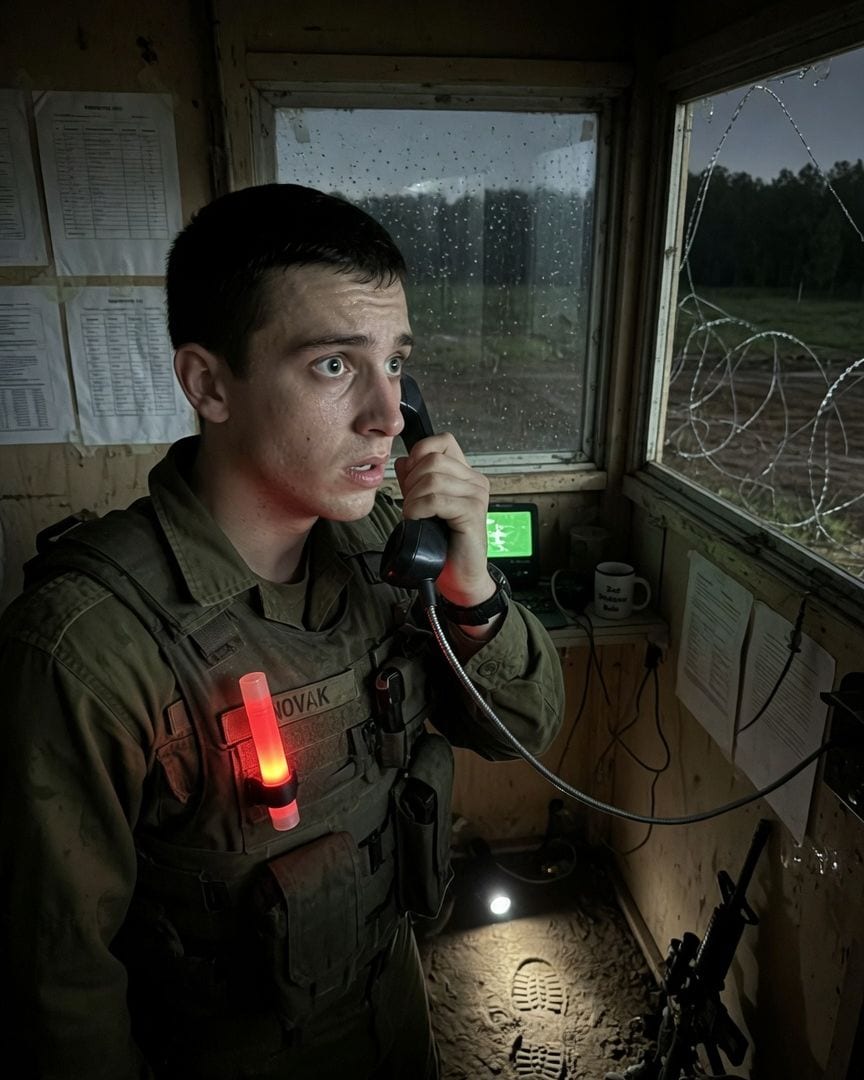
A sentry finds a fresh boot print *inside* the wire, but the barbed fence is untouched.
PFC Isaac Novak mans the outpost tower, sweeping the perimeter for any anomaly. After an unnervingly smiling man appears and vanishes beyond the wire, Novak descends to patrol. He finds a single fresh boot print deep *inside* the perimeter, yet the barbed wire remains perfectly intact and undisturbed.
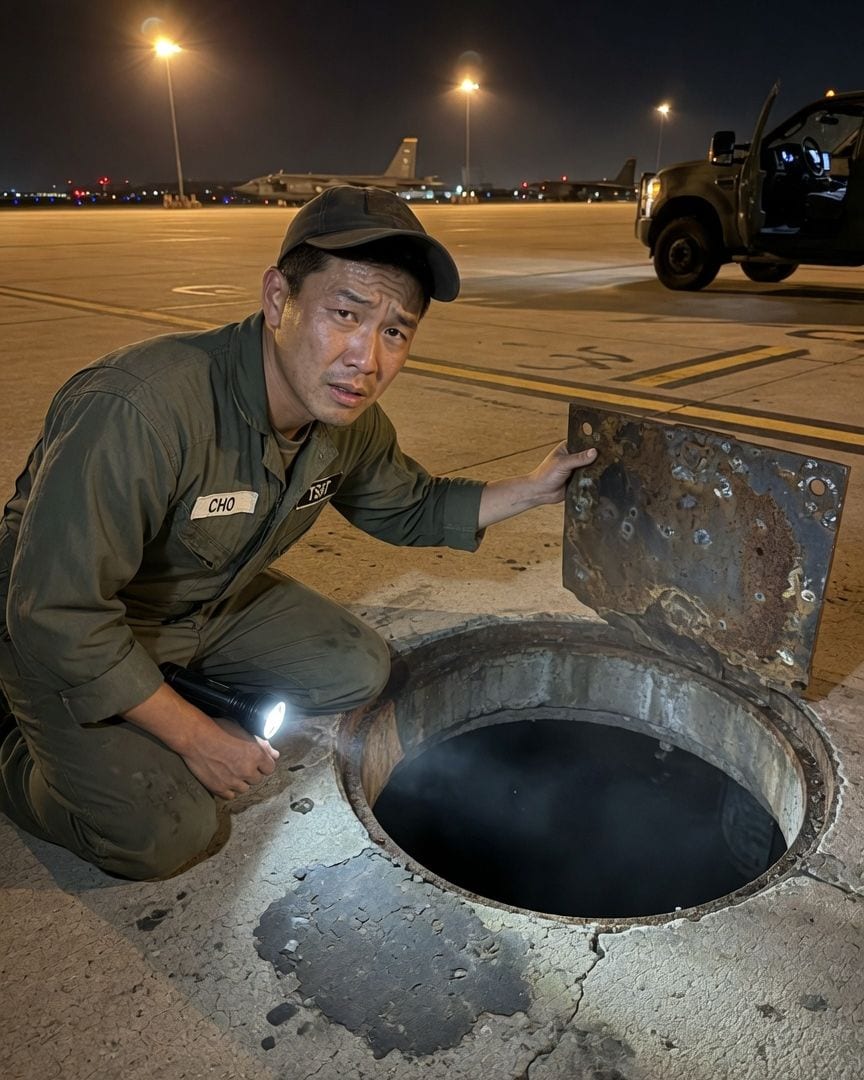
Two weeks from leaving, Technical Sergeant Cho felt a phantom weight pass through his truck, parked on the flight line.
Technical Sergeant Daniel Cho was counting down his final two weeks at the Dakota bomber base, determined to solve the phantom riddle of its floodlit flight line. Every night at 0148, a buried sensor logged a vehicle pass, yet overhead thermal cameras consistently showed nothing but empty concrete. To catch the anomaly, he parked his heavy maintenance truck directly over the sensor. But as the clock turned 0148, a low thrum vibrated through his teeth, and the sensor registered a second, impossible vehicle pass—right through his own parked truck. His investigation soon uncovered a hidden, unmapped metal plate in the concrete, sealing a dark shaft that hummed with a deep, rhythmic vibration, like an enormous heartbeat from beneath the earth.
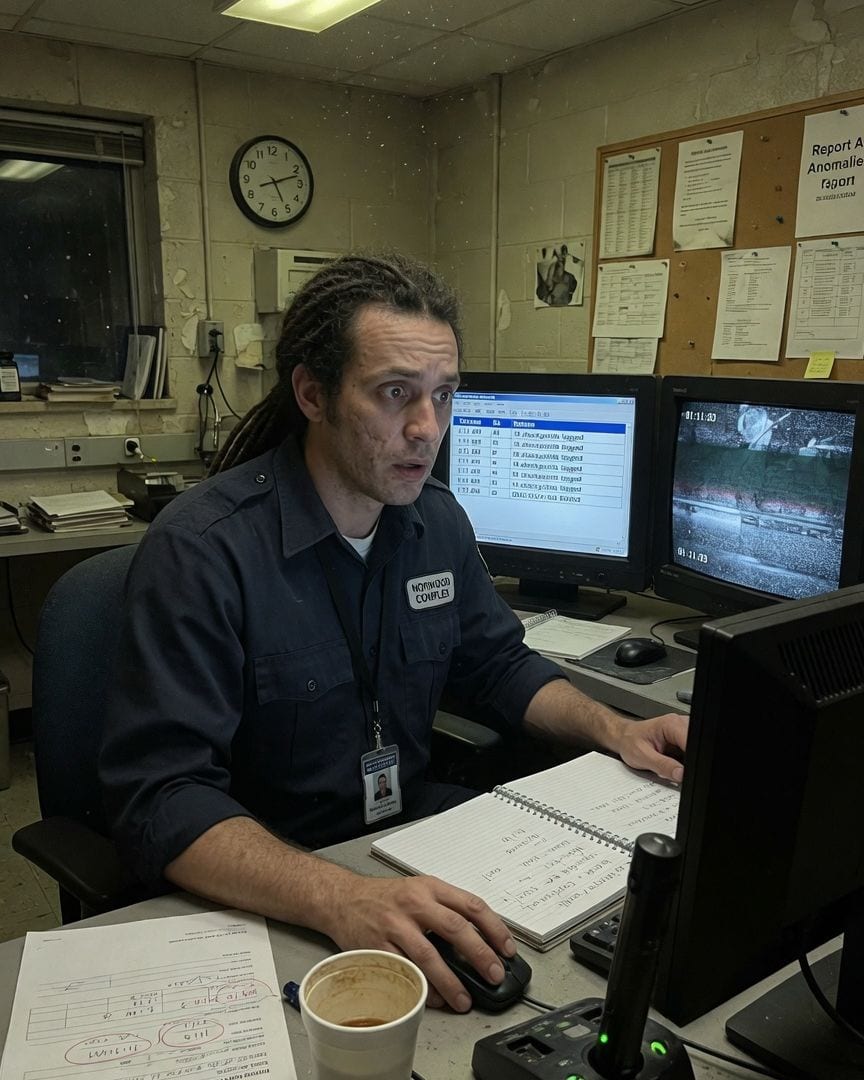
Three years ago, my security wand logged a full patrol at 1:11 AM. I was working in Arizona.
My night shift at the Norwood Complex involved the usual routine: plugging in my security wand and catching up on incident reports. But the morning's security log for that Friday showed an impossible full building sweep at 1:11 AM. All fourteen checkpoints were logged as hit by my wand, in under four minutes, a route that normally took me at least twenty.
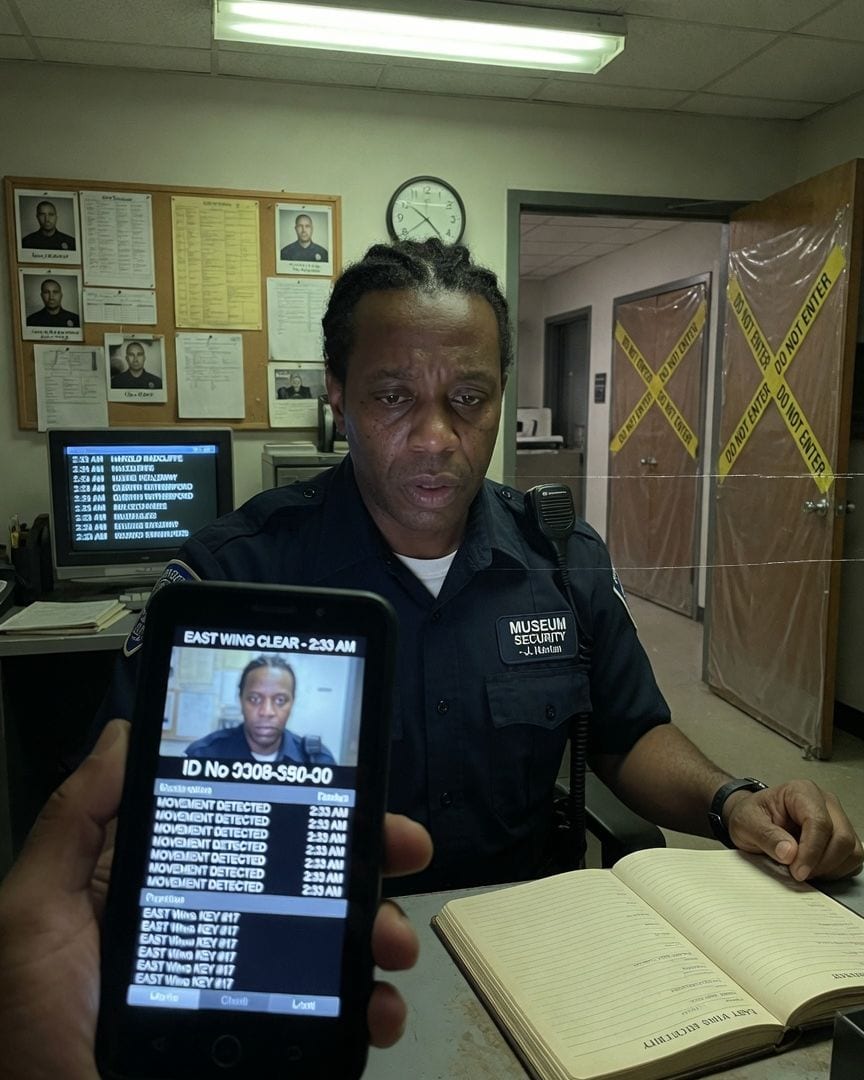
My guard log shows the east wing cleared at 2:33 AM. That wing's been sealed for months, doors screwed shut.
I was on my final security rounds in the quiet museum after midnight, ready to clock out. My handheld scanner showed the East Wing cleared at 2:33 AM under my ID, though it's been sealed for months. Then my hand brushed a faint, precise scratch on the plastic covering the doorframe, exactly where a security scanner would be held.
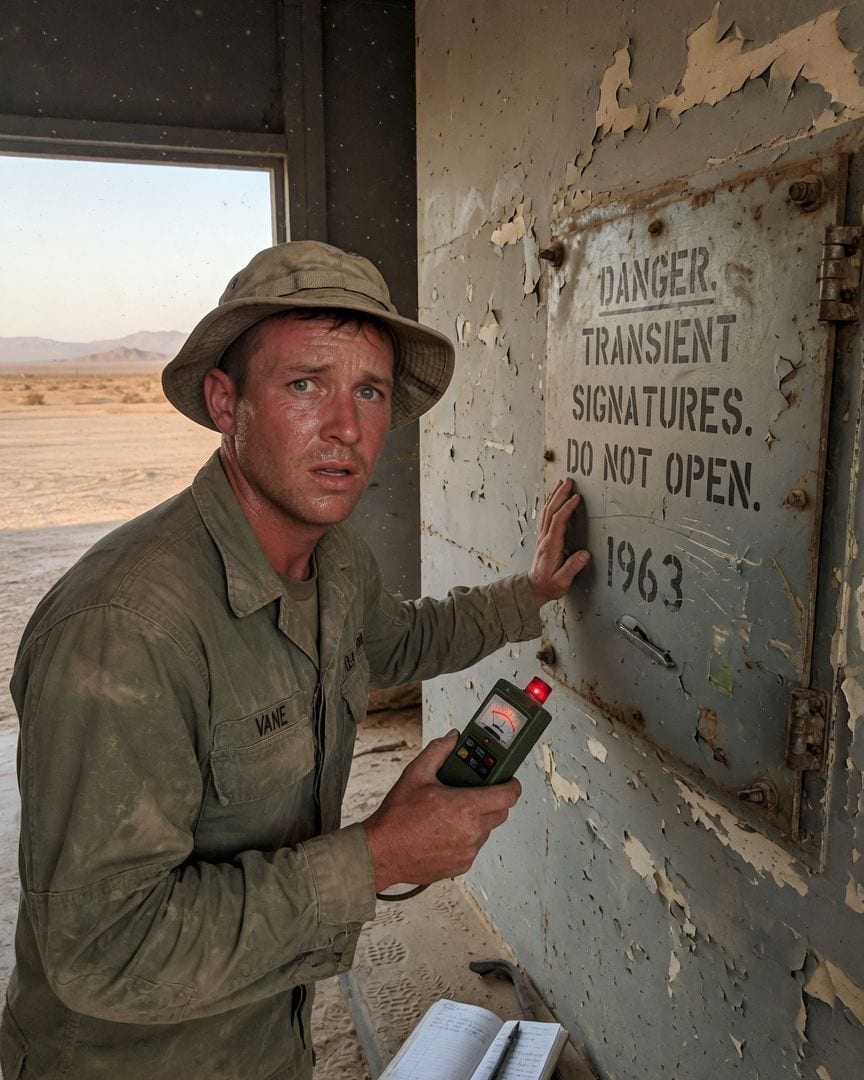
On Airman Purdy Vane's last survey of a Cold War testing range, hot footprints strode four hundred yards into a concrete wall with no door, and no prints leading out.
Airman Purdy Vane conducted his final, lonely survey of Sable Draw, a vast desert testing range slated for permanent closure. Under the relentless late summer sun, his Geiger counter, usually silent, suddenly shrieked. It led him to a perfect, four-hundred-yard track of intense radiation readings, like unhurried footprints, ending abruptly against the blank, doorless wall of a concrete instrument shed. Despite the range being officially cold for decades, Purdy later uncovered a hidden steel panel on that wall, bearing a stark, hand-painted warning: 'DANGER. TRANSIENT SIGNATURES. DO NOT OPEN. 1963.' How could something so dangerous remain hidden, decades after the desert was declared safe?
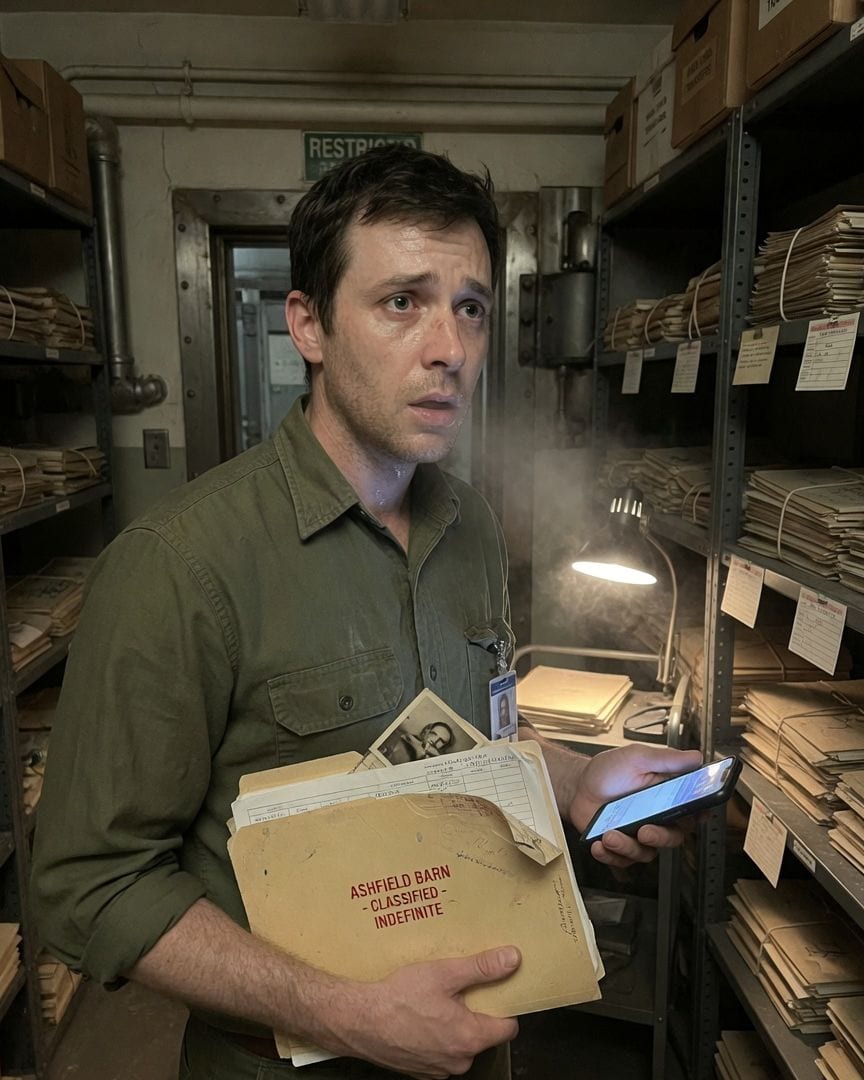
An archivist closing his vault found a file: boot prints led into a shed, none out. Its subject was 'in custody' for eighty-one years, re-signed six days ago.
Archivist Devin Mauch was on his last shifts, transferring files before Fort Loran’s vault closed for good. Tired and ready for his own move, he uncovered a slim, classified file about the Ashfield Barn. Inside was a sepia photo of a dilapidated shed, showing boot prints leading straight to its door, with none leading out. The official caption stated a 'subject' remained 'in custody, indefinite,' a status re-signed quarterly for eighty-one years, most recently just six days ago. Driven by a chill colder than the vault itself, Devin later found the shed, its dust-covered floor bearing the same impossible prints, and then heard a soft, almost imperceptible sound from its darkness.