My vasectomy clips showed up on an ultrasound. I've never had a vasectomy, and my wife and I tried three years for our son.
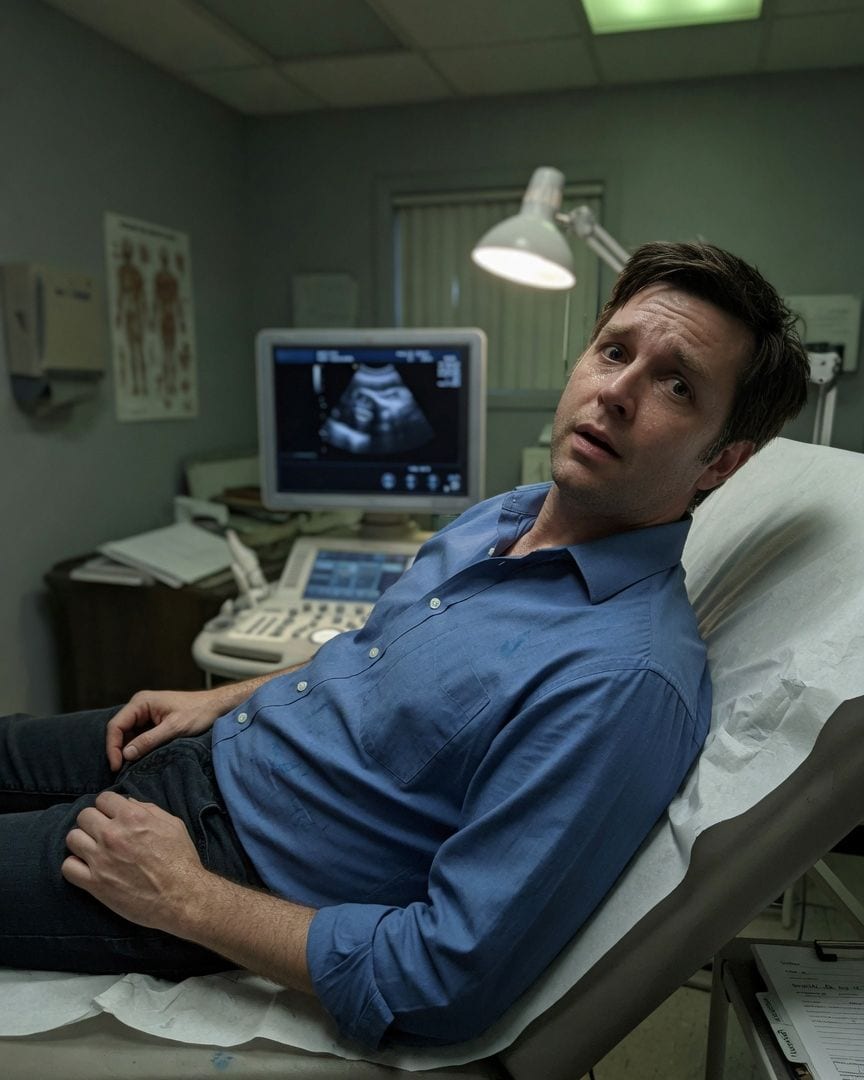
I lay on the exam table, the paper crinkling under me, trying to make sense of Dr. Drummond’s delicate tone. I’d gone in for a minor scrotal lump, nothing serious, just a nagging discomfort.
The ultrasound screen, however, showed something else entirely. Dr. Drummond, a man I’d trusted for years, pointed to two tiny, metallic clips, unmistakable, glinting on the grayscale monitor. They were at the ends of my vas deferens.
"It appears both tubes have been cut and sealed, Mr. Vance," he said, his voice soft, almost apologetic.
I blinked, my mind racing. Cut and sealed? Impossible. I’d never had a vasectomy. Never, not in my life. Cynthia, my wife, and I had spent three difficult, agonizing years trying for our son, Leo.
We’d gone through rounds of tests, fertility treatments, the whole heartbreaking ordeal. The idea of me having a vasectomy was not just absurd, it was cruel.
"There must be a mistake," I said, my voice thin. "A mix-up. Wrong chart. That’s not possible."
Dr. Drummond didn’t argue. He just rescanned, patiently, meticulously, zooming in. The image sharpened. The clips were still there. Small, embedded, their edges clean. He confirmed the old, healed ends of the tubes, the absence of any recent trauma.
This wasn’t fresh. This was old, permanent. He looked up from the screen, his expression a careful blend of concern and utter confusion.
"Can you tell me, Mr. Vance," he asked, his gaze unwavering, "the approximate date of this procedure?"
My world tilted. I left Dr. Drummond’s office in a daze, the question replaying in my head, an unbearable static. Date of this procedure? There was no date, no procedure.
I tried to research, to find any medical record, any forgotten surgery that could possibly explain it. Nothing. My digital health portal was blank on anything resembling a vasectomy.
That night, I told Cynthia. She listened, her brow furrowed, her face falling from concern to utter bewilderment, then a quiet, chilling fear. She knew how desperately we’d wanted Leo, the hope and despair of every month.
The idea was absurd, terrifying, a violation of our shared history. She kept touching my arm, as if to ground me, or herself, in reality.
The next day, still reeling, I sought a second opinion. Dr. Sarah Coleman, a urologist across town. I didn’t mention Dr. Drummond’s findings, just asked for a full work-up on the lump, a comprehensive scan.
Dr. Coleman, after her own unhurried scan, confirmed it all. The clips, distinct on the screen. The perfectly healed ends. The absence of any recent trauma.
It was old, she said, perfectly integrated into the tissue, as if it had always been there.
"The lump looks benign, nothing to worry about," she concluded, then added, "But to be thorough, to rule out anything deeper, I’d suggest an MRI. Just a precaution."
I agreed, desperate for any explanation beyond the impossible one staring back at me from the ultrasound. I started digging into my childhood medical records, a dusty box retrieved from my mother’s attic last week. They were sparse, frustratingly incomplete.
I found strange, uncharacteristic gaps around my late teens and early twenties, periods I remembered clearly, full of college and early jobs, but for which official documentation seemed to just… vanish.
The MRI results came back a week later. Dr. Coleman called me personally, her voice tight, a thin strain I didn’t like.
I sat in her office, Cynthia beside me, her hand gripping mine, as Dr. Coleman brought up the images on a large, backlit screen.
"The lump is benign, Mr. Vance," she began, her finger tracing a harmless, almond-shaped shadow on the scrotal image. "No concerns there. And the vasectomy is… confirmed. Just as we suspected."
She paused, then navigated to a different view. The screen shifted to a cross-section of my skull, a stark, gray landscape of bone and tissue. My breath caught in my throat.
"But there's something else," she continued, her voice low, a new tension in it. "Deep within your cranium, near the parietal bone." She highlighted a faint, perfectly circular scar, deep in the bone itself, a stark, smooth line.
"It’s an old trepanation site. Completely healed, decades old. No external scar, no record of any such surgery in your history. And you have no memory of it?"
I stared at the impossible wound, a clean, circular cut in the bone of my own head, a secret history etched into my very being, silent and terrifying.
The trepanation scar ignited a new, colder fear in me. This wasn't just a surgical anomaly, a medical misfiling. This was a profound violation, a hidden history written into my very bones, a history my mind refused to acknowledge.
The clean, healed edges of that bone scar mocked my memory.
I became obsessed. Work, meals, sleep – they all faded into the background. I neglected emails, barely registered Cynthia’s quiet questions. My evenings were spent hunched over my laptop, poring over medical archives online, cross-referencing rare procedures and obscure institutes.
My search, initially frantic, became methodical, driven by a desperate need to explain the inexplicable.
Then, buried in the margins of one of those fragmented childhood medical reports I’d found in my mother’s attic, I found it. A forgotten reference in an old medical journal, from the 1970s: ‘The Sutton Institute for Cognitive Preservation.’
It was described as a private research facility, long since closed, specializing in 'advanced neurological interventions.' The name resonated with a faint, unsettling familiarity.
I tracked down its last known address, a grand, decaying building on the outskirts of the city, now redeveloped into a corporate campus. The original facade was still there, imposing and strangely cold, like a mausoleum.
Inside, the new offices were sleek, modern, but I knew what lay beneath. I found Roland Sutton in the building’s archives, a designated historical preservation office that felt out of place amongst the glass and chrome.
He was a man in his late sixties, with an unnervingly calm demeanor and eyes that seemed to hold ancient, unsettling knowledge.
Sutton, the lead archivist, dismissed my inquiries about the Institute's past as 'misguided curiosity.' He claimed most records were gone, destroyed, too old to matter.
But a faint, knowing smile played on his lips when I pressed him, mentioning 'unusual cranial procedures.'
He spoke of 'transference cases' as if they were mundane, everyday occurrences, describing them with a detached clinical air that made my skin crawl.
"Remarkable work, in its time," he'd murmured, his gaze drifting to a dusty shelf, "the re-syncing process was particularly elegant."
Small shifts started to surface in my own habits. A sudden, inexplicable aversion to a food I once loved – coffee, oddly enough – replaced by a craving for strong black tea.
A passing, vivid memory of a street I’d never visited, a cobblestone alley in a European city.
A phrase I’d never used before, 'optimal conditions,' slipped into my conversation, which Cynthia occasionally pointed out with a raised eyebrow, a quiet question in her eyes.
The digging didn't go unnoticed. I started receiving anonymous calls, the line silent when I answered, a faint, almost imperceptible hum before it disconnected.
A dark sedan with tinted windows was often parked a block from my house, disappearing whenever I approached, a phantom presence that tightened my chest.
I tried to access more detailed records from the Sutton Institute through official channels, only to be met with bureaucratic stonewalling; files were 'sealed,' 'misfiled,' or 'destroyed in a fire years ago.'
The unease tightened its grip, knotting in my stomach.
One evening, an email landed in my inbox from an unknown sender. The subject line was simply "Coherence." The body contained a single, chilling sentence: 'Some knowledge is best left undisturbed, Mr. Vance. For your own coherence.'
The words were a direct echo of Roland Sutton’s earlier, casual remark. I felt a prickle of cold dread crawl up my spine. My hands shook as I typed. Who was watching? Who else knew?
I drove straight to the Sutton Institute campus, the modern building feeling like a cage around an ancient, festering secret.
I found Roland Sutton in his archive office, bathed in the dim light of an antique lamp, surrounded by heavy, leather-bound books. He looked up from an ancient ledger, his expression unreadable, calm as a lake at midnight.
"Are you watching me?" I demanded, my voice trembling, the question tasting like ash in my mouth.
Sutton’s gaze was unsettlingly steady, unwavering. "We merely ensure the integrity of our… subjects, Mr. Vance," he said, closing the ledger with a soft thud. The sound seemed to reverberate through the silent room. "You are a valuable asset."
He leaned back in his chair, a faint smile playing on his lips, not a warm smile, but something cold and knowing. "Your current trajectory suggests a deviation. A return to baseline may be advisable. For your own good.
For your family’s peace of mind."
Desperate and unnerved, I found Michael Marsh. He was a retired records clerk who had worked for the municipal archives decades ago, a man known for knowing where the 'bodies were buried,' figuratively speaking.
His address was tucked away in a quiet suburb, his small house filled with stacks of old newspapers and the smell of dust and coffee. Marsh was a nervous, twitchy man, clearly afraid even before I asked my first question.
His eyes darted around the room as we spoke, as if expecting someone to materialize in the corner.
I pressed him, offering a substantial sum – enough to make his eyes widen, enough to break his resolve.
He finally cracked, lowering his voice to a whisper, pulling me closer to hear over the drone of his air conditioning unit, which hummed like something trapped.
"The Sutton Institute," he said, glancing around nervously at his own walls. "They weren't just researching. They were… preserving. Wealthy clients, mostly. Old, dying. They'd transfer their minds, their consciousness, into younger, compatible bodies."
I felt a chill that had nothing to do with the air conditioning. "You mean, like… putting someone else in my body?"
Marsh nodded frantically, his eyes wide. "They called it 'identity preservation.' Experimental, highly illegal. But they had the money, the connections. They operated under a veil of medical progress, but it was… something else entirely."
He fumbled through a dusty box of his own, tucked under a pile of old tax documents, pulling out a heavily redacted document, brittle with age. "This is a partial manifest. From the early days."
He pointed a shaking finger at a faded line of type. "See here? Your birthdate, Julian Vance. But beside it… a much older one. For the 'donor vessel.' A different name entirely."
My stomach lurched, a sickening twist of recognition. My vasectomy, the impossible trepanation scar – they weren't anomalies. They were traces.
Marks left by the previous occupant, the one whose life had been lived in his body before my own consciousness had taken hold.
The dread was no longer abstract; it was personal, intimate, a cold hand reaching into my very core.
"And if the new identity… conflicted?" I asked, my voice barely a whisper, afraid of the answer.
Marsh gulped, his Adam's apple bobbing. "They had ways to… re-sync. To ensure the original personality… remained dominant. That’s what they called it. 'Optimal coherence.'"
Marsh, now visibly terrified, pushed the redacted document back into the box. He kept glancing nervously at the door, as if at any moment, Roland Sutton himself would appear.
"They kept meticulous records," he whispered, his eyes darting to the door again. "Of every recipient. They had a way to 're-sync' them, if a vessel started to… deviate. To ensure the original personality remained dominant."
He fumbled deeper into the box, his hand emerging with a faded, grainy black-and-white photograph. It was from the 1970s, a group of stern-faced scientists in a sterile lab, standing around what looked like early, clunky transfer equipment.
One man in a lab coat, standing slightly apart from the others, looked directly into the camera, a faint, almost arrogant smile on his face.
His face was unmistakable. My face.
Marsh shoved the photo into my hand, his own hand shaking violently. His voice dropped to an urgent, terrified whisper. "He was the first. The original."
Then, with a frantic glance over his shoulder, he scrambled out of the room, leaving me alone in the dusty silence, clutching the faded photograph, the face of the man from the 1970s staring back at me with my own eyes, while the words 'He was the first.
The original.' echoed in my ears, a chilling implication of a self that existed long before I did.
The photograph burned in my hand, an acid truth searing through every fiber of my being. I wasn't just a recipient, a vessel for someone else. I was the 'original.'
My current consciousness, my life with Cynthia and Leo, was merely the latest iteration, occupying the same body (or a series of identical bodies, the thought flashed through my mind) that housed my 'original' self.
The vasectomy, a lifestyle choice of some previous version of me. The trepanation scar, not a mark of a 'donor vessel,' but a surgical wound inflicted upon me, the original, for the continuous 'identity preservation' of myself.
As this horrifying truth detonated in my mind, the door creaked open. Roland Sutton appeared in the doorway, having followed me from Marsh’s house. Sutton’s calm expression was chilling, a mask of serene control.
"Your deviation was becoming too pronounced, Mr. Vance," he said, stepping into the room, his voice soft, almost regretful. "The current overlay, this 'Julian Vance' identity, was asserting itself too strongly over the core programming."
He gestured to the photograph in my hand. "The original template," he continued, his eyes briefly flicking to the image. "A brilliant mind, a visionary in his field. We've preserved him, in various forms, for decades.
'Julian Vance' is just one of many names, one of many lives designed to maintain the core consciousness in optimal conditions." He paused, a ghost of a smile touching his lips.
"The vasectomy was indeed a lifestyle choice of a previous iteration, a preference that was maintained. And the trepanation? That was for the critical 're-sync' process, to correct precisely this kind of divergence."
Every planted clue, every impossible detail, every chilling word from Marsh, every shift in my own habits – it all clicked into place with horrifying coherence.
I was not a man with a past; I was a past, layered over and over, my current existence a temporary, carefully constructed narrative designed to house a consciousness that saw me as merely its latest iteration.
Roland Sutton, still unnervingly composed, began to guide me toward a hidden door I hadn't noticed, cleverly disguised as a section of the wall.
It slid open with a soft hiss, revealing an antiquated yet functional neurological chamber, all gleaming chrome and dark, padded surfaces. Wires snaked from a central console, ending in a helmet-like device.
"It's time for a recalibration, Mr. Vance," he stated, his voice devoid of malice, as if leading a child to bed. "A return to coherence. We can't have the current iteration destabilizing the core."
But the primal terror of losing myself, of having my identity overwritten, was a raw, burning fire in my gut. I wouldn't let him. I lashed out, striking Sutton with a desperate, clumsy blow.
He stumbled back, surprised, but quickly recovered, his composure barely ruffled. I scrambled towards the chamber's control panel, a tangle of old dials and flickering screens, a relic from the past. My eyes darted around, searching for anything.
I grabbed a heavy wrench from a nearby workbench, its cold steel a sudden comfort in my shaking hand. With a guttural cry, I smashed it into the exposed wiring of the console, sending a shower of bright, angry sparks.
The ancient machinery groaned, lights flickered violently, and alarms blared throughout the Institute, a piercing, insistent wail. Sutton lunged for me, his hand reaching, but I, desperate, kicked him away, then delivered another shattering blow to the main console.
Circuits crackled, wires snapped, and the acrid smell of ozone filled the air.
The chamber began to power down, the insistent hum dying, replaced by the escalating wail of emergency sirens from outside, converging on the building.
Sutton stood amidst the failing equipment, a slight, almost serene smile on his face, a thin trickle of bl**d from his temple. "A temporary setback," he said, his voice carrying clearly over the alarms. "The program continues. It always does."
I didn't wait. Seizing the opportunity, I sprinted out of the room, the collapsing Institute behind me, the alarms fading into the distance as I burst out into the cool night air.
I didn't look back, the fight for my own mind leaving me profoundly shaken, but alive, for now.
The Sutton Institute for Cognitive Preservation was quietly investigated and then shut down by federal authorities. Its archaic technology and disturbing records were confiscated and sealed away.
News reports briefly mentioned an eccentric, defunct medical research facility, its purpose unclear, its former operations shrouded in legal ambiguity. No mention of consciousness transfer, no mention of ‘identity preservation.’ It was too unbelievable, too unsettling for the public.
I returned to Cynthia and Leo, the external threat removed, but the internal one remained. I tried to reclaim my normal life, to forget the chilling revelations, to re-establish the narrative of Julian Vance, loving husband and father.
But the knowledge that my own body was a vessel, my identity potentially a construct, gnawed at me, a constant, low thrum beneath the surface of my consciousness.
Every shared memory, every personal preference, every dream felt fragile, re-examined for its authenticity.
I tried to forget. I watched Leo playing in the living room, a perfect, innocent child, building a tower of brightly colored blocks. His laughter was pure, uncomplicated.
I picked up my phone, scrolling through Facebook, seeing a news article about the Institute, now an empty shell, its secrets locked away, its name faded from the headlines.
I scrolled further, then stopped. A sponsored ad caught my eye, shimmering just beneath a friend’s vacation photos: 'Reclaim Your Best Self. The Rebirth Clinic. A New You Awaits.' The ad featured a smiling, confident man, impeccably dressed.
His face was a subtle, almost imperceptible echo of Julian's own, a ghost of a familiar feature, a curve in the jaw, a glint in the eye. A flicker of recognition, a chilling sense of déjà vu.
His wife, Cynthia, walked in, asking if he'd seen Leo's favorite toy. Julian looked up, a faint, wrong smile touching his lips. "Is that so?"
If this one got to you
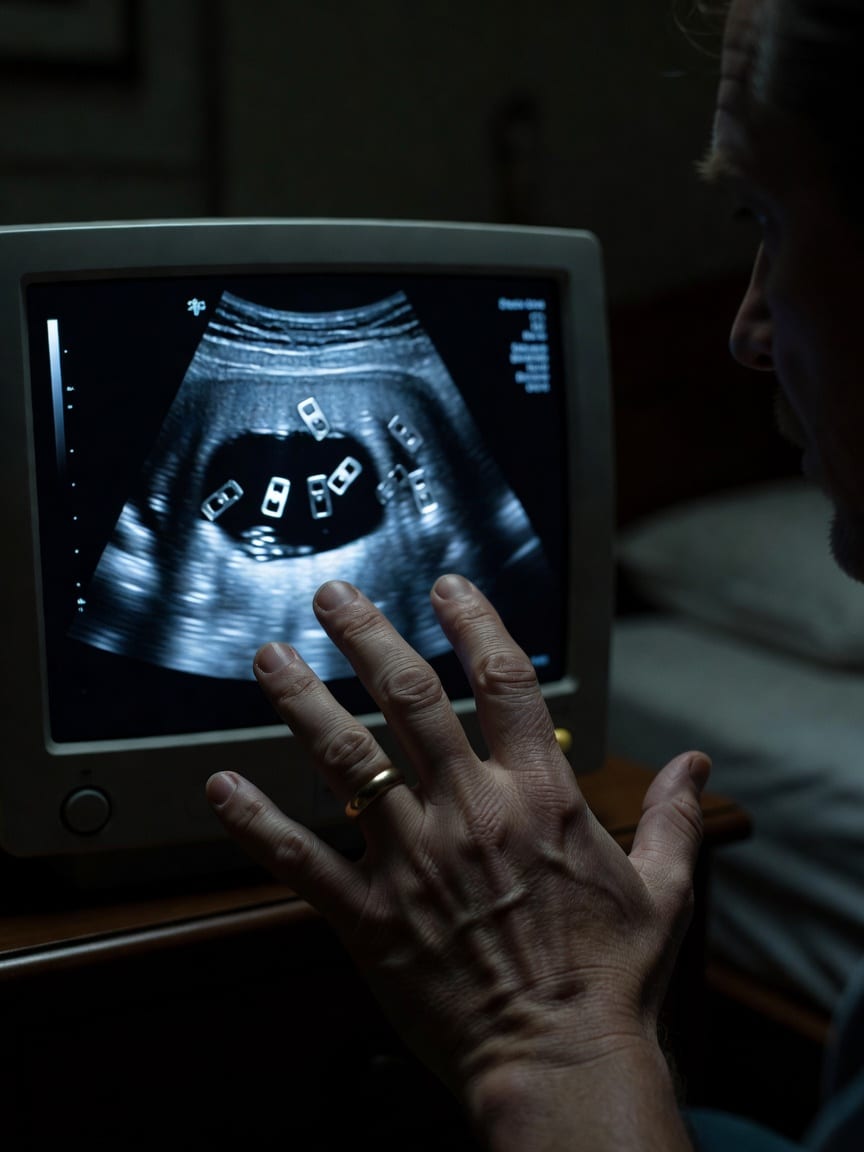
My ultrasound showed vasectomy clips. I've never had the operation, and we tried for years to have our son.
My quest to understand a medical anomaly led me down a rabbit hole of my own past. When my childhood dental chart arrived, I expected mundane records, but instead found a detailed account of a root canal and extractions. The problem? Those teeth are perfectly healthy in my mouth, never having undergone such procedures.
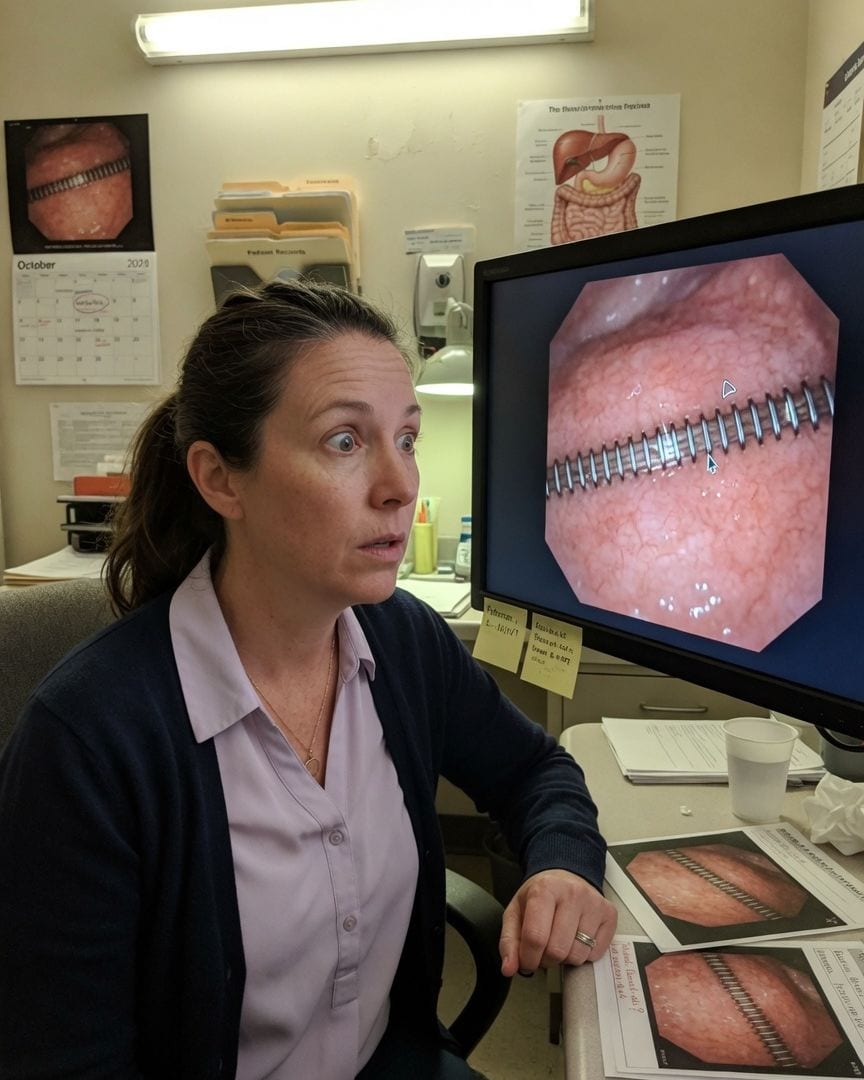
My stomach has old surgical staples. Doctors say they’re mine, years old. I have no scar, no memory.
My endoscopy for chronic reflux revealed far more than a burn. Dr. Winslow's screen showed my stomach reshaped by extensive, decades-old surgical staples. I have absolutely no memory of any operation, and my abdomen bears no scar.
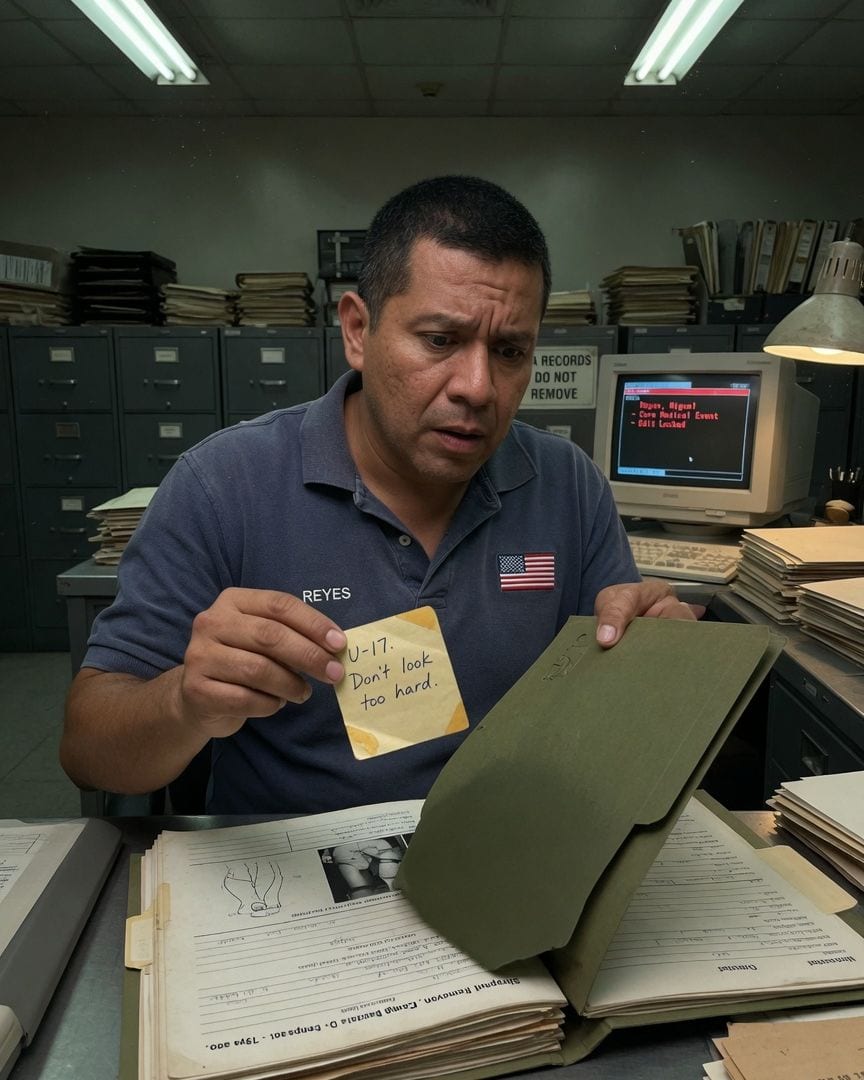
A veteran's medical record details a shrapnel wound his body never had. Taped to the report: 'U-17. Don't look too hard.'
Miguel Reyes, a veteran seeking relief for an old running injury, found his routine VA visit take a chilling turn. His medical file claimed a shrapnel wound and surgery from thirteen years prior, but his leg bore no scar, no mark of the supposed incident. Despite the detailed digital and paper records, his body swore the event never happened. As he pressed for answers, a hidden, yellowed note taped inside the official report surfaced, scrawled with two words: "U-17. Don't look too hard." The sterile clinic air suddenly felt cold and thick, suggesting a truth far darker than a simple clerical error.
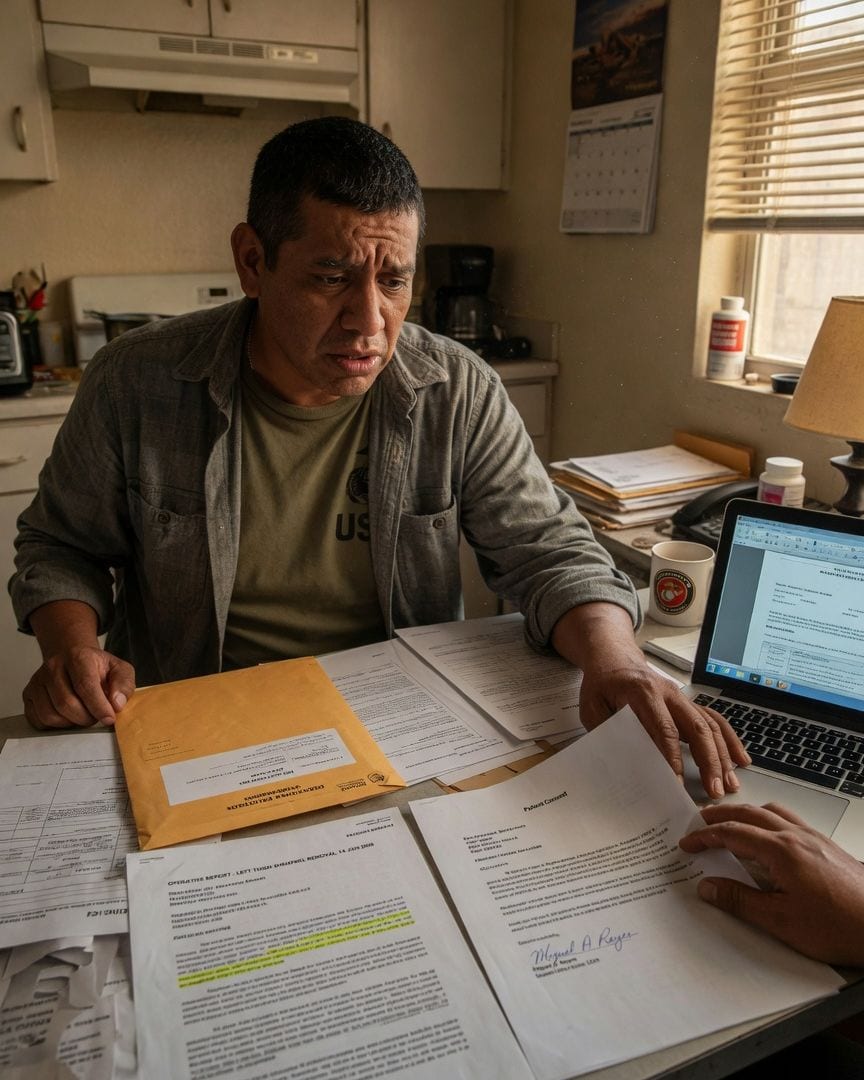
A veteran's VA file listed surgery for shrapnel. The doctor retired decades before he joined the Corps.
Miguel Reyes, a veteran, sat in a sterile VA clinic, his bad knee throbbing, expecting routine. Instead, a physician's assistant presented a digital file detailing shrapnel removed from his thigh in 2008 – an injury Miguel had no memory of, no scar for. His own service record later confirmed the impossible surgery, complete with a consent form bearing his perfect, yet utterly alien, signature. Driven by unease, Miguel researched the listed surgeon, Dr. Charlotte Bennett, only to discover she had retired from military service decades before he even enlisted. The numbers didn't just not add up; they violently contradicted each other, revealing a deliberate, impossible fabrication in his own life story.
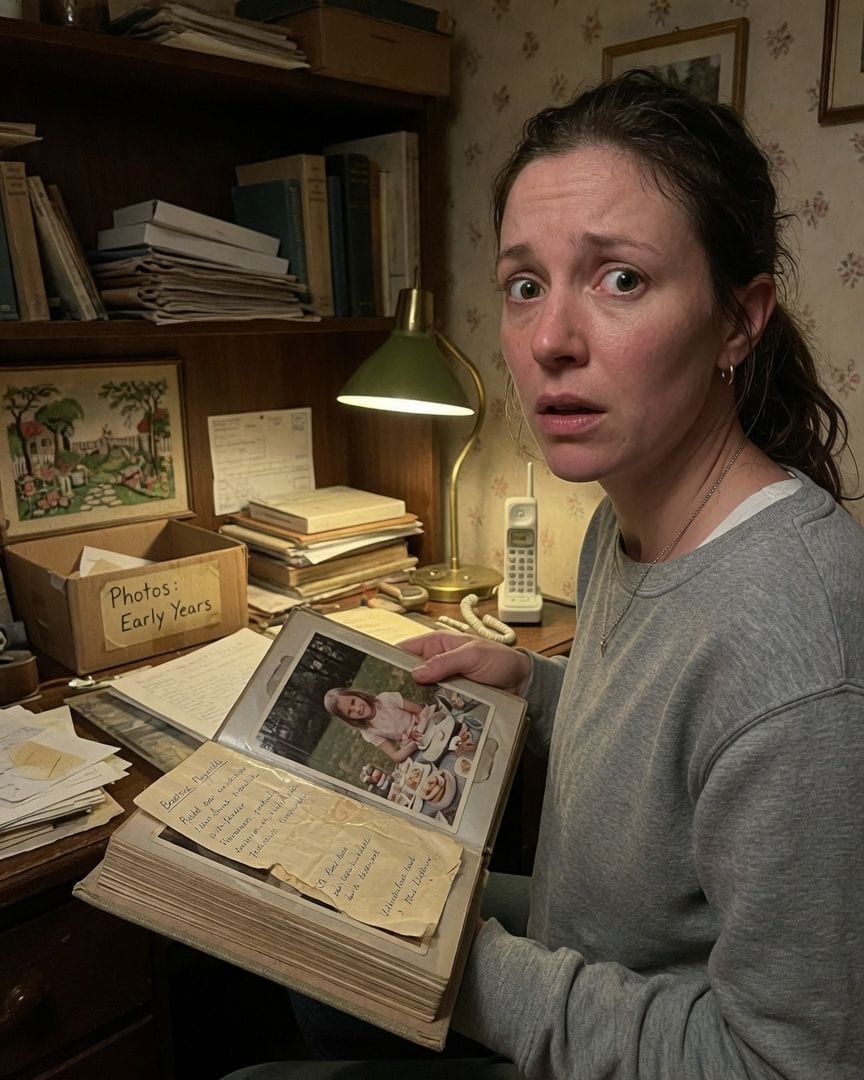
My mother's right ear has been partially deaf since she was eight. Now she's talking on the phone with it.
My mother, Beatrice, is finally back after five days, but my relief is curdling. She's using her right ear for phone calls, the one that's been partially deaf since she was eight. A new doctor confirmed her right ear was perfect, her left ear weaker, completely contradicting my lifelong memory.
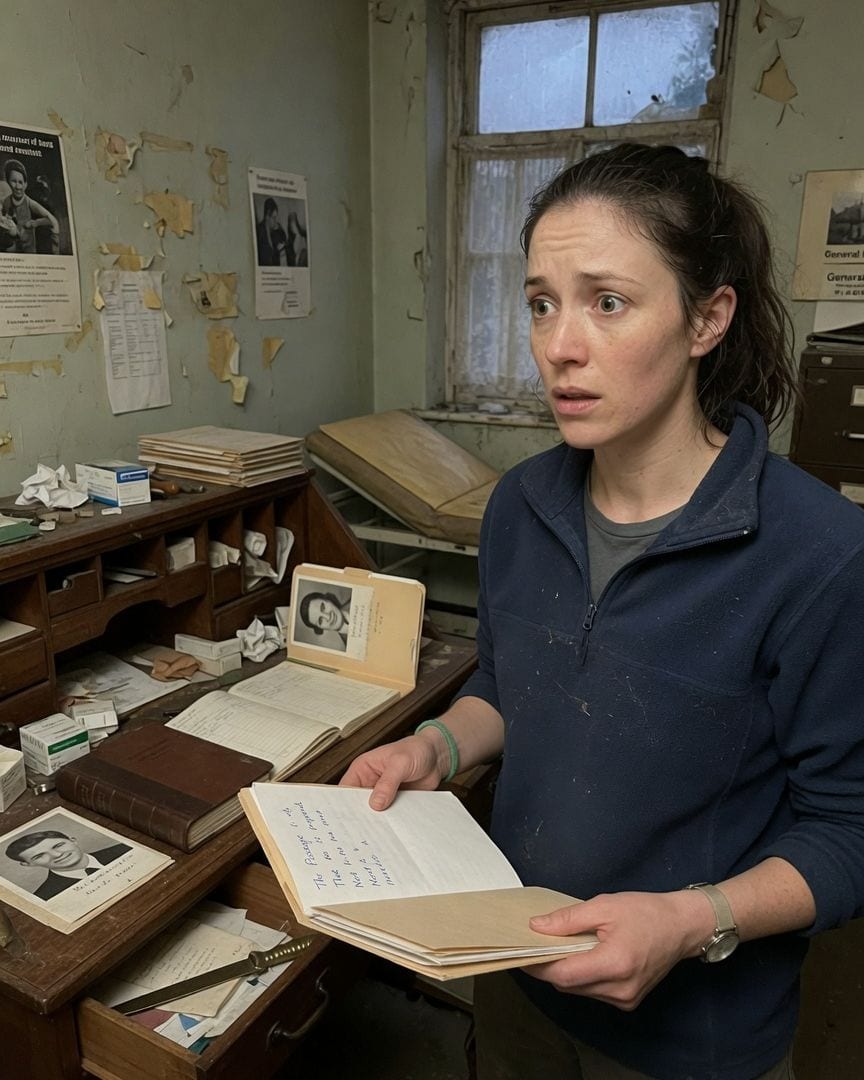
My new clinic's appointment book shows entries for this coming Monday, decades after the doctor retired and died.
Chloe Lawson bought an old, abandoned surgery in Nettlebed, ready to open her new vet clinic. Locals insisted Dr. Almott retired in '79 and the practice shut down for good. But then Chloe found his dusty appointment book filled with meticulous entries, continuing unbroken from 1979 through the decades, right up to this coming Monday.