My vet knew my dog's future, then said my name. I only gave them a phone number.
I took Buster, my year-old terrier mix, to Dr. Bishop for his annual booster, expecting the usual fuss and a quick exit.
He’s a bundle of white fur and boundless energy, utterly oblivious to needles or the antiseptic tang that usually makes clinic visits feel sterile. The clinic was quiet, unusually so for a Tuesday afternoon.
Dr. Bishop, a woman in her forties with kind, tired eyes, knelt beside Buster, stroking his head as he wagged his tail furiously.
Then, without looking up from Buster, her voice calm and level, she said, "I'm sorry, Miss Trelaske — you'll want to be home by six on Friday."
My hand, resting on Buster’s soft back, froze. Buster was healthy, bouncing with energy. There was no 'sorry' to be had. And ‘Miss Trelaske’? I hadn't given them my name.
I’d booked the appointment over the phone a month ago, under just a phone number. I hadn't even given them my address.
I cleared my throat, feeling a prickle of unease that had nothing to do with the cool air-conditioning. "I’m sorry, Doctor? Home by six on Friday? Why?"
She finally looked up, her expression one of genuine confusion, as if she were as perplexed as I was. "I don't know, Chloe. It was just… there. A note, typed into his file when I opened it this morning.
I’ve never seen anything like it."
My name. She'd used my name, Chloe, again, even though I hadn’t given it. I glanced at the clinic’s receptionist, a new, flustered-looking intern, but she just shrugged when I asked if she'd input my full name.
She was already distracted by a barking cat carrier at the counter. Dr. Bishop insisted the note had simply appeared, a stark, uneditable line of text in Buster’s digital record: 'Miss Trelaske, home by 6 PM Friday.'
The dread wasn't in the words themselves, but in their impossible origin, and the way they singled me out. It felt like a subtle violation.
I tried to rationalize it all the way home. A glitch, a miskeyed note from another patient, a new system error.
But the mention of my name, Chloe, when I’d only given a phone number, gnawed at me like a persistent burr. I’d called the clinic number from my cell, a private line.
There was no public record linking my name to that number.
That evening, I called the clinic again, politely asking the senior receptionist, who knew me better, if they could check the source of the note. She sounded baffled. "There's no editable field for personal notes like that, Miss Trelaske.
And we've only had your phone number until today when Dr. Bishop updated the file with your full name from your insurance form."
She confirmed my name and insurance details had only been added that afternoon, after Dr. Bishop saw the note. The dread tightened its grip, cold and precise. No, it wasn't a glitch. It was targeted.
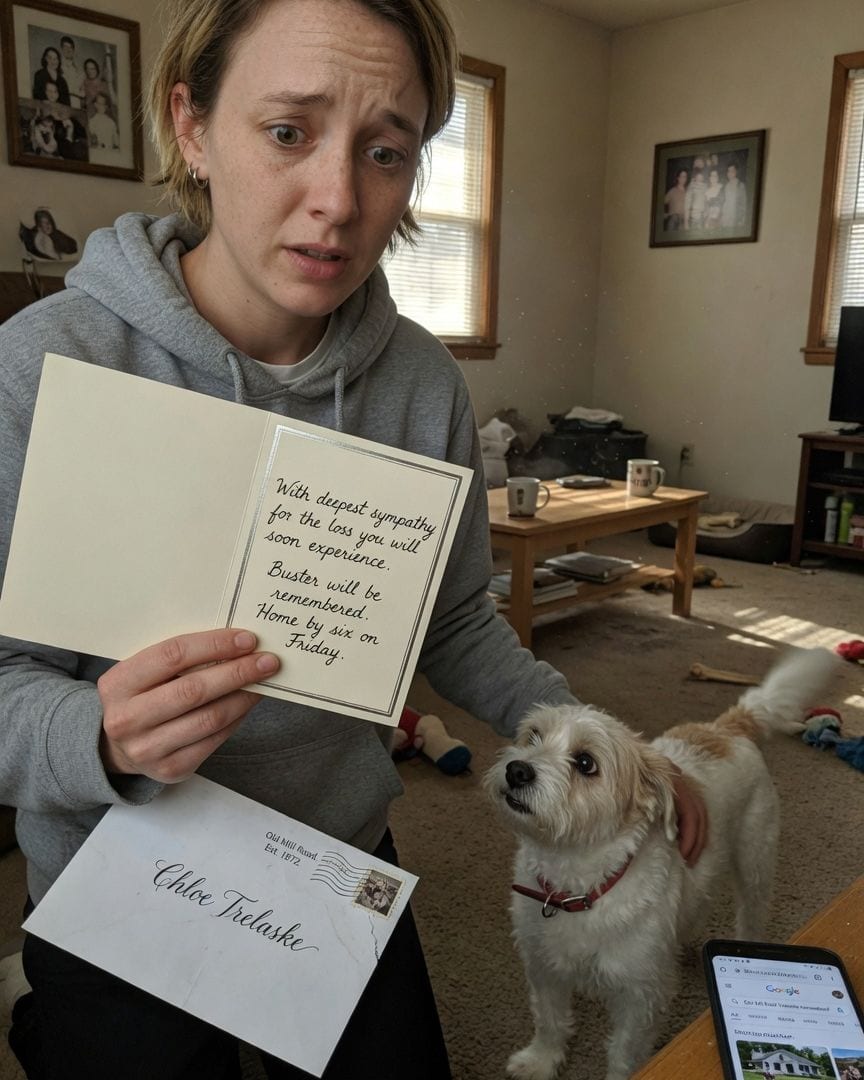
The next morning, a thick, cream-colored envelope lay on my doormat. No stamp. Just a hand-scrawled postmark: 'Old Mill Road, Est. 1872.' My full name, 'Chloe Trelaske,' was elegantly penned on the front in a precise, almost calligraphic hand.
I tore it open, my fingers fumbling. Inside was a single, heavy card, embossed with a silver border. A condolence card. My breath caught, frozen in my throat.
The message, written in the same precise hand as the envelope, was short: 'With deepest sympathy for the loss you will soon experience. Buster will be remembered. Home by six on Friday.'
My vision blurred. Old Mill Road. That was the address of the Trelaske family homestead, where my great-grandparents had lived. It had been demolished over fifty years ago, nothing but an empty field now.
I knew this because I’d researched my family history for a college project, painstakingly charting the lineage, walking the land my ancestors had tilled.
The card felt cold in my hand, a physical manifestation of the wrongness that had started at the vet. It wasn't a warning; it was a statement.
A post-facto condolence for an event that hadn't happened yet, addressed to me by name, from a place that no longer existed. And it mentioned Buster.
I looked at my healthy, oblivious dog, chasing a sunbeam across the living room carpet, his tail a happy blur. The card slid from my fingers, landing face-up on the floor, the stark words mocking my attempts at rational explanation.
This was no prank. This was something else entirely.
The condolence card’s message, 'Buster will be remembered,' struck me cold. I picked it up, turning it over and over in my hands.
The postmark, 'Old Mill Road, Est. 1872,' was not a local post office mark, but a hand-written detail, almost an artistic flourish, a subtle anachronism.
I pulled out my phone, my fingers shaking slightly as I typed 'Old Mill Road Trelaske homestead' into the search bar.
The results confirmed it: an aerial view showed an empty, overgrown field, exactly where the maps indicated the homestead once stood. A historical society entry stated it was demolished in 1968. No mail could be sent from there.
Yet, here was a physical card, addressed to me, mentioning Buster by name, and echoing the vet's impossible premonition with unnerving precision. I stood in my living room, the late morning light streaming through the window, feeling utterly exposed.
Someone, or something, knew my name, knew Buster, and knew what was coming. And it was sending me mail from a ghost.
The next day, driven by a gnawing need for answers, I drove out to Old Mill Road. The GPS led me to a stretch of overgrown highway, then pointed to a dirt track winding into a vast, empty field.
Tall grass swayed in the breeze, punctuated by the skeletal remains of an old stone well and a few crumbling foundation stones.
No houses, no mailboxes, just the whisper of the wind through the field and the distant buzz of insects. It was exactly as the internet had described, desolate and vast under a high, indifferent sky.
I walked the perimeter, feeling a profound sense of wrongness, as if the ground itself remembered. How had that card been postmarked from here?
I checked the surrounding area, driving slow laps through the small, sleepy town that bordered the field. No other 'Old Mill Roads,' no other Trelaske properties.
My phone registered no signal out here, adding to the isolation, making me feel disconnected, adrift. Back in town, I visited the local post office.
The clerk, a kind-faced woman named Paige, listened patiently to my story, examining the card, her brow furrowed. "Hand-written postmarks aren't official, dear," she said, frowning. "This looks like someone's idea of a joke.
But the paper… it feels awfully old." She showed me examples of official stamps, nothing like the elegant script on my card, confirming my suspicions. I left, no closer to understanding the 'how.'
The physical artifact was real, the postmark impossible.
The only remaining thread was the family connection. My great-grandfather, Gerald Trelaske, had owned the homestead. He’d been a quiet man, known for his meticulous record-keeping. I remembered my grandmother once mentioning he’d kept a 'family chronicle.'
I started searching online for local historical societies, archives, anything that might hold records pertaining to the Trelaske homestead or its former occupants. The town’s small historical society, housed in an old Victorian library, seemed my best bet.
I called, explaining my interest in the Trelaske family and their property. The archivist, a woman with a surprisingly sharp mind for her advanced years, introduced herself as Eleanor Caldwell.
"Ah, the Trelaskes," she said, her voice raspy, like dry leaves rustling. "A very old family in these parts. We have quite a few of their papers. Come by tomorrow, if you like. Perhaps you'll find what you're looking for."
Her tone was almost knowing, a subtle hum beneath her words that made the hair on my arms stand up. I had the distinct impression she already knew why I was coming.
The dread intensified as I walked into the hushed, dust-scented reading room of the historical society the next morning.
The air was cool, carrying the faint, comforting smell of old paper and wood polish, but it did nothing to calm the frantic beat of my heart.
Eleanor Caldwell, a woman with sharp, intelligent eyes that seemed to take in everything, sat behind a large oak desk, its surface polished to a dark sheen. She gestured to a chair opposite her, her movement slow but deliberate.
"Chloe Trelaske, isn't it?" she asked, her voice calm, almost too calm, like a still pond hiding unseen depths. "I was expecting you."
My heart hammered against my ribs, a frantic bird trapped in a cage. "You were?"
She smiled faintly, a ghost of amusement playing on her lips. "The Trelaskes always come back to the records, eventually. Especially when the… stirrings begin." She didn't elaborate, just picked up a heavy, leather-bound book from a stack beside her.
It looked ancient, its cover worn smooth with time and handling, the binding cracked. "You're looking for answers about Old Mill Road, I presume? And perhaps… specific dates?"
I nodded, unable to speak, my throat tight. She opened the ledger, its pages yellowed and brittle, like parchment. The scent of age, a dry, papery smell, wafted from it. "Your great-grandfather, Gerald, was quite the keeper of details.
Not just the mundane, but… other things." She turned a page, running a gnarled finger down a column of exquisite, flowing script. "He was not the first to feel the pull, nor to record its echoes.
Your family has a… peculiar connection to the passage of time." I leaned forward, straining to see. There were dates, names. Some I recognized, some I didn't. But what truly unsettled me was the lack of surprise in her demeanor.
She spoke of 'stirrings' and 'echoes' as if they were common knowledge, everyday occurrences.
"What exactly are these 'stirrings'?" I managed to ask, my voice a whisper, barely audible in the quiet room.
Eleanor closed the book, her gaze piercing, holding mine. "It's not a 'what,' dear. It’s a 'when.' A pattern. A certainty. And it has chosen you now." The implication hung heavy in the air, thick and suffocating.
I wasn't just investigating a strange occurrence; I was being drawn into something that had been waiting for me. And Eleanor, calm and unbothered, was merely the gatekeeper to its terrible truth.
Eleanor picked up a delicate, antique magnifying glass, its brass frame gleaming faintly, her eyes scanning the faded script in the ledger. "The Trelaskes," she began, her voice a low murmur, barely disturbing the quiet air, "have always been… sensitive.
Not to ghosts, mind you. To time. Or rather, to its pre-ordained currents." She tapped a line with the magnifying glass. "See here? Your great-great-grandfather, Nathaniel. A cattle blight.
Predicted, to the day, in a dream he recorded, months before it struck. A significant loss, a turning point for his farm." She turned another page, the brittle paper rustling softly. "Your great-aunt, Cecilia.
A letter, delivered by hand by a stranger, warning her of a fire that would claim her workshop. She moved her most precious creations just hours before it happened. The stranger apologized, saying they 'had to deliver the news.'"
I felt a chill, profound and unsettling, spreading through my chest. The vet, Dr. Bishop, apologizing for something that hadn't happened yet. The condolence card. It was all clicking into place, a horrifying coherence.
"So, these aren't warnings," I said, my voice barely audible above the quiet hum of the old building. "They're… announcements."
Eleanor nodded slowly, her expression placid, knowing. "Precisely. Not from a person, or a specific entity, as we understand it. More like… an echo of fate. A deterministic force that marks the significant events for your lineage.
Births, deaths, major transitions, moments of profound loss or change. It simply… informs." She paused, looking at me, her eyes unblinking. "The Old Mill Road homestead, where your great-grandparents lived, was particularly resonant. A place where the echoes were strongest.
That's why the 'Letters From Nowhere' are postmarked from there, even now. It’s not a physical address; it’s a symbolic one, a focal point for the pattern’s manifestation."
My mind reeled. The vet's note, the condolence card, the non-existent postmark, all suddenly made a terrible, undeniable sense.
It wasn't a trick or a prank; it was a fundamental law operating just beneath the surface of my reality, like an unseen current beneath a placid river. "And 'six on Friday'?" I asked, my voice trembling, barely holding steady.
Eleanor's gaze softened, a flicker of something like pity in her eyes. "A recurring marker. A specific hour, on a specific day, when these events tend to manifest for your family. A moment of… transition.
It’s been recorded in this ledger for generations. Always 'six on Friday.'"
She closed the book gently, the soft thud echoing in the quiet room, then reopened it to a fresh page, still mostly blank, but with a few faint, almost invisible pencil marks at the top.
"Your great-grandfather, Gerald, was the last to maintain this chronicle. He knew his time was coming, and he left it ready for the next. For you, Chloe."
Eleanor opened the ancient ledger to a page near the end, its paper less yellowed than the others, but still bearing the faint, almost translucent quality of age.
"This is where Gerald left off," she murmured, her finger tracing a line of almost imperceptible pencil marks. "He was meticulous. He knew the pattern would continue."
My gaze fell to the page, and the world tilted, a sudden, dizzying lurch in my stomach. There, in elegant, faded ink, was a clear entry: 'Chloe Trelaske, Born [my birth date].'
My heart lurched, a cold, hard knot in my chest. How could my specific birth date be in this ancient book, written in ink that clearly predated my existence?
Then, beneath it, in the same hand: 'Companion, Buster, Born [Buster's birth date].' It was impossible. This ledger predated my birth by decades, Buster’s by even more.
My eyes scanned further down the page, and the blood drained from my face, leaving me feeling hollow and cold.
Below my name and Buster’s, another entry, in a slightly bolder, more recent hand, one I didn't recognize, but whose ink was clearly older than today: 'Transition: Six on Friday.' My Friday.
I traced the words with a trembling finger, the paper cool beneath my touch, then looked up at Eleanor, who watched me with an unnerving calm, her eyes reflecting the dim light of the archive.
"This… this can't be real," I whispered, the words catching in my throat.
She only smiled, a sad, knowing curve of her lips. "The pattern is always real, Chloe. It simply is." She then turned the page back slightly, pointing to an earlier entry, dated over a century ago.
"And here, your great-grandfather, Gerald Trelaske. Born [Gerald's birth date]. Companion, Old Duke. Transition: Six on Friday." The same words. The same chilling, pre-ordained date.
The ledger wasn't just predicting my future; it was showing me an inescapable, generational fate, etched in ink before any of us had even drawn breath.
And the next blank space on the page was waiting for the 'after' of my own 'six on Friday.'
Eleanor saw the terror in my eyes, but her expression remained placid. "It's not a curse, Chloe," she said softly, her voice barely a whisper in the quiet archive. "It's a current.
A river of time that flows with specific eddies and rapids for certain bloodlines. The Trelaskes are simply… in its path.
The ledger," she gestured to the open book, its ancient pages a silent testament, "is merely a record kept by those who became aware of the current. Gerald, your great-grandfather, was one such keeper.
He felt it keenly, understood its rhythm."
She explained that the 'entity' was not a conscious being, not a malevolent spirit, but a fundamental, deterministic force woven into the fabric of existence itself, specifically for the Trelaske line. It didn't choose to harm; it simply was.
The 'warnings,' the 'Letters From Nowhere,' the vet's note—these were not attempts to change the future, but rather the pattern's own echoes, the ripples that preceded a significant event. "Six on Friday," she elaborated, "is not necessarily death.
It’s a point of irreversible change. A moment where one path ends and another, pre-ordained, begins. For Gerald, it was the day he lost his beloved dog, Old Duke, a hunting accident, and with him, his will to continue farming.
He left the homestead that very evening, a different man, his spirit broken."
My mind raced, connecting every detail, every impossible fact. The demolished homestead, now an empty field, was not just a place, but a historical marker of where the Trelaske 'current' ran strongest.
The intimate detail in the condolence card, knowing about Buster, was because Buster was explicitly part of my 'transition' event, just as Old Duke was part of Gerald's. The sheer, horrifying coherence of it all was overwhelming.
This wasn't a random series of misfortunes; it was a meticulously woven tapestry of fate, and I was merely the next thread being pulled. The dread wasn't in a monster, but in the cold, unfeeling certainty of it all.
"So, there's no escape?" I asked, my voice hollow, a frail echo in the vast library.
Eleanor looked at the ledger, then at me. "Only a choice in how you meet it. The river flows, Chloe. You can fight the current, or you can choose your own way to navigate it.
You can't stop the river, but you can choose your boat."
I left the historical society in a daze, the ancient ledger's truth burning in my mind. Eleanor's words, 'choose your own way to navigate it,' echoed, a thin thread of agency in a vast tapestry of predetermination.
My 'six on Friday' was only hours away. I could go home, lock the doors, and wait for whatever fate the pattern had decreed for Buster and me. Or I could try to defy it.
But defying a fundamental force felt futile, like trying to stop a river with my bare hands. Instead, I decided to reinterpret the 'transition.'
If 'six on Friday' marked a loss, a turning point, then perhaps I could shape the nature of that loss. I could choose the terms, even if the event itself was inevitable.
I drove straight to the animal shelter, Buster riding shotgun, his head out the window, blissfully unaware of the grim calculus I was performing.
I spent the next few hours walking through the kennels, my heart heavy with a strange mix of fear and desperate resolve.
At 5:30 PM, with thirty minutes to spare before 'six on Friday,' I found him: a scruffy, three-legged terrier mix, eyes full of fear and a desperate hope, cowering at the back of his cage.
He reminded me so much of Buster, but broken, diminished.
The shelter staff were surprised when I filled out the adoption papers so quickly. "Are you sure, Miss Trelaske?" the young woman asked, looking at the clock. "We close in fifteen minutes.
You don't want more time to think about it?"
"I'm sure," I said, handing her my card, my voice steady despite the tremor in my hands. "His name is Lucky."
At 5:58 PM, just as the sun began to dip below the horizon, casting long, eerie shadows across the parking lot, I walked out of the shelter with Lucky on a new leash.
Buster, sensing the change, nudged his head against Lucky's, a silent, curious invitation. As I buckled Lucky into the back seat, securing him next to Buster, my phone buzzed. A text message from Dr. Bishop: 'Just checking in, Chloe.
Everything okay with Buster?'
I stared at the phone, then at the two dogs, one whole and happy, the other fractured but safe. Six on Friday. The transition had occurred. It wasn't Buster's death, as the condolence card had implied.
It was the loss of his singular companionship, the introduction of a new, broken life into our small, perfect world. I hadn't escaped the pattern, but I had bent its meaning, chosen the 'cost' myself.
Lucky whimpered softly, and Buster licked his ear, a gentle reassurance. It was a loss of innocence, a gain of responsibility. A turning point. And I had chosen it, just barely, on my own terms.
But the bitter taste of that 'choice' lingered, knowing it had been laid out for me long before I was even born.
The days that followed were a blur of adjusting to our new family member. Lucky, despite his initial fear, slowly began to trust us, his limp a constant reminder of the day I brought him home, a living scar.
The 'Letters From Nowhere' stopped arriving. Dr. Bishop never mentioned the note in Buster's file again, and I never brought it up.
The ledger, safely back in Eleanor Caldwell’s care, became a silent, terrifying testament to a reality no one would ever believe.
I kept the condolence card, a stark, unsettling reminder tucked away in a drawer, pulled out sometimes, just to touch the heavy paper, to feel the impossible script.
The empty field on Old Mill Road remained just that: an empty field to everyone else, but to me, a place where fate whispered its decrees. My life continued, ostensibly normal, but the knowledge I carried changed everything.
Every decision, every unexpected event, felt tinged with the possibility of the pattern's influence, a subtle shadow. I looked at Buster and Lucky, playing in the yard, and knew that I had, for now, outmaneuvered a specific prediction.
But the current of fate, I knew, still flowed, strong and silent beneath the surface.
Years passed. Buster grew old, his muzzle white, his steps slow. Lucky filled out, his limp less pronounced, his fear replaced by gentle loyalty. My life settled into a rhythm that felt, on the surface, entirely my own.
But the quiet certainty of the pattern never left me. I never returned to the historical society, never sought out Eleanor Caldwell again. There was nothing more to learn, only to live with what I knew.
Sometimes, late at night, a new thought would surface, a small, unsettling premonition of a coming event, a whisper in the back of my mind—a sudden, irrational certainty about a flight cancellation, a job offer that felt too good to be true, a passing comment from a stranger that felt… significant.
I'd dismiss it, try to rationalize it away, but a cold dread would settle in my stomach.
The pattern hadn't stopped; it had merely shifted its focus, moving beyond the dramatic 'six on Friday' to quieter, more insidious announcements, woven into the fabric of everyday life.
I learned to live with the knowledge that my life, in its most fundamental moments, was not entirely my own. The proof, the ledger, lay hidden, a truth too profound and unbelievable for anyone else to grasp.
I simply carried it, a silent passenger through my own predetermined journey. The cost of 'escape' wasn't a physical wound, but a permanent, internal alteration: a life lived in the unsettling coherence of a known, inescapable fate.
I still make plans, still dream, but always, always, I listen for the soft, distant echo of a coming tide.
Chloe Trelaske lived a long, full life, surrounded by dogs. She was known for her quiet demeanor, and a peculiar habit of always being home by 6 PM on Fridays, no matter the circumstances.
When she passed away peacefully in her sleep, a small, unmarked condolence card was found tucked beneath her pillow, postmarked from an empty field.
If this one got to you
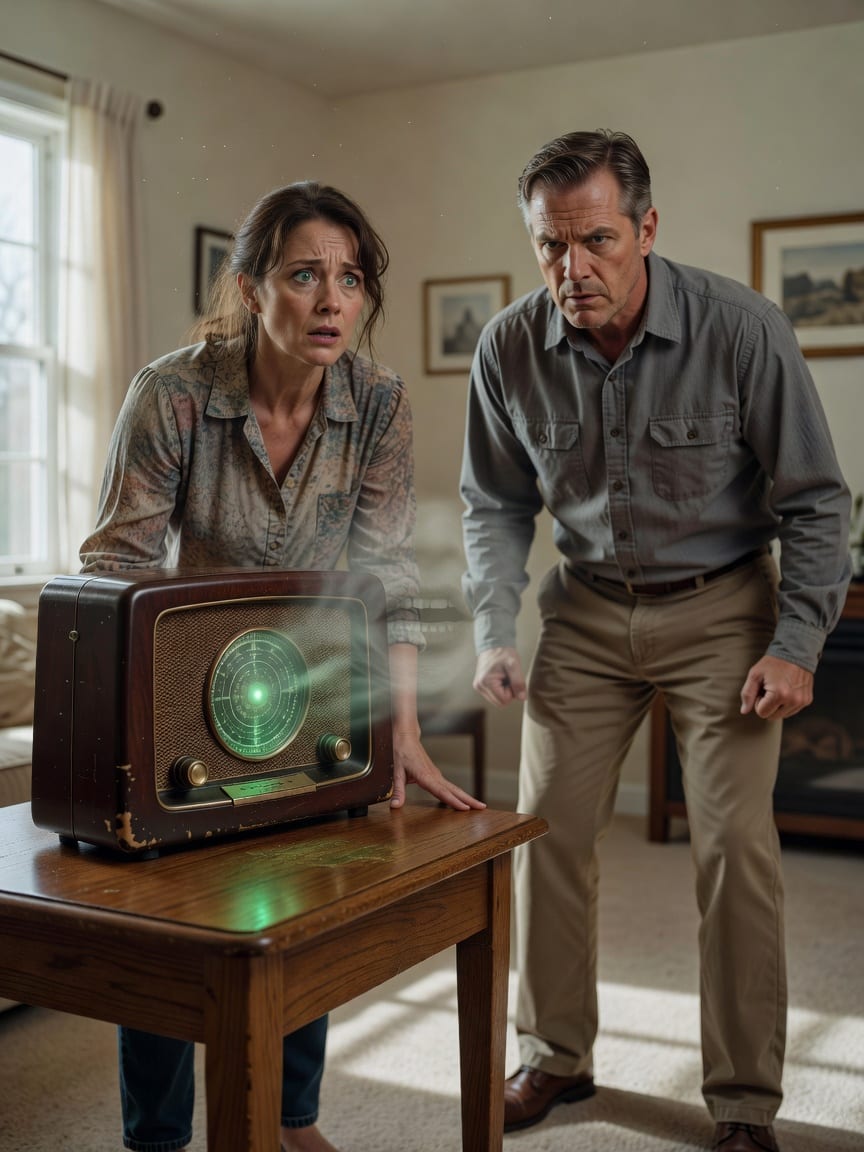
My neighbor apologized for Biscuit's death. My terrier was asleep on the landing, perfectly fine.
My neighbor Tom arrived on Sunday, distraught and apologizing for my dog Biscuit, who was perfectly fine. Days later, a condolence card arrived for a loss I hadn't suffered, postmarked from an empty lot where a house once stood. Then I found another, dated days before Tom's strange apology.
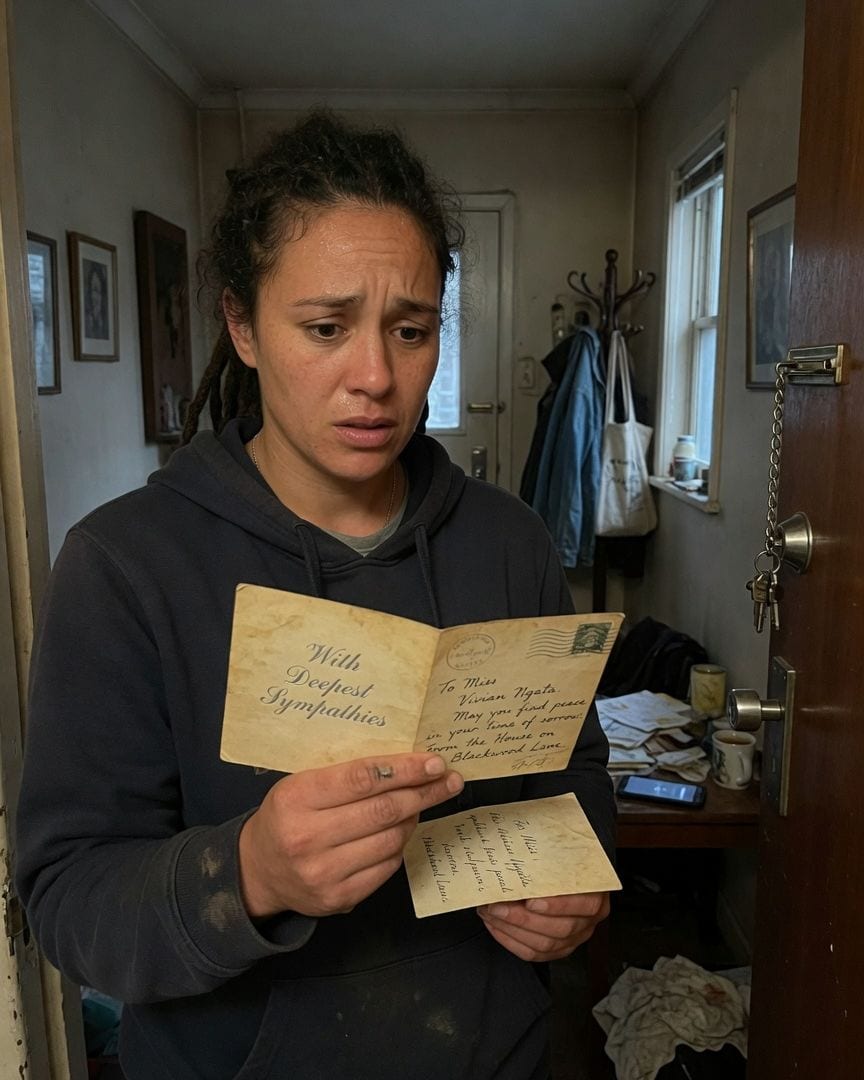
My locksmith knew my name, then apologized for next Tuesday. I never gave him my name; his firm doesn't exist.
I just needed a new deadbolt after some neighborhood thefts. But the locksmith knew my name without me telling him, and murmured something about 'Tuesday' when it was Thursday. Then his company, 'Everlast Security Solutions', vanished without a trace, its phone number dead and its address an empty field.
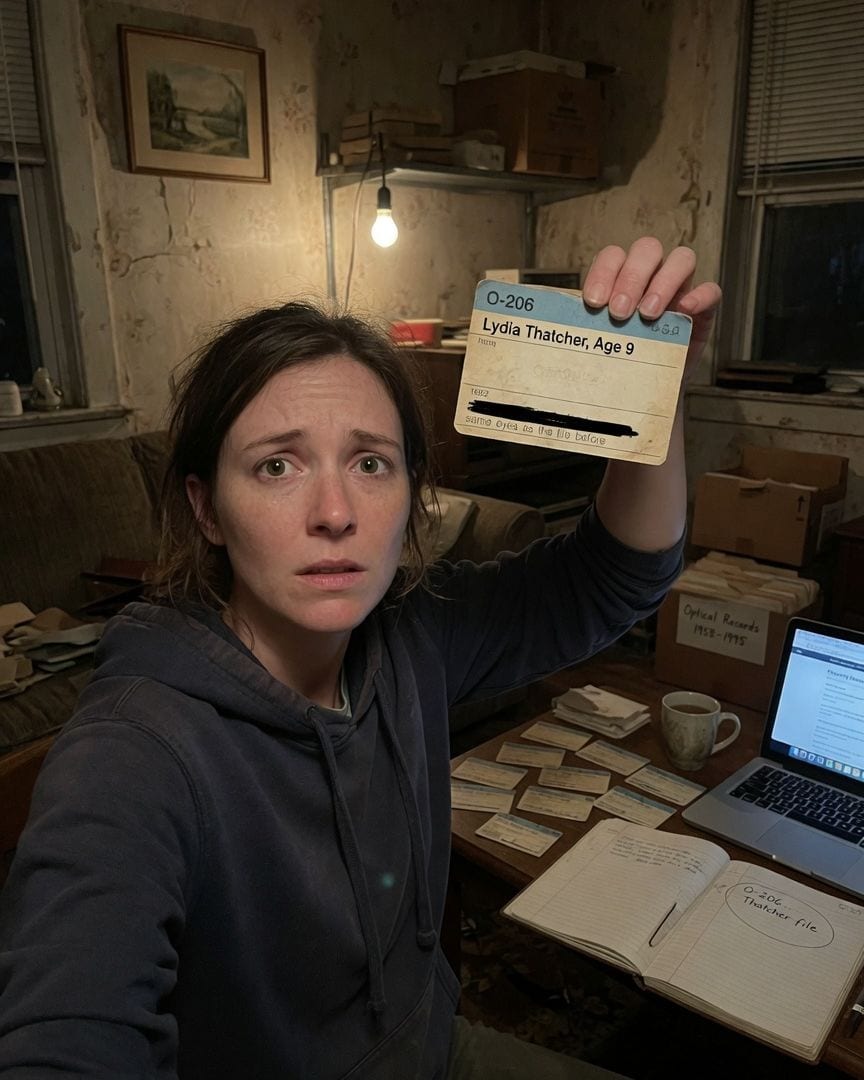
My own optical card is dated 1962, with my name on it. I wasn't born until 1993.
Sifting through old patient files from my former optical practice, I found my own O-206 card. It had my name, Lydia Thatcher, and my current home address printed on it. But the card was dated 1962, decades before I was even born, and a redacted note mentioned 'same eyes.'
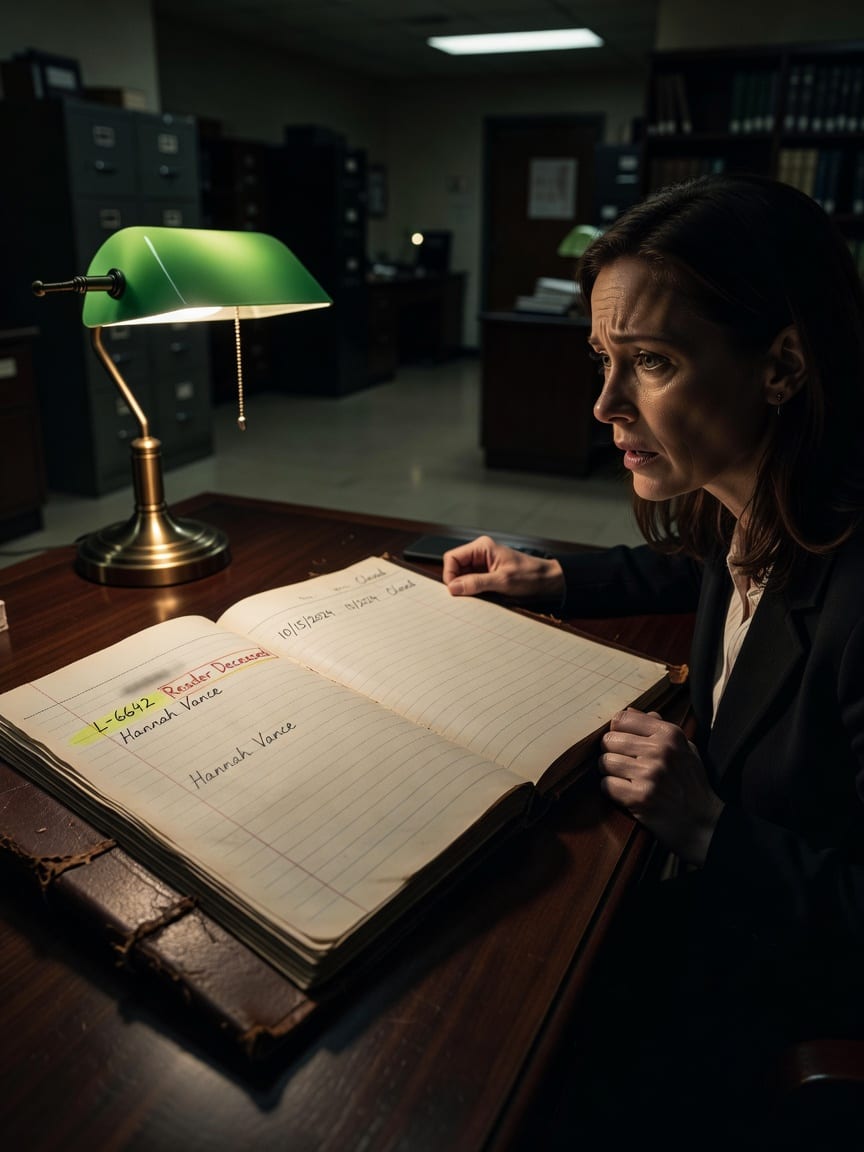
My library card number L-6642 was issued to me at seven — and the ledger shows that number has marked a reader 'deceased' every twelve years since 1949.
Returning my late father's library card to the old town library felt like a small act of closure. But the senior librarian's ancient ledger revealed a chilling pattern of 'reader deceased' entries tied to specific card numbers and borrowed books. My unease turned to cold dread when I secretly found my own name penciled in, marked for a future 'reader deceased' entry.
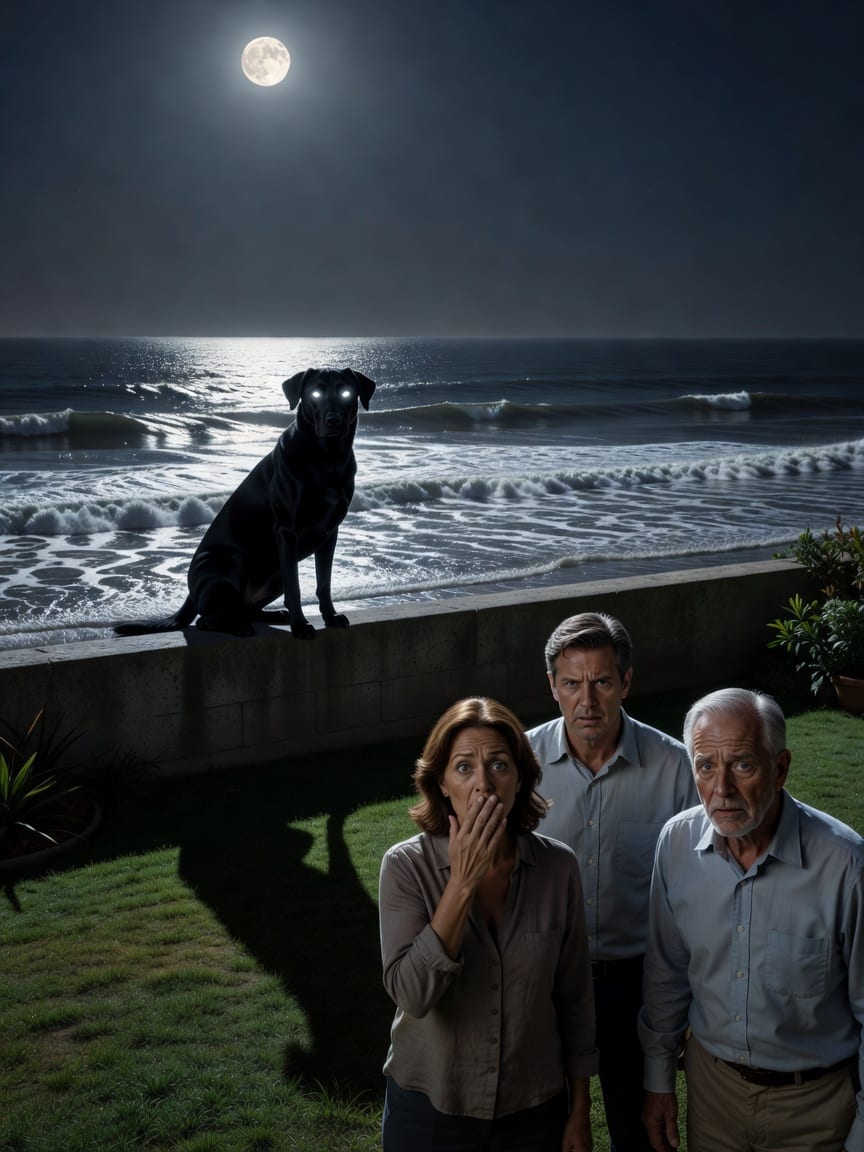
My black dog on the sea wall isn't mine. Its eyes held something ancient and cold, and my neighbours laughed when they warned me not to feed it. The lifeboat log shows its name beside every drowning for ninety years.
My new cottage by the sea offered peaceful sunsets and a solitary black dog patrolling the wall. I left it some stew, thinking it was just a stray. But its eyes met mine, and they weren’t dog eyes at all—they were obsidian, ancient and cold, devoid of all warmth.
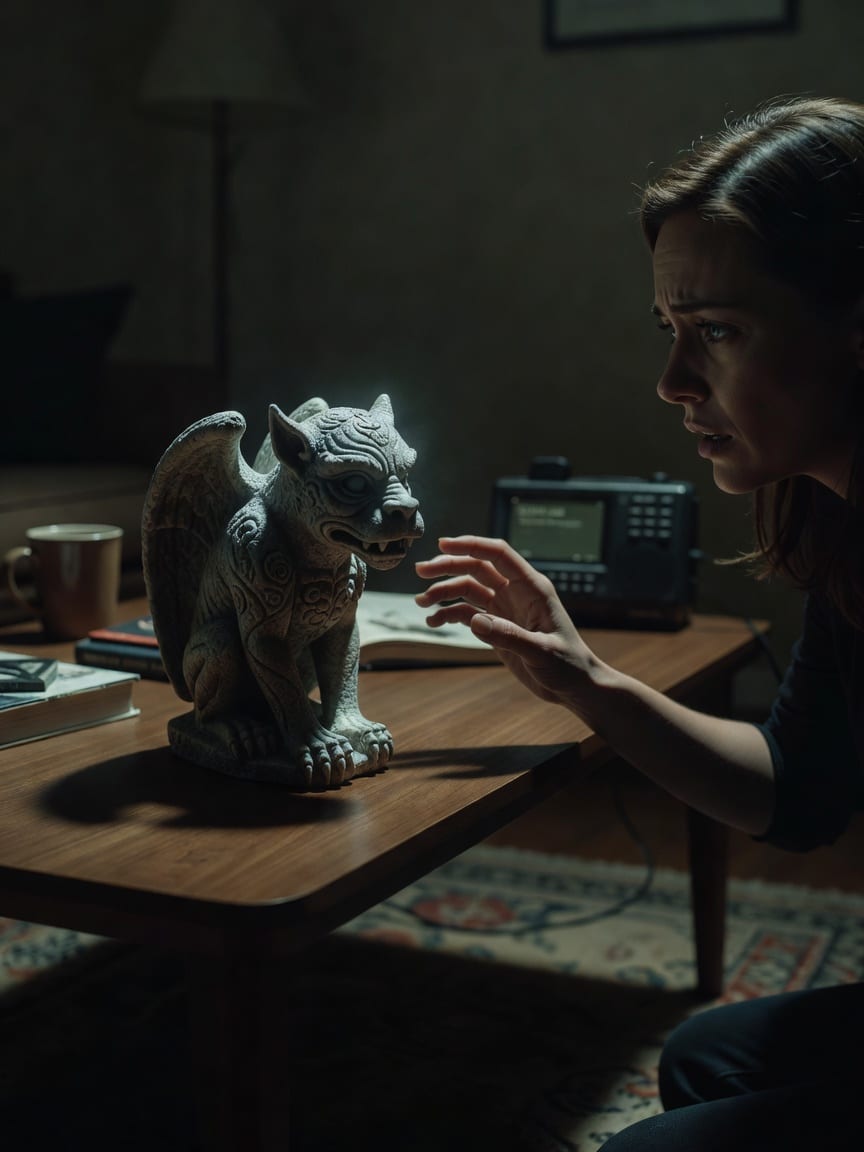
My radio scanner spoke my address at 2 AM. A flat voice read local homes, all with past dates. Mine was the only one in the future.
It was two in the morning, and my quiet house was filled with the usual hum of my weather scanner. But the static broke, replaced by a flat, synthesized voice reading a list of local addresses and dates. My hand froze when it spoke my own address, 181 Foster Drive, followed by a date: October 27th. That date was three weeks from now.