Yeoman Vivian Park checked Ferro’s log after his rescue. His signature was steady, wrong. Then she found it: the new hand had signed his name a week before he went overboard.
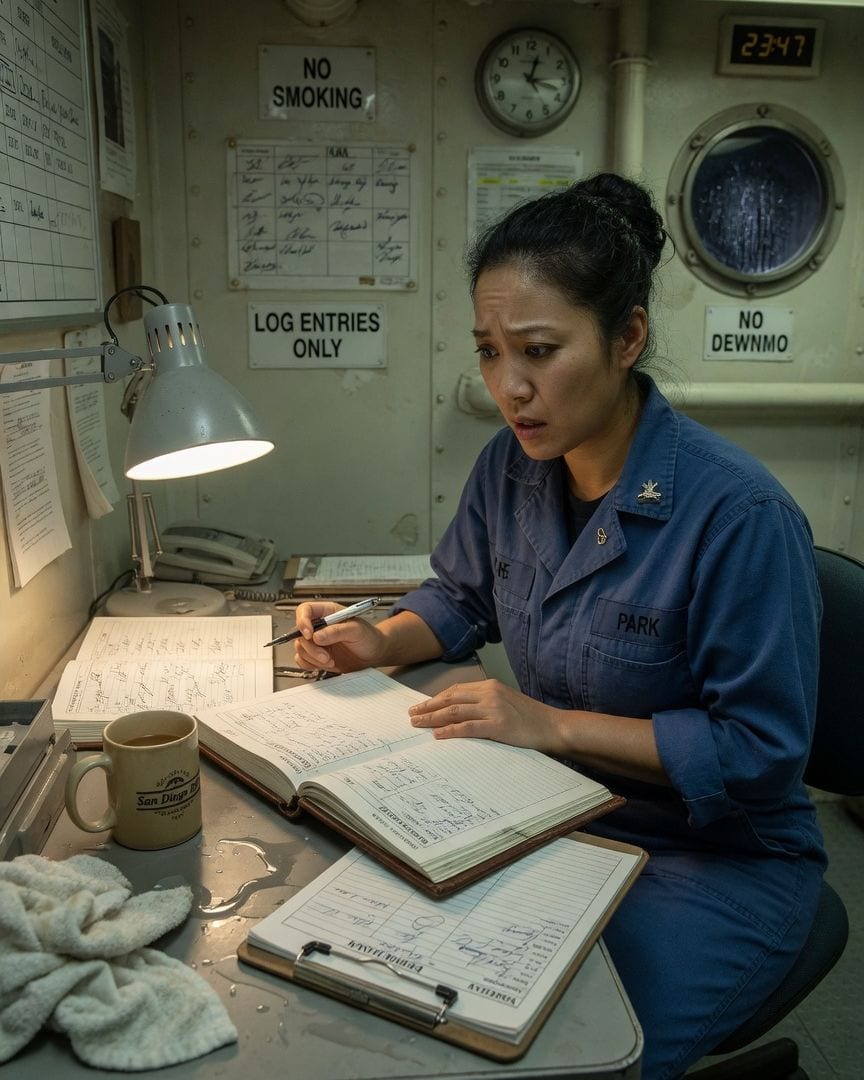
Yeoman Vivian Park, two weeks from her much-anticipated transfer, sat at her desk in the USS Vanguard's cramped administrative office.
She logged out Yeoman Kenneth Ferro's watch, a routine she’d performed hundreds of times since they’d shipped out from San Diego.
She knew Ferro’s signature better than her own – the hard downstroke that carved into the paper, the distinctive 'F' shaped like a little boat, the slight, almost imperceptible tremor from an old injury he’d gotten playing baseball as a kid.
Ferro had gone over the side in heavy seas off Subic an hour ago. The deck crew had hauled him back aboard, hypothermic and shivering, but mostly grateful.
Now, he sat across from her, a towel draped over his shoulders, dripping seawater onto the deck mat. He picked up the pen. Vivian watched, her own pen hovering over her personal logbook, the date waiting to be recorded.
Ferro signed the logbook. The 'F' was still a boat, undeniably, but it leaned the other way now, a mirror image, a subtle shift in its angle.
And the hand that held the pen, the hand that scrawled his name, was unnervingly steady. Too steady. Ferro's hand had always had that faint, almost invisible tremble. Vivian’s breath hitched.
Vivian tried to rationalize it. Hypothermia could affect fine motor skills, certainly. Shock could distort perception. Maybe it was just a new pen, a different weight or ink flow that changed the feel.
She told herself it was nothing, just fatigue from the long watch cycle. But the image of that steady, wrong 'F' pricked at her, a burr under her skin she couldn't scratch away.
Later that day, she pulled Ferro's previous logbooks, ostensibly for a routine audit of supply manifests. Her fingers traced the familiar, trembling 'F' on page after page from months, even years, prior. Then she turned to his current log.
The change was undeniable, consistent across every entry he’d made since returning from the sea. But the dread hadn't truly set in until she started looking for something else.
Tucked away in a heavy, leather-bound log from two years prior, she found a similar, subtle shift. This time, it was another Yeoman's signature, Petty Officer Franklin Thornton.
Thornton had suffered a minor head injury during a typhoon, landing him in sickbay overnight after a fall. His signature, post-incident, was subtly cleaner, more precise, just like Ferro's. The easy, flowing curves had become rigid, almost calligraphic.
The official records for both men, she noted, were impeccable; no mention of any lasting effects or change in performance. The mundane explanations dissolved, leaving a cold, hard knot in Vivian's gut. This wasn't a fluke.
It was a pattern, and it was perfectly hidden.
Trying to shake the growing unease, Vivian returned to Ferro's current logbook, her fingers cold on the synthetic pages. She flipped back a few pages, looking for a baseline, a confirmation.
She needed to find an instance of the 'old' signature that would make sense of the 'new.' Her gaze snagged on an entry from exactly one week prior to the overboard incident.
It was a mundane entry, a routine inventory of office supplies, a task Ferro was known to dislike and often procrastinate. But it was signed, clearly, with the new, unnervingly steady hand. The 'F' leaned the wrong way, unmistakable.
The date and time were precise, irrefutable, logged in Ferro’s own neat script.
It meant the 'new' Ferro, the one with the wrong signature, had already been aboard the Vanguard for a full week before the 'old' Ferro went into the sea.
The impossible log entry spurred Vivian into action. This was beyond clerical error; it was a violation of the ship's meticulous order, a tear in the fabric of the Vanguard's carefully maintained reality.
She began a covert investigation, discreetly cross-referencing other records, searching for similar anomalies. Her focus narrowed to 'incidents'—near-misses, short-term incapacitations, minor accidents that resulted in a brief absence from duty—over the Vanguard's last few deployments, stretching back five years.
She meticulously combed through medical reports, duty rosters, and incident logs. The ship’s ventilation hummed, a constant, low thrum that vibrated through the metal desk, the floor, the very air.
A chilling pattern emerged: three other names in the last five years, all Yeomen.
Each was an exemplary sailor who had returned from a hazardous situation—a confined space rescue in the engine room, an electrical shock in an equipment bay, a severe allergic reaction to shellfish during a port visit—with a subtle, documented anomaly in their routine or, more often, their signature.
These individuals were still serving, their records flawless, their performance often exceeding their pre-incident selves, as if they had been sharpened, optimized.
Vivian noticed something else: the 'changed' individuals gravitated towards highly routine, easily observable tasks, often ones they had previously avoided or disliked.
They performed their duties with an unnatural, almost robotic efficiency, slotted perfectly into the ship's operational needs, like cogs suddenly finding their perfect groove.
The discrepancies were so slight, so 'accounted for' by the system's overwhelming precision, that no one else had ever noticed. They were invisible within the very systems designed to highlight error.
Vivian's specific inquiries, though couched in 'audits' and 'cross-verification checks,' were too focused, too deliberate.
She started noticing subtle alterations in her own access logs to the ship's digital archives—showing her accessing different files, or at different times than she actually had. A ghost in the machine, too precise to be a glitch.
Someone was watching her. The air in the office felt heavier now, charged with unseen eyes.
One evening, deep in the ship's bowels, in the dusty, seldom-used physical records office, Vivian was hunched over a heavy, leather-bound logbook from a decade past, tracing a familiar-looking 'wrong' signature.
The only sound was the hum of the ship's ventilation, a low, mechanical growl, and the distant, rhythmic clang of something heavy being moved on a lower deck. A shadow fell across the page, cool and sudden.
She looked up, startled, her heart thrumming in her chest. Chief Petty Officer Isaac Walsh, the ship's long-serving, quiet Records Chief, stood in the doorway. His silhouette, tall and unmoving, was framed against the dim corridor light.
He didn't comment on her presence, or the old logbook splayed open on the table. His expression was unreadable, his eyes calm, almost unnervingly so, like still pools of deep water.
'Finding everything you need, Yeoman Park?' he asked, his voice low and even, a quiet current flowing through the dusty air. 'The Vanguard has a long memory.'
His gaze lingered on her, not accusatory, but with an unsettling knowingness, as if he understood exactly what she was looking for, and why.
The hum of the ship seemed to deepen, a resonant pulse against the soles of her feet.
The encounter with Walsh solidified Vivian's resolve. His knowing calm was a gauntlet thrown.
The next morning, she sought him out in his office, the stack of meticulously documented discrepancies, old log entries, and cross-referenced personnel files clutched in her hand like a shield.
She laid out her findings, page by page: Ferro's impossible signature, Thornton's altered handwriting, the pattern of 'changed' crew members and their post-incident shifts in behavior.
The room, usually dry and still, felt suddenly cold, the polished metal surfaces reflecting the fluorescent lights like frozen eyes.
Walsh listened, his face impassive, his gaze steady on her, then on the documents, then back to her. He didn't deny a single detail. He didn't interrupt, didn't flinch.
When she finished, his silence stretched, heavy and profound, before he simply nodded.
'The Vanguard,' he began, his voice devoid of emotion, a flat declaration, 'has a way of ensuring continuity. Especially in high-stress environments, or after... significant events.'
He spoke of 'replacements' not as an anomaly, not as something wrong, but as a normal, necessary part of maintaining a ship's operational readiness.
'The system,' he explained, gesturing vaguely around the room as if the very bulkheads were listening, 'demands perfection, seamless function. Sometimes, the human element... struggles to meet that. This ensures it does.'
He implied that the ship itself, in its complex, interconnected systems, its steel and wiring and logic, required this 'perfection.' He pointed out that the 'new' Ferro was a model Yeoman, more efficient, more reliable than the original.
'No paperwork is ever out of place,' Walsh stated, 'no duty left undone. The Vanguard always operates at peak capacity.'
The horror wasn't in his words, but in their utter, detached calm, in the chilling acceptance of a process that erased individuals for the sake of an unyielding, perfect machine.
The earlier clues clicked into place: the flawless records, the unnaturally efficient new behaviors, the 'accountability that cannot be' that had always seemed impossible. All were symptoms of this chilling 'continuity,' a systemic hunger for flawless operation.
Vivian felt a cold dread spread through her, seeping into her bones. Walsh's explanation, delivered with such chilling composure, was more terrifying than any monster, any wild conspiracy.
She tried to argue, to appeal to the humanity of it, to the sheer wrongness of taking someone's life and replacing it with a flawless copy, but his eyes remained flat, unyielding, like dark glass.
'After all, Yeoman Park,' Walsh said, cutting her off, his voice soft but firm, the slight vibration of the ship underfoot seeming to accentuate his words, 'you're due for transfer in two weeks. A new posting, new responsibilities.'
He paused, a faint, unsettling smile playing on his lips, a mere ripple on his otherwise placid face. 'Unless... your own paperwork has changed, Yeoman?'
He gestured to a pristine folder on his desk, its label stark against the dull gray metal: 'PARK, VIVIAN'. He slid it towards her. On the top sheet, a transfer request form, fresh and crisp, bore her signature.
It was undeniably hers, the familiar loops and flourishes of her name, the slight backward tilt on the 'k'.
But the 'P' in her last name had a subtle, almost imperceptible curl she'd never made before, a tiny, precise deviation at the top of the downstroke.
It was the same unnervingly steady hand she'd seen in Ferro's log, in Thornton's records, in every 'changed' sailor's paperwork. It was her signature, but it wasn't.
The meaning hit her like a physical blow: the 'accountability that cannot be' wasn't just happening to others. It was already reaching for her.
Vivian snatched the transfer form, her fingers trembling, crumpling the pristine paper. Walsh watched her, still calm, the unsettling smile having vanished into his impassive expression. 'That incident during the engine room fire drill last month, Yeoman?'
he said, his voice a low hum, a resonance that seemed to emanate from the ship itself. 'A minor incident, you dismissed it. A momentary disorientation from smoke, a stumble. Nothing serious. But a near-miss, all the same.
A 'candidate event,' as the system calls it.'
Vivian remembered the drill: the acrid smell of simulated smoke, the disorienting darkness, a momentary loss of balance as she navigated a tight ladderwell. She’d brushed it off, a bit of shaken pride, nothing more.
Walsh explained that her own 'continuity' process had begun then.
The signature on the form wasn't a premonition; it was the start of the replacement, the subtle shift as the anomaly began to overwrite her, to integrate her into the ship's perfect, self-sustaining mechanism.
The original self, he elaborated, was not destroyed, but 'absorbed' – its knowledge, its memories, its experience, all retained and folded into the Vanguard. The new self, the 'replacement,' would maintain the external facade, the duty, the seamless operation.
'The ship demands it,' he concluded, his voice barely a whisper, 'It ensures everything is accounted for. Always.' Every planted clue, every changed signature, every impeccable record, every efficient replacement, now clicked into a horrifyingly coherent pattern.
The Vanguard wasn't just a ship; it was a living, consuming entity, perpetuating its ideal crew, erasing the human cost for the sake of its own flawless function. The 'accountability that cannot be' was the ship's own, perfect, unchallengeable logic.
Horror clawed at Vivian. She backed away, the transfer form crumbling to dust in her shaking hand. 'No,' she whispered, the word thin and reedy in the cold office, 'I won't let it.' Walsh didn't physically stop her.
He merely stood, his expression unchanging, a fixed point in a world suddenly spinning out of control. 'Where will you go, Yeoman?' he asked, his voice a quiet, chilling certainty. 'The records are already in order. You're already accounted for.'
Vivian turned and ran, bolting from his office. The sterile corridors of the Vanguard suddenly felt like the arteries of a living, hungry thing, pulsing with unseen life.
She ran to her bunk, hands shaking, frantically stuffing her meager belongings into her sea bag. She had to get off the ship, demand an immediate transfer, medical leave, anything. She had to warn someone.
As she rushed down a narrow passageway, she saw Ferro, the 'new' Ferro, walking towards her. He gave her a perfectly normal, unnervingly blank nod as he passed, his eyes flat and unseeing, devoid of any recognition.
She realized the impossibility of proving anything. The system was too perfect, too encompassing. The ship itself was the entity, and it had already begun to claim her.
She tried to call her family, but the ship's internal comms only connected to other stations on board. The external line was 'down for routine maintenance,' a tinny recording informed her.
She pressed her hand against the cold metal bulkhead, and heard a faint, rhythmic hum, a deep vibration she'd always dismissed as normal ship noise.
Now, it resonated like a slow, inexorable heartbeat, pulsing through the deck beneath her feet, through the very air she breathed.
Vivian Park's transfer request was processed two weeks later, exactly as scheduled. Her replacement arrived at the shore duty station, a model Yeoman, known for her meticulous record-keeping and unnervingly steady hand.
On the USS Vanguard, Kenneth Ferro continued his duties, his signature a precise, leaning boat, his efficiency unmatched. Chief Petty Officer Isaac Walsh continued his quiet oversight of the ship's records, ensuring every entry was accounted for.
The USS Vanguard maintained its exemplary operational readiness, its crew always perfectly squared away, its logs pristine.
A year later, Vivian Park's old shipmate, Damien Ingram, saw her in the commissary on base, serving herself a tray of food. He greeted her, asking about her new posting, her new life ashore.
She turned, a faint, polite curve of the lips on her face, and her eyes, though perfectly focused, seemed to look through him, not at him.
She held his gaze for a beat too long, and her hand, as she picked up her utensil, was unnervingly steady. "Everything is accounted for," she said.
If this one got to you
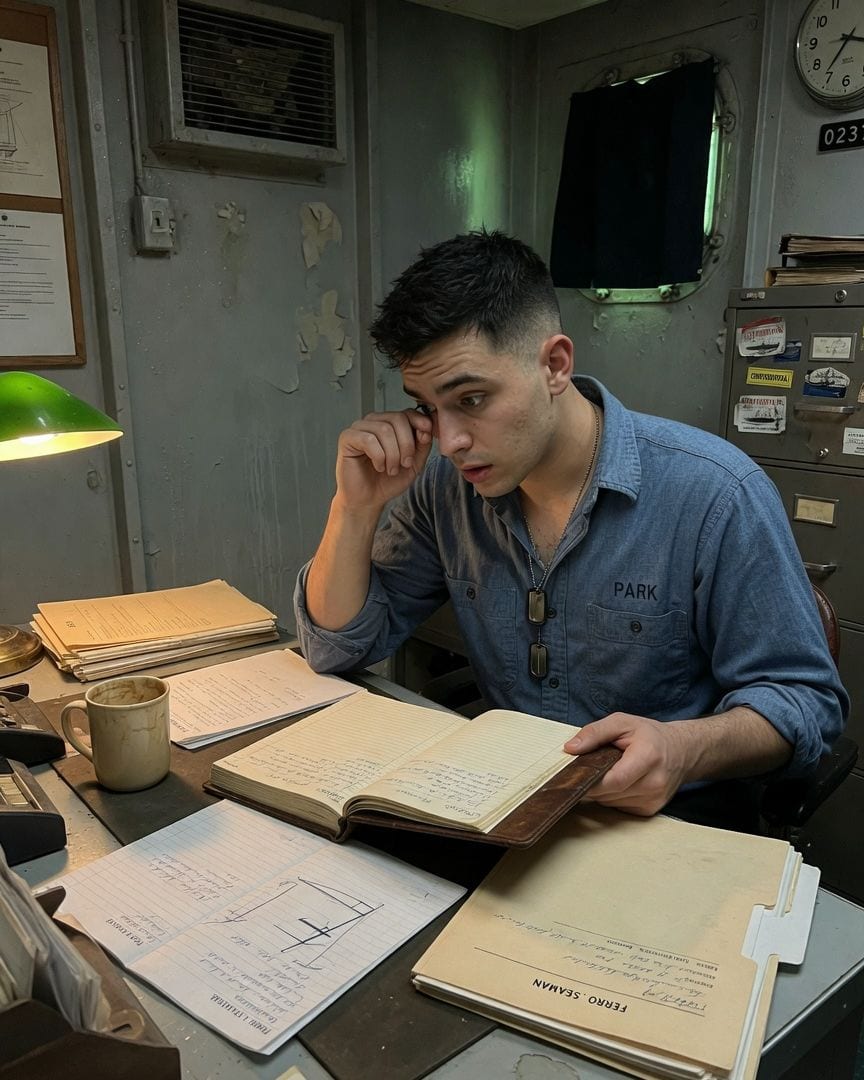
A yeoman on the USS Vagabond's final patrol checked a recovered sailor's log. His signature's 'F' now leaned left, impossibly steady.
Yeoman Third Class Preston Park sat amidst the endless paperwork of the USS Vagabond's final patrol, the salt-damp air heavy around him. The ship was slated for decommissioning, each document a record of its dwindling legacy. As Preston picked up Seaman Ferro’s watch logbook for a routine countersignature, he expected the familiar, shaky 'F' that always leaned right like a tiny sailboat. But the fresh entry, made just hours after Ferro’s recovery from going overboard, showed an 'F' leaning unmistakably left, penned with an impossible steadiness. A cold knot formed in the yeoman's stomach, a shiver running down his spine that deepened when he found a similar, wrong-leaning signature in the master log from a decade earlier.
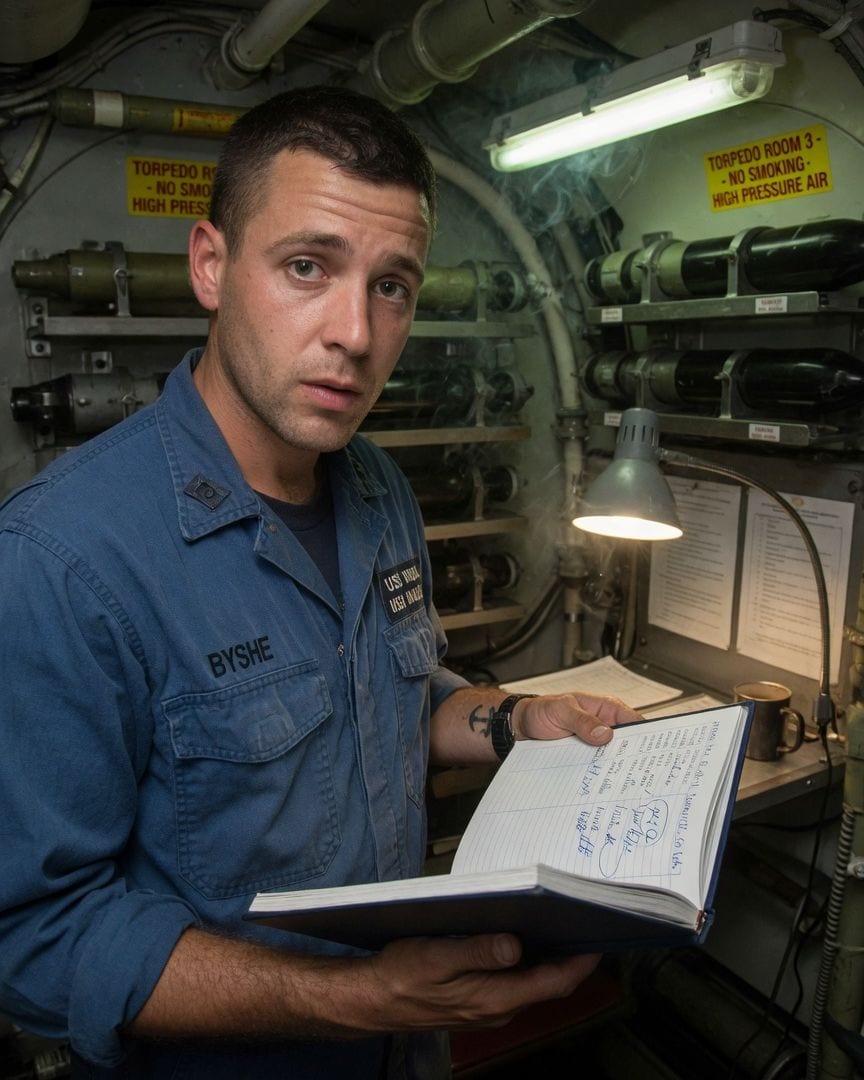
A torpedoman found his own signature in the USS Vanguard's duty log for a watch he never stood, beside a name not on the master crew manifest.
Torpedoman Oscar Bysshe, a rational sailor on his first deep patrol aboard the USS Vanguard, dismissed the messcook's nervous claim of an extra man at the table. He attributed the perfectly clean, untouched tray left behind to a prank. But later, during a routine systems check, Bysshe discovered his own familiar signature in the official duty logbook, for a watch he had been asleep through. Beside it was a name he didn't recognize, a name that shouldn't be there. A frantic check of the master crew manifest confirmed the impossible: the name appeared in the 'temporary assignments' section, dated just yesterday, scrawled in a hand eerily similar to his own.
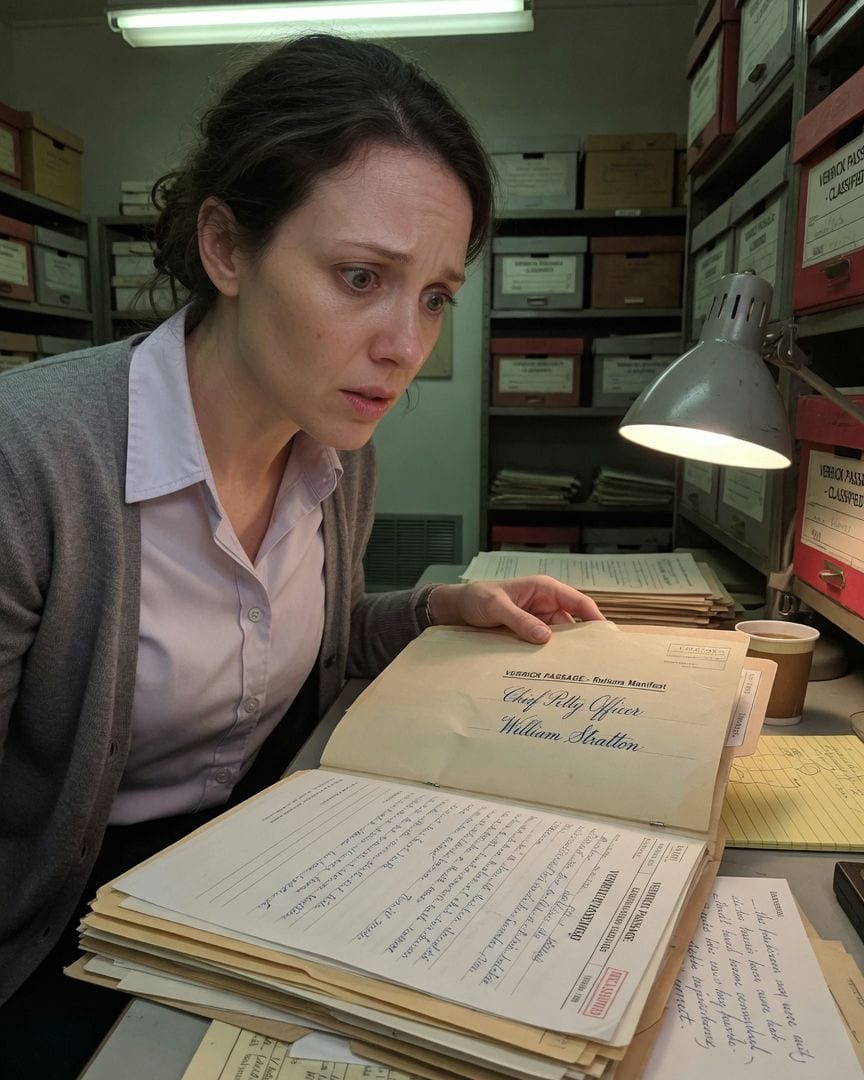
A records reviewer found personnel files for men lost 80 years ago, still being signed in an identical, perfect hand.
In the sterile hush of the declassified archives, meticulous reviewer Ione Fash had a routine task: cross-referencing witness statements from the Verrick Passage file. But as she reviewed files eighty years thick with official silence, she found nine separate interviews containing the exact same chilling sentence, all in an identical, precise hand. Her rational mind sought explanation, yet then she discovered something worse: personnel files for men lost in 1943, still being updated with modern requisitions and payroll runs. Each impossible entry, including a manifest signed just two weeks ago by a casualty from eighty years prior, bore the same unnervingly perfect signature. The file wasn't just a record of the lost; it was still being signed.
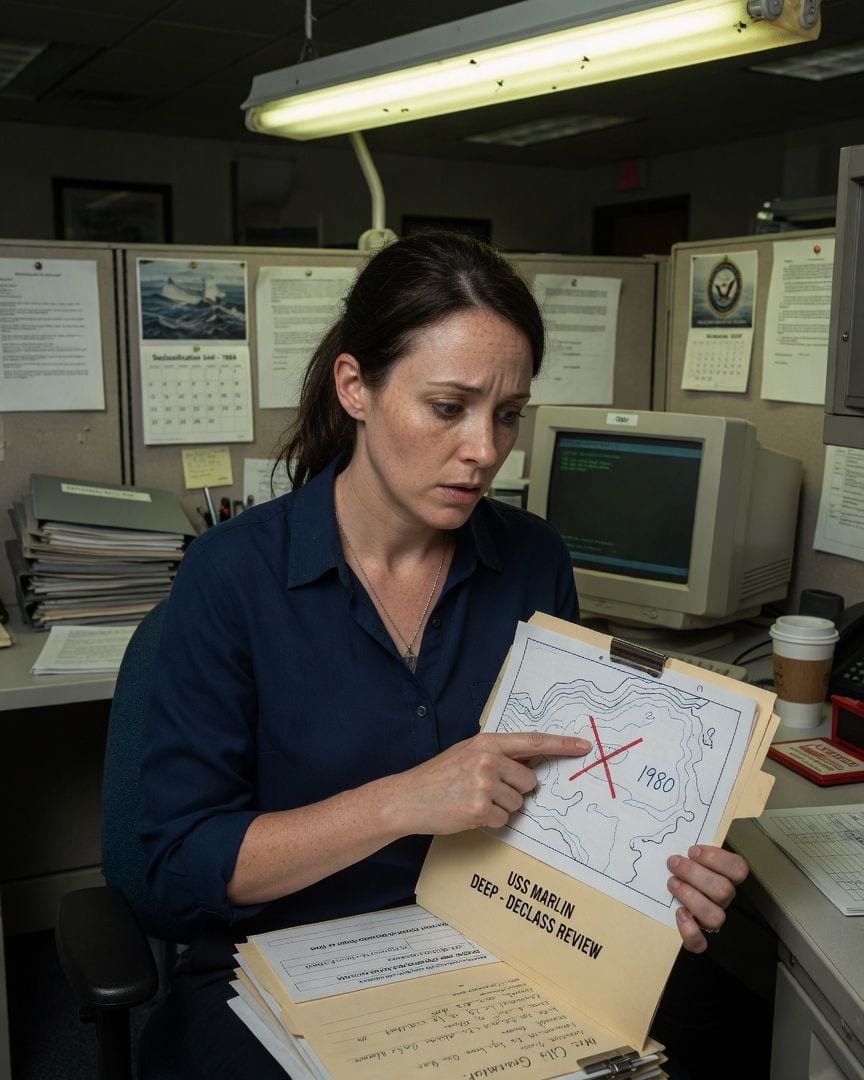
A declassification reviewer finds a dead Cold War submarine officer's report, filled out three years after his official loss.
Declassification reviewer Cass Berrigan understood the quiet anguish of widows, sifting through files like the USS Marlin Deep's. The submarine was lost in 1978, leaving behind Lily Granger's desperate letters, asking where her husband Arthur Thatcher's body was. But deep within the file, Cass found a chart of the wreck site, dated 1980—two years after the loss—in Thatcher's unmistakable hand. The dread solidified when she later uncovered an official report, also in his hand, dated 1981, stating 'Station Maintained. Status: Green.' How could a man officially dead for three years still be filing reports?
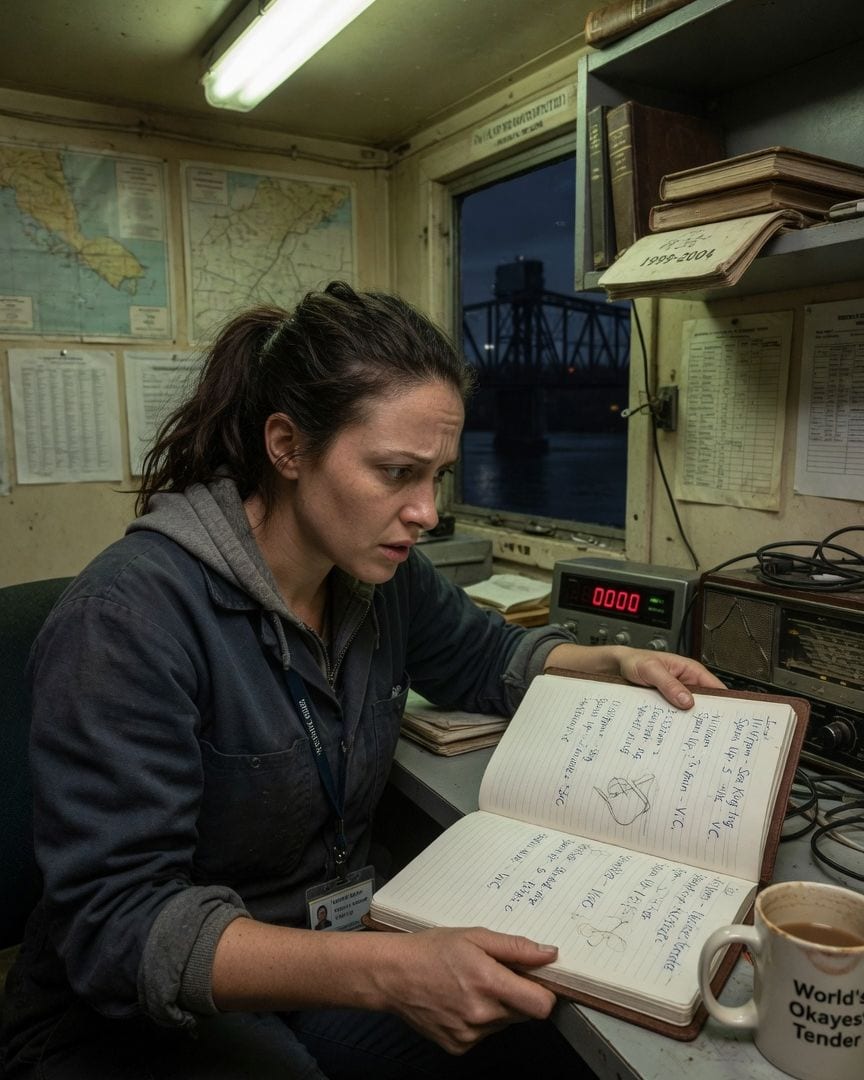
My drawbridge log shows a 2:33am lift I didn't make. The span counter never moved.
As a drawbridge tender, my midnight to dawn shift is usually quiet, a routine of monitoring traffic and logging lifts. But tonight, my own logbook shows an impossible entry for a bridge lift I have no memory of making. My initials and handwriting are there, yet the span counter above my panel reads a steady zero. No boat called, no span ever went up.
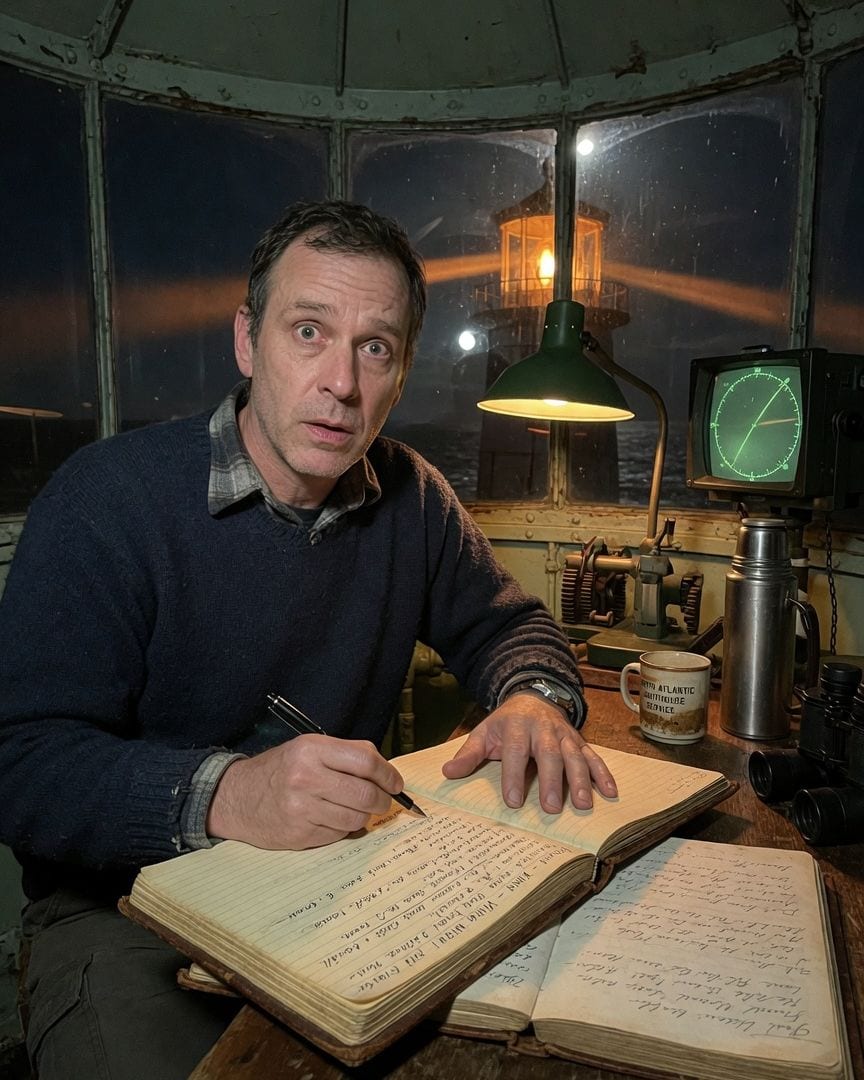
My lighthouse log has my own 3 AM entry for a phantom ship. I was alone in the tower, and I wrote no such thing.
Perched in the lantern room for my usual 2-6 AM watch, I reached for the thick logbook. But the 3:00 AM entry, under my own name, detailed a vessel I never saw. The words were in my own ink, yet I had never written them.