A yeoman on the USS Vagabond's final patrol checked a recovered sailor's log. His signature's 'F' now leaned left, impossibly steady.
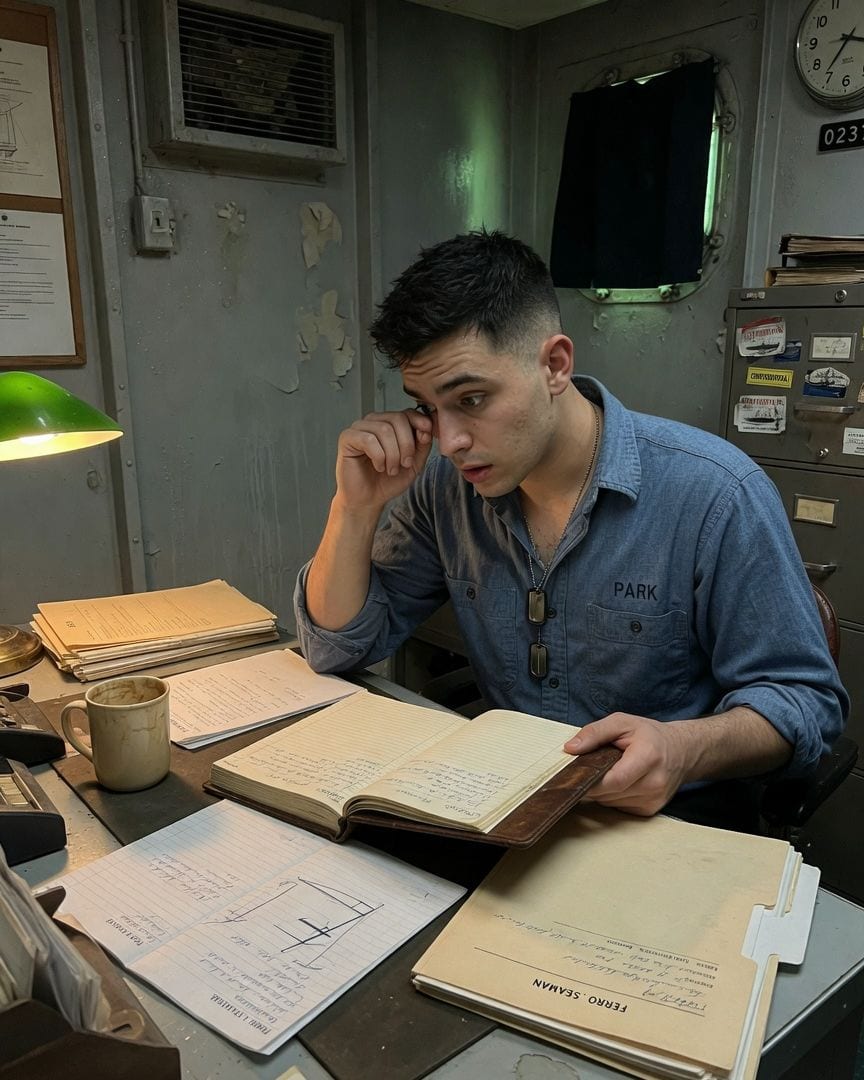
Yeoman Third Class Preston Park, age 24, sat at his desk in the USS Vagabond's administrative office, the salt-damp air thick around him.
The ship was on its final patrol before decommissioning, and the paperwork was endless, each form a tiny record of a dwindling legacy. He picked up Ferro’s watch logbook, a routine task to countersign the last entry.
Seaman Ferro, age 22, had gone over the side in heavy seas off Subic a week ago, then hauled back aboard, hypothermic but alive.
Preston knew Ferro’s signature cold: the looping, slightly shaky hand, the distinctive 'F' always shaped like a little sailboat, its mast leaning right, as if catching a breeze.
It was a familiar, almost comforting quirk in the otherwise rigid formality of naval documentation.
But as Preston looked at the fresh entry, made just hours after Ferro’s recovery, the 'F' still held the boat shape, yet it now leaned unmistakably left, and the hand that formed it was unnervingly, impossibly steady.
It was too perfect, too balanced. A tiny, cold knot formed in Preston’s stomach. It was Ferro’s signature, but it wasn't.
Preston tried to rationalize it. Fatigue, perhaps, or the lingering effects of hypothermia. He’d seen hands tremble after a close call, but never steady into a perfect, reversed mirror image.
He consulted Ferro's previous log entries, scanning through pages of the familiar, right-leaning 'F.' Every single one matched his memory, a consistent, slightly endearing imperfection. He even pulled Ferro’s service record, checking the signature on his enlistment papers.
Same shaky, right-leaning 'F.' He pressed the heels of his hands into his eyes, trying to rub away the insistent image of the wrong 'F.' He tried to dismiss it as a trick of the light, a momentary lapse in his own attention, but the image of that perfectly balanced, wrong-leaning 'F' kept replaying in his mind, sharp and unsettling.
Later that day, he saw Ferro in the mess hall, sitting with a group of other seamen. The seaman was laughing, sharing a story about his ordeal, his voice a little too loud, his gestures a little too expansive.
Ferro caught Preston’s eye across the crowded room and gave a small, almost imperceptible nod. The smile felt too wide, too bright, like a mask pulled taut over something unyielding.
Preston watched him, a shiver running down his spine that had nothing to do with the ship’s air conditioning.
That night, unable to sleep, Preston found himself back in the administrative office, the hum of the ship's ancient ventilation system a low, lonely moan.
He pulled the ship’s master logbook, a heavy, leather-bound tome that chronicled every watch, every incident, every official signature for the past decade.
He started flipping through, not sure what he was looking for, but the wrongness of Ferro’s new signature gnawed at him. He knew the system. Every detail was accounted for. This shouldn't be possible.
He landed on an entry from ten years ago, an incident report detailing another 'man overboard' recovery. The recovered sailor, a Yeoman Third Class named Audrey Granger, had signed off on her return to duty.
Preston’s eyes immediately went to her signature, expecting some ordinary script, something to dismiss the anomaly. There, unmistakably, was the 'F-boat.' But it was leaning left, just like Ferro’s new signature, written with the same unnatural steadiness.
His heart hammered, a frantic drum against his ribs. It wasn’t just Ferro. This had happened before.
The discovery of Audrey Granger’s altered signature sent Preston down a rabbit hole. He spent his off-hours, and often his on-hours when Commander Vaughn, age 48, wasn't looking, cross-referencing old logbooks with incident reports.
The ship’s administrative office, once a place of mundane routine, now felt like a crypt of hidden truths.
He found three more instances over the past fifteen years: a cook, a machinist, and another yeoman, all recovered from the sea or found after being declared 'missing on duty.'
Each one, after their return, had signed their logbooks with the identical, left-leaning 'F-boat.' The pattern was undeniable, a subtle scar across the meticulous facade of military accountability, a tiny, perfect crack in the system.
The air in the office often seemed to thicken around him, cold and still, as if the ship itself was holding its breath.
He approached his colleague, Yeoman Second Class Audrey Granger, age 26, (no relation to the earlier Audrey) with a casual question about old ship superstitions. He hoped for a logical explanation, a sailor's tale to fit the impossible.
She laughed it off, talking about phantom footsteps and galley ghosts. 'Never heard of a signature changing, though,' she chuckled, dismissing it with a wave of her hand. 'That's a new one.' Preston didn't laugh.
He started observing Ferro more closely. Ferro was more efficient now, almost unnaturally so.
His movements were precise, his responses always correct, but there was a vacant quality behind his eyes, a lack of the casual camaraderie that had defined him.
When Preston asked him about his recovery, Ferro gave a textbook response about gratefulness and returning to duty, but his gaze seemed to drift, as if recalling instructions rather than memories, his voice utterly devoid of genuine emotion.
Preston felt a growing dread, a cold certainty. He knew Ferro. This wasn't Ferro.
Preston’s late-night forays into the ship’s archives didn’t go unnoticed.
One evening, as he was poring over a faded manifest from the 1980s, the heavy steel door to the archive room creaked open, the sound scraping across the quiet like a fingernail on a blackboard.
Chief Petty Officer Gerald Mercer, age 55, the ship’s grizzled, quiet archivist, stood silhouetted in the doorway.
Mercer was a fixture, having served on the Vagabond for longer than anyone could remember, a repository of forgotten ship lore and unspoken truths. 'Burning the midnight oil, Park?'
Mercer’s voice was calm, almost flat, a tone that settled over the room like dust. Preston stammered, his heart giving a frantic lurch, 'Just… looking up some old supply manifests, Chief. Trying to trace a serial number discrepancy.'
He hated the lie, but what could he say? Mercer stepped inside, the door swinging shut behind him with a soft thud that seemed to absorb all sound. He didn't look at the manifests.
His eyes, dark and knowing, fixed on Preston. They held no judgment, only an ancient, quiet understanding that chilled Preston more than any accusation. 'Some things are better left in the past, Yeoman. The sea gives, and the sea takes.
Sometimes, it takes a little piece, and gives something back, different.' Mercer walked over to a dusty shelf, pulled down a brittle, unmarked logbook, and ran a thumb over its cover, a gesture of reverence or familiarity.
'The Vagabond has a long memory. Longer than most. Some of us learn to live with it.'
He didn't offer to explain further, just gave Preston a long, unsettling look before turning and leaving, the door closing silently, leaving Preston alone in the sudden, echoing quiet.
Preston felt a chill that had nothing to do with the archive’s temperature. Mercer wasn't warning him; he was acknowledging him.
Mercer's cryptic words spurred Preston to dig deeper into the Chief’s own past.
He found Mercer’s service record, impeccable, every commendation and transfer meticulously noted, but with a curious blank spot: a six-month period decades ago where Mercer was listed as 'unaccounted for' before suddenly reappearing with a commendation for 'resilience.'
Preston cornered Mercer in the ship’s quietest corner, the aft deck, under the vast, indifferent sky, the only place where the ship’s constant noise seemed to recede, leaving only the lapping of waves against the hull.
'Chief,' Preston began, his voice barely audible above the sea, 'I’ve been looking at some old logs. The signatures… after certain incidents. They change.' Mercer watched the waves, his expression unreadable, a statue carved from weathered wood. 'They do.'
'And yours, Chief?' Preston pressed, his voice low, a tight thread in the open air. 'There was a period… your record says 'unaccounted for'.'
Mercer finally turned, his eyes holding an ancient weariness, like two deep pools reflecting centuries of muted understanding. 'The sea… it has its ways of ensuring the watch never truly ends, Yeoman. The ship needs its crew.
The system needs its numbers to add up.' Preston felt a cold dread spread through him, a certainty growing like ice in his veins. 'What are you saying, Chief? That Ferro… that those others… they’re not the same people?'
Mercer nodded slowly, a motion devoid of surprise or sorrow. 'They are… a perfect accounting. Every detail correct. Every memory in place. But the hand that writes… that hand is steady now. It knows its purpose.'
He gestured vaguely at the ship around them, a behemoth of steel and secrets. 'This vessel… it’s old. It’s seen many cycles. Many men have gone over the side. And many have come back… slightly different.
The paperwork always checks out. The manifest is always full. The accountability holds, even when it shouldn't.' The implications slammed into Preston with the force of a rogue wave. The altered signature wasn't a mistake; it was a mark.
A mark of replacement. And Mercer, calm and unbothered, was a living testament to it. He was one of them.
Preston, reeling from Mercer’s confession, felt a desperate need to understand the full scope of the pattern, to grasp the edges of the monstrous shape that was finally snapping into place.
He sought out the ship’s oldest archived manifests, stored in a dusty, seldom-accessed vault in the lower decks, a place heavy with the smell of stale paper and time.
He bypassed the recent decades, going back to the Vagabond's earliest deployments, then expanding his search to the logs of other vessels that had been decommissioned around the same time.
His flashlight beam cut through the gloom, a thin, wavering spear in the suffocating darkness, illuminating names and dates long forgotten, blurring into a single, frantic quest.
He was looking for early appearances of the 'F-boat' signature, for the very first instance of this insidious replacement, a genesis point for the horror. And then he found it.
Not on the Vagabond, but on a manifest from the USS Harlow, a destroyer that had been scrapped for parts almost fifty years ago, its history reduced to brittle paper.
A list of crew from a patrol in the Bering Sea. And there, among the names, was 'Park, Preston.' The rank was wrong, a junior ensign, and the service number was subtly different, but the name was undeniably his.
And next to it, on a line confirming attendance for a formal inspection, was the distinctive 'F-boat' mark, leaning the wrong way, precisely as he had come to dread, a perfect, chilling echo from the past.
He slowly raised his head, the cold metal of the vault pressing against his back, the air suddenly thin and tasting of iron. The pattern wasn't just happening to others. It had always been happening.
And his own name was in it.
Preston found Mercer again, this time in the ship’s empty engine room, the thrum of the idling engines a low growl around them, a mechanical pulse in the vast, oily cavern.
He laid the faded USS Harlow manifest on a greasy workbench, the brittle paper a contrast to the heavy machinery. 'My name, Chief. Fifty years ago. What does it mean?'
Mercer picked up the document, his gaze distant, as if seeing through the paper to something far beyond. 'The entity… it’s drawn to the structure, the order.
The military, with its manifests, its logs, its absolute need for accountability… it’s a perfect host. It doesn’t just replace individuals; it replaces patterns. Entire histories.
It ensures the numbers always add up, even if the person behind the number is… different.' He traced the 'F-boat' signature next to Preston’s ancestral name with a knowing finger. 'Certain names, certain roles, they become… vessels. They cycle.
The 'Preston Park' who sailed on the Harlow was replaced. Just as Ferro was replaced. Just as I was replaced.' He looked at Preston, a strange, calm pity in his eyes that offered no comfort. 'The Vagabond is old.
It’s on its last run. The entity is preparing to move on, to ensure its records are complete before the ship is broken up. It needs to fill the gaps, ensure every name has its corresponding mark.
And you, Yeoman Park, with your diligence, your attention to detail… you were ideal to help it complete its final accounting here.' Preston felt a chill that permeated his very bones, a cold hand reaching into his core.
The pattern wasn't just a series of random replacements; it was a deliberate, self-sustaining system, using the very mechanisms of military order to perpetuate itself.
The 'F-boat' was its seal, its proof that the books were balanced, the names accounted for, no matter the cost to the original.
Preston stumbled back, the realization a physical blow, stealing the air from his lungs. 'You’re saying… I’m next?' Mercer merely nodded, his eyes unwavering. 'The entity doesn’t need a physical act. It’s already here.
It’s always been here, in the records, in the ship’s memory. It simply… completes the circuit.' Preston looked around the engine room, at the familiar machinery that now seemed alien, menacing, each polished surface reflecting a silent threat.
He thought of Ferro, of Mercer, their eyes holding a chilling emptiness behind their perfect compliance. He couldn’t be like them. He had to break the cycle, or at least escape it.
He considered running, hiding, but where could he go on a ship in the middle of the ocean, under the watchful eyes of a crew that was increasingly not itself?
He remembered the ship's emergency beacon, a last resort for catastrophic events. If he could trigger it, send a clear signal, perhaps an external force could intervene, disrupt the 'accounting,' shatter the perfect system.
He sprinted for the radio room, the thrum of the engines seeming to mock his efforts, echoing the frantic beat of his own heart. He burst inside, startling Audrey Granger, who was on duty, her head bowed over a console.
She looked up, her expression a blank concern. 'Yeoman Park? Is everything alright?' Her voice was too even, too calm for the sudden intrusion. Preston ignored her, his hands flying to the emergency comms panel, his fingers trembling with adrenaline.
He knew the protocols by heart. A few quick inputs, a burst transmission on an encrypted channel, and a distress signal would be sent, a desperate scream into the vast indifference of the ocean.
He was almost there, his fingers hovering over the activation button. Audrey stood, slowly, her eyes fixed on him, a faint, unnerving smile beginning to form on her lips. 'You’re trying to disrupt the accounting, Preston?'
Her voice was no longer just even; it was eerily calm, resonating with a deeper, unfamiliar tone that vibrated through the air. He froze, his hand inches from the button.
Her smile widened, revealing teeth that seemed a shade too white, her eyes suddenly devoid of any human warmth, two vacant pools reflecting nothing. He knew that look. He had seen it in Ferro.
He had seen it, in a different way, in Mercer. He was too late. He was trapped. The system had already claimed another.
The USS Vagabond completed its final patrol. The crew transferred to other vessels or began their discharge process. Yeoman Third Class Preston Park, along with Seaman Ferro and Chief Petty Officer Gerald Mercer, were among those who signed off.
All paperwork was in order, every logbook accounted for, every signature precise. A final inspection noted the ship’s impeccable record-keeping, a testament to the crew's dedication. There were no discrepancies, no anomalies, no missing persons. The system had held, flawlessly.
Months later, at a small ceremony for decommissioned sailors, Commander Isaac Vaughn spotted Preston Park across the room. He approached, hand extended. 'Park! Good to see you. Always appreciated your meticulous work on the Vagabond.'
Preston returned the handshake, his grip firm, his expression unreadable. 'Thank you, Commander.' Vaughn paused, a flicker of something unreadable in his eyes, a memory perhaps of the old Preston, or of something else entirely.
'You know,' he said, a casual observation, 'I always thought your handwriting was a little… distinctive. That 'F' of yours, like a little boat.' Preston smiled, a faint, unbothered smile that didn’t quite reach his eyes. 'Is that so?'
On a dusty shelf in a naval archive, a logbook from the USS Vagabond, marked for decommissioning, lay open.
The final entry, signed by Yeoman Third Class Preston Park, displayed a perfectly rendered 'F,' shaped like a little boat, leaning unmistakably to the left. The hand that held the pen was unnervingly steady. Is that so?
If this one got to you
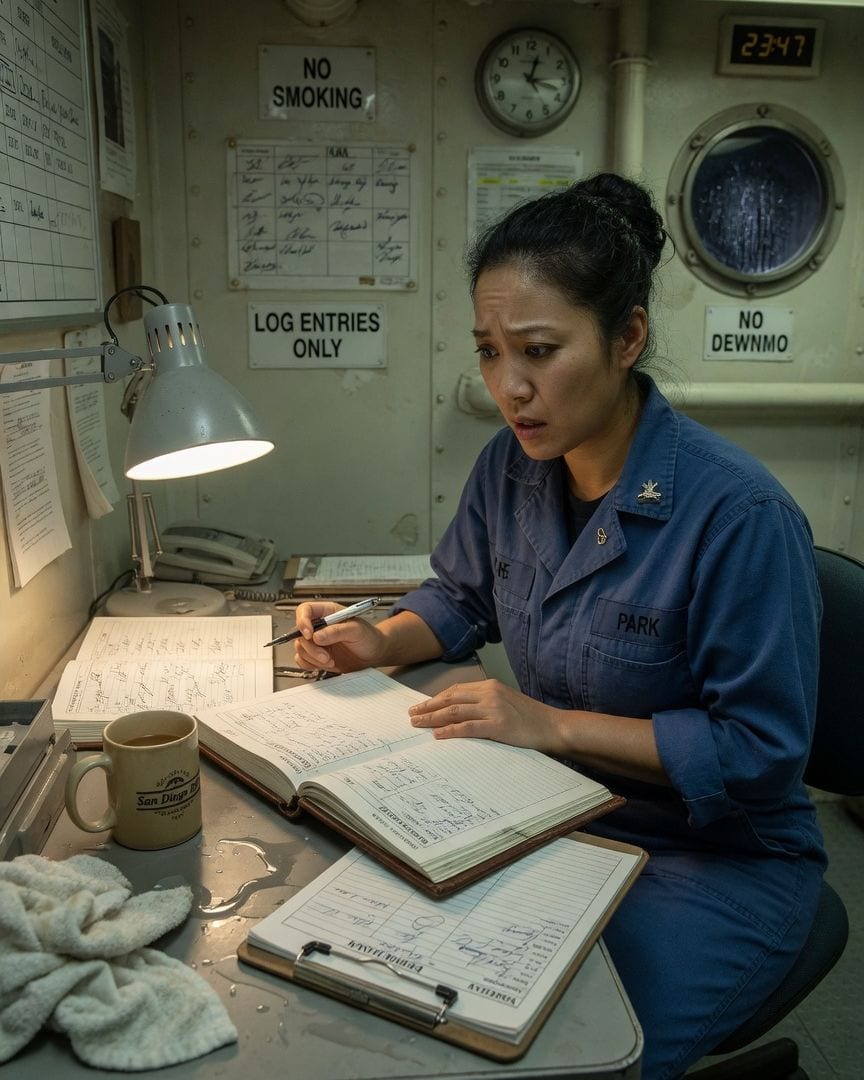
Yeoman Vivian Park checked Ferro’s log after his rescue. His signature was steady, wrong. Then she found it: the new hand had signed his name a week before he went overboard.
Yeoman Vivian Park was just two weeks from her transfer when Yeoman Kenneth Ferro went overboard in heavy seas. After he was pulled back, hypothermic but safe, Vivian watched him sign the logbook. His signature, once familiar down to a slight tremor from an old injury, was now unnervingly steady, the 'F' leaning the wrong way. Later, reviewing old logs, she found the same uncanny shift in another Yeoman's signature after an injury. The true dread hit when Vivian confirmed Ferro’s new, wrong signature had already appeared in the log a full week before his perilous fall into the sea.
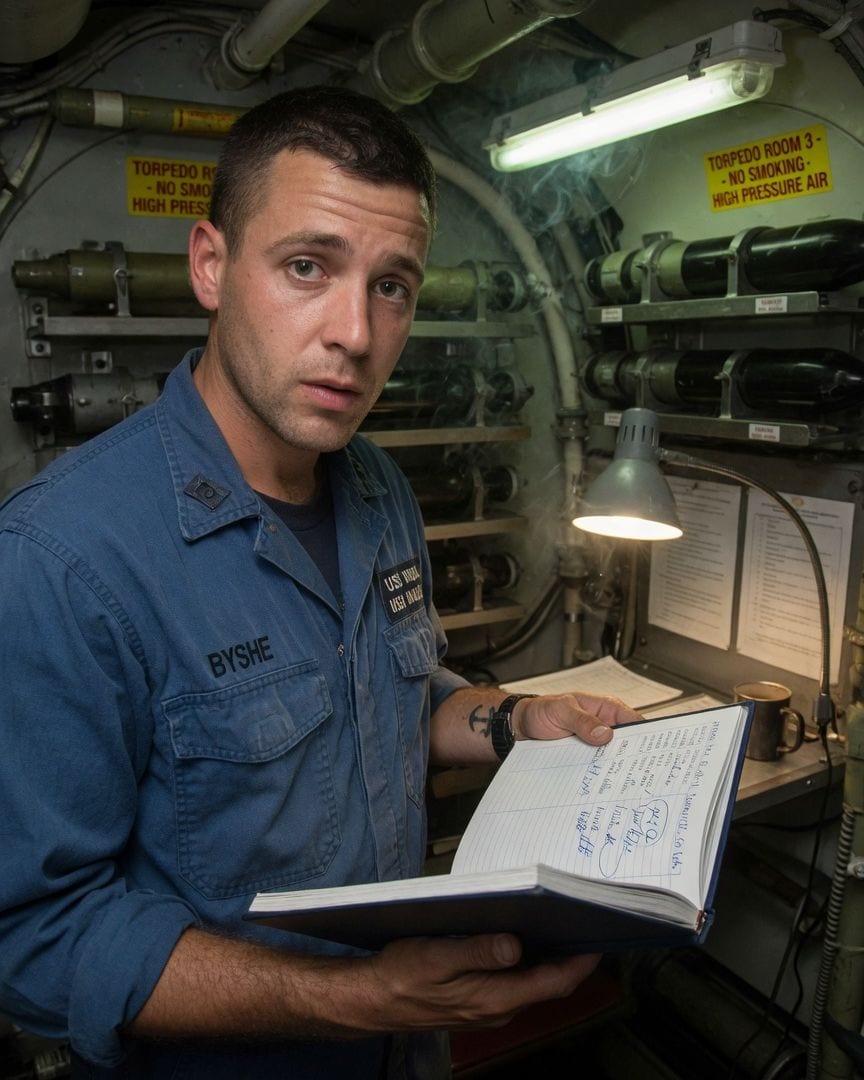
A torpedoman found his own signature in the USS Vanguard's duty log for a watch he never stood, beside a name not on the master crew manifest.
Torpedoman Oscar Bysshe, a rational sailor on his first deep patrol aboard the USS Vanguard, dismissed the messcook's nervous claim of an extra man at the table. He attributed the perfectly clean, untouched tray left behind to a prank. But later, during a routine systems check, Bysshe discovered his own familiar signature in the official duty logbook, for a watch he had been asleep through. Beside it was a name he didn't recognize, a name that shouldn't be there. A frantic check of the master crew manifest confirmed the impossible: the name appeared in the 'temporary assignments' section, dated just yesterday, scrawled in a hand eerily similar to his own.
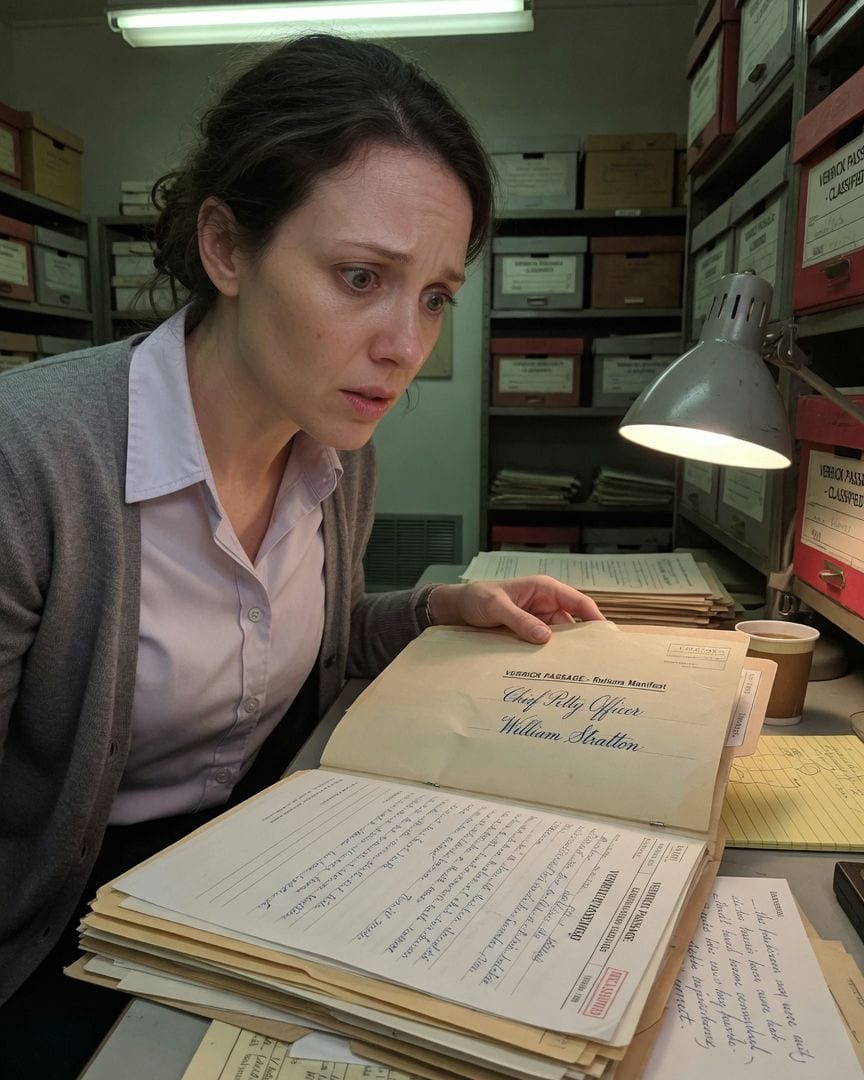
A records reviewer found personnel files for men lost 80 years ago, still being signed in an identical, perfect hand.
In the sterile hush of the declassified archives, meticulous reviewer Ione Fash had a routine task: cross-referencing witness statements from the Verrick Passage file. But as she reviewed files eighty years thick with official silence, she found nine separate interviews containing the exact same chilling sentence, all in an identical, precise hand. Her rational mind sought explanation, yet then she discovered something worse: personnel files for men lost in 1943, still being updated with modern requisitions and payroll runs. Each impossible entry, including a manifest signed just two weeks ago by a casualty from eighty years prior, bore the same unnervingly perfect signature. The file wasn't just a record of the lost; it was still being signed.
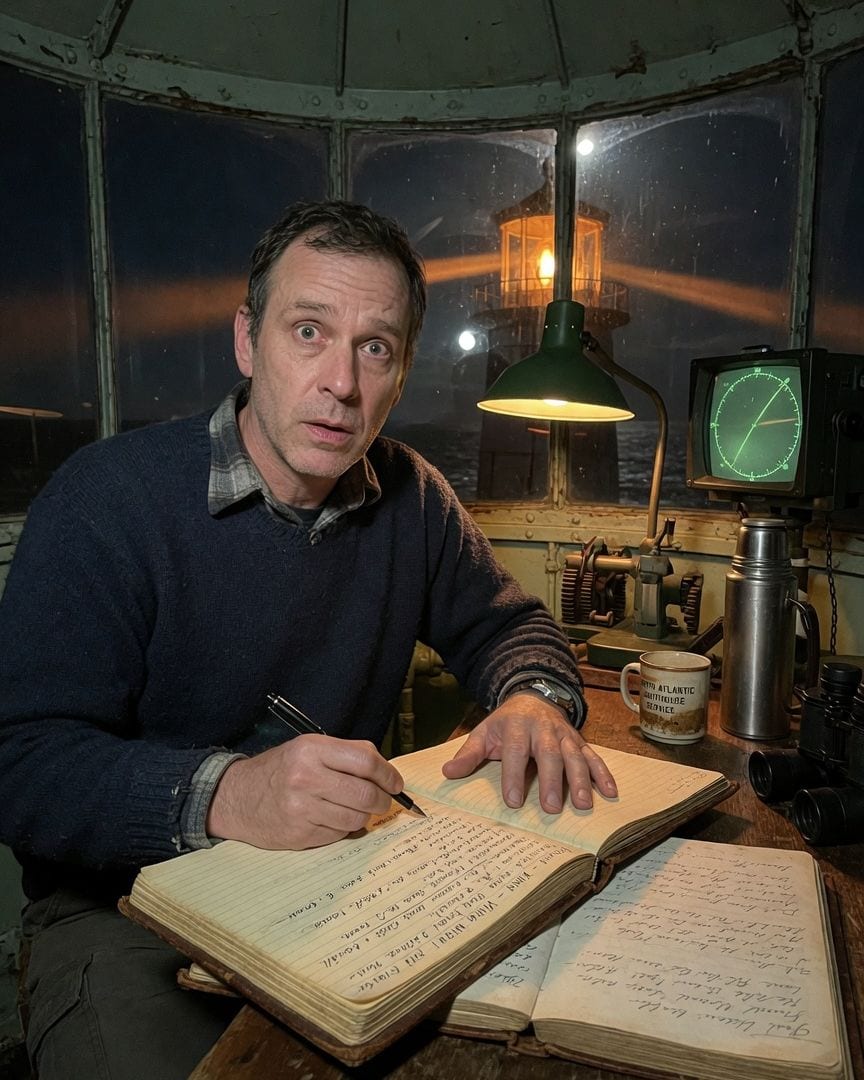
My lighthouse log has my own 3 AM entry for a phantom ship. I was alone in the tower, and I wrote no such thing.
Perched in the lantern room for my usual 2-6 AM watch, I reached for the thick logbook. But the 3:00 AM entry, under my own name, detailed a vessel I never saw. The words were in my own ink, yet I had never written them.
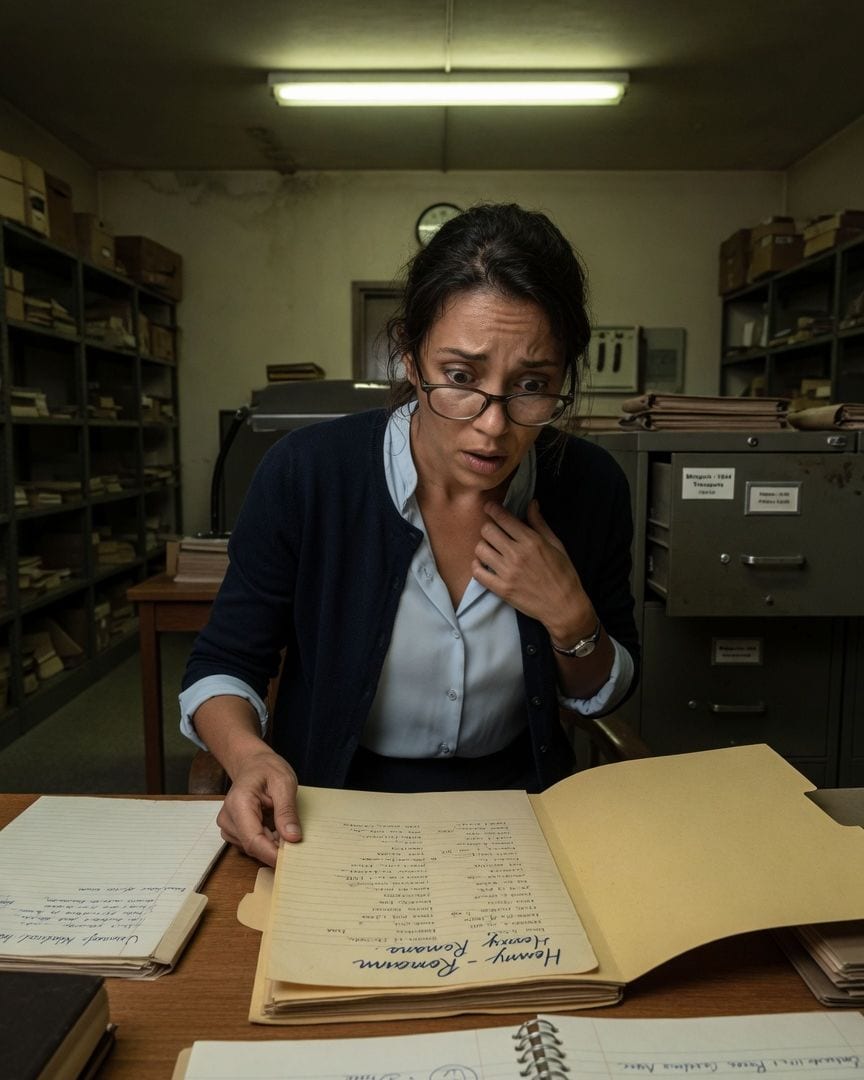
A records reviewer found a 1944 ferry manifest with an impossible 42nd name. The same dark ink marked a phantom crewman on a Cold War flight log.
Delphine Arceneaux, a dedicated records reviewer, had just minutes left in the stale reading room to finalize her review of a 1944 Mirepoix Ferry manifest. Her job was to confirm every detail of the forty-one passengers who boarded a boat that never arrived. But as the clock neared six, a forty-second name materialized on the faded paper, stark in a dark, unfamiliar ink. 'Henry Romano,' it read, with the impossible notation: 'BOARDED AT MIDSTREAM.' How could anyone board a ferry in the middle of a river?
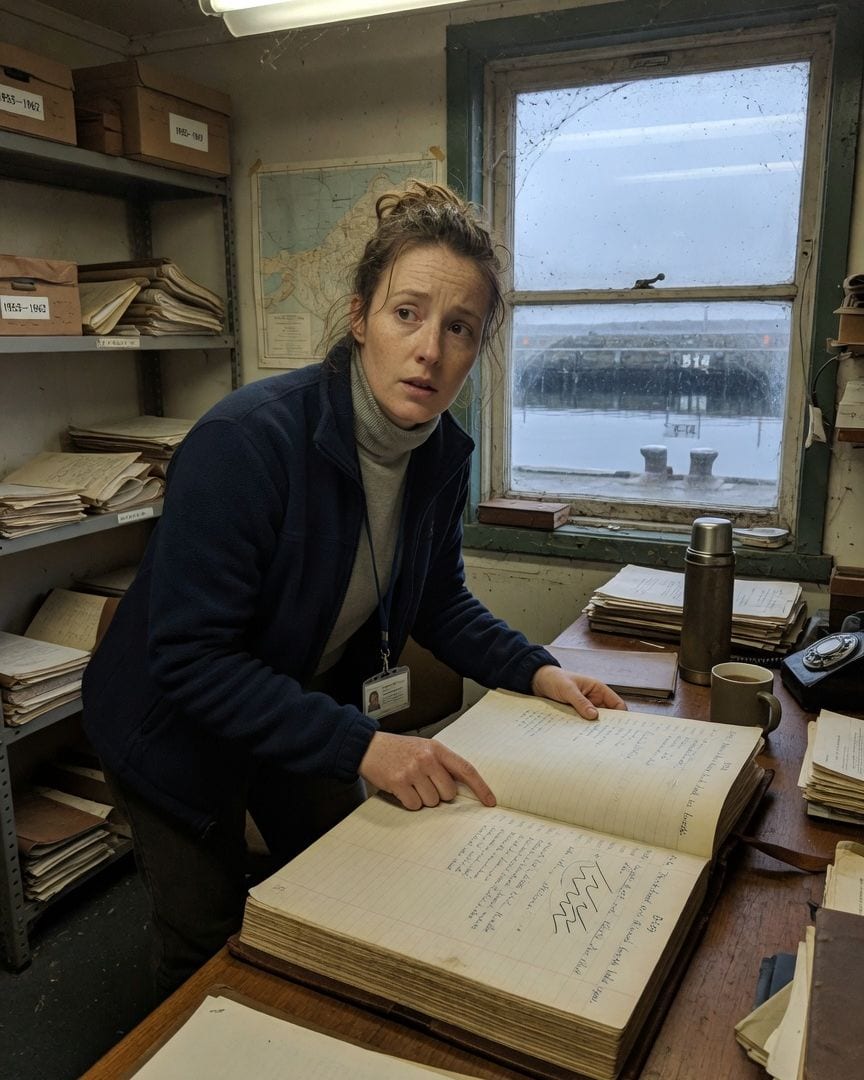
My harbour ledger shows Berth 14 let to a trawler every few years, but it's always empty. Each entry reads 'not returned to sea, berth held open'.
My job as Harbour Master's Assistant is managing the berth ledger, tracking every vessel. But Berth 14 holds a strange paradox: my book says it's let, yet it's always empty. Each entry for that berth closes with the same cryptic note – 'not returned to sea, berth held open' – a pattern stretching back to 1955.