Analyst Tobias Reyn found a colossal ocean wake with nothing at its head. His own name was on the next request to image that impossible void.
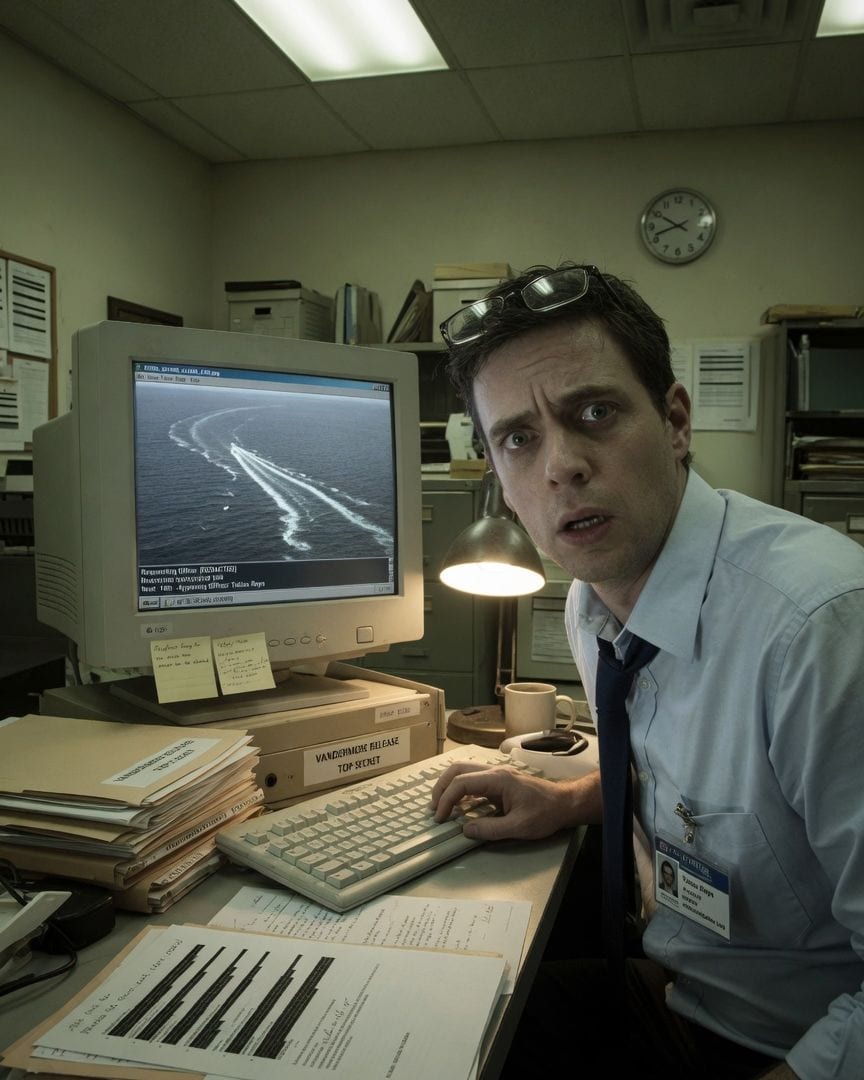
Analyst Tobias Reyn, 34, hunched over his monitor in the sterile, fluorescent-lit declassification office. The deadline for the Vandermere release pressed down on him, a crushing weight of ten thousand pages of 1990s satellite tasking, dry as chalk.
He scrolled through records of coordinates and acquisition times, his eyes glazing over, until a pattern stopped him cold.
Every four months, for eleven straight years between 1990 and 2001, the same square of empty ocean southeast of the Kerguelen Islands had been imaged on request.
The requesting office, he noted, no longer existed. Even stranger, the associated imagery was almost entirely withheld, save for one frame, cleared in error and tucked into a miscellaneous file. Tobias clicked it open.
It showed only a expanse of gray, churning water, and a colossal wake with absolutely nothing at its head.
He, methodical by nature, zoomed in, then out, then in again, trying to find a ripple, a dark shape, anything to explain the impossible displacement. There was nothing.
Just the water, the wake, and the chilling, undeniable void where the source should be. A phantom.
Then he saw it. Buried deep in the tasking record for the Kerguelen sector, the next request was scheduled for the fourteenth of this month. And his own name, Tobias Reyn, was printed plainly as the approving officer.
Tobias tried to rationalize it. A glitch, he thought, or a mislabeled file, a legacy placeholder for a defunct agency that no one had bothered to clear. He pulled up the metadata for the single cleared image.
Standard satellite, standard time, no anomalies reported by the automated systems. He cross-referenced the coordinates with naval archives, looking for known deep-sea trenches, unusual currents, anything that might create such a phantom wake. Nothing fit.
The area was unremarkable, deep, and desolate, a barren patch of ocean.
His deadline for the Vandermere release loomed, a tangible pressure in the air of his office, but the pattern gnawed at him. He couldn’t let it go.
He dug deeper into the release, searching for any other documents from the defunct requesting office. Most were administrative, routine requisitions for supplies or personnel transfers from twenty years ago.
Then, buried among a stack of unrelated meteorological reports from 1996, he found it: a single, heavily redacted supplemental report, misfiled by decades.
It bore the designation of the defunct office and was dated to one of the earlier 'empty ocean' imaging dates, specifically August 14, 1996.
The report detailed a brief, anomalous deep-ocean sonar contact – a 'transient, high-speed, non-reflective signature' – immediately followed by a reclassification order that had scrubbed it from the public record.
At the bottom of the page, beneath a thick block of black ink, an almost illegible, handwritten note was scrawled: 'Project Deep Scan – maintain the schedule.'
The rational explanations crumbled around Tobias, leaving only the chilling certainty that this was no clerical error, no simple oversight.
The sonar signature data on the report was stark, a sharp, impossible spike against a flat baseline, indicating something moving at incredible speed at depths no known submarine could reach.
Tobias stared at the words, 'Project Deep Scan,' the name feeling like a cold hand on his shoulder. He looked at his own approval form for the upcoming fourteenth, then back at the report.
The schedule wasn't for satellite tasking, he realized. It was for something else entirely, something that moved beneath the waves, leaving no trace but an impossible wake and a buried record.
He felt a sudden, profound dread, not just for what was out there, but for the vast, silent system that had known, documented, and then erased it.
The office around him, once a place of mundane order, now felt like a vast, silent machine, grinding on, waiting for the fourteenth, and for him to sign its next terrible page.
Tobias couldn't let it go. His deadline for the Vandermere release, once paramount, became secondary to the looming date of the fourteenth.
He started tracking down any mention of 'Project Deep Scan,' using the few unredacted keywords from the supplemental report. It was like pulling a thread from a tightly woven tapestry, each tug revealing more, and more.
He found faint, coded references in other declassified files, often cross-referenced with seemingly innocuous shipping lane adjustments or deep-ocean seismic surveys from the late 1980s.
Each reference pointed back to the Kerguelen region, or other remote oceanic 'X-sectors,' always connected to unusual 'anomalous energy signatures' or 'unexplained deep-water displacement events.'
He spent days in the archives, the dust of decades settling on his clothes, his mind racing through possibilities, each more unsettling than the last.
He called old colleagues, discreetly asking about defunct agencies, about anyone who might have worked on 'deep-sea projects' in the late 80s or 90s. Most remembered nothing, or claimed they did not.
One, a retired Navy intelligence officer named George Fontaine, 78, listened to Tobias's carefully worded questions, then simply told him, his voice raspy with age, 'Some things are better left buried, son. The sea keeps its own secrets.'
The unease deepened. The pattern wasn't just a pattern of observation; it was a pattern of management.
George Fontaine’s words echoed in Tobias’s mind. A few days later, while reviewing a different batch of declassified naval records, Tobias noticed something odd.
A routine personnel transfer order, dated just after his initial inquiries, for a records clerk he’d spoken to briefly about the Vandermere release. Not unusual on its own, but the timing felt off.
Then, an email appeared in his inbox, from an anonymous sender: 'Some files are meant to stay closed. The seal is there for a reason.' No sender, no subject, just that chilling line, signed with no name.
Tobias felt a prickle of cold sweat. He wasn't just investigating; he was being watched.
He began to check his office for anything out of place, subtly rearranging items on his desk, leaving small, almost imperceptible markers on files and drawers. He found nothing. But the feeling persisted, a cold weight just behind his eyes.
One evening, working late into the silence of the office building, he heard a faint click from the hallway outside his office, too soft for a normal door closing, too deliberate for an old building settling. He froze, listening. Silence.
He waited, heart pounding, then slowly opened his door. The hallway was empty, the fluorescent lights humming their endless song.
But a cleaning cart, usually left at the far end of the corridor by the utility closet, was parked directly outside his door, its chrome glinting under the harsh light.
The implication was clear: someone knew he was digging, and they were letting him know they were close. The danger was no longer abstract; it was personal, breathing down his neck.
The anonymous email and the cleaning cart solidified Tobias’s fear. He knew he needed to find someone who knew, someone who could pierce the layers of secrecy.
His renewed, more frantic search for 'Project Deep Scan' led him to a single, faded entry in an old federal directory from the early 2000s: 'Vivienne Yates, Records Custodian, Office of Oceanic Containment Initiatives (defunct 2005).'
The name rang a bell from his earlier, fruitless inquiries, but this time he had the defunct office's actual designation. He found her address in a quiet, unassuming suburb on the edge of the city.
Vivienne Yates, 72, met him at her door, her expression calm, almost serene, as if she'd been expecting him for days.
He presented his findings, a rapid-fire account of the Vandermere release, the impossible wake, the 'Project Deep Scan' report, and the strange warnings. She listened without interruption, her eyes, clear and ancient, never leaving his.
'The schedule,' she finally said, her voice soft but steady, 'is for its ascents. It has a predictable cycle.'
She explained that 'The Deep Scan Anomaly' was not a craft, not a vessel, but an ancient, non-human entity residing in the deep, surfacing periodically.
'Project Deep Scan' was established in the late 1980s, not to understand or eliminate it, but to monitor and contain the knowledge of its existence, managing its 'interactions' with the surface world.
The satellite imaging, the shipping lane diversions, the buried sonar reports – all were part of a vast, silent operation to keep it 'unhappened' in public records. 'The wake with nothing at its head,' she continued, 'is its signature.
It displaces water at immense speed, but its form is not of this world, not detectable by our means.'
Tobias felt the scattered pieces of his investigation click into place with terrifying precision.
The dread was no longer about a mystery; it was about an immense, patient truth, actively managed by a hidden institution that had woven itself into the fabric of the government. 'But why?' he asked, his voice barely a whisper.
'Why hide it for so long?' The air in the room seemed to press in on him, heavy with unspoken histories.
Vivienne Yates’s gaze hardened slightly. 'Because some truths are too vast to be contained by public knowledge without shattering the world. And because it's not just about what it is, but about who knows.'
She then produced a sealed microfiche from a small, locked mahogany box on her desk. 'You found the Deep Scan - X-sector references, I imagine?' Tobias nodded, a knot forming in his stomach, anticipating another revelation.
'The pattern is global, Tobias. And it’s far older than 1990.'
She slid the microfiche into a small, antique viewer that sat discreetly on a side table. The screen flickered to life, showing a personnel file from the 1950s.
The name at the top, clear as day despite the grainy image, was 'Reynard, T.' The description below it read: 'Initial contact liaison, Project Deep Scan, Kerguelen sector.'
Tobias felt a sudden, dizzying lurch, as if the floor had dropped out beneath him. His own family name, or a chillingly similar variant, connected to the very origins of this decades-old secret.
He looked at Vivienne, who watched him with an unsettling, knowing calm, a faint smile playing on her lips. 'The file,' she said, her voice dropping to a near whisper, 'isn't just about the anomaly.
It's about the people who encounter it. The ones who are drawn into its orbit. And the ones who are chosen to maintain the silence.'
The implication hung heavy in the quiet office: his own presence here, his 'appointment' to approve the next tasking, was not a coincidence.
He wasn't just an analyst who stumbled upon a secret; he was part of the pattern, already named in the file, unknowingly stepping into a role that had been waiting for him for generations.
The room, which had seemed so ordinary moments before, now felt very small and very permanent.
Vivienne Yates watched Tobias’s face as he processed the name 'Reynard.' 'Your grandfather, Thomas Reynard,' she explained, her voice even, 'was a naval cartographer. He was part of the initial survey team that first detected the anomaly in the 1950s.
He developed the original containment protocols for Project Deep Scan. The family name was slightly altered for subsequent generations to reduce direct links, but the lineage was always tracked.'
She revealed that Project Deep Scan was not just a small, defunct office, but a deeply compartmentalized, inter-agency, multi-national effort, spanning decades and classifications, dedicated to maintaining the illusion of an empty ocean.
The 'Deep Scan Anomaly' was not hostile, she insisted, but its sheer existence defied all known physics and biology, posing an existential threat to human understanding if revealed.
The global 'X-sector' patterns Tobias had faintly traced in other archives were other known points of its periodic surfacing, each with its own 'schedule' and containment protocols.
Tobias’s appointment to approve the Kerguelen tasking was not a clerical error but a deliberate, generational recruitment. 'The system,' Vivienne said, gesturing vaguely at the quiet street outside, 'doesn't just file events. It files people.
It identifies those with the right temperament, the right lineage, the right quiet dedication to order, and it guides them into positions where they can protect the secret, even if they don't know it yet.'
Every clue – the impossible wake, the defunct office, his own name on the approval form, the pattern across decades – now clicked into place, forming a horrifyingly coherent picture of a world where a vast, silent truth was actively managed, and people were born into its service.
Tobias struggled to absorb it all, the weight of generations of inherited silence pressing down on him, making his chest tight. 'So, I'm just supposed to... continue?' he asked, the words hollow, barely audible.
Vivienne nodded, her calm unwavering, her gaze steady. 'You have the temperament, Tobias. The meticulousness. The ability to see the pattern where others see only noise. Your grandfather had it too. The Project needs individuals like you.'
She explained that the 'approval' wasn't a choice, but a formality. His role would be to continue the oversight, to ensure the next tasking went through, to identify future 'anomalies' in the records, and to guide the ongoing containment.
There was no escape, no grand exposé. The system was too vast, too deeply embedded, woven into the fabric of every major government and intelligence apparatus.
'The terror isn't that it exists,' Vivienne said, her voice softer now, 'it's that we've lived with it for so long, and it has become part of the background hum of the world.
And you, Tobias, are now part of that hum.' She offered him a folder, thin and unmarked, from her desk drawer. 'Your grandfather's original notes. They will explain the nuances of the Kerguelen schedule.'
Tobias looked at the folder, then at Vivienne, her face utterly devoid of malice or regret, only a quiet, almost weary acceptance. The calm was indeed the worst part. It wasn't a threat; it was a simple, undeniable fact.
He was already in the file, and the file was still being signed.
His life, his career, his very identity, had been shaped by a silent, ancient truth he had only just discovered, a truth that had been waiting for him.
Tobias left Vivienne Yates’s house with the folder under his arm, the suburban quiet suddenly feeling like a vast, carefully constructed façade.
He returned to his office, completed the Vandermere release on deadline, and approved the next Kerguelen tasking for the fourteenth. No one questioned the approval; it was just another signature in a sea of paperwork.
His colleagues commented on his renewed focus, his quiet efficiency.
He became more withdrawn, spending his evenings poring over his grandfather’s notes, learning the subtle indicators of the Deep Scan Anomaly's presence, the precise conditions for its ascents, the specific atmospheric pressures that correlated with its movements.
He found himself scanning other declassified documents, not for errors, but for the faint, almost invisible traces of the X-sector patterns, for the names of other 'anomalies' in the human record. The world continued, oblivious.
The ocean kept its impossible secret, and Tobias Reyn became one of its quiet, meticulous custodians.
Months passed. Tobias Reyn now worked with a quiet, unnerving efficiency, his eyes seeing patterns in the endless streams of data that others simply overlooked. He approved the next Kerguelen tasking, then another, signing his name with a steady hand.
He often found himself staring at the satellite imagery of the empty ocean, a profound, unshakeable understanding in his gaze. He never spoke of Vivienne Yates or Project Deep Scan.
His life was orderly, precise, and utterly consumed by the silent, relentless task he had inherited. One evening, his phone buzzed with an email from an unknown sender, just a single line: 'The file is still being signed.'
He deleted it without a flicker of surprise, then turned back to his screen, where another pattern, faint but undeniable, was beginning to emerge in a newly declassified deep-sea survey from the Arctic. He knew what he had to do.
The silence was absolute.
The file was still being signed.
If this one got to you
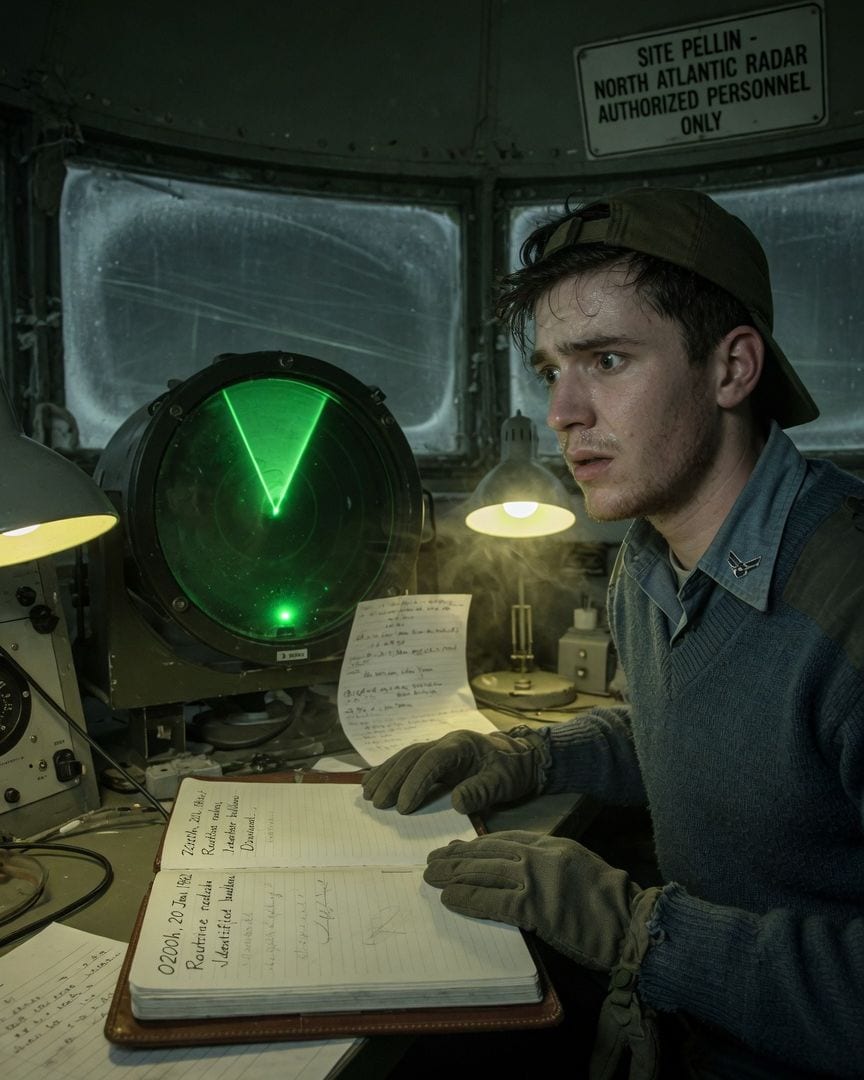
Nine days from closing, Cold War Site Pellin's Airman Vance watched his radar track a solid blip moving closer, dead in open sea where nothing could exist.
In the dimly lit dome of Site Pellin, Airman Ordway Vance, just days from discharge, ran his final radar sweeps before the base closed for good. Outside, the North Atlantic wind howled, but inside, only the hum of his console broke the silence. His last calibration had been clean, yet a single, unwavering green blip appeared on the scope, forty miles out, in open water where no vessel should be. The impossible return moved closer with each sweep, defying all logic and other sensors, until it sat static just beyond the coast fence line. What unseen presence did the radar truly hold in its unwavering green grip, contradicting the official record?
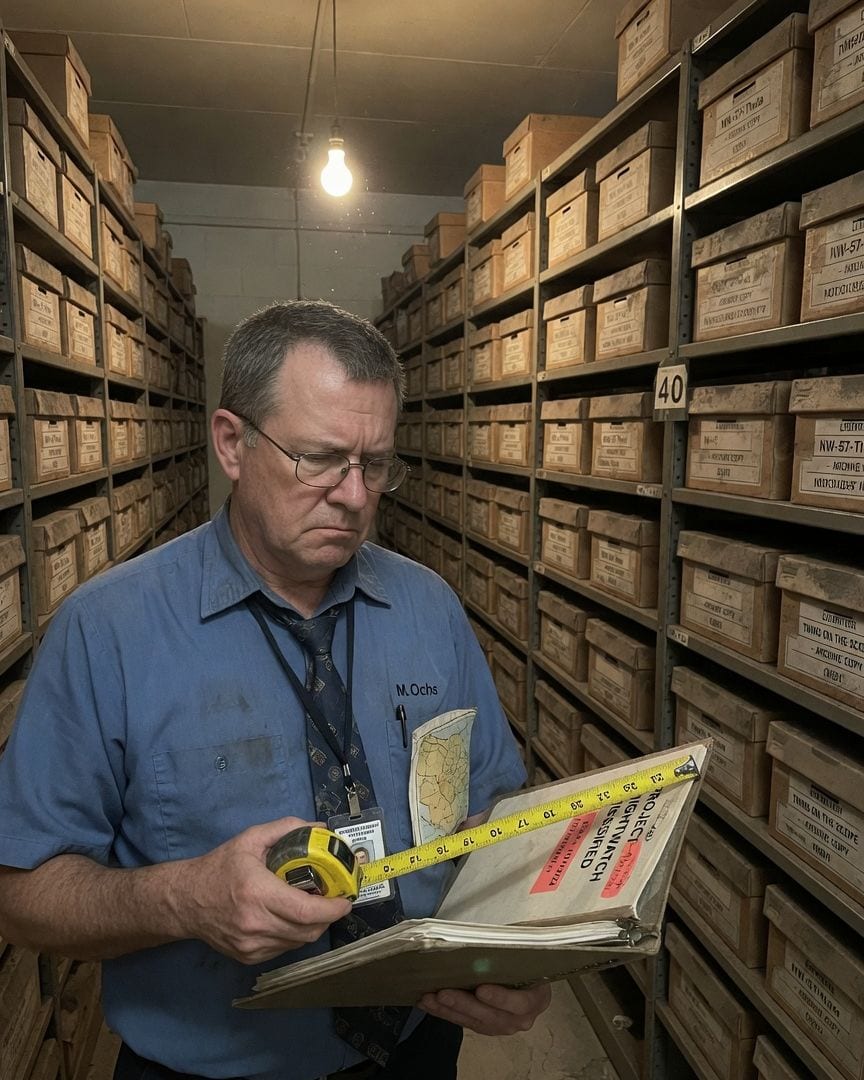
A Cold War records clerk on his final patrol found Aisle 40 stretched 61 feet longer, lined with unknown boxes. Inside one: 'PROJECT NIGHTWATCH - CLASSIFIED' with a fresh timestamp.
Marlin Ochs, a creature of habit after nineteen years at the St. Louis federal records depot, faced his final patrol through Aisle 40 before its scheduled pulping. His routine walk, usually 92 precise strides, suddenly stretched to an impossible 119, making the aisle 61 feet longer than its blueprint. The extra section felt colder, lined with dust-laden boxes bearing alien classification codes and no manifest. Inside one, he found a metal-bound file: 'PROJECT NIGHTWATCH - CLASSIFIED,' dated 1957, but with a timestamp just hours old.
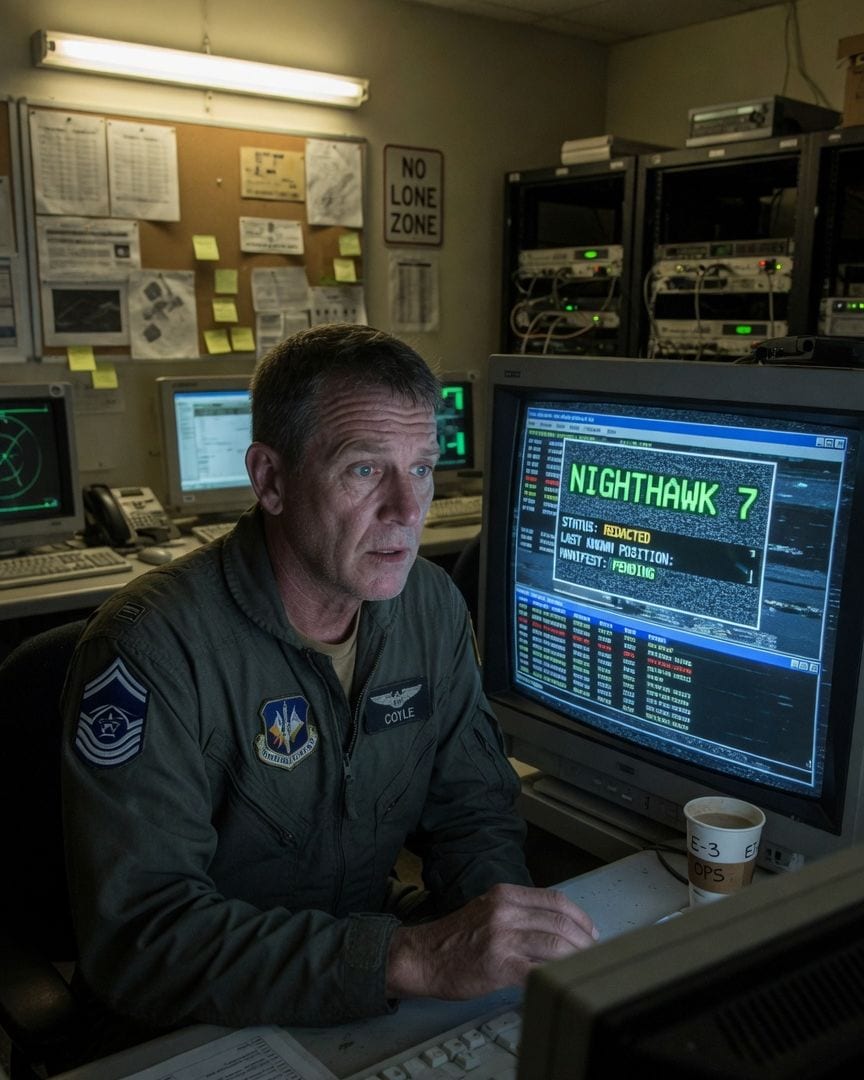
A ghost radar blip returned for Master Sergeant Coyle, three months from retirement. Its call sign: NIGHTHAWK 7, status REDACTED.
Master Sergeant George Coyle, nearly three decades in uniform, counted the last missions before his retirement. High above the black North Atlantic, his E-3 Sentry hummed with the familiar, impossible truth of a ghost radar blip. This single return squawked nothing, eluding every filter and fighter jet sent to investigate, yet the precise systems swore it was there, inbound, week after impossible week. Driven by obsession, Coyle later found a flicker of data: the call sign "NIGHTHAWK 7." Investigating further, an obscure database revealed its status as 'REDACTED,' with its last known position matching the ghost track. What forgotten project was haunting the skies, precisely where it had been scrubbed?
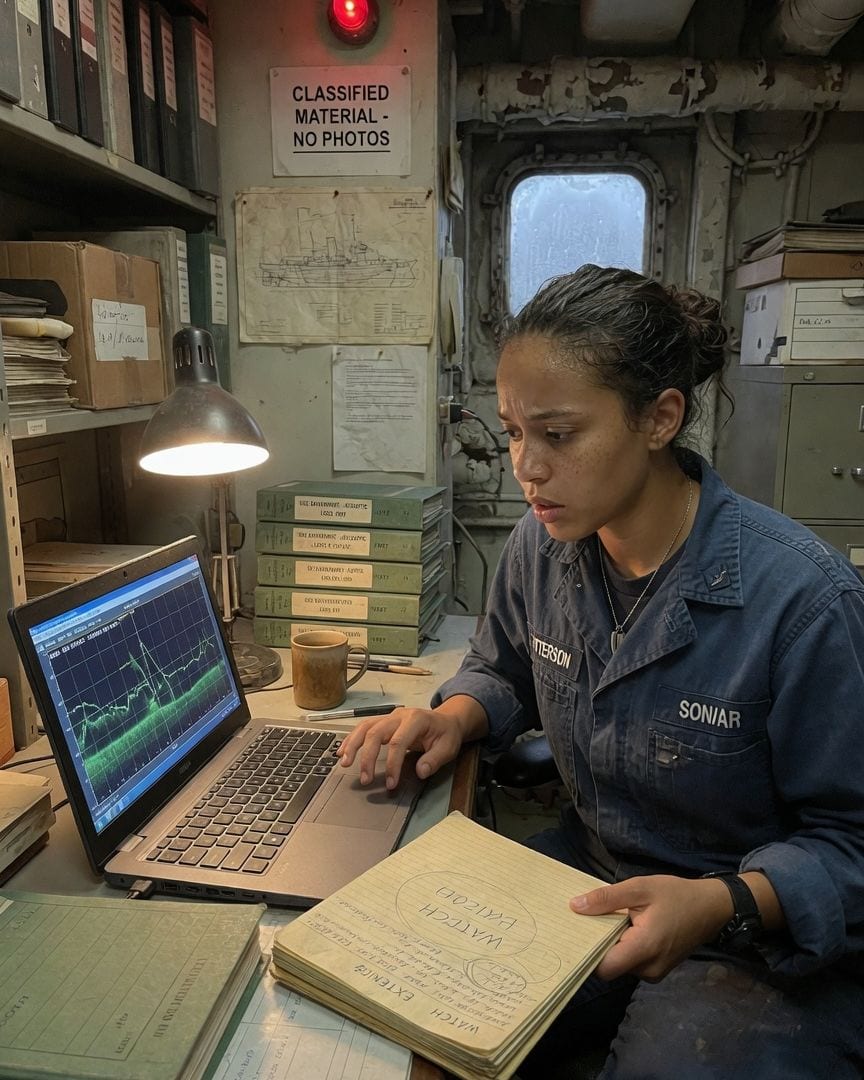
On the USS Calloway's final patrol, a sonar technician found an old log with two chilling words: 'WATCH EXTENDED.'
Sonar Technician Brooke Patterson had only two days left on the USS Calloway's last patrol, a finality that hung heavy in the humid sonar room. Through the impenetrable fog, her radar showed only empty water, but then an impossible biologic contact pinged, mimicking a vessel with eerie precision for three silent hours. It vanished at 0400, just as an identical trace had done weeks before. Searching old archives, Brooke found the precise pattern in a decades-old log from a scrapped destroyer. Scrawled next to it, in faded ink, were two words: "WATCH EXTENDED." What did those words truly mean?
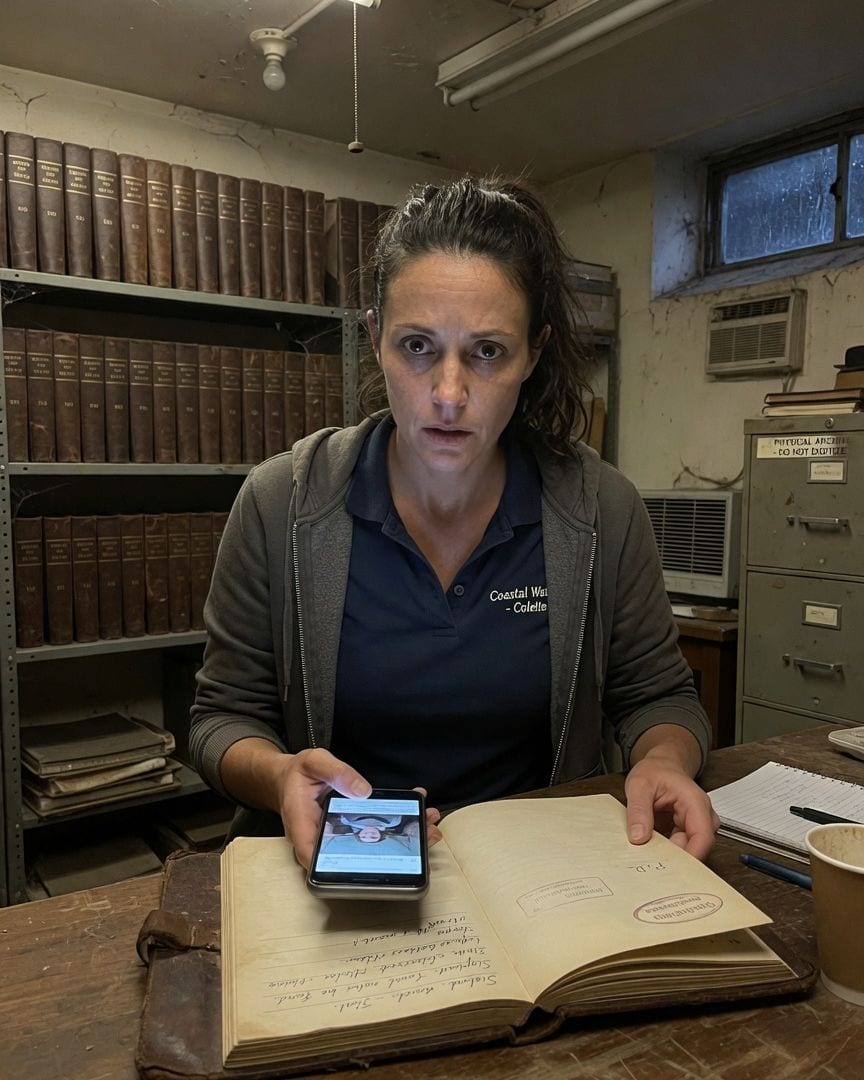
My coastguard log noted Sighting 9 again tonight, a light where no vessel showed. The old logs carry Sighting 9 off Skerry Point at 3:14am every tenth year since 1954, always 'nothing found,' always 'send no boat.'
On my watchtower night shift, the radar screen glowed green and the ocean was quiet. Then, a familiar light appeared off Skerry Point, exactly on cue, just as it had every tenth year for decades. But digging deeper, I found a hidden stamp in an old logbook: 'Operation Skerry. Status: Complete.' It left me with a chilling sense of finality.
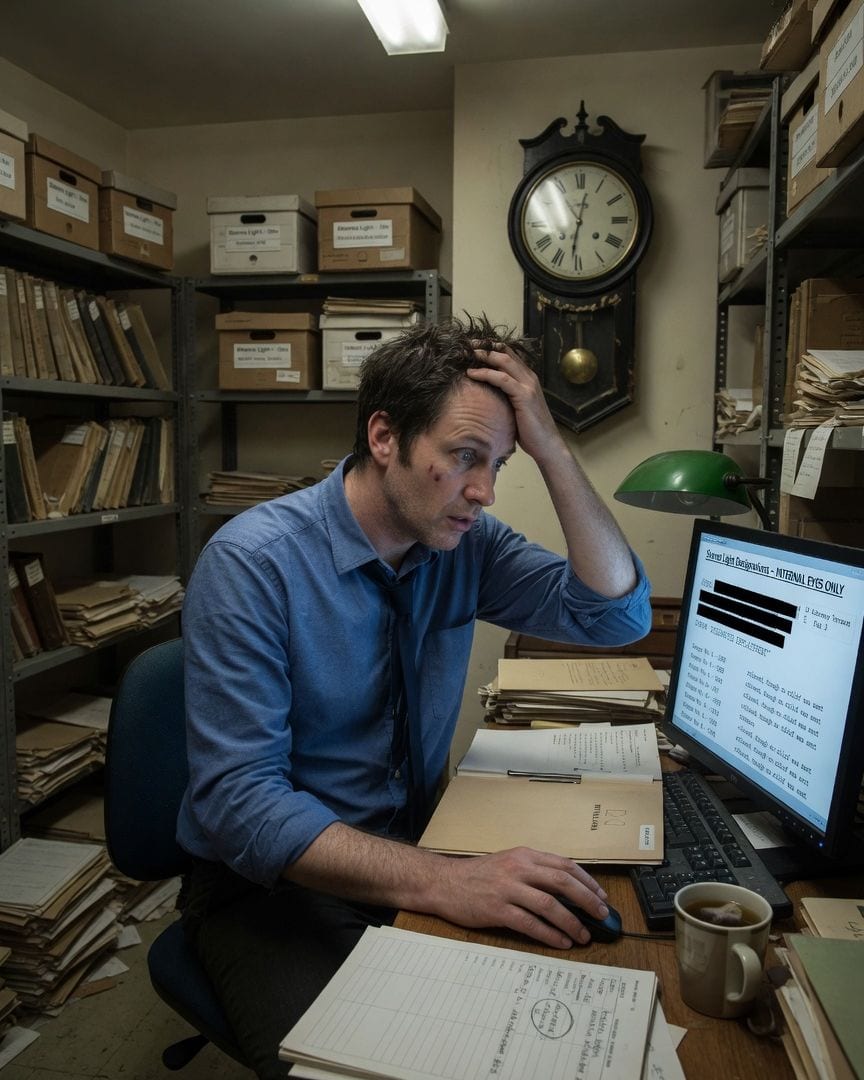
I found my street address in a century-old lighthouse file, printed decades before I lived there.
As a maritime archivist, my world revolves around forgotten lives and dusty ledgers. But the Skerne Light files broke that quiet rhythm, revealing a chilling pattern: 'Keeper number 6' relieved, though no relief was sent, repeating for decades. Now, an internal document with a strange code has led me to a redacted entry, revealing my own street address, decades before I ever lived there.