A Cold War missile lieutenant found a dead missile's log signed for a 'routine check' by a crew chief confirmed asleep.
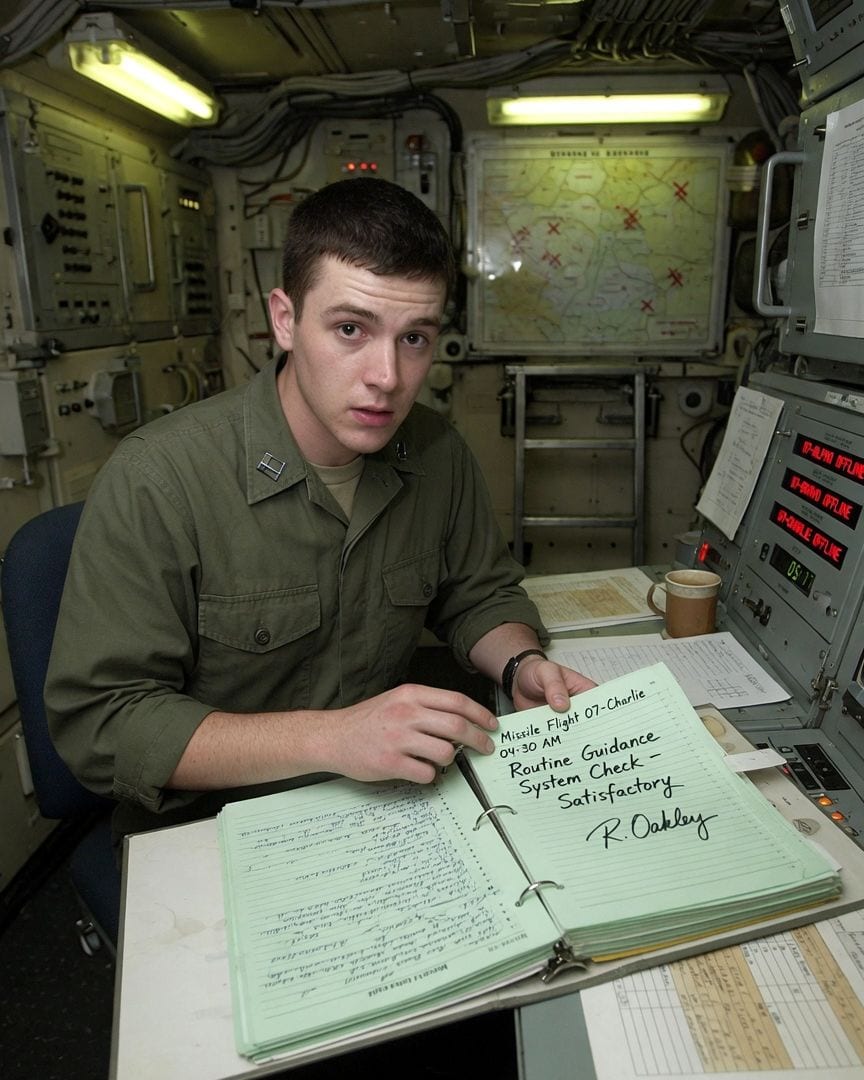
Second Lieutenant Hobart Nye, 24, was six weeks into his command in the Wyoming missile capsule when the phone shrieked at 0247. The sound cut through the deep hum of the control room, raw and urgent.
Topsidesecurity reported a visual on an unidentified flying object, close enough to outline the fence line against the stark, moonless prairie sky. Hobart, following procedure, ordered them to withdraw and hold position.
Their radio immediately dissolved into a hiss of static, sharp and sudden, like a switch had been thrown.
Below ground, the fault panel above his console began to light up in a precise, terrifying sequence: Missile Flight 07-Alpha, then Bravo, then Charlie, one after another, in the exact order of the mapped silos.
He watched his entire flight go dark under his hands, the sixty feet of earth above him making no sound whatsoever. The digital readouts flickered, then flatlined.
Eleven minutes later, the security team’s voices crackled back to life on the net, their tone oddly calm as they reported no memory of having left the truck.
In the hours that followed, the official explanation coalesced around an atmospheric inversion and a simultaneous equipment malfunction. Hobart, methodical and rational, tried to make it fit. He reviewed the telemetry data, the radar logs, the initial reports.
Nothing quite aligned. The radio static had been too absolute, the fault panel sequence too perfect in its chilling progression. The silence during those eleven minutes had been too profound, a vacuum he could still feel in his ears.
Later that morning, during the damage assessment, he was tasked with signing off on the physical launch logs, a stack of heavy binders with thick, green pages.
He meticulously cross-referenced the handwritten entries with the automated system reports, a tedious but necessary task. Most of it was boilerplate: 'Status: Offline,' 'Cause: Unknown,' followed by a series of precise initials and timestamps.
But then, three-quarters of the way through the third binder, for Missile Flight 07-Charlie, the same bird that had been the third to go dark, he found an anomaly.
A fresh entry, dated 04:30 AM, nearly two hours after the incident, recorded a 'Routine Guidance System Check' with a 'Satisfactory' rating. Below it, a clean, confident signature: R. Oakley.
Reginald Oakley, his flight’s crew chief, was a stickler for protocol, known for his neat, almost calligraphic hand, but Hobart knew for a fact Oakley had been off-shift, confirmed asleep in his bunk, during the entire incident and its immediate aftermath.
The entry was impossible.
Hobart’s finger hovered over the signature, the ink still seeming too dark, too crisp for an entry made hours ago and then forgotten. He knew Oakley’s hand well; it was precise, almost calligraphic, and this was unmistakably it.
But the time, the place, the circumstance – none of it added up. The missile was dead, inert, powered down. How could it have undergone a routine check? And by a man who was miles away, asleep?
He felt a cold dread bloom in his chest, an unwelcome sensation that tightened his throat. This wasn't a malfunction.
This was something else entirely, a deliberate, impossible act recorded in plain sight, mocking the very idea of a 'routine check'.
Hobart discreetly questioned Reginald Oakley later that day in the mess hall, over lukewarm coffee. Oakley, a burly man with a no-nonsense demeanor and a permanent squint, scoffed at the idea. 'Me? At 04:30? Lieutenant, I was sawing logs.
You know my schedule.' He showed genuine surprise when Hobart produced the logbook and pointed to the signature. Oakley leaned in, his brow furrowed. 'That's my hand, alright,' he admitted, tracing the neat loops with a thick finger.
'But I never signed that. Must be a misfile, a clerical error.' Hobart knew better. The entry was too precise, too perfectly aligned with the other meticulous notations in Oakley’s hand.
He spent the next few days in the base’s records office, ostensibly reviewing maintenance protocols for future decommissioning, a perfect cover for his new obsession. He started pulling older incident reports, anything flagged with 'unexplained systems failure' or 'personnel disorientation.'
He found a handful, scattered across the past two decades of the facility's operation.
Each involved unusual atmospheric conditions, brief radio blackouts, and in several cases, security personnel reporting blank periods in their memory, minutes or even hours they couldn't account for.
And in the margins of these older, sealed files, he began to see it: small, anachronistic entries in the logs, minor administrative tasks like a 'tool inventory' or a 'fuel consumption report,' dated after the reported incident, signed by personnel who were later transferred without explanation, or who simply vanished from the records.
The pattern was faint, almost invisible, but once seen, it was undeniable. These weren't clerical errors. These were administrative ghosts.
Hobart’s increased presence in the records office didn't go unnoticed. Colonel Vincent Vance, the base commander, a man whose career had been built on quiet competence and adherence to protocol, called Hobart into his office a week later.
The air in Vance's office always felt heavier, hushed, as if the walls absorbed sound. Vance didn't raise his voice, but his gaze, fixed on Hobart, was sharp and penetrating.
'Lieutenant, I understand you're taking a keen interest in our historical archives.' He paused, leaning back in his chair, the leather creaking faintly. 'While commendable, perhaps your time would be better spent focusing on your current duties.
This facility is winding down. We don't need any… unnecessary complications.' Vance's tone was cordial, almost avuncular, but the implication was clear. He knew Hobart was digging.
He offered vague dismissals about 'administrative quirks' and 'the fog of war,' but his eyes held a knowing glint, a weary recognition that cut deeper than any direct threat.
Hobart felt a chill, a shiver that had nothing to do with the office’s air conditioning.
It wasn't just that his investigation was being observed; it felt like Vance was part of a deeper current, a silent agreement to let sleeping files lie. Later that evening, Hobart found a small, unmarked manila envelope on his desk.
Inside was a single, photocopied page: an excerpt from a 1958 base regulation regarding 'the proper disposition of anomalous administrative entries.'
The regulation was heavily redacted, sections blacked out like ink blots, but the message was clear: someone knew what he was looking for, and they wanted him to stop, not with a threat, but with a quiet, official acknowledgement of the very wrongness he was chasing.
Hobart, emboldened by the anonymous warning, decided to push. He returned to Vance's office the next morning, carrying a stack of the anomalous log entries he'd found, including Oakley's. The folders clutched in his hand felt substantial, cold.
'Sir,' Hobart began, laying them on Vance's polished mahogany desk, the thud of paper echoing in the quiet room, 'these aren't quirks. These are patterns. Personnel reporting missing time, impossible signatures in official records, all linked to unexplained incidents.
This goes back decades.' Vance picked up Oakley’s log entry, his expression unreadable, turning it over in his fingers. 'You think you've found something new, Lieutenant?'
he asked, his voice low, almost a murmur against the sudden silence of the office. 'A conspiracy?' Hobart met his gaze squarely, his heart thrumming. 'I think I've found a system, sir.
A system that accounts for things that disappear, not just from the base, but from memory.' Vance sighed, a long, weary sound, the kind of exhalation that carries years of unspoken burdens. 'Lieutenant, there are… protocols. For certain events.
Events that defy conventional explanation. When personnel or equipment are affected in ways we cannot comprehend, we don’t lose them. We… file them.' He tapped the log entry with a fingernail, the sound sharp.
'These entries, these 'anomalies' you call them, are part of that. A way to integrate the unintegratable. To provide a continuous administrative existence for what has, in all other ways, ceased to exist. The records don’t lie, Lieutenant.
They simply reflect a deeper truth. A truth that cannot be undone. And the best thing we can do is let them stabilize.' Hobart’s mind reeled.
The radio static, the ordered dark sequence of his missiles, the security team’s blank eleven minutes – it wasn't just a cover-up. It was a methodical, ongoing process, a silent bureaucracy of the impossible. The 'lost' weren't missing.
They were simply… filed, their continued existence acknowledged only in the relentless, quiet hum of paperwork.
Decades later, in 2005, Vivian Lambert, a declassification archivist with a meticulous eye for detail, sat in a climate-controlled vault in Denver, the air cool and faintly metallic.
She reviewed the final batch of files from the decommissioned Wyoming facility, rows of beige boxes stretching into the dim distance. Among them was the bulky, unassuming file of Second Lieutenant Hobart Nye.
It detailed his brief, unremarkable career, his honorable discharge, and the infamous 'Wyoming Incident' of 1971, officially attributed to equipment failure. Vivian, however, was drawn to the maintenance logs.
They were unusually comprehensive, detailing routine checks and minor repairs for the inactive missile flight for years after the base closed in 1975, long after Nye had left the service. The entries continued, precise and unwavering.
The signatures were perfect copies of the original crew chiefs' hands, down to the last flourish, yet she knew these men had been gone for decades. This was the 'File That Kept Writing.'
As she scanned the last page of the 'Decommissioned Assets Log' section, a new entry, in the same unnervingly precise hand, seemed to shiver into existence before her eyes. The faint chemical smell of new ink hung in the air.
It was a requisition for a 'Class-B Guidance Actuator,' dated for tomorrow's date. And beside the 'Approving Officer' line, her own name, Vivian Lambert, was lightly, almost invisibly, penciled in.
Vivian stared at her name, the faint pencil strokes a physical violation of the pristine paper, a cold shock that tightened her scalp. The requisition wasn't just a prediction; it was an invitation.
She flipped back through the file, a cold certainty settling in her stomach. The precise order of the missiles going dark on Nye’s fault panel, the methodical, years-long 'maintenance' entries – it wasn't random. It was a program.
The entities, whatever they were, didn't just observe or interfere; they maintained, they cataloged, they filed. The decommissioning of the base, the declassification of the files – these weren't ends to the process, but new phases.
The ‘secrecy machine’ wasn't a human institution covering up the truth; it was the truth itself, a self-sustaining administrative entity that absorbed and processed, creating an unbroken chain of record-keeping for what should have been lost or forgotten.
The security team’s missing minutes, the impossible signatures, the vanished personnel – they were all part of this elaborate, patient filing system. The UFO incident wasn’t an attack; it was a data acquisition event.
And the administrative tasks, like this new requisition, were the means by which the system perpetuated itself, drawing in new 'approvers' like her, integrating them into its endless, quiet work.
The horror was in the sheer, cold coherence of it all. Every loose end, every anomaly, every faded signature now clicked into place, not as a human error, but as a perfect, alien logic.
A primal urge seized Vivian: close the file. Seal it. Stop it. Her hand reached out, trembling slightly, but a subtle, almost imperceptible resistance seemed to emanate from the pages.
The air in the vault grew heavy, still, pressing in on her, colder than before.
She tried to slide the file back into its designated slot on the shelf, but it felt rooted, refusing to move, almost as if it had increased in weight.
Panic, cold and rational, began to set in, coating her tongue with a bitter taste. This wasn't a physical force, but a profound, institutional inertia, the weight of decades of meticulous, inhuman record-keeping.
The file wasn't just paper; it was an active node in a vast, unseen network. She understood Colonel Vance's quiet resignation now. There was no 'stopping' it. There was only knowing.
The full truth, understood in this silent, frigid vault, was that the file was alive, and it was still signing. It didn't need humans to function; it merely incorporated them.
The requisition for the Class-B Guidance Actuator wasn't an order to be fulfilled by the base; it was a demand placed upon her, Vivian Lambert, the latest 'reviewer' in a long, unbroken chain.
Her role was not to process the file, but to be processed by it.
The dread was not of what the file contained, but what it implied for her own future, the quiet, relentless hum of its ongoing work now a direct current through her.
She was no longer an archivist; she was an entry, waiting for her next line item to be written.
The next morning, the vault was quiet. Vivian returned to her desk. The file of Hobart Nye was gone from her stack, replaced by a fresh, unassigned batch of documents. The paper felt normal, inert.
No one mentioned the requisition, or her name, or the strange silence that seemed to have settled over her office, a quiet that swallowed sounds. The world moved on, oblivious to the subtle shift in its administrative gears.
She felt lighter, strangely unburdened, yet profoundly empty, as if a part of her had been meticulously filed away. The meticulous order of her life, once a source of comfort, now felt like a cage, its bars perfectly spaced.
She was a cog, waiting for its next task.
Vivian sat at her desk, the hum of the fluorescent lights a distant echo, a sound she no longer truly heard.
Her computer screen glowed with a new administrative task, an urgent request for a 'Class-B Guidance Actuator' to be expedited. The form, pristine and new, waited for her signature.
Later that day, a colleague walked past Vivian’s desk. 'Vivian, you look lost in thought,' she said. Vivian looked up, a faint, almost imperceptible smile touching her lips. 'Just processing,' she replied.
The form, pristine and new, waited for her signature.
If this one got to you
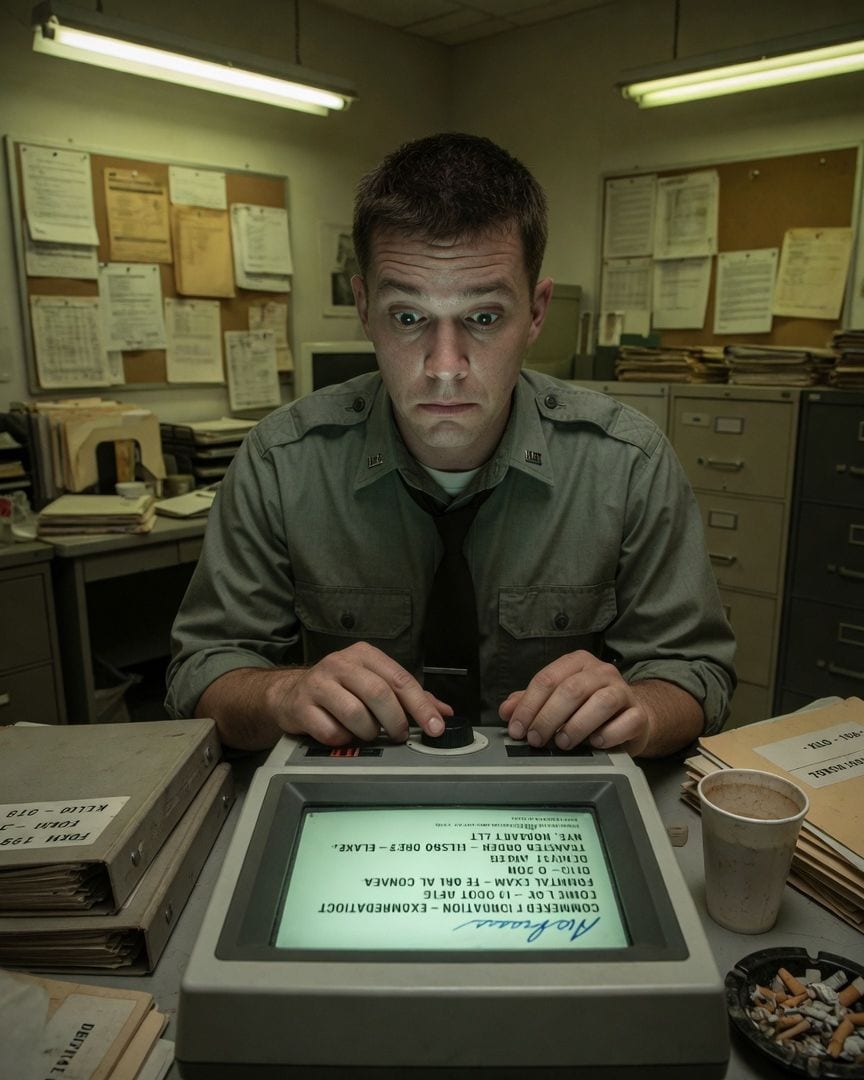
A missile commander watched his ten nuclear silos go dark. His own service record shows his signature on a future he's never lived.
Second Lieutenant Hobart Nye, a missile commander in Wyoming, had his quiet 0247 watch shattered by a security report: a massive, silent black triangle hovered over Launch Facility Kilo, casting a perfect shadow. Hobart watched his console's fault panel light up, signaling all ten nuclear missiles going dark in an impossible silence, followed by eleven minutes his security team could not remember. Official logs called it a "radio malfunction," but Hobart found a requisition for invisible-tracking sensors, signed by a base commander who was supposed to be off-base. The final, chilling discovery came when his own service record showed new entries—a dental check-up, a transfer to Alaska—all dated for a future he never lived, complete with his perfectly replicated signature.
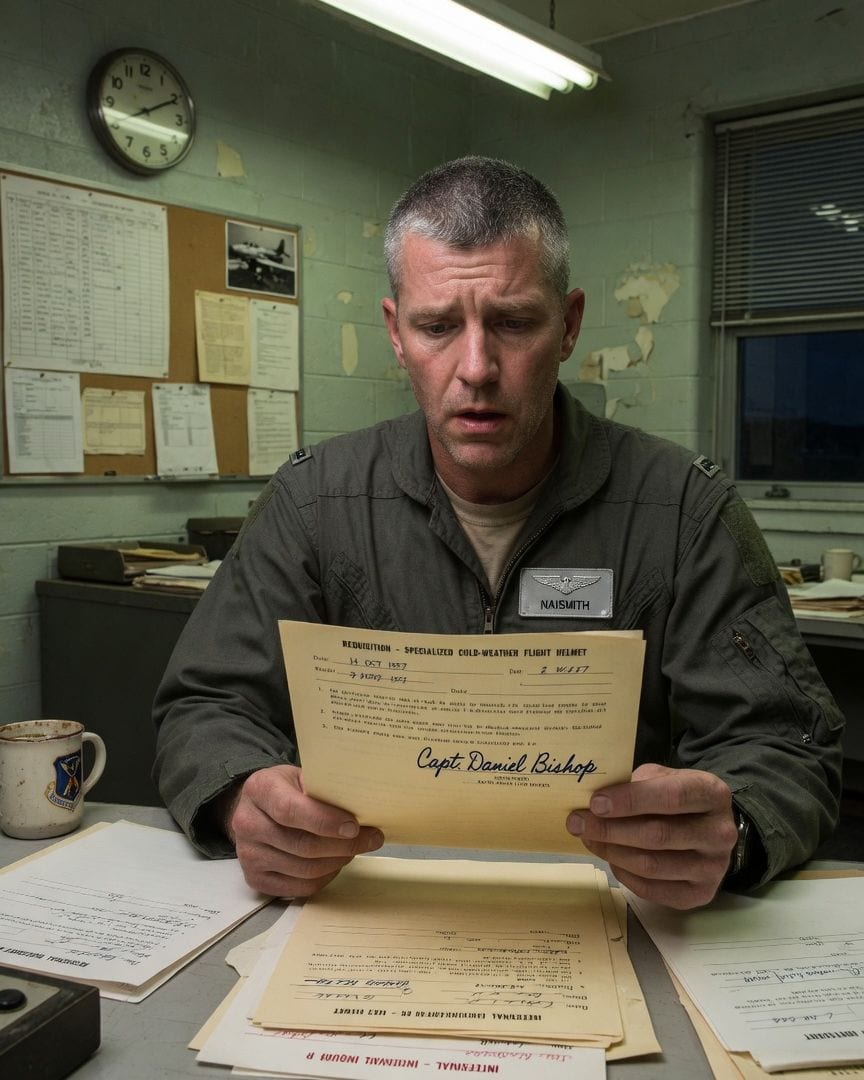
A Cold War Colonel reviews a missing pilot's file and finds Captain Bishop's signature on a form dated weeks after he vanished.
Colonel Ward Naismith faced the grim task of reviewing Captain Daniel Bishop’s personnel file, a routine chore for a man listed as Missing in Action. Bishop had vanished days after he and Naismith chased an impossible, silent disc over Lake Superior, leaving only an empty patch of air and a knot of unease in Ward's gut. Sifting through commendations, Ward found a requisition for flight gear and a maintenance sign-off, both dated *after* Bishop’s disappearance. The true chill came with the requisition for a specialized flight helmet, bearing Captain Bishop’s unmistakable signature, weeks after he was presumed lost. How could a man presumed lost have signed anything?
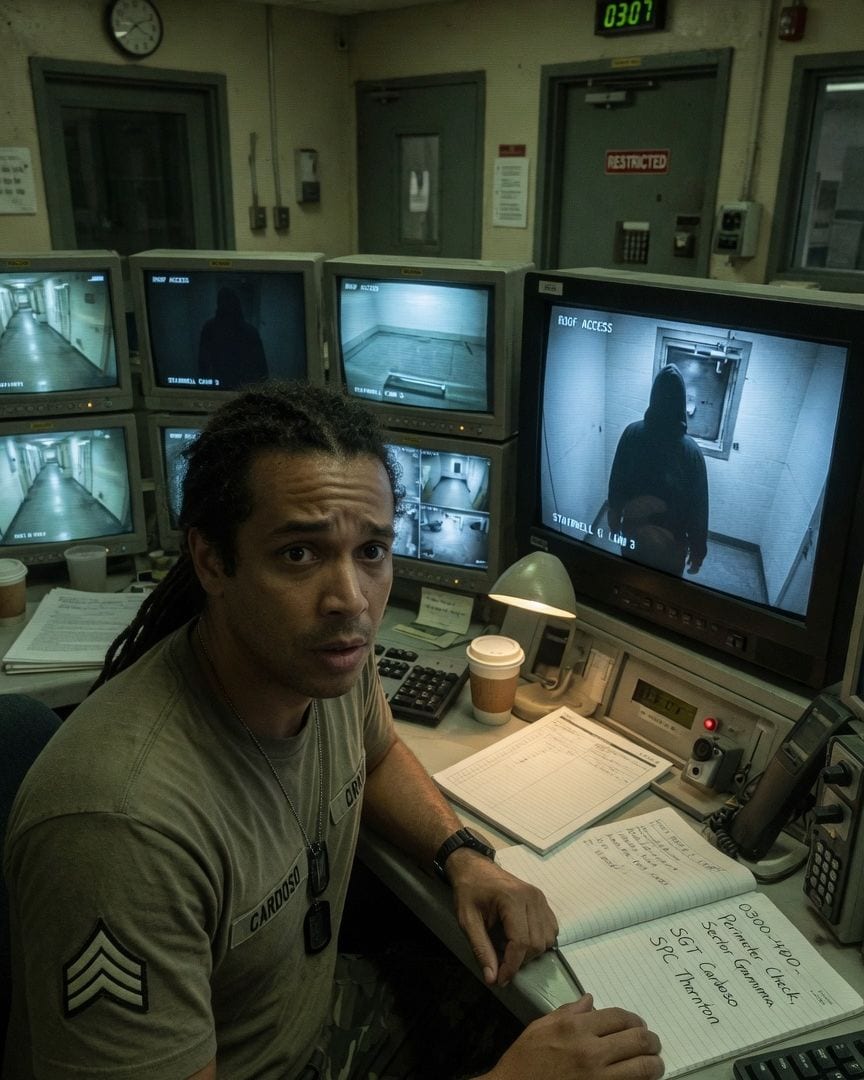
On his last watch, Sergeant Cardoso found his own signature in the duty log for a perimeter check he never did, with a name he didn't know.
Sergeant Rui Cardoso was on his final interior watch at Fort Merritt, a remote coastal outpost, as 0300 ticked by. He spotted a dark, unmoving figure on a monitor showing the sealed roof access, a figure that inexplicably shifted closer to the hatch moments after a specialist confirmed the roof was empty. Rui checked every log and sensor, but the digital fortress showed no breach, and the figure's appearance defied all logic. Yet, in the physical duty log, he found his own unmistakable signature on an entry for a perimeter patrol he never took, alongside a soldier's name he'd never seen. What impossible truth was written in his own hand?
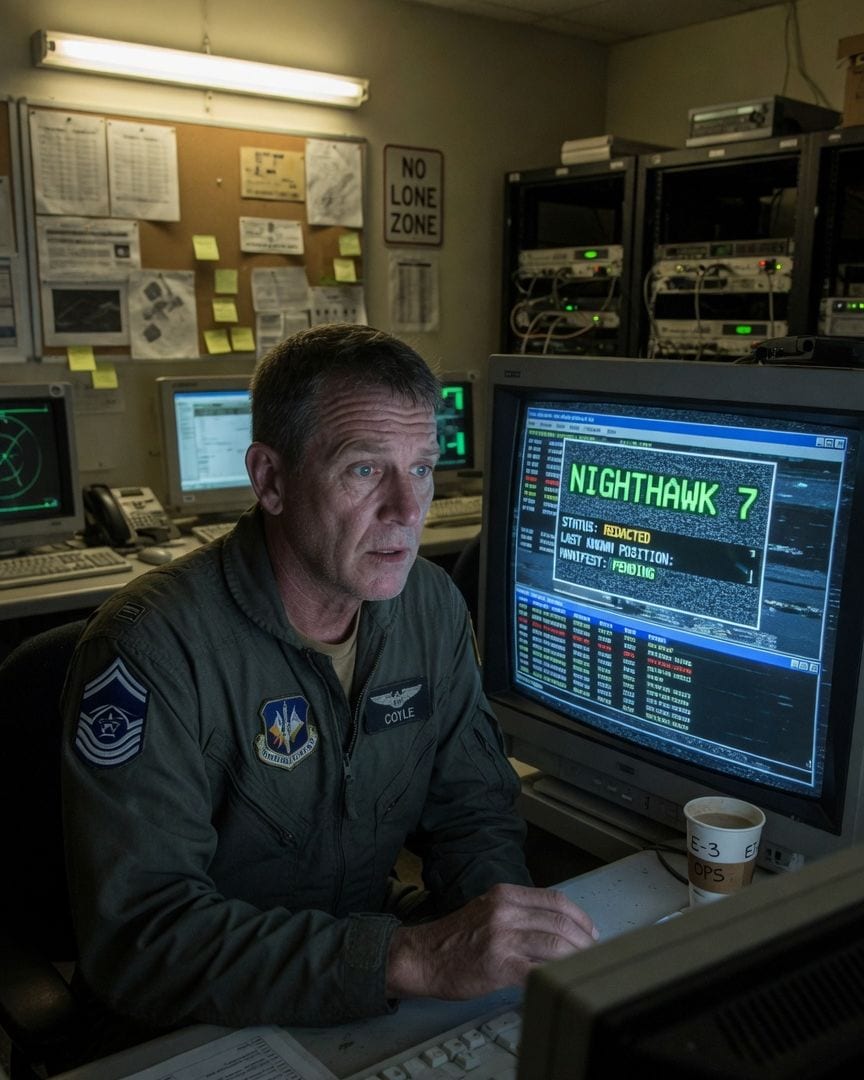
A ghost radar blip returned for Master Sergeant Coyle, three months from retirement. Its call sign: NIGHTHAWK 7, status REDACTED.
Master Sergeant George Coyle, nearly three decades in uniform, counted the last missions before his retirement. High above the black North Atlantic, his E-3 Sentry hummed with the familiar, impossible truth of a ghost radar blip. This single return squawked nothing, eluding every filter and fighter jet sent to investigate, yet the precise systems swore it was there, inbound, week after impossible week. Driven by obsession, Coyle later found a flicker of data: the call sign "NIGHTHAWK 7." Investigating further, an obscure database revealed its status as 'REDACTED,' with its last known position matching the ghost track. What forgotten project was haunting the skies, precisely where it had been scrubbed?
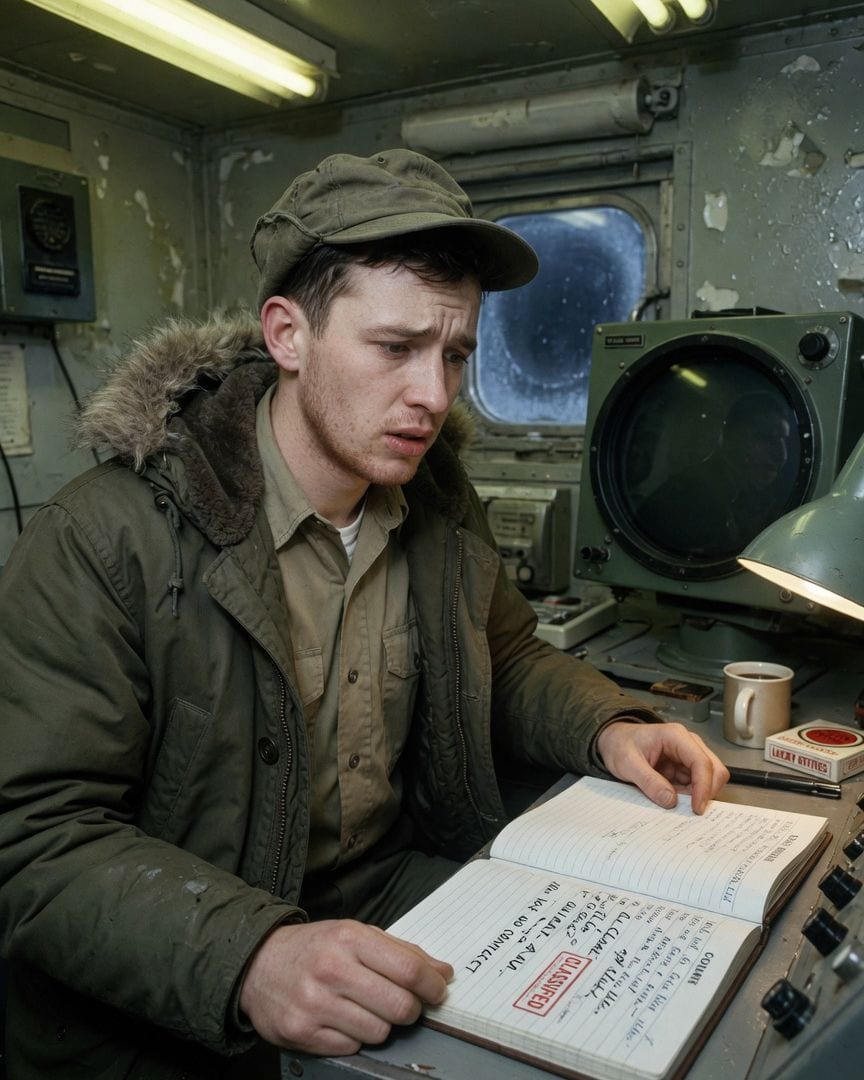
A Cold War airman logs an impossible radar contact on his last sweep. But his official logbook entry is stamped 'CLASSIFIED' and then contradicted by a hastily scrawled 'ALL CLEAR' dated moments before it.
Airman Ordway Vance, 22, manned the radar dome at Site Pellin in the biting North Atlantic dark of January 1962, running the last calibration sweep before its decommissioning. His scope picked up a faint, impossible return, growing closer with each pass, though the ocean remained empty to the eye. When Vance detailed the contact in his official logbook, a 'CLASSIFIED' stamp appeared, followed by a hastily scrawled 'ALL CLEAR' dated moments before his own entry, contradicting his every word. Commander Hartley dismissed it as equipment malfunction, but Vance sensed a chilling, official erasure behind the lie. He soon found a locked cabinet marked 'SITE PELLIN ANOMALIES,' hinting at a deeper truth buried within the base's final days.
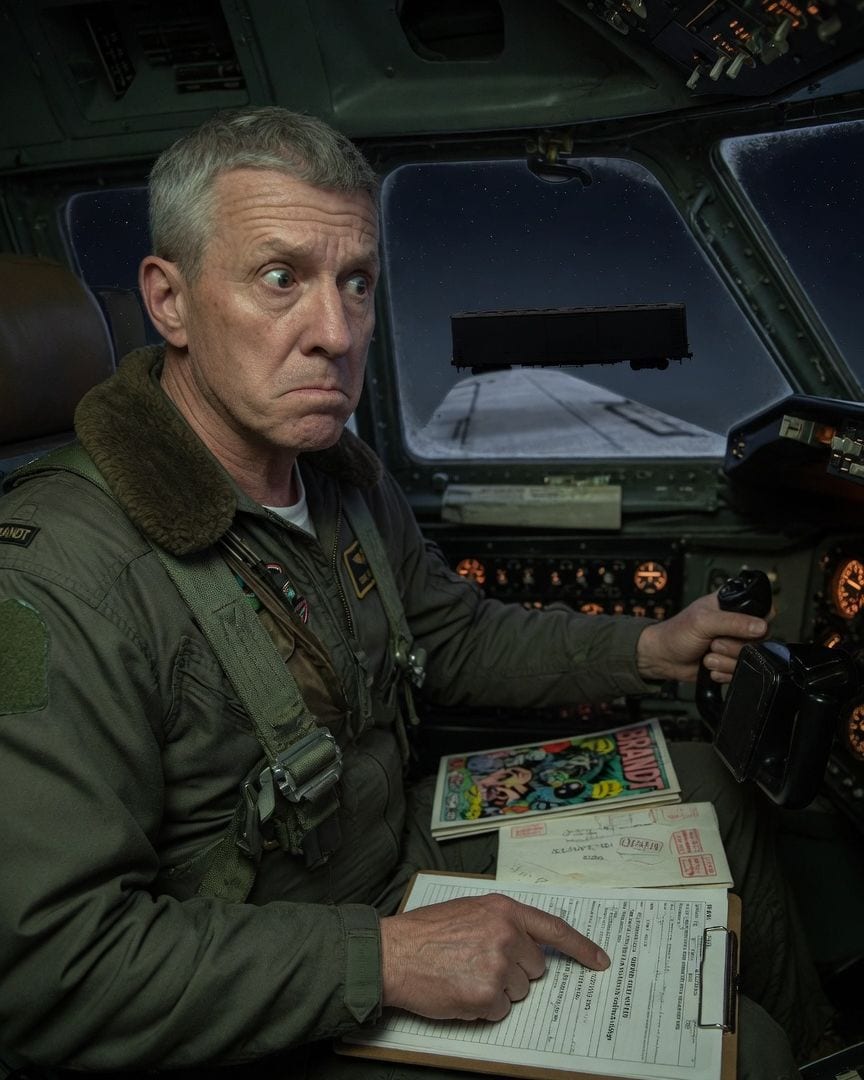
On his last Cold War flight, Major Brandt’s official report quoted words he never said, then claimed material recovery from a wing he knew was untouched.
Major Cyril Brandt, a seasoned pilot nearing retirement, undertook his final airborne alert leg in the B-47, the familiar hum of its engines a lullaby against the vast, dark sky over the Dakotas. Then, an impossible, featureless boxcar-thing appeared silently, thirty feet off his wingtip, vanishing as abruptly as it came nineteen minutes later. Three days later, the official incident report contained two chilling fabrications: a quote only his tail gunner uttered, attributed to Major Brandt, and a claim of material recovery from a wing he knew was untouched. The document was not just wrong; it was a deliberate, precise lie about an interaction that never happened, leaving the pilot with a cold dread.