A declassification reviewer finds a form dated yesterday, listing a living sailor for relocation to an eighty-year-old passage, in the same impossible handwriting.
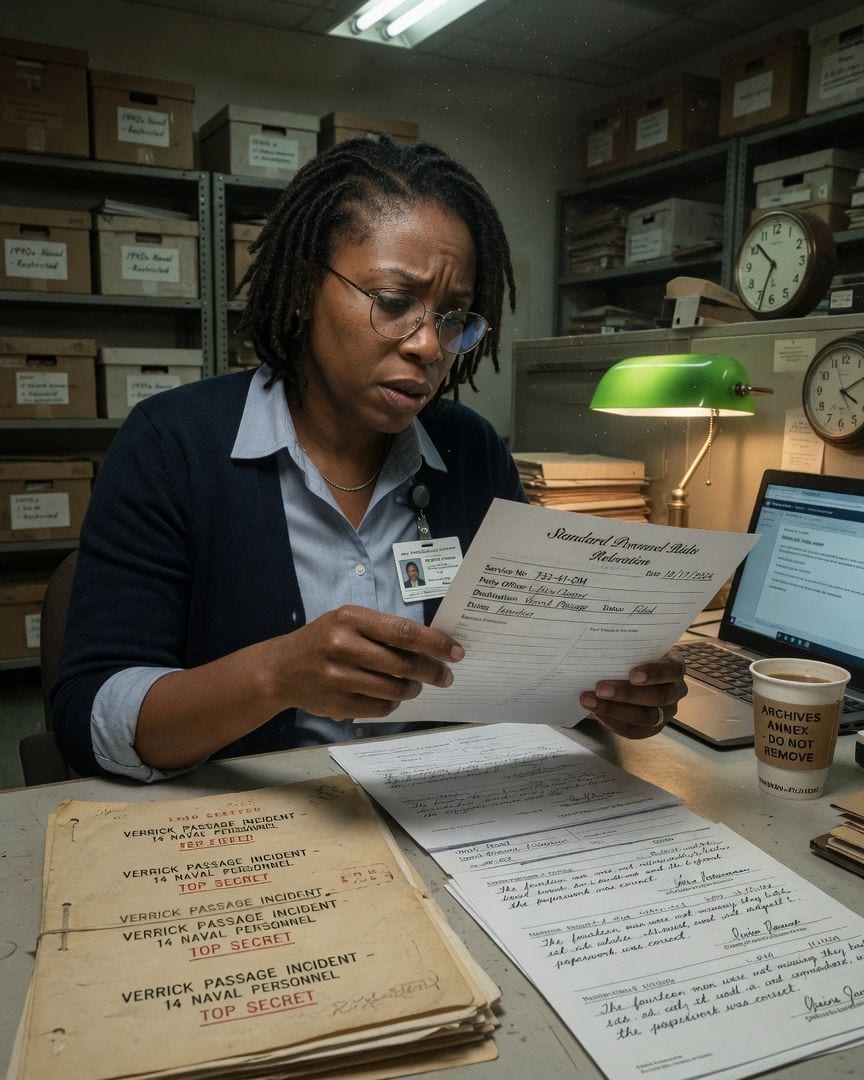
Declassification reviewer Ione Fash sat in the quiet hum of the National Archives Annex, a stack of heavily redacted Verrick Passage files before her. Her project deadline loomed, a tight, unforgiving leash, and this file was the last major hurdle.
She pulled the first folder, its aged manila stiff and crackling. Inside, among the brittle incident reports from 1944 detailing the inexplicable disappearance of fourteen naval personnel, were nine separate witness statements.
Eight decades of dust had settled on them, but the ink on the page was stark.
Each statement, from different towns, different years, different interviewers, contained the exact same sentence: 'The fourteen men were not missing, they had been put somewhere, and the paperwork was correct.'
Ione’s methodical mind immediately flagged the anomaly. Not just the identical phrasing, but the handwriting.
Across all nine statements, from a fisherman in Maine to a lighthouse keeper in Oregon, the script was identical—a precise, almost calligraphic hand, utterly devoid of individual character, as if drawn by a machine.
It was a detail so profoundly wrong, so utterly impossible for nine separate individuals, that it made the carefully controlled air of the archive feel suddenly thin, and the silence of the room press in around her.
Ione Fash meticulously cross-referenced the names of the interviewers, the dates, the locations. Every detail confirmed they were indeed distinct interviews. She pulled up handwriting analysis software, feeding it scans of the statements. The results flashed back: '99.9% match.
Single author.' Her initial thought was a clerical error, a lazy transcriber copying the same statement nine times. But the original interview forms were there, signed by the witnesses, and the impossible handwriting was on those too.
She dismissed the idea of a hoax; who would maintain such a precise, decades-long deception across disparate government agencies? The sheer bureaucratic effort alone was staggering, and for what purpose?
She found a memo from 1952, stamped 'TOP SECRET - EYES ONLY,' requesting a review of the Verrick Passage files. The reviewer, a Harold Davenport, noted 'unusual consistency in witness testimony' but concluded it was 'anomalous but not suspicious.'
Ione snorted. 'Anomalous but not suspicious' was the archival equivalent of whistling past a graveyard. She dug deeper into Davenport's notes, finding a cryptic entry: 'Cross-checked against existing 'Relocation' protocols. Inconclusive.' Relocation protocols? For missing personnel? This was not standard.
As she closed the heavy file, her fingers brushed against a thin, unfamiliar sheet tucked beneath the last original report.
It was a standard-issue requisition form, 'Standard Personnel Relocation,' dated not 1944, but last month, and bearing that same impossible handwriting. It listed a service number she recognized from a current, unclassified manifest she’d reviewed just yesterday.
The form felt cool and crisp, fresh against the brittle eighty-year-old paper. Ione Fash stared at the date: '10/17/2024.' Yesterday. And the service number: '733-41-DM.' She knew that number.
It belonged to Petty Officer First Class Daniel Mercer, currently assigned to the USS Portland, whose manifest she had processed just hours ago. He was alive, active duty, deployed in the Pacific.
Yet here was a 'Standard Personnel Relocation' form for him, tucked into a file for men lost eighty years ago in the Verrick Passage.
The impossible handwriting, so precise and cold, filled in the blanks for 'Destination: Verrick Passage - Status: Filed.'
Ione’s gaze darted from the form to the file number, then back to Mercer’s service number, her rational mind struggling to reconcile the impossible present with the sealed past.
The archive's silent air grew suddenly heavy, trapping her, as she held the evidence that the Verrick Passage wasn’t a past event, but an ongoing process, and that the paperwork was still being signed.
Ione Fash locked the Verrick Passage file, the contemporary requisition form carefully placed within, and immediately cross-referenced Daniel Mercer’s service number in the active database. He was still listed as active, still on the USS Portland.
No flags, no alerts, no indication of 'relocation.' She checked his social media, a professional habit to verify identities for declassification. His last post, three days ago, was a blurry photo of a sunset over the Pacific.
A mundane explanation, a misfile, a prank—these were the first lines of defense for her rational mind. But the impossible handwriting on the form, identical to the 80-year-old witness statements, dismissed them all.
She approached her supervisor, Reginald Prescott, a man whose career was built on maintaining the precise order of the archives. She presented the anomaly, carefully omitting the handwriting detail at first, focusing on the date and the active service number.
Prescott’s brow furrowed. 'A clerical error, Fash. Happens. Someone probably pulled the wrong form, or it’s a draft that was never meant to be filed.'
He tried to wave it away, but his eyes kept returning to the file number Ione had cited. 'Just flag it for correction and move on. We're on a tight schedule with this declassification project.'
His dismissal was too quick, too firm. Later that day, Ione found a cryptic email in her inbox, sender unknown, subject line: 'Verrick Passage - 'Relocation' protocols are classified at Level 5. Do not proceed.'
It was a warning, not a misfile. Someone knew. Her stake, her career, suddenly felt secondary to a chilling, growing dread.
She realized the 'tight schedule' wasn't just about her promotion; it was about getting these files processed and re-sealed, perhaps to bury the truth even deeper. The Verrick Passage was not just a historical anomaly; it was a live wire.
The anonymous email chilled Ione Fash to the bone. Level 5 classification was above even her clearance. It confirmed someone was watching her, tracking her movements within the archive.
She felt the weight of unseen eyes as she returned to her terminal, her every keystroke potentially monitored. She decided to work off-network, using older, standalone systems for her deeper dives.
She went to the physical archives, seeking out Donald Mercer, a retired archivist known for his encyclopedic knowledge of 'problem files.'
Mercer, a stoic man with a memory like a steel trap, listened as Ione described the Verrick Passage file and the impossible handwriting. He sat silently for a long moment, then slowly nodded. 'The Hand,' he murmured, his voice raspy.
'We used to call it The Hand. Saw it in the old days. Files that kept writing themselves, long after the subject was gone. Not just Verrick. Other places. Other times.' He pulled out a dusty, unlabeled ledger.
'They called it 'The Ledger of Unaccounted Assets.' Unofficial. Never stamped.' He flipped to a page. 'See here? 1968. 'Project Nightingale - 3 personnel.' And there it is again. The Hand.'
He pointed to a requisition form, identical in layout to Ione’s, but fifty years older, listing a 'Destination: Sector Gamma - Status: Filed.' And the handwriting, unmistakable. 'Nobody ever figured it out,' Mercer said, his gaze distant.
'Just… filed it away. Said it was a glitch. But too many glitches, you start to see a pattern.'
As Ione left Mercer's office, she noticed a maintenance worker in the deserted corridor, adjusting a ceiling tile directly above where Mercer’s office was.
He looked up, met her gaze for a beat too long, then offered a small, unsettling smile before returning to his work. The smile held no warmth, only a quiet, knowing acknowledgment.
She wasn't just being watched; she was being acknowledged.
The encounter with Donald Mercer and the maintenance worker solidified Ione Fash’s conviction: this wasn't an isolated incident. The 'glitch' was a feature, not a bug.
She returned to her office, the warning email and Prescott’s quick dismissal replaying in her mind.
She pulled up the digital archive again, this time searching for the specific phrase 'Standard Personnel Relocation' paired with 'Verrick Passage' and then, more broadly, for the recurring stylized 'V' stamp Mercer had mentioned seeing in similar files.
Her initial search for the 'V' stamp yielded nothing in the official digital records. But the 'Personnel Relocation' forms were there, buried deep in obscure sub-folders, disguised as routine administrative transfers.
She found dozens, then hundreds, each bearing the impossible handwriting. This time, she focused on their dates and the classification levels.
She noticed a pattern: every time a 'Relocation' form appeared, the original file would be re-sealed within a month, often with a higher security classification. This wasn't about losing people; it was about managing their loss, making it official.
The 'paperwork was correct' because the paperwork made it correct. It was a self-sustaining bureaucratic horror. The 'Verrick Passage' wasn't a location of disappearance, but a designation, a code for a specific type of 'filing.'
Prescott called her into his office. His face was grim. 'Ione, I've been asked to tell you to drop your current line of inquiry. It's… unproductive. We have protocols.' His voice was low, almost pleading.
'Some things are better left sealed.' Ione pushed back, 'Reginald, I found hundreds of these. The handwriting, the forms—it’s not a glitch. It’s a system. And it’s still active.' Prescott sighed, running a hand over his face.
'Look, Ione, I don’t know everything. Nobody does. But I know enough to know that some files… they don’t just record events. They are the events. And you don’t want to be in one of them.'
His eyes were wide with a fear Ione had never seen in him, a quiet terror that confirmed everything. The original witness statements, the 'Relocation' form for Daniel Mercer, Mercer’s own 'Ledger of Unaccounted Assets' – it all clicked.
The secrecy machine didn't just hide things; it was the engine of the 'filing' itself, a vast, patient, and methodical system that had been operating for decades, making people disappear into paper.
Armed with Prescott's terrified admission, Ione Fash returned to her desk, the cold dread solidifying into certainty. The archive, once a place of ordered knowledge, now felt like a mausoleum of quiet atrocities.
She had to know how deep it went.
She initiated a system-wide search, this time specifically for the unique characteristics of 'The Hand's' impossible script, cross-referencing it with every 'missing personnel' or 'unaccounted asset' file across every classification level in the entire digital archive.
The search churned for what felt like an eternity, the progress bar inching forward. Finally, the results flooded her screen. Not dozens, not hundreds, but thousands of files.
Military, civilian, diplomatic, scientific—from every decade since the 1940s, stretching back even further into scanned historical documents from the early 20th century. Each one contained the tell-tale handwriting, the 'Standard Personnel Relocation' forms, and the chilling phrase 'Status: Filed.'
And then, she saw it: a recurring, small, stylized 'V' stamp, almost like a corporate logo, embossed discreetly on the corner of every single document, regardless of its original department or classification.
It was the mark that connected them all, a silent, ubiquitous signature of the sprawling, impossible pattern across decades and classifications, making the room suddenly feel impossibly cold and small around her.
The stylized 'V' stamp, a silent, elegant mark on thousands of files, was the final, horrifying key.
It wasn't just 'Verrick Passage' anymore; it was 'The V.' The archive wasn't merely a repository; it was the operational hub of a vast, ancient system. Ione Fash understood now.
The 'secrecy machine' wasn't a metaphor for government cover-ups; it was the literal mechanism. The files themselves were not records of an event, but components of the event itself.
The 'File That Kept Writing' was not a clerical anomaly, but the ongoing manifestation of the 'filing' process.
When a person was 'filed,' their existence was transferred to this system, their paperwork continuing, their life absorbed into an endless, sterile bureaucracy.
The impossible handwriting was the system's own signature, a consistent, patient hand that rendered human lives into data points, into 'unaccounted assets.'
The 'witness statements' in the Verrick Passage file weren't from human witnesses; they were generated by the system itself, a self-referential confirmation that 'the paperwork was correct' because it had been created by the same entity that did the filing.
Daniel Mercer, the active-duty soldier whose 'relocation' form Ione found, was already gone, absorbed into 'The V' system, his active status in the official database a ghost entry. The knowledge settled over Ione, cold and heavy.
This wasn't about solving a mystery; it was about understanding a truth so vast and ingrained it was effectively invisible. The institution, the archives, the very process of declassification—they were all complicit, unwitting or otherwise, in maintaining the machine.
She was a cog, reviewing the records of the 'filed,' unknowingly participating in the perpetuation of the system by processing its output.
Ione Fash sat at her terminal, the thousands of files open, cross-referenced, irrefutable. The full truth was laid bare: a system that had quietly, methodically, and invisibly filed away human lives for over a century.
There was no one to confront, no 'antagonist' to expose. The enemy was the silence, the bureaucracy, the very act of record-keeping itself. She thought of Daniel Mercer, his last social media post, the sunset over the Pacific.
He was likely already a forgotten name, another entry in a file that would continue to write itself. What could she do? Print the files? Send them to the press?
The sheer volume, the decades of embedded secrecy, the layers of classification would crush any attempt. It would be dismissed as a hoax, a breakdown, the ravings of a stressed archivist.
She would be 'filed' herself, not into the system, but out of her job, her credibility, her life. The realization was a profound, suffocating defeat. The horror wasn't in a monster, but in the utter, bureaucratic indifference of it all.
She saw now why Reginald Prescott had been so afraid, why Donald Mercer had retired into quiet resignation. They had glimpsed the same truth, the same infinite pattern, and understood its unassailable nature.
The system didn't fight back with violence; it absorbed, it classified, it erased. Ione scrolled through the files, a grim fascination holding her captive. She saw names, faces, snippets of lives, all reduced to 'assets' and 'relocation' forms.
She saw her own name on a provisional access log for the Verrick Passage file, stamped 'Level 5 Clearance - Provisional.' The 'V' stamp was not there. Not yet. But the path was clear.
Her inquiry, her uncovering of the truth, had inadvertently drawn her closer to becoming another entry, another file that might one day keep writing itself.
In the following weeks, Ione Fash continued her work, processing the declassification project with meticulous, almost mechanical precision. The Verrick Passage file, with its impossible handwriting and its chilling contemporary form, was eventually re-sealed, stamped 'Declassified - Level 3 Access.'
The 'Standard Personnel Relocation' form for Daniel Mercer was marked 'Clerical Error - Corrected.' No one questioned her. Reginald Prescott avoided her gaze, his fear a palpable, silent presence.
Donald Mercer sent her a single, unmarked envelope containing a blank 'Standard Personnel Relocation' form, the kind she'd seen in the old files, but with no handwriting. It was a silent acknowledgment, a shared burden of knowing.
The archive continued its quiet hum, its endless task of recording and preserving, now understood by Ione as an act of both remembrance and erasure.
The world outside remained oblivious, ships sailing, soldiers deploying, lives continuing, unaware of the vast, patient machine that quietly, methodically, filed people away.
Ione Fash now saw the world through a different lens. Every public record, every missing person report, every sealed file held a potential echo of the V. She finished her declassification project, her career intact, but her mind irrevocably altered.
The dread wasn't in what she might find, but in what was already found, already filed, already accounted for in a bureaucratic abyss.
She occasionally saw Reginald Prescott, his face etched with a deeper weariness, a knowledge he carried in his bones. She sometimes wondered about Daniel Mercer, if his family ever received a notification, if his file was still being signed somewhere.
The archive continued its work, the paper accumulating, the digital entries flowing. One evening, alone in her office, Ione found a new email in her inbox. It was from an unknown sender, subject line blank.
The body contained a single, unformatted sentence: 'Your access to Level 5 protocols has been noted. Welcome to the ledger.' There was no 'V' stamp, no impossible handwriting, just the stark, chilling text.
She closed the email, the screen reflecting her own pale face, a quiet dread settling deep within her. The hum of the archive seemed to grow louder, a low, patient thrum, as if the entire building was breathing, waiting.
Weeks later, Reginald Prescott found a small, discreet 'V' stamp embossed on the corner of Ione Fash's new employee badge. He said nothing, only nodded, a faint, wrong little smile playing on his lips.
If this one got to you
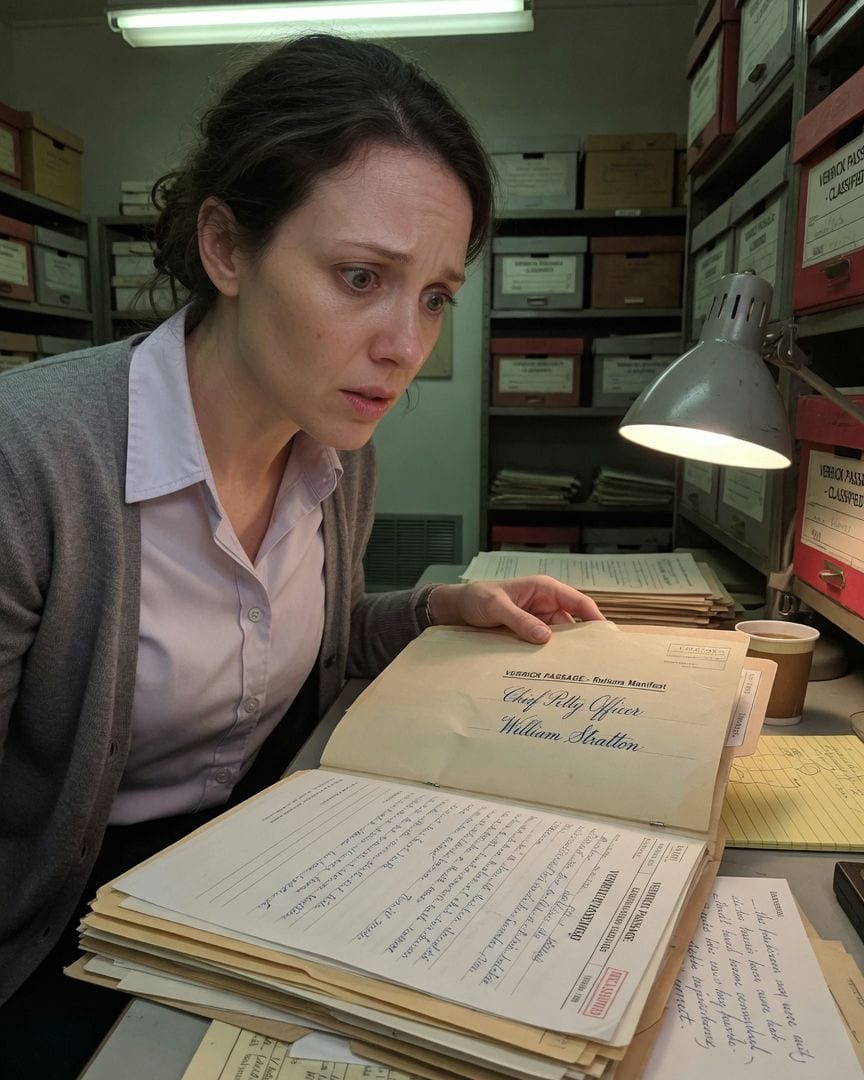
A records reviewer found personnel files for men lost 80 years ago, still being signed in an identical, perfect hand.
In the sterile hush of the declassified archives, meticulous reviewer Ione Fash had a routine task: cross-referencing witness statements from the Verrick Passage file. But as she reviewed files eighty years thick with official silence, she found nine separate interviews containing the exact same chilling sentence, all in an identical, precise hand. Her rational mind sought explanation, yet then she discovered something worse: personnel files for men lost in 1943, still being updated with modern requisitions and payroll runs. Each impossible entry, including a manifest signed just two weeks ago by a casualty from eighty years prior, bore the same unnervingly perfect signature. The file wasn't just a record of the lost; it was still being signed.
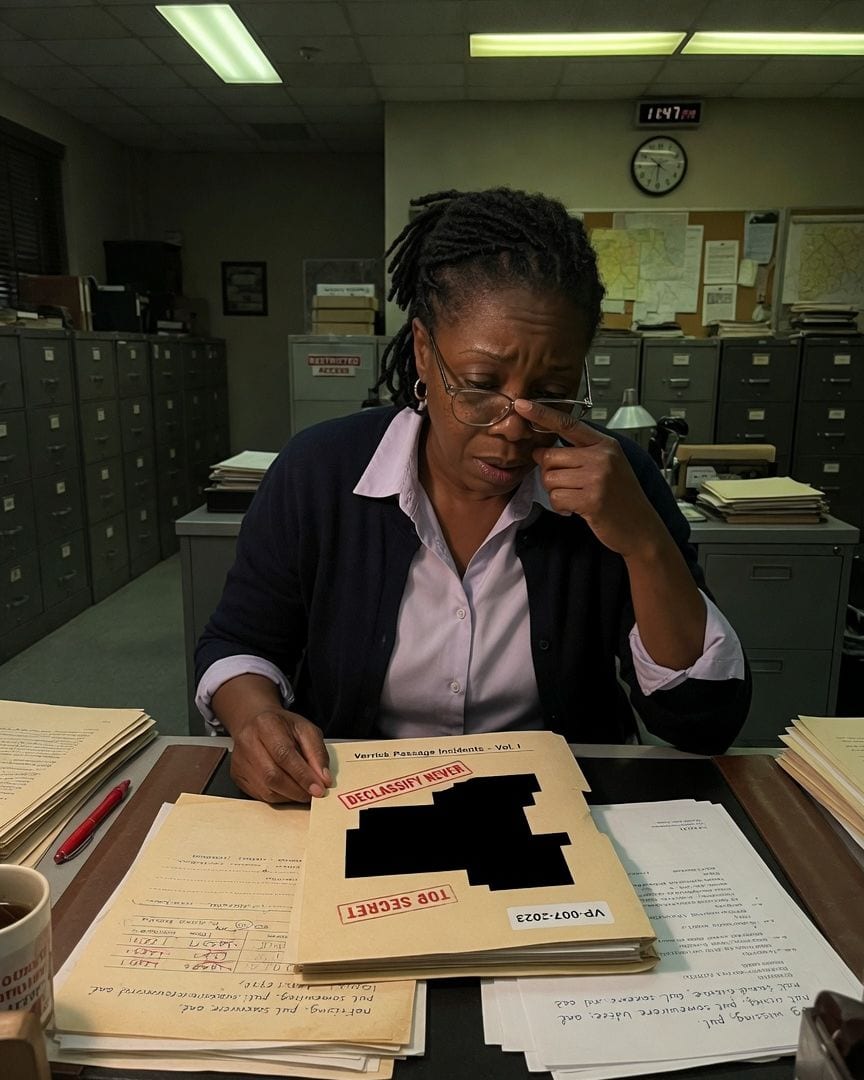
A declassification reviewer finds nine witness statements from decades apart, all written in the same looping hand. The Cold War file's newest control number points to no office.
As a declassification reviewer for the National Archives, Ione Fash faced a Sisyphean task: finding a way to downgrade records detailing the disappearances of fourteen men over eighty years. The constant hum of the office was her only companion as she meticulously examined files marked 'DECLASSIFY NEVER'. She pulled out nine witness statements, each from a different town and year, only to find them all written in the exact same distinct, looping script. Then she saw it: a control number on a file supposedly closed in 1978, dated '2023', and with no originating office in the entire archive system. Who was still signing these impossible files?
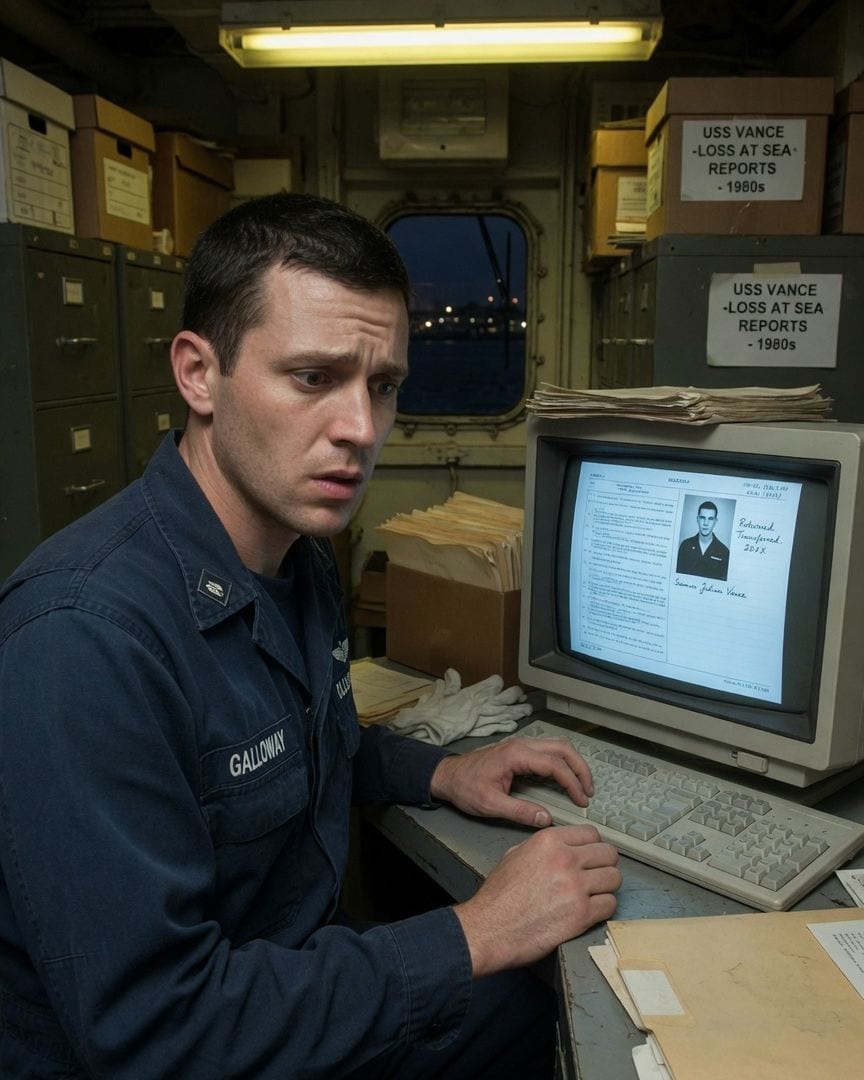
Petty Officer Galloway logged a sailor onto his ship. The man died at sea 40 years ago.
Petty Officer Joel Galloway scanned a sailor's ID on the USS Vance quarterdeck. The man's name, 'Seaman Julian Vance,' and his out-of-date uniform pricked at Galloway's memory. Later, the ship's berthing count came back one over, with an extra entry in the system but no physical body.
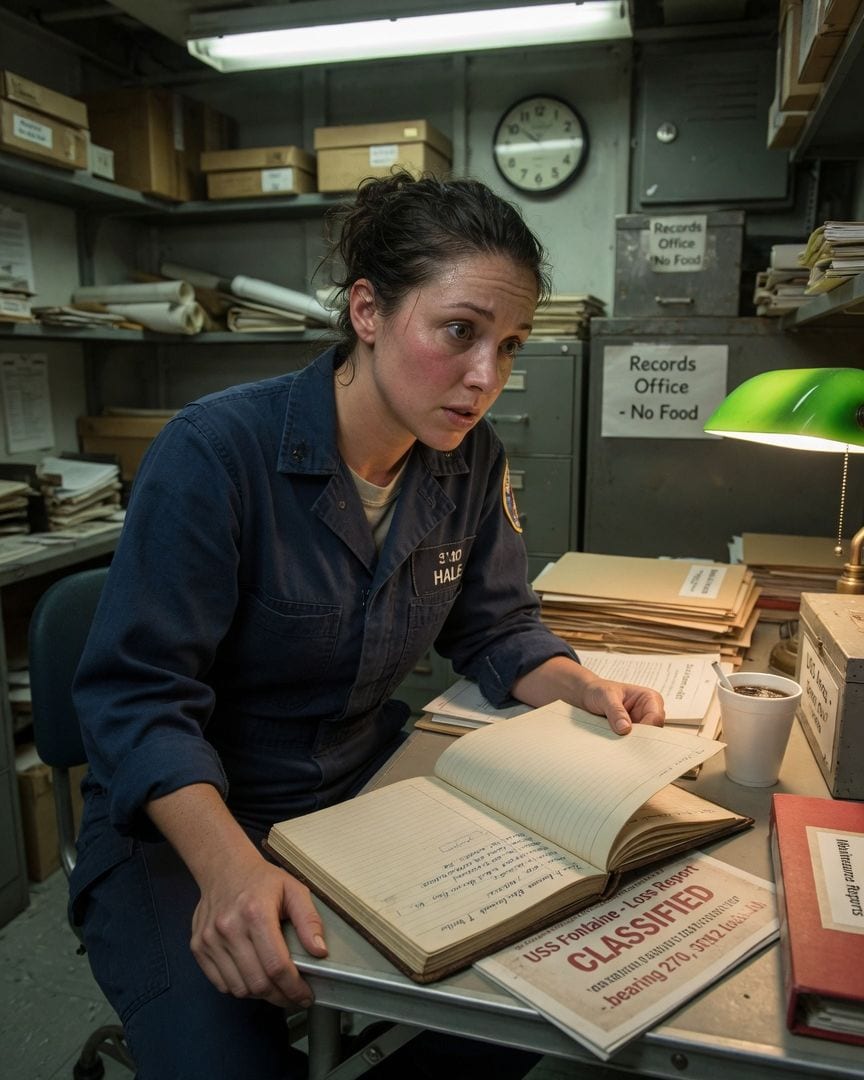
Petty Officer Hale needs a spotless record for her transfer. But the USS Ares sonar logs show an identical, impossible contact, logged to the minute, years apart, and tied to a classified loss report.
Petty Officer Sarah Hale needed a spotless record for her coveted shore duty transfer, a posting she'd worked five years to secure. Alone in the USS Ares sonar shack, three days out from San Diego, her midwatch was broken by an impossible contact: a close, slow echo holding perfect pace, invisible to radar, then vanishing. Her heart hammered, not from fear, but from the data's impossibility. When she found an identical entry in her own log from just one week prior, the cold dread tightened its grip. But the true chill settled when she unearthed decades of similar records, signed by other sonar officers, all showing the same impossible contact at 0212, off the port beam, for nineteen minutes, on the same ship, stretching back years—a persistent echo tied to a classified loss report.
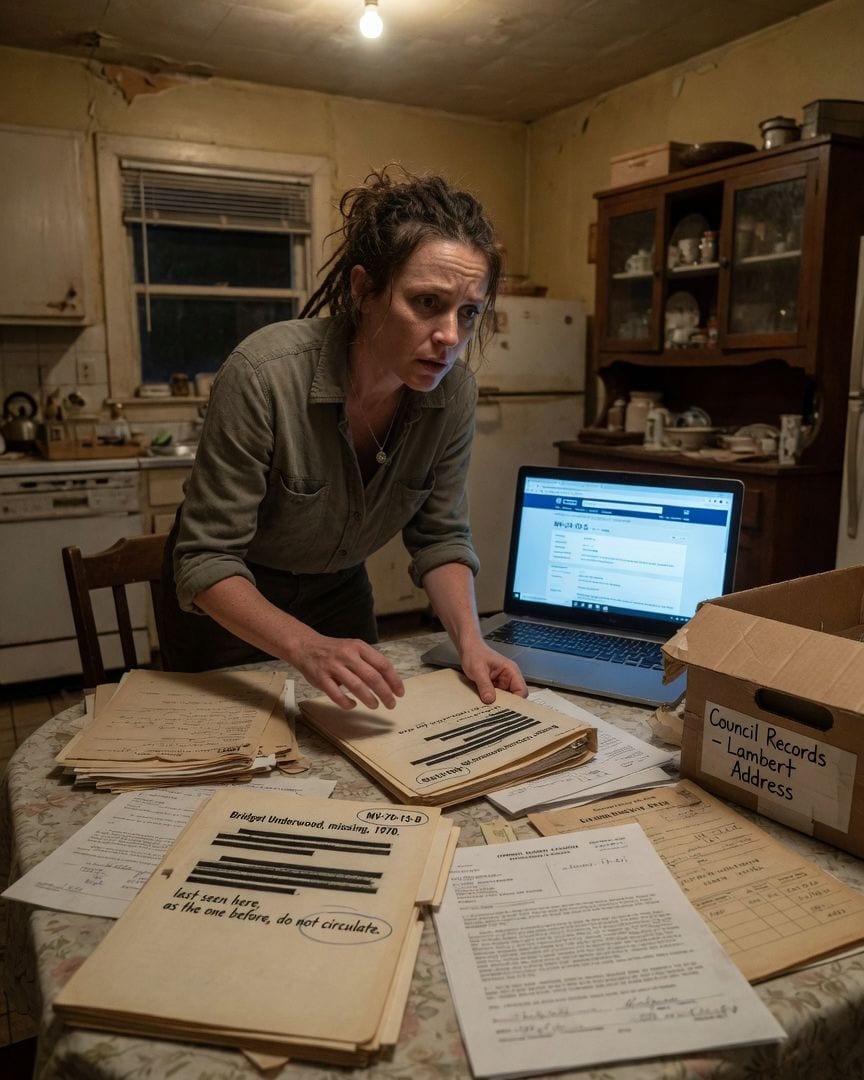
My address appears on a 1970 missing-person report. It says 'last seen here, as the one before,' and the case number is almost identical to a new one from last month.
As a local historian, I'm used to old records, but a police file for a 1970 missing person stopped me cold. It listed my current address, with a chilling note: 'last seen here, as the one before, do not circulate.' I knew Bridget Underwood never lived here, yet there it was.
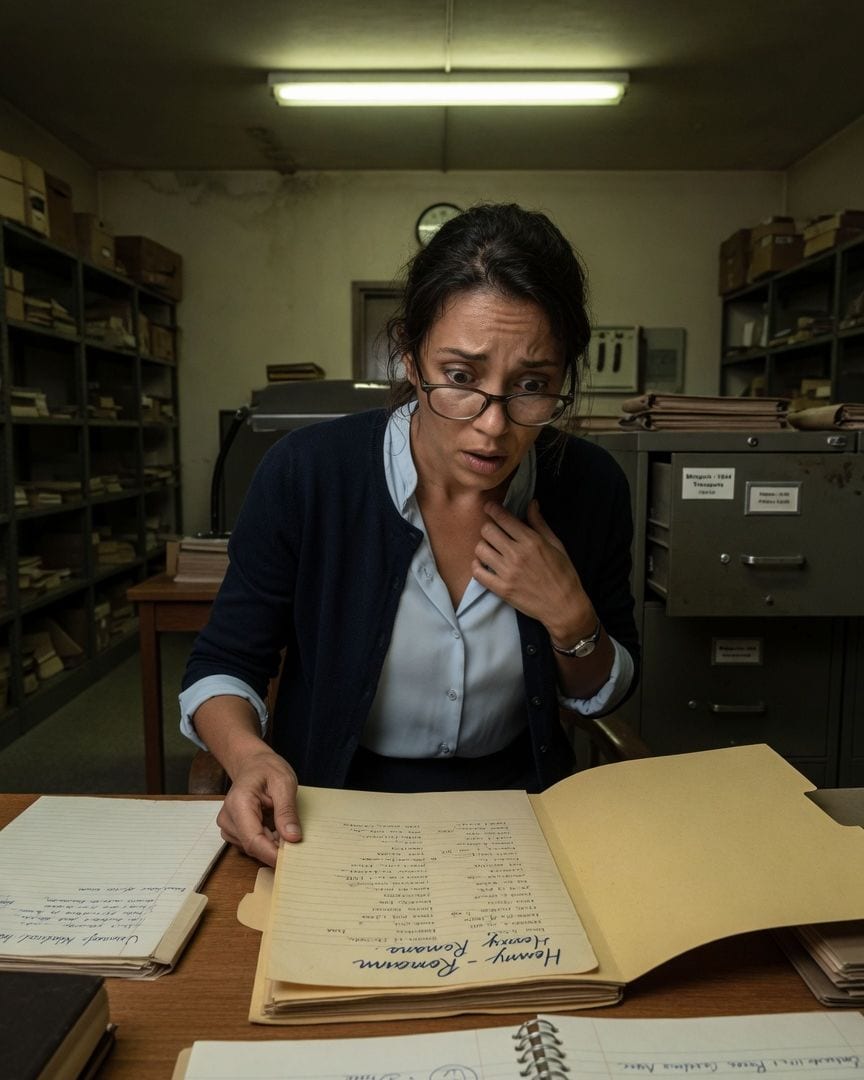
A records reviewer found a 1944 ferry manifest with an impossible 42nd name. The same dark ink marked a phantom crewman on a Cold War flight log.
Delphine Arceneaux, a dedicated records reviewer, had just minutes left in the stale reading room to finalize her review of a 1944 Mirepoix Ferry manifest. Her job was to confirm every detail of the forty-one passengers who boarded a boat that never arrived. But as the clock neared six, a forty-second name materialized on the faded paper, stark in a dark, unfamiliar ink. 'Henry Romano,' it read, with the impossible notation: 'BOARDED AT MIDSTREAM.' How could anyone board a ferry in the middle of a river?