On his last audit before retirement, Barrow Nunnelly’s measuring wheel found a Cold War storage cave 211 feet longer than any map, holding a pilot's helmet named SULLIVAN, O.
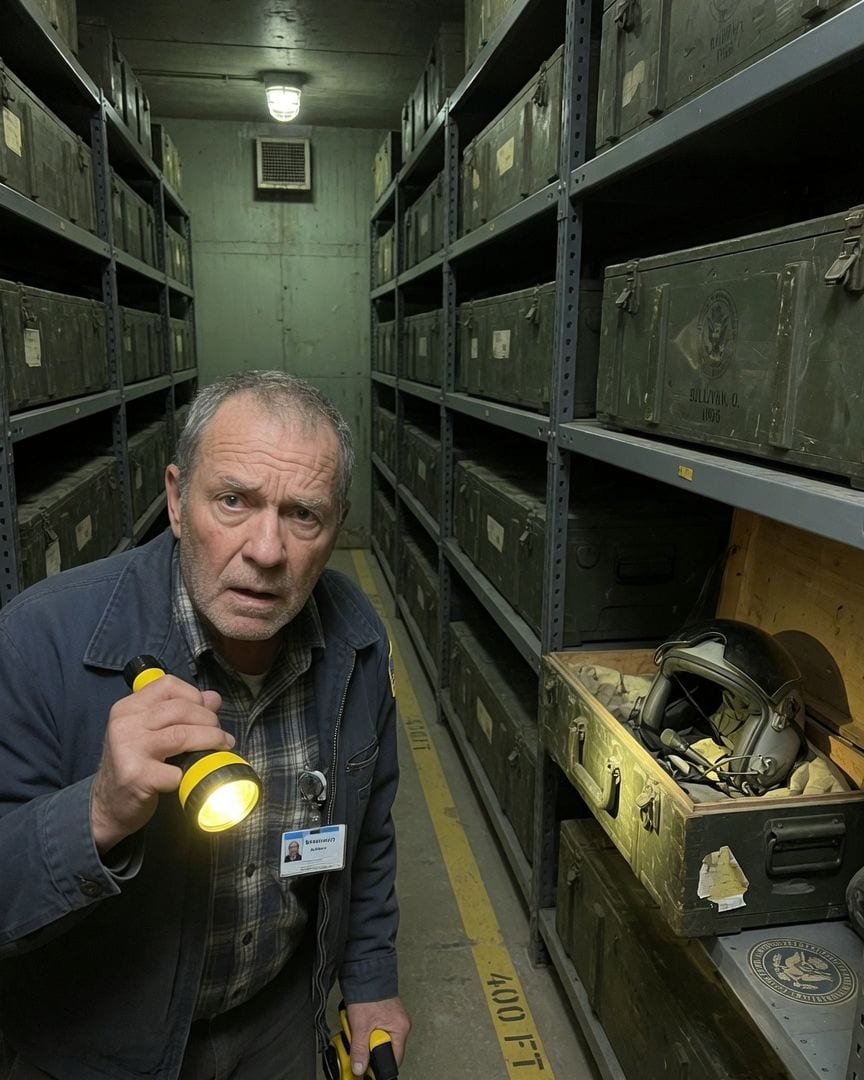
Barrow Nunnelly, sixty-three years old with a persistent ache in his lower back, carefully guided his measuring wheel down the main aisle of Cheatham Storage Cave 3.
The air hung at a steady fifty-two degrees, a constant hum of ventilation the only sound in the vast, subterranean chamber.
His contract, one last push before truly retiring, was to audit the facility, a task not fully completed since 1968. According to the official blueprints, Cave 3 stretched precisely four hundred feet. His wheel clicked past four hundred.
It kept going. Four hundred and fifty. Five hundred. Six hundred. It stopped at six hundred eleven feet, the digital readout glowing starkly in the dim light.
The rows of industrial shelving, meticulously loaded with sealed containers, stretched the entire impossible length.
Every shelf was full, every bin listed, and the facility’s inventory agreed with the longer, physical reality of six hundred eleven feet, not the charted four hundred.
Barrow walked it again, a knot tightening in his stomach, then called for Julian Sheppard, a younger man from the day shift, to verify. Julian walked it, his face unreadable, his own wheel stopping at six hundred eleven.
He handed it back to Barrow and wouldn’t say anything else about it, just walked away, leaving Barrow standing in the cold, impossible silence.
Barrow spent the next day poring over the facility’s paper archives. He tried to find a mundane explanation: a forgotten annex, a survey error, a misfiled blueprint.
He cross-referenced the current Cave 3 inventory with every blueprint he could find, both digital and crumbling paper copies from the 60s. The blueprints consistently showed four hundred feet.
Yet, the inventory for Cave 3, meticulously updated over the decades, listed items for six hundred eleven feet, complete with corresponding shelf locations that, according to the maps, simply did not exist.
The sheer, quiet coherence of the false record was more unsettling than any wild discrepancy. He returned to Cave 3, his flashlight cutting through the gloom. He meticulously examined the section of the cave beyond the charted four-hundred-foot mark.
The concrete walls were seamless, showing no signs of recent construction or expansion. The shelving, however, did subtly change. Beyond the four-hundred-foot line, the industrial units, while structurally identical, were older, some bearing faded, unidentifiable stencils beneath layers of dust.
The containers on these shelves were different too—heavy-duty, military-grade crates, many unmarked, others bearing obscure federal agency seals Barrow didn't recognize, long since obsolete. He ran his hand over one, feeling the cold, smooth metal.
His flashlight beam settled on a particularly robust container, sealed with multiple heavy latches, its surface scuffed but otherwise pristine. A faded, water-resistant label was peeling at one corner, but the date, etched into the metal below, was clear: 1966.
It was not on any inventory.
Barrow Nunnelly, his fingers stiff from the cold, worked at the heavy latches. They groaned, protesting decades of disuse, before finally yielding. The seal, a complex, multi-layered federal emblem, cracked and fell away.
He slowly lifted the lid, the hinges squealing in the silent cave. Inside, nestled within inert packing material that offered no clue to its purpose, lay a single, worn flight helmet.
It was olive drab, with a cracked visor and a microphone boom bent at an unnatural angle. A faded name was stenciled on the side, almost illegible, but Barrow’s flashlight caught it, clear as day.
"SULLIVAN, O." He held his breath, the cold air suddenly feeling like ice in his lungs. This was not a clerical error. This was something else entirely.
Back in his motel room, Barrow Nunnelly’s bad back forgotten, he typed 'Oliver Sullivan missing pilot' into his tablet.
The search results were sparse but chillingly consistent: a young pilot, Oliver Sullivan, went missing in 1967 from a nearby airbase, his F-4 Phantom vanishing without a trace during a routine training flight. No wreckage, no body, no explanation.
His flight log, the articles stated, was never recovered. The airbase was only fifty miles from Cheatham. The next morning, Barrow confronted Lydia Hale, the Cheatham facility manager.
He presented her with his measurements, the conflicting blueprints and inventory, and a grainy photo of the flight helmet. Lydia, a sharp woman in her fifties, initially insisted on a 'legacy clerical error' or 'misfiled inventory codes.'
Her composure, however, frayed around the edges. She mentioned 'archaic federal contracts' and 'long-standing agreements with various agencies' that complicated Cheatham's administrative structure.
She refused to acknowledge the helmet or its implications, her eyes flicking nervously to the closed-circuit camera in her office.
Barrow pressed, demanding access to older records, specifically federal contracts and audit reports predating 1968, the year of the last full audit.
Lydia, after a long, uncomfortable silence, granted him limited access to a dusty, rarely used archive room, emphasizing that anything 'classified' would remain inaccessible. He knew he was being watched, but the thread was too compelling to ignore.
He felt a profound unease settle over him, the kind that came from realizing a vast, patient machine had been operating in plain sight, unnoticed.
In the archive room, Barrow found fragmented old logs, some handwritten, some typewritten on yellowed paper.
They referenced 'Annex-C3' and 'Special Storage Protocols,' along with unusual 'federal inspections' that bypassed Cheatham management entirely, occurring at odd hours, sometimes in the dead of night.
The inspection reports were heavily redacted, entire paragraphs blacked out, but the dates spanned decades, a quiet, consistent presence. As Barrow dug deeper, he became acutely aware of being observed.
An old-model, dark sedan, a generic make he couldn't quite place, started appearing. It was always parked near his motel when he left for Cheatham, always gone when he returned. It was never overtly threatening, just present, a silent sentinel.
One evening, after a particularly frustrating day in the archives, Barrow returned to his motel room to find a typewritten note slipped under his door. The paper was heavy, the font old-fashioned.
It read, simply: "Some things are better left filed." There was no sender, no return address, just the stark, chilling message. He checked his phone; there were no messages, no missed calls.
The sedan was parked outside, its windows tinted, reflecting the motel's neon sign. He knew then that his digging had been noticed, not just locally, but by the same patient, pervasive entity that had overseen the Cheatham caves for decades.
The threat was no longer an abstract puzzle; it was personal, a cold hand reaching from the shadows.
The anonymous note spurred Barrow into action. He needed a direct source, someone who had been there. He found Frank Romano, a retired Cheatham supervisor, listed in an old personnel file as having worked at the facility since 1962.
Romano, now in his late seventies, lived in a quiet, unassuming house a few towns over. His initial conversation with Barrow was guarded, full of polite evasions. Barrow, however, came prepared.
He laid out the conflicting blueprints, the inventory discrepancy, and the 'Annex-C3' logs. He showed Romano the photo of Oliver Sullivan's helmet. The old man’s composure finally cracked.
Romano admitted that after a specific 'incident' in the mid-1960s – a 'big one,' he called it, though he wouldn't elaborate – a 'special unit' from a federal agency had moved into Cheatham.
They worked for months, modifying Cave 3, extending it, installing new shelving. New blueprints and inventory lists were issued afterward, replacing the old ones, and everyone was told to 'forget' the previous layout.
He confirmed the extra 211 feet were for 'special storage,' but he never saw the contents, only the sealed crates. He spoke of pilots, aircraft, and 'things that didn't come back right' that the special unit seemed interested in.
Romano’s voice dropped to a near whisper as he confessed he’d signed a non-disclosure agreement, a thick, official document, that he believed was 'still active.'
He lived with the quiet dread of it, never speaking of it, never looking too closely. Julian’s silence, Lydia’s evasiveness, the anonymous note – it all snapped into focus for Barrow.
It wasn't just a cover-up; it was a deeply ingrained, long-standing system of enforced secrecy, a machine that had been running for decades, filing away not just objects, but memories and truths.
Romano, visibly shaken by dredging up old ghosts, gave Barrow a lead: a specific, old 'declassified' federal archive number he’d seen on some of the special unit's paperwork back in the 60s.
He warned Barrow it was probably a dead end, just more blacked-out bureaucracy. Barrow, however, clung to it. He returned to his motel room, fired up his tablet, and accessed the public federal archive online.
The number led to a highly redacted file titled 'Project CHEATHAM: Annex Discrepancy Protocol.' He scrolled through mentions of 'Cheatham Facility,' 'Annex C3,' and 'Object Recovery,' the black bars of redaction more numerous than the visible text.
It was a dizzying, frustrating read, hinting at vast operations without ever revealing their nature. Then, as he neared the end of the document, a chilling section appeared, titled: 'Observer Identification & Tracking.' Below it, a list of names.
His heart slammed against his ribs. There it was: 'Nunnelly, B.' And next to it, an initiation date – a month before he’d even taken the contract for the Cheatham audit. He wasn't an accident. He was part of it.
The page ended abruptly, the words 'Next Page Loading...' blinking mockingly on the screen, the cursor a silent, patient eye, waiting for him to scroll down.
Barrow's fingers trembled as he tapped the screen, loading the next page. The document continued, detailing a chilling pattern. 'Observers,' it explained, were carefully chosen individuals with specific skill sets and circumstances that would lead them to 'discover' discrepancies.
Their 'discovery' of anomalies—like the extended Cave 3 or the presence of peculiar artifacts—was not accidental but monitored, a controlled system designed to 'refresh' institutional knowledge without full, dangerous exposure.
The items in the annex, like Sullivan's helmet, were not merely stored; they were 'triggers' or 'proofs' for these 'observers,' designed to initiate their involvement.
The file described how the 'Annex Discrepancy' at Cheatham, and similar 'anomalies' at other federal facilities across the country, were part of a long-standing, multi-decadal system.
These were not random events; they were carefully managed 'containment zones' for objects and records tied to 'unexplained phenomena' and 'disappearances.'
The institution's purpose, as vaguely outlined, was to maintain a continuous, low-level awareness of these events among a chosen few, ensuring the 'filing' wasn't just about objects, but about people and their experiences, integrating them into the institution’s ongoing, secretive operations.
The entire audit, his bad back, his need for the contract—it had all been a setup. He was not an auditor; he was an 'observer,' and he had just signed on to a file that had been open for generations.
A cold dread settled over Barrow. He was not an investigator; he was a pawn. He scrambled to download the full file, to save every page, every chilling detail.
He managed to copy a few more crucial pages, including a list of other 'observers' and their 'assignments,' when his tablet screen flickered. The Wi-Fi connection died. The internet, his lifeline to the outside world, was suddenly gone.
A soft, insistent knock sounded at his motel room door. Barrow froze, his heart hammering. He peered through the peephole. It was Julian Sheppard, the day shift worker from the caves.
Julian looked tired, his face etched with something Barrow now recognized as resignation, but his eyes were clear, almost unnervingly so. "Mr. Nunnelly," Julian said, his voice flat, devoid of emotion, "They sent me to collect the wheel.
And the file. It's time to sign off." Barrow backed away from the door, his mind racing. He knew he couldn't fight them. Julian wasn't a threat, not in the traditional sense, but an extension of the system.
His only option was to run. He grabbed his small messenger bag, securing the thumb drive with the partially downloaded file deep inside. He quietly unlatched the back window, pushing it open just enough to slip through.
As he dropped to the ground, he saw the familiar dark sedan pull slowly into the motel parking lot, two figures, indistinct in the twilight, getting out and heading toward the front entrance. Barrow didn't look back.
He ran, melting into the shadows of the adjacent alley, the cold air biting at his face. He was free, for now, but he knew the file wasn't closed. Not for him.
Barrow Nunnelly disappeared from Cheatham that night. His contract was terminated, the official reason cited as 'abandonment of duties.'
His personal effects, a small box of clothes and a few books, were mailed to an empty post office box he’d used once, decades ago.
Julian Sheppard returned to his day shift at the Cheatham caves, his face expressionless, his routine unchanged. Lydia Hale, the facility manager, quietly retired a few months later, citing 'personal reasons,' though her eyes held a haunted, distant look.
The Cheatham storage caves remain un-audited, their impossible length a silent, sealed secret. The dark sedan was never seen in the area again.
For most, the story simply ended there, a minor administrative footnote in the quiet life of a remote federal facility. But for Barrow, the story had only just begun.
Barrow Nunnelly, now living under an assumed name hundreds of miles away, occasionally checks a specific, obscure online forum where others, like him, post cryptic messages about 'discrepancies' and 'filed memories.'
He never posts, just reads, a ghost in the digital ether. He knows the file isn't closed, not for him, that his 'active' status means he's still part of the system, just on a different assignment now.
He checks his email. An attachment from an unknown sender. He opens it. It's a single, scanned page. His name. "Nunnelly, B. Status: Active."
Years later, a new auditor takes a contract at a remote federal storage facility in Nevada. His wheel gives an impossible measurement. He calls for a second opinion. The man who arrives, quiet and methodical, introduces himself as Julian.
Julian Sheppard watches the new auditor carefully, a faint, almost imperceptible smile touching his lips as the man's wheel spins past the charted length. The file is still being signed.
If this one got to you
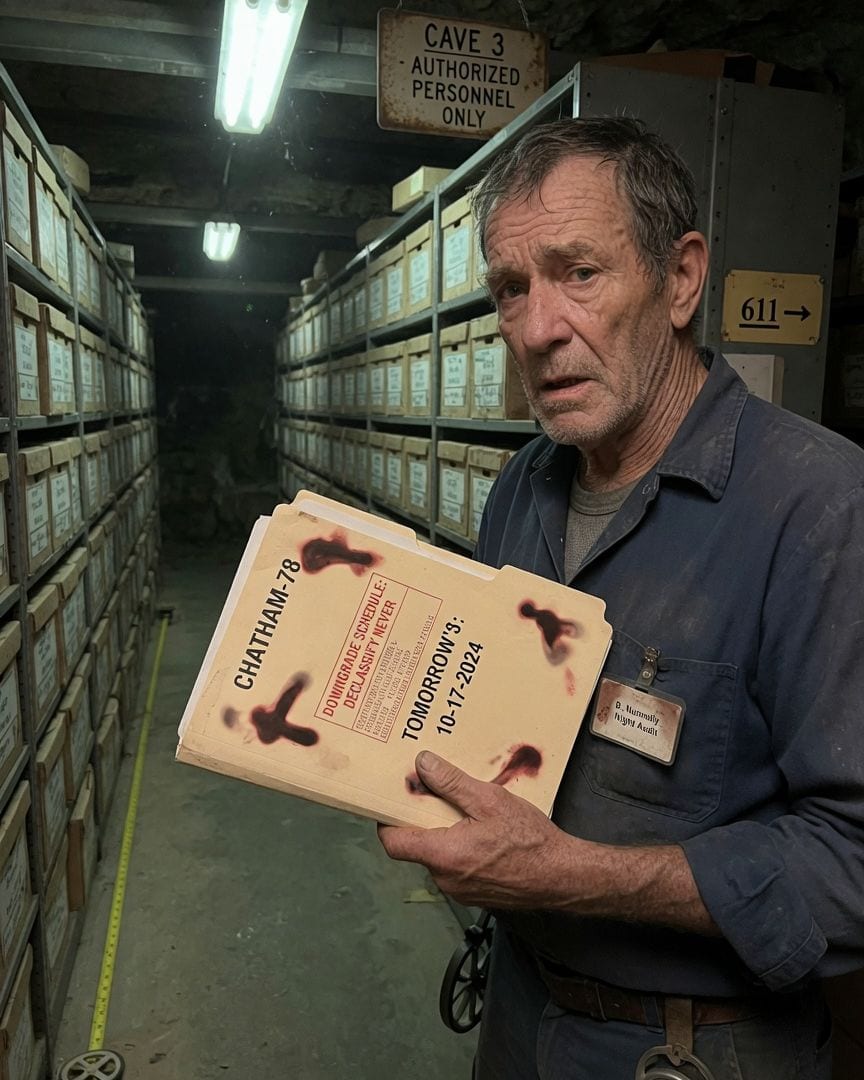
A methodical auditor measured his storage cave 211 feet too long, finding Cold War files inside stamped with tomorrow's date.
Barrow Nunnelly, a methodical sixty-three-year-old burdened by a bad back, undertook the colossal task of auditing the Cheatham storage caves, which hadn't seen a full inspection since 1968. His measuring wheel in Cave 3, officially four hundred feet long, clicked to a stop at an impossible six hundred eleven, confirming an extra two hundred eleven feet of shelving that simply didn't exist. Among these newly discovered, deeply unsettling Cold War files, Barrow found documents with strange, organically curved redactions and an alphanumeric code from no known office, all stamped with a chilling classification: 'DECLASSIFY NEVER.' Yet, beneath that, printed in crisp black ink, was an official date that hadn't happened yet. It was tomorrow.
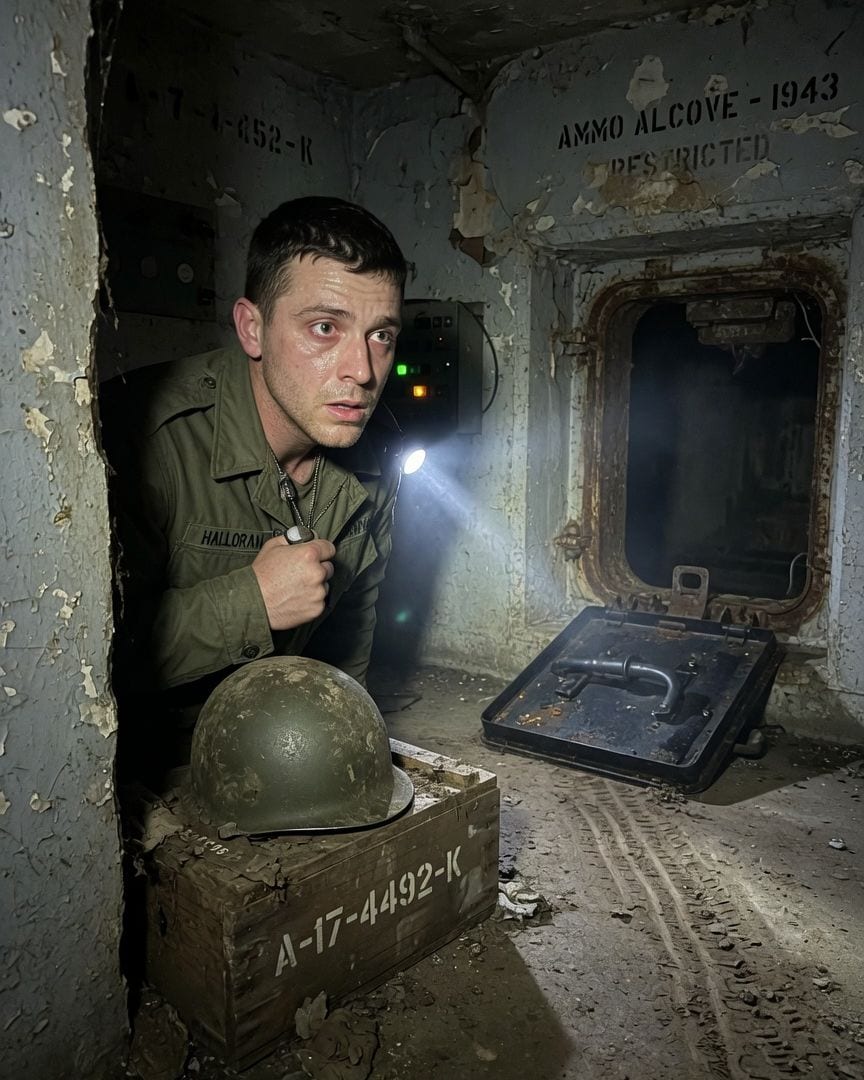
A coastal sentry on his last watch found the bunker's decades-sealed hatch ripped open by impossible strength.
Private Daniel Halloran shivered through his final hours on watch at the old WWII coast-artillery bunker, counting down to his discharge and going home. The pre-dawn fog rolled in thick, and through its swirling white, he watched a landing party form on the beach below, their outdated gear impossibly clean, their forms unmoving. After dawn burned off the mist, the beach was empty, but up the embankment, the bunker's rear hatch—sealed for decades—stood violently ripped open, its locking bar twisted. Inside the dark, silent chambers, Daniel's flashlight found a mud-caked military helmet, unlike any he'd ever seen, bearing a faded serial number that felt sickeningly familiar.
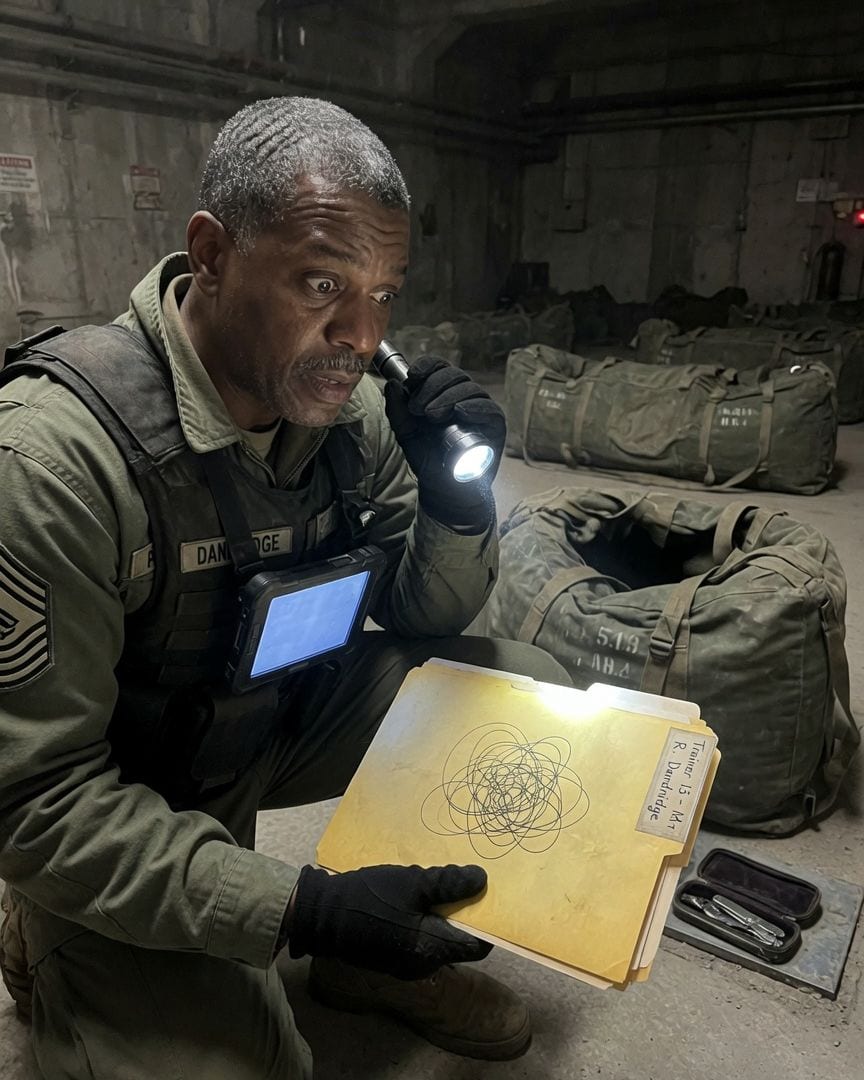
Thirty days from closing a Cold War vault, a Master Sergeant finds a thirteenth warhead cradle with his own name on it, its velvet lining strangely warm.
Master Sergeant Ruel Dandridge had just thirty days left at Kestrel Mountain, conducting its final inventory before the underground vault was sealed forever. He methodically counted twelve warhead trainer cradles, but then his beam caught a thirteenth: bolted down, empty, its straps dented as if something immense had shifted. A tag bore his own precise handwriting: ‘Trainer 13 - R. Dandridge,’ an impossible find in a bay he'd never entered and not on any manifest. Prying at its base, Ruel discovered a hidden compartment holding a yellowed file with a symbol that pulsed with light and subtly shifted, its velvet lining strangely warm. This confronted the Master Sergeant with a pattern that defied all logic.
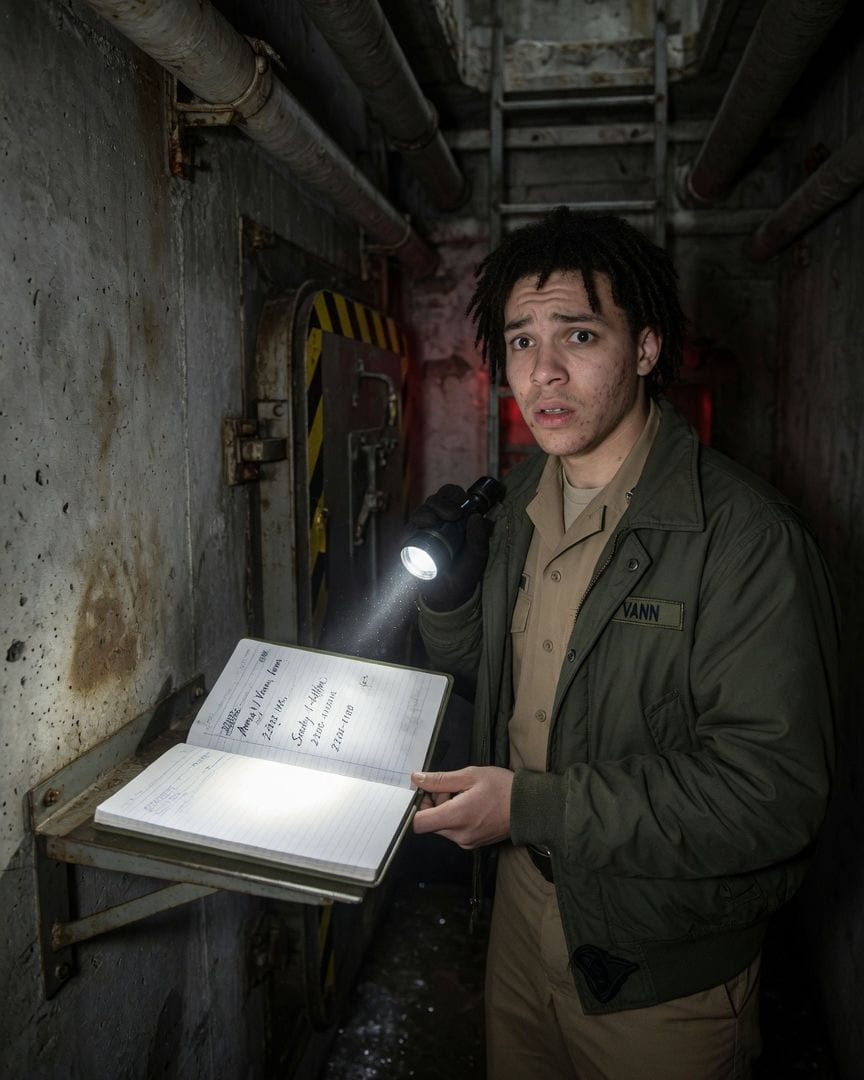
On his last patrol, Airman Vann sees a Cold War silo hatch light up from *inside*—it was welded shut a decade ago.
Airman Vincent Vann was on his last patrol across a vast, desolate Cold War missile field in the Dakotas, the cold, starless sky mirroring the emptiness of the landscape before his transfer. His routine check of eight hardened silo caps was shattered when a red fault light pulsed on Silo 4’s access panel, signaling an impossible breach from *inside* a hatch sealed for a decade. As more silos lit up, ignoring base orders, Vann found the hatch unlocked from within and descended into the dark shaft, where he discovered a pristine logbook bearing his own signature next to a chilling entry from a non-existent sentry, dated for *that very night*. Now, a steady *thump* echoed from deeper within the sealed concrete, leaving the Airman desperate for an explanation that simply wasn't there.
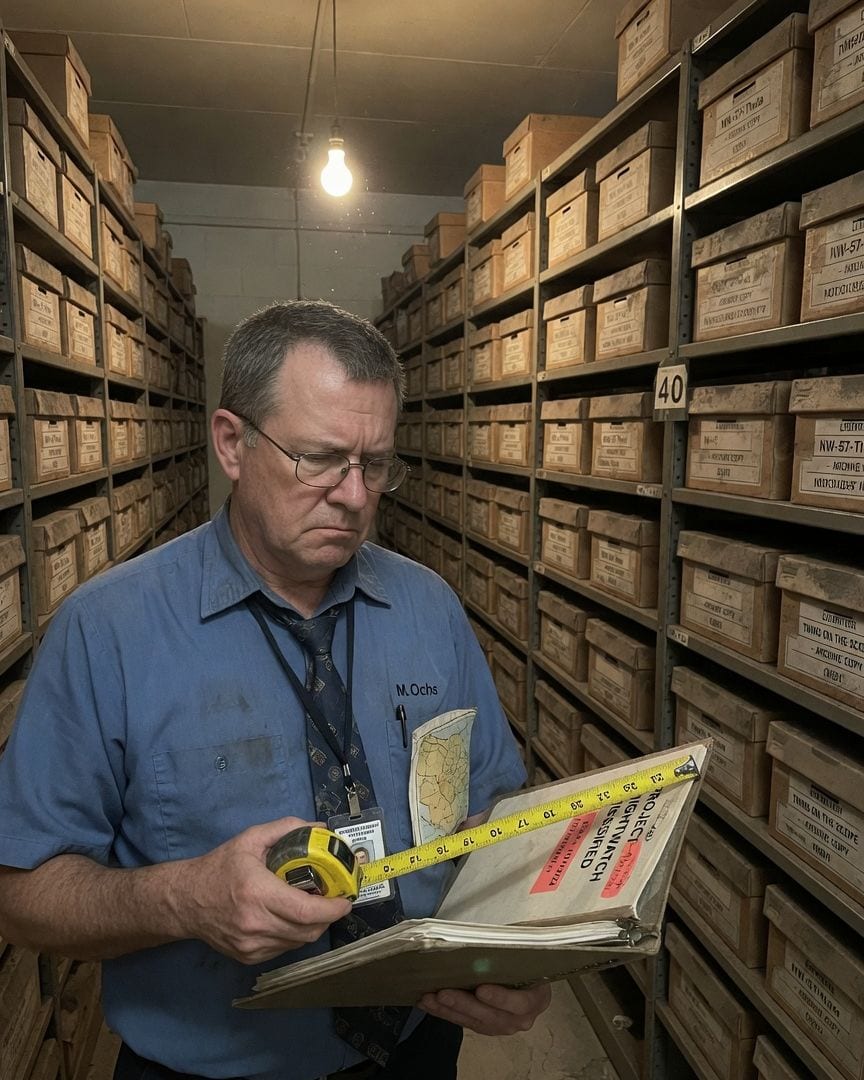
A Cold War records clerk on his final patrol found Aisle 40 stretched 61 feet longer, lined with unknown boxes. Inside one: 'PROJECT NIGHTWATCH - CLASSIFIED' with a fresh timestamp.
Marlin Ochs, a creature of habit after nineteen years at the St. Louis federal records depot, faced his final patrol through Aisle 40 before its scheduled pulping. His routine walk, usually 92 precise strides, suddenly stretched to an impossible 119, making the aisle 61 feet longer than its blueprint. The extra section felt colder, lined with dust-laden boxes bearing alien classification codes and no manifest. Inside one, he found a metal-bound file: 'PROJECT NIGHTWATCH - CLASSIFIED,' dated 1957, but with a timestamp just hours old.
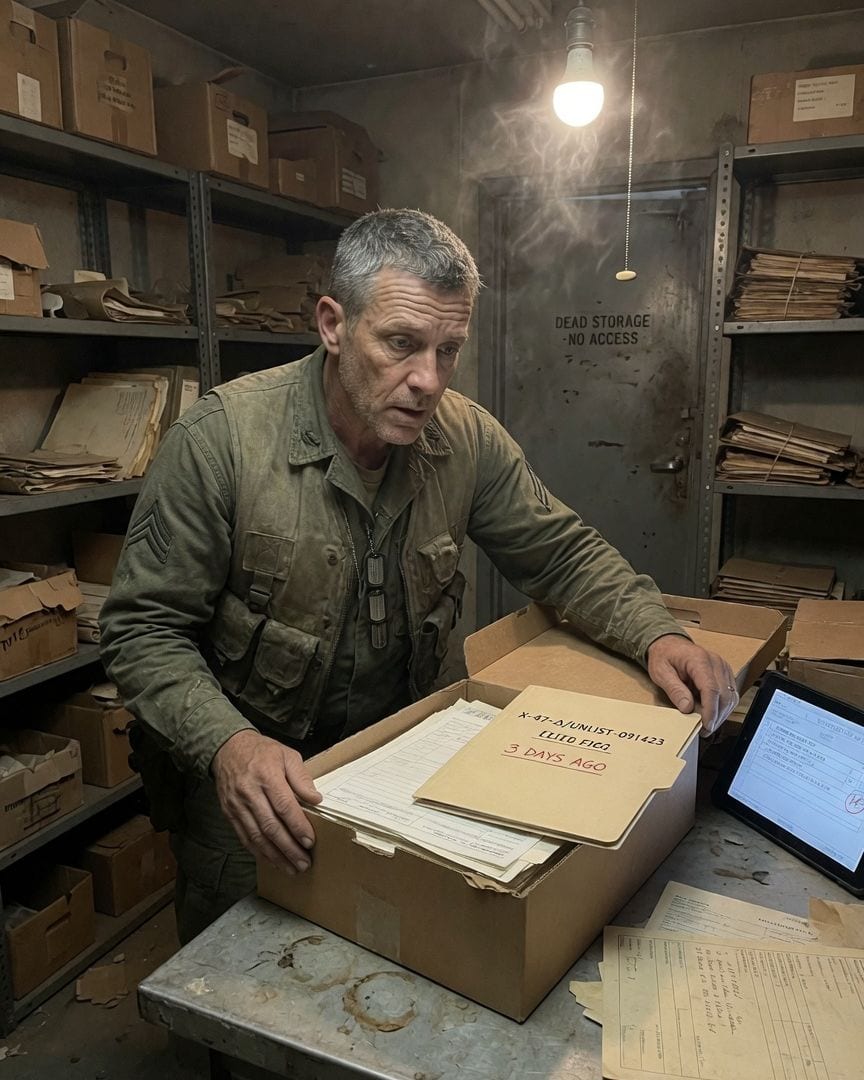
Sergeant Pryor, days from retirement, finds a four-hundred-foot crater. The desert floor is still warm, but no one remembers the blast.
Sergeant Alden Pryor, forty years old and just eleven days from retirement, drove the familiar Ranier Flats fence line for one of his final patrols. The desert stretched out, silent and vast, until he discovered a four-hundred-foot crater, dark and impossibly vast, where the sand had fused into slick glass. The ground within the crater was still faintly warm, a subtle heat defying the cool desert air. Yet, every official log confirmed the blast, while no one recalled a tremor or flash across three states.