Thirty days from closing a Cold War vault, a Master Sergeant finds a thirteenth warhead cradle with his own name on it, its velvet lining strangely warm.
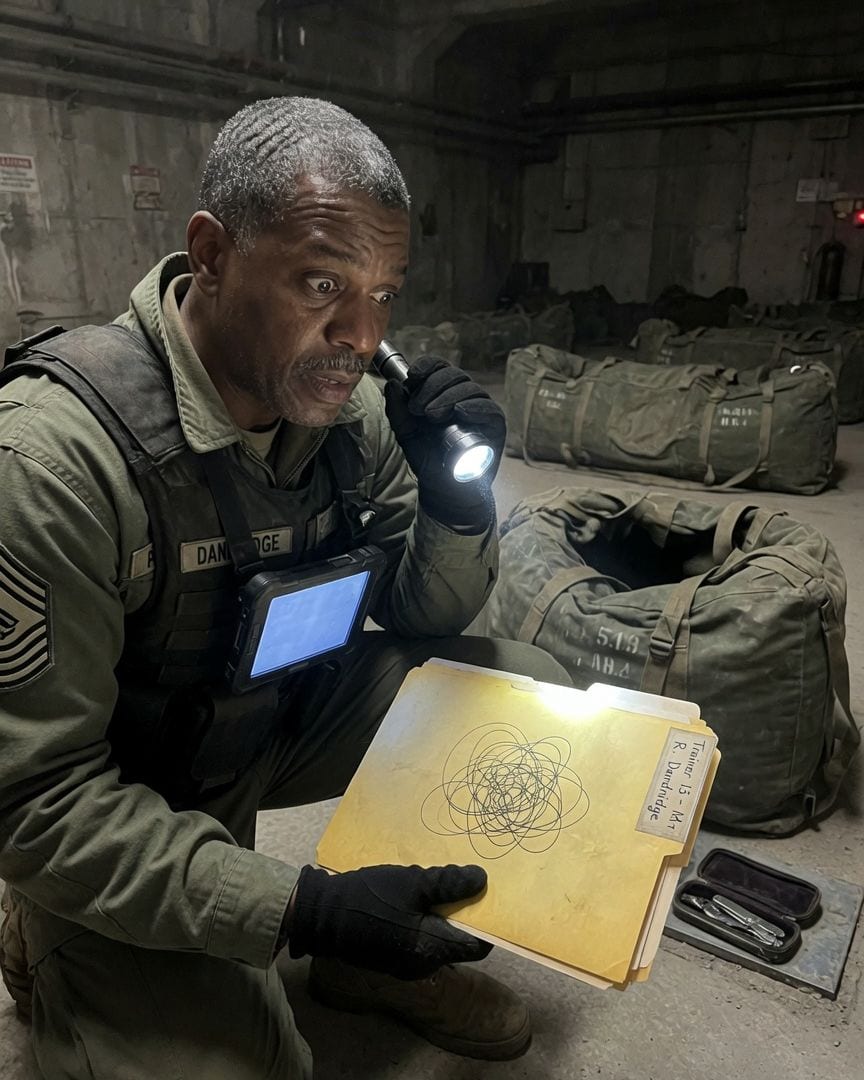
Master Sergeant Ruel Dandridge ran a gloved hand over the cold, dusty steel of the twelfth warhead trainer cradle. Thirty days to the wire, one last inventory, then Kestrel Mountain would be poured over, sealed for good.
He moved methodically through the cavernous underground vault, his flashlight beam cutting through the gloom, ticking off serial numbers against his clipboard. Twelve cradles on the list, twelve full racks.
But as he rounded the far bay, his beam caught a thirteenth. It was bolted down, just like the others, thick canvas restraining straps drawn tight. But it was empty.
Not just empty; the straps were dented, as if something inside had shifted with immense force. He crouched, his boots crunching on fine grit. A small, laminated tag hung from one buckle.
His own precise, blocky handwriting filled it: ‘Trainer 13 - R. Dandridge’. A chill that had nothing to do with the vault’s temperature pricked his skin. He had never been in this bay before.
Ruel tried to force a rational explanation. A misfile? A prank? He checked the vault’s digital manifest again on his tablet; only twelve trainers were ever assigned to Kestrel Mountain.
He radioed a junior NCO, Private Oscar Sutton, who was on perimeter duty.
“Private, any record of a Trainer 13, or anyone accessing Bay 13 recently?”
Sutton’s voice crackled back, confused. “Negative, Master Sergeant. Bay 13 hasn’t been on the inventory in decades. Empty storage.”
Ruel ran his fingers along the dented metal of the cradle. It felt… wrong. Not just old damage, but a fresh, deep impression, as if something heavy had recently been removed, or forced out.
The air in the bay felt thick, almost humid, despite the vault’s deep-earth chill. He noticed a faint seam where the floor met the cradle’s base, too precise for a simple mounting plate.
He pulled his multitool, prying at the seam. It gave way with a faint groan of metal, like an ancient lock giving up its secret, revealing a hidden compartment, dark and smelling faintly of ozone and old paper.
Inside, nestled in a velvet lining, was a single, thick, yellowed file. No classification marks, no unit stamps.
Just a crudely drawn symbol on its cover—a knot of lines that seemed to subtly shift and reconfigure in his peripheral vision, impossible to focus on directly. His eyes ached trying to hold it steady.
Ruel hesitated, his gloved hand hovering over the file. The symbol on the cover seemed to pulse with a faint, internal light, defying the dimness of the vault.
Every instinct screamed at him to leave it, to report it, to dismiss it as some forgotten relic. But the dented cradle, his own handwriting, the impossible shifting symbol—they were a pattern that refused to be ignored.
He gripped the file, its weight surprisingly substantial, and carefully lifted it from the compartment. The velvet lining beneath it felt strangely warm.
He turned the file over, the unsettling symbol facing him, and prepared to open it, his heart pounding a slow, heavy rhythm in the silent vault.
Back in his office, Ruel locked the file in his personal safe. He spent the next day trying to cross-reference Kestrel Mountain’s historical records, attempting to find any mention of ‘Bay 13’ or ‘Trainer 13’.
All official digital archives were either heavily redacted or simply missing data for that specific section of the vault. He contacted Sarah Beaumont, a records analyst at HQ, known for her tenacity.
“Sarah, I need eyes on any non-standard materiel shipments to Kestrel Mountain, pre-2000. Anything unusual, anything that doesn’t fit the standard warhead trainer profile.”
Sarah, initially skeptical, called him back two days later. Her voice was tight. “Master Sergeant, I’m seeing… anomalies. Irregular requisition orders for 'containment units' and 'biological stabilization equipment' that don't match any known inventory, all routed through Kestrel Mountain.
And then they just vanish from the system.” The line went quiet for a moment. “It’s like they were never there, but the paper trail for their arrival is undeniable.”
Meanwhile, Ruel cautiously began reading the yellowed file. Its contents were handwritten reports, accounts of 'recoveries' and 'disappearances' of 'anomalous materiel' that read like fever dreams, yet were meticulously logged with dates and coordinates.
He saw a recurring pattern: objects, and sometimes people, would 'return' from unexplained disappearances, but subtly wrong, or simply vanish after being brought to Kestrel Mountain.
Each entry was chillingly precise, detailing not just the events, but the subsequent erasure from official records. The sheer volume of disappearances made his head spin.
The next morning, Ruel found his access card flagged. Several restricted areas of the vault, including the main exit routes, were suddenly inaccessible to him. A maintenance crew, not on the schedule, appeared in his section, ostensibly to check ventilation.
They spent an hour conspicuously working on a panel near Bay 13, their eyes frequently darting towards Ruel’s office.
The air in the vault, already thick, seemed to press in on him, the low thrum of the facility resonating in his chest like a muffled heartbeat.
Later that day, an untraceable, encrypted message appeared in his secure inbox: 'LEAVE THE FILES ALONE, SERGEANT. YOUR DISCHARGE IS PENDING.' The message had no sender, no subject line. He immediately called Sarah Beaumont. Her voice was a hushed whisper.
“Someone’s been asking about my access logs for Kestrel Mountain, Master Sergeant. High-level inquiries. I think they know I helped you.” A cold dread settled in Ruel’s stomach. He wasn’t just investigating; he was being watched, cornered.
The facility that was supposed to be closing around him was tightening its grip. The scheduled sealing felt less like an exit and more like a final trap closing.
Ruel pressed Sarah. “What else did you find, Sarah? Don’t hold back.”
Her voice, now trembling, broke. “There’s an old sub-ledger, Master Sergeant. Unofficial. Hidden deep in a legacy system. It’s for Kestrel Mountain. It lists 'non-standard assets' and mentions… 'assimilation protocols'. It’s not about trainers, sir. It’s a filing system.”
Ruel’s mind raced, connecting her words to the strange reports in his yellowed file. The 'recoveries' were not materiel; they were things, or people, that had been 'filed' away. The 'disappearances' were entries.
Kestrel Mountain wasn’t a vault for warheads; it was an institutional black hole, a place where reality was rewritten. He remembered the dent in the cradle, the tight straps on empty air. Something had been there, then 'filed'.
The phrase 'assimilation protocols' chilled him to the bone. He opened the file again, his hands shaking slightly.
He flipped through pages detailing 'Subject: The Fisher King', 'Subject: Echo-17', each entry a meticulous, horrifying account of something removed from the world, documented, then lost to official memory.
His own handwriting on that tag, his lack of memory—it was all part of the protocol. He was already compromised.
The entire facility hummed around him, a low, resonant drone that seemed to vibrate his very teeth, amplifying the insidious truth.
Ruel continued scanning the file, his eyes darting across dates, names, and cryptic designations. The entries spanned decades, a chilling testament to Kestrel Mountain's true purpose. He landed on a page, thick and coarse, distinct from the others.
It was dated today. The ink was a darker hue, still faintly glistening. He read the header: 'OPERATION: KESTREL MOUNTAIN DECOMMISSIONING. PROTOCOL: ASSIMILATION EVENT.'
Below it, in stark, precise lettering, was 'Subject: Dandridge, Ruel, MSgt, Service No. [his own service number]'. His breath hitched. His own name. His own service number. It wasn’t a historical record; it was a live document.
It was still being written. The paper felt faintly warm beneath his fingers, the ink still wet, as if the entry had just been signed. He looked up, his eyes sweeping the silent, oppressive vault.
He was already in the file.
Ruel, armed with the file and Sarah’s sub-ledger data, tracked down Carl Hawkins, the retired Kestrel Mountain site manager, to a quiet, unassuming bungalow in a remote mountain town.
Hawkins, a man with placid eyes and a gentle smile, offered Ruel a cup of coffee. He listened calmly as Ruel laid out the evidence: the file, the cradle, Sarah’s findings. Hawkins didn't deny a thing.
“Kestrel Mountain,” he began, his voice soft, almost paternal, “was never about warheads, Master Sergeant. It was about coherence. About ensuring the ledger balanced. There are things, you see, that simply don’t fit. Things that return wrong, or shouldn't exist.
They create… ripples. Our job was to smooth those ripples. To file them.” He explained that the 'trainers' were a conceptual cover, and the empty cradles were for 'assets' that had been successfully 'processed'. Ruel's own handwriting on the tag?
“An initialization protocol,” Hawkins said, without a trace of malice. “A necessary step to integrate new personnel into the system, to ensure… compliance. Memory is a malleable thing, Master Sergeant.
We simply helped it align with the truth of the system.” The calm, unbothered way Hawkins explained it, as if detailing a mundane office procedure, was far more terrifying than any threat.
The aroma of coffee filled the small room, clashing strangely with the chilling words.
Hawkins leaned forward, his placid smile unwavering. “Your discharge, Master Sergeant, isn’t an exit. It’s a transfer. The final stage of your assimilation. You’ll be joining a new department, maintaining a different kind of record. Yours, and others.”
He gestured to the file Ruel still clutched. “You’ve already proven your aptitude for discovery. Now, you’ll apply it to maintenance.”
Ruel felt a wave of icy terror. “I won’t,” he managed, pushing back from the table.
Hawkins sighed, a sound of gentle disappointment. “Resistance is… inefficient.”
Ruel bolted for the door, but it was locked. He tried the windows, but they were barred, disguised to look like ordinary frames from the outside.
A low hum filled the house, a subtle vibration that seemed to resonate in his bones, making the ceramic coffee mugs on the table shiver. Hawkins stood, moving with an unnerving grace. “The Kestrel Mountain site will be sealed, yes.
But the records continue.” Ruel realized Hawkins wasn’t just a retired manager; he was an active component, a living archive. He was trapped, not just in the house, but in the system itself.
The hum intensified, a pressure building behind his eyes.
He grasped at his head, the shifting symbol from the file cover flashing in his mind’s eye, clearer than ever before, settling into a pattern that felt like an imprint directly on his optic nerve.
Master Sergeant Ruel Dandridge’s discharge papers were processed on schedule. His personal effects were shipped to a forwarding address that was never claimed.
The Kestrel Mountain site was sealed, 'poured over' with tons of concrete as planned, its true purpose buried beneath the mountain. Sarah Beaumont's access to all classified records was permanently revoked.
She was transferred to a remote, sub-basement archive in a forgotten annex of the Pentagon, tasked with cataloging obsolete microfiche. The institutional silence around Kestrel Mountain became absolute, a vast, echoing void where records once existed.
Weeks later, Sarah Beaumont, surrounded by the silent hum of ancient servers and the smell of decaying paper, received a nondescript brown package. No return address. Inside, wrapped in plain butcher paper, was a single, thick, yellowed file.
Its cover bore a crudely drawn symbol, a knot of lines that seemed to subtly shift and reconfigure. Her hands trembled as she opened it. The first page, crisp and new, read: 'OPERATION: ARCHIVE RELOCATION. PROTOCOL: ASSIMILATION EVENT.'
Below it, in precise, dark ink, was 'Subject: Beaumont, Sarah, Analyst'.
The package sat on her desk for days, untouched. Her colleagues noticed her silence, the way her eyes seemed to drift, unfocused, towards the symbol on the file’s cover.
One afternoon, a junior clerk, Oscar Sutton, asked her if she was alright. She looked at him, a faint, unsettling smile on her lips. The date was recent.
If this one got to you
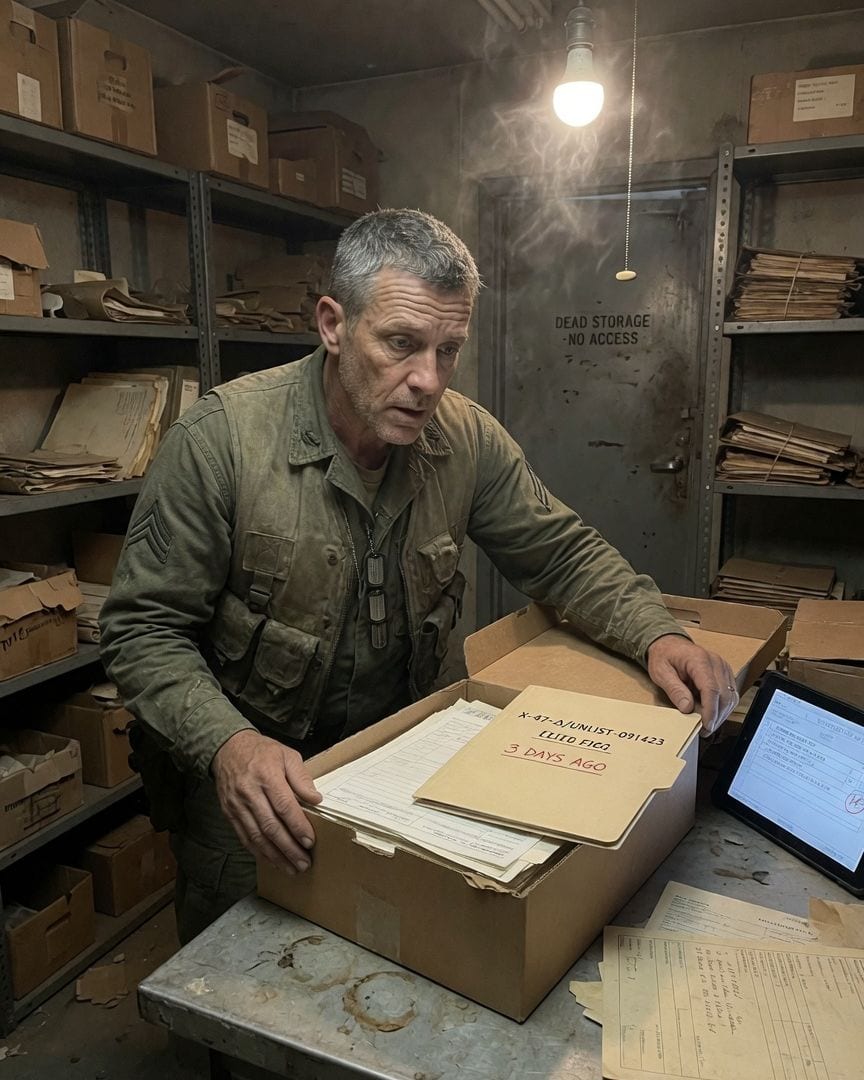
Sergeant Pryor, days from retirement, finds a four-hundred-foot crater. The desert floor is still warm, but no one remembers the blast.
Sergeant Alden Pryor, forty years old and just eleven days from retirement, drove the familiar Ranier Flats fence line for one of his final patrols. The desert stretched out, silent and vast, until he discovered a four-hundred-foot crater, dark and impossibly vast, where the sand had fused into slick glass. The ground within the crater was still faintly warm, a subtle heat defying the cool desert air. Yet, every official log confirmed the blast, while no one recalled a tremor or flash across three states.
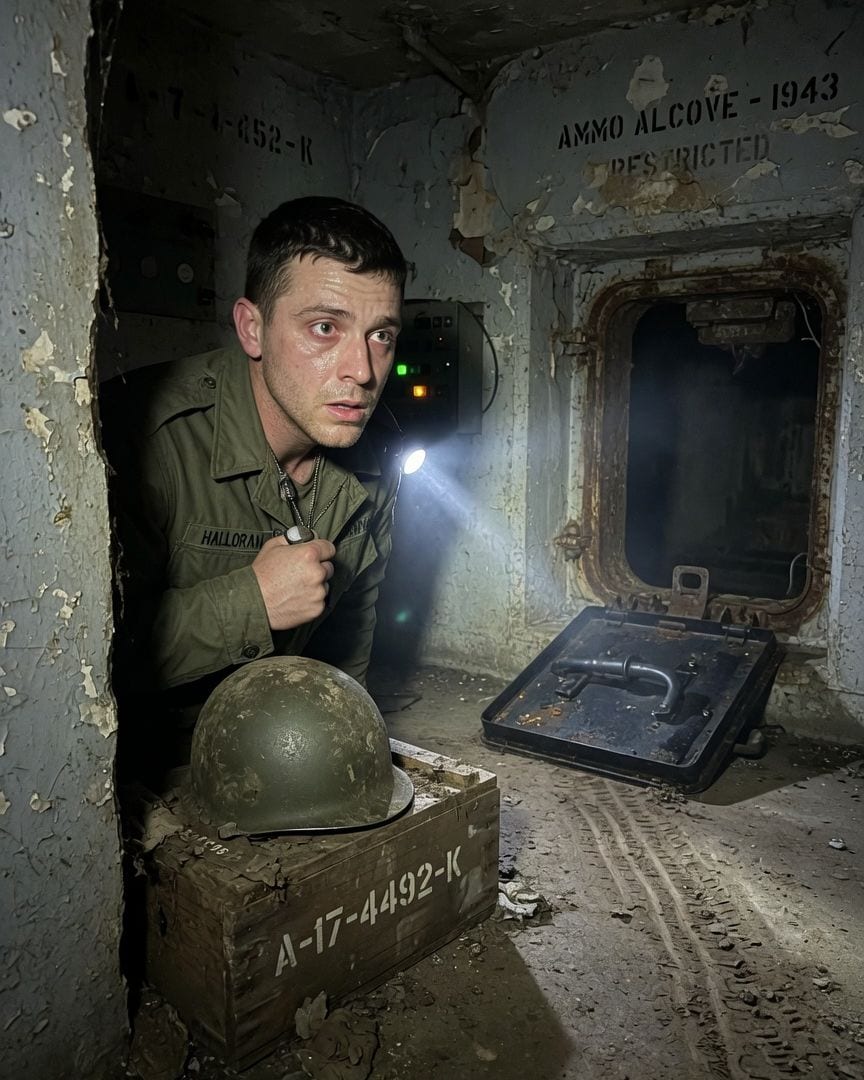
A coastal sentry on his last watch found the bunker's decades-sealed hatch ripped open by impossible strength.
Private Daniel Halloran shivered through his final hours on watch at the old WWII coast-artillery bunker, counting down to his discharge and going home. The pre-dawn fog rolled in thick, and through its swirling white, he watched a landing party form on the beach below, their outdated gear impossibly clean, their forms unmoving. After dawn burned off the mist, the beach was empty, but up the embankment, the bunker's rear hatch—sealed for decades—stood violently ripped open, its locking bar twisted. Inside the dark, silent chambers, Daniel's flashlight found a mud-caked military helmet, unlike any he'd ever seen, bearing a faded serial number that felt sickeningly familiar.
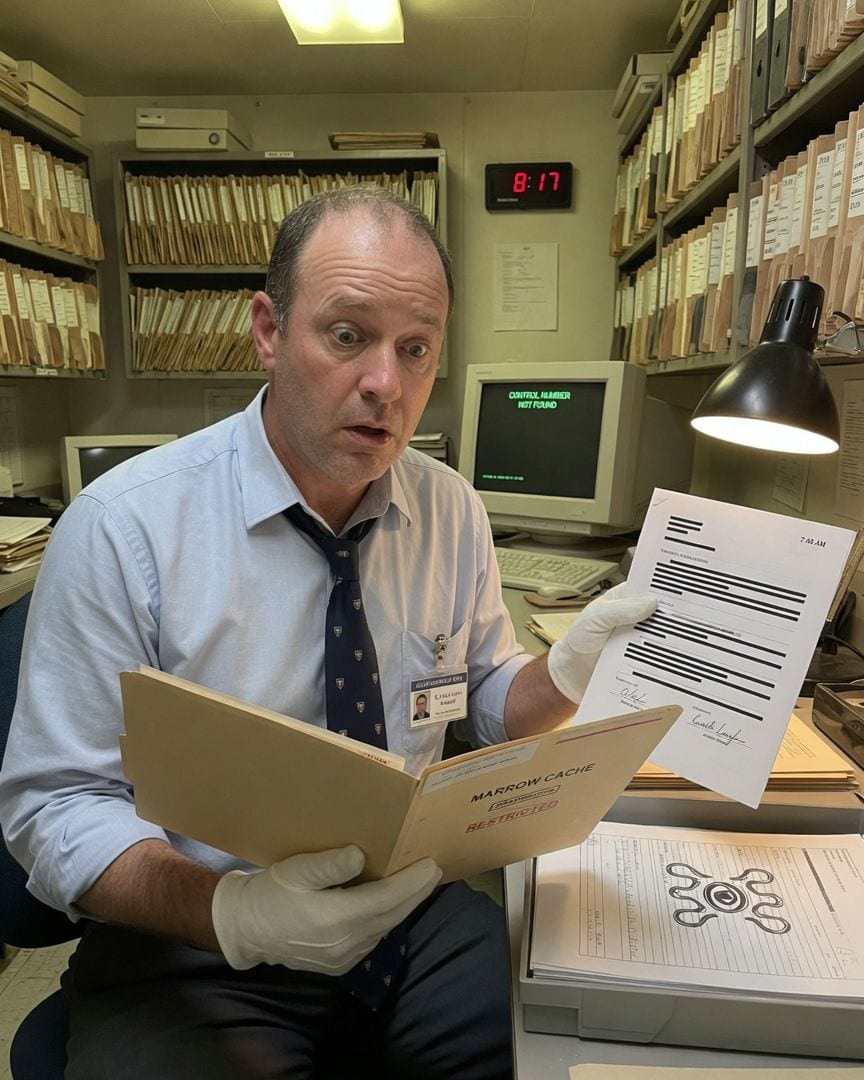
A records manager found a file extension signed at 7:48 AM. He hadn't clocked in yet, and a strange symbol pulsed in its redacted pages.
Corwin Vale, lead records manager for Fort Ruthven, lived by routine, his world precise and ordered. This morning, however, that order shattered when he found the Marrow Cache file's extension signed at 7:48 AM. Corwin had not clocked in until 8:00 AM, and the vault logs showed no other entry. As he reviewed the heavy file, he discovered its control number did not exist in any database. Then, deep within the redacted pages, a strange, geometric symbol pulsed faintly, an alien glyph etched into the classified paper. What impossible secret did the file hold?
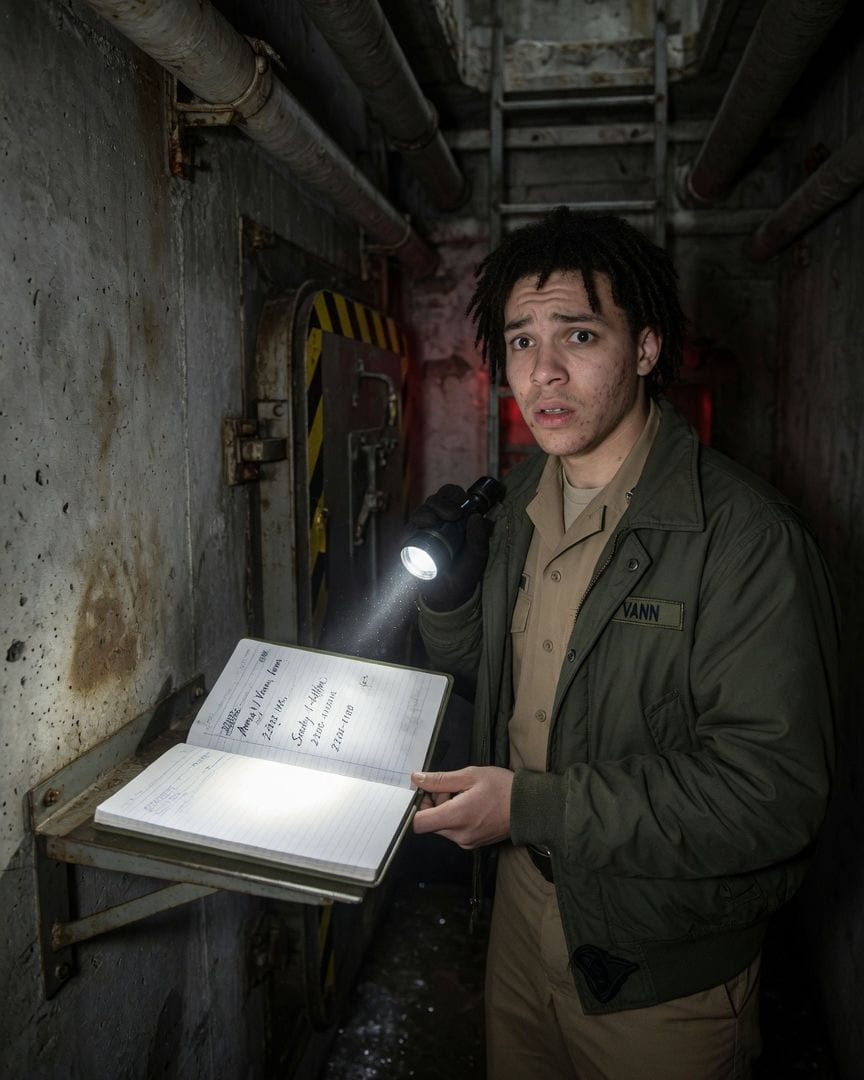
On his last patrol, Airman Vann sees a Cold War silo hatch light up from *inside*—it was welded shut a decade ago.
Airman Vincent Vann was on his last patrol across a vast, desolate Cold War missile field in the Dakotas, the cold, starless sky mirroring the emptiness of the landscape before his transfer. His routine check of eight hardened silo caps was shattered when a red fault light pulsed on Silo 4’s access panel, signaling an impossible breach from *inside* a hatch sealed for a decade. As more silos lit up, ignoring base orders, Vann found the hatch unlocked from within and descended into the dark shaft, where he discovered a pristine logbook bearing his own signature next to a chilling entry from a non-existent sentry, dated for *that very night*. Now, a steady *thump* echoed from deeper within the sealed concrete, leaving the Airman desperate for an explanation that simply wasn't there.
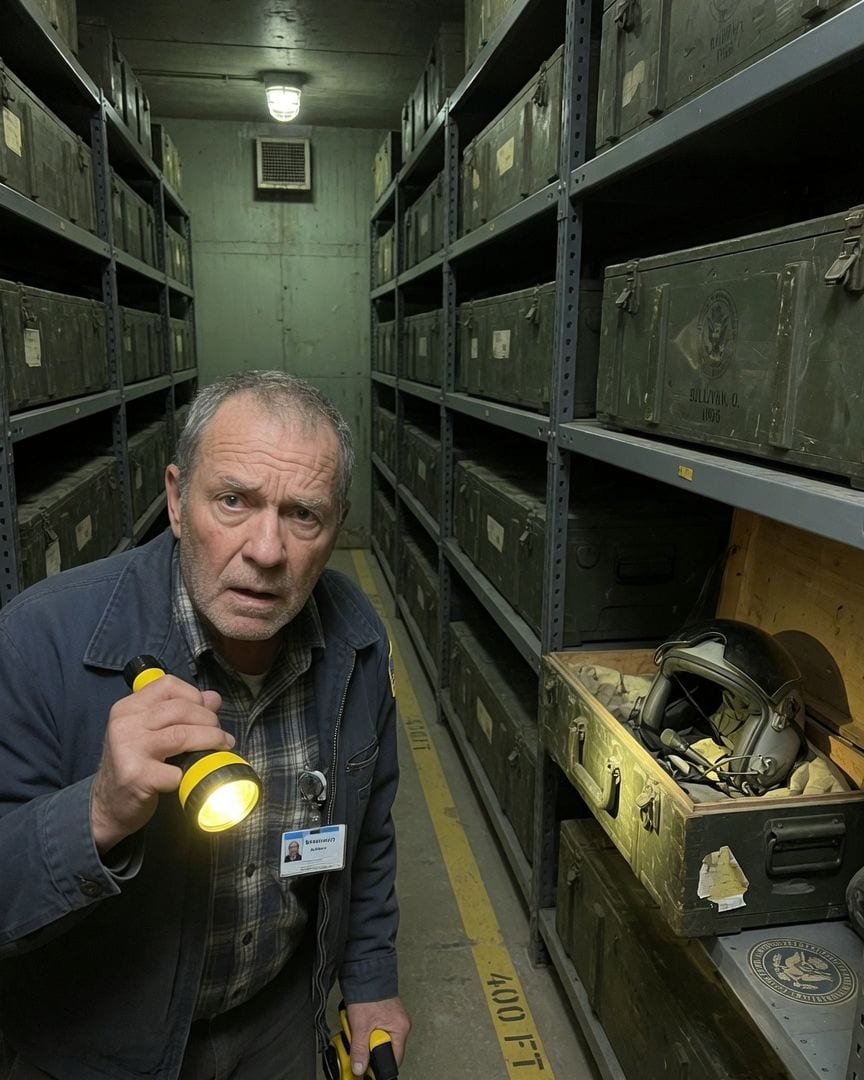
On his last audit before retirement, Barrow Nunnelly’s measuring wheel found a Cold War storage cave 211 feet longer than any map, holding a pilot's helmet named SULLIVAN, O.
Barrow Nunnelly, a sixty-three-year-old auditor, faced his last contract before retirement: an audit of Cheatham Storage Cave 3. The vast, subterranean chamber, humming at a steady fifty-two degrees, was officially four hundred feet long, a fact confirmed by decades-old blueprints. Yet, Barrow’s measuring wheel clicked past four hundred, then five hundred, finally stopping at an impossible six hundred eleven feet. Beyond the charted length, he found older industrial units holding military-grade crates with obsolete federal seals, culminating in a sealed container from 1966 holding a worn flight helmet bearing the name "SULLIVAN, O." The cold silence of the cave now held an impossible, untold story.
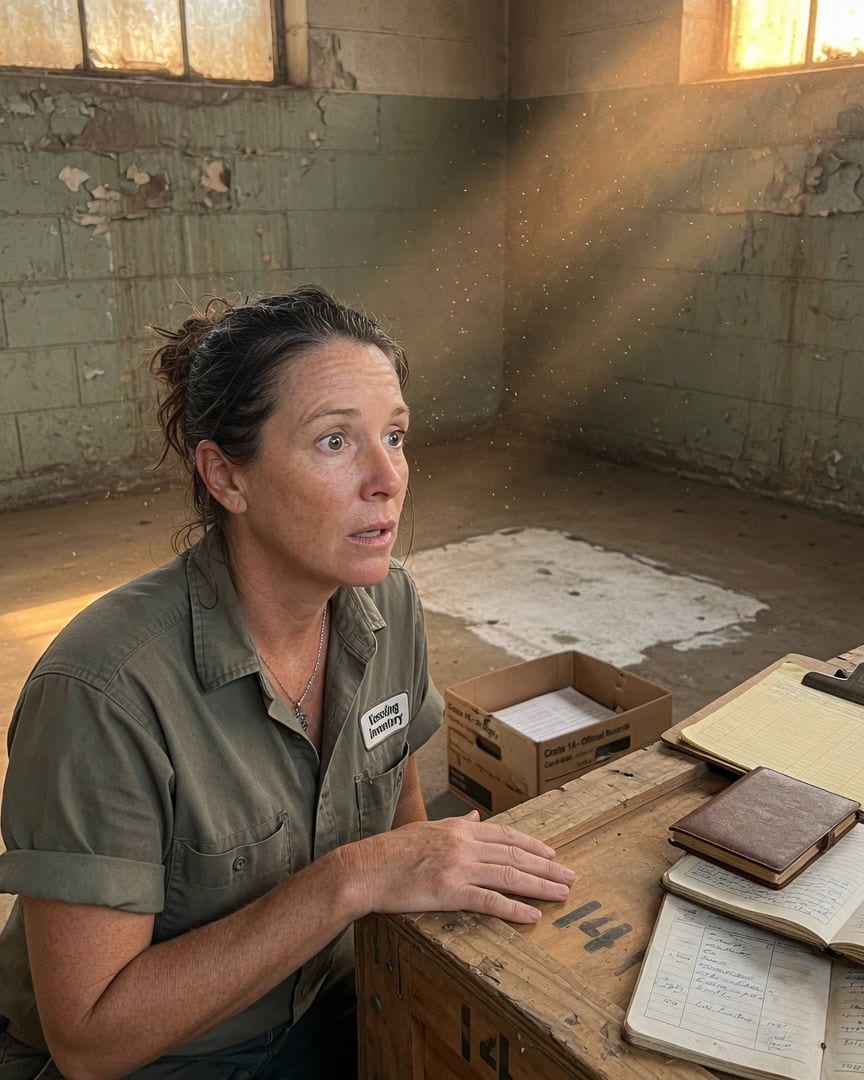
A Cold War base's hidden ledger showed a dead man's signature, dated five years after his death.
With demolition crews just a day away, inventory specialist Deborah Kessling raced through the vast, dusty Carolina warehouse, tasked with logging its final forgotten equipment. In a cold, far corner, she discovered Crate 14, an unremarkable box that inexplicably radiated an absolute, bone-deep chill, having spalled the concrete beneath it for decades. Her research uncovered an official logbook detailing quarterly signatures for sixty years, unbroken by base closures or disasters, but a hidden ledger revealed an entry from 1980 signed by Lars Thornton, a logistics officer confirmed dead since 1975. As Deborah read the dead man's words describing 'a faint, rhythmic pulse,' a subtle thrum began to vibrate through the floor beneath her feet. What was Crate 14 protecting?