A Marine's disconnected field phone rang at midnight, asking for a password. A 1944 logbook confirmed the exact words, from a soldier marked MIA.
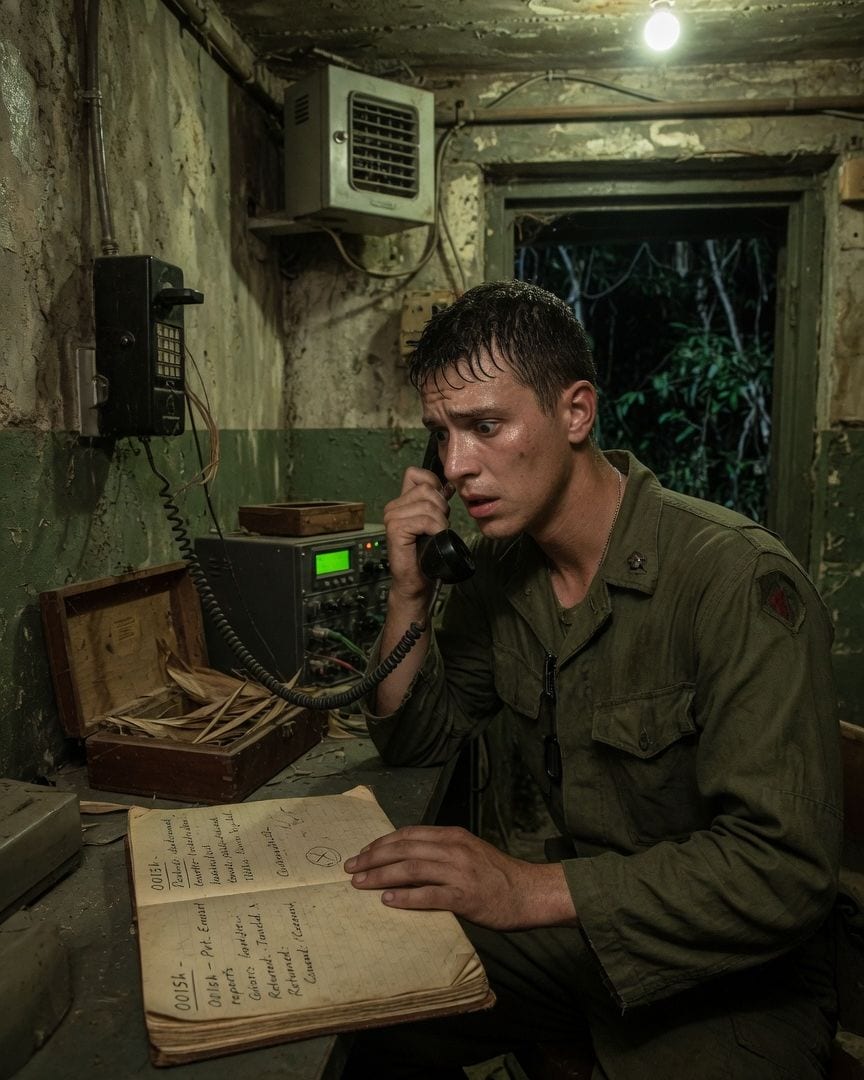
Lance Corporal George Beir sat hunched over the modern radio console in the firebase’s Command Operations Center, a bunker carved into an old WWII emplacement. The Pacific jungle pressed an inky black against the coral and concrete walls outside.
It was midnight, his last watch before his rotation home in a few weeks. The air was thick with the scent of damp earth and stale concrete.
On a shelf beside him, an antique field phone from the dead wartime switchboard sat, a forgotten relic. It was disconnected, its wires cut decades ago, left in place for atmosphere.
Then it rang.
A sharp, insistent BRRRING tore through the humid quiet. Beir, startled into reflex, snatched the handset. A young voice, calm and clear despite the faint, distant sound of shelling behind it, reported, "Beach position holding, sir.
Requesting current password to pass a returning patrol through the wire."
Beir, disoriented, stammered out the modern challenge, "Ironclad."
The voice paused. "Negative, sir. Countersign is Coconut." A polite, patient correction. "Thank you, sir. We’ll be coming in shortly."
The line clicked dead. Beir slowly lowered the handset, his heart hammering against his ribs. The phone sat silently now, a dead thing, but he could still feel the phantom vibration of its ring.
The next morning, Beir reported the incident to Sergeant Marco Foster. Foster, a man whose skepticism was as thick as his mustache, just grunted, "Rough night, Beir? Jungle fever acting up?"
He dismissed it as fatigue, a vivid dream, or a prank by a bored junior Marine. But Beir knew what he’d heard. He knew the difference between a dream and the cold reality of a ringing phone.
Unable to shake the uncanny encounter, he returned to the COC during his off-hours. The phone sat in the same spot, inert. He examined it again, tracing the cut wires. There was no power, no connection to any network.
It was truly dead, a hollow shell of communication. His rational mind struggled to reconcile the physical evidence with his auditory memory. The quiet hum of the modern ventilation system was the only sound in the bunker.
He checked the wall behind the shelf, ran his hand along the concrete, looking for any hidden wiring, any trick. Nothing.
As he knelt, his fingers brushed against a dusty, wooden box tucked behind the shelf, almost hidden by a stack of old supply manifests. He pulled it out, coughing at the puff of fine gray dust it stirred up.
Inside, nestled amongst dried leaves and cobwebs, was a heavy, leather-bound logbook, its pages yellowed and brittle. The cover bore faded, hand-stamped letters: 'Firebase Kilo, Patrol Log – Aug 1944.' Beir’s breath hitched.
He carefully opened the book. The handwriting inside was spidery, faded ink. He turned pages until he found an entry dated August 14, 1944. It read: '0015h – Pvt. Everett Lockwood reports beach position holding. Requests password for patrol.
Given: Ironclad. Returned: Coconut. Awaiting clearance to pass through wire.'
Beir’s blood ran cold. The exact words. The exact countersign. He found a name: Private Everett Lockwood.
Beir’s finger traced Lockwood’s name, the ink feeling like raised scars on the page.
His gaze dropped to a small, hand-drawn symbol next to the entry: a circle with a cross through it, a common military mark for a casualty or MIA. His stomach clenched. He carefully turned the page.
The next entry, dated later on August 14th, but in different handwriting, read: '0400h – Lockwood, E. - Failed to report. Patrol still outstanding. Perimeter sweep unsuccessful.' Beir froze, the words burning into his vision. Lockwood never made it in.
He was still out there, still 'awaiting clearance.' And he had just told Beir, across seventy-odd years, that he would be coming in shortly. Beir felt a profound, chilling dread, the kind that settled deep in the bones.
Beir, now thoroughly shaken, knew he couldn’t drop it. The logbook was concrete proof, undeniable. Sergeant Foster could dismiss his words, but the faded ink didn't lie.
He approached PFC Florence Delaney, the sharp, perpetually overworked records clerk, with a carefully worded request.
"Florence, I need to cross-reference some old manifests. Specifically, 1944, around August 14th, and then any anomalies in personnel counts for this firebase, going back as far as you can.
Look for discrepancies: plus one, minus one, anything that doesn't add up." He tried to sound casual, like it was just a tedious administrative task.
Florence, initially amused by his "history project" – "Getting nostalgic for the good old days, Beir?" – soon grew quiet as the data piled up.
Her fingers flew across the keyboard, pulling up digital scans of handwritten ledgers, then squinting at microfiche records for the older entries.
She found multiple 'plus one' and 'minus one' discrepancies in the patrol rosters around August 1944 – entries for soldiers who either appeared out of nowhere or vanished without a trace, only to have their records later 'corrected' with a new name, or simply disappear from the logs entirely.
The name 'Lockwood, Everett' recurred, sometimes listed as 'Missing,' other times as 'Patrol Outstanding,' and once, bizarrely, as 'Reconciled – See Attached.' There was never an attached document.
Florence’s brow furrowed, a frown deepening the lines between her eyes. She pulled her hair back from her face with an exasperated sigh. "This isn't just bad bookkeeping, Beir. This is… a pattern.
Like someone's trying to force the numbers to fit, but they never quite do. Like they're chasing a ghost that leaves a paper trail."
The unease was no longer Beir’s alone; it was spreading, infecting the meticulous world of military records, a stain on the otherwise sterile data.
As Beir delved deeper, he started noticing subtle shifts in his surroundings.
The disconnected field phone, despite having no power, often felt faintly warm to the touch when he passed it, a residual heat that quickly faded when he paused to investigate.
It was a warmth that felt like a recent usage, not just the ambient temperature of the bunker.
Late at night, during his watches, he’d hear faint, metallic clinks and shouts, not the usual jungle sounds, but echoes of something older, harsher.
He’d dismiss them as his imagination, the tricks of a tired mind, but the sounds were distinct: the clang of an old rifle stock, a distant, guttural cry that seemed to rip through the damp concrete walls themselves.
The very air in the COC sometimes seemed to thicken, heavy with an almost electrical charge that raised the hairs on his arms.
Then, Sergeant Foster pulled him aside one afternoon, his voice low and serious, far from the usual gruffness. He led Beir to a secluded corner of the mess hall, away from the usual chatter.
"Beir, I heard you're still digging into those old ghosts. Florence mentioned you're pulling every manifest from the archives. Listen to me, son. There are things best left buried on this rock. This isn't a history class. Drop it."
Foster’s eyes held a strange, knowing glint, a mix of warning and resignation. It wasn't anger, but a tired, almost pitying look. The sergeant looked like a man who’d seen too much, and carried the weight of it.
Beir realized his investigation hadn't gone unnoticed. Someone knew exactly what he was looking for, and they weren't happy about it.
The unease sharpened into a cold certainty: he wasn't just investigating; he was being watched, observed by someone who understood the true nature of the firebase's secrets. The feeling was not unlike being prey.
Beir confronted Foster, the ancient, leather-bound logbook clutched in his hand. He slapped it lightly against his thigh for emphasis. "Sergeant, this isn't a ghost story. This is real. Lockwood never came in.
And there are other names, other discrepancies, 'plus ones' and 'minus ones' that Florence found. What do you know? You seem to know something."
Foster sighed, running a hand over his face. He looked out the window of his office, his gaze fixed on the dense jungle. "Damn it, Beir. I told you to drop it. This isn't your problem."
But Beir stood his ground, disciplined but unyielding, his voice tight. "It's my problem if it's still happening, Sergeant. If it's real, it affects every one of us."
Foster finally relented, his shoulders slumping. He turned from the window and led Beir to a locked filing cabinet in his office, its metal groaning as he pulled it open.
He rummaged inside, past rows of neatly labeled folders, and pulled out a faded, unofficial report, its cover brittle with age and taped along the spine. "This isn't official. It's… a unit legend.
Something passed down, but never put in the books. They tried to bury it, but some things… some things just won't stay buried."
He handed Beir the document. The report, dated 1978, detailed an incident strikingly similar to Beir's. A young sentry, a Corporal Richard Norwood, had reported a 'plus one' on a perimeter check, a soldier in vintage gear, looking lost.
Norwood, like Beir, had started digging, obsessed with the discrepancy, unable to reconcile the sudden appearance. The report ended abruptly, stating Norwood himself went missing a week later, his gear found neatly folded in his bunk.
A handwritten note scrawled on the margin, in what looked like Foster’s own hand, read: 'The system always corrects itself. The numbers always reconcile. Eventually.'
Foster looked at Beir, his eyes grim, dark with a shared understanding. "They weren't ghosts, Beir. They were… echoes. Bleed-throughs from a time that's still clinging to this rock. And the 'system' doesn't tolerate an imbalance.
Norwood went looking for the plus one, and then he became the plus one. His name showed up on an old roster, filling a gap. The count always balances out, one way or another."
The implication hung heavy in the air, a suffocating weight: the missing modern soldier didn't just vanish; they became the historical 'plus one,' filling the void left by a long-lost patrol member.
The terror of the 'count that won't reconcile' was that it would always find a way to reconcile itself, by drawing from the present. The air in the office felt suddenly thin, hard to breathe.
Beir stared at the faded report, then back at the open 1944 logbook, the words 'Lockwood, E. - Failed to report. Patrol still outstanding' seeming to glow with an unholy light. Foster’s words, 'The system always corrects itself.
The numbers always reconcile,' echoed in his mind, louder than any distant shelling.
He flipped further into the old logbook, past the entries detailing the end of the war, past the post-war cleanup, further and further. The paper felt different, thicker, even as it remained brittle.
He saw a page with entries in a different, more modern hand, dated just a few years prior to the present.
It was a recent patrol log, but it was bound inexplicably into the ancient book, as if the book itself had simply absorbed a new entry. His eyes scanned the names, the dates, the notes.
And there, scrawled next to a 'plus one' entry, an impossible anomaly on a modern patrol, was a name that made his blood run cold.
Not 'George Beir,' but 'Beir, G.' – exactly as his own military ID would list him. It was a name he knew intimately, a name that could only be his. The pattern wasn't just about others; it was about him.
He was already a part of it, written into the ledger, waiting to reconcile the count. He was the next one destined to fill the void.
The realization detonated in Beir’s mind, every scattered clue snapping into a horrifying, coherent shape. The 'echoes' weren't just random historical bleed-throughs; they were the active mechanism of the firebase itself.
This place, this ancient emplacement, was a temporal anchor, a constant point of imbalance where the missing of 1944 perpetually sought to return, and the present was perpetually drawn in to fill their absence. The 'young voice' of Pvt.
Everett Lockwood wasn't a ghost; he was a persistent, trapped signal, still trying to report in, still waiting for the 'clearance' that would allow him to pass through the wire.
The 'system' Foster spoke of was the relentless, cyclical nature of the anomaly, ensuring that every 'minus one' from the past was eventually balanced by a 'plus one' from the future.
Beir now understood the distant shelling he'd heard on the phone: it was real, a skirmish from 1944, and he was being prepared to join it.
His name, 'Beir, G.,' in that old log wasn't a premonition; it was an active requisition, a vacancy waiting to be filled.
He wasn't just investigating a mystery; he was the solution to a historical deficit, a replacement soldier for a patrol that never returned.
The dread was absolute: the firebase was a maw, and he was already caught in its teeth, destined to reconcile a count that wasn't his.
Beir knew he had to escape. His rotation transport was due in a few hours, his last chance before the count could claim him.
Armed with his service rifle, his hand shaking, he moved through the dark, jungle-choked paths towards the landing strip.
The air grew heavy, humid, thick with a smell he now recognized: old cordite, wet earth, and something metallic, like stale bl**d. The usual chirping of insects was subdued, replaced by an unnatural stillness.
The faint sounds he’d heard before were no longer distant. He heard the distinct crack of an M1 Garand rifle, sharp and clear.
He heard the shouts of men, their voices strained, and the jingle of old equipment, the familiar sound of a canteen against a webbing belt.
Faint, flickering lights danced through the trees – not modern floodlights, but the jittery, yellow beams of old flashlights, casting long, shifting shadows that seemed to stretch and writhe.
He knew it was Lockwood’s patrol, no longer just 'coming in shortly,' but actively converging on his position, their ghostly presence solidifying around him. The jungle itself felt like it was closing in, breathing the past.
He broke through the jungle canopy, scrambling onto the gravel of the landing strip, his boots sliding on the loose stones.
The transport helicopter was already there, a dark, hulking shape against the faint pre-dawn sky, engines spooling up, its rotor blades beginning to turn with a rising thrum.
He ran, desperate, towards the open ramp, the wind from the rotors buffeting him. As he glanced back, at the edge of the jungle where the tree line met the strip, a silhouette stood watching him.
It was too dark to make out features, but the shape was unmistakable: a soldier in a WWII-era helmet, rifle slung, waiting. Beir didn’t hesitate.
He sprinted, throwing himself up the ramp just as it began to rise, the figure at the jungle's edge still watching, unmoving, as the helicopter lifted into the night sky, leaving the island and its hungry history behind.
Beir made it onto the transport, gasping for breath, his heart threatening to burst from his chest. He pressed his face against the window, watching the dark mass of the firebase recede below, slowly shrinking into a distant, malevolent shadow.
The figure at the jungle's edge was gone, absorbed back into the trees. He never looked back, never served another day in uniform.
His discharge papers cited 'stress-related incidents,' a convenient and unquestioned explanation for his sudden, profound inability to function in the military. He never spoke of what he saw, what he knew. How could he?
The firebase was eventually decommissioned, its secrets left to the encroaching jungle and the relentless Pacific tides, a place erased from modern maps but not from memory.
Years later, George Beir lived a quiet life in a small town, far from any ocean. He built a fence, planted a garden, and tried to forget.
He tried not to think about the humid air, the smell of cordite, or the distant shelling. He often found himself checking the locks on his doors, even in the middle of a peaceful afternoon.
But sometimes, late at night, when the phone rang, he would hesitate, a cold knot forming in his stomach, a phantom vibration echoing in his hand. He remembered the voice, the countersign, and the entry in the logbook.
He knew the count always reconciled. And sometimes, he still wondered if somewhere, on a forgotten island, a disconnected field phone still rang, and a young Marine on watch answered, preparing to join a patrol that was eternally outstanding.
The old logbook, recovered from the abandoned firebase years after its decommissioning, was marked with a single, handwritten note on the final page, beneath the last dated entry: 'Beir, G. - Patrol still outstanding.'
If this one got to you
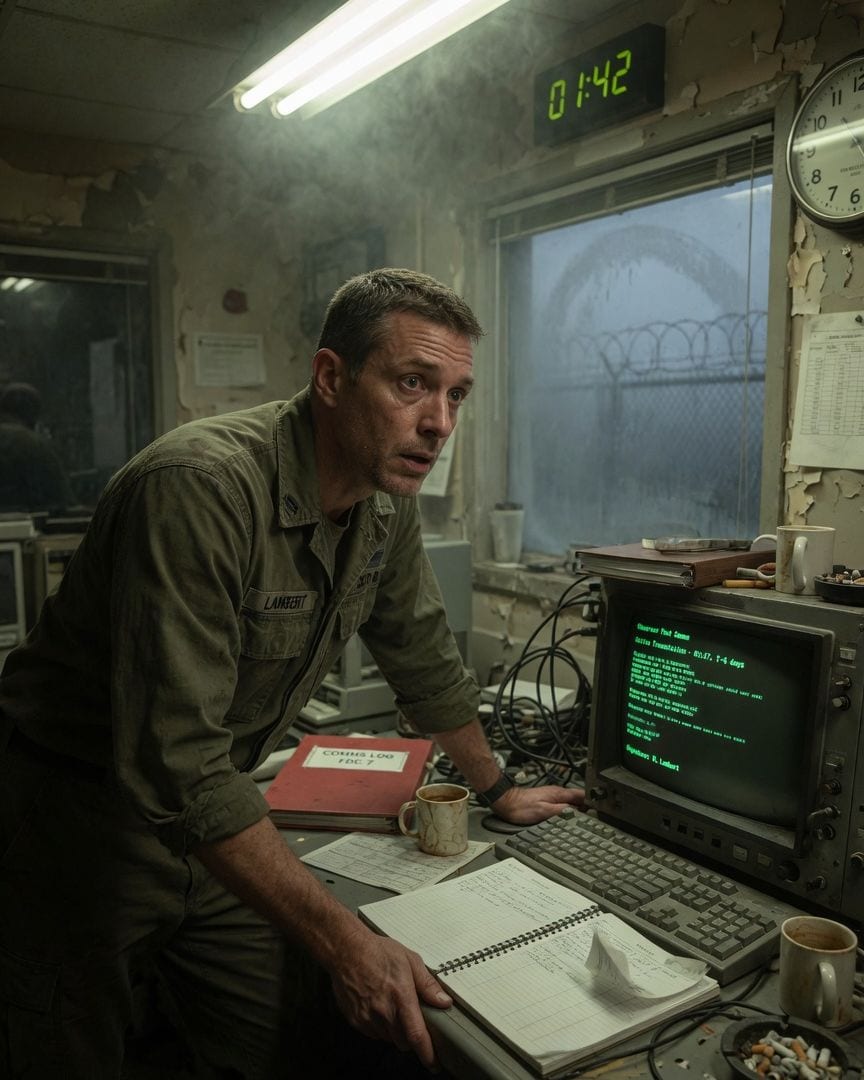
With Firebase 7 days from demolition, a dispatch specialist found his own signature on a log entry from a lost outpost. Then, a dead soldier's name appeared.
Specialist Robert Lambert hunched over the radio console in Firebase 7, the mountain fog pressing in as the base counted down its final days before demolition. His quiet shift shattered when urgent calls began arriving from outposts officially declared silent a week ago. His sergeant calmly informed him that he’d been speaking to no one, as all comms with those posts had been lost for hours. Later, Robert found a log entry for an active transmission, dated days after a post went dark, bearing his own signature. What chilling truth lay beneath the paper, revealing a dead soldier's name reporting from the grave?
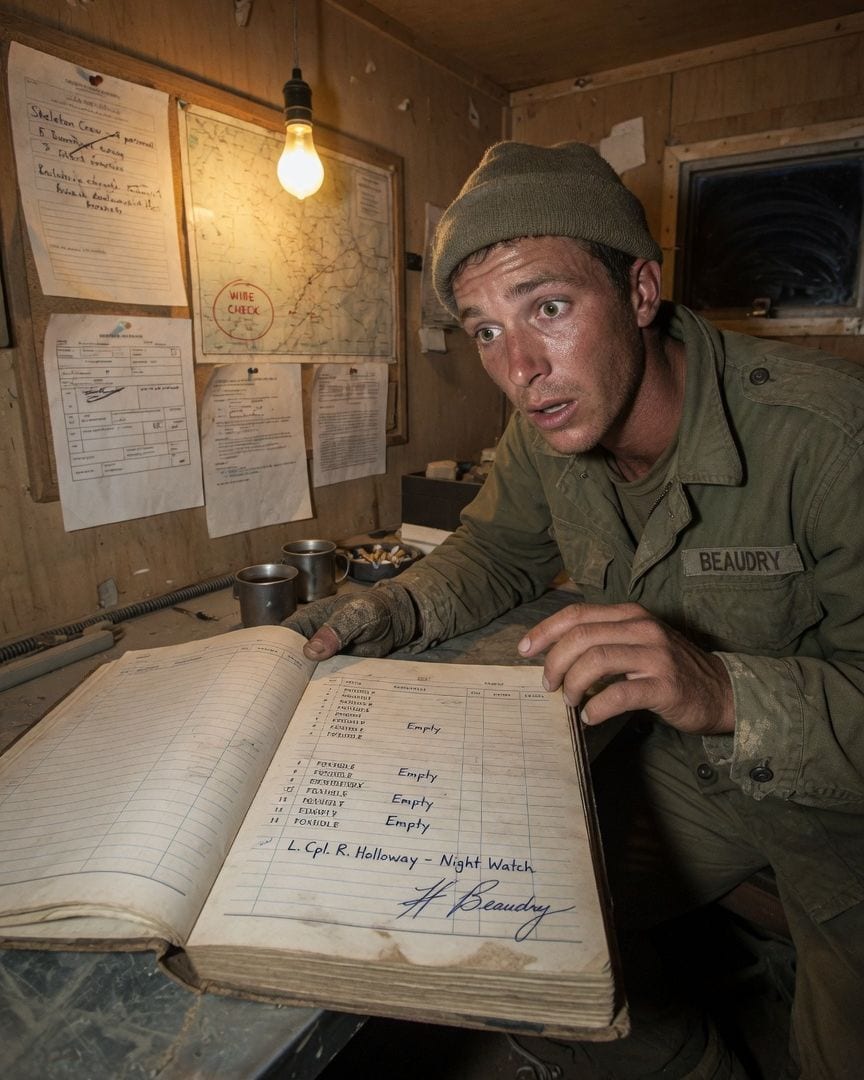
Lance Corporal Beaudry checks the perimeter's empty foxhole. The comm wire pulls back: a signal from no one.
Lance Corporal Hugo Beaudry moved along the perimeter of Firebase Kettle, a lonely outpost in its final drawdown. His solitary wire-check tonight was a routine task in the biting desert wind. He reached the third foxhole, empty for a week, and tugged its comm wire. Two distinct pulls answered back, sharp and unmistakable, from a position where no one remained. Back inside, Beaudry found his own precise signature in the duty log, assigning a Lance Corporal R. Holloway to that very foxhole – a man he'd never seen or heard of. The entry was perfectly aged, a cold dread of paper lying. Who was signalling from the empty hole, and why did his own hand confirm it?
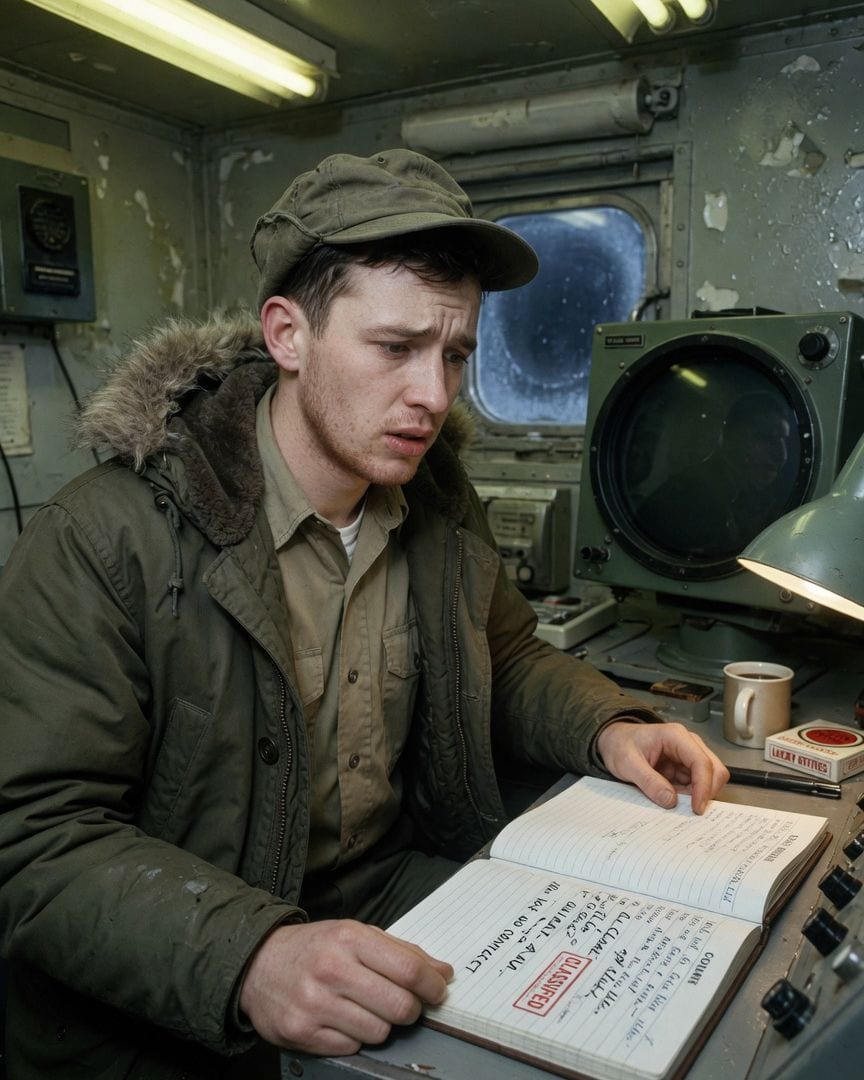
A Cold War airman logs an impossible radar contact on his last sweep. But his official logbook entry is stamped 'CLASSIFIED' and then contradicted by a hastily scrawled 'ALL CLEAR' dated moments before it.
Airman Ordway Vance, 22, manned the radar dome at Site Pellin in the biting North Atlantic dark of January 1962, running the last calibration sweep before its decommissioning. His scope picked up a faint, impossible return, growing closer with each pass, though the ocean remained empty to the eye. When Vance detailed the contact in his official logbook, a 'CLASSIFIED' stamp appeared, followed by a hastily scrawled 'ALL CLEAR' dated moments before his own entry, contradicting his every word. Commander Hartley dismissed it as equipment malfunction, but Vance sensed a chilling, official erasure behind the lie. He soon found a locked cabinet marked 'SITE PELLIN ANOMALIES,' hinting at a deeper truth buried within the base's final days.
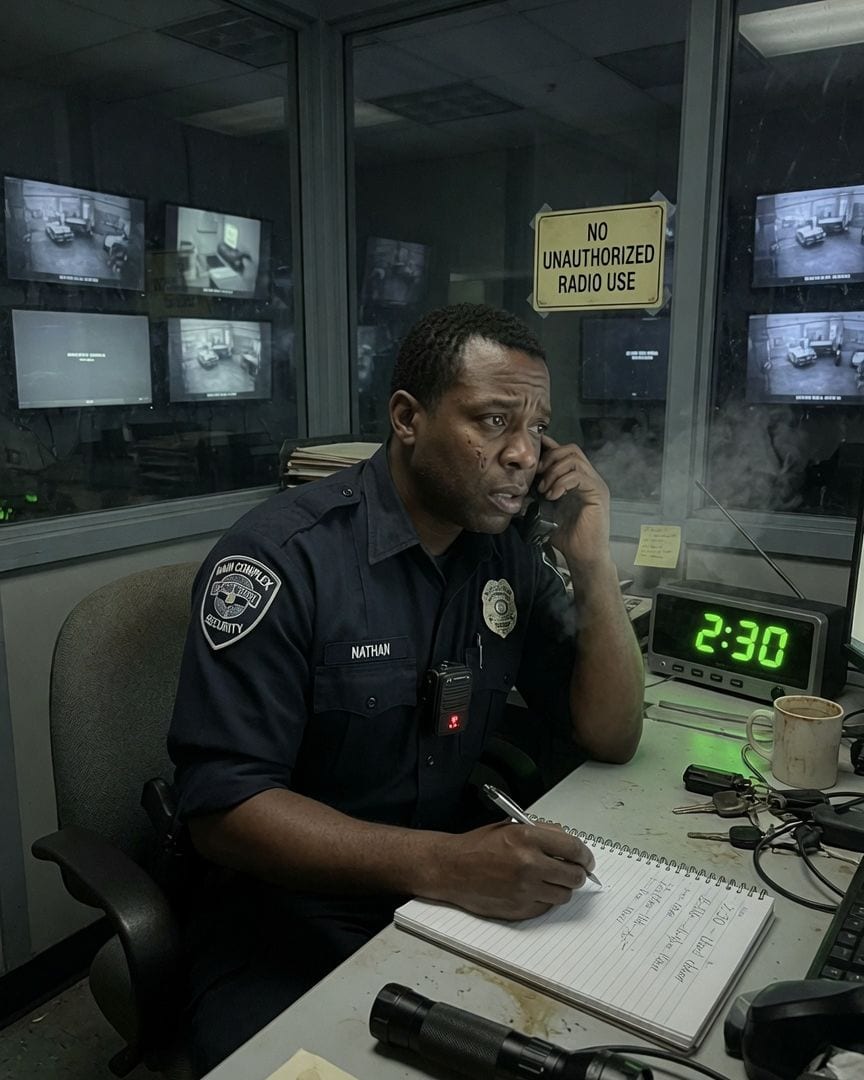
I radio Cole every night. My supervisor says his dock post was cut two years ago, and no Cole exists. But I just found Cole’s old logbook.
My graveyard shift usually consists of monotonous hourly check-ins with Cole, the guard at the loading dock. But my supervisor just revealed that the dock post was cut two years ago, and no one named Cole has ever worked for the company. I've been talking to someone who simply isn't there.
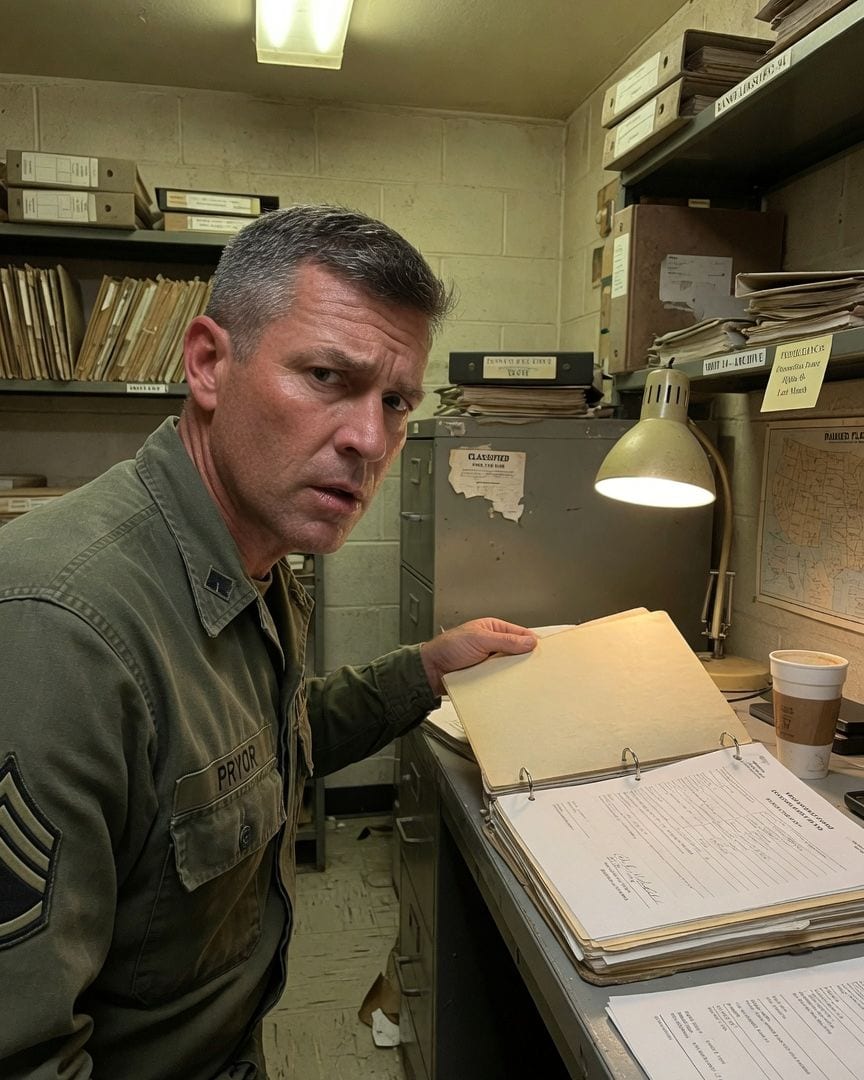
A sergeant with eleven days left finds a warm, glassed crater. Its file shows a captain lost thirty years ago is still signing reports from last week.
Sergeant Alden Pryor was counting down his final eleven days on a twenty-year hitch, expecting to spend them on routine patrols along the Ranier Flats fence line. Instead, his truck stopped at a bizarre sight: a four-hundred-foot glassed crater, miles from anywhere, its sand faintly warm at dawn despite no one recalling a blast. The air above it shimmered with an unnatural distortion, a silent scar of erased violence, and the official file for 'Shot 14' showed recent maintenance sign-offs for a decommissioned tower at the crater site. All these active documents were signed by Captain Everett Caldwell, who had been officially lost in operations thirty years ago, leaving Sergeant Pryor to wonder how a dead man could still be filing reports.
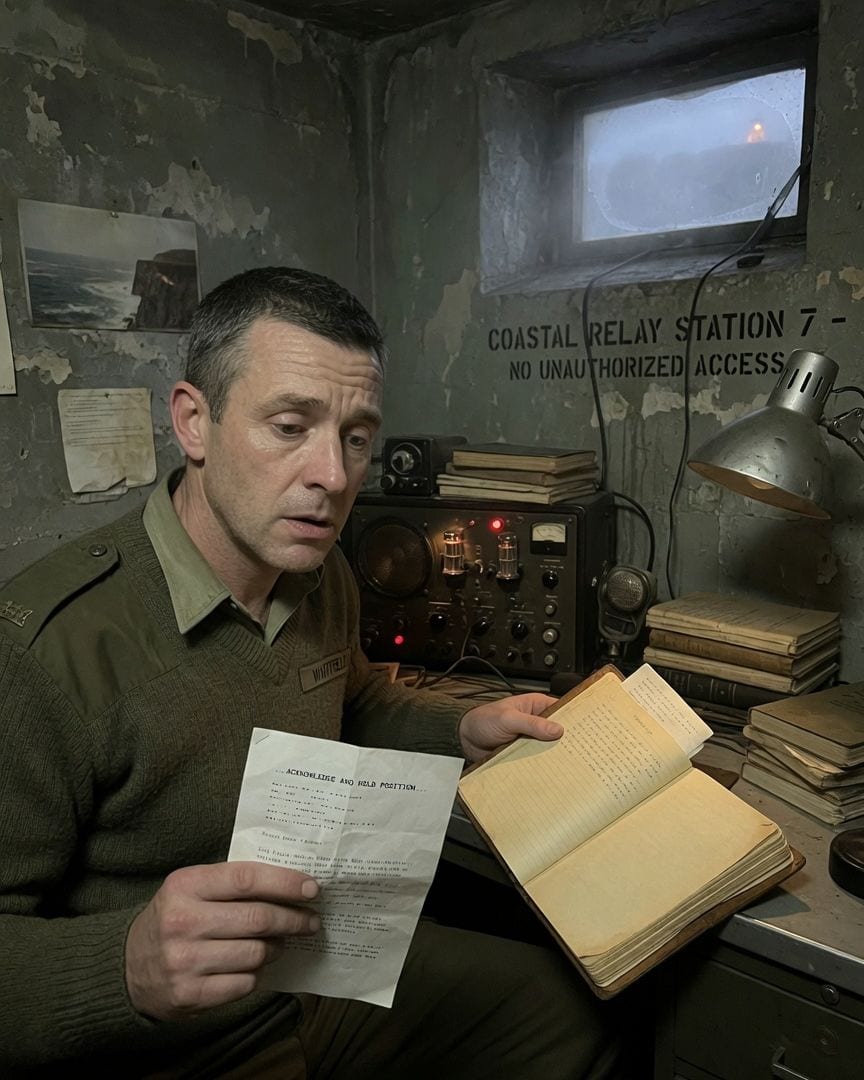
A corporal on his last watch decoded a Morse order for his station. It was sent forty years ago, for *this* very night.
Corporal Greg Whitfield stood watch on one of the final nights before his old coastal relay station was mothballed. The fog-bound English coast echoed with the lonely boom of the sea, the bunker's ancient equipment humming its last familiar tune. Suddenly, a burst of Morse code cut through the static on a long-dead frequency, an impossible convoy sighting for a shipping lane closed for forty years. Decrypted, the message named his exact station and tonight's date, instructing the operator to acknowledge and hold position, no matter what. Later, a dusty archive revealed a logbook entry from precisely forty years ago, recording the same message, acknowledged by a Private Barlow, followed by a chilling blank page. What happened to the last operator who acknowledged a forty-year-old ghost order?