A Master-at-Arms on the storm-tossed USS Borealis counted his crew, but one man too many reported. He found the extra Cold War sailor making his bed, a man lost at sea decades ago.
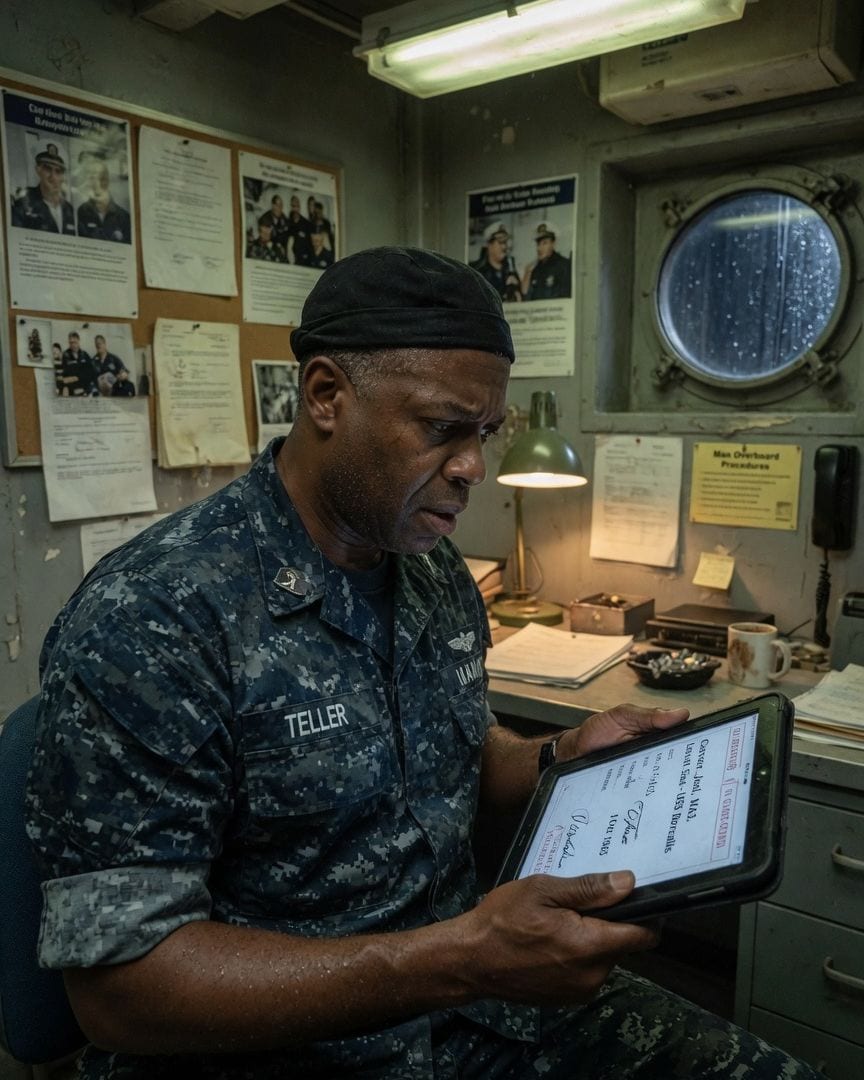
The cruiser USS Borealis pitched hard in heavy seas, a grinding shudder that resonated through her aged hull.
Master-at-Arms First Class Desmond Teller braced against a bulkhead in the Main Passageway, the scent of ozone and brine thick in the air.
He barked orders over the intercom, his voice cutting through the ship's groans and the howl of the storm outside. A rogue wave, taller than the mast, had swept the weather deck, and protocol demanded an immediate man-overboard muster.
Divisions formed in the driving spray, soaked to the bone, their faces grim under the emergency lights. One by one, they reported their numbers. Every division came back "all hands present."
Yet, when Teller tallied the final count against the ship's manifest, the total was one over the number signed aboard. He swore, rubbing his eyes, the fatigue of the long watch tightening his jaw. "Again!"
he ordered, "Full muster at quarters, by name!"
The second muster was meticulous, deliberate. Every billet was called, every name answered, every man accounted for. Teller walked the lines himself, his flashlight beam sweeping across faces.
The light caught the badge of an MA3 in Supply Division, a fresh-faced sailor he didn't immediately recognize. Teller paused, checked the list in his hand, then moved on. The numbers came back, division by division, exactly as before.
And still, standing silently in the ranks of Supply Division, was one man too many. The MA3, the one Teller had seen, stood with no billet, no gap in the line that should have existed for an extra man.
His uniform was regulation, his face grim, his gaze fixed on some distant horizon, as if already dismissed.
Teller immediately flagged the anomaly to Commander Josephine Abbott, the Executive Officer, a no-nonsense officer who ran the ship with the precision of a German clock.
She blamed a sensor malfunction, a clerical error in the digital manifest, or perhaps a sleep-deprived MA1. "Run it again, MA1," she ordered, her voice clipped, "and double-check the berthing assignments. We are not carrying a phantom crewman, Teller."
Teller spent the next three hours in a meticulous, physical sweep, going bunk by bunk through the berthing compartments, comparing faces to the photos on the digital manifest he held on his tablet.
He found the extra man in Berthing 3, quietly making his rack, folding a gray wool blanket with practiced, deliberate motions.
The man had no ID card displayed, no name tag on his uniform, just the MA3 rating sewn into his sleeve. When Teller asked his name, the sailor replied, his voice calm, "Carver. Joel Carver, MA3."
Teller nodded slowly, his fingers already flying across the screen of his tablet. He checked the current manifest again. No Joel Carver. He checked the pending transfer list, the sick bay roster, the disciplinary log. Nothing.
The man was solid, spoke clearly, and moved with purpose, but he simply didn't exist on paper. Teller tried to find his service record, his entry date, anything at all that would reconcile his presence.
The system, designed for absolute accountability, returned only blanks for Joel Carver, a ghost in the machine who could fold a blanket and respond to a question.
The air in the berthing felt unnaturally still, the quiet hum of the ship's ventilation like a held breath.
Frustrated, a cold knot forming in his stomach, Teller retreated to his office, the digital manifest still open on his screen. He pulled up the ship's historical records, searching for any "Carver, Joel" associated with the USS Borealis.
He scrolled through decades of manifests, transfer orders, incident reports. He clicked filters, expanding his search radius. The ship’s fans whirred, sounding suddenly louder in the silence of his small office.
His finger froze on a digital entry from 1983, a faded scan of a handwritten log. "Carver, Joel. MA3. Lost at Sea - USS Borealis." The date, the rank, the ship, the name – it all matched.
Teller's blood ran cold. He stared at the name 'Carver, Joel' in the faded, official 'Lost at Sea' registry from 1983, then back at the ship's current digital manifest, which clearly showed no such name.
Yet, the man with Carver's face was standing in the berthing compartment, humming softly as he folded a blanket on a bunk that should be empty.
Teller, profoundly shaken, approached his superior, Chief Master-at-Arms William Prescott, a grizzled veteran close to retirement who often seemed to have seen too much.
Prescott listened to Teller's account of Joel Carver, his face impassive, his eyes tracking the younger MA1's every gesture. He slowly nodded. "I've heard stories, Teller," Prescott admitted, his voice a low rasp. "Things that don't make the official logs.
Things that get... filed away." He advised Teller to observe Carver, to see if he settled into a routine, to see if the 'glitch' resolved itself. Teller did.
Joel Carver performed his duties with quiet efficiency, always assigned to the Supply Division, always seeming to be exactly where he was needed, yet never officially assigned.
He spoke only when spoken to, his eyes often distant, as if seeing through the present moment, observing something beyond the bulkhead.
Teller noted subtle anachronisms: Carver's uniform, while seemingly standard issue, had stitching details and a slightly different cut that predated current regulations by decades. The fabric felt heavier, the colors just a shade off.
He also noticed Carver always gravitated towards the same, usually empty, bunk in Berthing 3, keeping it meticulously made, even when other bunks were available. It was always spotless, the blanket pulled taut, an unspoken claim.
Teller began to document everything in his personal logbook, cross-referencing Carver's movements with duty rosters, finding him consistently filling a gap that shouldn't exist, a phantom crewman holding up his end of the bargain.
He even found a faded, analog photo in the ship's archives, a crew portrait from the early 80s, and there, unmistakable, was Joel Carver's face, younger, but undeniably him.
Teller's intense scrutiny of Carver did not go unnoticed. One evening, as Teller reviewed security camera footage of Carver moving through a deserted passageway, the XO, Commander Abbott, appeared in the doorway of his office.
The fluorescent light of the passageway behind her cast a stark, unyielding glow. "MA1 Teller," she said, her voice sharp, cutting through the silence of the office, "your focus on this 'ghost sailor' is becoming a distraction.
Are you implying our systems are fundamentally flawed, or are you just fatigued?" Teller tried to explain, showing her the historical record of Carver's loss, the lack of current documentation, the impossible presence.
She stared at the old document, then back at the digital manifest on his screen. "Coincidence," she declared, her jaw tight. "A poorly documented transfer. A name-match. The sea can play tricks, MA1. Let it go."
The way she said "Let it go" felt less like an order and more like a warning.
Later that night, Teller found a small, hand-drawn sketch of a ship's bell on his bunk, tucked under his pillow. It wasn't folded or creased, as if it had simply appeared.
The drawing was simple, almost childlike, but rendered with a heavy, deliberate hand. It wasn't a threat in the conventional sense, but a quiet, unsettling message.
It felt like a warning, or perhaps a plea, from someone who knew exactly what he was uncovering, someone who didn't want the current system to 'correct' the anomaly, to erase Joel Carver again.
The image of the bell, traditionally used to mark the end of a watch or signal a death at sea, felt profoundly unsettling. It wasn't Abbott's style, far too cryptic for her direct approach.
And it certainly wasn't Carver's; the man barely spoke. It was from a different time, a different hand, a quiet presence reminding him that he was now being watched, not just watching.
The air in the berthing felt heavy, as if the ship itself held its breath.
Teller confronted CPO Prescott with the bell sketch, laying it flat on Prescott’s battered desk. Prescott sighed, a long, weary sound, running a hand over his face.
"There's a reason this ship's getting decommissioned, MA1," he said, his voice low, gravelly. "It's old, yeah, but there are... other reasons."
He leaned back in his chair, the springs groaning in protest, and recounted hushed stories, passed down through generations of MAAs on the Borealis. Tales of impossible counts, of sailors appearing and disappearing, always after a major loss at sea.
He spoke of a "curse" some called it, a "debt" the ship carried, a tally that had never truly balanced.
Prescott then led Teller to a locked, rarely accessed compartment in the ship's lowest decks, a dusty, forgotten archive of old paper logs. The air in the small room was cold and smelled of aged paper and rust.
He pulled out a series of heavy, leather-bound volumes, their covers cracked and worn. "The official digital records are... sanitized," he explained, tapping a thick volume. "But these? These are the real story."
He opened a logbook from the 1980s, the brittle pages yellowed with time, pointing to an entry by a former MA1, dated weeks after the 1983 incident.
It detailed "unreconciled counts" and "anomalous personnel" following the tragedy that claimed Joel Carver. The language was guarded, formal, but the implication was clear: Joel Carver was not the first.
The log detailed other names, other "extra" sailors, all linked to past "Lost at Sea" reports specific to the Borealis. The pattern was undeniable.
The ship wasn't just old; it was haunted by its own incomplete records, by the ghosts of its unaccounted dead. Prescott’s voice was a gravelly whisper, barely audible above the distant thrum of the engines.
"They just want to be counted, son. Before the ship goes. They want to muster out."
The truth hit Teller like another rogue wave, colder and more profound than the one that had started this whole ordeal. The "one over" wasn't a glitch in the system; it was a symptom of a deeper, systemic failure.
It was the ship's past trying to reconcile itself, its forgotten crew seeking their final due. Prescott, his face pale, slowly slid a thick, leather-bound logbook across the table. It was marked 'USS Borealis - MA Division - 1979-1985'.
He pointed a trembling finger to an entry dated weeks after the '83 incident, a formal report from a former MA1 detailing 'unreconciled counts' and 'anomalous personnel' that perfectly mirrored Teller's own experience, ending with a chilling, penciled note in the margin: 'They just want to be counted.'
Prescott explained that the "extra" sailors, like Joel Carver, were not malicious. They were simply crew members whose service had been abruptly cut short, their names never properly struck from the ship's spiritual manifest.
They were caught in a perpetual duty, an echo of their service. The decommissioning of the Borealis was, for them, the final, terrifying deadline. It was their last chance to be seen, to be acknowledged, to complete their muster.
Carver and the others were drawn to the ship during its final voyage, their essence solidifying as the ship itself began its winding down, seeking the closure that the living system had denied them.
Teller recalled Carver's distant gaze, his quiet routines, the way he meticulously kept his specific bunk in Berthing 3. It was his old station, Prescott confirmed, his assigned berth from 1983.
Carver wasn't a threat; he was a sailor trying to finish his watch. The bell sketch, Prescott explained, was likely from another "extra" crewman, a warning to Teller not to fight the inevitable, but to understand.
The ship was their home, and they, its forgotten crew, sought only to be properly dismissed from it, to be logged out of service forever. The cold in the archive felt less like age and more like a collective sigh.
Teller knew he couldn't "fix" this with a report or a disciplinary action.
The horror was that the system, designed to account for every single soul, had failed these men, trapping them in an endless duty, a limbo on the waves.
As the USS Borealis steamed towards its final port, Teller began to subtly alter his routines. He found himself pausing, listening more carefully.
During the final, official inventory and decommissioning preparations, he would ensure that when he called a muster in Berthing 3, or the Supply storeroom, he would pause for an extra beat, letting the silence hang, as if waiting for another name.
He would ensure that when he checked a manifest, he would look for the names that weren't supposed to be there, and acknowledge them in his own mind, a silent nod to the uncounted.
He couldn't add Joel Carver to the official, final manifest without causing a panic, without shattering the carefully constructed reality of the living crew, but he could, in his own way, count him.
He found Joel Carver standing in the dim, echoing light of the engine room, a wrench in his hand, though no work was being done. The air thrummed with residual heat, and the smell of oil clung to everything.
Carver looked at Teller, and for the first time, his distant eyes seemed to focus, a flicker of something like understanding, or perhaps gratitude, passing between them.
Teller simply nodded, a silent acknowledgment of a service that would finally be completed, a debt finally understood. He heard the faint, distant clang of a ship's bell, not from inside the ship, but somehow, from within him.
The USS Borealis reached port and was decommissioned without further incident. The final reports were filed, the last crew transferred.
Commander Abbott, relieved that her final tour had concluded without major personnel "anomalies," commended Teller on his "diligent work" in reconciling all personnel records.
CPO Prescott quietly retired a few weeks later, never speaking of the ship's "debt" again, disappearing into civilian life as if trying to outrun the echoes. Teller, however, carried the knowledge with him.
He had seen the gaps in the most ironclad of systems, the places where the living simply stopped looking, and the dead refused to stop serving.
He often wondered about the other ships, the other lost at sea incidents, the other unspoken, impossible counts that must exist in the fleet, adrift in plain sight.
Years later, now a Chief Petty Officer on a different vessel, Desmond Teller found himself reviewing old decommissioning reports for a similar cruiser, the USS Vanguard.
He paused at the final muster report, his finger tracing a name, familiar and impossible, at the very bottom of the reconciled list. It was officially marked "Administrative Anomaly."
He recognized the ship, a sister vessel to the Borealis, and the name, a sailor listed as "Lost at Sea" decades ago from the Vanguard.
The system, in its relentless pursuit of order, had simply folded the impossible into a new, official category, but it had counted him. The ship's final manifest, officially reconciled, still carried one name too many.
If this one got to you
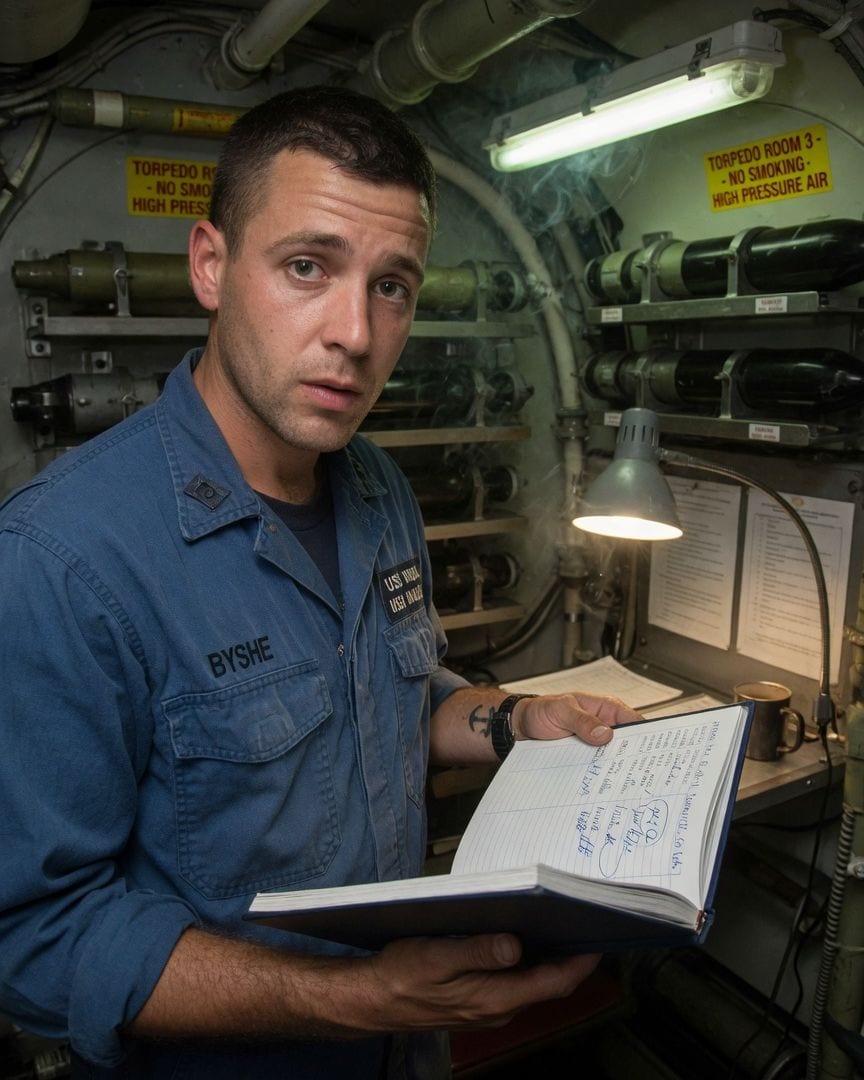
A torpedoman found his own signature in the USS Vanguard's duty log for a watch he never stood, beside a name not on the master crew manifest.
Torpedoman Oscar Bysshe, a rational sailor on his first deep patrol aboard the USS Vanguard, dismissed the messcook's nervous claim of an extra man at the table. He attributed the perfectly clean, untouched tray left behind to a prank. But later, during a routine systems check, Bysshe discovered his own familiar signature in the official duty logbook, for a watch he had been asleep through. Beside it was a name he didn't recognize, a name that shouldn't be there. A frantic check of the master crew manifest confirmed the impossible: the name appeared in the 'temporary assignments' section, dated just yesterday, scrawled in a hand eerily similar to his own.
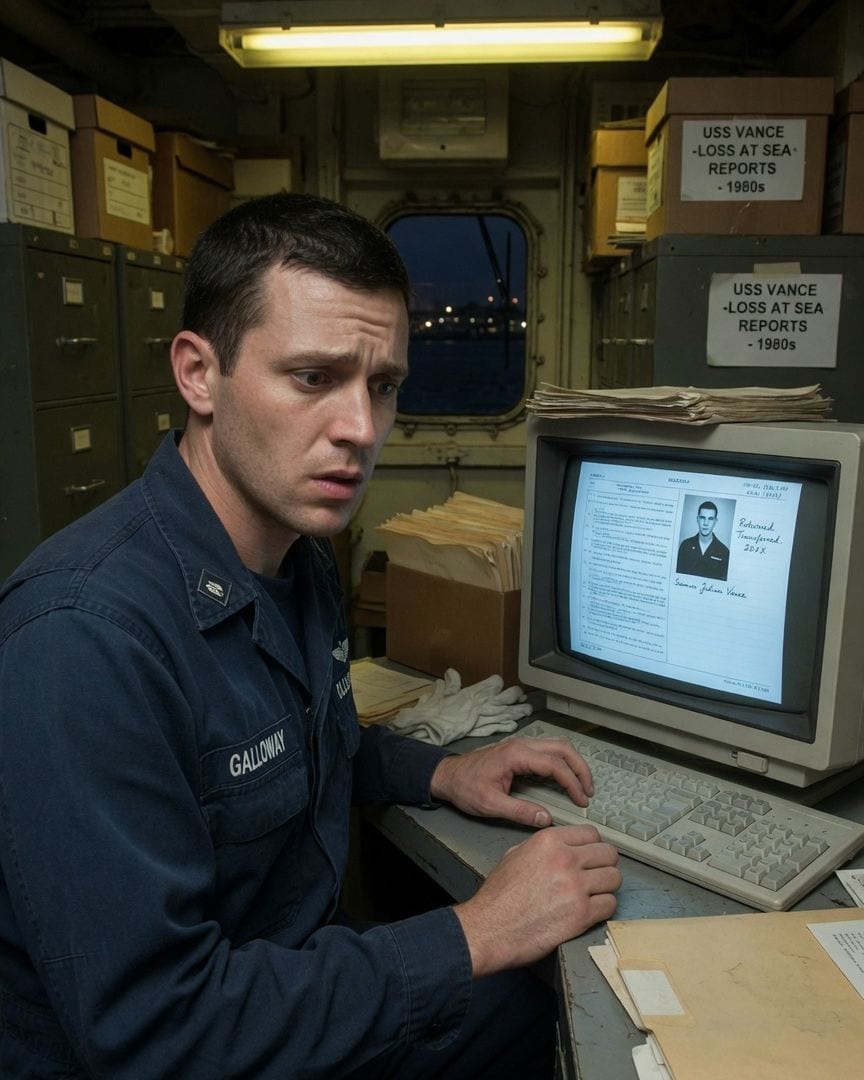
Petty Officer Galloway logged a sailor onto his ship. The man died at sea 40 years ago.
Petty Officer Joel Galloway scanned a sailor's ID on the USS Vance quarterdeck. The man's name, 'Seaman Julian Vance,' and his out-of-date uniform pricked at Galloway's memory. Later, the ship's berthing count came back one over, with an extra entry in the system but no physical body.
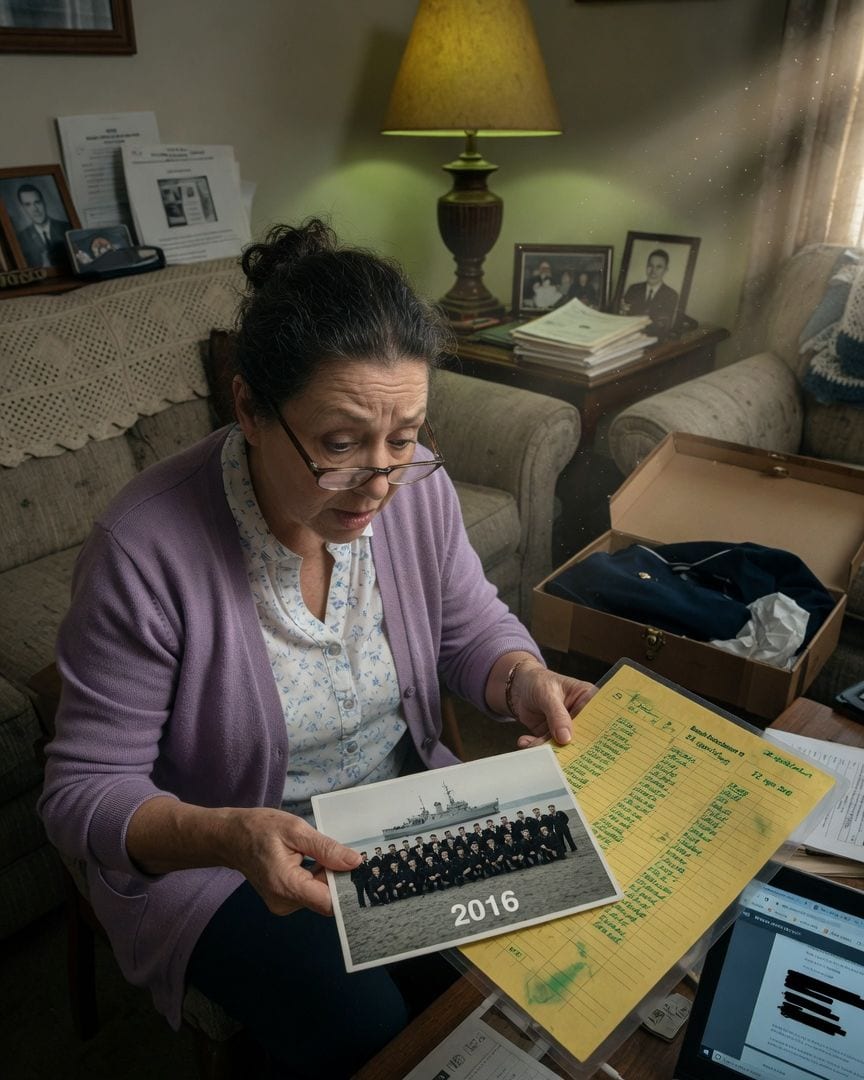
Marisol Frayne unlatched her husband's old footlocker. A photo inside showed his ship, pristine in 2016, three years after the Navy declared it lost.
Marisol Frayne, 62, finally unlatched her husband’s old footlocker in 2024, eleven years after the Navy declared his ship, the Kaskillan, lost at sea. Dust motes danced in the afternoon light as she lifted the lid, releasing the scent of old canvas and cedar. Inside, beneath his perfectly folded dress blues, she found a photograph of David and his crew standing before a pristine Kaskillan. Her breath caught: the photo was dated 2016, three years after the official reports claimed the ship vanished with all hands. Marisol's methodical search then revealed official logs showing a K-class vessel designation active in 2016, leaving a chilling void where her husband's fate should have been.
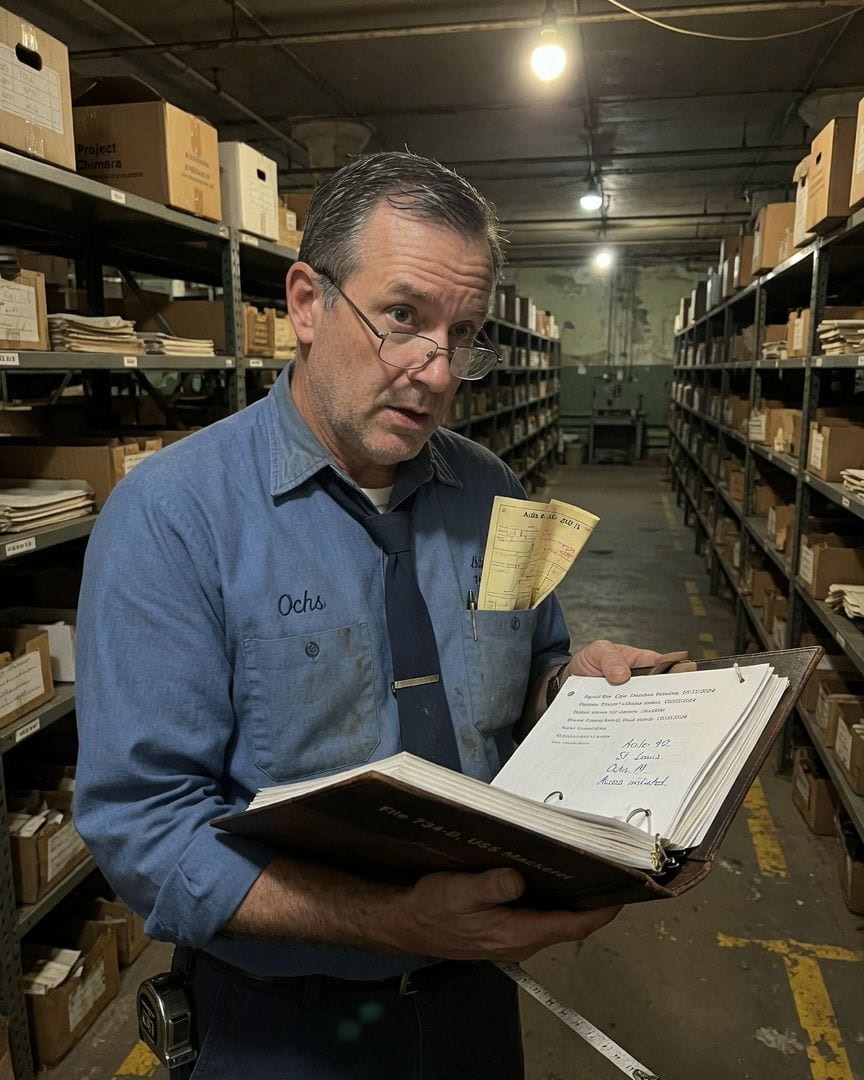
On his final inspection, a depot worker found Aisle 40 had grown 61 feet longer, and a Cold War submarine file hummed warm in his hand.
Marlin Ochs, a man of precise rhythms at the St. Louis depot, approached Aisle 40 for its final inspection before the entire structure was pulped tomorrow. For nearly two decades, the aisle had been a consistent ninety-two paces long. But on this night, his boot heels clicked past the expected mark, stretching to one hundred and nineteen paces, revealing an impossible, colder extension. Deep inside, Marlin found a heavy, leather-bound binder titled 'File 734-B, USS Mackerel,' a Cold War submarine lost with all hands in 1958. It felt oddly warm, almost humming against his palm, filled with maintenance logs and payrolls dated decades after the sub was sunk.
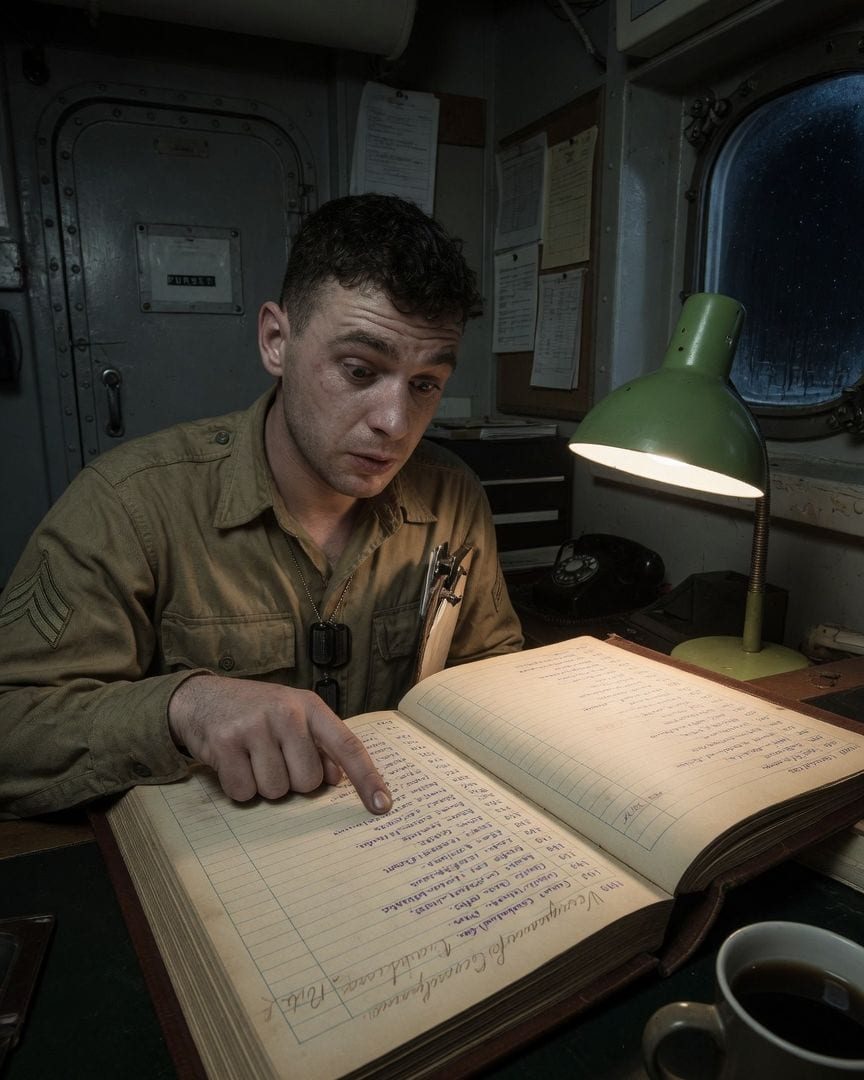
On his final crossing, Corporal Kowalski found a WWI soldier's name: 'Vestergaard, Corporal, 1918,' on his 1943 manifest.
Corporal Arthur Kowalski was on his final Atlantic crossing aboard the USS Harrington, a promised reprieve before reassignment, but the cold Atlantic air was nothing compared to the chill seeping into his bones. Despite the official roll listing 402 men, the boat drill revealed 403 soldiers lined up, an impossible discrepancy that defied every record. His discreet investigation led him to the ship's master embarkation roll, where beneath the 1943 entries, he found a faint, handwritten name: 'Vestergaard, Corporal. 1918.' A World War I soldier’s name, in archaic ink, woven into a modern manifest – how could such an impossible entry exist?
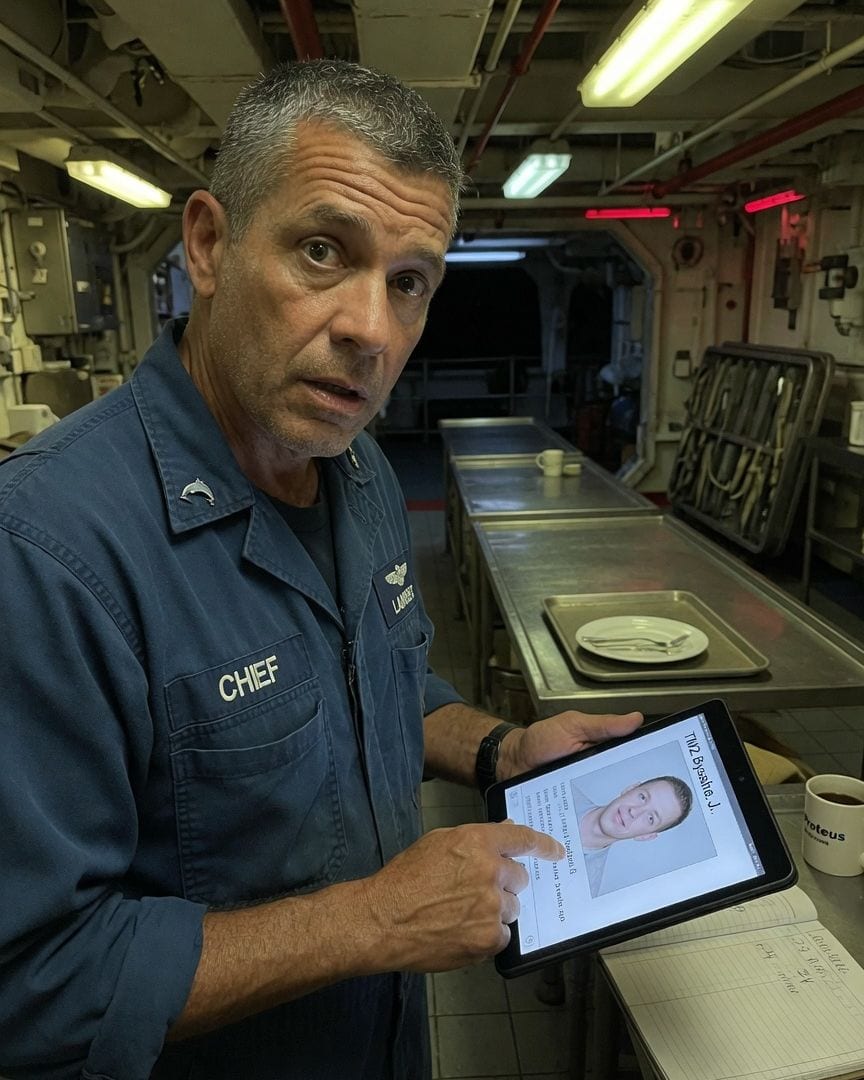
Chief Maxwell Lambert, on his final patrol, found his own signature approving a transfer for a sailor he'd never met.
Chief Maxwell Lambert was nearing the end of his final deep-sea patrol on the USS Proteus, looking forward to shore duty. The familiar hum of the boat and the clatter of the mess hall usually brought comfort, marking each day closer to home. One night, a young messcook reported a strange discrepancy: one plate short, but one man over on chow. Chief Lambert himself then saw a silent, unfamiliar figure eating alone in the shadows of the mess hall, a man who vanished into the passageway without a trace. Later, checking personnel logs, he found every man accounted for. Yet, his own signature approved a transfer for Torpedoman Bysshe—a sailor he had no memory of meeting, whose file photo was unsettlingly generic. How could his official record swear to a man he knew had never served on his boat?