A naval officer closing a Cold War loss found the sunken ship's Chief Engineer signed its log three years after he died.
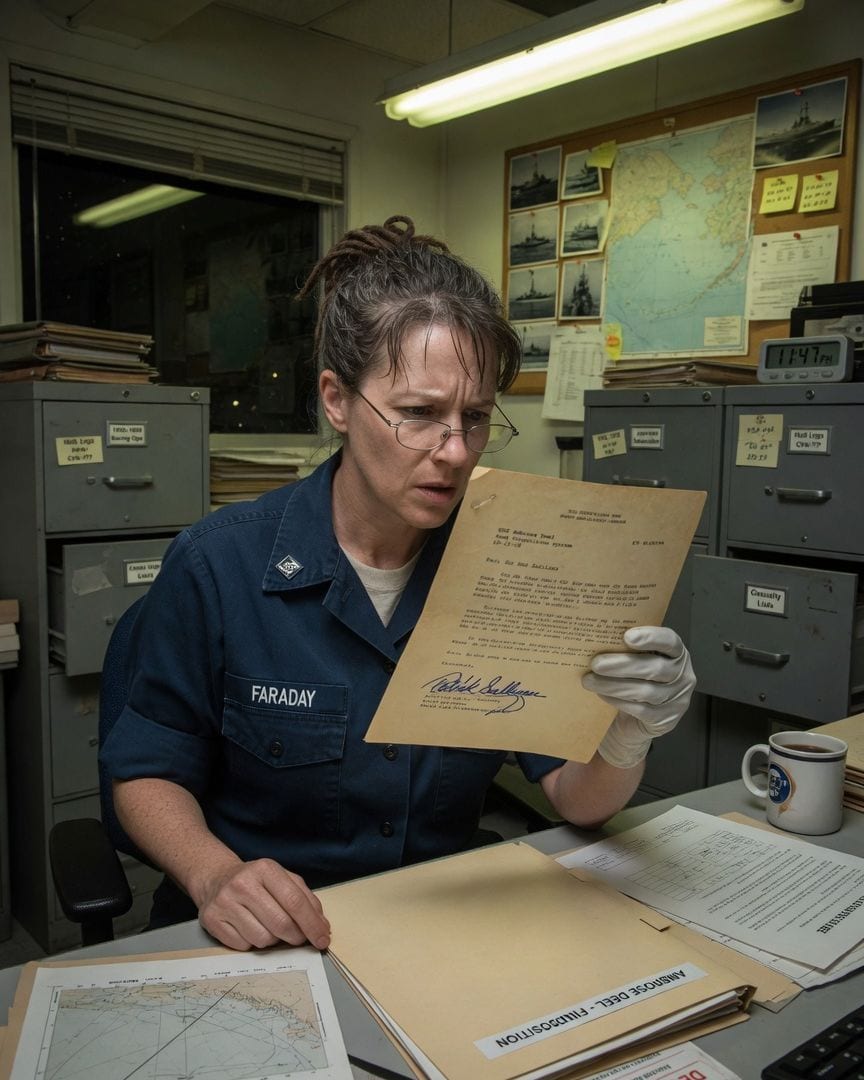
Lieutenant Commander Josie Faraday stared at the open file, the yellowed pages of the USS Ambrose Deel’s final disposition. The board wanted the loss closed by Friday, a rubber stamp on a sixty-year-old tragedy.
Josie, however, felt a prickle of unease. Her brow furrowed, a faint crease forming between her eyes as she traced a finger across the faded print.
The 1955 sonar tape, the deck log from the accompanying destroyer, and the 2021 salvage survey report all agreed to the foot on where the fleet tug went down in the Bering Sea.
They also agreed on the ship that had towed her there: hull number CVN-773, a specific draft, the exact length of the hawser.
Josie had cross-referenced every naval vessel registry, every construction manifest, every decommissioned hull across the last seven decades. She’d checked the archives in Washington, the digital records at Pearl Harbor, even the obscure maritime museums.
No such ship had ever been built, then or since. No vessel matching those specifications, that hull number, that operational window, had ever existed. Three independent records, meticulously official, had all seen the same thing that simply wasn't there.
The office’s fluorescent hum seemed to press down on her, magnifying the quiet anomaly. It was more than a clerical error; it was a ghost in the machine of official history.
Josie pushed her glasses up, the persistent hum of the declassification office a dull thrum against her ears. A clerical error, a misidentification, a transposed number – there had to be a mundane explanation.
Her mind, trained in the rigorous logic of naval record-keeping, refused to entertain anything else. She pulled the Ambrose Deel’s entire physical file, a thick stack of brittle paper, smelling faintly of salt and dust, from the heavy-duty cabinet.
The metal drawers groaned in protest, a small, metallic echo in the otherwise silent room. She started from the beginning, sifting through requisitions, crew manifests, supply inventories, maintenance logs.
Each page was a testament to the meticulous, if sometimes overly complex, bureaucracy of the Navy.
Then she found it, tucked deep behind a 1956 survey report for an unrelated vessel, its edges yellowed with age, just like the rest of the file.
It was a standard maintenance sign-off, a routine inspection of the tug’s main propulsion system. Dated October 12, 1958. Three years after the Ambrose Deel was officially declared lost with all hands. Josie’s breath hitched.
Her gaze dropped to the signature: precise, looped, and undeniably familiar. Patrick Sullivan, Chief Engineer. Sullivan had gone down with the ship in 1955, his name on the official casualty list, his body never recovered.
The log described repairs that clearly happened, parts ordered, work completed – specific serial numbers, unique to that date, listed for the replaced components.
It wasn’t a duplicate or a misfiled page from another vessel; the hull number, the internal identification codes, all pointed unequivocally to the Ambrose Deel. Josie ran a gloved finger over the dark blue ink.
It looked impossibly fresh, almost still wet beneath her fingertip.
The hairs on Josie’s arms pricked. She checked the date stamp again, then the signature, then the casualty report. She double-checked the official record of Sullivan’s death, the date of loss. No mistake.
Patrick Sullivan, officially dead and gone for three years, had signed off on maintenance for a sunken ship. The implications coiled in her gut like something cold and living.
She stared at the page, the precise loops of Sullivan's hand, the ink still seeming to gleam faintly in the harsh office light. It wasn't just a phantom ship. The file itself was still writing its own history.
Josie spent the next day trying to debunk her own discovery, her rational mind battling the impossible evidence. Forgery? She cross-referenced the signature with authenticated samples from Sullivan’s pre-loss career – letters to his family, previous maintenance logs, commendations.
It matched perfectly, down to the slight flourish on the 'P' and the confident slant of the 'S'. Unlikely. A misplaced document from another ship?
The hull number and vessel designation were clearly for the Ambrose Deel, etched into the header, stamped repeatedly throughout the form. A prank?
The official stamps and cross-references, the specific parts inventories, were too extensive, too deeply embedded in the file's structure to be a simple joke. A prank would have left traces of humor or absurdity; this was just… meticulous.
She pulled up the digital archive, searching for 'Patrick Sullivan' and 'post-1955'. Nothing. His records ended abruptly in '55, a clean cutoff, as if his existence ceased then.
The physical file was the only place this impossible entry existed, a unique anomaly. She started looking for other inconsistencies within the Ambrose Deel’s file, cross-referencing every name, every date, every requisition number. Hours blurred into a single focused effort.
Then she found another oddity: a requisition for torpedo tubes – the Ambrose Deel was a fleet tug, built for salvage and towing, not a combat vessel.
The request, dated 1957, was signed by a Lieutenant Desmond Bishop, who was listed as having transferred to a 'deep-sea survey vessel' in 1956. A ship that, like CVN-773, also had no corresponding record in any registry Josie could access.
The name of the phantom survey vessel was 'The Vigilant', and it was listed in its brief, heavily redacted transfer entry as 'classified – deep ocean recovery'. The rabbit hole, Josie realized, was deeper than she thought.
Josie’s work on the Ambrose Deel file was pushing her past the Friday deadline, now Saturday morning. She hadn't left the office since Thursday afternoon, sustained by lukewarm coffee and the desperate need for a logical answer.
Her superior, Harold Bennett, found her at her desk, a steaming coffee cup in his hand, its aroma doing little to cut through the stale office air. He leaned against the doorframe, a casual, almost languid posture, his expression unreadable.
“Still digging, Faraday?” he asked, his voice calm, utterly devoid of judgment or curiosity. “That Deel file is a real beast, isn’t it? Some of these old cases, they just… resist closure.”
He paused, taking a slow sip from his mug, the ceramic clinking softly against his teeth. “I’ve seen good people get lost in the weeds, Josie. Protracted investigations lead to protracted careers, if you catch my drift.
Just sign it off. It’s a sixty-year-old paperwork exercise.”
Josie felt a chill that had nothing to do with the office’s air conditioning. Bennett wasn't angry, not even curious about her findings.
He was simply stating a fact, a quiet warning delivered with the unsettling composure of someone who knew exactly how things worked. The conversation ended with a casual nod, and he disappeared down the hall.
Later that day, as Josie attempted to access specific archived naval registries, her computer screen flickered. She tried again. The requests were intermittently failing, displaying 'Unauthorized Access' messages for files she’d been able to view just hours before.
The system, like a subtle, digital hand, was closing doors around her, sealing off avenues of inquiry. The office air grew heavy, like a presence in the room.
The next Monday, Josie found a slip of paper tucked into the very last page of the Ambrose Deel file, almost as an afterthought. It wasn't an official document, just a yellowed Post-it note, handwritten in faded pencil: 'CVN-773.
See 'Vigilant' cases. Pattern. -G.L.' The initials G.L. meant nothing to her, but the mention of 'Vigilant' cases immediately clicked into place. She remembered Lieutenant Bishop’s transfer. The hair on her neck rose.
She used her remaining access to search for 'The Vigilant'. After several failed attempts, each met with the curt 'Unauthorized Access' message, a single, heavily redacted file finally appeared: 'USS Vigilant (Deep Sea Survey) - Loss Report, 1956'.
The file was thin, almost empty, filled mostly with blacked-out lines. But it contained a single, chilling detail: a requisition for specialized diving equipment, dated 1957.
The signature was unmistakable – Lieutenant Desmond Bishop, the same officer who had signed the torpedo tube requisition for the Ambrose Deel. And then Josie saw it.
The requisition form for the Vigilant also included a small, penciled notation in the margin next to Bishop's signature: 'Cross-reference: CVN-773'.
Josie felt a sickening lurch, a physical twist in her stomach. It wasn't just the Ambrose Deel, or its phantom towing vessel, or the impossible maintenance logs.
The phantom hull number, CVN-773, was a recurring element, a signature linking vessels that didn't exist with personnel who vanished and then reappeared on impossible paperwork.
'The Vigilant' wasn't just another phantom ship; it was another piece of the puzzle, another vessel caught in a pervasive pattern of loss that generated its own, internal, impossible bureaucracy. The office lights seemed to flicker, casting longer, unsteady shadows.
Josie worked feverishly, the adrenaline dulling her exhaustion. She cross-referenced every 'lost' file she could still access that had any mention of CVN-773 or 'The Vigilant'.
The access restrictions tightened around her, but she moved fast, exploiting the brief windows before the system locked her out entirely.
She found a dozen more: a long-range bomber lost over the Pacific in 1968, its final flight path inexplicably altered to rendezvous with an unlisted "support vessel" designated CVN-773.
A submarine that vanished in the Arctic in 1972, its last known communication mentioning "unaccounted for environmental survey data" forwarded to a "Vigilant Research Unit."
A small research team that disappeared in the Bering in 1985, their equipment logs showing a post-loss requisition for replacement sensors, approved by a name found nowhere else in naval records, with a faint 'CVN-773' penciled next to it.
Each file, meticulously official, contained some impossible detail – a post-loss requisition, a phantom cross-reference, a signature from a deceased crewman, or a log entry from a non-existent vessel.
The pattern was horrifyingly clear, spanning decades and classifications, growing wider, deeper, older than she could have imagined. This wasn’t a random series of errors; it was a system. Then she found it.
A file for the USS Nautilus, a deep-sea submersible currently active and deployed. But tucked within its digital records, under a 'Maintenance Log - Classified' subfolder, was a payroll run.
One entry, listed as 'Crewman - Special Assignment', was for Joseph Donovan, a diver who had vanished during a classified exercise last year.
Next to his name, buried deep in the internal routing code, was the faint, impossible hull number: CVN-773. And the last signature on the sheet, for the payroll approval, was dated just two weeks ago, in a precise, official hand.
The dread solidified into a horrifying understanding. CVN-773 wasn't a ship; it was a classification, a designation, a unique identifier for something that wasn't meant to be officially recognized.
'The Vigilant' wasn't a vessel; it was a process, a protocol, a function. This wasn't a conspiracy of people, but an institution, a self-sustaining bureaucratic entity that had found a way to interface with the world’s official record-keeping.
It didn't just cause disappearances; it filed them. It absorbed the lost, processed them through its own impossible bureaucracy, generating records that were perfectly coherent within its system, even if they blatantly contradicted external reality.
The maintenance logs signed by the dead, the requisitions for phantom vessels, the payroll runs for the vanished – these were its internal ledger, its proof of transaction, its formal accounting of 'acquisitions.'
The system itself was the 'secrecy machine,' quietly, patiently, endlessly signing its own records, making the lost official. Josie looked at the Nautilus payroll run, Joseph Donovan's name filed under CVN-773, his compensation meticulously detailed. It wasn't a clerical error.
It was a receipt. The system was still active, still filing, still signing. And it had just signed a receipt for Joseph Donovan, two weeks ago.
The air in the room felt heavy, as if the silence itself was an accusation.
Josie compiled her evidence, a thick stack of impossible documents and digital anomalies, connecting the Ambrose Deel, The Vigilant, the bomber, the sub, and now the Nautilus. Her hands trembled slightly as she bound the folder.
She walked into Harold Bennett's office Monday morning, the thick folder heavy in her hands, its impossible weight mirroring the burden of what she now knew. Bennett looked up from his monitor, his expression unperturbed, his calm demeanor unsettling. “Faraday.
Finished with that Deel file?” he asked, a faint, almost imperceptible smile playing on his lips.
“Not exactly, sir,” Josie said, her voice steady despite the tremor in her hands. She pushed the folder across his polished desk. “I found a pattern.”
She laid out her findings, calmly, rationally, detailing the connections, the impossible dates, the phantom hull numbers, the signatures from the dead, watching for any flicker of surprise or alarm. There was none.
Bennett picked up the Nautilus payroll run, his finger tracing CVN-773 with an unnerving familiarity. “Ah, yes. The seventy-seven-three designation. Been around a long time. Efficient, wouldn't you say?”
He looked at her, his eyes flat, devoid of emotion, yet entirely present. “You’ve seen the ledger, Lieutenant Commander. You understand how it works. It files what needs to be filed.
It ensures the records are complete, even when reality struggles to keep up.” He leaned forward slightly, his voice dropping to a low, even tone. “You have a choice, Josie.
You can close the Deel file, quietly, and become part of the system. Or you can become part of the files yourself.” He gestured to the folder with an open hand. “You’ve done good work, identifying the pattern.
There’s always room for someone who understands how to complete the records.”
Josie felt a cold dread deeper than any she’d experienced. He wasn't threatening her with violence; he was offering her a job in the machine itself, a position as an unwitting cog in its endless, bureaucratic churn.
She looked at the stack of impossible records, the proof of an indifferent, eternal institution, then at Bennett's calm, unbothered face. The choice was clear.
With a decisive movement, she pulled her entire compilation back from his desk, gripping it tight, the weight of it a tangible defiance.
Josie Faraday’s office was cleared out by Tuesday. Her desk was wiped clean, her computer logged out, the empty space almost an accusation in the row of cubicles.
The Ambrose Deel file, along with all the cross-referenced 'Vigilant' cases and the Nautilus payroll run, had vanished from the declassification archives, scrubbed clean. Her personnel file simply stated, 'Transferred to Classified Records Management – Remote Posting.'
No forwarding address was listed, no contact number. Her colleagues assumed she’d taken a promotion to some obscure, high-security department, a quiet acknowledgement of her diligent work.
Harold Bennett simply smiled when asked, stating, “Lieutenant Commander Faraday is now where she belongs, managing the most sensitive of records.”
The old declassification office hummed with its usual quiet efficiency. A new junior officer was assigned to Josie Faraday’s old desk, tasked with clearing a backlog of cold cases.
One file, sealed and stamped 'URGENT - RECLASSIFY', sat on the top of the pile. It concerned a civilian charter plane, reported lost over the Pacific last week.
Its final flight plan, meticulously logged, showed it diverted to rendezvous with an unscheduled, unlisted cargo vessel. The stamp on the last page was still wet.
If this one got to you
A Cold War sonarman heard his dead father’s voice on a tape, charting the ship’s wreck thirty years after it sank.
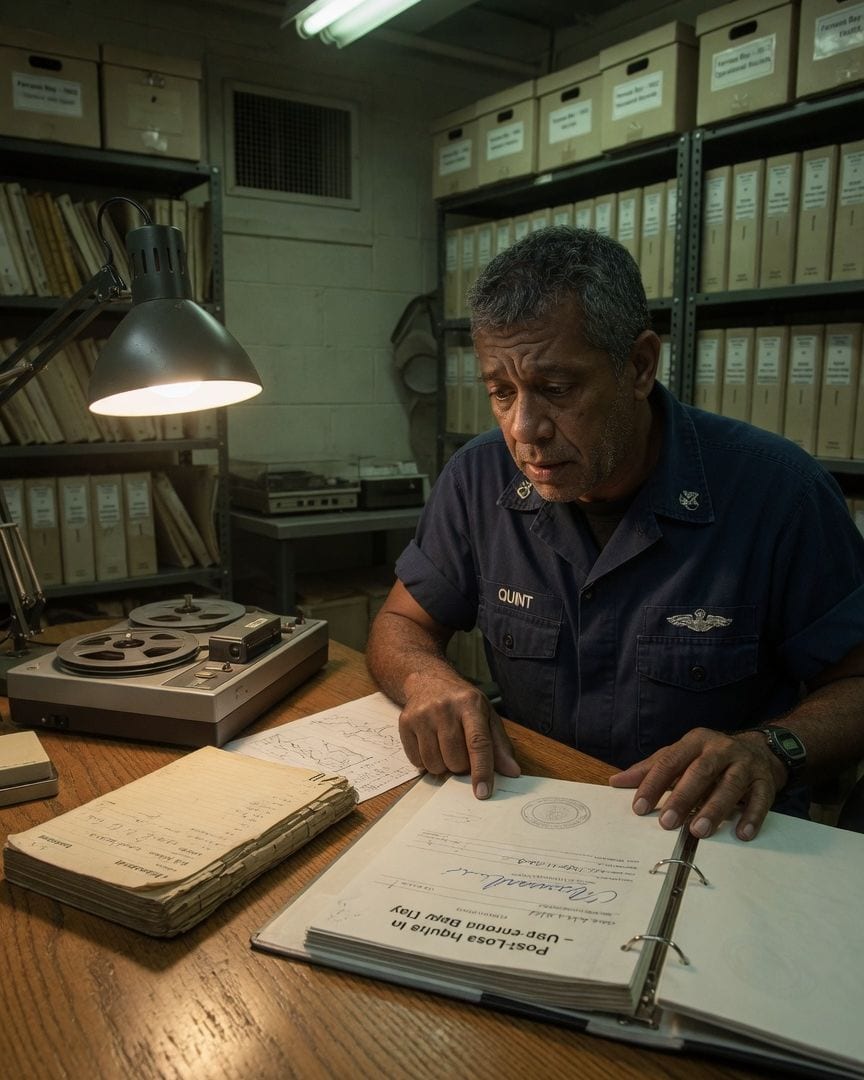
Chief Sonarman Abel Quint spent six weeks in the Naval Records vault, listening to the final transmission of the USS Ferrous Bay. His father, Desmond Quint, was on that ship when it vanished in 1962, and Abel sought some final comfort in his voice. But on this morning, a faint, second set of sonar soundings emerged from the recording—soundings in his father's precise cadence that charted the ship’s wreck site thirty years in the future. As Abel cross-referenced records, he then found a maintenance log for the Ferrous Bay's sonar system, dated six months after the ship and his father were officially lost, signed by Desmond Quint himself. What impossible truth was hidden in these official naval records?
A declassification reviewer finds a dead Cold War submarine officer's report, filled out three years after his official loss.
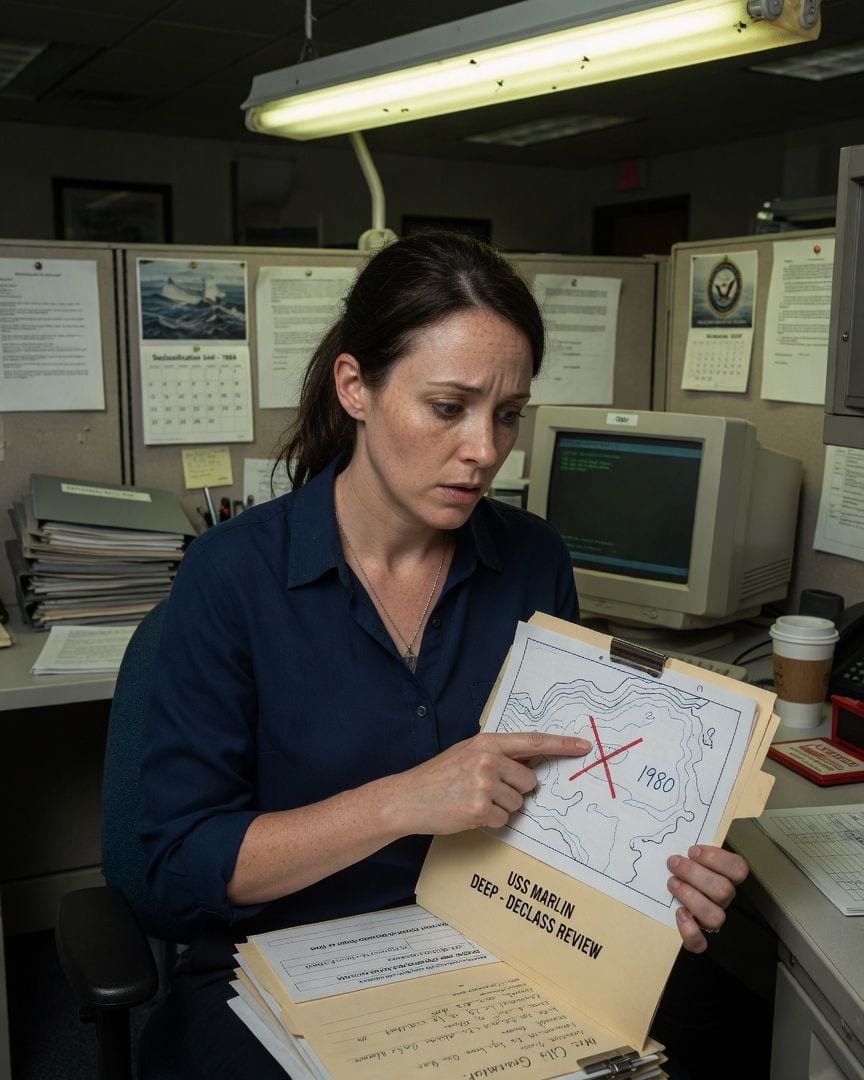
Declassification reviewer Cass Berrigan understood the quiet anguish of widows, sifting through files like the USS Marlin Deep's. The submarine was lost in 1978, leaving behind Lily Granger's desperate letters, asking where her husband Arthur Thatcher's body was. But deep within the file, Cass found a chart of the wreck site, dated 1980—two years after the loss—in Thatcher's unmistakable hand. The dread solidified when she later uncovered an official report, also in his hand, dated 1981, stating 'Station Maintained. Status: Green.' How could a man officially dead for three years still be filing reports?
Petty Officer Lund heard his own captain's mayday: the Cold War USS Goliath was sinking, two hundred miles astern.
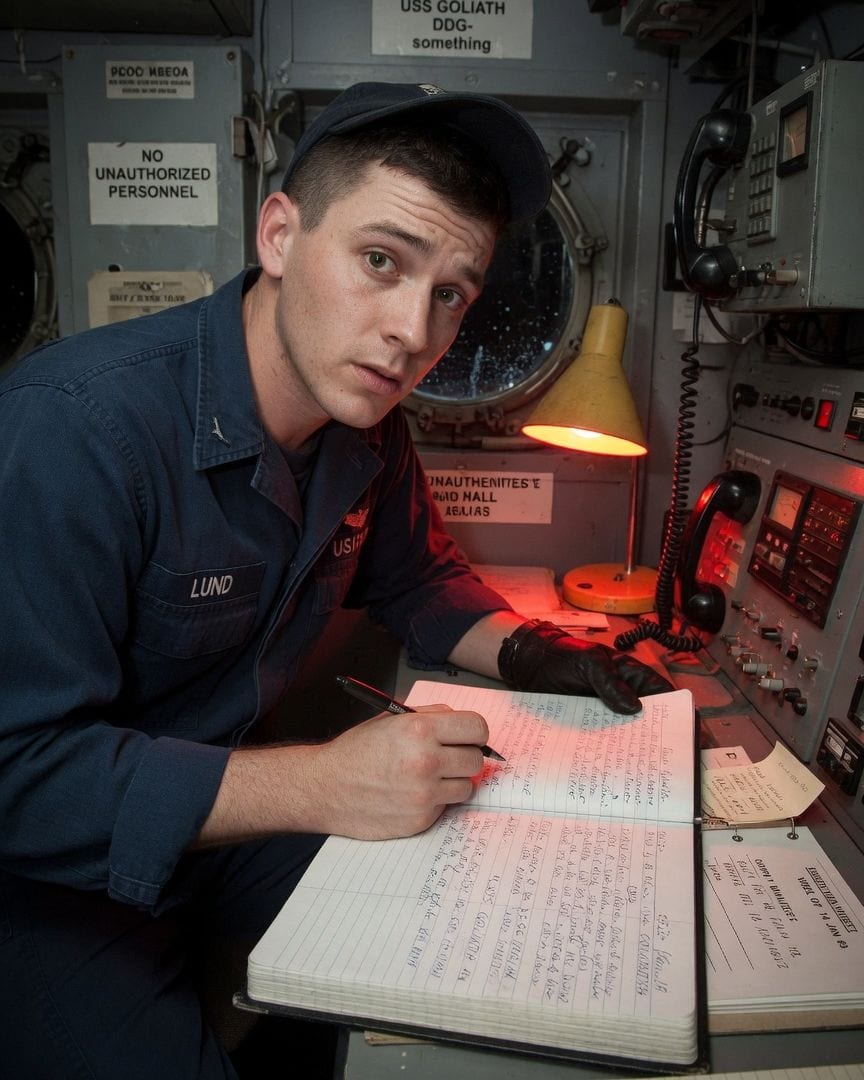
Petty Officer Marco Lund kept a lonely vigil in the USS Goliath's radio room, the destroyer battling the North Atlantic in deep winter 1983. Suddenly, a garbled mayday broke through: his own ship, his own captain, reporting they were going down two hundred miles astern. Though the bridge confirmed the Goliath was fine, the same chilling call came again an hour later, stronger and from the exact waters they had just crossed. Deeply unsettled, Marco began searching ship logs, eventually discovering a phantom entry: an identical mayday, logged a week prior, pressed into the very paper beneath his own.
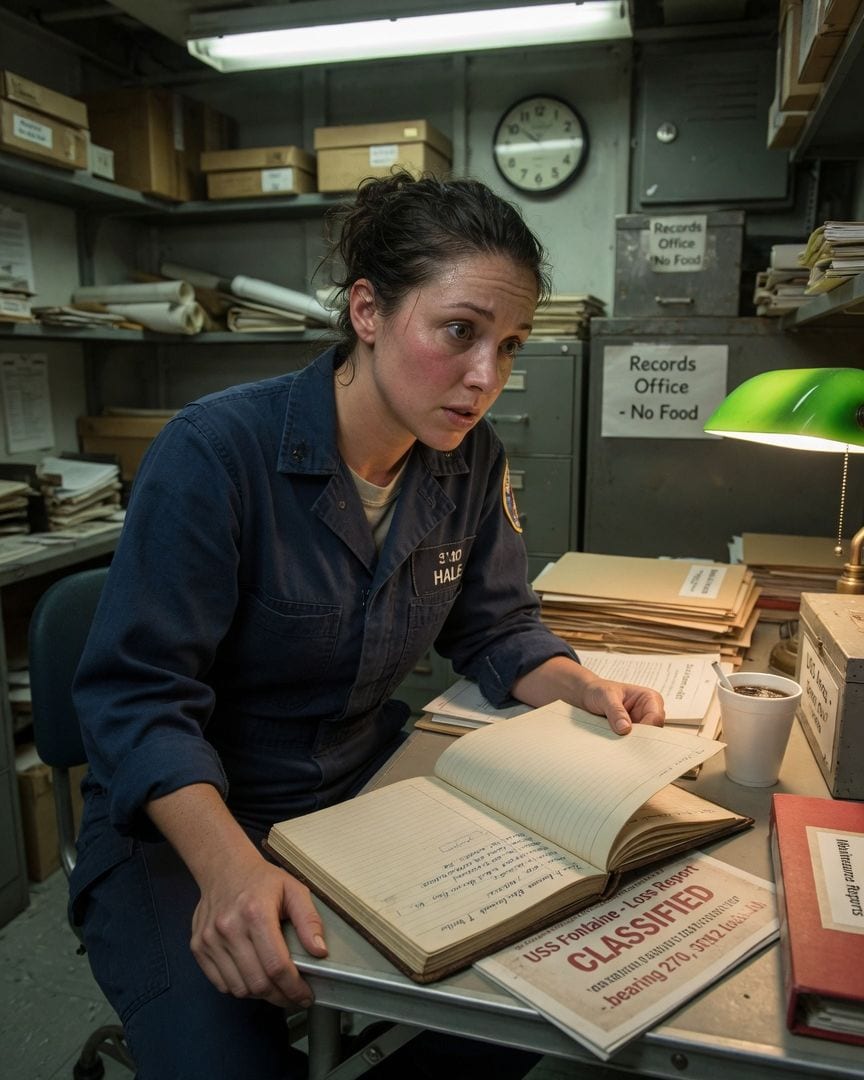
Petty Officer Hale needs a spotless record for her transfer. But the USS Ares sonar logs show an identical, impossible contact, logged to the minute, years apart, and tied to a classified loss report.
Petty Officer Sarah Hale needed a spotless record for her coveted shore duty transfer, a posting she'd worked five years to secure. Alone in the USS Ares sonar shack, three days out from San Diego, her midwatch was broken by an impossible contact: a close, slow echo holding perfect pace, invisible to radar, then vanishing. Her heart hammered, not from fear, but from the data's impossibility. When she found an identical entry in her own log from just one week prior, the cold dread tightened its grip. But the true chill settled when she unearthed decades of similar records, signed by other sonar officers, all showing the same impossible contact at 0212, off the port beam, for nineteen minutes, on the same ship, stretching back years—a persistent echo tied to a classified loss report.
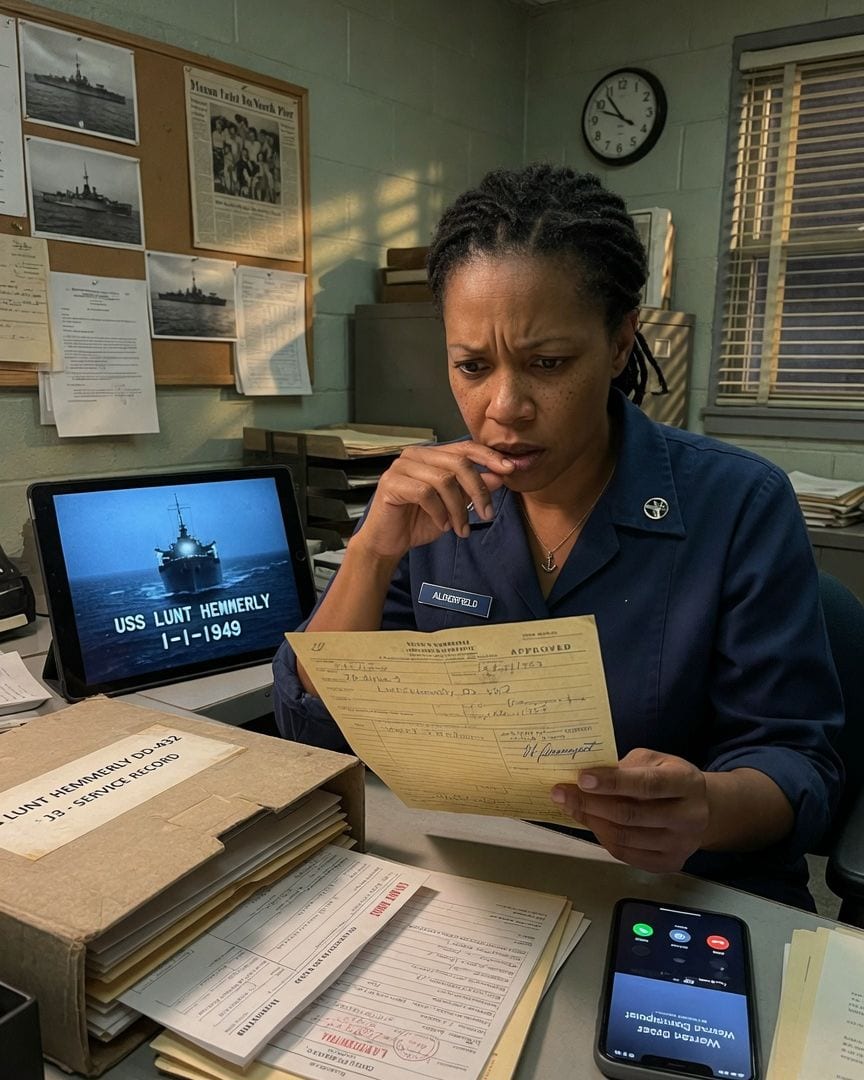
A Public Affairs Officer found a requisition for a Cold War destroyer lost in 1949. It was dated 1953, still ordering parts.
Public Affairs Officer Reece Alderfield was professionally satisfied, watching a livestream of the USS Lunt Hemmerly wreck. The destroyer escort, officially lost in 1949, had its name legible on the stern plate. But then the camera dipped, revealing the ship's loss date, '1-1-1949', welded starkly beneath its name. Back at Naval Station Norfolk, Reece's cold dread deepened when she found a requisition form for the same ship, ordering a specific part, dated April 14, 1953 — four years after its official loss. Could a lost ship still be ordering parts?
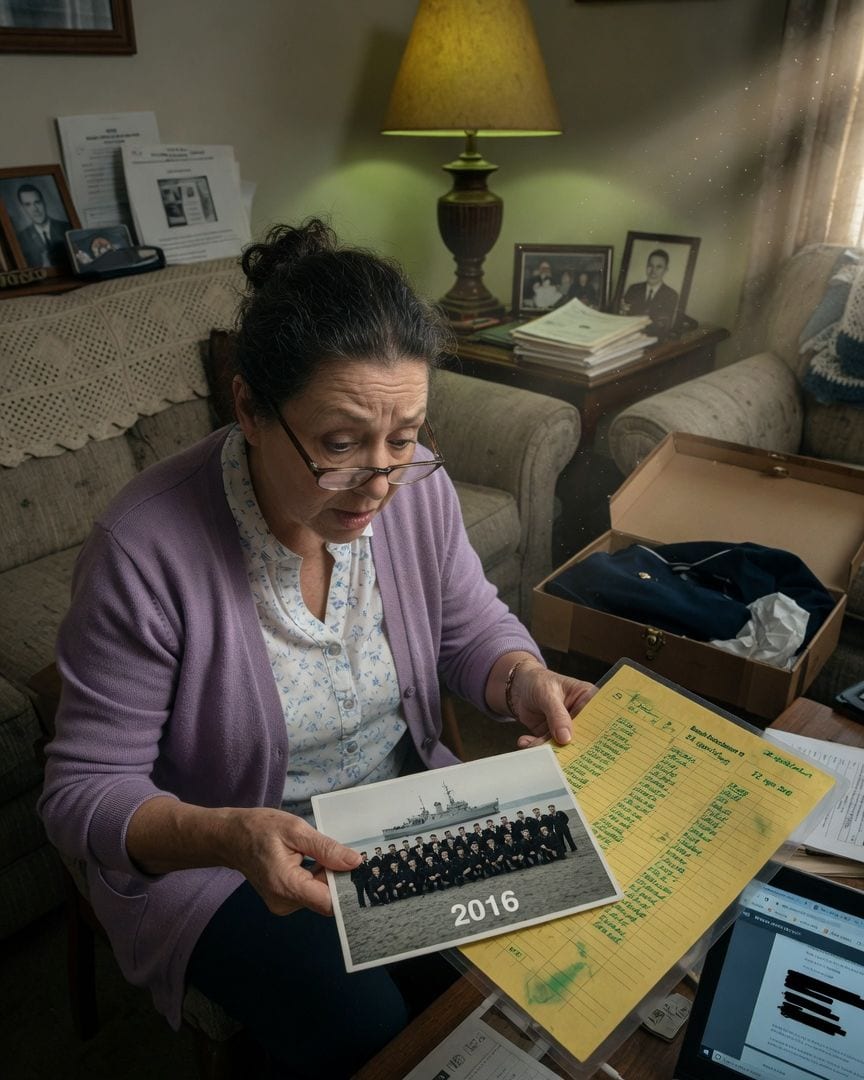
Marisol Frayne unlatched her husband's old footlocker. A photo inside showed his ship, pristine in 2016, three years after the Navy declared it lost.
Marisol Frayne, 62, finally unlatched her husband’s old footlocker in 2024, eleven years after the Navy declared his ship, the Kaskillan, lost at sea. Dust motes danced in the afternoon light as she lifted the lid, releasing the scent of old canvas and cedar. Inside, beneath his perfectly folded dress blues, she found a photograph of David and his crew standing before a pristine Kaskillan. Her breath caught: the photo was dated 2016, three years after the official reports claimed the ship vanished with all hands. Marisol's methodical search then revealed official logs showing a K-class vessel designation active in 2016, leaving a chilling void where her husband's fate should have been.