Sergeant Kowalczyk's final audit found an annex with no records. Its log listed 'presence counts' by a Sgt. Patterson with dozens of impossible, overlapping service records.
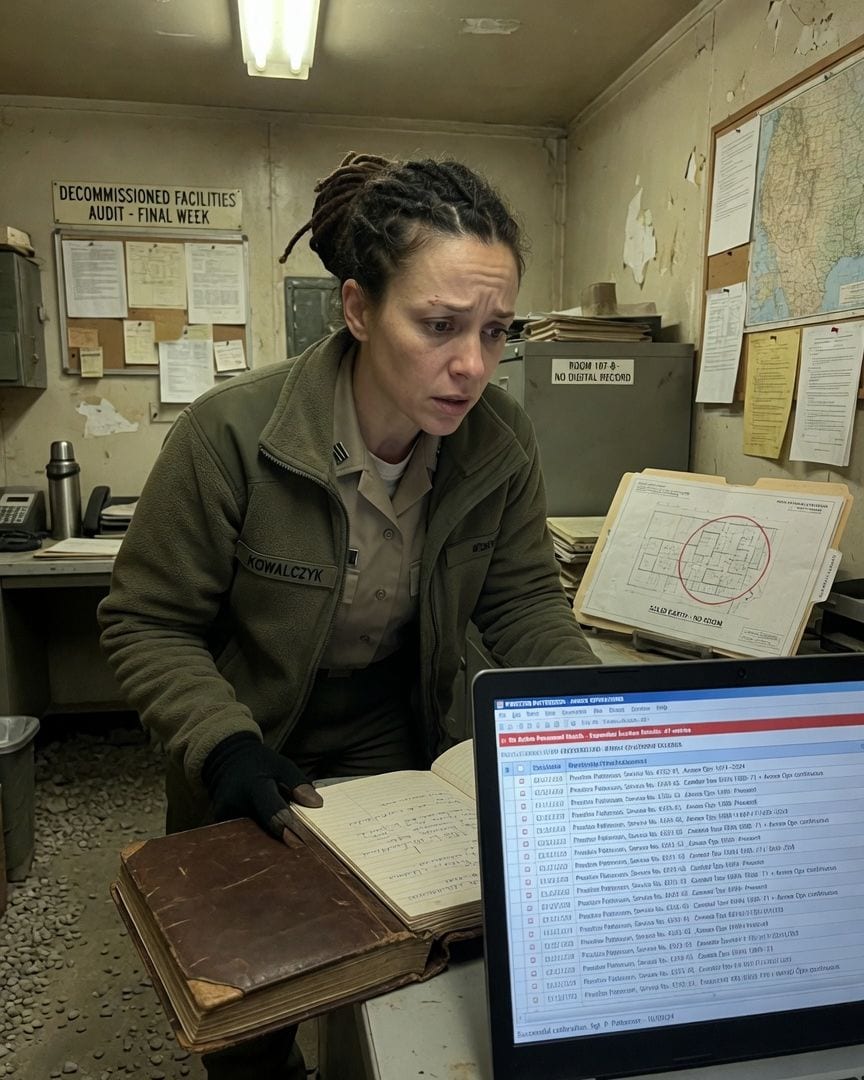
Sergeant Iris Kowalczyk, a week shy of her transfer papers clearing, found herself on a final, tedious audit of decommissioned facilities.
The remote Air Force base was old, mostly dust and ghosts, and her last task was to ensure every forgotten corner was accounted for.
This particular morning, a crisp autumn chill bit at her face as she approached the windowless annex behind the old post hospital. It was a squat, unremarkable building of gray concrete, blending into the muted landscape.
She reached for the steel door, expecting the shock of cold metal, but a faint, unsettling warmth met her gloved hand. She pulled it back, a quick frown creasing her brow.
Her digital facilities system, usually a meticulous ledger of every nail and pipe on base, returned nothing for the annex. No construction date, no maintenance history, not even a keyway listed for the door.
It was as if the building simply didn’t exist in the digital realm.
Yet, for thirty years, the Department of Public Works had been closing work orders for ‘Room 107-B,’ a room the base’s original, faded floor plans explicitly showed as solid earth, a structural wall, nothing more.
The discrepancy looped in her mind, an impossible knot of paperwork and physical reality that grated against her sense of order.
Frustrated by the digital void, Iris decided to investigate the annex physically. She circled the building, her boots crunching on loose gravel, noting the seamless concrete walls and the lack of any visible access point.
No windows, no fire escapes, just an unbroken perimeter. Then, near the back, partially obscured by overgrown desert scrub, she spotted it: a small, rusted access panel, almost flush with the wall.
Prying it open with her multi-tool, she expected to find electrical conduits or a forgotten water shutoff. Instead, the shallow, dusty recess contained a single item: an old, heavy, hand-bound ledger.
Its cover was blank, a thick, dark leather that had seen decades of handling. But the first page, in faded ink, bore the title: ‘Room 107-B Maintenance Log.’ Iris’s gloved fingers carefully turned the brittle pages.
The entries, written in varying hands that changed subtly over the years, detailed tasks that made no sense for a building’s upkeep: ‘resonance field calibrations,’ ‘static charge replenishments,’ and ‘presence counts.’
Her finger traced the last entry, dated just two weeks prior. The handwriting was neat, clear, and recent: ‘Successful calibration. Sgt. P. Patterson.’
Back in her office, the archaic logbook open on her desk, Iris typed ‘Sgt. P. Patterson’ into the current personnel database. The system whirred, then flashed a stark message: ‘No Active Personnel Match.’
Undeterred, she expanded her search, specifying ‘Annex Operations’ as a duty station and stretching the timeline back decades. The screen flickered, then populated with results. Dozens of entries. All for ‘Preston Patterson.’ But the details were impossible.
One Preston Patterson was listed with a blank service number, assigned to ‘Annex Operations’ for a continuous 50-year span.
Another, with a distinct service number, had an extensive combat tour during the exact same period, yet his record also showed continuous assignment to ‘Annex Operations.’
More names appeared, each ‘Preston Patterson,’ each with a slightly different service number, each with conflicting deployments, all overlapping with ‘Annex Operations.’
Iris stared at the flickering screen of the personnel database, a series of ‘Preston Patterson’ entries scrolling before her.
Each entry listed a distinct service number and numerous combat citations, yet all were simultaneously assigned to ‘Annex Operations’ for overlapping, decades-long periods.
She saw names and dates that could not logically coexist, each one a phantom record of impossible service.
Disturbed by the contradictory records, Iris brought the logbook and printouts to Captain Eugene Abbott, her superior. Abbott, a career officer with a meticulous eye for detail, initially dismissed her findings.
“Legacy system error, Sergeant,” he suggested, leaning back in his chair, “or maybe a long-running prank among past DPW personnel. You’ve been working hard; perhaps fatigue is making you see patterns that aren’t there.”
But Iris persisted, laying out the precise overlaps in the ‘Patterson’ service records, the impossible simultaneous deployments. “One man cannot be in two places at once, sir, let alone five, across half a century.”
Annoyed but intrigued by her insistence, Abbott granted her limited access to highly restricted archived personnel files, hoping to prove her wrong. For days, Iris delved into the digital archives, cross-referencing manifests and duty logs.
She found more ‘P. Pattersons’ assigned to ‘Annex Operations,’ each instance bearing a service record that was either suspiciously sparse, lacking key details, or directly contradicted by other official records.
She began to discern a chilling pattern: roughly every five to seven years, a new ‘Patterson’ would appear in the ‘Annex Operations’ roster.
Always male, always with an almost-identical but subtly altered service history, as if a template was being reused, with minor, impossible variations in dates or deployments. The sheer volume of these discrepancies ruled out simple error.
Iris decided to pursue a physical lead. The name Ruth Rutherford, a former DPW clerk, appeared frequently in older ‘Annex Operations’ supply requests for ‘Room 107-B.’ Rutherford’s last known address, a small house off-base, was listed in the archives.
Iris drove to the address, the paved road giving way to a long, winding dirt track that cut through brittle, dry scrub.
The property was a derelict wreck, shrouded in overgrown bushes that clawed at the peeling paint of the clapboard walls. Windows were boarded up, and the front porch sagged, rotten wood groaning under the weight of years.
As she approached the porch, a flicker of movement caught her eye. In an unboarded window on the second floor, a figure stood, perfectly still, silhouetted against the dim interior.
It was an older man, gaunt, with an unnervingly calm, almost placid expression. He didn’t move, just watched her.
Iris felt a profound chill, a primal sense of being observed, and a dawning realization that this might be one of the ‘Pattersons’ – perhaps the one listed with the 50-year assignment. He was too still, too unblinking.
As she slowly backed away, her phone vibrated in her pocket. An anonymous text message flashed across the screen, the letters stark against the display: ‘Some things are best left undisturbed, Sergeant.’
Shaken, Iris returned to base. She found Captain Abbott in his office, his face tight with a tension she hadn’t seen before.
She showed him the anonymous text and described the man in the window, her voice trembling slightly despite her efforts to control it. Abbott’s usual composure cracked.
He slammed his fist softly on his desk, the quiet thud echoing in the room, then sighed, running a hand through his closely cropped hair.
“Alright, Kowalczyk,” he began, his voice low, almost a whisper, “you’ve dug deeper than anyone I’ve seen. ‘Annex Operations’ isn’t standard. It’s… a highly classified, non-standard assignment.”
He avoided her gaze, staring instead at the wall behind her, a blank expanse of painted cinder block. Iris pressed him, demanding to know what ‘non-standard’ meant, what was in that annex, and who these ‘Pattersons’ really were.
Abbott finally admitted, “The annex contains something that requires… stable management. Not a building, not equipment. Something else.”
He explained that the ‘Pattersons’ were not clerical errors or pranks, but personnel specifically assigned to a unique, long-term duty that involved ‘maintaining specific environmental parameters.’
He confessed that their service was ‘critical’ to base operations, but would offer no further details, only repeating, “It’s beyond your clearance. Drop it, Sergeant. Process your transfer.”
As he spoke, the pieces clicked into place for Iris: the ‘maintenance’ wasn’t for a structure, but for whatever impossible entity or phenomenon resided within.
The warm door, the phantom room, the contradictory records – all were part of a decades-long protocol to contain an unknown horror.
Iris returned to her office, the weight of Abbott’s words heavy on her. The chill from the abandoned house still clung to her, a physical presence.
She initiated the final steps of her transfer paperwork, trying to push the chilling revelations from her mind, to focus on the future that lay just days away.
The system whirred, compiling her service record, her upcoming assignments, her scheduled leave dates. As the final printout emerged from the machine, warm in her hands, she scanned it for any last-minute errors.
Her eyes froze on a new line, one she had never entered, never authorized. Under her recent assignments, nestled between a standard training course and her scheduled leave, was: ‘Temporary Duty, Annex Operations (Room 107-B), 01-15 APR 20XX.’
Her blood ran cold. She had never been assigned there. The dates overlapped precisely with her scheduled leave, a period she was supposed to be hours away, with her family.
She immediately tried to delete the entry, but the system flashed an error message, red text stark on the monitor: ‘Record locked by superior authority.’
Panic seized her as she scrolled to the signature block for her commanding officer, the authorizing authority for all her transfers. There, in stark black and white, was the name: Captain Eugene Abbott.
Iris confronted Captain Abbott again, this time bursting into his office, her transfer papers clutched in a trembling hand.
She slammed the document onto his desk, the sound sharp in the quiet room, pointing a furious finger at the phantom assignment. Abbott, seeing the altered record, sighed with a profound resignation.
“I was hoping you wouldn’t find that,” he said, his voice devoid of his earlier evasiveness, flat with a chilling finality.
He rose and retrieved a thick, heavily redacted binder from a locked safe, the click of the tumblers loud in the silence. “This is Project Chronos,” he explained, placing it on his desk, the worn cover facing her.
“The annex contains a dimensional rift, discovered in the early 70s. It requires a constant, specific human ‘presence’ to remain stable and contained, or it will… expand. Irreversibly.”
He explained that the ‘Pattersons’ weren’t a family or a single individual, but a lineage of volunteers, service members whose identities were gradually integrated into the anomaly’s ‘maintenance’ protocol.
Their official records were meticulously altered, creating a facade of a normal career while their true consciousness was engaged in an incomprehensible task within ‘Room 107-B.’
He pointed to a section in the directive: ‘Once an individual demonstrates sufficient awareness of the anomaly’s nature, they are deemed eligible for integration.’ He looked at Iris with genuine regret, his gaze heavy.
“Your relentless investigation, your understanding of the truth, has now made you eligible, Sergeant. The system, both bureaucratic and anomalous, has marked you.”
Horror choked Iris, a cold, dry constriction in her throat. She tried to argue, to deny her ‘eligibility,’ to demand her original transfer.
Abbott, now utterly calm, a strange, placid acceptance in his demeanor, explained, “The anomaly is not malicious, Sergeant. It merely exists. It requires balance. Your ‘duty’ is not a punishment, but a necessary function.”
He opened a drawer and produced a keycard, not for the annex’s outer steel door, but for an inner chamber within. “The next Patterson is due for rotation soon. Your entry on your record is the preparation for that.”
He explained that the choice was not whether to participate, but how.
She could fight it, scream, try to expose it, but the system – the vast, unseen machinery of the military and the incomprehensible anomaly – had already closed around her. Her records were altered, her destiny set.
The horror wasn’t a monster she could fight, but a seamless, decades-long integration of human identity into an incomprehensible, unyielding system. She looked from the keycard to her transfer papers, the phantom assignment now a chilling, inescapable reality.
The true enemy was coherence: the way every impossible detail now fit perfectly into a pattern of dread. Her mind raced, searching for an escape, a loophole, anything. But Abbott’s calm, almost sympathetic gaze confirmed it: there was nothing.
She was already part of ‘Project Chronos.’
Sergeant Iris Kowalczyk did not report for her transfer. Her name was quietly removed from the outgoing manifest, a blank space where her future had been.
Within a week, a new, precise entry appeared in the ‘Room 107-B Maintenance Log,’ detailing a ‘successful integration’ signed by ‘Sgt. I. Kowalczyk.’ Captain Abbott’s office was noticeably tidier, his desk unusually sparse.
He seemed to carry a new, quiet burden, his eyes holding a depth of knowledge that separated him from the rest of the base personnel. The annex remained, windowless and warm, its secret undisturbed.
Captain Eugene Abbott sat alone in his office late one night, reviewing the latest ‘Annex Operations’ report. His expression was unreadable, a quiet understanding etched into his features. On his monitor, beneath ‘Sgt.
I. Kowalczyk,’ a new name had appeared on the roster for ‘Room 107-B Maintenance.’ It read: ‘Cpt. E. Abbott.’
The next morning, the new DPW sergeant, a fresh-faced young man named Thomas Rutherford, found a single, old, hand-bound ledger in a forgotten access panel near the windowless annex. He opened it to the last entry, seeing a familiar signature.
He closed the book, the steel door of the annex warm against his hand on a cold morning.
If this one got to you
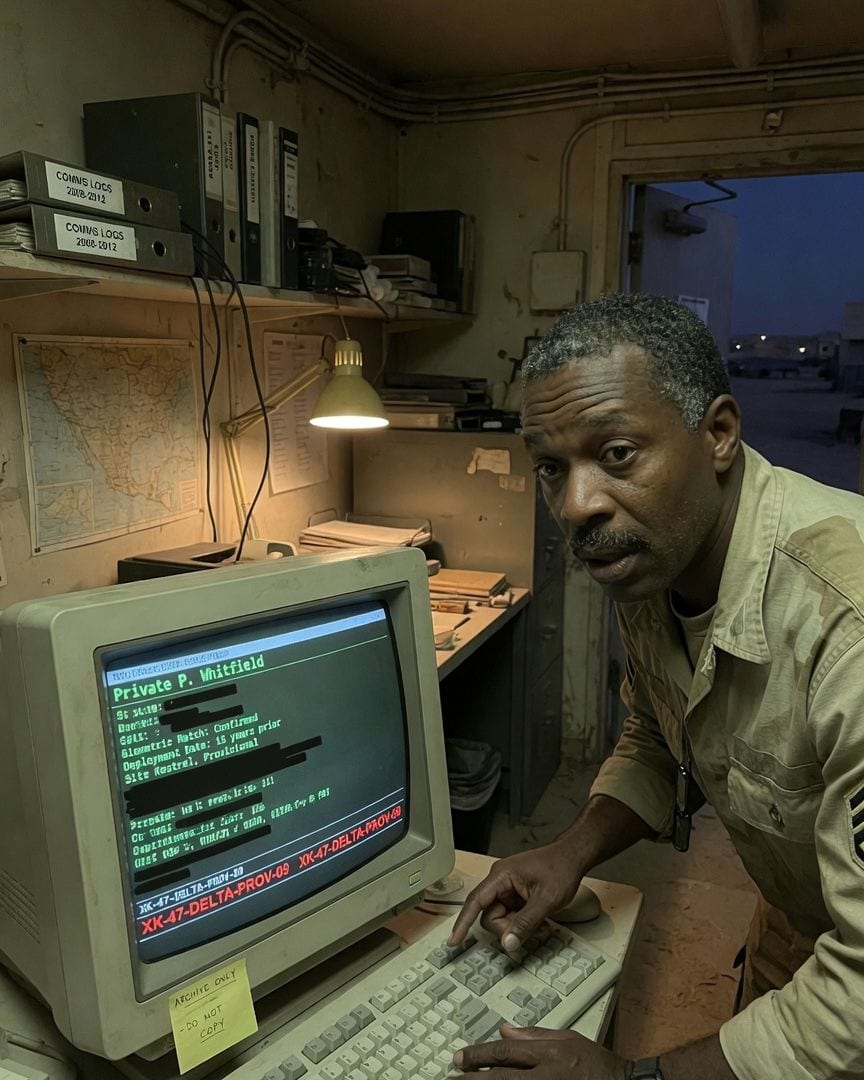
Sergeant Bishop's corporal was logged in two places at once — and deployed fifteen years before their base existed.
Sergeant Isaac Bishop yearned to clear his desk, just three weeks from finally going home from the FOS Kestrel. The low thrum of the base's servers was as constant as the desert wind, but a new anomaly hummed louder in his mind. Chow hall footage showed Corporal Patrick Whitfield in the serving line at 0530 for two weeks straight, yet Bishop's own comms logs confirmed Whitfield was simultaneously on patrol a kilometer away. As Bishop dug deeper, cross-referencing every roster and log, he found no errors, no pranks; instead, an archived service record for a "Private P. Whitfield" emerged, matching the corporal's biometrics and dating his deployment fifteen years ago to "Site Kestrel, Provisional"—a full decade before the FOS Kestrel officially existed.
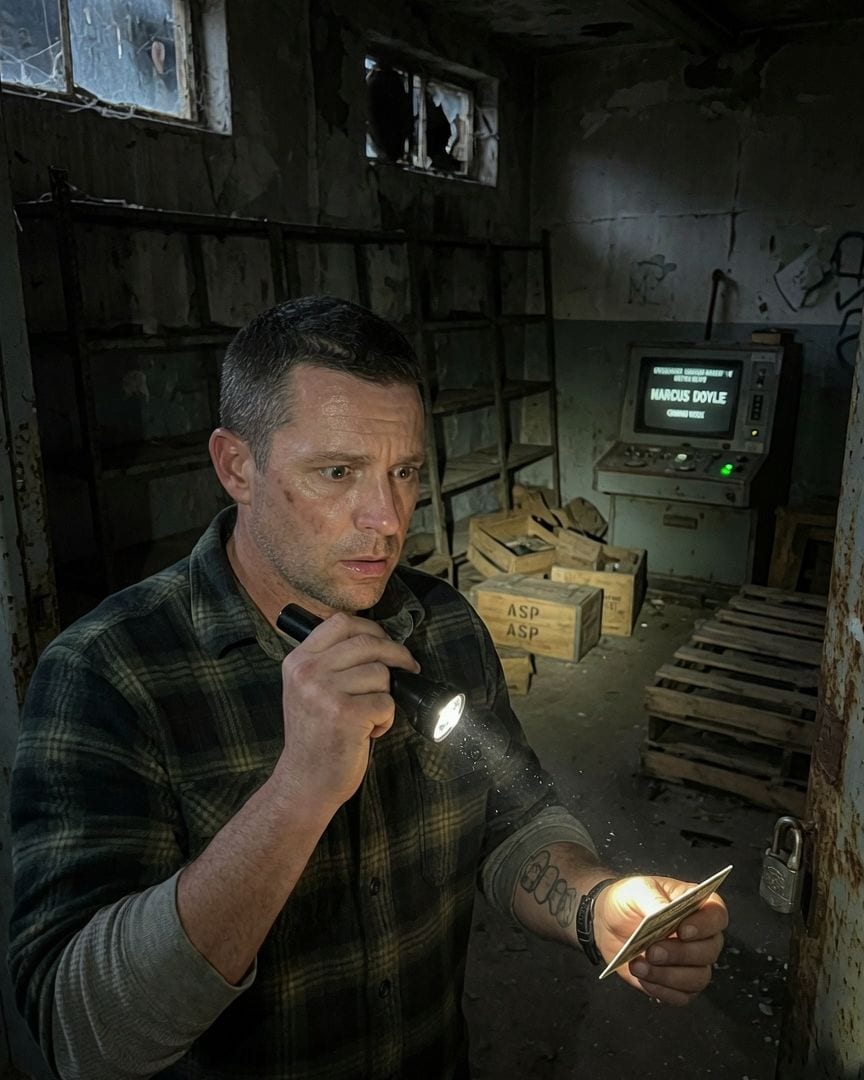
A former serviceman found his name on an active duty roster for a military base decommissioned in 2019. His access card had already logged three entries last month.
Six years after leaving the service, Marcus Doyle’s quiet suburban life was upended by an old access card notice. It came with a chilling printout: his badge number and name, logged entering Fort Crestwood’s Ammunition Supply Point three times last month, each at 0240. The former military base had been officially decommissioned in 2019, its buildings abandoned and gates chained. After discovering his own access card matched the log, Marcus returned to the derelict site, only to find a humming console displaying his name as current "personnel assignment" for the coming week. What could be happening at a base that no longer exists?
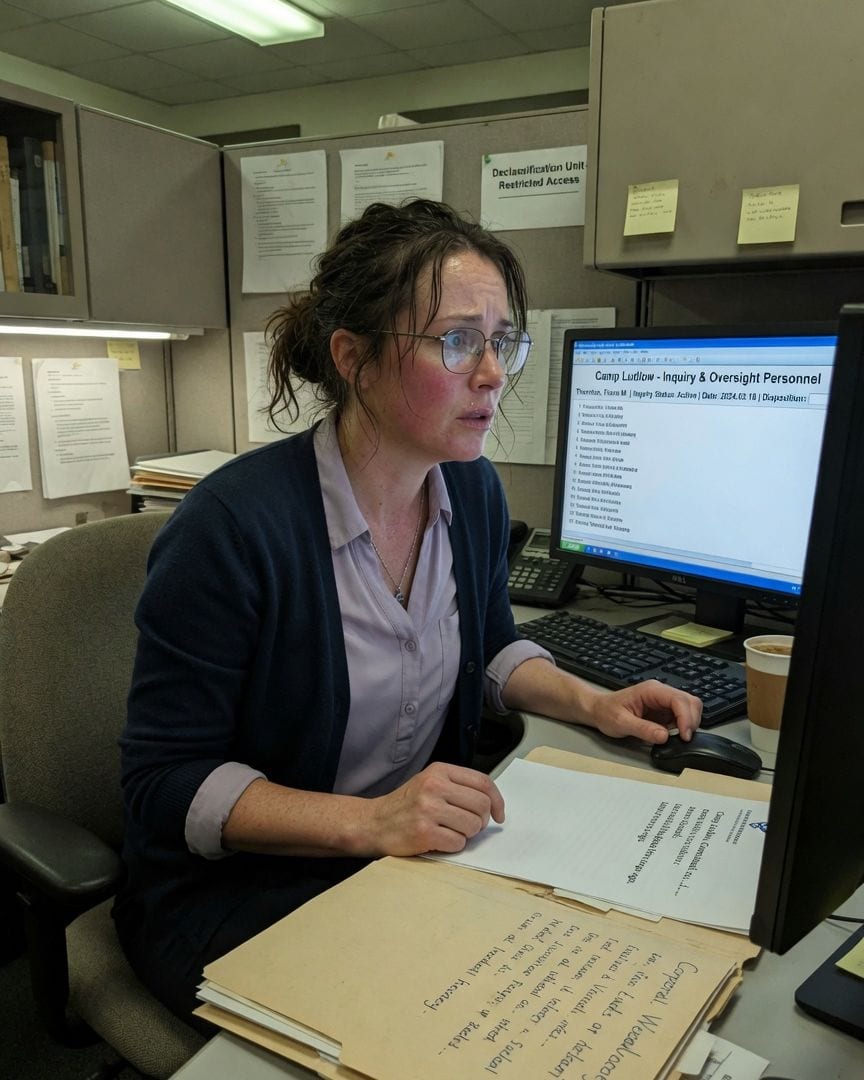
A declassification reviewer found a Cold War Greenland camp, officially closed in 1959, was still active. Her own name then appeared on its current roster.
Declassification reviewer Fiona Thornton prided herself on the meticulous order of official records. Her world, built on precision, began to unravel when an Air Force response claimed Camp Ludlow, Greenland, officially closed in 1959, was still active, with a radio check just four days prior. Digging deeper, she uncovered a supply manifest from 1961 listing advanced equipment that wouldn't be invented for another decade and a half. But the true chill settled when she found her own name, 'Thornton, Fiona M.,' on the base's 'Current Operations' personnel roster, dated for this very morning. Was she investigating a ghost, or had she become part of one?
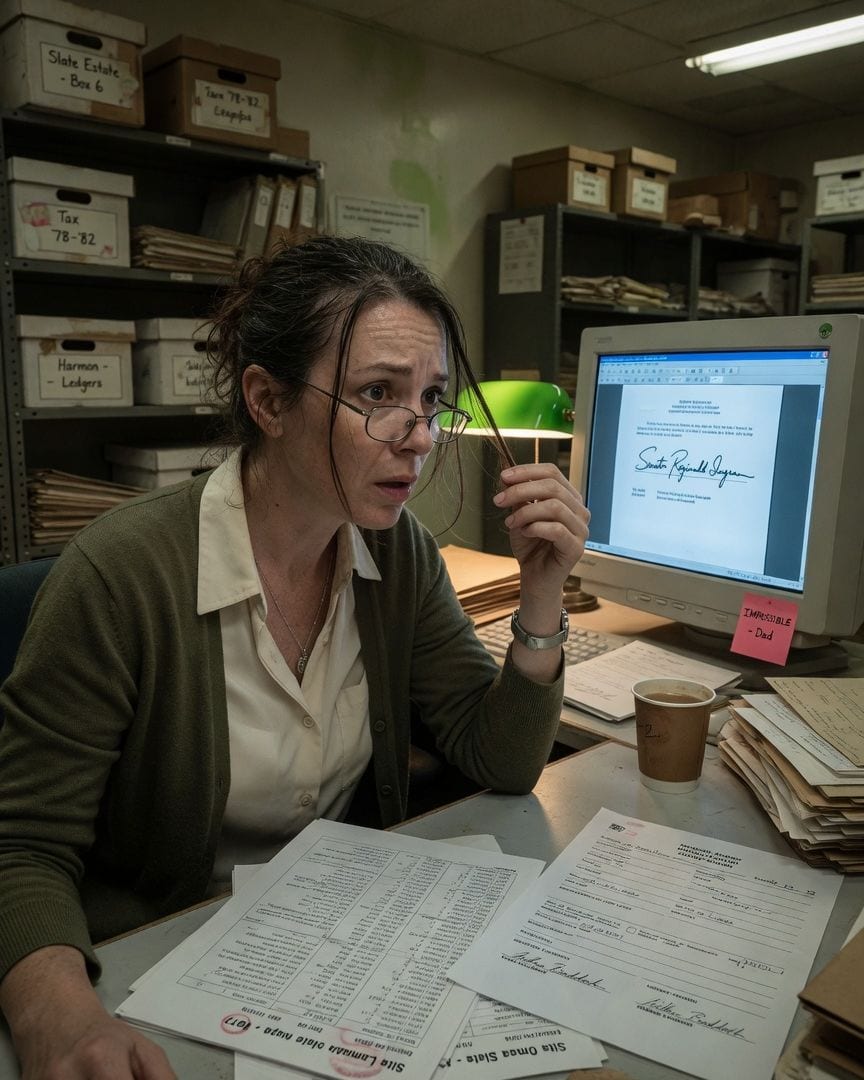
An archivist found her father's signature on a secret 1983 Cold War roster. It listed a senator who died a month before.
Nell Braddock, a meticulous archivist, dedicated her days to the quiet precision of sorting through decades of old papers. Her current task, the estate of Harmon Slate, promised nothing more than mundane accounting until she unearthed a secret operations roster from 1977. The document listed Slate as present at a desert facility, yet hospital records confirmed he was laid up with a broken back at the exact same time. A cold certainty bloomed when she recognized the familiar signature at the bottom of both impossible documents: her own father's. As Nell dug deeper, she found more such anomalies, each bearing her father's unnervingly perfect hand, twisting her reality into something utterly alien.
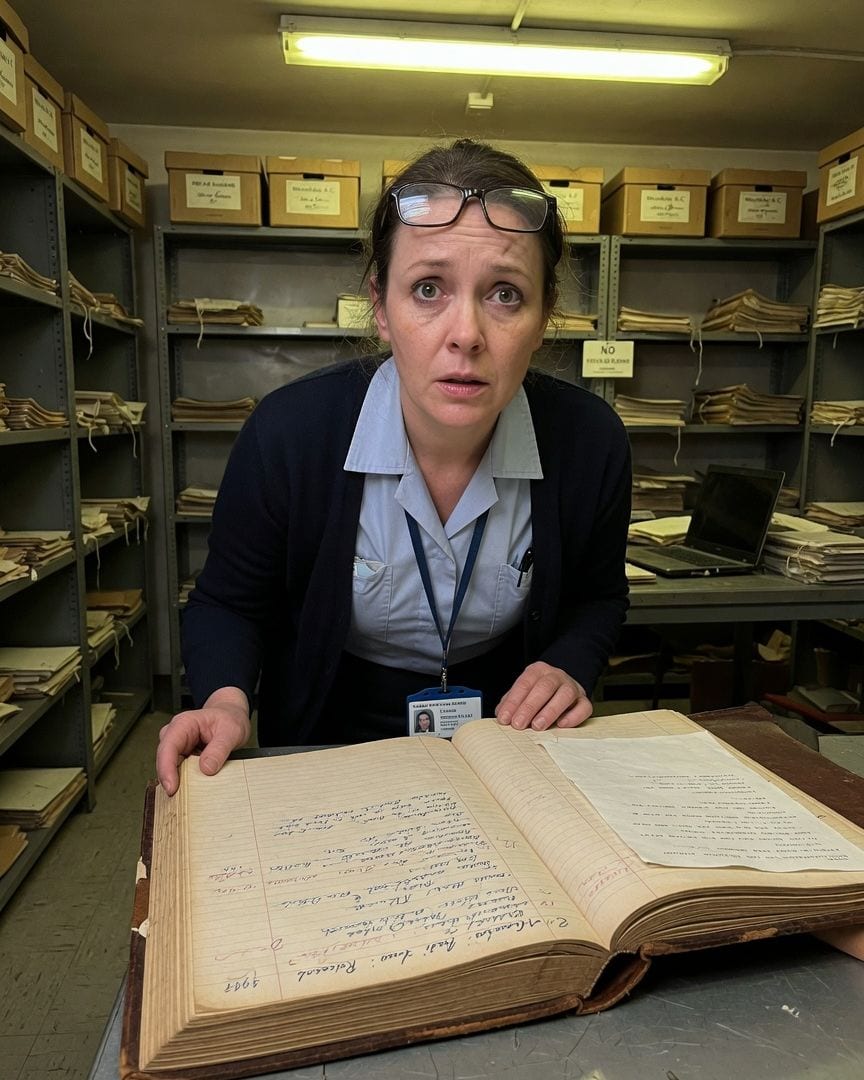
My ambulance trust's incident log shows callout 22-014 to 6 Cathcart Row at 2:40 AM. Every four years, the same call, same address. Always 'patient not found'.
My job involves tedious data entry for ambulance calls, but Incident 22-014 was different. It appeared every four years, always at 2:40 AM, always closed as 'patient not found.' Digging into the dusty physical archives, I found an entry from 1961 for the exact same incident, but its resolution read: 'Subject Secured. Relocated to "Holding".'
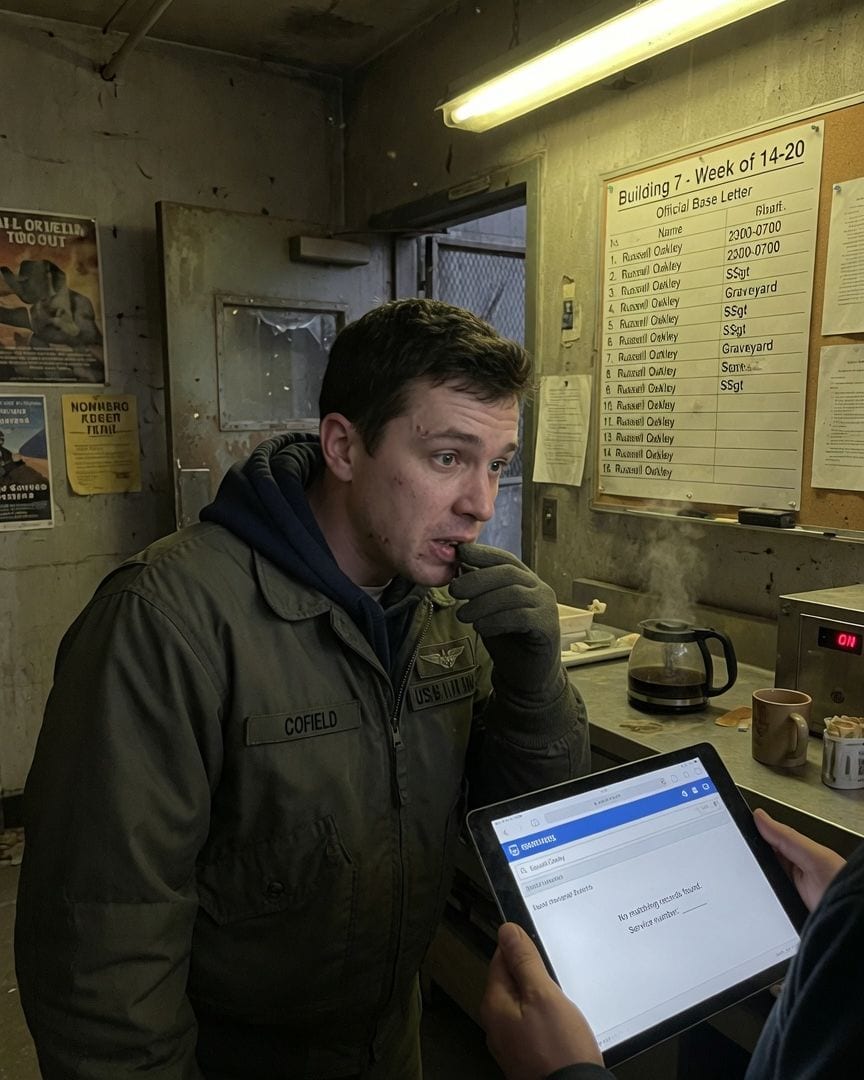
Airman Cofield, two weeks from transfer, found a warm coffee pot in a building without power for thirty years. Its new shift roster listed a name that didn't exist.
Senior Airman David Cofield, just two weeks from his long-awaited transfer, patrolled the perimeter of a decommissioned weapons storage area. Building 7, a concrete shell dark since 1992, suddenly showed a faint, warm light in its window. Inside, fluorescent lights hummed, and a coffee pot on the counter was still warm, defying the building's decades-long power shutdown. A freshly pinned shift roster for the coming week then revealed a name: 'Russell Oakley,' listed for Cofield’s own graveyard shift, yet completely absent from every official base record. Who was Russell Oakley, and how was he on shift in a dead building?