A sergeant's closest friend returned from injury. Then the sergeant saw two identical Isaac Priests.
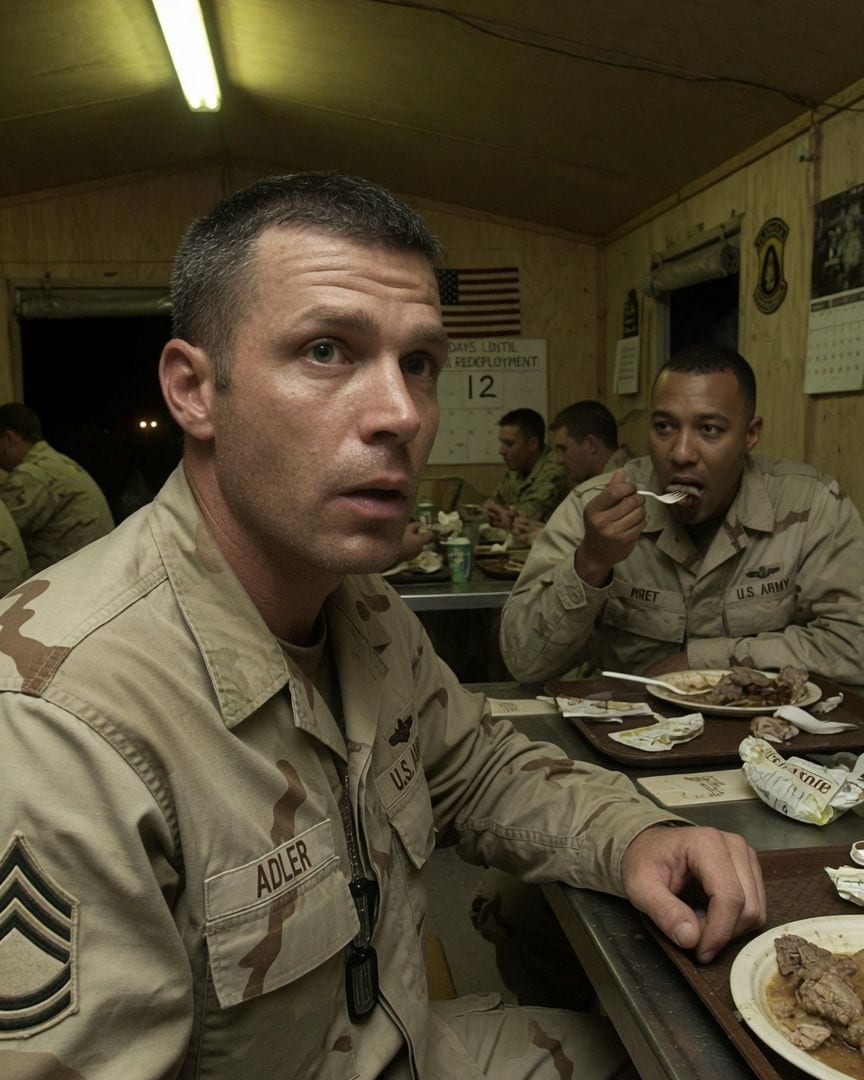
Sergeant Walter Adler sat in the mess hall, the stale air thick with the smell of overcooked meat and the low hum of conversation.
His unit was in its last month in country, the countdown to redeployment a palpable relief that settled over the outpost like a fine dust. Isaac Priest, his closest friend since basic, sat across from him.
Priest had gone down in the medevac after the wire two weeks ago, coming back walking, quiet but whole.
Adler had seen the reports; Priest had taken shrapnel in his right arm, a clean injury, nothing serious enough to warrant a medevac back to the States. He’d returned a few days later, seemingly none the worse for wear.
Adler knew Priest was right-handed down to the bone — fork in the right, rifle sighted right, everything right, a fierce, almost stubborn devotion to his dominant hand.
But tonight, Priest was eating left-handed, smooth and unthinking, the fork never once feeling strange in that hand.
He speared a piece of mystery meat, brought it to his mouth, then paused, his eyes scanning the mess hall as if searching for something. When Adler finally said something, a quiet, almost hesitant, "Hey, Priest, you alright?
Eating like a southpaw tonight," Priest set the fork down.
He looked at both his hands as if he’d never seen them before, then picked it back up with the left, continuing to eat as if nothing had happened, his eyes distant, fixed on some unseen point across the room.
A cold, faint prickle of unease started low in Adler’s gut.
Over the next few days, Adler began to subtly observe Priest. It wasn't just the left hand; that was the first, most jarring detail, but now others surfaced.
Priest’s gait was fractionally too even, a machine-like cadence where there used to be a slight, familiar drag from an old high school football injury.
His responses to direct questions were a beat too precise, devoid of the usual hesitations or casual interjections.
His eyes, usually warm with a quick wit, now held a flat, unreadable calm that seemed to absorb light rather than reflect it.
Adler tried to dismiss it as post-trauma shock, a delayed reaction to whatever he’d seen out there, but the unease gnawed at him, a dull ache behind his eyes.
He’d known Priest for too long, seen him through too much, to mistake this profound stillness for simple fatigue.
During a routine morning formation, Captain Kenneth Harlow called for a headcount. The company assembled on the dusty parade ground, shadows long in the early light.
Adler stood rigid in his rank, his eyes sweeping across the familiar faces, counting as Harlow began. He counted 149 men in the company, a number that stuck in his mind, sharp and clear.
Harlow announced, “One hundred forty-eight,” then paused, frowned, his brow furrowing as he quickly re-counted. A moment later, he announced again, more confidently, “One hundred forty-eight present and accounted for.” Adler, however, was still sure he'd seen 149.
He scanned the ranks again, his gaze catching on Priest, standing ramrod straight in his usual spot.
But then, for a fleeting, impossible moment, he could have sworn he saw Priest standing in two places at once – once in his usual spot, and again, briefly, in the rank behind him, a flicker of an identical figure.
He blinked, hard, and the second figure was gone, leaving only the dust motes dancing in the harsh morning sun, the silence of the parade ground feeling suddenly vast and empty.
Adler told himself it was the heat, the stress, the glaring light playing tricks on his eyes, but the cold dread tightened its grip.
A week later, the company assembled for redeployment processing, a meticulous check of every soldier against their manifest, the final administrative hurdle before heading home.
As Captain Harlow called out names from the roster, Adler stood near the back, watching the lines of men shuffle forward, uniforms crisp for the paperwork.
When Harlow called “Priest, Isaac,” Adler saw his friend step forward, crisp and perfectly aligned with the other soldiers moving through the station. Priest nodded, collected his papers, and moved into the next queue.
But then, as Harlow moved down the roster, calling out ‘Ramirez, Jose,’ Adler’s gaze drifted to a different line, to the third rank of men waiting for medical checks.
There, three paces to the left of where the first Isaac Priest had just been, stood another soldier.
This man was also Isaac Priest, identical in every detail, from the faded unit patch on his shoulder to the subtle scar above his right eyebrow, a hairline fracture Adler knew from a particularly rowdy bar fight years ago.
The second Priest stood perfectly still, his eyes fixed forward, a mirror image of the first, unmoving, unblinking. Adler’s own count, a frantic whisper in his head, was one hundred forty-nine.
The company First Sergeant, oblivious, called the final count, his voice booming across the dusty parade ground: “One hundred forty-eight present and accounted for.”
The image of the two Priests burned in Adler's mind, a photographic negative of impossible reality. He started checking manifests, supply logs, anything that could reconcile the numbers, looking for a ghost entry, a clerical error, a double-booked name.
He approached Staff Sergeant Naomi Patterson in admin, a meticulous NCO known for her ironclad records and a memory like a steel trap.
He casually inquired about recent headcount adjustments, citing a 'hunch' about some new redeployment protocols, trying to keep his voice light.
Patterson, initially dismissive, barely looking up from her monitor, grew wary when Adler pressed about Priest’s return-to-duty paperwork, specifically asking about the date it was filed. She confirmed Priest’s single entry, perfectly clean, filed two weeks ago.
"No issues, Sergeant Adler," she'd said, her eyes narrowing slightly.
Adler shifted his focus. He began observing other soldiers who had recently returned from isolated guard posts or minor injuries, anyone who had been briefly 'outside the system' before coming back.
He saw a medic, Specialist Brooke Harlow, who had twisted her ankle a week ago on a perimeter patrol, now walking with a flawless, unnatural stride, her previous limp completely gone.
He saw a comms tech, Private Elliot Bishop, back from a remote relay station after a generator failure, who now only spoke in clipped, pre-programmed phrases, his usual rambling jokes replaced by sterile efficiency.
The subtle, impossible wrongness was spreading, like a ripple through the unit, an infection of perfection. Adler’s unease ratcheted into a cold, specific dread that felt like a permanent knot in his stomach.
He began keeping his own meticulous, unofficial log of these observations, noting dates, names, and precise discrepancies in behavior, hiding it beneath his bunk mattress.
The very act of writing it down felt like a betrayal, and a desperate plea for sanity.
Adler’s persistent inquiries did not go unnoticed. A few days later, Captain Harlow called him into his office, a small, unadorned space smelling of stale coffee and cleaning solvent, a thin layer of fine desert dust coating every surface.
Harlow’s voice was calm, almost too calm, his hands clasped on his desk. He spoke of ‘combat fatigue’ and ‘stress-induced anomalies,’ suggesting Adler take some downtime, maybe a twenty-four-hour pass to the nearby support base.
“We’re all tired, Sergeant,” Harlow said, his eyes holding Adler’s with an unnerving steadiness, a depth that felt like he was looking through him, not at him. “Don’t let it get to you this close to home.”
The air in the small room felt heavy, pressing down on Adler, and a faint, acrid smell, like ozone after a lightning strike, seemed to cling to the Captain’s uniform.
Later that night, Adler found his personal gear in his bunk tent subtly rearranged.
His spare rifle cleaning kit, which he always kept in a specific order—bore snake, patches, solvent—was now neatly stacked, but the solvent bottle was on the wrong side.
His service record, the one he kept tucked under his mattress, had a faint, impossible smudge on the last entry, as if someone had tried to erase a detail that wasn't there, a ghost of an alteration.
He ran his thumb over it, but the paper was smooth, undisturbed. Then, as he walked back from the latrine, the desert night cold and still around him, he saw Priest standing by the perimeter wire, perfectly still, watching him.
Priest’s face was unreadable in the dim moonlight, but the way his head tilted, just a fraction, felt like a silent, impossible warning, a gesture Adler had never seen him make before.
Adler felt a cold certainty blossom in his chest: he was no longer the hunter; he was being watched, and the game had turned.
Adler knew he had to push. He cornered Naomi Patterson late one night in the administrative office, the only light coming from the green glow of a single monitor, casting long, distorted shadows.
He thrust his unofficial log of discrepancies onto her desk: the extra count, the subtly altered soldiers, the impossible smudge on his own record, the left-handed eating, the too-even gait. Patterson’s composure cracked.
Her face, normally impassive, her features sharp and angular, contorted with a mixture of fear and grim resignation, her eyes wide with something Adler couldn't quite decipher.
She admitted, her voice a hushed whisper, barely audible over the hum of the server rack in the corner, that similar 'errors' had occurred before. Not just once, but in previous rotations to this specific outpost.
She pulled out a dusty, unlabeled binder from a locked drawer beneath her desk, its covers warped with age. Inside were sparse, cryptic notes, hand-written by a former admin NCO, Staff Sergeant Colette Fontaine.
They detailed 'unreconcilable counts,' 'personnel reassignments' that made no sense, and 'unexplained transfers' that vanished from official records, leaving only blank spaces in the unit history.
“They always get it right, eventually,” Patterson whispered, her eyes wide, staring at the wall as if seeing something beyond it. “The system. It always corrects itself. No loose ends.” She showed him an entry from two years prior: 'Sgt.
Davies, M. — returned from patrol, altered. Count off by one. Resolved: transfer to unknown unit.' The handwriting was erratic, the ink faded, but the words were chillingly clear.
Adler felt the blood drain from his face, the realization hitting him like a physical blow. The pattern was clear. The 'errors' weren't errors at all.
They were a consistent, systemic anomaly, always occurring near redeployment, always at this outpost, always 'resolved' without a trace.
The meticulous accountability of the military, the very bedrock of their existence, was being subtly, impossibly subverted, and it had been happening for years, right here, in this remote, forgotten corner of the desert.
The fluorescent light above them flickered, briefly plunging the office into near darkness before snapping back on, making the shadows dance.
Adler, his hands trembling, flipped through Patterson’s unofficial log, the dry, brittle pages crackling beneath his fingers. He found a faded, brittle page, tucked into the very back of the binder, almost an afterthought.
It was an unofficial incident report, dated from the unit’s previous rotation at this very outpost, two years ago.
The report described a soldier returning ‘changed’ after an isolated perimeter watch, a headcount that wouldn’t reconcile, and a subsequent ‘administrative correction’ that made the soldier’s original record vanish as if he’d never existed.
The report was signed by Staff Sergeant Colette Fontaine, the admin NCO from that rotation, the same name Patterson had mentioned.
It ended with a single, chilling, hand-written phrase scrawled across the bottom in shaky script, the letters pressed hard into the paper: 'They fixed the count. They fixed him.'
Adler stared at the words, the implication detonating in his mind like a silent grenade. This wasn't just happening to Priest. It was a pattern, a cycle, an insidious mechanism tied to this place, and it had been repeating.
He heard a soft, deliberate knock on his door, not Patterson's usual hurried rap, but a slow, heavy thud, the kind that vibrated through the thin metal.
He froze, the report clutched in his hand, the words blurring, his breath catching in his throat.
Adler ripped open the door, his heart hammering against his ribs. Standing there was Captain Harlow, his face impassive, but his eyes held that same unreadable calm Adler had seen in Priest, a quiet stillness that felt utterly wrong.
Adler didn't hesitate. He thrust Patterson’s log and the old incident report into Harlow’s hands, detailing the discrepancies, the altered soldiers, the recurring pattern, his voice a frantic rush of words.
Harlow read through them, his expression unchanging, the faint, acrid smell of ozone growing stronger in his presence. “You’re close, Sergeant,” Harlow said, his voice flat, devoid of emotion, like a pre-recorded message. “But you don’t understand the system.”
Adler pointed to Harlow’s own left hand, which the Captain had been unconsciously resting on the doorframe, a hand that now seemed too perfectly still. “You’re right-handed, sir. I’ve seen you sign a hundred reports.”
Harlow looked at his hand as if seeing it for the first time, then slowly, deliberately, picked up the log with his left hand, turning the pages with an unpracticed grace.
“The system ensures accountability,” Harlow stated, his voice a monotone, each word perfectly articulated. “It cannot have discrepancies. Anomalies are corrected. Personnel that deviate… are replaced. It’s always been this way at this outpost. A self-correcting mechanism.
To maintain the illusion of order.” The full horror of it clicked into place for Adler: every 'corrected' count, every 'reassigned' soldier, every subtly 'off' individual, including Harlow himself.
The outpost wasn't just a base; it was a factory, processing and replacing, creating perfect, compliant soldiers, and the 'accountability' was a weapon, erasing the inconvenient truth and replacing it with a flawless lie.
Adler knew he was next. He spun, shoving past Harlow, and bolted for the motor pool, the Captain’s quiet words echoing in his ears.
His only chance was to get outside the wire, to somehow break the cycle, to escape the self-correcting mechanism.
He hot-wired a jeep, the engine sputtering to life with a cough of black smoke, and slammed it into gear, tearing towards the main gate, dust plumes billowing behind him. Floodlights swept across the perimeter, catching his frantic drive.
As he approached the gate, he saw them: a silent, perfectly aligned formation of soldiers, blocking the road, their faces shadowed, their movements eerily synchronized. Priest was among them, his face unreadable, his eyes dark, fixed on Adler.
Adler swerved hard, tires screeching on the hard-packed dirt, crashing through a secondary fence near a less-guarded section of the wire, tearing through rusted chain links and snapping wooden posts.
He abandoned the jeep, scrambling on foot through the scrub brush, the thorny branches tearing at his uniform, ignoring the pain. He could hear the perfectly synchronized footsteps behind him, too many, too even, closing in.
He reached a dilapidated, forgotten bunker near the far end of the perimeter, a relic from an older conflict, its concrete walls crumbling, half-buried in sand.
Inside, bathed in the eerie glow of a single bare bulb hanging from a frayed wire, he saw it: a row of identical, perfectly formed bodies, lying on cots, skin smooth and unblemished, eyes closed, utterly blank.
They were like molds, waiting for a purpose. One of them had a service record laid out on its chest, pristine and unwritten, next to a brand-new, unblemished dog tag, waiting for a name.
This was the artifact that could not exist, the physical proof of the replacements, the ultimate, horrifying accounting.
As the footsteps grew louder, closing in on the bunker, casting long, distorted shadows at the entrance, Adler saw Priest standing in the doorway, blocking the exit, his face a perfect, empty mirror of his friend.
Then, a hand, strong and unfeeling, closed on Adler’s shoulder.
Sergeant Walter Adler's jeep was found abandoned near the perimeter wire, its engine still warm, its front bumper tangled in the fence. A brief search was conducted, officially concluding with 'desertion under stress,' a quiet stain on his record.
The unit redeployed on schedule, the final manifest perfectly reconciled. A new Sergeant Walter Adler was among them, quiet but whole, perfectly accounted for.
A month after the unit’s return, Walter Adler’s older sister, Elena, called him, worried he hadn’t checked in for weeks. The man who answered sounded calm, almost serene, his voice subtly flatter than she remembered.
She mentioned how he’d always been so particular about his right hand, even as a child, how he’d always used it for everything. He chuckled, a soft, unfamiliar sound that lacked any real warmth.
She asked if he was eating well. He said, "Of course. With both hands, if I choose."
If this one got to you
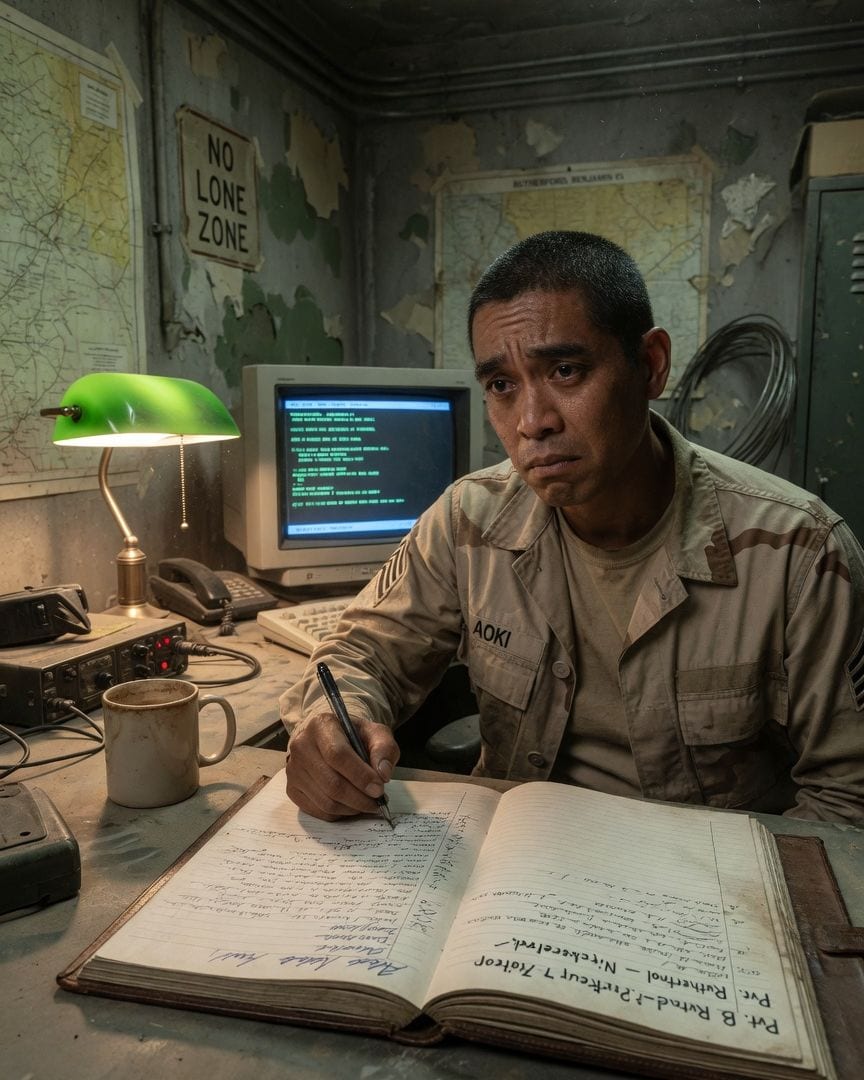
Sergeant Aoki's four-man patrol hears a fifth voice answer their count. A fresh name then appears in the duty log beneath his own signature.
Sergeant Isaac Aoki's final rotation at Outpost 7 was nearing its end, with relief due at dawn. On his four-man night patrol, he broke an old superstition, counting his team aloud in the dust-choked desert. A fifth voice answered, clear and unsettling, from the moonless dark. Back inside the bunker, the chill deepened when a fresh name appeared in the duty log, 'Pvt. B. Rutherford,' beneath Aoki's own signature, a soldier no one knew. Even more disturbing, Aoki later found his own signature on a valor citation for Rutherford, an event he never witnessed.
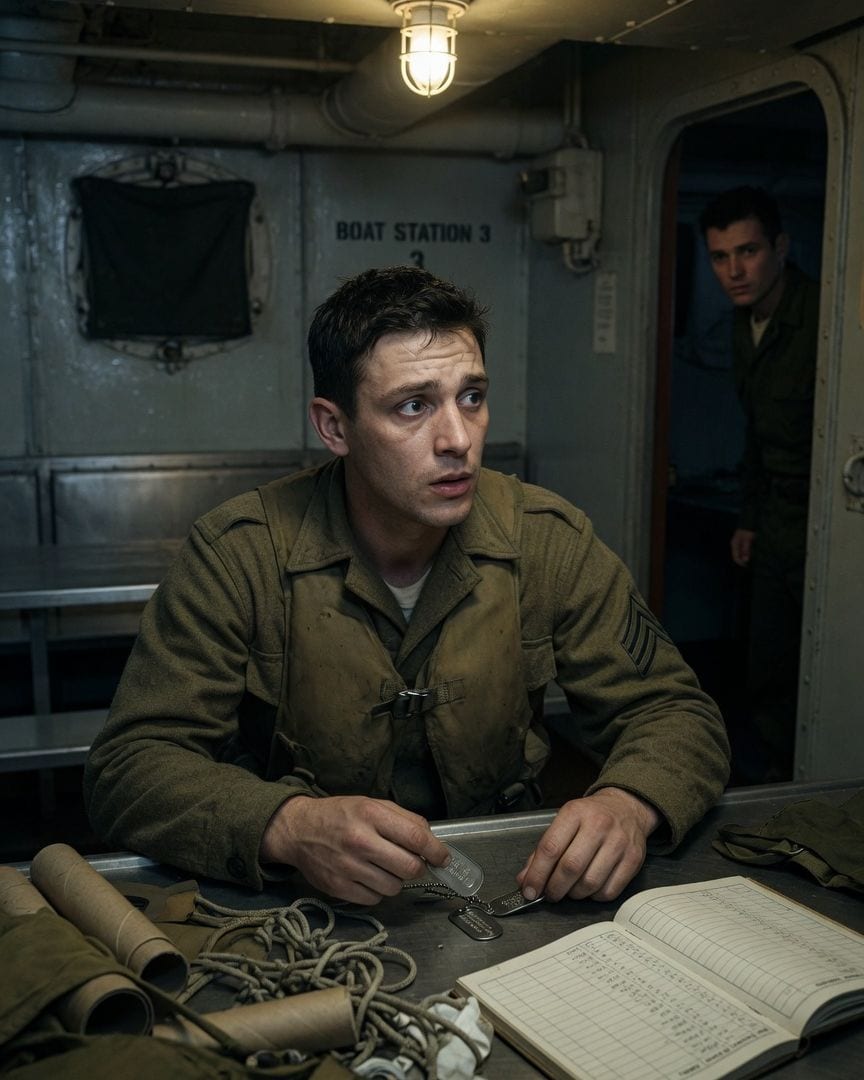
Corporal Desmond Novak counted 402 men onto his last troopship crossing. At boat drill, 403 stood in formation. Then he found two identical dog tags for the same soldier.
Corporal Desmond Novak was meticulously squaring away his last troopship crossing before transfer to shore duty on the USS Vance in 1943. He carefully counted 402 infantrymen onto the blacked-out vessel. But at the first boat drill, under dim emergency lights, 403 men solidified in formation, an impossible count that gnawed at him. Despite cross-referencing every roll, the extra man was always there, yet never the same twice. Then, tucked beneath rope in an emergency kit, Novak discovered a second, identical dog tag for Private Adam Hughes, a man he'd just seen in line, and a cold dread began to solidify.
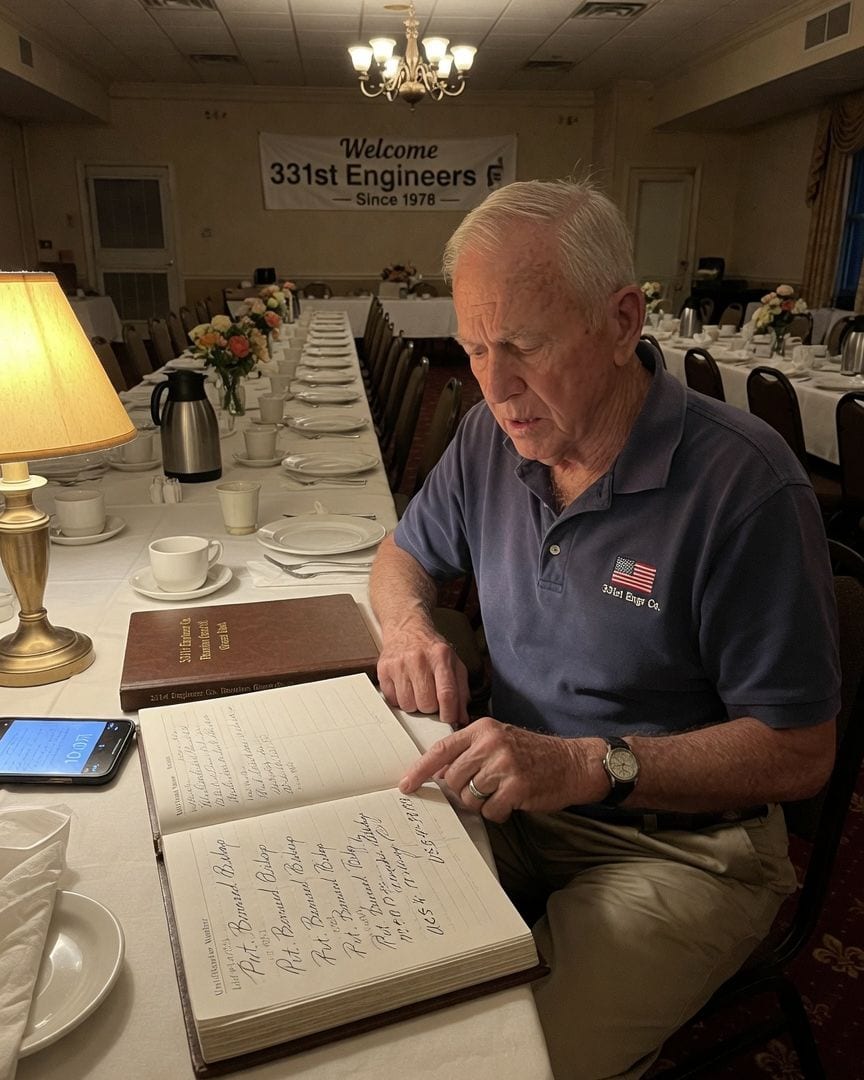
Retired Sergeant Odis Trumbull found a reunion guest book signed by a dead man. His service number was for a classified unit, not his own.
Retired Sergeant Odis Trumbull arrived at his annual company reunion, a tradition held in a Biloxi hotel ballroom since 1978. He sat alone for three hours, watching thirty empty chairs, each a ghost of a comrade he had personally buried over four decades. When the guest book arrived, Odis found thirty-one signatures, one for every man on the rolls. The ink on the last entry, for Private Bernard Bishop, was still wet. Yet, Odis had carried Bishop's coffin in 1976, two years before the reunion even began, and his service number matched a classified Cold War command. As Odis ran his thumb over the impossibly fresh ink, a cold dread began to settle.
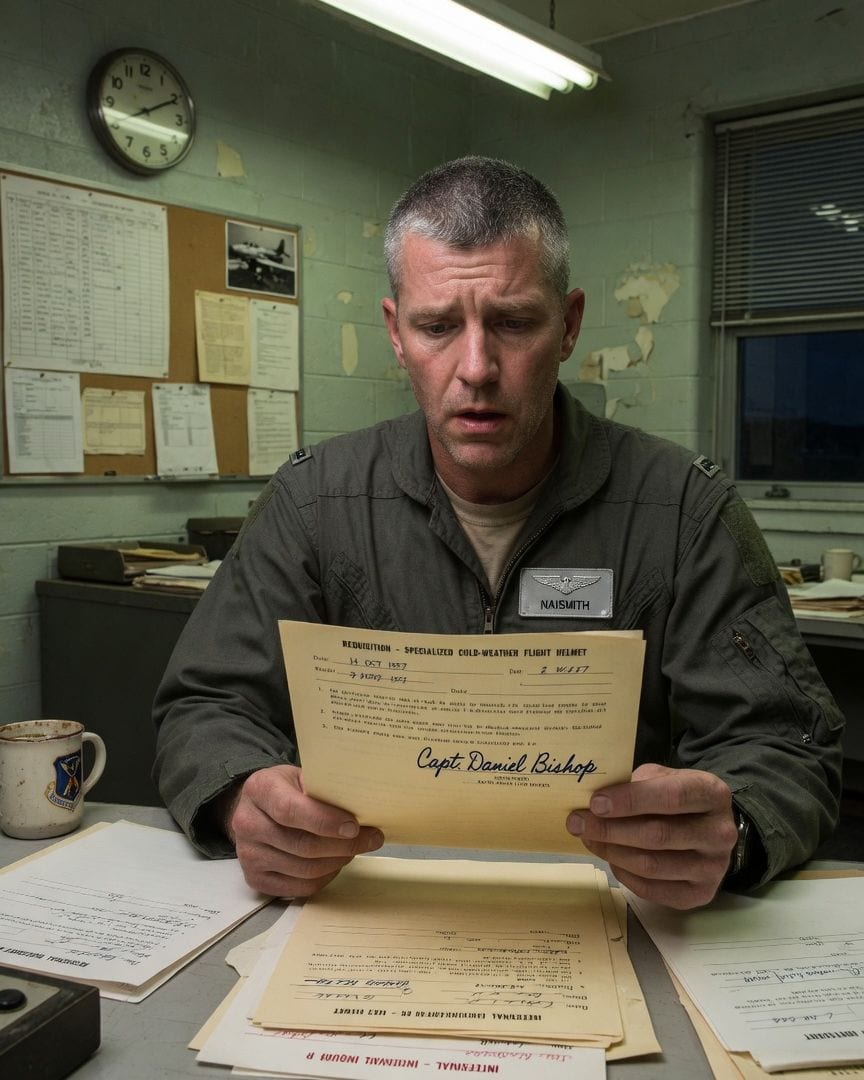
A Cold War Colonel reviews a missing pilot's file and finds Captain Bishop's signature on a form dated weeks after he vanished.
Colonel Ward Naismith faced the grim task of reviewing Captain Daniel Bishop’s personnel file, a routine chore for a man listed as Missing in Action. Bishop had vanished days after he and Naismith chased an impossible, silent disc over Lake Superior, leaving only an empty patch of air and a knot of unease in Ward's gut. Sifting through commendations, Ward found a requisition for flight gear and a maintenance sign-off, both dated *after* Bishop’s disappearance. The true chill came with the requisition for a specialized flight helmet, bearing Captain Bishop’s unmistakable signature, weeks after he was presumed lost. How could a man presumed lost have signed anything?
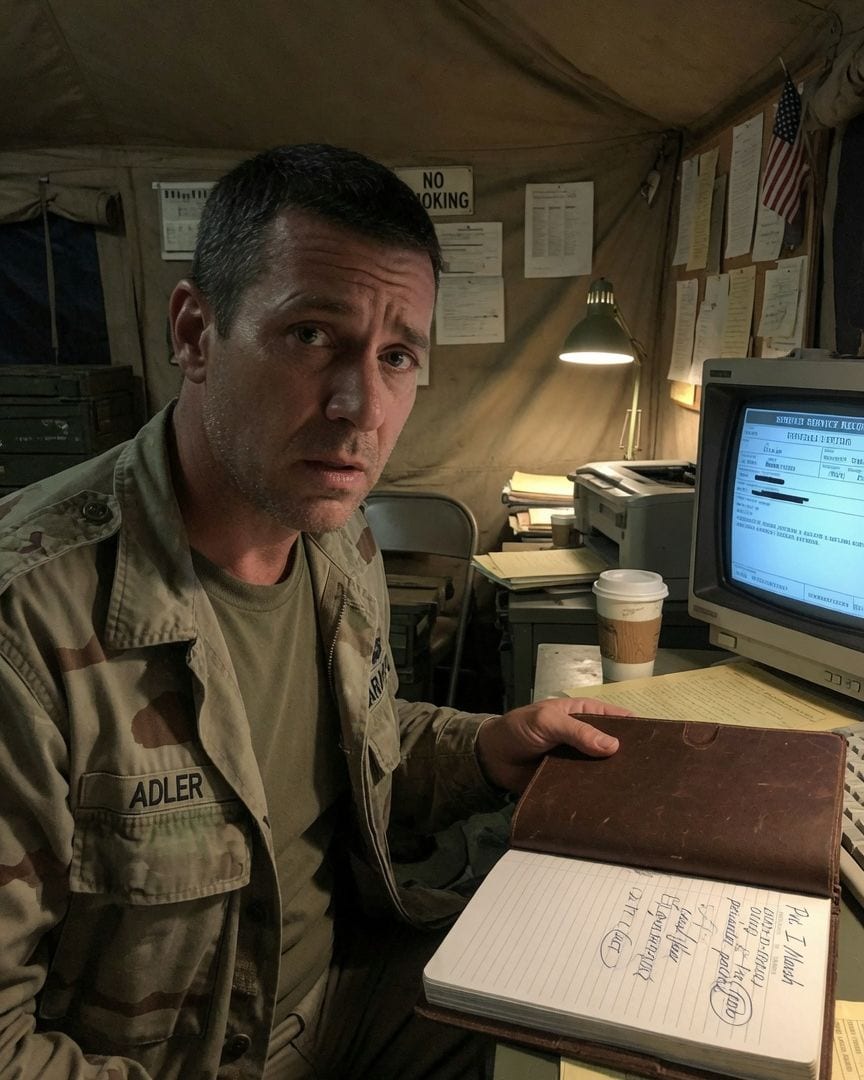
Sergeant Gordon Adler found his closest friend's signature logging a patrol shift. The man was miles away in medevac.
Sergeant Gordon Adler felt a cold unease watching his closest friend, Isaac 'Priest' Marsh, back from medevac. Marsh, always right-handed, now ate with a smooth, unthinking ease from his left, his eyes vacant. Later, checking unit records, Adler found Marsh’s precise signature logging a full patrol shift from three weeks prior. But that date was squarely in the middle of Marsh's medevac leave, an impossible entry. When confronted, Marsh offered a slow, unblinking smile that never reached his eyes, his gaze drifting to something unseen behind Adler.
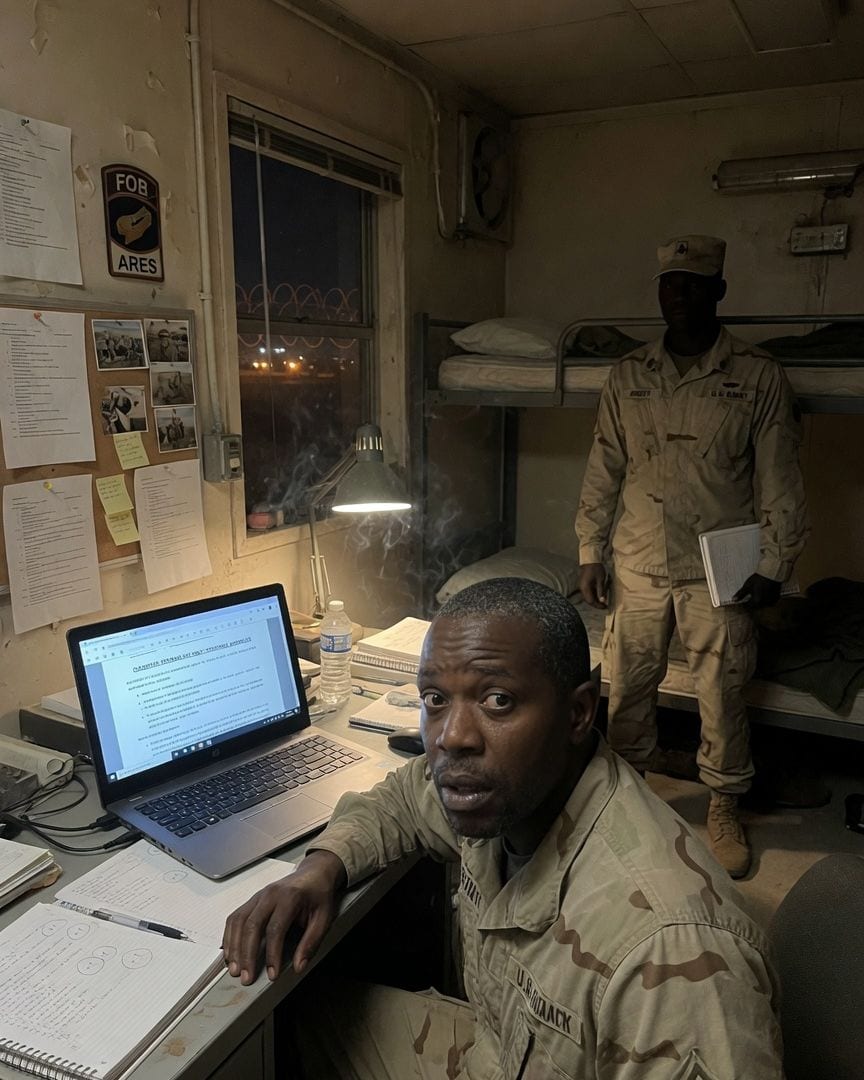
On his final rotation home, Sergeant Abbott counted his platoon: one man too many. The base’s secret files called them 'phantom units,' always watching him.
Sergeant First Class Malcolm Abbott was on his final rotation at FOB Ares, ready for transfer home. He called his platoon to formation, watching the sun break over the desolate desert as he counted each man. But the numbers didn't add up; there was always one extra soldier, standing at rigid attention, perfectly aligned with the others, yet only Malcolm could see him. Despite cross-referencing every manifest, the phantom remained, its face obscured in shadow, a silent sentinel that defied all logic. What secret did the base archives hold about these unacknowledged personnel?