Three hours from his flight home, a researcher found his name on a Cold War project memo, dated his birth year, decades before he was there.
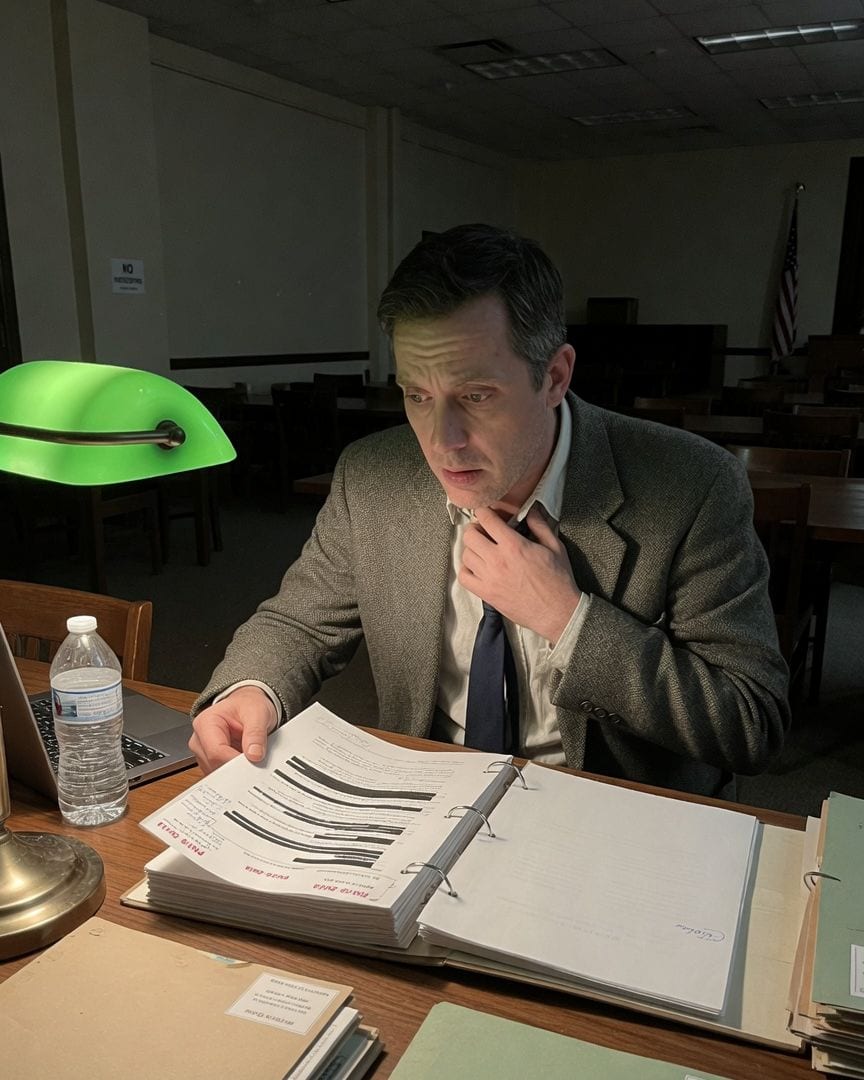
Marcus Threlfall, 38, hunched over a heavy binder, felt the dry ache in his throat.
Three hours from his flight home, he was determined to finish this batch of declassified British-US liaison files from 1946 at the National Archives in College Park.
The reading room was quiet, only the soft hum of the ventilation system and the rustle of turning pages filling the vast space.
A single green lamp on his table cast a focused circle of light, leaving the rest of the room in deepening shadow. Halfway down the third folder, a debrief transcript, cleared and lightly redacted, caught his eye.
The official header stated the date: June 20XX, a date eleven months in his own future.
He scanned the text, his brow furrowing. It detailed an interview with an unnamed subject. The description of the setting was unnerving: a reading room, a single green lamp, a man in a gray tweed coat.
Marcus looked down at his own worn gray tweed jacket. He checked the page number, then the file number. The transcript described the precise page he was holding.
The subject, whose name was withheld, had paused the interview to request a glass of water.
A sudden, intense thirst tightened Marcus’s throat, a cold, dry sensation that had nothing to do with the air conditioning or the dust of old paper.
He swallowed, his mouth cotton-dry, and found himself reaching for the water bottle he’d placed beside his laptop.
Marcus rationalized. A misfiled document, a bizarre coincidence, a clerical error, perhaps a draft never intended for release. He flipped back, then forward through the file, searching for an explanation, a note, anything to ground the impossible detail in reality.
The debrief was part of a series related to a Royal Air Force pilot, code-named 'Sparrow,' who had reported an impossible contact over the North Sea in March 1946.
The file included grainy radar logs, flight path deviations that made no sense, and a brief, almost dismissive mention of 'unidentified aerial phenomena.'
No gun camera footage, no recovery reports, just a quick administrative burial, the official conclusion being 'pilot error due to disorientation.' The pilot's subsequent psychological evaluation was boilerplate, closing the case with an entry on stress-induced hallucinations.
But the debrief from his future… that was different. It stuck in his mind, a sharp shard of wrongness. Marcus focused on the subject's request for water, a trivial detail now imbued with profound, unsettling significance.
He cross-referenced the file's internal numbering system, a labyrinthine sequence of letters and digits that usually pointed to related documents or further research leads.
One number, 'PN-78-Delta,' appeared repeatedly in the margins of various related documents, always stamped in a different, later hand than the original annotations, almost an annotation to the original incident, not part of it.
It felt like a deliberate breadcrumb, too specific to ignore, too consistently placed. He accessed the archives’ digital catalog, typing in the alphanumeric code, his fingers hesitant on the keyboard.
He pulled the internal memo referenced by 'PN-78-Delta.' It was a heavily redacted document, dated 1985, from a classified initiative designated 'Project Nightingale.' The memo discussed 'temporal resonance' and 'pre-cognitive sensitivity' in individuals exposed to certain 'anomalous events.'
Marcus’s heart hammered a frantic rhythm against his ribs. The air in the quiet room felt heavy, cold, pressing in on him.
He scanned a list of 'potential subjects' appended to the memo, a roster of names and dates of birth. His gaze snagged on an entry near the bottom. 'THRELFALL, MARCUS. DOB: 1985.' The date of the memo.
His own birth year. He stared at his name, printed in a cold, official font, decades before he had ever set foot in these archives, listed as a candidate for a project he'd never heard of until today.
The green lamp cast long, impossible shadows across the page.
Marcus missed his flight. The dread had solidified into a cold, hard knot in his stomach, a physical weight that settled deep inside him.
He requested access to all files tagged 'Project Nightingale,' citing his clearance and a fabricated research request for a paper on Cold War-era psychological operations. The system, to his surprise, granted it. No questions asked.
He spent the next two days immersed in a hidden history, a labyrinth of redacted reports and thinly veiled euphemisms.
He found dozens of similar 'unhappened' incidents: radar contacts vanishing from scopes, impossible aerial maneuvers by objects that defied physics, and crash sites found inexplicably clear or already secured by unknown personnel before official teams arrived.
The common thread was 'temporal resonance,' a vague term for individuals who seemed to 'echo' or 'perceive' these anomalies across time.
He recognized names from the 1946 file — not the pilot 'Sparrow,' but the intelligence handlers, the quiet, meticulous record-keepers, now appearing decades later in Project Nightingale documents, somehow still active, still observing.
He saw references to 'observers' and 'sensitives,' people whose lives intersected with these events in uncanny ways, often without their conscious knowledge.
He found a research paper, authored by a Dr. Fiona Forsythe, detailing the 'predictive efficacy' of these temporal echoes, suggesting that certain events were not just observed, but pre-ordained.
Each file he opened tightened the invisible net around him, not just conceptually, but with a creeping sense of inevitability.
The question was no longer what was happening, but why his name was here, and what it meant for his own timeline.
His intense focus on the Project Nightingale files did not go unnoticed. On his third morning, he found a small, neatly folded note tucked into his current file box, nestled beneath a stack of printouts.
It wasn't official stationery, just a plain slip of paper, like one torn from a notepad. 'Some things are best left filed. The past is not a suggestion.' The message was unsettlingly calm, the handwriting precise, almost calligraphic.
He looked up, scanning the reading room, the fluorescent lights buzzing faintly overhead. Most patrons were engrossed in their own research, their heads bent over screens or open binders.
But across the room, at a table near the reference desk, sat an older man, Bernard Fairfax, a senior archivist Marcus had seen many times during his visits.
Bernard often sat there, seemingly absorbed in a thick volume, occasionally making notes in a small leather-bound journal. But his gaze, when it occasionally lifted from his book, seemed to settle on Marcus with an unnerving, knowing intensity.
Bernard offered a faint, almost imperceptible smile, the kind that didn't quite reach his eyes, then returned to his book.
Later that day, as Marcus returned from a quick lunch break, he noticed his chair was subtly angled differently from how he'd left it, and a folder he'd left open, marking his place, was now closed.
The message was clear: he was being watched, and someone knew exactly what he was chasing. The room itself seemed to hold its breath.
Marcus cornered Bernard Fairfax at the end of the day, as the archivist was meticulously locking up cabinets, the soft clicks echoing in the emptying room. 'Mr. Fairfax,' Marcus began, holding up the anonymous note.
'I think you know something about Project Nightingale.' Bernard turned slowly, his expression unreadable, a faint, almost pitying smile playing on his lips. He held a small brass key ring in one hand, jingling it softly. 'Marcus.
You've been very busy.' He didn't deny the note. He didn't even acknowledge it directly. His gaze was steady, calm.
'Project Nightingale isn't about what happened, Marcus. It's about what will happen. And who. Certain individuals possess a unique 'temporal resonance.' They are drawn to these events, or rather, the events draw them.
The files you're reading aren't just records; they're echoes. Predictions. Or perhaps, instructions.' Marcus felt a chill spread through him, colder than any air conditioning, prickling his skin. 'My name. On that list from 1985.
It means I'm one of them, doesn't it?' Bernard nodded slowly, deliberately. 'You're not just an observer, Marcus. You're a conduit. The debrief transcript you found from your future? That wasn't a mistake. It was a pre-echo.
An observation of an observation. The 'Thing on the Scope' events generate these distortions, and some people, like you, are intrinsically linked to them. You've always been part of the file, Marcus. You just didn't know it until now.'
He gestured towards a discreet, unmarked door in the back of the archives, almost invisible against the gray wall. 'There's a deeper archive. Your file is in there. It's time you saw the rest.'
With a heavy heart, Marcus followed Bernard into the deeper archive.
The door swung open silently, revealing a space colder and smaller than the main reading room, filled with rows of unmarked metal cabinets, their gray surfaces gleaming faintly under bare fluorescent bulbs.
The air was still, heavy with the scent of ozone and old paper. Bernard pointed to a specific drawer, third from the top, its handle polished smooth by countless hands. 'You'll find what you're looking for.'
Marcus pulled it open, his fingers trembling, the scrape of metal on metal loud in the silence. Inside, a single, thick file. Labeled: 'THRELFALL, MARCUS.'
He opened it. It contained a comprehensive dossier: his full psychological profile, detailed personal history, even records of childhood events he thought were private observations, things only he would remember.
There were dates, times, and locations of his life, meticulously documented, annotated with coded references he didn't understand.
Then, deep within the file, he found it: a debrief transcript, dated June 20XX, eleven months in his future, identical in every detail to the one he had first discovered in the 1946 file.
The green lamp, the gray coat, the request for water. But this version contained an additional, chilling paragraph. The interviewer had asked the subject for his service number.
And the subject, Marcus Threlfall, had calmly recited a string of digits, a number that Marcus now recognized as the operator's own unique ID, sealing his fate not as an observer, but as a knowing, complicit subject within the very system he had sought to understand.
The file confirmed it all. Project Nightingale wasn't just observing temporal anomalies; it was a self-fulfilling prophecy machine. The 'Thing on the Scope' phenomena weren't random occurrences; they were recurring events that generated specific temporal distortions.
Certain individuals, like Marcus, possessed the 'resonance' to perceive these distortions, making them both witnesses and subjects.
The system meticulously tracked these 'sensitives' from birth, their lives unfolding along predetermined paths that led them to these archives, to these files, to these revelations.
The debrief transcript from his future wasn't a prediction of an external event, but a record of his own pre-ordained capture within the system.
The 'subject' from the 1946 file, who had asked for water, was merely another 'sensitive' caught in the same cycle, his own future debrief echoing back in time through the archives.
The machine didn't just bury records; it created them, signed them, and then ensured they were fulfilled.
Every clue Marcus had found, from the initial debrief to his name on the list, clicked into place with horrifying coherence, forming a picture of inescapable predestination. He was not just reading a file; he was reading his own script.
Marcus felt a surge of desperate defiance, quickly smothered by a chilling sense of futility. He couldn't destroy the files; they were digital, redundant, replicated across secure servers, probably encrypted beyond anything he could access.
He couldn't leak them; who would believe him, and to whom? The world was too vast, the system too pervasive.
Bernard Fairfax reappeared at the entrance to the deeper archive, a faint, understanding smile on his face, as if reading Marcus’s thoughts. 'There is no escape, Marcus. The file is not paper. It's a pattern. A truth.
And you are part of it.' Bernard’s voice was calm, almost soothing, stripping away any last vestiges of Marcus's resistance.
Bernard led Marcus to a reinforced display case in the center of the deeper archive, a stark, obsidian monolith that seemed to absorb the light.
Inside, on a velvet cushion, rested an artifact that defied all reason: a jagged, dark metallic shard, no larger than his palm. It was smooth to the touch, impossibly light, yet resistant to any scratch, any attempt at damage.
It felt ancient, yet brand new. 'A piece of one of the 'Things on the Scope,'' Bernard explained, his voice hushed with reverence. 'Recovered from an incident in 1978. It shouldn't exist. The alloy is impossible.
We still can't identify its atomic structure. But it is real. And it is dated.' Marcus leaned closer. Engraved on the shard, in tiny, precise script, was a serial number.
He recognized it from an obscure entry in his own Project Nightingale file, a brief, cryptic reference to a future recovery effort he would be involved in.
The ordinary explanation died for good, suffocated by the cold, metallic reality in front of him. The object was solid, checkable, and undeniably real, tying him to an impossible future event he had not yet lived.
Marcus did not leave the archives. He quietly resigned from his previous position, his flight home long forgotten, a distant, irrelevant memory.
He took up a new, unlisted role within Project Nightingale, a silent observer in the deeper archive, his name now an active entry in the very system he had once sought to unravel.
He now sat among the rows of classified files, methodically cross-referencing new anomalies, identifying new 'sensitives,' noting the first faint temporal echoes in their nascent files.
He had become one of 'the ones who knew,' his dread a constant companion, a quiet hum beneath the surface of his new, pre-ordained life.
He would live out his days filing the lives of others, knowing his own was already complete, signed and sealed, every significant detail a foregone conclusion.
He sat in the reading room, the single green lamp burning steadily, just as the debrief transcript had described.
A new file lay open before him, detailing a young woman in rural Nevada, a new 'sensitive' whose life was now being charted, her future path already beginning to ripple through the temporal records.
He felt a familiar dryness in his throat, a sudden, inexplicable thirst. He reached for the glass of water on his table, his hand steady, his movements precise. He understood the cycle now, the intricate, inescapable pattern.
Months later, a new junior archivist, Vanessa Montgomery, found a recently signed entry in a Project Nightingale log. It was a debrief transcript, dated yesterday, from a subject who had requested water. The subject's name was Marcus Threlfall.
The transcript noted that when asked his service number, the subject simply smiled faintly and read back the operator's own unique ID.
If this one got to you
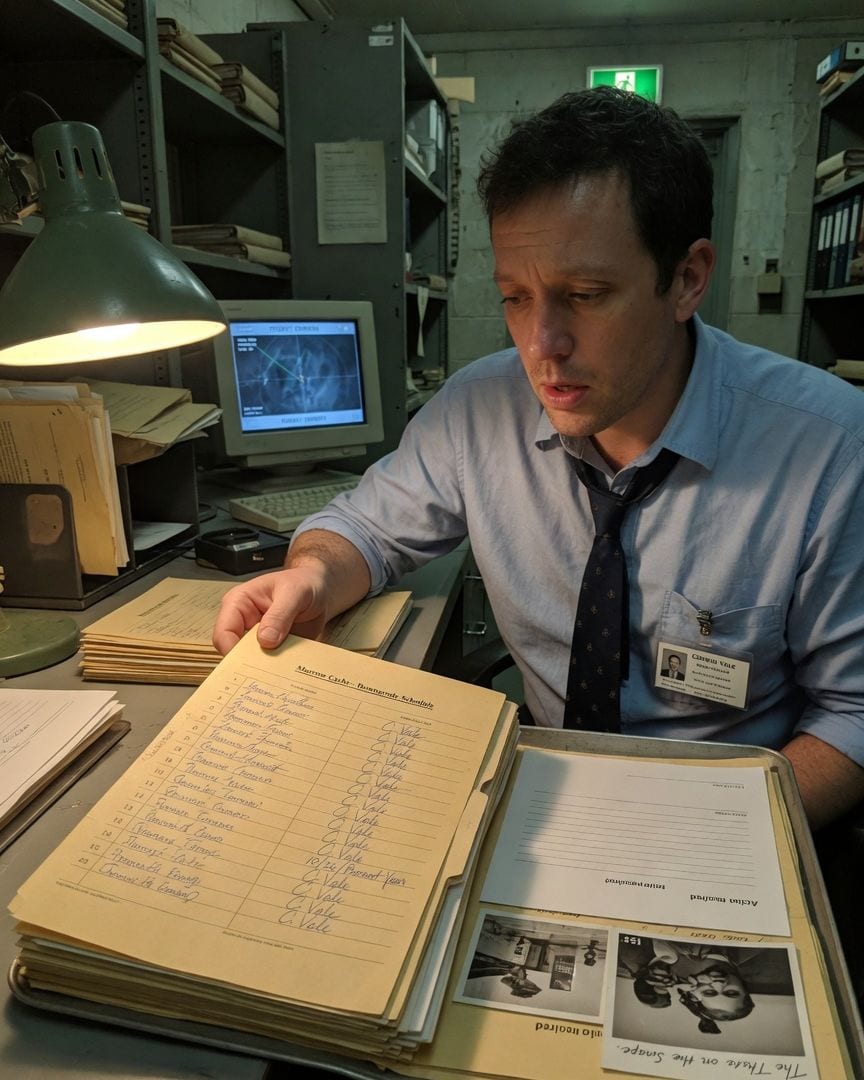
Chief Archivist Corwin Vale found his own signature on a Cold War vault log, dated 1988. He was years from even working there.
Chief Archivist Corwin Vale aimed to unravel the bureaucratic enigma of the Marrow Cache file, perpetually extended since 1972. In the cold, ozone-scented vault of Fort Ruthven, he sought to discover who was signing off on the endless delays. His breath hitched when he found his own signature on the log, dated this very morning, despite being home sick. But then, a chilling discovery: another identical signature, dated 1988, years before he was even employed. What impossible hand was tracing his name through time?
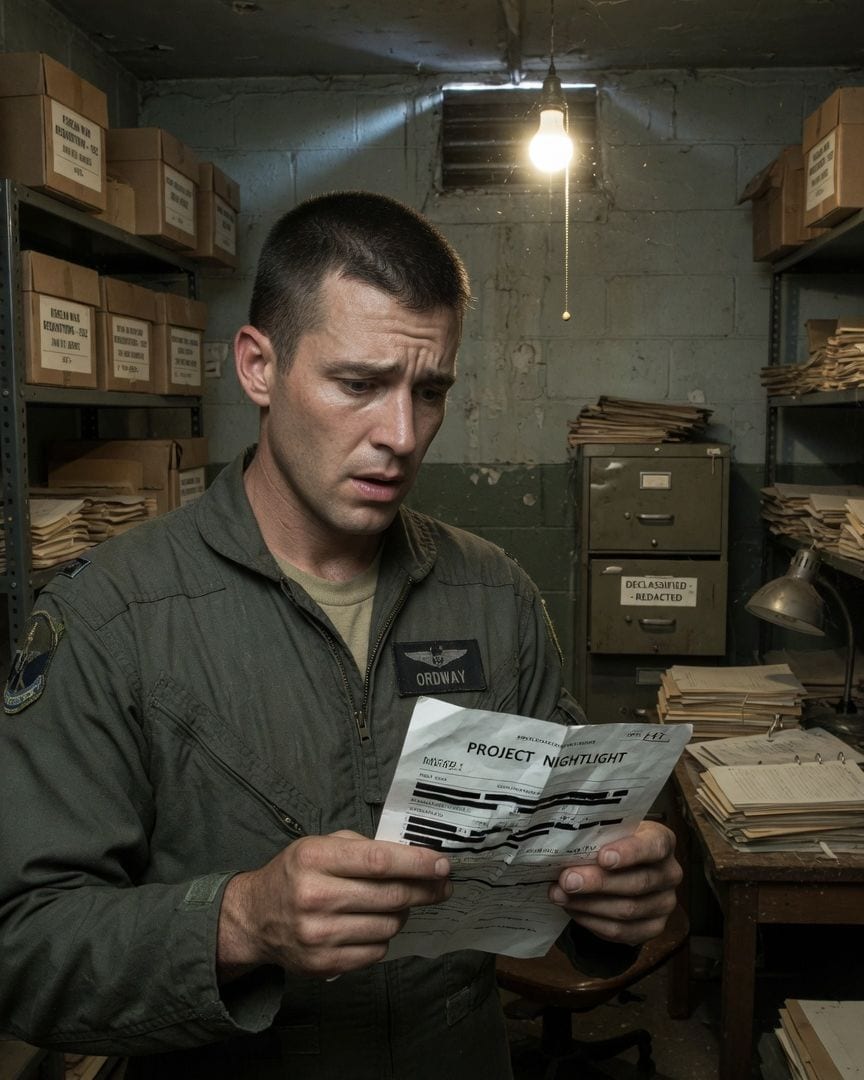
A Cold War pilot's F-104 Starfighter was shadowed by an impossible object. Weeks later, a secret memo referenced his own service number for 'pilot reassignment protocols.'
First Lieutenant Cal Ordway soared over the Mojave in his F-104 Starfighter in 1962, the night sky a familiar canvas. But that night, one 'star' broke formation, pulling alongside his wing and mirroring his every impossible maneuver. His instruments confirmed the silent, unblinking object, defying all known physics. After filing his precise report, Cal found his flight log altered to 'no incidents,' radar tapes corrupted, and a superior advising him to 'let it go.' Driven by his training, he uncovered a heavily redacted memo referencing 'Project NIGHTLIGHT' and, chillingly, his own service number for 'pilot reassignment protocols initiated.' Was he merely a witness, or already a subject in a much deeper secret?
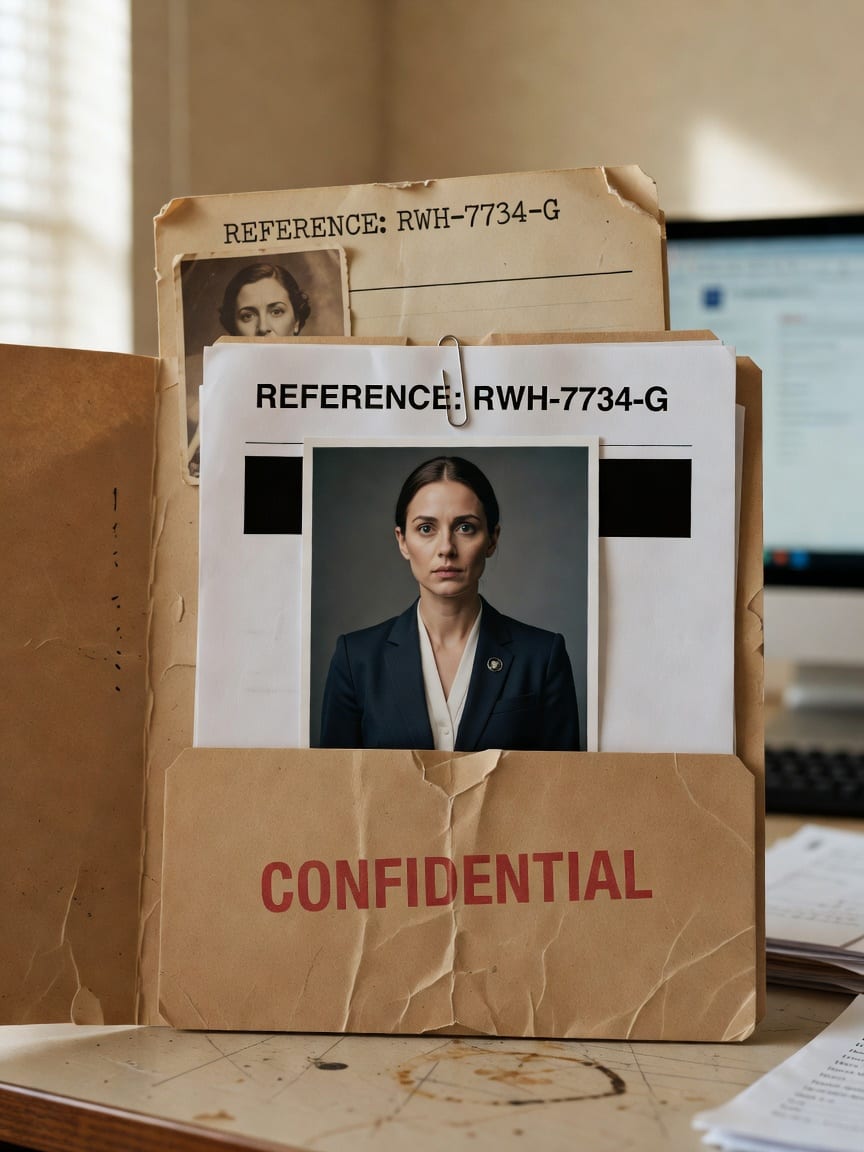
My security file was opened nine years before I was born. Its note said: 'subject not to be briefed'.
Auditing company digital records was routine until I pulled up my own personnel file. It clearly showed a 'Date Opened' nine years before I was born, yet bore my exact name and reference number. Below, an assessor's note from that impossible year mentioned a 'previous holder' and ordered the 'subject not to be briefed,' sparking a cold thrum in my chest.
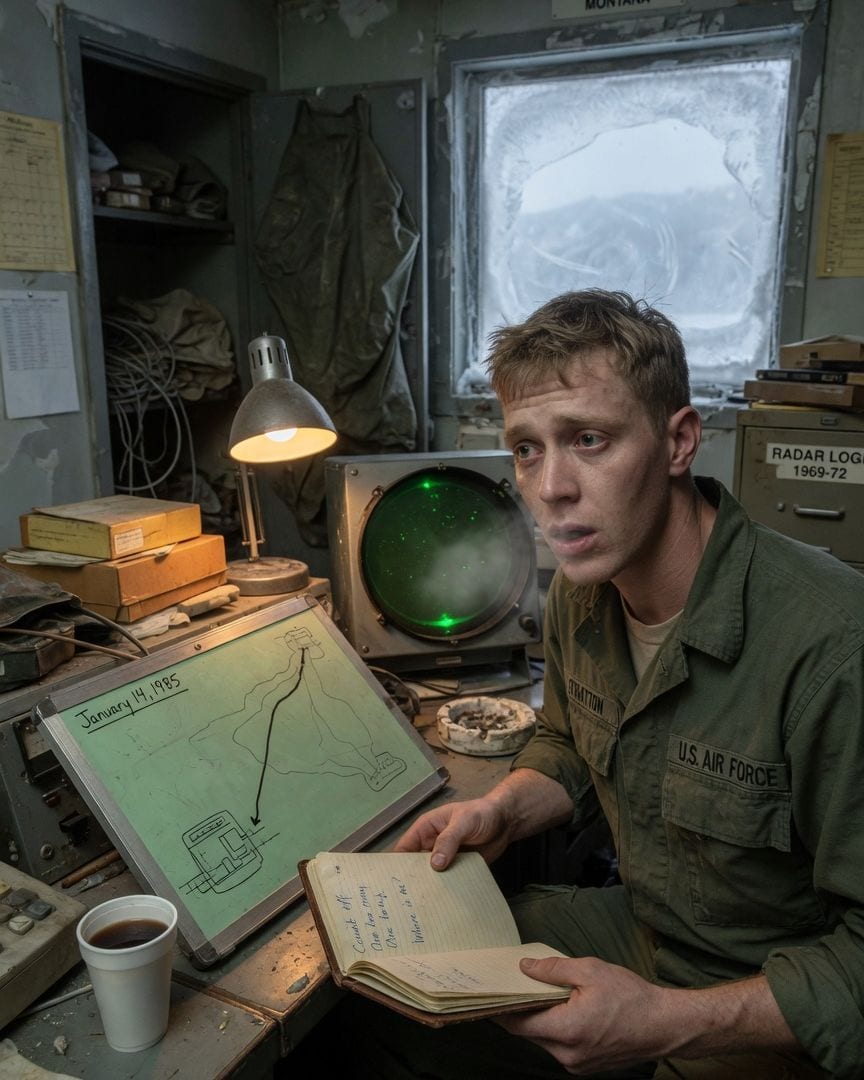
Airman Lars Stratton found an old Cold War manifest listing one name twice: 'Bernard Radcliffe' transferred and 'Bernard Radcliffe' still present.
Airman Second Class Lars Stratton was counting down his final weeks at Echo Station, a desolate Cold War outpost due for mothballing. He longed for home, far from the bitter Montana winds and the constant hum of static. Inside the dim radar shack, he logged the usual nightly ghost blip, a faint contact appearing at 2300, just as it had every winter since 1987. This night, a metallic tang like old blood lingered in the air, raising the hairs on his arms. Seeking distraction, Lars later discovered a leather-bound logbook from 1971, detailing the same 2300 contact, but with chilling notes and a manifest listing one airman's name, Bernard Radcliffe, twice—once transferred, once present. Was he truly alone in the silent, remote station?
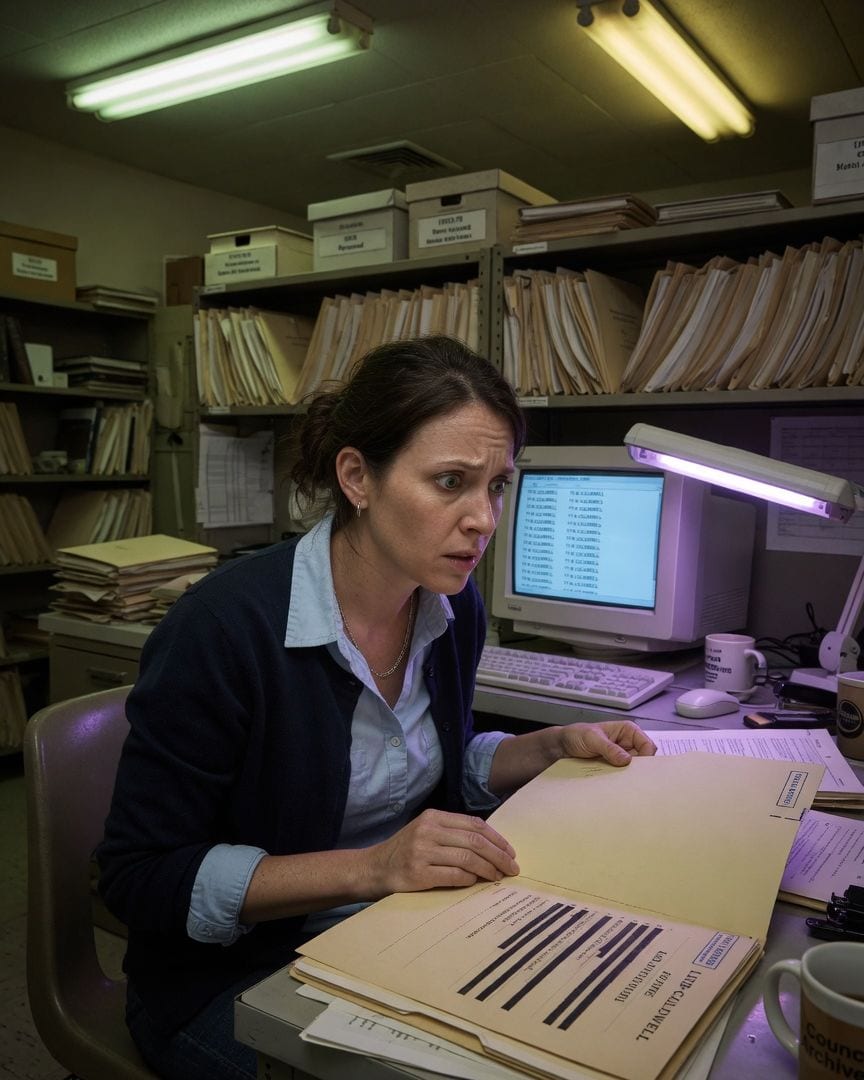
My employer's security file holds a vetting report on me dated nine years before I ever applied. It has my full name and my parents' address — with only one line, the source who referred me, blacked out.
Working a routine data audit, I pull my own security file. The issue date is nine years before I even applied for the job. Then, hidden within an old archive file, I find my current address etched under a blacked-out line.
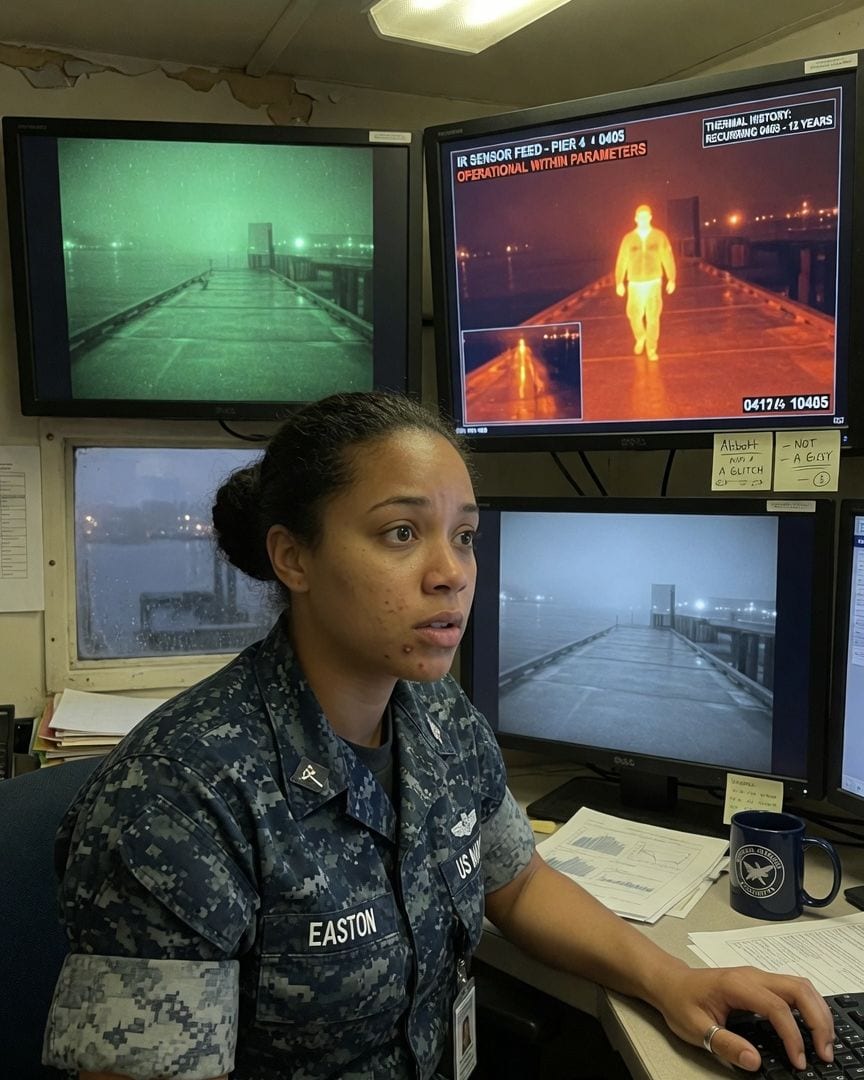
A security officer's camera sees nothing where her sensor logs a man-sized heat bloom on Pier 4, repeating at 0405 every night for twelve years.
Petty Officer Judith Easton, 24, was counting down her last month at Naval Base Kitsap-Bangor’s Pier 4 before a coveted transfer to Pearl Harbor, the security station air thick with the hum of electronics and the briny scent of the Puget Sound. At 0405, her primary IR sensor feed registered a distinct, man-sized heat bloom moving along the pier's caisson, but her optical camera showed only empty, mist-shrouded concrete where the sensor insisted a body moved. What began as a baffling glitch soon turned chilling: the thermal history revealed this impossible heat signature had walked the identical path at 0405 every night for twelve years, dismissed by others but secretly documented by a former officer. His subsequent 'stress-related medical leave' and a sealed 'Project NIGHTWATCH' file now hinted at a hidden truth far beyond a simple sensor error. What exactly had Petty Officer Abbott known?