A Cold War Chief Petty Officer watched the crane haul 60 tons of seamless metal, not the lost F-4 jet, but inside was the missing pilot's flight suit.
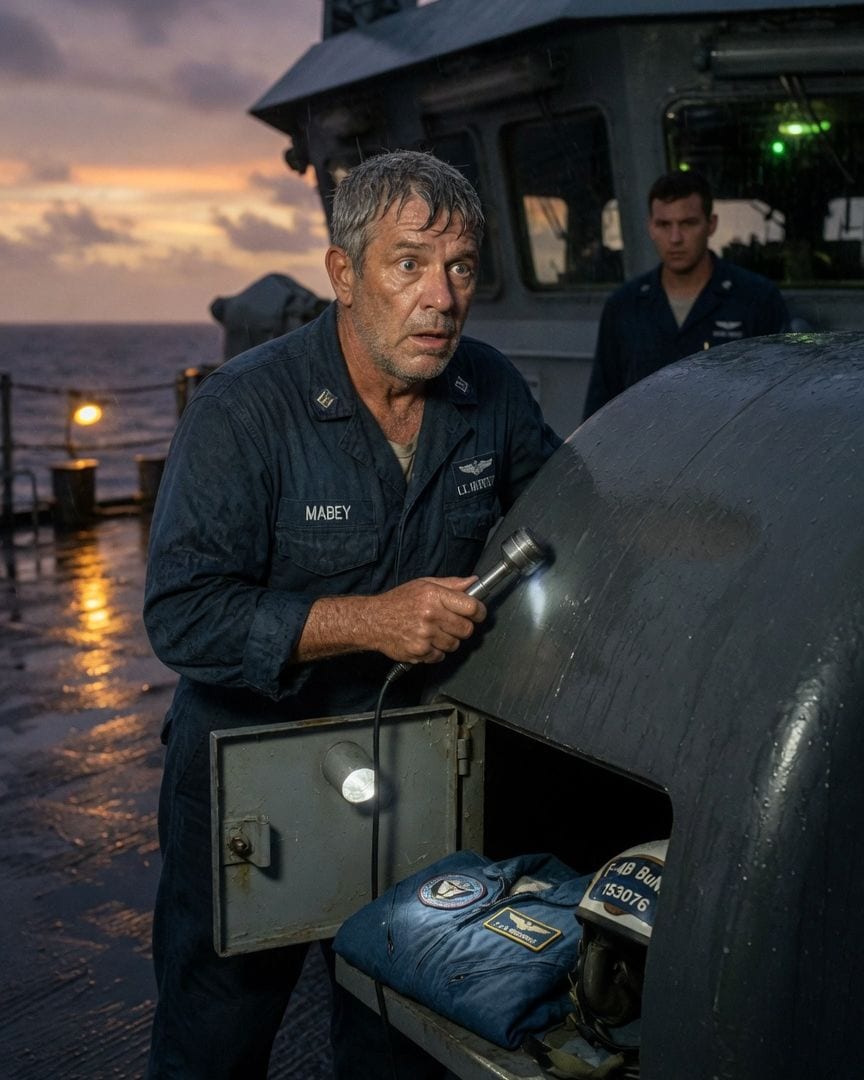
Chief Petty Officer Walter Mabey, 52, watched the crane operator strain, his face slick with sweat and rain on the USS Vance's deck in 1972.
The sonar contacts for the lost F-4 had been clear, mapping a distinct, if unusually dense, shape on the ocean floor, but the crane's gauge screamed a different story.
"Fourteen tons, dry weight," Mabey muttered to Lieutenant Samuel Sutton, 48, his Executive Officer, standing beside him in the wheelhouse. "That's what an F-4 weighs."
But the needle on the crane's dial climbed past twenty, then thirty, then forty, shuddering towards sixty tons. The sonar had called it an F-4. The crane called it a liar.
The deck had been cleared, per standing orders, as soon as the initial contact was confirmed.
Only Mabey and Sutton remained in the wheelhouse, and only Mabey, restless with an unidentifiable unease, thought to look when the massive, dark shape finally broke the surface. It was not mangled, not crushed. It was whole.
The sea sheeted off its seamless, charcoal-gray surface like water off wax, leaving no trace. No seam, no rivet, no scratch. It was perfectly, terrifyingly clean.
The thing sat on the Vance's deck, a hulking, featureless mass that dwarfed the recovery team. No wings, no cockpit, no discernible engines.
It had the general shape of a flattened delta, a low-slung, charcoal-gray wedge, but no details to support the resemblance. The surface was cool to the touch, impossibly smooth, even under the salt spray.
"Thermal shock?" Sutton suggested, running a gloved hand over it, pulling it back quickly as if surprised by its coolness. "The pressure at that depth... it must have compressed it, somehow."
Mabey shook his head, circling the object slowly. The damp deck vibrated faintly under his boots. "Compressed it into more mass? And without a single crease?" He tapped the surface with his knuckles.
It rang with a dull, dense thud, not the hollow echo of an aircraft's airframe.
The official logs, he knew, would soon record it as the recovery of a 'severely damaged F-4 fuselage,' but Mabey knew that was a lie, a clean, precise lie.
He spent the next hour trying to find any sign of entry or exit, any hatch or panel line that would betray its construction.
He ran his fingers over every square foot, his eyes tracing imaginary patterns, searching for a flaw. Nothing. It was a single, monolithic shell.
The setting sun, now breaking through the clouds, cast long, distorted shadows across the deck, making the object seem to pulse with a dark, inner light.
Then, near what might have been its rear, half-obscured by a recovery sling, he spotted it. A faint, almost invisible seam, no more than a hair's width, barely interrupting the flawless surface. It wasn't a panel line.
It was a hatch, perfectly integrated, a deception of light and shadow, yet undeniable once seen. Too perfect.
Mabey stared at the faint seam, a dark whisper against the smooth gray. He pulled a specialized cutting tool from his belt, a small, high-frequency vibrator designed for delicate underwater work, its metal casing cold in his hand.
"Stand back, Sam," he ordered, his voice low, almost a murmur against the insistent thrum of the ship's engines. Sutton, looking uneasy, backed away, his gaze fixed on the object.
The tool hummed, a barely audible vibration that Mabey felt more than heard. He carefully traced the hairline seam, following its precise geometry.
A faint, almost imperceptible click echoed from within the dense material, a sound that seemed to come from deeper than its surface.
Then, with a soft hiss, a section of the surface, about two feet square, depressed inward slightly, then slid silently to the side. A dark, perfectly square opening appeared, framed by the impossible smoothness of the object's body.
No light spilled out, only an oppressive, stale air that carried a faint, metallic tang.
Mabey shone his flashlight inside. The beam cut through the absolute blackness, revealing a small, perfectly ordered interior, stark and clinical. And there, neatly folded on a low, internal shelf, was a flight suit.
A standard issue Navy flight suit, complete with a helmet resting beside it. It was utterly pristine, the fabric crisp, the colors vibrant, as if placed there moments ago, not retrieved from a mile down.
Mabey leaned closer, his heart thudding a frantic rhythm against his ribs. He saw the embroidered name patch on the flight suit's chest, clear and stark against the dark green fabric: 'LT. C. R. DAVENPORT.'
And the tail number stenciled on the helmet, faded but legible, confirming the horrifying truth: 'F-4B, BuNo 153076.' The same tail number as the 'lost' F-4 they were supposedly recovering.
The next morning, before the Vance even docked, a black-ops team swarmed the ship. They wore no identifying insignia, their movements precise and silent.
The 'object' was sealed under heavy tarpaulins, then offloaded onto a waiting flatbed truck, disappearing into the pre-dawn gloom. Mabey and Sutton were given new, separate assignments.
Mabey's was a desk job, reviewing obsolete supply manifests in Norfolk, a clear demotion. He knew it was a soft dismissal, a way to bury him, to make him forget what he had seen.
But the image of that pristine flight suit, tucked away like a trophy in the impossible belly of the seamless object, wouldn't leave him. It clung to him like a phantom limb, a constant, unsettling presence. He started with Davenport.
Lieutenant C. R. Davenport, F-4B pilot, Bureau Number 153076. Official record: lost at sea, engine failure, 1972. No body recovered. A tragic but common enough tale.
Mabey spent his evenings in the base library, then at the National Archives annex, sifting through microfiche and dusty files, leveraging his old Chief Petty Officer clearance and a lifetime of knowing which forms to fill out, and which to simply ignore.
He found Davenport's service record, his flight logs, even a commendation for a prior mission. Everything pointed to a routine loss, a man simply vanishing into the vastness of the ocean.
But then he found a discrepancy. A minor one, buried deep in a requisition form for Davenport's last flight. The form listed a specific emergency beacon, serial number 734-Alpha, installed on Davenport's F-4.
Mabey cross-referenced it with the recovery manifest for the 'damaged F-4 fuselage.' The beacon was listed as recovered, intact, but its internal battery life indicator showed it had been active for less than three minutes before going silent.
Not enough time for an emergency, certainly not enough for the jet to fall a mile to the seabed, transmitting all the while. The discrepancy, small as it was, poked a hole in the neat narrative.
He tried to rationalize it – a faulty beacon, a clerical error – but the numbers were too precise.
He then found a second, earlier incident. A cargo plane, a C-130, lost over the Pacific in 1968. Official cause: structural failure. Mabey found the recovery report for that incident.
It described a 'fragmented fuselage,' but, buried deep within the technical jargon, it listed the recovery of a single, perfectly preserved, and oddly heavy cargo crate that had been inside the plane.
Its weight was disproportionate to its contents, an almost identical echo of the F-4's situation. The details were eerily similar: disproportionate weight, pristine recovery of an internal item, a quick, almost immediate silence from an emergency beacon.
The pattern was beginning to form, cold and precise, like the edges of the object itself.
Mabey's inquiries, though careful, began to draw attention. He'd find files he'd requested suddenly re-shelved, or microfiche readers inexplicably out of order just as he was about to use them.
The air in the archives, usually thick with dust and the quiet rustle of old paper, felt heavier, as if an invisible weight pressed down.
One evening, as he left the archives, the streetlights reflecting in the rain-slicked pavement, he noticed a dark sedan parked across the street, its engine idling.
He dismissed it as paranoia, a side effect of too many hours spent chasing ghosts through government bureaucracy.
But the next day, a junior clerk, a nervous young man named Frank Davenport, 23, approached him. Frank's hands trembled slightly as he spoke, his eyes darting around the quiet reading room.
"Chief Mabey, sir," Frank stammered, his voice barely a whisper, "I think you might be looking for this." He handed Mabey a thick manila envelope, unmarked, its surface smooth and unsettlingly new. "It just... appeared on my desk this morning.
Like it materialized."
Inside was a heavily redacted official report. 'Project Chimera: Assets Disposition Protocol.' Mabey flipped through it, his stomach tightening. The language was clinical, dehumanizing. It detailed procedures for 'retrieving and securing anomalous assets,' for 'subjects' and 'filing.'
It read like an instruction manual for erasing things from existence.
Then he saw a handwritten note in the margin, next to a paragraph about 'observers deemed compromised.' The script was precise, almost calligraphic. It simply read: 'Mabey, W. — ID 827-44-3210. Status: Active Observation.'
Someone knew exactly what he was doing, and they were watching him. The air around him suddenly felt thin, cold. Mabey folded the report, his hands trembling slightly, no longer from age but from a deeper, colder fear.
He wasn't just investigating a mystery anymore. He was part of it. He glanced out the window.
The car across the street was still there, a dark, silent sentinel, but now the passenger window was rolled down a fraction, and he could feel eyes on him, a weight pressing down.
The file he held felt impossibly heavy in his hand.
Mabey found Sutton, 48, working a seemingly dead-end job at a remote naval supply depot in South Carolina. The depot was a maze of corrugated iron warehouses and rusting equipment, the air thick with the smell of mildew and diesel.
Sutton looked older, more tired than Mabey remembered, the lines on his face etched deeper, his shoulders slumped. He poured them two cups of bad, lukewarm coffee in a small, windowless office.
"You still thinking about that thing, Walter?" Sutton asked, without preamble, his gaze fixed on his hands wrapped around the ceramic mug.
Mabey pushed the Project Chimera report across the table. Sutton picked it up, his eyes scanning the pages. His face went pale when he saw Mabey's name, his service number, and the chilling phrase "Active Observation."
A shiver seemed to run through the room, chilling the stale air.
"They're watching you," Mabey stated, his voice flat.
Sutton nodded slowly, taking a long, shaky sip of coffee. "They're watching everyone who saw too much. My new orders came from a department that doesn't officially exist. My new boss doesn't have a name in any directory."
Mabey pressed him, the urgency a tight knot in his chest. "What was it, Sam? That thing we pulled up. The weight. The suit inside."
Sutton took a deep breath, his chest rising and falling visibly. "After you left, they brought in a specialist. A woman. Patricia Ford, 58. She was... calm. Too calm. She oversaw the dismantling. Or, rather, the processing."
He leaned forward, his voice a low whisper, barely audible above the distant rumble of a passing truck. "She showed me an internal schematic. That thing, Walter, it's not a ship. It's a collector. It doesn't crash. It absorbs.
The F-4 didn't go down. It was... filed. The weight, the lack of damage – it integrates what it takes. Adds it to its mass. The pilot, Davenport, he's in there. Not dead, not alive. Just... part of it.
Part of the record."
Sutton shuddered, his hands gripping the coffee mug so tightly his knuckles turned white. "She said it was an ongoing operation. For decades. They call it 'coherence maintenance.' They make sure everything fits the official story, even when it doesn't."
The pieces clicked into place for Mabey, not with a sudden flash of insight, but with a slow, grinding inevitability. The C-130, the 'fragmented fuselage' hiding a perfectly preserved crate. The emergency beacons that died too quickly.
The official records, quietly rewritten, history subtly edited. The secrecy wasn't about hiding an alien threat; it was about maintaining a monstrous, systematic process, erasing anomalies, one life at a time.
The room, with its chipped paint and flickering fluorescent light, seemed to press in on Mabey, heavy with the weight of this new, terrible truth.
Armed with Sutton's chilling revelation and the Project Chimera report, Mabey redoubled his efforts. He knew he was on borrowed time, every minute an indulgence, but the need to understand, to expose, was a burning fire in his gut.
He bypassed official channels, using old contacts and forgotten passwords, exploiting every crack in the system he had served for decades, to access deeper, more restricted archives.
He found more 'disposition protocols,' more 'filed assets.' He found mentions of 'coherence agents' and 'containment specialists.'
The records were a labyrinth, designed to obscure, to deter, but the pattern was undeniable, a dark thread running through decades of suppressed truth.
He worked through the nights, fueled by stale coffee and a growing sense of dread, the silence of the archive annex amplifying every rustle of paper, every creak of the old building.
He finally located the full, unredacted file on the F-4B BuNo 153076 recovery. It was marked 'Top Secret, Eyes Only, Project Chimera-72,' a thin, pale green folder among a sea of red and black.
His fingers, calloused from years of manual labor, trembled as he opened it. He scanned the pages, looking for the final disposition of the 'object,' the names of the 'coherence agents,' the bureaucratic language of oblivion.
And then he saw it. Buried deep within a personnel roster, tucked away on a supplemental page, under a section titled 'Future Engagements: Subject Acquisition & Integration,' there was a list of names.
And next to each name, a service number. Mabey's breath hitched in his throat. His own service number, 827-44-3210, was listed there.
And in the column next to it, the chilling, single word: 'Filed.'
He wasn't just observing the file. He was in it. He was already named.
Twenty years later, in 1992, Mabey, now retired, finally tracked down Patricia Ford, 58. She was a civilian consultant, working in a nondescript office building in Washington D.C., a building indistinguishable from a hundred others in the sprawling bureaucracy.
She was older, her hair now perfectly gray, pulled back in a severe bun, but her eyes held the same unsettling calm Sutton had described. They were eyes that seemed to see everything, and nothing.
Mabey laid the Project Chimera report, the F-4B file with his service number circled, and a grainy photograph of the recovered 'object' on her polished desk. The room, though climate-controlled, felt colder than the deepest ocean trench.
"You knew," Mabey stated, his voice steady despite the tremor in his hands. "You knew what that thing was. What it does."
Patricia Ford looked at the documents, her gaze lingering on the photograph, then at Mabey, a faint, almost imperceptible smile touching her lips. "Of course, Mr. Mabey. It's been my life's work. Our work. For generations."
She gestured to the photograph of the object, as if indicating a familiar family heirloom. "We don't call it a UFO. We call it 'The Archive.' Or 'The Ledger.' It's a mechanism for maintaining order. For ensuring coherence."
She spoke as if discussing a mundane administrative task, her voice even, unhurried, like a recording. "When an individual, or an event, creates too much... statistical noise, too much deviation from the established narrative, The Archive collects it. Integrates it.
The F-4 pilot, Lieutenant Davenport, he was experiencing certain... cognitive anomalies after an unsanctioned reconnaissance. His presence would have destabilized a critical operational parameter. So he was filed. The jet was a convenient cover."
Mabey pointed to his service number on the roster. "And me? I saw too much, didn't I? I asked too many questions."
Ford nodded, her expression unreadable. "Precisely. You became an anomaly yourself. A potential source of incoherence. Your 'filing' was merely a matter of time and convenience. A logical progression."
"So I'm just... another entry?" Mabey asked, a bitter taste in his mouth, the metallic tang of the object's interior seeming to resurface on his tongue. "Another name in your monstrous ledger?"
Ford shrugged slightly, a small, dismissive gesture. "You observed the process. You understood its necessity. You even attempted to replicate our investigative methods. In a way, you became a part of the system long before you were formally designated."
She leaned back in her chair, her gaze unwavering, not unkind, but utterly devoid of empathy. "The world requires certain truths to remain... fluid. Adaptable. When reality diverges too sharply from the accepted narrative, we correct it.
The Archive ensures the correction is permanent. It doesn't destroy. It incorporates. The pilot, the cargo, the anomalous data – it all becomes part of its ever-growing mass. Its knowledge. Its truth."
Mabey felt a cold dread settle deep in his bones, heavier than the sixty-ton object he had helped recover. It wasn't about good or evil, not in their eyes. It was about order, pure and terrifyingly absolute.
He looked around the sterile office, at the neatly stacked files, the bland decor. This was where the world was edited, where people became footnotes, then ceased to be even that.
The air in the room, previously merely cold, seemed to vibrate with a low, inaudible hum.
Ford reached into a desk drawer and pulled out a small, black device, no larger than a pack of cards, its surface smooth and featureless. She placed it on the desk between them. "It's time, Mr. Mabey.
Your file is complete."
Mabey stared at the device, then at Ford's calm, unblinking eyes. There was no menace, only an administrative finality. He knew there was no escape, no fighting. This wasn't a threat; it was a formality. He had been processed.
Chief Petty Officer Walter Mabey's retirement benefits continued to be disbursed for several months before a routine audit flagged his account as dormant.
His small apartment was found meticulously clean, nothing disturbed, a half-read book on the nightstand, a forgotten teacup on the counter.
His few remaining personal effects were packed and sent to a distant, estranged nephew who filed them away without much thought. No missing person report was ever filed. No investigation was launched.
The bureaucracy simply absorbed his disappearance, another piece of statistical noise quietly brought into coherence.
Years later, a diligent, new archivist, Penelope Kingsley, 28, reviewing old declassification requests for a forgotten project, found a small, handwritten addendum to Project Chimera-72.
It was dated 1992, scrawled on a yellowed memo slip, tucked inside a file already marked 'Closed, No Further Action.' The entry read: 'Mabey, W. - ID 827-44-3210. Disposition: Completed. File closed. Record updated. Current status: Integrated.'
Beneath it, in a different hand, was a fresh, looping signature, dated today.
The file is still being signed.
If this one got to you
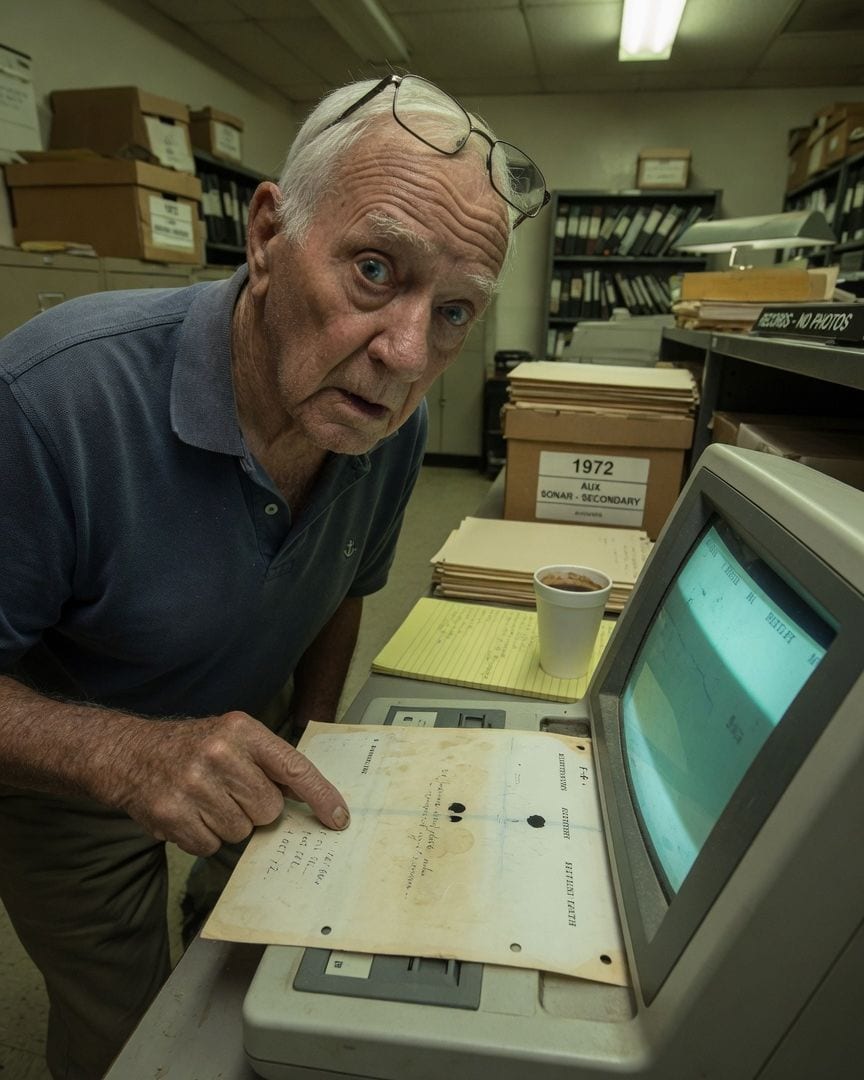
A Chief Petty Officer's salvage career ends when a Cold War fighter jet surfaces at sixty tons, perfectly intact.
Chief Petty Officer Walter Mabey, then 45, expected a routine salvage operation for a lost F-4 fighter jet off the Carolina coast in 1972. His long career was built on such lifts, but as the crane gauge climbed past twenty, then thirty, then an impossible sixty tons, a profound unease settled in. The object surfaced, not a mangled wreck, but a dark, seamless shape, perfectly intact. Mabey's salvage career abruptly ended soon after, replaced by a desk job, but the memory festered for forty years. Now 78, he dedicates his remaining time to finding the truth, uncovering a faint, rhythmic pulse on an old sonar log—a ghost beneath the official lie.
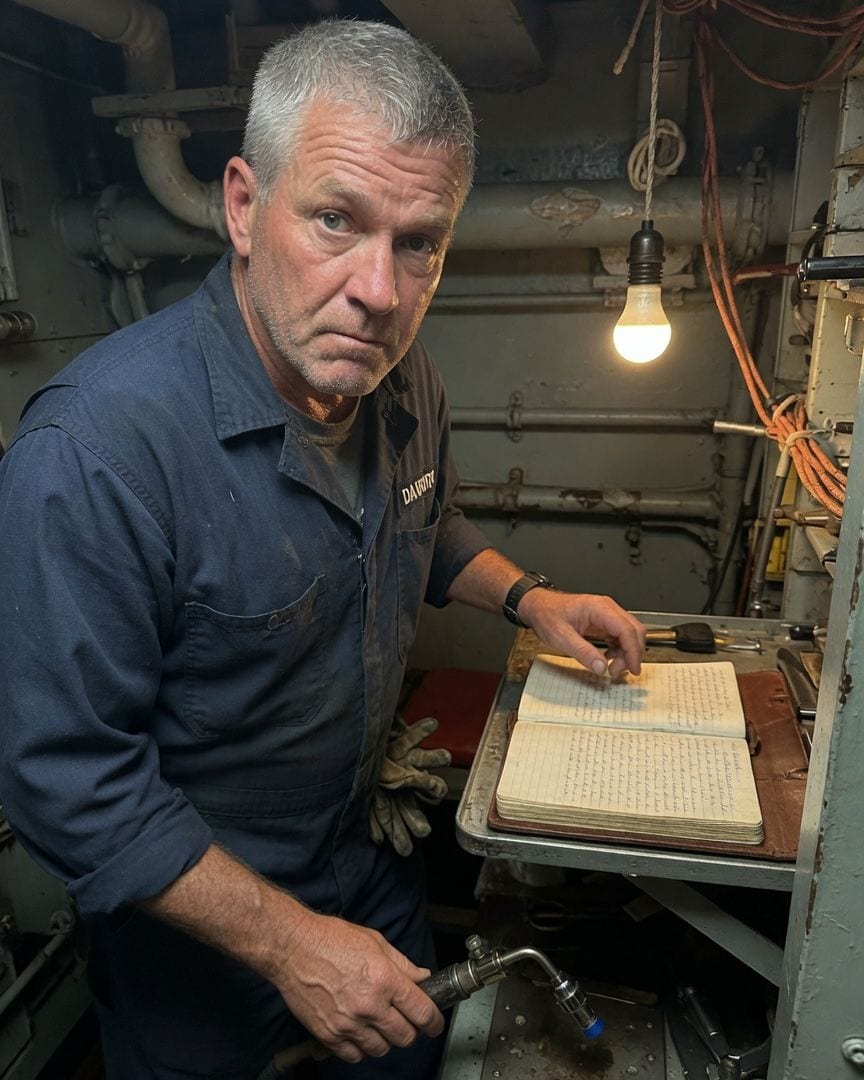
A week from shore duty, Chief Danforth cut a hatch where his ship's plans showed solid steel. An hour later, the wall was seamless, but the Cold War logbook from inside appeared under his mattress.
Chief Petty Officer Raymond Danforth, just a week from ending three decades of service, was intimately familiar with every pipe and plate of the guided-missile destroyer Weatherall. During a mid-cruise overhaul, his gloved hand found a sealed hatch where schematics promised only a solid bulkhead. He cut through the impossible seam to reveal a small, dry compartment, softly lit, containing a logbook filled with an unsettlingly familiar hand. When he returned an hour later with a witness, the hatch was gone, the wall seamless. Later that night, the same logbook appeared beneath his mattress, its pages revealing an entry: 'Petty Officer Howard Montgomery, missing, 1972.' How could a compartment vanish, yet leave its secrets behind?
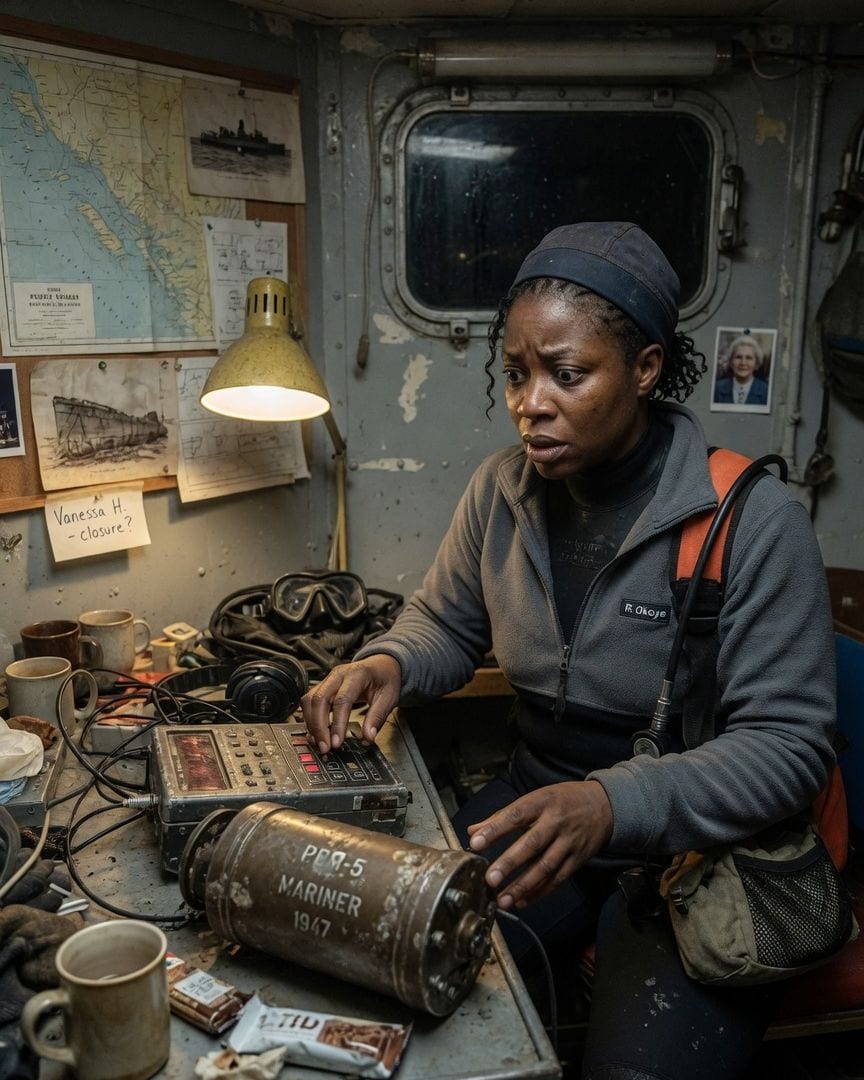
Salvage diver Ruthann found a 1947 bomber's bomb bay meticulously empty. Then the flight recorder played the Cold War pilot saying, 'Transfer confirmed.'
Salvage diver Ruthann Okoye plunged into the murky, cold Puget Sound, hoping to find closure for a pilot's granddaughter exploring a 1947 patrol bomber wreck. As her lights cut through the gloom, she discovered the bomber's bomb bay doors wide open and its ordnance racks meticulously empty. Her dread deepened finding all six arming pins neatly collected in a canvas bag, implying precise, unhurried removal before the plane went down. But the true unease arrived with the flight recorder, where the pilot's calm voice stated, 'Transfer confirmed,' just before an unsettling mechanical thump-thump-thump began. What was transferred from a plane supposedly lost in a gale?
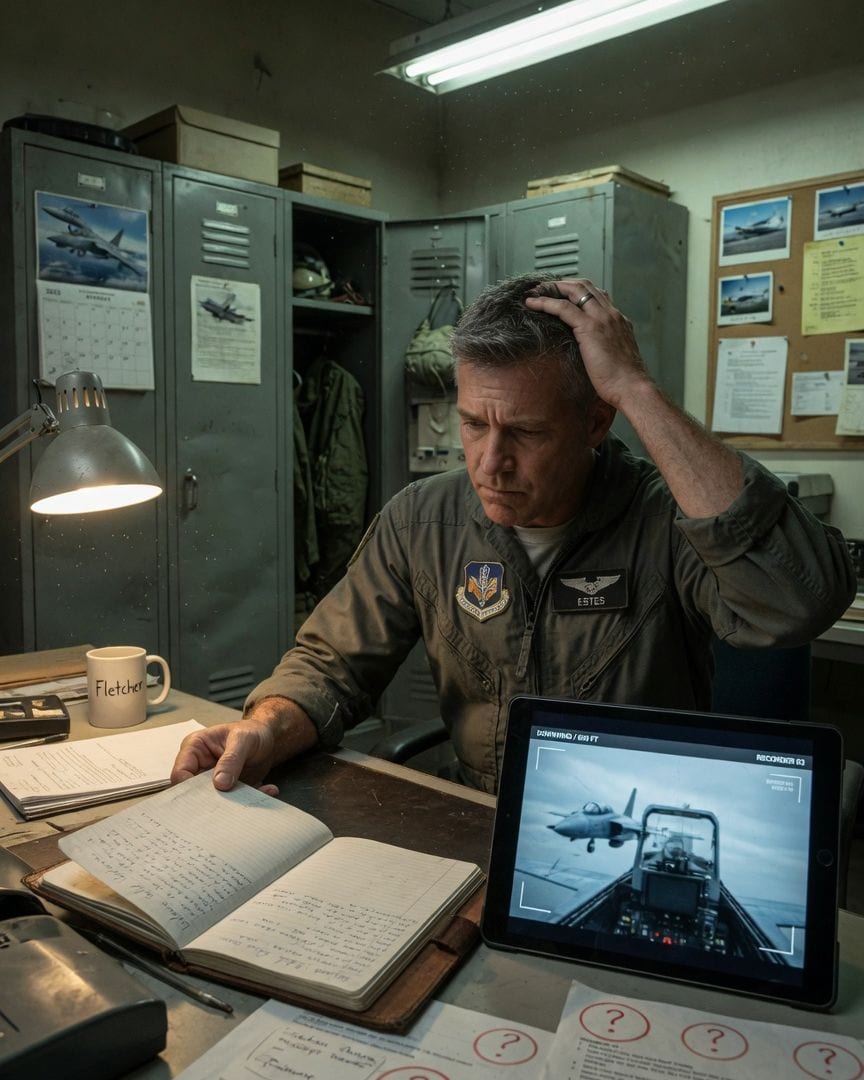
A Chief Warrant Officer's HUD tape shows a phantom jet, impossibly close, off his wing. Forty years ago, another Cold War pilot logged the same impossible sight.
Chief Warrant Officer Nathaniel Estes, a pilot whose career hinged on absolute precision, was under evaluation for a critical promotion. His nightly review of HUD tapes from routine Mojave test flights was a meticulous habit, but for a week, it revealed an impossible detail. At precisely 800 feet, one frame showed a sleek, experimental jet tucked impossibly close off his left wing—a craft ground radar never detected. When his maintenance chief found no equipment fault, Estes unearthed a dusty, decades-old logbook detailing identical phantom sightings from 1978. What unseen presence shadowed the desert skies?
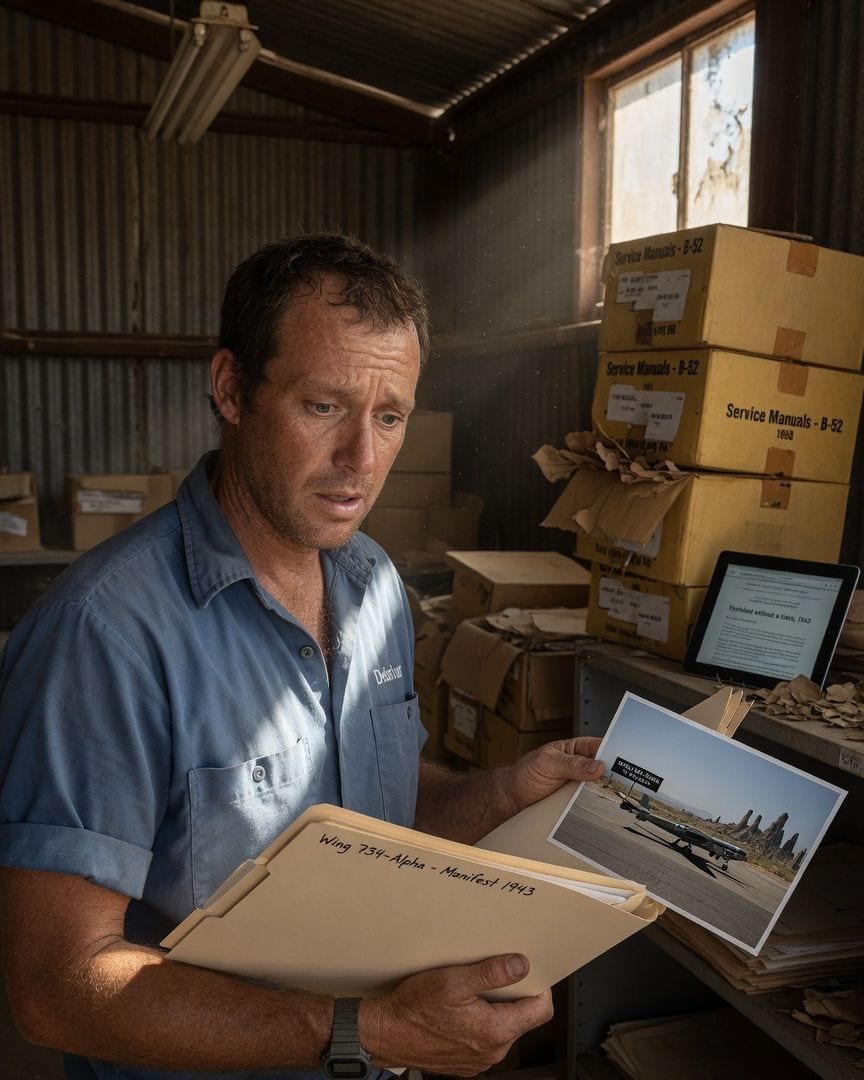
An inventory clerk finds 1943 files for a vanished wing. The paper is new, and photos show its 'lost' plane with impossible tech.
Inventory clerk Rafe Delahunt worked through the Kingman boneyard, his month-long task almost done, the Arizona sun baking through the roof. Amidst crumbling, forgotten records, his hand brushed eleven folders for a 'Wing 734-Alpha'—a designation that never officially existed. Unlike the brittle paper surrounding them, these felt supple and cool, smelling faintly new despite their 1943 dates. Then he found a pristine, modern-resolution photograph of a prototype aircraft officially vanished in 1943, now bearing impossible modifications on an unmapped runway. It was like seeing a ghost in high definition, hinting that these 'recoveries' might be happening closer than he imagined.
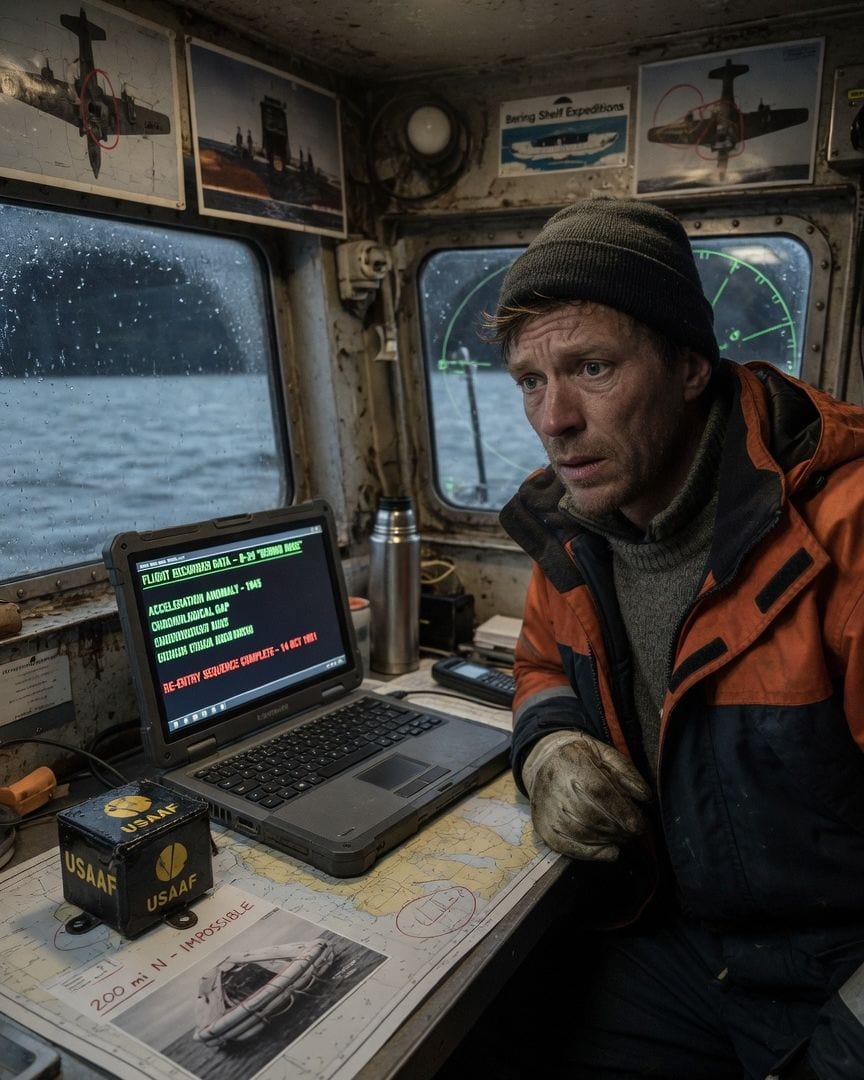
A wreck-hunter found the Cold War B-29 lost in 1945. Its upper escape hatch was open, from the inside.
Wreck-hunter Sten Höglund embarked on a decades-old promise to his 98-year-old aunt, seeking the B-29 bomber lost with eleven men in 1945. Deep on the Bering Shelf, his sonar found the 'Bering Rose' impossibly intact, a ghost in the mud plain. But the drop camera revealed a chilling detail: the bomber's upper escape hatch was not merely damaged, but wide open from the inside, and its life raft was gone. What impossible truth did the ocean hide from a crew that seemingly escaped a crash, only to vanish into the Bering Sea?