A Master Sergeant's Cold War gun camera film showed a disc looking back, then his evidence was declared 'damaged beyond recovery'.
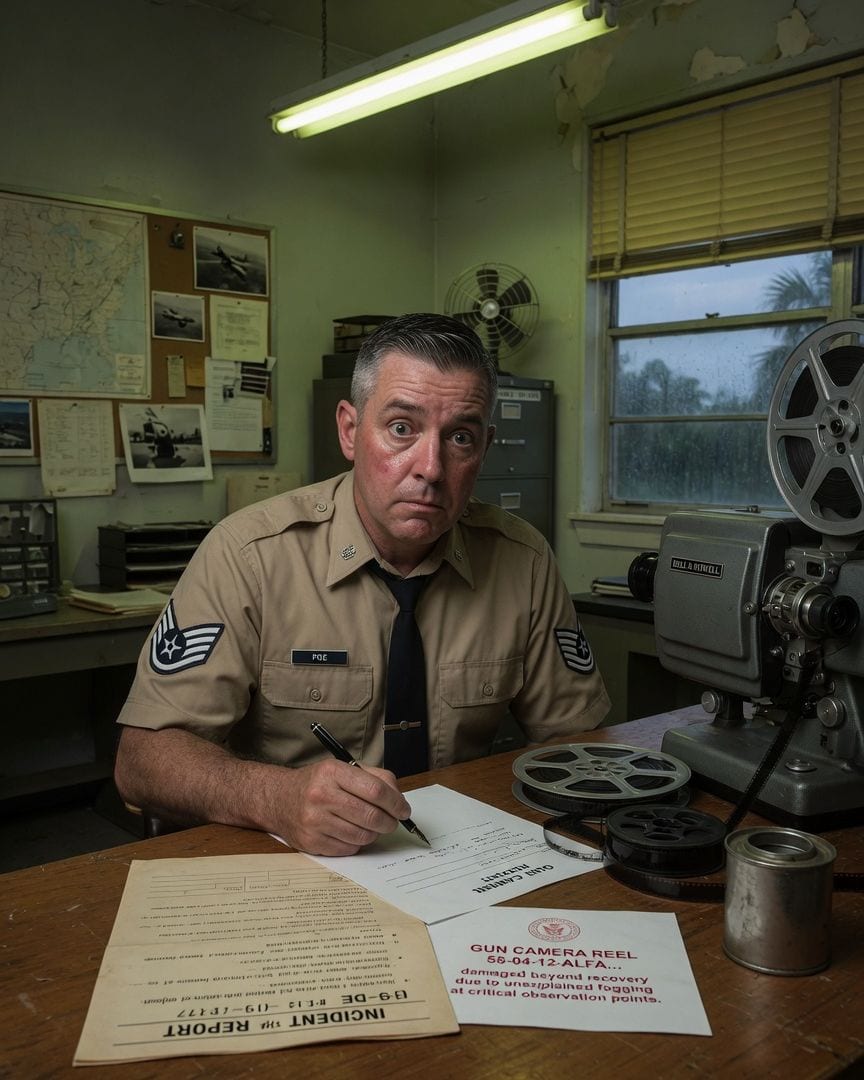
The humid Florida air of 1958 hung heavy in the gun camera analysis lab at Homestead Air Force Base. Master Sergeant Elgin Poe, a man whose career was built on precise, dispassionate observation, was the last on the bench.
The afternoon's 'hot' reel, from a fighter pilot's frantic report of an anomalous aerial phenomenon, was the only one left. Elgin threaded the 16mm film, the projector's whir a familiar drone.
Frame by frame, the silvery disc held formation off the F-86's wing, a silent, impossible ballet against the endless blue. He watched the pilot’s maneuvers, the blur of speed, and then, at frame two hundred and four, the disc rotated.
Not drifted, not tumbled, but turned, deliberately, unmistakably, putting its featureless face squarely toward the gun camera lens.
Elgin had spooled ten thousand feet of film in his career, documenting everything from missile tests to reconnaissance runs, and never once had a target looked back. A cold certainty settled in his gut.
He wound the reel forward, then back, confirming the impossible motion. On the last frame before the film ran out, it was closer still, filling the frame more than any normal object could have shifted in a split second.
The quiet hum of the projector suddenly felt loud, intrusive, in the still room.
Elgin replayed the sequence, slowing it down, frame by agonizing frame. He checked the lens, the film stock, the projector's calibration. No distortion, no anomaly in the equipment. The disc was solid, metallic, and intelligent.
He drafted his preliminary report, meticulously detailing the visual contact and the object's deliberate rotation. The report was concise, factual, devoid of conjecture, simply stating what the film clearly showed.
Later that day, he submitted it to Colonel Carl Novak's office, along with the reel. He expected questions, perhaps an urgent debriefing. What he received the next morning was far stranger.
A junior clerk, Audrey Sutton, delivered the official incident report form 19-B. It described 'atmospheric inversion phenomena' and 'misidentified meteorological balloon.' There was no mention of the disc's impossible maneuver, no reference to the object's clear, metallic form.
Attached was a separate memo, stamped with Novak's official seal, a stark white rectangle against the beige paper.
It stated: 'Gun camera reel 58-04-12-Alfa, pertaining to incident report 19-B, found damaged beyond recovery due to unexplained fogging at critical observation points. No visual confirmation of anomalous object.'
Elgin knew, with a certainty that chilled him to the bone, that the film had been perfectly clear when he watched it. The ordinary explanation had been manufactured, not just for the public, but for him. His evidence had vanished.
The air in the office, still and heavy, seemed to press in on him, as if the room itself was holding its breath.
Master Sergeant Poe stared at the official incident report, his signature line a blank expanse. The report detailed a 'high-altitude weather balloon' and explicitly stated 'no visual confirmation of anomalous object.'
Beside it, a memo from Colonel Novak's office declared his gun camera reel, the one he'd just seen the disc turn in, 'damaged beyond recovery due to unexplained fogging' at the exact frames where the impossible had occurred.
He knew it was a lie, and the pen in his hand felt impossibly heavy. His career, his integrity, hinged on this moment.
He could sign, make it all go away, become another technician who'd seen nothing, or he could refuse. The silence in the small office felt like a physical weight, pressing down on his chest, threatening to crush him.
Elgin did not sign. He returned the report unsigned, citing 'discrepancies between visual evidence and narrative.' The next day, he was reassigned, not to a disciplinary hearing, but to a dead-end archival project, sifting through decades of declassified flight logs.
The humidity in the archives was thicker, mustier than the analysis lab, a constant, heavy blanket. But the seed of doubt had been planted. Quietly, methodically, he began to pull at threads.
He cross-referenced 'damaged film' reports, 'misidentified' contacts, and 'personnel reassignments' from other bases.
He found a disturbing pattern: highly experienced airmen, pilots, and radar operators who reported similar impossible observations were often quietly moved or discharged, their records scrubbed of any mention of their 'anomalous' reports.
The repetition of terms like 'equipment malfunction' and 'pilot fatigue' in wildly different incidents across different years felt less like coincidence and more like a template.
He dug through old requisitions for film stock, trying to find any anomaly in the batches, but found none.
Instead, he found multiple instances of 'Project NIGHTWATCH' classification stamps on vaguely worded memos, always accompanied by a note of 'film integrity compromise' or 'sensor malfunction.' The words were different, but the pattern was identical to his own experience.
The official explanations were a lie, a systemic one. He began to feel less like an archivist and more like an archaeologist, unearthing a buried, impossible history.
Elgin's quiet digging did not go unnoticed. One afternoon, Colonel Novak summoned him to his office, the air conditioning a frigid shock after the stifling archives. Novak, usually brusque, was unusually calm.
'Sergeant Poe,' he began, leaning back in his leather chair, the leather creaking faintly, 'I understand your... dedication to accuracy. It's a commendable trait in a technician.' He paused, his gaze unblinking.
'But sometimes, accuracy is a luxury we cannot afford. There are things, Elgin, that are better left undisturbed.' It was a warning, delivered with a chillingly paternal tone, devoid of heat or anger, which made it all the more unsettling.
A few days later, a request Elgin had placed for a 1953 incident report, one with an unusually high 'film damage' rating from an unnamed air force base in the Pacific, vanished from the system.
His phone calls to contacts at other bases started going unanswered, or routed to dead lines with static like insects buzzing.
He noticed a dark sedan, civilian plates, parked down the street from his off-base housing for three consecutive nights, its occupants unseen behind tinted windows. The dread turned personal.
He was no longer just investigating a cover-up; he was becoming part of the file itself.
He felt the weight of unseen eyes, the silent pressure of an institution that knew exactly where he was, and what he was looking for.
The files weren't just records; they were a net, and he was tangled in its threads, the knots tightening imperceptibly around him.
Driven by the chilling sense of being watched, Elgin redoubled his efforts. He started focusing on the 'Project NIGHTWATCH' classification stamp, a recurring motif in the 'damaged film' reports.
He spent weeks in the deepest, most secure sections of the base archives, navigating labyrinthine paper trails, the fluorescent lights humming incessantly overhead, casting long, sterile shadows.
He knew the system, knew its weak points: the occasional misfiled document, the aging clerk who overlooked a detail, the sheer volume of paper that made absolute control impossible.
He finally located a heavily redacted 'Project NIGHTWATCH' memo from 1953, marked 'EYES ONLY, COMMAND STAFF,' tucked away beneath a stack of mundane supply requisitions.
It was a policy document, outlining procedures for managing 'Anomalous Aerial Phenomena (AAP) exhibiting intelligent response to observation.' The language was clinical, detached, but the implications were horrifying. It detailed protocols for 'evidence suppression,' 'witness reclassification,' and 'narrative control.'
One paragraph, less redacted than the others, described 'AAP behaviors' including 'deliberate rotation to achieve direct visual contact with observation platforms.' Elgin felt a cold, hard click in his mind, like a tumblers in a safe falling into place.
Frame 204. The disc had not just been there; it had seen him. This wasn't a mistake or a misidentification. It was an interaction, a conscious act.
The memo confirmed the institution had known for at least five years, probably far longer, that these 'things' were intelligent, aware, and actively engaging with human observers.
The official reports were not errors; they were part of a deliberate, long-standing deception. The dread wasn't just in the 'thing' itself, but in the vast, patient machine that filed it away, quietly humming in the background of existence.
Elgin reread the 'Project NIGHTWATCH' memo, the implications of its cold, bureaucratic language sinking in like concrete. He scrolled through the attached appendices, lists of 'incident classifications' and 'observer profiles.' His breath caught, the paper trembling in his hand.
Then, in a section titled 'Witness Recategorization' for a 1953 incident, he found it. A single, unredacted line, stark against the blacked-out text around it: 'Master Sergeant Elgin Poe, Homestead AFB, Film Analysis, 1953 Incident: Primary Candidate, Phase II Deployment.'
The date was five years before his current posting, five years before the disc had turned its face to his lens.
He wasn't just observing a cover-up; he had been observed, and named, long before he even knew what he was looking for.
He remembered a vague incident from '53, a 'fogged' reel he'd dismissed as equipment error, just a blip in a long career. Now, it was clear.
He was not just a witness to a recent event, but a known quantity, a recurring factor in a pattern that stretched back decades.
His current assignment, his 'discovery' of the disc, suddenly felt less like an accident and more like a carefully orchestrated re-engagement. He wasn't chasing the file; the file was, and always had been, chasing him.
The 1953 file, now a terrifying personal history, laid bare the full truth.
Elgin found his own meticulously detailed analysis of the 'fogged' reel from that year, an analysis he'd long since forgotten, where he’d noted a 'peculiar, non-random rotation' of an object before the film degraded.
His initial report had been dismissed, and he’d been quietly moved to a different unit, his file flagged. The current incident wasn't a new phenomenon, but a 're-engagement,' as the memo put it.
The 'saucers' weren't just objects; they were entities that possessed an uncanny awareness, deliberately presenting themselves, almost provocatively, to specific observers. And the institution, through 'Project NIGHTWATCH,' had been tracking both the entities and the chosen observers for decades.
He found a specific protocol, 'Observer Integration Phase II,' which detailed how individuals like him, once flagged, were to be 're-introduced' to the phenomenon under controlled conditions, their reactions monitored, their subsequent investigations managed.
The 'damaged' film, the dismissive reports, the reassignments – it all clicked into place, a vast, patient, and utterly coherent system designed to contain both the truth and the people who stumbled upon it.
His entire career, his entire life, felt like a carefully managed experiment, every promotion, every transfer, a step in a predetermined path.
Armed with the full, devastating truth, Elgin sought out Colonel Novak, not in his office, but in the quiet, empty officers' club late one evening. The clinking of unseen ice from the bar was the only sound.
Novak, now a year older, looked tired but unsurprised. Elgin laid out the documents on the polished wooden table: the memos, the 1953 'Project NIGHTWATCH' protocol, his own flagged personnel file.
'Sir,' he began, his voice steady despite the tremor in his hands, 'this isn't about a weather balloon. This is about Project NIGHTWATCH. This is about decades of deliberate deception. It's about me.'
Novak picked up Elgin's 1953 re-evaluation report, his gaze lingering on the faded ink. The corners of his mouth twitched, not quite a smile.
'You were always a sharp one, Sergeant Poe,' he said, his voice devoid of emotion, flat as the documents spread between them. 'Too sharp, perhaps, for your own good.' He didn't deny it. He simply confirmed it.
'The files, Elgin, are never closed. They are merely updated. You’ve had your Phase II engagement. You've followed the thread. You've reached the conclusion. What do you expect now? A medal? A public apology?'
Novak leaned forward, his eyes fixed on Elgin, reflecting the dim light from a wall sconce. 'This isn't a battle, Sergeant. It's a process. And you, like so many others, have been processed.
The information you found proves it, not discredits it. You are now fully integrated. Your file is complete. Your purpose, fulfilled.' The casual indifference was worse than any threat, more chilling than any monster.
It was the calm, steady hand of the machine, signing off on another life, the cold finality of it settling over the room like a shroud.
Within weeks, Master Sergeant Elgin Poe received an honorable discharge, citing 'stress-related medical conditions.'
His classified archive access was revoked, and all the files he had meticulously uncovered were re-sealed, marked with new classification stamps, effectively disappearing again behind layers of official secrecy.
He left Homestead Air Force Base, his career ending not with a bang, but with a quiet, bureaucratic whimper. The official narrative remained undisturbed.
The world continued, oblivious, while the vast, patient machine of 'Project NIGHTWATCH' hummed on, its processes uninterrupted, its secrets maintained. Elgin was simply another name moved from the active ledger to the archived.
His truth, absorbed and neutralized, became just another piece of the buried record.
Elgin Poe spent his remaining years in a small, quiet town, far from any military installation. He never spoke of what he found, or what he saw.
He simply existed, a man who knew a truth too vast and too indifferent to fight. His gaze often drifted to the empty sky, a flicker of something haunted in his eyes.
He understood now that some secrets were not meant to be uncovered, only absorbed.
The memory of the disc, turning its featureless face to the lens at frame 204, was a permanent imprint on his mind, a silent communion with an intelligence that saw, and filed.
He was a completed entry, his knowledge now part of the system’s knowledge, contained and accounted for.
He would sometimes trace faint, invisible lines on the tabletop, as if outlining a vast, unseen chart, mapping the patterns of observation and re-engagement he had once uncovered. His own story, he knew, had been signed off decades ago.
The file is still being signed.
If this one got to you
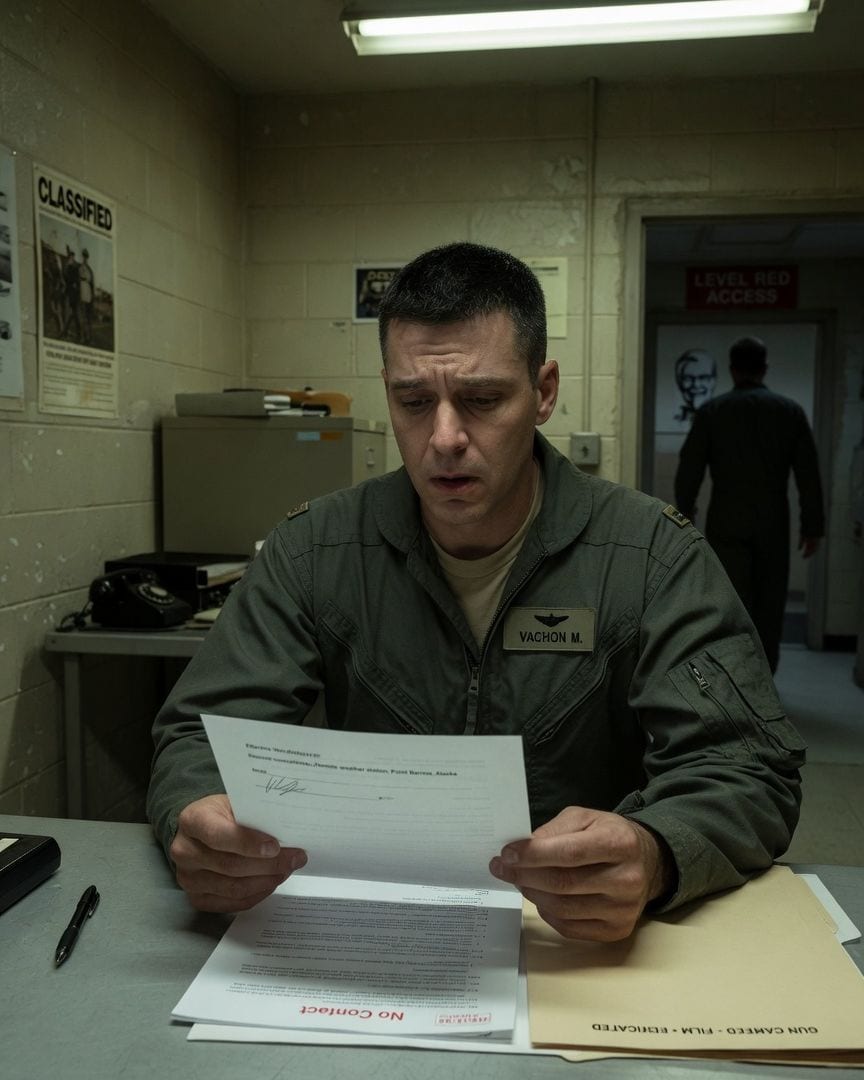
A pilot with a daughter waiting felt his stick tremble: a silent disc slid sideways, impossibly, at forty thousand feet.
Captain Merle Vachon had a newborn daughter waiting at home and just eleven minutes of fuel left when he spotted the impossible. High above the Nevada ranges, at forty thousand feet, a silent, featureless disc hung utterly still, then slid sideways with an impossible, smooth translation. His breath hitched, mundane answers dying in his mind, a cold knot tightening. Later, watching the gun camera film, he saw the disc grow larger, not zooming, but approaching, until it pulsed faintly in the sixty-first frame. His commanding officer confiscated the reel and ordered him to sign a 'No Contact' report, transferring him immediately to a remote weather station in Alaska. What impossible sight had Captain Vachon truly witnessed?
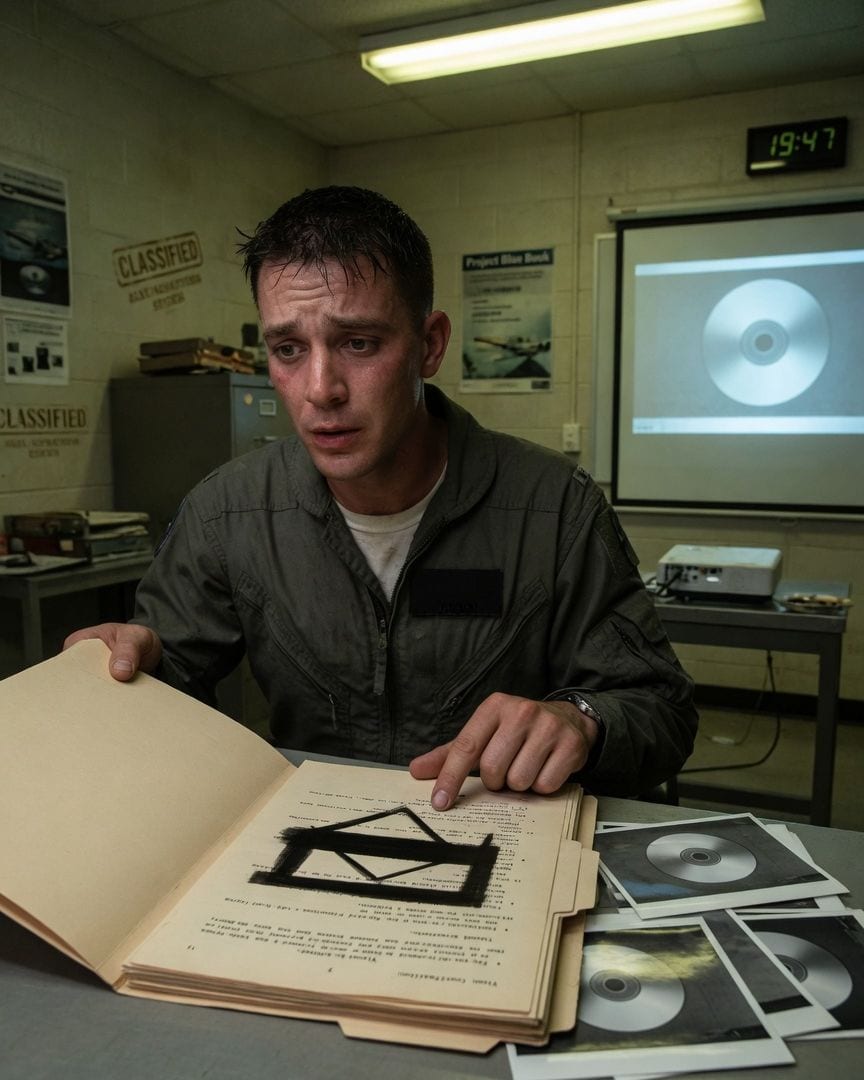
Returning to his newborn daughter, a Cold War pilot found a perfect diamond shape hidden within his classified report's redactions.
Captain Merle Vachon had one last intercept before he could return home to his newborn daughter Nora. High over the Nevada ranges in his F-86 Sabre, he encountered a disc that moved with impossible, silent displacement, defying all known physics. Days later, the official gun camera film showed the object impossibly close, directly contradicting Vachon’s own telemetry and eyewitness account. But the true chilling detail emerged when he found a perfect diamond shape outlined by redacted black ink within his classified incident report.
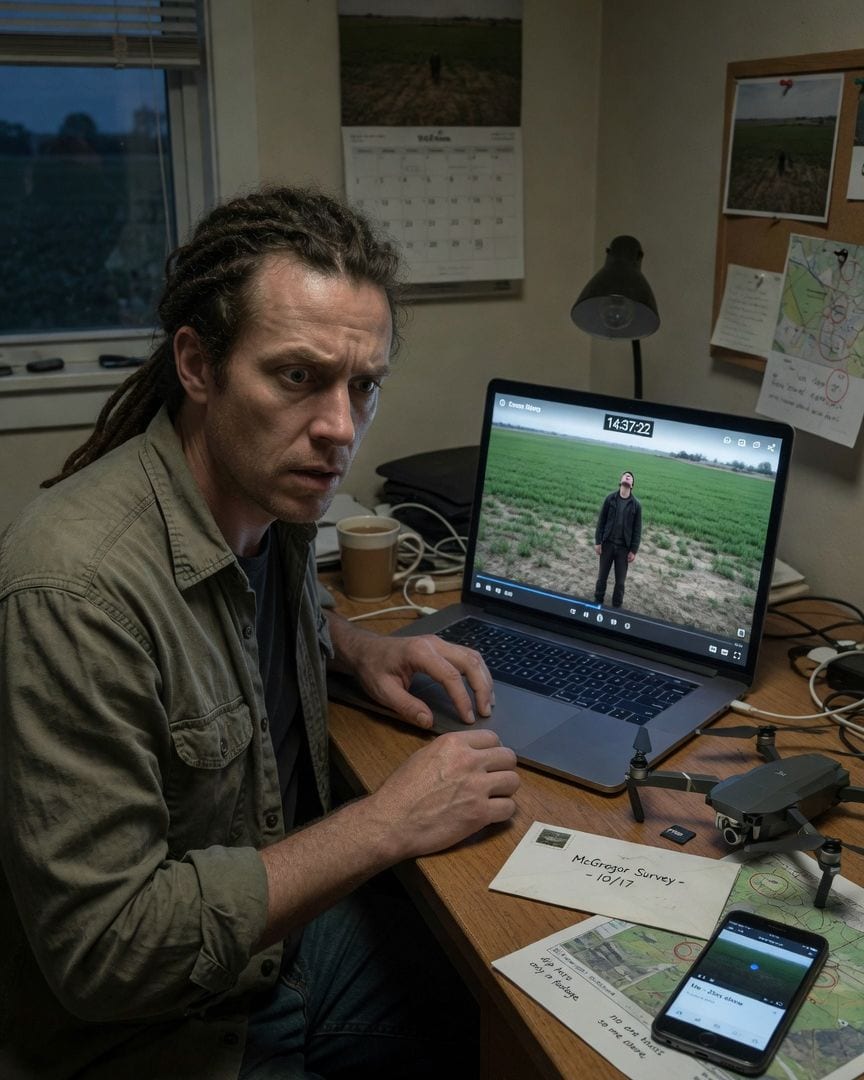
My drone's return footage shows a man standing alone in the field, looking up. The field was empty when I flew out, and I was alone.
I sent my drone for a routine agricultural survey, mapping crop health across a farmer's property. But reviewing the footage, a man materialized, standing perfectly still in the middle of a field I knew was completely empty. He was looking straight up at my drone, a solid figure where no one should have been.
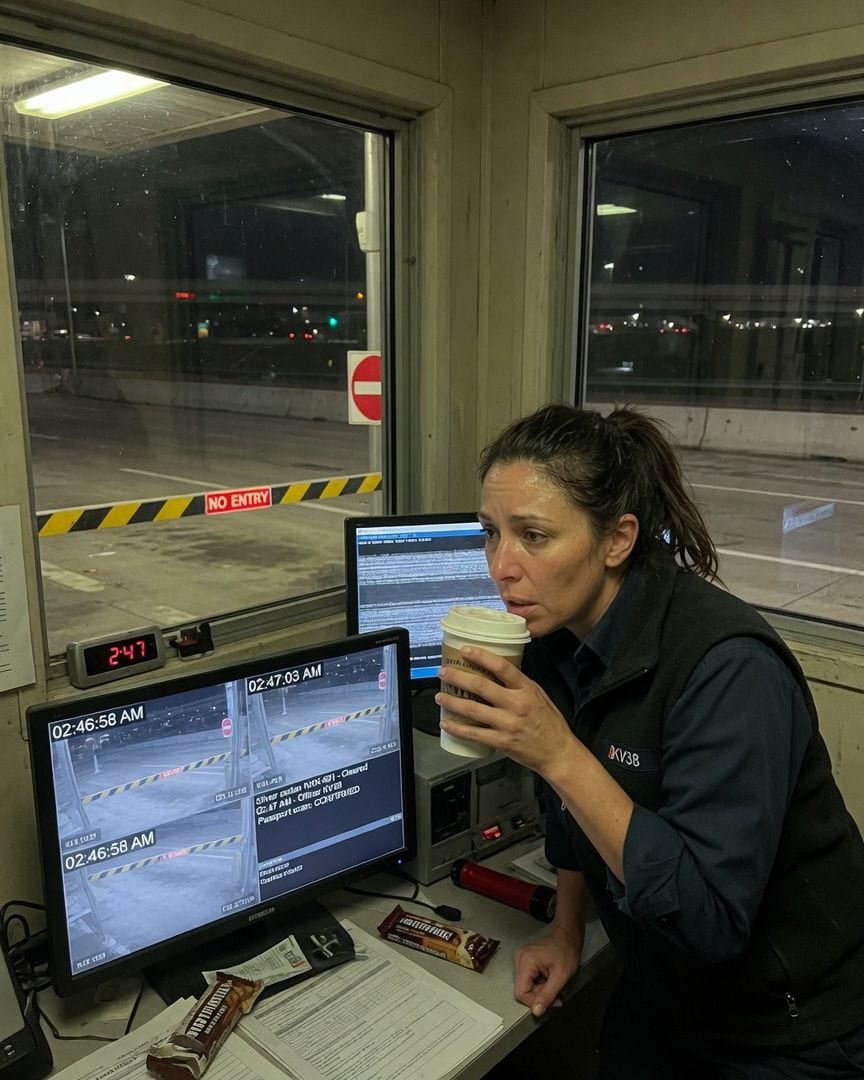
My lane's barrier was down, but my log cleared a car at 2:47 AM. With my code.
Working the quiet overnight shift at the Vance-Romano land crossing, I expected only routine system logs. Instead, a new entry showed a silver sedan cleared northbound through my Lane 3, stamped with my officer code. The issue: my lane had been closed and locked all night, and I hadn't seen a single car pass. Then I discovered the external camera feed for those crucial seconds was simply gone.
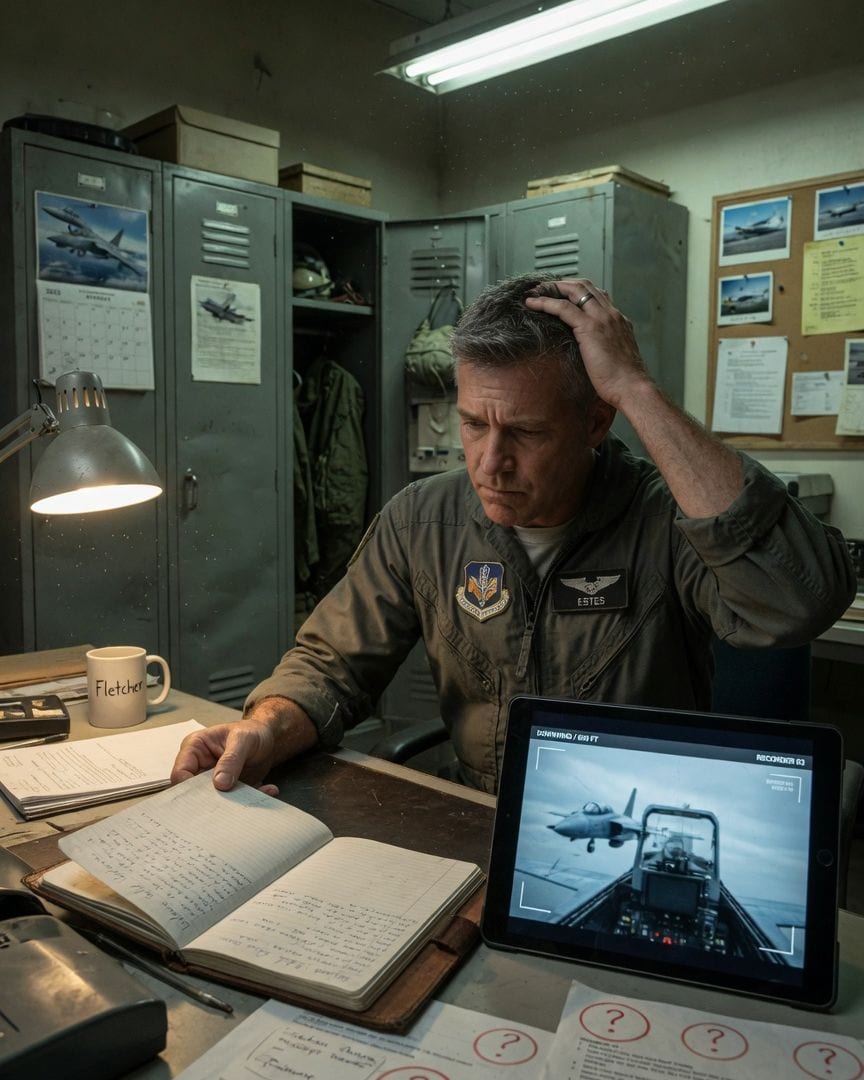
A Chief Warrant Officer's HUD tape shows a phantom jet, impossibly close, off his wing. Forty years ago, another Cold War pilot logged the same impossible sight.
Chief Warrant Officer Nathaniel Estes, a pilot whose career hinged on absolute precision, was under evaluation for a critical promotion. His nightly review of HUD tapes from routine Mojave test flights was a meticulous habit, but for a week, it revealed an impossible detail. At precisely 800 feet, one frame showed a sleek, experimental jet tucked impossibly close off his left wing—a craft ground radar never detected. When his maintenance chief found no equipment fault, Estes unearthed a dusty, decades-old logbook detailing identical phantom sightings from 1978. What unseen presence shadowed the desert skies?
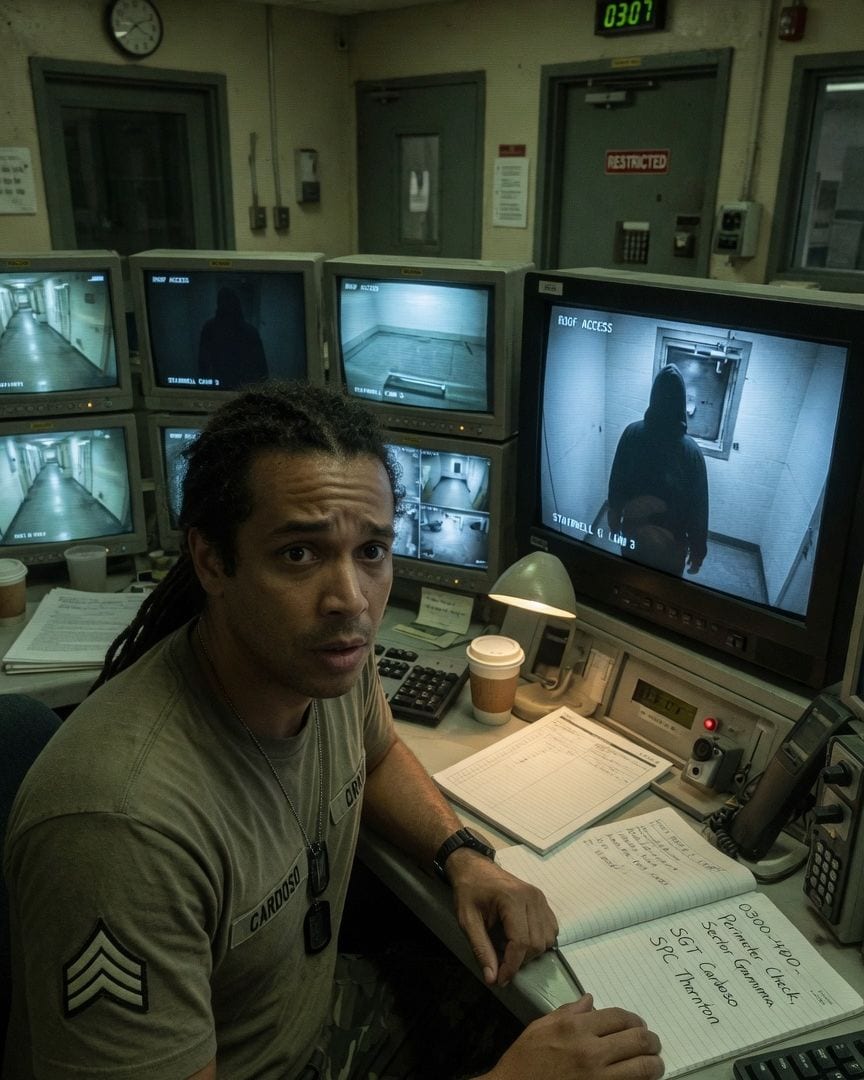
On his last watch, Sergeant Cardoso found his own signature in the duty log for a perimeter check he never did, with a name he didn't know.
Sergeant Rui Cardoso was on his final interior watch at Fort Merritt, a remote coastal outpost, as 0300 ticked by. He spotted a dark, unmoving figure on a monitor showing the sealed roof access, a figure that inexplicably shifted closer to the hatch moments after a specialist confirmed the roof was empty. Rui checked every log and sensor, but the digital fortress showed no breach, and the figure's appearance defied all logic. Yet, in the physical duty log, he found his own unmistakable signature on an entry for a perimeter patrol he never took, alongside a soldier's name he'd never seen. What impossible truth was written in his own hand?